Volume 1 — The Birds of Washington (continued 3)
Reading edition
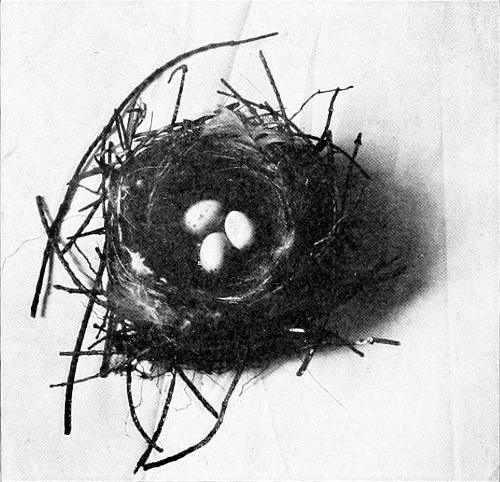
Taken in Tacoma. Photo by the Author. NEST AND EGGS OF PINE SISKIN.
The eggs are three or four in number, tho sets of one and two are not rare in some seasons. They are a very pale bluish green in color, with dots, blotches, streaks, and occasional marbling, of rufous and brown, chiefly about the larger end. They vary considerably in size and shape, running from subspherical to a slender ovate. Measurements of average eggs are .68 × .48 inches.
Incubation lasts about twelve days, and the young-are ready to fly in as many more. The brood does not remain long in a family group but joins the roving clan as soon as possible. We suspect, therefore, that the Siskin raises but one brood in a season; and she undoubtedly heaves a sigh of relief when she may again don her evening gown, and rejoin “society.”
[89]
No. 31. WESTERN GOLDFINCH.
A. O. U. No. 529a. Astragalinus tristis pallidus (Mearns).
Synonyms.—Pale Goldfinch. “Wild Canary.” “Summer Yellow-bird.” Thistle-bird.
Description.—Adult male in summer: General plumage clear lemon or canary yellow; crown patch, including forehead and lores, black; wings black, varied by white of middle and lesser coverts, tips of greater coverts and edges of secondaries; tail black, each feather with white spot on inner web; tail coverts broadly tipped with white; bill-orange, tipped with black; feet and legs light brown; irides brown. Adult female in summer: Above grayish brown or olivaceous; wings and tail dusky rather than black, with white markings rather broader than in male; below whitish with buffy or yellow suffusion brightest on throat and sides. Adult male in winter: Like adult female but brighter by virtue of contrasting black of wing and tail; white markings more extended than in summer. Female in winter: not so yellow as in summer, grayer and browner with more extensive white. Young: Like winter adults but browner, no clear white anywhere, cinnamomeus instead. Length of adult male: (skins) 4.71 (120); wing 2.95 (75); tail 1.97 (50); bill .41 (10.4); tarsus .55 (14.1).
Recognition Marks.—Warbler size; black and yellow contrasting, with conical bill, distinctive; undulating flight; canary-like notes. Feeds on thistle seed as does also Spinus pinus, a closely related but much less handsome species.
Nesting.—Nest: A beautiful compact structure of vegetable fibers, “hemp,” grasses, etc., lined with vegetable cotton or thistle-down, and placed at varying heights in trees or bushes, usually in upright crotches. Eggs: 3-6, pale bluish white, unspotted. Av. size, .65 × .52 (16.5 × 13.2). Season: July and August; one brood.
General Range.—Western United States, except the Pacific coast district, north to British Columbia and Manitoba, south to northern and eastern Mexico.
Range in Washington.—East-side, not common resident in half-open situations and along streams; resident but roving in winter.
Authorities.—Chrysomitris tristis, Brewster, B. N. O. C. VII. Oct. 1882, p. 227. (T). D¹. D². Ss¹. Ss². J.
Specimens.—P. Prov. C.
“Handsome is that handsome does,” we are told, but the Goldfinch fulfils both conditions in the proper sense, and does not require the doubtful apology of the proverb, which was evidently devised for plain folk. One is at a loss to decide whether Nature awarded the Goldfinch his suit of fine clothes in recognition of his dauntless cheer or whether he is only happy because of his panoply of jet and gold. At any rate he is the bird of sunshine the year around, happy, careless, free. Rollicking companies of them rove the country-side, now searching the heads of the last year’s mullein [90] stalks and enlivening their quest with much pleasant chatter, now scattering in obedience to some whimsical command and sowing the air with their laughter. Perchic’-opee or perchic’-ichic’-opee, says every bird as it glides down each successive billow of its undulating flight. So enamored are the Goldfinches of their gypsy life that it is only when the summer begins to wane that they are willing to make particular choice of mates and nesting spots. As late as the middle of July one may see roving bands of forty or fifty individuals, but by the first of August they are usually settled to the task of rearing young. The nesting also appears to be dependent in some measure upon the thistle crop. When the weeds are common and the season forward, nesting may commence in June; but so long as thistle down is scarce or wanting, the birds seem loath to begin.
Nests are placed in the upright forks of various kinds of saplings, or even of growing plants, in which latter case the thistle, again, proves first choice. The materials used are the choicest obtainable. Normally the inner bark of hemp is employed for warp, and thistle-down for woof and lining, so that the whole structure bleaches to a characteristic silver-gray. In the absence or scarcity of these, grasses, weeds, bits of leaves, etc., are bound together with cobwebs, and the whole felted with other soft plant-downs, or even horse-hair. The whole is made fast thruout its depth to the supporting branches, and forms one of the most durable of summer’s trophies.
From four to six, but commonly five, eggs are laid, and these of a delicate greenish blue. Fourteen days are required for hatching; and from the time of leaving the nest the youngsters drone babee! babee! with weary iteration, all thru the stifling summer day.
During the nesting season the birds subsist largely upon insects of various kinds, especially plant-lice, flies, and the smaller grasshoppers; but at other times they feed almost exclusively upon seeds. They are very fond of sunflower seeds, returning to a favorite head day after day until the crop is harvested. Seeds of the lettuce, turnips, and other garden plants are levied upon freely where occasion offers; but thistle seed is a staple article, and that is varied by a hundred seeds besides, which none could grudge them.
Thruout the winter the Western Goldfinches are much less in evidence, the majority of them having retired to the southland at that season. Those which remain are somewhat altered to appearance: the wings and tail show much pure white, and the yellow proper is now confined to the throat and the sides of the head and neck. He is thus a lighter and a brighter bird than his eastern brother. But the western bird has the same merry notes and sprightly ways which have made the name of Goldfinch synonymous with sunshine.
[91]
No. 32. WILLOW GOLDFINCH.
A. O. U. No. 529b. Astragalinus tristis salicamans (Grinnell).
Synonyms.—California Goldfinch. “Yellow-bird,” etc.
Description.—Similar to A. t. pallidus, but wings and tail shorter and coloration very much darker; adult male in summer plumage has tinge of pale olive-green on back, while winter adults and young are decidedly darker and browner than corresponding plumage of A. t. pallidus. Wing (of adult male) 2.75 (70); tail 1.73 (44).
Recognition Marks.—As in preceding but decidedly darker and browner, especially in winter.
Nesting.—As in A. t. pallidus.
General Range.—Pacific coast district from Lower California (Cerros Id.) north to British Columbia. Has been taken at Okanagan Landing, B. C. (Brooks).
Range in Washington.—Not common resident on West-side only, chiefly in cultivated valleys.
Authorities.—Chrysomitris tristis Bon., Baird, Rep. Pac. R. R. Surv. IX. 1858, 421, 422, part. C&S. L². Kb. Ra. Kk. B. E.
Specimens.—(U. of W.) Prov. B. E.
Goldfinches are a bit of a rarity on Puget Sound. Of course we see them every season, and one may see a great deal of a particular troop, once its general range is ascertained; but, taken all in all, the bird is not common. Neither Cooper nor Suckley saw this Goldfinch, altho particularly wondering at its absence. The clearing of the forests and the cultivation of the soil is conducive to its increase, however; and there is every reason to believe that we are seeing more of it year by year.
There has been a warm discussion as to the subspecific validity of the Willow Goldfinch, but those who see birds of this form in late winter or early spring cannot but be impressed with the striking brownness of its plumage, as well as by the more extensive white upon the wings, as compared with the eastern bird. Beyond its partiality for willow trees, it has no further distinguishing traits, unless, perhaps, it may be reckoned less tuneful, or noisy.
[92]
No. 33. CASSIN’S PURPLE FINCH.
A. O. U. No. 518. Carpodacus cassinii Baird.
Synonym.—Cassin’s Finch.
Description.—Adult male: Crown dull crimson; back and scapulars vinaceous mixed with brownish and sharply streaked with dusky; wings and tail dusky with more or less edging of vinaceous; remaining plumage chiefly dull rosy, passing into white on belly and crissum; under tail-coverts white streaked with dusky. Adult female: Everywhere (save on wings, tail and lower abdomen) sharply streaked with dusky, clearly, on a white ground, below; above on an olive-gray or olive-buffy ground. Immature male: Like female in plumage and indistinguishable. Length of adult 6.50-7.00 (165.1-177.8); wing 3.62 (92); tail 2.56 (65); bill .50 (12.6); tarsus .73 (18.5).
Recognition Marks.—Sparrow size: red of crown contrasting with back distinctive as compared with C. p. californicus; general streakiness of female (and male in more common plumage).
Nesting.—Nest: of twigs and rootlets lined with horse-hair, string, etc., placed in pine or fir tree well out from trunk. Eggs: 4 or 5, colored as in succeeding species; a little larger. Av. size .85 × .60 (21.6 × 15.2). Season: June; one or two broods according to altitude.
General Range.—Western United States from the eastern base of the Rocky Mountains west to (but not including?) the Pacific coast district; north to British Columbia; south over plateau region of Mexico; found chiefly in the mountains.
Range in Washington.—At least coextensive with pine timber in eastern Washington; found to summit of Cascades but westerly range imperfectly made out.
Authorities.—[“Cassin’s Purple Finch,” Johnson, Rep. Gov. W. T. 1884 (1885), 22.] Carpodacus cassini, Dawson, Auk, Vol. XIV. 1897, p. 177. D¹. J.
Specimens.—Prov. C.
Cassin’s Finch is the bird of the eastern Cascades and the timbered foothills of northern Washington. While ranging higher than other finches, it shares with them an inclination to urban life, and a full realization of the advantages of gardens and cultivated patches. At Stehekin I saw a flock of them gleaning crumbs as complacently as sparrows, in the yard at the rear of the hotel. At Chelan they haunt the lonesome pine trees which still dot the shores of the lake, seemingly regarding their gnarled recesses as citadels where alone they may be safe from the terrors of the open country.
As the bird-man lay sprawling in the grateful shadow of one of these grim sentinels, munching a noonday lunch, and remonstrating with Providence at the unguarded virtues of the all-crawling ant, he spied a last year’s Oriole’s nest hanging just over his head, while an accommodating Cassin Finch [93] called his attention to this year’s nest in process of construction, by going over and helping herself to a beakful of material, which she pulled out of the structure by main force. She evened things up, however, (for the bird-man) by immediately visiting her own nest, pitched on the upper side of a horizontal branch near the end.
This female Cassin was a wearisome bird, for she sat and twittered inanely, or coaxed, every minute her husband was in the tree. He, poor soul, was visibly annoyed at her indolence, not to say her wantonness, and had as little to do with her as possible. However, he was a young fellow, without a bit of red on him, and he should not have been over-critical of his first mate in honeymoon.
On the pine-clad slopes of Cannon Hill in Spokane, there is no more familiar sound in June than the wanton note of the female Cassin Finch, oreé-eh, oreé-eh, delivered as often as not with quivering wings, and unmistakably inviting the attentions of the male. Perhaps it is fair to call this a love note, but it is delivered with the simpering insistence of a spoiled child.
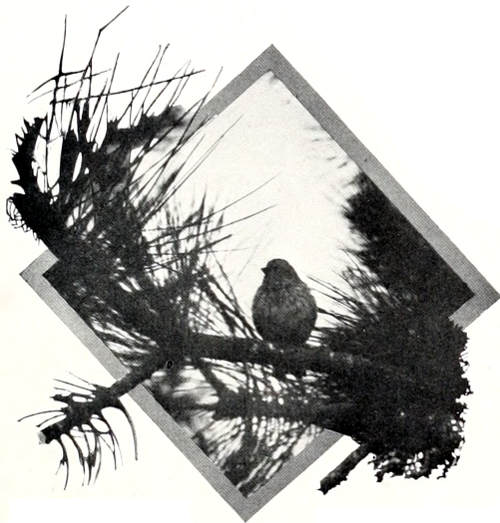
Taken in Spokane. Photo by the Author. CASSIN’S FINCH.
The sight of a singing male in high plumage is memorable. He selects a position at the tip of a pine branch, or perhaps on a bunch of cones at the very top of the tree, and throws himself into the work. His color, crimson, not purple, is pure and clear upon the crown only; elsewhere, upon nape, shoulders, and breast, it presents merely a suffusion of red. A song heard near Chelan was much like that of a California Purple Finch in character, but less musical and more chattering, with the exception of one strong note thrown in near the close. This note was very like the characteristic squeal of the Evening Grosbeak, gimp, or thkimp, out of all keeping with the remainder—unquestionably borrowed.
The Cassin Finch is quite as successful as a mimic as his cousin from [94] California. Besides his own wild, exultant notes, he rapidly strings together those of other birds, and renders the whole with the spontaneity and something of the accent of the Lark Sparrow. Indeed, when I first heard one sing on a crisp May morning on the banks of the Columbia, I thought I was hearing a rare burst of the latter bird, so much of its song had been appropriated by the Finch. Besides this, strains of Western Vesper Sparrow, Mountain Bluebird, and Louisiana Tanager were recognized.
No. 34. CALIFORNIA PURPLE FINCH.
A. O. U. No. 517a. Carpodacus purpureus californicus Baird.
Description.—Adult male: General body plumage rich crimson or rosy red, clearest on crown and upper tail-coverts, more or less mingled with dusky on back and scapulars, passing into white on crissum and under tail-coverts; wings and tail brownish dusky with reddish edgings. Bill and feet brownish. Adult female: Above olive dusky in streaks, with edging or gloss of brighter olivaceous; underparts whitish, everywhere, save on middle abdomen, crissum and under tail-coverts, streaked with olive dusky, finely on throat, broadly on breast and sides, shading into pattern of upperparts on sides of head, neck and chest. Immature male, and male in ordinary(?) plumage: exactly like female in coloration. Length about 5.75 (146); wing 3.07 (78); tail 2.28 (58); bill .45 (11.5); tarsus .70 (17.9).
Recognition Marks.—“Warbler size” but sturdier, an unmistakable sparrow; rosy coloration of male distinctive (without crossed mandibles) but streaky pattern oftenest seen. Distinguishable from the Pine Siskin (Spinus pinus) by larger size, more sedate ways and absence of sulphury wing- and tail-markings.
Nesting.—Nest: well built, of fir twigs, heavily lined with green moss, horse-hair, string, etc.; placed in tree (deciduous or evergreen) at elevation of 5-40 feet and usually at some distance from trunk; measures outside 5 in. wide by 3 in. deep, inside 2½ in. wide by 1¼ in. deep. Eggs: 4 or 5, light greenish blue, spotted and streaked with violaceous and black, chiefly about the larger end. Round ovate to elongate ovate; varying in dimensions from .75 × .56 (19 × 14.2) to .91 × .59 (22.8 × 15). Season: first week in May and first week in June; two broods.
General Range.—Pacific coast district from southern California north to British Columbia (including Vancouver Island). More or less resident thruout range but drifts (casually?) to southeastward in Arizona during migrations.
Range in Washington.—West-side, chiefly at lower levels; especially partial to orchards and cultivated sections. Irregularly resident but numbers augmented in spring.
Authorities.—Carpodacus californicus Baird, Baird, Rep. Pac. R. R. Surv. IX. 1858, 414. T. C&S. L². Rh. Kb. Ra. Kk. B. E.
Specimens.—U. of W. Prov. P. B. BN. E.
[95]
Of the streaked, streaky is this demure and inoffensive bird in the olivaceous plumage, in which we usually see him, and always see her. But the sharpness and magnitude of the dusky streaks above and below confer a measure of distinction, even when there is no trace of the adult crimsons, miscalled purple. This finch is a familiar object about the gardens, orchards, and parks in Western Washington. It moves about for the most part silently, inspecting birds and flowers, sampling fruit, or gleaning seeds from the ground in company with its own kind, or with the humbler and equally streaked Siskins. While not altogether dependent upon human bounty, it probably owes more to man than does any other native species.
Wright’s Park, in Tacoma, appears to lead the state by two weeks in the early budding of its flowering plants, and here Purple Finches appear to the best advantage. In the luxuriant bushes of the red flowering currant (Ribes sanguineum) one may see them feeding during the last week of March. The Finches pluck the flowers assiduously, and either eat the fleshy part at the base, the tender ovary, or else press out the nectar just above, or both. A flower is first plucked off whole and held in the bill, while the bird appears to smack its lips several times; then the crimson corolla is allowed to drop upon the ground, which thus becomes carpeted with rejected beauty. Like many related species, the California Finch is rather unwary, so that one may study his behavior at close range.
Because the Purple Finch is usually so unobtrusive, we are startled at the first outburst of spring song. Nothing more spontaneous could be desired, and the mellow, musical yodelling of this bird is one of the choicest things allowed us on the West-side. The song is midway between a trill and a carol, and has a wild quality which makes it very attractive. The notes are so limpid and penetrating that one is sometimes deceived as to the distance of the singer, supposing him to be in a neighboring copse when, in truth, he occupies a distant fir-top. Cheedooreédooreé dooreé dooreé dooreé dooreé dooreé dreeetoreet may afford an idea of the rolling, rollicking character of the song, but is, of course, absurdly inadequate.
A master singer among the Purple Finches once entertained us from the top of a fir tree a hundred feet high. He was in the dull plumage, that is, without red; and altho he sang briskly at intervals we were not prepared for any unusual exhibition of vocal powers on his part. It was a long time, therefore, before we put the cry of a distant Steller Jay up to him. Our suspicions once aroused, however, we caught not only the Steller jay cry, unmistakably, but also half a dozen others in swift and dainty succession, after the usual Purple Finch prelude. I clearly recognized notes of the Flicker, Steller Jay, Canary, American Crossbill, and Seattle Wren. These imitative efforts varied in correctness of execution, and came to us with the [96] distance of the original singer plus that of the Finch, so that the result was not a little confusing, tho very delightful when explained.
During courtship this Finch will execute an aerial song-dance, consisting of sundry jerks and crazy antics, interspersed with a medley of ecstatic notes; at the conclusion of which he will make a suggestive dive at his fianceé, who meanwhile has been poking fun at him.
For some reason nests have been exceedingly hard to find. Many birds are always pottering about with no apparent concern for nesting time, and Mr. Bowles hazards that they do not mate until the third year. Apropos of this, one remarks the scarcity of highly plumaged males at all seasons. I have gone six months at a time, where Finches were not uncommon, without seeing a single red bird. In fact, I never found the latter common except in the vicinity of Tacoma.
Nests are placed, preferably, near water, in evergreen or deciduous trees, and at heights varying from six to forty feet. They usually occur on a bough at some distance from the trunk of a supporting tree, seldom or never being found in a crotch. Composed externally of fir twigs, they are lined copiously with green moss, horse-hair, and string, and contain four or five handsome blue-green eggs, spotted and dashed with violet and black.
Two broods are probably brought off in a season, the first about the 20th of May and the second a month later. A sitting female outdoes a Siskin in her devotion to duty, and not infrequently requires to be lifted from her eggs. The male trusts everything to his wife upon these occasions, but is on hand to do his share of the work when it comes to feeding the babies.
No. 35. ENGLISH SPARROW.
Introduced. Passer domesticus (Linn.).
Synonyms.—House Sparrow. Domestic Sparrow. Hoodlum.
Description.—Adult male: Above ashy gray; middle of back and scapulars heavily streaked with black and bay; tail dusky; a chestnut patch behind eye spreading on shoulders; lesser wing-coverts chestnut; middle coverts bordered with white, forming a conspicuous white bar during flight; remainder of wing dusky with bay edging; below ashy gray or dirty white; a black throat-patch continuous with lores and fore-breast; bill and feet horn color. Adult female: Brownish rather than gray above; bay edging lighter; no chestnut, unmarked below. Length 5.50-6.25 (139.7-158.8); wing 3.00 (76.2); tail 2.20 (55.9); bill .50 (12.7). Sexes of about equal size.
Recognition Marks.—“Sparrow size,” black throat and breast of male; female obscure brownish and gray.
Nesting.—Nest: a globular mass of grass, weeds and trash, heavily lined with feathers, placed in tree and with entrance in side; or else heavily lined [97] cavity anywhere. Holes in trees and electric lamps are alike favored. Eggs: 4-7, whitish, heavily dotted and speckled with olive-brown or dull black. The markings often gather about the larger end; sometimes they entirely obscure the ground color. Av. size, .86 × .62 (21.8 × 15.8). Season: March-September; several broods.
General Range.—“Nearly the whole of Europe, but replaced in Italy by P. italiæ, extending eastward to Persia and Central Asia, India, and Ceylon” (Sharpe). “Introduced and naturalized in America, Australia, New Zealand, etc.” (Chapman).
Range in Washington.—As yet chiefly confined to larger cities and railroad towns, but spreading locally in farming sections.
Authorities.—Rathbun, Auk, Vol. XIX. Apr. 1902, p. 140. Ra. Kk. B. E.
Specimens.—B. C.
What a piece of mischief is the Sparrow! how depraved in instinct! in presence how unwelcome! in habit how unclean! in voice how repulsive! in combat how moblike and despicable! in courtship how wanton and contemptible! in increase how limitless and menacing! the pest of the farmer! the plague of the city! the bane of the bird-world! the despair of the philanthropist! the thrifty and insolent beneficiary of misguided sentiment! the lawless and defiant object of impotent hostility too late aroused! Out upon thee, thou shapeless, senseless, heartless, misbegotten tyrant! thou tedious and infinite alien! thou myriad cuckoo, who dost by thy consuming presence bereave us daily of a million dearer children! Out upon thee, and woe the day!
Without question the most deplorable event in the history of American ornithology was the introduction of the English Sparrow. The extinction of the Great Auk, the passing of the Wild Pigeon and the Turkey,—sad as these are, they are trifles compared to the wholesale reduction of our smaller birds, which is due to the invasion of this wretched foreigner. To be sure he was invited to come, but the offense is all the more rank because it was partly human. His introduction was effected in part by people who ought to have known better, and would, doubtless, if the science of ornithology had reached its present status as long ago as the early Fifties. The maintenance and prodigious increase of the pest is still due in a measure to the imbecile sentimentality of people who build bird-houses and throw out crumbs for “the dear little birdies,” and then care nothing whether honest birds or scalawags get them. Such people belong to the same class as those who drop kittens on their neighbors’ door-steps because they wouldn’t have the heart to kill them themselves, you know.
The increase of this bird in the United States is, to a lover of birds, [98] simply frightful. Their fecundity is amazing and their adaptability apparently limitless. Mr. Barrows, in a special report prepared under the direction of the Government, estimates that the increase of a single pair, if unhindered, would amount in ten years to 275,716,983,698 birds.
As to its range, we note that the subjugation of the East has long been accomplished, and that the conquest of the West is succeeding rapidly. It is not possible to tell precisely when the first Sparrows arrived in Washington, but it is probable that they appeared in Spokane about 1895. Of its occurrence in Seattle, Mr. Rathbun says: “Prior to the spring of 1897 I had never seen this species in Seattle, but in June of that year I noted a pair. The following season I saw fourteen; in 1899 this number had increased to about seventy, associating in small flocks.”
The favorite means of dissemination has been the box car, and especially the grain car. The Sparrows, being essentially grain and seed eaters, frequent the grain cars as they stand in the railroad yards, and are occasionally imprisoned in them, hopeful stowaways and “gentlemen of fortune.” On this account, also, the larger cities and railroad towns are first colonized, and at this time of writing (Jan., 1908) the birds are practically confined to them, Tacoma having an especial notoriety in this respect because of its immense grain-shipping interests.
Difficult as it may seem, it is true that the English Sparrow adopts the policy of Uriah Heep upon first entering a town. With all the unctuous humility of a band of Mormon apostles, the newcomers talk softly, walk circumspectly, and either seek to escape notice altogether, or else assiduously cultivate the good opinion of their destined dupes. Thus, I resided in the town of Blaine for two months (in 1904) without running across a single member of the pioneer band of nine English Sparrows, altho I was assured on good authority that the birds had been there for at least two years previous.
It requires no testimony to show that the presence of this bird is absolutely undesirable. It is a scourge to the agriculturist, a plague to the architect, and the avowed and determined enemy of all other birds. Its nests are not only unsightly but unsanitary, and the maudlin racket of their owners unendurable. The bird is, in short, in the words of the late Dr. Coues, “a nuisance without a redeeming quality.” Altho we assent to this most heartily, we are obliged to confess on the part of our race to a certain amount of sneaking admiration for the Sparrow. And why, forsooth? Because he fights! We are forced to admire, at times, his bull-dog courage and tenacity of purpose, as we do the cunning of the weasel and the nimbleness of the flea. He is vermin and must be treated as such; but, give the Devil his due, of course. What are we going to do about it? Wage unceasing warfare, as we do against rats. There will possibly be rats as long as there are men, [99] but a bubonic plague scare operates very effectually to reduce their numbers. No doubt there will be English Sparrows in cities as long as there are brick-bats, but a clear recognition of their detestable qualities should lead every sensible person to deny them victuals and shelter. The House Sparrow is no longer exterminable, but he may be, must be kept within bounds.
No. 36. SNOWFLAKE.
A. O. U. No. 534. Plectrophenax nivalis (Linn.)
Synonym.—Snow Bunting.
Description.—Adult male in summer: Pure white save for bill, feet, middle of back, scapulars, bastard wing, the end half of primaries and inner secondaries, and the middle tail-feathers, which are black. Female in summer: Similar, but upperparts streaked all over with black, and the black wings largely replaced by fuscous. Adults in winter: Entire upperparts overcast with browns—rusty or seal brown—clear on crown, grayish and mottled with dusky centers of feathers on back, scapulars, etc.; also rusty ear-patches, and a rusty collar, with faint rusty wash on sides. The black of wing and tail-feathers is less pure (fuscous in the female) and edged with white or tawny. Length 6.50-7.00 (165.1-177.8); wing 4.12 (104.6); tail 2.54 (64.5); bill .40 (10.2).
Recognition Marks.—Sparrow size; conspicuously and uniquely white, with blacks and browns above.
Nesting.—Does not breed in Washington. “Nest: on the ground in the sphagnum and tussocks of Arctic regions, of a great quantity of grass and moss, lined profusely with feathers. Eggs: 4-6, very variable in size and color, about .90 × .65 (22.9 × 16.5), white or whitish, speckled, veined, blotched, and marbled with deep browns and neutral tints” (Coues.).
General Range.—“Northern parts of the northern hemisphere, breeding in the Arctic regions; in North America south in winter into the northern United States, irregularly to Georgia, southern Illinois, Kansas and Oregon.”
Range in Washington.—East-side, of regular occurrence in open country; casual west of the Cascades.
Migrations.—Nov. 4, 1899 (Yakima County). March 17, 1896 (Okanogan County).
Authorities.—[“Snow Bunting,” Johnson, Rep. Gov. W. T. 1884 (1885), 22.] Dawson, Auk, XIV. 1897, 178. T. D¹. D². B. E.
Specimens.—(U. of W.) Prov. B. E. P.
I well remember my first meeting with this prince of storm waifs, the Snowflake. It was in Chelan County on a chilly day in December. A distant-faring, feathered stranger had tempted me across a bleak pasture, when all at once a fluttering snowdrift, contrary to Nature’s wont, rose from [100] earth toward heaven. I held my breath and listened to the mild babel of tut-ut-ut-tews, with which the Snow Buntings greeted me. The birds were loath to leave the place, and hovered indecisively while the bird-man devoured them with his eyes. As they moved off slowly, each bird seemed alternately to fall and struggle upward thru an arc of five or six feet, independently of his fellows, so that the flock as a whole produced quite the effect of a troubled snowstorm.
Snowflakes flock indifferently in winter and may occur in numbers up to several hundred. At other times a single, thrilling, vibrant call-note, tew or te-ew, may be heard during the falling of the real flakes, while the wandering mystery passes overhead, unseen. Stray birds not infrequently mingle with flocking Horned Larks; while Snowflakes and Lapland Longspurs are fast friends in the regions where the latter are common.
Probably these birds are of regular tho sparing occurrence in the Big Bend and Palouse countries, but they do not often reach the southern border of the State; and their appearance on Puget Sound, as upon the prairies of Pierce County, is quite unusual. While with us they move aimlessly from field to field in open situations, or glean the weed-seed, which forms their almost exclusive diet. In time of storm, or when emboldened by the continuance of winter, they may make their appearance in the barnyard, or about the outbuildings, where their sprightly notes and innocent airs are sure to make them welcome.
It is difficult to conceive how these birds may withstand the frightful temperatures to which they are subjected in a winter upon the Saskatchewan plains, and yet they endure this by preference to the effeminizing influences which are believed to prevail south of “Forty-nine,” and especially west of the Rockies. Close-knit feathers, the warmest covering known, fortified by layers of fat, render them quite impervious to cold; and as for the raging blizzard, the birds have only to sit quietly under the snow and wait till the blast has blown itself out.
The sun alone prevails, as in the case of the man with the cloak, and at the first hint of the sun’s return to power, these ice-children hasten back to find their chilly cradles. A few nest upon the Aleutian Islands, and along the shores of northern Alaska; but more of them resort to those ice-wrapped islands of the far North, which are mere names to the geographer and dismal memories to a few hardy whalers. Peary’s men found them breeding in Melville Land; and if there is a North Pole, be assured that some Snowflake is nestling contentedly at the base of it.
[101]
No. 37. ALASKAN LONGSPUR.
A. O. U. 536a. Calcarius lapponicus alascensis Ridgw.
Description.—Adult male in summer: Head, throat, and fore-breast black; a buffy line behind eye and sometimes over eye; a broad nuchal patch, or collar, of chestnut-rufous; remaining upperparts light grayish brown, streaked with black and with some whitish edging; below white; heavily streaked with black on sides and flanks; tail fuscous with oblique white patches on the outer rectrices; feet and legs black; bill yellow with black tip. Adult male in winter: Lighter above; the black of head and chestnut of cervical collar partially overlaid with buffy or whitish edging; the black of throat and breast more or less obscured by whitish edging. Adult female in summer: Similar to male in summer, but no continuous black or chestnut anywhere; the black of head mostly confined to centers of feathers,—these edged with buffy; the chestnut of cervical collar only faintly indicated as edging of feathers with sharply outlined dusky centers; black of throat and chest pretty thoroly obscured by grayish edging, but the general pattern retained; sides and flanks with a few sharp dusky streaks. Adult female in winter: [Description of October specimen taken in Seattle] Above buffy grayish brown streaked (centrally upon feathers) with black, wing coverts and tertials with rusty areas between the black and the buffy, and tipped with white; underparts warm buffy brownish, lightening on lower breast, abdomen, and under tail-coverts (where immaculate), lightly streaked with black on throat, chest, and sides, sharply on sides and flanks. Length of adult males about 6.50; wing 3.77 (95.8); tail 2.50 (63.3); bill .46 (11.7); tarsus .86 (21.8). Female smaller.
Recognition Marks.—Sparrow size; terrestrial habits; black head and breast of male. The bird may be distinguished from the Horned Lark, with which it sometimes associates, by the greater extent of its black areas, and by the chirruping or rattling cry which it makes when rising from the ground.
Nesting.—Does not breed in Washington. Nest: in grass tussock on ground, flimsy or bulky, of grasses and moss, frequently water-soaked, and lined carefully with fine coiled grass, and occasionally feathers. Eggs: 4-6, light clay-color with a pale greenish tinge, variously marked,—speckled, spotted, scrawled, blotched, or entirely overlaid with light brown or chocolate brown. Av. size .80 × .62 (20.3 × 15.7). Season: first week in June; one brood.
General Range.—“The whole of Alaska, including (and breeding on) the Pribilof and Aleutian Islands, Unalaska, and the Shumagins; east to Fort Simpson, south in winter thru more western parts of North America to Nevada (Carson City), eastern Oregon, Colorado, western Kansas, etc.” (Ridgway).
Range in Washington.—Presumably of more or less regular occurrence in winter on the East-side. Casual west of the Cascades.
Authorities.—[“Lapland Longspur,” Johnson, Rep. Gov. W. T. 1884 (1885) 22.] Dawson, Auk, Vol. XXV. Oct. 1908, p. 483.
By all the rules this bird should be abundant in winter in the stubble fields of the Palouse country, if not upon the prairies of Pierce, Thurston, and [102] Chehalis Counties. Bendire reported them from Camp Harney in eastern Oregon, and Brooks says they are common on Sumas Prairie, B. C.; but we have only one authentic record for this State, that of a straggler taken near Seattle in October, 1907. These Longspurs abound in Alaska during the nesting season, but it would appear that the mountain barriers habitually deflect their autumnal flight to the eastward, and that the few which reach us straggle down the coast.
Those who have seen Iowa prairies give up these birds by scores and hundreds every few rods, have been able to form some conception of their vast numbers, but it remained for the storm of March 13-14, 1904, to reveal the real order of magnitude of their abundance. An observer detailed by the Minnesota State Natural History Survey estimates that a million and a half of these “Lapland” Longspurs perished in and about the village of Worthington alone; and he found that this destruction, tho not elsewhere so intense, extended over an area of fifteen hundred square miles.
In spite of such buffetings of fortune, those birds which do reach Alaska bring a mighty cheer with them to the solitudes. As Nelson says: “When they arrive early in May the ground is still largely covered with snow with the exception of grassy spots along southern exposures and the more favorably situated portions of the tundra, and here may be found these birds in all the beauty of their elegant summer dress. The males, as if conscious of their handsome plumage, choose the tops of the only breaks in the monotonous level, which are small rounded knolls and tussocks. The male utters its song as it flies upward from one of these knolls and when it reaches the height of ten or fifteen yards, it extends the points of its wings upwards, forming a large V-shaped figure, and floats gently to the ground, uttering, as it slowly sinks, its liquid tones, which fall in tinkling succession upon the ear, and are perhaps the sweetest notes that one hears during the entire spring-time in these regions. It is an exquisite jingling melody, having much less power than that of the Bobolink, but with the same general character, and, tho shorter, it has even more melody than the song of that well known bird.”
No. 38. WESTERN LARK SPARROW.
A. O. U. No. 552 a. Chondestes grammacus strigatus (Swains.).
Synonyms.—Quail-head. Western Lark Finch.
Description.—Adult: Head variegated, black, white, and chestnut; lateral head-stripes black in front, chestnut behind; auriculars chestnut, bounded by rictal and post-orbital black stripes; narrow loral, and broader submalar black stripes; malar, superciliary, and median stripes white, the two latter becoming buffy [103] behind; upper parts buffish gray brown, clearest on sides of neck, streaked by blackish brown centers of feathers on middle back and scapulars, persisting as edging on the fuscous wings and tail; tail-feathers, except middle pair, broadly tipped with white; below white, purest on throat and belly, washed with grayish buff on sides and crissum, also obscurely across fore-breast, in which is situated a central black spot. Length 6.25 (158.8); wing 3.35 (85); tail 2.68 (68); bill .47 (12); tarsus .80 (20.3).
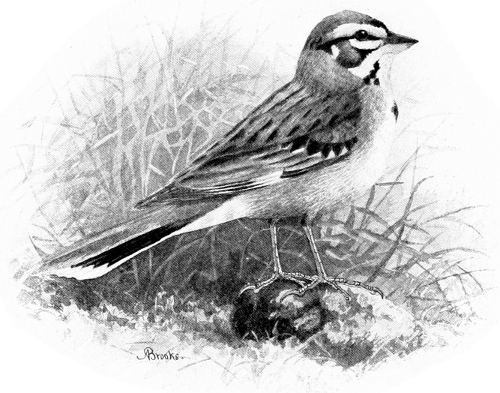
WESTERN LARK SPARROW.
Recognition Marks.—Sparrow size; head variegated black, white, and chestnut; fan-shaped tail broadly tipped with white and conspicuous in flight (thus easily distinguished from the Western Vesper Sparrow with square tail and lateral white feathers).
Nesting.—Nest: of grasses, lined with finer grass, rootlets and occasionally horse-hair, on the ground or, rarely, in low bushes or trees. Eggs: 5, white, pinkish or bluish white, spotted and scrawled in zigzags and scrolls with dark [104] browns or purplish blacks, chiefly at the larger end; notably rounded in shape. Av. size .82 × .65 (20.8 × 16.5). Season: May 15-June 5; one brood, rarely two.
General Range.—Western United States and plateau of Mexico; north to middle British Columbia, Manitoba, etc.; east to eastern border of Great Plains; west to Pacific Coast, including peninsula of lower California; south in winter to Guatemala.
Range in Washington.—Summer resident east of Cascades only, in Upper Sonoran and Arid Transition zones.
Migrations.—Wallula, May 6, 1907; Yakima Co., May 1, 1906; ibid, May 3, 1900; Chelan, May 19, 1896.
Authorities.—[“Western lark finch,” Johnson, Rep. Gov. W. T., 1884 (1885), 22.] Belding, Land Birds Pacific District (1890), p. 148 (Walla Walla, J. W. Williams, 1885). (T.) (C&S.) D¹. D². Ss¹. Ss². J.
Specimens.—(U. of W.) C. P.
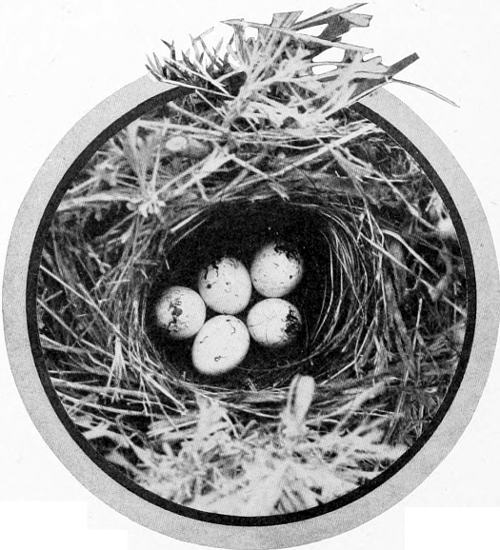
Taken in Douglas County. Photo by the Author. A SAGE-BUSH NEST.
As in the case of the Sandwich and Savanna Sparrows, the curiously striped coloration of this bird’s head is evidently intended to facilitate concealment. The bird peering out of a weed clump is almost invisible. And yet, as I was once passing along a sage-clad hillside in Chelan county with an observing [105] young rancher, my companion halted with a cry. He had caught the gleam of a Lark Sparrow’s eye as she sat brooding under a perfect mop of dead broom-sage. The camera was brought into requisition, and the lens pointed downward. The camera-cloth bellied and flapped in the breeze, yellow tripod legs waved belligerently, and altogether there was much noise of photographic commerce, but the little mother clung to her eggs. The stupid glass eve of the machine, spite of all coaxing, saw nothing but twigs, and we were obliged to forego a picture of the sitting bird. To get the accompanying picture of eggs, I was obliged to hack away the protecting brush, having first slipped in a handkerchief to protect the nest and contents from showering debris.
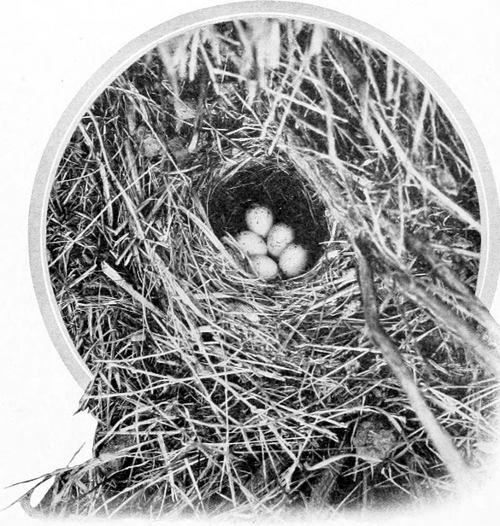
Taken near Chelan. Photo by the Author. GROUND NEST OF WESTERN LARK SPARROW.
The desert harbors many choice spirits, but none (save the incomparable Sage Thrasher) more joyous or more talented than the Lark Sparrow. Whether it is running nimbly along the ground or leaping into the air to catch a risen grasshopper, one feels instinctively that here is a dainty breed. The bird loves to trip ahead coquettishly along a dusty road, only to yield place at last to your insistent steed with an air of gentle reproach. As it flits away you catch a glimpse of the rounded tail, held half open, with its terminal rim of white, and you know you have met the aristocrat of the sage.
Lark Sparrows are somewhat irregular in distribution, but their range [106] corresponds roughly with the northern extension of the Upper Sonoran zone, with overflow into the adjacent Arid Transition. Altho prairie birds, they are fond of scattered trees, fences, telegraph poles, or anything which will afford sufficient elevation for the sweet sacrament of song.
This bird, more frequently than others, is found singing in the middle of the very hottest days in summer, and at such times his tremulous notes come to the ear like the gurgling of sweet waters. But Ridgway’s description has not been surpassed:[15] “This song is composed of a series of chants, each syllable rich, loud, and clear, interspersed with emotional trills. At the beginning the song reminds one somewhat of that of the Indigo Bird (Passerina cyanea), but the notes are louder and more metallic, and their delivery more vigorous. Tho seemingly hurried, it is one continued gush of sprightly music; now gay, now melodious, and then tender beyond description,—the very expression of emotion. At intervals the singer falters, as if exhausted by exertion, and his voice becomes scarcely audible; but suddenly reviving in his joy, it is resumed in all its vigor, until he appears to be really overcome by the effort.”
These gentle birds are evidently profiting somewhat by the human occupation of the soil, and adapt themselves readily to changed conditions. They are reported as breeding in the valley of the Willamette in Oregon, but we have no records of their occurrence in Washington west of the Cascades.
No. 39. WESTERN VESPER SPARROW.
A. O. U. No. 540a. Poœcetes gramineus confinis Baird.
Synonyms.—Western Grass Finch. Bay-winged Bunting.
Description.—Adults: General tone of upperparts slaty or grayish brown on the edges of the feathers, modified by the dusky centers, and warmed by delicate traces of rufous, bend of wing bay, concealing dusky centers; wings and tail fuscous with pale tawny or whitish edgings,—outer tail-feathers principally or entirely white, the next two pairs white, or not, in varying amount; below sordid white, sharply streaked on breast, flanks, and sides with dusky brown; the chin and throat with small arrow marks of the same color and bounded by chains of streaks; auriculars clear hair-brown, with buffy or lighter center; usually a buffy suffusion on streaked area of breast and sides. Length of adult male: 5.75-6.25 (146.1-158.8); wing 3.29 (83.6); tail 2.59 (65.8); bill .44 (11.2); tarsus .85 (21.6). Female a little smaller.
Recognition Marks.—Sparrow size; general streaked appearance; white lateral tail-feathers conspicuous in flight; frequents fields and the open sage.
Nesting.—Nest: on ground, usually in depression, neatly lined with grasses, [107] rootlets, and horse-hair. Eggs: 4 or 5, pinkish-, grayish-, or bluish-white, speckled, spotted and occasionally scrawled with reddish-brown. Av. size, .82 × .60 (20.8 × 15.2). Season: first week in May, second week in June; two broods.
General Range.—Western United States (except Pacific coast district) and Canada north to Saskatchewan east to Manitoba, the Dakotas (midway), western Nebraska, etc.; breeding from the highlands of Arizona and New Mexico northward; in winter from southern California east to Texas and south to southern Mexico.
Range in Washington.—East-side, sparingly distributed in all open situations.
Migrations.—Spring: Yakima Co., March 15, 1900; Chelan Co., March 31, 1896.
Authorities.—Dawson, Auk, XIV. April 1897, p. 178. Sr. D². Ss¹. Ss². J.
Specimens.—P. Prov. C.
A sober garb cannot conceal the quality of the wearer, even tho Quaker gray be made to cover alike saint and sinner. Plainness of dress, therefore, is a fault to be readily forgiven, even in a bird, if it be accompanied by a voice of sweet sincerity and a manner of self-forgetfulness. In a family where a modest appearance is no reproach, but a warrant to health and long life, the Vesper Sparrow is pre-eminent for modesty. You are not aware of his presence until he disengages himself from the engulfing grays and browns of the stalk-strewn ground or dusty roadside, and mounts a fence-post to rhyme the coming or the parting day.
The arrival of Vesper Sparrow, late in March, may mark the supreme effort of that particular warm wave, but you are quite content to await the further travail of the season while you get acquainted with this amiable newcomer. Under the compulsion of the sun the bleary fields have been trying to muster a decent green to hide the ugliness of winter’s devastation. But wherefore? The air is lonely and the sage untenanted. The Meadowlarks, to be sure, have been romping about for several weeks and getting bolder every day; but they are roisterous fellows, drunk with air and mad with sunshine. The winter-sharpened ears wait hungrily for the poet of common day. The morning he comes a low sweet murmur of praise is heard on every side. You know it will ascend unceasingly thenceforth, and spring is different.
Vesper Sparrow is the typical ground bird. He eats, runs, sleeps, and rears his family upon the ground; but to sing—ah, that is different!—nothing less than the tip of the highest sage-bush will do for that; a telegraph pole or wire is better; and a lone tree in a pasture is not to be despised for this one purpose. The males gather in spring to engage in decorous concerts of rivalry. The song consists of a variety of simple, pleasing notes, each uttered two or three times, and all strung together to the number of four or five. The characteristic introduction is a mellow whistled he-ho, a little softer in tone [108] than the succeeding notes. The song of the western bird has noticeably greater variety than that of the eastern. Not only is it less stereotyped in the matter of pitch and duration, but in quality and cadence it sometimes shows surprising differences. One heard in Chelan County would have passed for Brewer’s on a frolic, except for the preliminary “hee-ho’s”: Heéoo heéoo heéoo buzziwuzziwuzzi wuzziwuzziwuzzi weechee weechee. And indeed it would not be surprising if he had learned from Spizella breweri, who is a constant neighbor and a safe guide in matters of sage lore. The scolding note, a thrasher-like kissing sound, tsook, will sometimes interrupt a song if the strange listener gets too close. Early morning and late evening are the regular song periods; but the conscientious and indefatigable singer is more apt than most to interrupt the noontide stillness also.
Since this species is a bird of open country and uplands, it cares little for the vicinity of water; but it loves the dust of country roads as dearly as an old hen, and the daily dust-bath is a familiar sight to every traveler. While seeking its food of weed-seeds and insects, it runs busily about upon the ground, skulking and running oftener than flitting for safety. Altho not especially timid it seems to take a sort of professional pride in being able to slip about among the weed stems unseen.
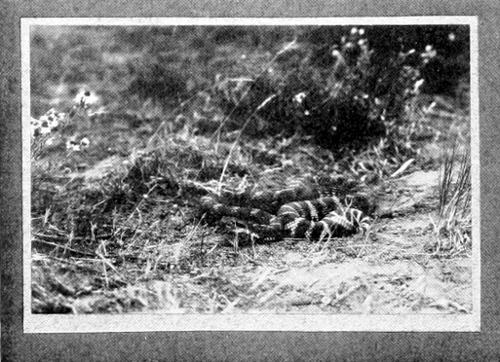
Taken in Douglas County. Photo by the Author. THE ENEMY. THE RATTLESNAKE IS THE SCOURGE OF ALL GROUND-NESTING BIRDS.
It is, of course, at nesting time that the sneak-ability of the bird is most severely tested. The nest, a simple affair of coiled grasses, is usually sunk, or chambered in the ground, so that its brim comes flush with the surface. For the rest, the brooding bird seldom seeks any other protection than that of “luck,” and her own ability to elude observation when obliged to quit the nest. Her behavior at this time depends largely upon the amount of disturbance to which she is subjected. At first approach of danger she is inclined to stick to her post till the last possible moment, and then she falls lame as she flutters off. But if often frightened, she shrewdly learns to rise at a considerable distance.
[109]
Two and sometimes three broods are raised in a season, the first in late April, the second in late June or early July. Pastures and fallow grounds are favorite spots for home building, but I have frequently come upon the nests in the open sage, and here oftenest upon hillsides or tops of low ridges.
Altho not averse to the wilderness, there is reason to believe that this bird profits by the advent of civilization, and that its numbers are slowly increasing.
No. 40. OREGON VESPER SPARROW.
A. O. U. No. 540 b. Poœcetes gramineus affinis Miller.
Synonyms.—Pacific Vesper Sparrow. Miller’s Grass Finch.
Description.—Similar to P. g. confinis but smaller and coloration darker, browner above, more distinctly buffy below. Length of adult male about 5.75 (146); wing 3.04 (77.2); tail 2.28 (57.9); bill .43 (10.9); tarsus .81 (20.6). Female a little smaller.
Recognition Marks.—As in preceding, less liable to confusion because of absence of Brewer Sparrow, Western Lark Sparrow, etc., from range.
Nesting.—Nest: on ploughed ground or under shelter of fern-stalk, fallen branch, or the like; of grasses lined with hair; measures externally 3 inches across by 2 in depth, inside 2¼ across by 1¼ in depth. Eggs: 3 or 4, size and color as in preceding. Season: May; one brood, rarely two.
General Range.—Pacific coast district from northern California north to British Columbia (including Vancouver Island); south in winter thru southern California to Cape St. Lucas.
Range in Washington.—Of local occurrence on prairies and in cultivated valleys west of the Cascades—not common.
Migrations.—Spring: Tacoma April 9, 1906; April 13, 1907.
Authorities.—Poocætes gramineus Ba[i]rd, Baird, Rep. Pac. R. R. Surv. IX. 1858, p. 447 (part). (T). C&S. Ra. B.
Specimens.—(U. of W.) P. Prov. B. E.
The appearance of a Vesper Sparrow where trees are the rule is something of an anomaly. Nevertheless, this plains-loving bird seems to do very well in the prairie region south of Tacoma; and it has been here at least long enough to begin to assume the darker garb which characterizes old residents of the Sound region.
The bird is becoming fairly common wherever conditions in the large are suitable for it. I found it in numbers at Dungeness in the spring of 1906; and the agricultural lands of the Skagit are being accepted by this gentle songster as tho duly made and provided.
Mr. Bowles finds that eggs may not be looked for in the vicinity of [110] Tacoma before the first week in May, and they are not certainly found before the middle of that month. Open prairie is most frequently selected for a site, and its close-cropped mossy surface often requires considerable ingenuity of concealment on the bird’s part. Ploughed ground, where undisturbed, is eagerly utilized. At other times a shallow cup is scraped at the base of a small fern, or the protection of a fallen limb is sought.
The eggs, from three to five in number, are perhaps the most handsomely, certainly the most quaintly marked of any in the sparrow family. The ground color is grayish white; and this, in addition to sundry frecklings and cloudings of lavender, is spotted, blotched, and scrawled, with old chestnut.
The female sits closely and sometimes will not leave the nest until removed. She seldom flies at that, but steps off and trips along the ground for some distance. Then she walks about uneasily or pretends to feed, venturing little expression of concern. Curiously, her liege lord never appears, either, in defense of his home, but after the young are hatched he does his fair share in feeding them.
No. 41. SANDWICH SPARROW.
A. O. U. No. 542. Passerculus sandwichensis (Gmelin).
Synonym.—Larger Savanna Sparrow.
Description.—Adults: General tone of upper plumage grayish brown—the feathers blackish centrally with much edging of grayish-brown (sometimes bay), flaxen and whitish; a mesial crown-stripe dull buffy, or tinged anteriorly with yellowish; lateral stripes with grayish brown edging reduced; a broad superciliary stripe yellow, clearest over lore, paling posteriorly; cheeks buffy with some mingling and outcropping of dusky; underparts whitish, clearest on throat, washed with buffy on sides, heavily and sharply streaked on sides of throat, breast, sides, flanks and thighs with dusky; streaks nearly confluent on sides of throat, thus defining submalar area of whitish; streaks darkest and wedge-shaped on breast, more diffused and edged with buffy posteriorly; under tail-coverts usually but not always with concealed wedge-shaped streaks of dusky; bill dusky or dull horn-color above, lighter below; feet palest; iris dark brown. Fall specimens are brighter; the yellow, no longer prominent in superciliary stripe, is diffused over plumage of entire head and, occasionally, down sides; the bend of the wing is pale yellow (or not); the sides are more strongly suffused with buffy which usually extends across breast. Length about 5.75 (146); wing 2.99 (76); tail 2.00 (51); bill .47 (12); tarsus .88 (22.5).
Recognition Marks.—Warbler size (but much more robust in appearance than a Warbler); general streaky appearance; the striation of the head, viewed from before, radiates in twelve alternating areas of black and white (or yellow); larger and lighter than the (rare) Savanna Sparrow (P. s. savanna); larger. [111] darker and browner than the common Western Savanna Sparrow (P. s. alaudinus).
Nesting.—Not yet reported breeding in Washington. Nest and eggs as in P. s. alaudinus.
General Range.—“Unalaska Island (also Shumagin islands and lower portion of Alaska peninsula?) in summer; in winter, eastward and southward along the coast to British Columbia, more rarely to Northern California” (Ridgway). Also breeds extensively in western British Columbia and on Vancouver Island (Auct. Fannin, Kermode, Dawson).
Range in Washington.—Spring and fall migrant on both sides of the Cascades (sparingly on East-side); (presumably) resident in winter west of the range; possibly summer resident in northwestern portion of State.
Migrations.—Spring: April (West-side); South Park April 24, 25, 29, 1894; May (East-side); Yakima Co. May 8, 10, 1894; Fall: September.
Authorities.—Passerculus sandwichensis Baird, Baird, Rep. Pac. R. R. Surv. IX. 1858, p. 445. C&S. Rh. Kb.
Specimens.—U. of W. Prov. C.
The interrelations and distributions of the Passerculus sandwichensis group are not at all clear as yet, but the migrant birds of spring and middle fall are usually of this form, and hail from or are bound for the coast of British Columbia and Alaska. At Blaine I have found them skulking about the fish-trap timbers of Semiahmoo spit, during the last week in September; or hiding in the rank grass which lines the little waterways draining into Campbell Creek. At such times they keep cover until one is almost upon them, and then break out with a frightened and protesting tss, only to seek shelter again a dozen feet away.
No. 42. SAVANNA SPARROW.
A. O. U. No. 542 a. Passerculus sandwichensis savanna (Wilson).
Synonyms.—Savannah Sparrow. Meadow Sparrow. Ground Sparrow.
Description.—Adult: Similar to P. sandwichensis but decidedly smaller and darker (usually browner as well), with bill both relatively and absolutely smaller, and with less or less conspicuous yellow in superciliary stripe. Length about 5.60 (142.2) wing 2.68 (68); tail 1.90 (48.2); bill .41 (10.4); tarsus .82 (20.8).
Recognition Marks.—Warbler size; 12-radiant pattern of head; general streakiness of upperparts; sharply streaked on breast and sides; darker.
Nesting.—Has not been discovered breeding in Washington but probably does so. Nest and Eggs as next.
[112]
General Range.—Eastern North America breeding from the northern United States to Labrador and the Hudson Bay country; casual(?) in the Western United States.
Range in Washington.—Imperfectly made out; many birds resident on West-side believed to be of this form.
Authorities.—Bowles and Dawson, Auk, Vol. XXV. Oct. 1908, p. 483.
Specimens.—Bowles, Tacoma, April 28, 1907 (4).
Some specimens we get on Puget Sound are no larger than typical Western Savanna, but are more strongly and brightly colored—handsome enough to be sandwichensis proper. Are these resaturated forms the bleached alaudinus, so long resident in the wet country as to be now reassuming the discarded tints of old? Are they, rather, intergrades between P. s. sandwichensis and P. s. alaudinus, theoretically resident on the lower Sound and in B. C.? Or are they casual overflows of true savanna, ignorant of our western metes and bounds? I do not know. Tweedledum or tweedledee? Here is a fine problem for the man with a gun, to whom a new subspecies is more than the lives of a thousand innocents. But I disclaim all responsibility in the matter.
No. 43. WESTERN SAVANNA SPARROW.
A. O. U. No. 542b. Passerculus sandwichensis alaudinus (Bonap.).
Synonym.—Gray Savannah Sparrow.
Description.—Similar to P. s. savanna but decidedly paler and grayer; less bay or none in edging of feathers of upperparts; yellow of superciliary stripe usually paler, sometimes nearly white; bill longer and relatively weaker. Other dimensions about as in P. s. savanna.
Recognition Marks.—As in preceding—paler.
Nesting.—Nest: in grassy meadow, of dried grasses settled deeply into dead grass or, rarely, into ground. Eggs: 4 or 5, grayish white to light bluish green, profusely dotted or spotted and blotched with varying shades of brown and slate, sometimes so heavily as to conceal the ground color. Av. size, .75 × .55 (19 × 13.97). Season: third week in May; one brood.
General Range.—Western North America from the eastern border of the Great Plains breeding from the plateau of Mexico to northwestern Alaska; in winter south to Lower California and Guatemala.
Range in Washington.—Both sides of the Cascades in low-lying meadows. Perhaps sparingly resident in winter on West-side.
[113]
Migrations.—Spring: About April 1st; Bremerton March 23, 1906.
Authorities.—Passerculus alaudinus Bonap. Baird, Rep. Pac. R. R. Surv. IX. 1858, 447. (T). C&S. L¹. Rh. Ra. Kk. J. B. E.
Specimens.—U. of W. P¹. Prov. B.
Not every bird can be a beauty any more than every soldier can be a colonel; and when we consider that ten times as many shot-guns are in commission in time of peace as rifles in time of war, we cannot blame a bird for rejoicing in the virtue of humility, envying neither the epaulets of General Blackbird nor even the pale chevrons of Sergeant Siskin. A Savanna Sparrow, especially the washed-out western variety, is a mere detached bit of brown earth done up in dried grasses; a feathered commonplace which the landscape will swallow up the instant you take eyes off it. To be sure, if you can get it quite alone and very near, you see enough to admire in the twelve-radiating pattern of the head, and you may even perceive a wan tint of yellow in the superciliary region; but let the birdling drop upon the ground and sit motionless amidst the grass, or in a criss-cross litter of weed-stalks, and sooner far will you catch the gleam of the needle in the haystack.
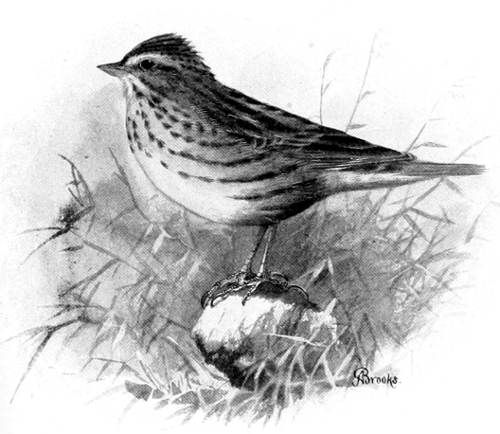
WESTERN SAVANNA SPARROW.
Savannas are birds of the meadows, whether fresh or salt, and wherever well-watered grasses and weeds abound, there they may be looked for. During migration, indeed, they may appear in most unexpected places. I saw one last year, at Bremerton, which haunted the vicinity of a tiny cemented pond in the center of a well-kept lawn. This bird hopped about coyly, peering behind blades of grass, and affecting a dainty fright at the sight of water, very much as a Chipping Sparrow might have done. In their nesting [114] habits these little fellows approach more closely to colonizing than any other members of the Sparrow family. Large tracts of land, apparently suitable, are left untenanted; while, in a near-by field of a few acres, half a dozen pairs may be found nesting. More recently the birds have accepted the shelter of irrigated tracts upon the East-side, and their numbers would seem almost certainly to be upon the increase.
To ascertain the presence of these birds, the ear-test is best, when once the song is mastered. The latter consists of a series of lisping and buzzing notes, fine only in the sense of being small, and quite unmusical, tsut, tsut, tsu wzzzzztsubut. The sound instantly recalls the eastern Grasshopper Sparrow (Coturniculus savannarum passerinus), who is an own cousin; but the preliminary and closing flourishes are a good deal longer than those of the related species, and the buzzing strain shorter.
Love-making goes by example as well as by season, so that when the choral fever is on they are all at it. The males will sing from the ground rather than keep silence, altho they prefer a weed-top, a fence post, or even a convenient tree. The female listens patiently near by, or if she tries to slip away for a bit of food, the jealous lover recalls her to duty by an ardent chase.
The nest is settled snugly in the dead grasses of last year’s ungathered crop, and is thus both concealed from above and upborne from below, and is itself carefully done in fine dead grasses.
The sitting bird does not often permit a close approach, but rises from the nest at not less than thirty feet. The precise spot is, therefore, very difficult to locate. If discovered the bird will potter about with fine affection of listlessness, and seems to consider that she has done her full duty in not showing the eggs.
No. 44. DESERT SPARROW.
A. O. U. No. 573 a. Amphispiza bilineata deserticola Ridgw.
Description.—Adults: Above brownish gray, browner on middle of back and on wings; a conspicuous white superciliary stripe bounded narrowly by black above and separated from white malar stripe (not reaching base of bill) by gray on sides of head; lores, anterior portion of malar region, chin, throat and chest centrally black, the last named with convex posterior outline; remaining underparts white tinged with grayish on sides and flanks; tail blackish, the outer web of outermost rectrix chiefly white, the inner web with white spot on tip, second rectrix (sometimes third or even fourth) tipped with white on inner web. Bill dusky; feet and legs brownish black. Young birds like adults but without black pattern of head markings; chin and throat white or flecked with grayish; breast streaked with same and back faintly streaked with dusky; some buffy [115] edging on wing. Length of adults about 5.35 (135.9); wing 2.55 (65); tail 2.48 (63); bill .40 (10); tarsus .75 (19).
Recognition Marks.—Warbler size; grayish coloration; strong white superciliary; black throat distinctive.
Nesting.—Not yet reported from Washington. “Nest in bushes, slight and frail, close to the ground; eggs 2-5, 0.72 × 0.58 (18.3 × 14.7), white with a pale greenish or bluish tinge, unmarked; laid in May, June and later” (Coues).
General Range.—Arid districts of southwestern United States and northwestern Mexico west from western Texas to California north probably to southern Idaho and Washington; south, in winter to Chihuahua, Sonora and Lower California.
Range in Washington.—Probably summer resident in Upper Sonoran and Arid Transition life-zones; believed to be recently invading State from south.
Authority.—Dawson, Auk, Vol. XXV. Oct. 1908, p. 483.
If one happens to be fairly well acquainted with the licensed musicians of the sage, the presence of a strange voice in the morning chorus is as noticeable as a scarlet golf jacket at church. The morning light was gilding the cool gray of a sage-covered hillside in Douglas County, on the 31st day of May, 1908, and the bird-man was mechanically checking off the members of the desert choir, Brewer Sparrow, Lark Sparrow, Vesper Sparrow and the rest, as they reported for duty, one by one, when suddenly a fresh voice of inquiry, Blew chee tee tee, burst from the sage at a stone’s cast. The binoculars were instantly levelled and their use alternated rapidly with that of note-book and pencil as the leading features of the stranger’s dress were seized upon in order of saliency: Black chin and throat with rounded extension on chest outlined against whitish of underparts and separated from grayish dusky of cheeks by white malar stripe; lores, apparently including eye, black; brilliant white superciliary stripe; crown and back warm light brown.
The newcomer was a male Desert Sparrow and the interest aroused by his appearance was considerably heightened when it was recalled that he was venturing some five hundred miles north of his furthest previously recorded range. This bird, probably the same individual, was seen and heard on several occasions subsequent thruout a stretch of half a mile bordering on Brook Lake. Once a female was glimpsed in company with her liege lord, flitting coquettishly from bush to bush; but the most diligent search failed to discover a nest, if such there was. Nesting was most certainly on the gallant’s mind for he sang at faithful intervals. The notes of his brief but musical offering had something of the gushing and tinkling quality of a Lark Sparrow’s. A variant form, whew, whew, whiterer, began nicely but degenerated in the last member into the metallic clicking of Towhee.
We have here, in all probability, another and a very conspicuous example [116] of that northward trend of species which we shall have frequent occasion to remark. The passion of the North Pole quest is not merely a human weakness; it is a deep-rooted instinct which we only share with the birds. There was once a near-Eden yonder, a Pliocene paradise, from which the cruel ice evicted us—birds and men—long, long ago. We go now to reclaim our own.
No. 45. SAGE SPARROW.
A. O. U. No. 574.1. Amphispiza nevadensis (Ridgw.).
Synonyms.—Artemisia Sparrow. Nevada Sage Sparrow.
Description.—Adults: Upperparts (including auriculars and sides of neck) ashy gray to ashy brown, clearer and grayer anteriorly, browner posteriorly; pileum, back and scapulars sharply and narrowly streaked with black; wings and tail dull black with light brownish or pale grayish edging; the rectrices marked with white much as in preceding species; a supraloral spot, an orbital ring and (usually) a short median line on forehead white; sides of head slaty gray; lores dusky; underparts white, clearest on throat where bounded and set off from white of malar area by interrupted chain of dusky streaks, occasionally with dusky spot on center of breast, marked on sides and flanks with buffy and streaked with dusky; edge of wing pale yellow or yellowish white. Bill blackish above, lighter below; legs dark brown, toes darker; iris brown. Young: “Pileum, hindneck, chest and sides, as well as back, streaked with dusky; otherwise essentially as in adults” (Ridgway). Underparts save on throat sometimes tinged with yellowish or buffy. Length of adult male about 6.00 (152.4); wing 3.11 (79); tail 2.95 (75); bill .39 (10); tarsus .84 (21.5). Female a little smaller.
Recognition Marks.—Sparrow size (barely); ashy gray plumage; white throat defined by dusky streaks.
Nesting.—Nest: of twigs, sage bark, and “hemp” warmly lined with wool, rabbit-fur, cow-hair or feathers, placed low in crotch of sage bush. Eggs: 3-5, usually 4, brownish- or greenish-gray as to ground, dotted, spotted or clouded, rarely scrawled, with chestnut or sepia and with some purplish shell markings. Av. size .80 × .60 (20.3 × 15.2). Season: April, June; two broods.
General Range.—Great Basin region of the Western United States, west to eastern base of Sierra Nevada, east to eastern base of Rockies, north (at least) to northern Washington; south, in winter, into southern Arizona, etc.
Range in Washington.—Upper Sonoran and Arid Transition life zones in eastern Washington north at least to the Grand Couleé; summer resident.
Authorities.—[“Sagebrush Sparrow” Johnson, Rep. Gov. W. T. 1884 (1885), 22.] Amphispiza belli nevadensis, Dawson, Wilson Bulletin, No. 39, June, 1902, p. 65. Ss¹. Ss².
Specimens.—U. of W. P.
[117]
Thank God for the sage-brush! It is not merely that it clothes the desert and makes its wastes less arid. No one needs to apologize for the unclad open, or to shun it as tho it were an unclean thing. Only little souls do this,—those who, being used to small spaces, miss the support of crowding elbows, and are frightened into peevish complaint when asked to stand alone. To the manly spirit there is exultation in mere space. The ground were enough, the mere Expanse, with the ever-matching blue of the hopeful sky. But when to this is added the homely verdure of the untilled ground, the cup of joy is filled. One snatches at the sage as tho it were the symbol of all the wild openness, and buries his nostrils in its pungent branches to compass at a whiff this realm of unpent gladness. Prosy? Monotonous? Faugh! Back to the city with you! You are not fit for the wilderness unless you love its very wormwood.
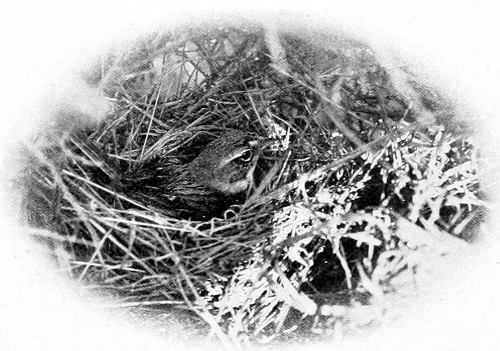
Taken in Douglas County. Photo by W. Leon Dawson. SAGE SPARROW ON NEST. THIS BIRD WAS NOT THE VICTIM OF THE MISFORTUNE MENTIONED IN THE TEXT.
The sage has interest or not, to be sure, according to the level from which it is viewed. Regarded from the supercilious level of the man-on-horseback, it is a mere hindrance to the pursuit of the erring steer. The man a-foot has some dim perception of its beauties, but if his errand is a long one he, too, wearies of his devious course. Those who are best of all fitted to appreciate its infinite variety of gnarled branch and velvet leaf, and to revel in its small mysteries, are simple folk,—rabbits, lizards, and a few birds who have chosen it for their life portion. Of these, some look up to it as to the trees of an ancient forest and are lost in its mazes; but of those who know it from the ground up, none is more loyal than the Sage Sparrow. Whether he gathers a breakfast, strewn upon the ground, among the red, white, and blue, of storkbill, chickweed, and fairy-mint, or whether he explores the crevices of the twisted sage itself for its store of shrinking beetles, his soul is filled with a vast content.
Here in the springtime he soon gets full enough for utterance, and mounts the topmost sprig of a sage bush to voice his thanks. In general character [118] the song is a sort of subdued musical croaking, mellow and rich at close quarters, but with little carrying power. The bird throws his head well back in singing, and the tail is carried more nearly horizontal than is the case with most Sparrows. A song from the Yakima country ran: Heo, chip’peway, chip′peway, chip′peway, but a common type heard on the banks of the Columbia in Walla Walla County, and repeated upon the northern limit of the bird’s range in Douglas County, is Tup, tup, to weely, chup, tup. A more pretentious ditty, occupying two seconds in delivery, runs Hooriedoppety, weeter wee, doodlety pootat′er,—an ecstacy song, wherein the little singer seems to be intoxicated with the aroma of his favorite sage.
One may search a long time in the neighborhood of the singer—who, by the way, closes the concert abruptly when he realizes that he is likely to give his secret away—before finding the humble domicile a foot or two up in a sage bush. A nest which contained five eggs was composed externally of sage twigs set into a concealed crotch of the bush, but the bulk of it consisted of weed-bark and “hemp” of a quite uniform quality; while the lining contained tufts of wool, rabbit-fur, cow-hair, feathers, and a few coiled horse-hairs. The feathers were procured at some distant ranch, and their soft tips were gracefully upturned to further the concealment of the eggs, already well protected by their grayish green tints.
Another nest, sighted some forty paces away, contained one egg, and we had high hopes of being able to secure photographs upon our return with the camera. But a few rods further we came upon a crew of sneaking Magpies, scouring the sage with a dozen beady eyes, and passing sneering or vulgarly jocose remarks upon what they found. When we returned, therefore, a day or two later, we were not surprised to learn that the feathered marauders had preferred egg-in-the-bill to souvenir photographs.
No. 46. SLATE-COLORED JUNCO.
A. O. U. No. 567. Junco hyemalis (Linn.).
Synonyms.—Snow-bird. Eastern Snow-bird.
Description.—Adult male in summer: Upperparts, throat and breast slate-color deepening to slaty-black on pileum, the bluish tinge lacking on wings and tail; below, abruptly white from the breast, the flanks ashy slate; the two outer pairs of tail-feathers entirely, and the third pair principally white; bill flesh-color, usually tipped with black. Adult female: Similar to male; throat and breast paler; a brownish wash over the upperparts, deepest on nape and upper back; wings brownish fuscous rather than black, and sides tawny-washed. Adult male in winter, becoming like female, but still distinguishable. Length 6.00-6.50 [119] (152.4-165.1); wing 3.07 (78); tail 2.80 (71.1); bill .49 (12.5). Female averages slightly smaller than male.
Recognition Marks.—Sparrow size; white lateral tail-feathers; hood slaty as compared with J. oreganus and J. o. shufeldti.
Nesting.—Not known to breed in Washington. Nest and eggs as next.
General Range.—North America, chiefly east of the Rocky Mountains, breeding in the hilly portions of the Northern States (east of the Rockies) north to the Arctic Coast and west to the valleys of the Yukon and Kowak Rivers, Alaska; south in winter as far as the Gulf States and sparingly over the Western States to California, Arizona, etc.
Range in Washington.—Casual during migrations; may winter rarely in company with J. oreganus.
Authorities.—Not previously published: W. T. Shaw in epist. Dec. 1, 1908. J. H. Bowles in epist. Jan. 19, 1909.
Specimens.—P¹.
This the familiar Snow-bird of the East is occasionally seen west of the Rocky Mountains in winter and during migrations, specimens having been taken at Sumas, B. C., by Mr. Allan Brooks, and at Corvallis, Oregon, by Mr. A. R. Woodcock, in addition to the one reported from Pullman. It is not impossible that the bird is more common than we have been supposing, because, when found, it appears to be mingling freely with flocks of allied species, quite unaware of the fact that such actions are of interest to inquisitive bird-men.
No. 47. OREGON JUNCO.
A. O. U. No. 567a. Junco oreganus (Towns.).
Synonyms.—“Oregon Snow-finch.” Western Snow-bird. Oregon Snow-bird. Townsend’s Junco.
Description.—Adult male: Head and neck all around and chest (abruptly defined along convex posterior edge) sooty black; back and scapulars and edging of tertials warm reddish brown (nearly walnut brown); rump, upper tail-coverts and middle and greater wing-coverts slaty gray or ashy gray, sometimes glossed with olivaceous; wings and tail dusky, edged with ashy; the outermost rectrix wholly and the second chiefly touched with white, the third pair touched with white near tip; sides of breast, sides and flanks strongly washed with pinkish brown (vinaceous cinnamon); remaining underparts (below chest) white. Bill pinkish white with dusky tip; iris claret red. Adult female: Head and neck all around and chest scarcely contrasting in color with upperparts but changing from warm brown (bister) above to dull slaty overlaid with brownish on throat and chest; brown of back (bister or dull sepia) without reddish tinge; white on second rectrix not so extensive as in male; wash of sides duller, not so vinaceous. [120] Young: Top of head and hind-neck grayish brown streaked with dusky, back and scapulars warmer brown streaked with black; throat, chest, sides and flanks pale buffy brown streaked with blackish; otherwise as in adult. Length of adult males about 6.35 (161.3); wing 2.95 (75); tail 2.56 (65); bill .43 (11); tarsus 83 (21). Females smaller.
Recognition Marks.—Sparrow size; black of head and throat contrasting with white of breast; white lateral tail-feathers; head black as compared with J. hyemalis; back reddish brown as compared with J. o. shufeldti.
Nesting.—Nest: on ground at base of small bush or under fallen branch, sometimes in open wood or set into brushy hillside, of dead grasses and weed stems, scantily lined, or not, with hair; dimensions 2½ inches wide by 1½ inches deep inside. Eggs: 2-5, usually 4, varying in ground color from pure white to pinkish white or pale blue, spotted or freckled and blotched with light reddish brown or brownish black, with occasional light cloudings of lavender; long oval to short ovate; variable in size, .80 × .60 (20.3 × 15.2) to .73 × .56 (18.5 × 14.2). Season: fourth week in April to first week in July or August according to altitude; two or three broods.
General Range.—Pacific Coast district; in summer from southern British Columbia north to Yakutat Bay, Alaska; in winter south irregularly to California (Santa Cruz and San Mateo counties), straggling across the Cascade-Sierras into interior.
Range in Washington.—Formerly summer resident, now chiefly migrant and winter resident west of the Cascades; winter resident and migrant east of Cascades.
Authorities.—?Townsend, Journ. Ac. Nat. Sci. Phila. VII., 1837, 188 (part). Junco oreganus Sclater, Baird, Rep. Pac. R. R. Surv. IX., 1858, 467. T. C&S. L¹. Rh. D¹. Kb. Ra. D². Kk. B.
Specimens.—U. of W. P¹. Prov. B.
In speaking of Juncoes it is necessary to distinguish between the rufous-backed bird of winter, the Oregon Junco proper, and the brownish-gray-backed bird of summer, the Shufeldt Junco. A dozen years ago oreganus was supposed to be the common breeding bird of Puget Sound and the neighboring foothills, altho Shufeldt’s was well known in the more open situations. Latterly, however, there has not been any authentic account of the nesting of the red-backed bird within the State. 1903 witnessed its last appearance as a summer bird, and that only in the highlands. Recent specimens taken during the breeding season at places so remote from each other as the prairies of Pierce County, the banks of the Pend d’Oreille in Stevens County, and the High Cascades in Whatcom County, have all proven to be J. o. shufeldti.
The fact appears to be that we have detected a Washingtonian instance of that northward trend of species clearly recognizable in the East, but obscured to our vision heretofore in the West by reason of varied conditions and insufficient data. The theory is that the birds are still following the retreat of the glacial ice. We know that the glacial ice-sheet, now confined [121] to Greenland and the high North, once covered half the continent. In our own mountains we see the vestigial traces of glaciers which were once of noble proportions. We know that the southward advance of the continental ice-sheet must have driven all animal life before it; and, likewise, that the territory since relinquished by the ice has been regained by the animals. What more natural than that we should witness thru close observation the northward advance of those varieties of birds which are best suited to withstand cold, and the corresponding occupation of abandoned territory on the part of those next south?
Juncoes, moreover, are erratic in their migrations, and in the West, at least, tend to become non-migratory. While Oregon Juncoes are the common winter birds of Puget Sound, Shufeldt’s are not entirely absent at this season, and we may even look to see them hold their own thruout the year. The problem is further complicated by what we call vertical migration, by which is meant that mountain birds descend to the valleys in winter instead of flying southward. Our winter Shufeldts, therefore, may or may not be strictly resident on, say, Steilacoom Prairie. The summer birds may retire to California; the winter birds may have descended from the Olympics or Mount Rainier.
No. 48. SHUFELDT’S JUNCO.
A. O. U. No. 567b. Junco oreganus shufeldti (Coale).
Synonyms.—Washington Junco. Hybrid Snow-bird (Coues). Rocky Mountain Junco (Coues).
Description.—Adults: Similar to J. oreganus but back (in males) grayish, or grayish-brown to sepia; in females sepia to drab; black of head and throat more slaty; also averaging larger. Length: 6.00-6.50 (152.4-165); wing 3.15 (80); tail 2.72 (69); bill .43 (11); tarsus .83 (21).
Recognition Marks.—Sparrow size; black of head and throat contrasting with brownish-gray of back and with white of breast; grayer on back than preceding.
Nesting.—Nest: much as in preceding, occasionally placed at moderate heights in trees. Eggs: 4 or 5, pale bluish white, spotted and blotched with light reddish brown and lavender, usually in light ring, occasionally in confluent mass about larger end; size larger than preceding. Av. .80 × .60 (20.3 × 15.2). Season: fourth week in April to August according to altitude; two broods.
General Range.—Breeding from northern Oregon north into British Columbia east to mountains of Alberta and Idaho; south in winter over Rocky Mountain plateau region to Mexico,—northern California.
[122]
Range in Washington.—Common summer resident thruout the State, in or near coniferous timber, from sea level to limit of trees; sparingly resident in winter chiefly west of Cascades.
Authorities.—As in preceding. (T). C&S. Sr. Ra. D². J. B. E.
Specimens.—U. of W. P¹. B. Bn.
However it may fare with the Oregon Junco (q. v.), the southern invaders, the birds with the rusty gray backs, now appear to possess the land. They have stolen back sometime in March, so unobtrusively we scarcely noticed when the substitution of gray-backs for red-backs was effected; but soon we do notice that the yards and clearings are frequented by happy rollicking troops of Shufeldt Juncoes, and we notice too that some pronounced flirtations are being carried on.
There is a jovial restlessness about these birds in flock which is contagious. Their every movement is accompanied by a happy titter, and the pursuit of necessities is never so stern that a saucy dare from one of their number will not send the whole company off pell-mell like a route of school-boys. Whenever a Junco starts to wing, it flashes a white signal in the lateral tail-feathers; and this convenient “recognition mark” enables the birds to keep track of each other thruout the maddest gambols in brush-lot or tree-top.
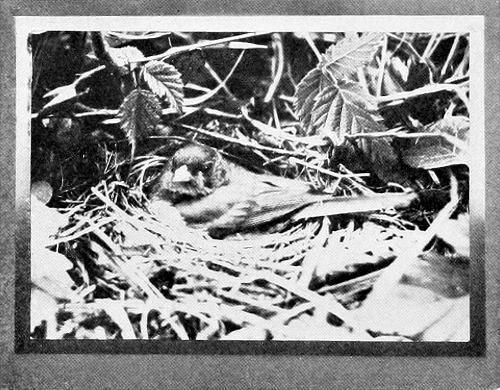
Taken near Portland. Photo by W. L. Finley. SIR! YOU INTRUDE! FEMALE SHUFELDT JUNCO ON NEST.
On a sunny day in March the Juncoes gather for a grand concert. The males mount the bush-tops and hold forth in rival strains, while the females lurk under cover and take counsel of their hearts. Junco’s song is a sweet little tinkling trill, not very pretentious, but tender and winsome. Interspersed with this is a variety of sipping and suckling notes, whose uses are hard to discern. Now and then, also, a forcible kissing sound may be heard, evidently a note of repulsion instead of attraction, for it is employed in the breeding season to frighten enemies. During the progress of the concert some dashing young fellow, unable fully to express his emotion in song, [123] runs amuck, and goes charging about thru the woodsy mazes in a fine frenzy—without, however, quite spilling his brains. Others catch the excitement and the company breaks up in a mad whirl of amorous pursuit.
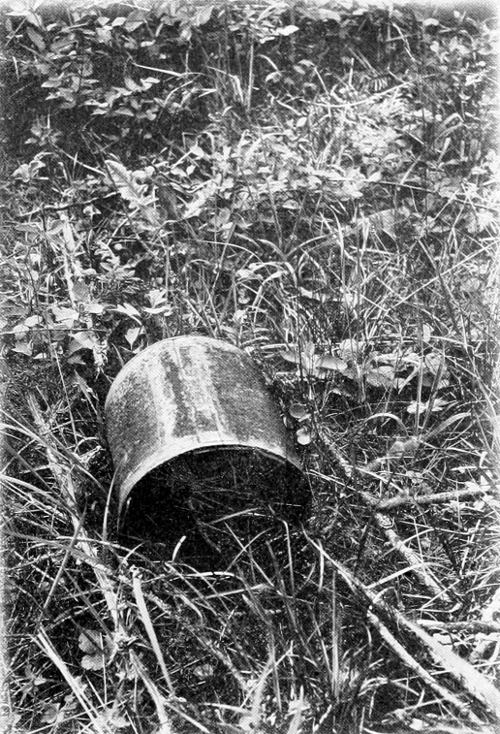
Taken in Tacoma. Photo by the Author. UNDER A TIN ROOF. THE NEST IN THE CAN CONTAINS FIVE EGGS.
At the end of the brief song period, Juncoes deploy thruout the half-open woods or prairie borders of the entire State, from sea-level to timber-line. The variety and interest of their nesting habits are scarcely exceeded by those of any other bird. In general they appear to be guided by some thought of seclusion or protection in their choice of nesting sites. Steep hillsides or little banks are, therefore, favorite places, for here the bird may excavate a cool grotto in the earth, and allow the drapery of the hillside, mosses and running vines, to festoon and guard the approaches. At Newport we found them nesting in the road-cuts. At Snoqualmie the side of a haystack sheltered a confiding pair. At Tacoma the birds nest at the base of tiny clumps of oak, or under the shelter of brush-piles. Several [124] nests have been found in old tin cans flung down upon the prairie and only half obscured by growing grasses. Again the birds trust to the density of vegetation, and shelter in the grass of unmowed orchards, weed-lots, and meadows. One site was found in which the bird occupied a carefully chosen fern arbor in the midst of a collection of whitened bones, evidently the mortal remains of a defunct draft horse. The situation was delightfully gruesome, and, touched no doubt with vanity, the owner sat for her portrait at four feet, á la Bernhardt.
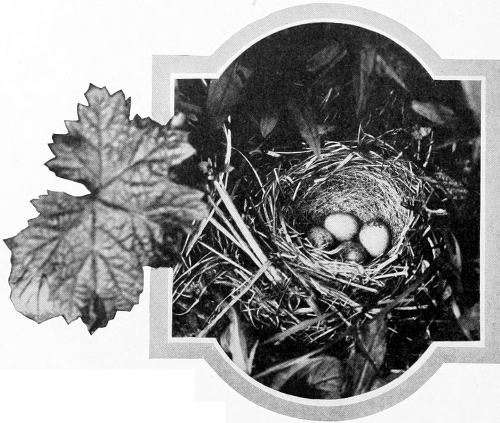
Taken in Whatcom County. Photo by the Author. NEST AND EGGS OF SHUFELDT JUNCO.
Juncoes keep very quiet during the nesting season until disturbed, and they are very close sitters. When nearly stepped on the bird bursts off, and, if there are young, crawls and tumbles along the ground within a few feet of the intruder, displaying wings and tail in a most appealing manner. The tssiks of both birds are incessantly repeated, and the whole woodside is set agog with apprehension.
If one posts himself in a suspected locality not too near the nest, it is only a question of time till the solicitude of the nursing mother will triumph over fear. One such I traced to a charming mossy bank, overlooking a [125] woodland pool; but on the first occasion it took the parent bird exactly half an hour to go thru all the feints and preliminaries before she ventured on the final plunge. There were half-grown babies in this nest, and since we were in summer camp (at Glacier, near the foot of Mt. Baker), I resolved to make friends of this promising family with a view to portraiture.
As I sat next day watching my Juncoes, and waiting for the sun to get around and light up the vicinity of the nest, the call to dinner sounded. The mother bird, not without much misgiving and remonstrance, had just visited her babies, so I rose to go; but as I did so, caught sight of a stout garter snake, who lay watching the scene from a distance of fully twenty feet, a wicked gleam of intelligence in his eye. With quick suspicion of his purpose, I seized stones and hurled at his retreating form; but the ground was rough and he managed to escape into a large brush-pile. At table I ate hurriedly, listening the while for the faintest note of trouble. When it came, a quick outcry from both parents, instead of premonitory notes of discovery, I sprang to my feet, clutched a stick, and rushed down to the spring. Alas for us! Satan had found our Eden! The nest was emptied and the snake lay coiled over it in the act of swallowing one of the little birds. Not daring to strike, I seized him by the throat and released the baby Junco, whose rump only had disappeared into the devouring jaws. Then with the stick I made snake’s-head jelly on a rock and flung the loathsome reptile away. But it was all too late. One young bird lay drowned upon the bottom of the pool, and the other (I think there were only two) soon died of fright and the laceration of the hinder parts attendant upon ophidian deglutition. It was all so horrible! the malignant plan, the stealthy approach, the sudden alarm, the wanton destruction of the fledglings, the grief of the agonized parents, the remorse of the helper who came too late! Is it any wonder that our forbears have pictured the arch-enemy as a serpent?
No. 49. WESTERN TREE SPARROW.
A. O. U. No. 559 a. Spizella monticola ochracea Brewster.
Description.—Adults: Pileum, a streak behind eye and a small patch on side of chest cinnamon-rufous or light chestnut; a superciliary stripe and remaining portions of head and neck clear ashy gray; throat and chest of same shade superficially but duller by virtue of concealed dusky; an ill defined spot of dusky in center of lower chest; remaining underparts dull white washed on sides with brownish; general color of upperparts light buffy grayish brown, much outcropping black on back, scapulars and tertials; some rusty edging on back feathers, scapulars and greater wing-coverts; middle and greater wing-coverts [126] tipped with white, forming two conspicuous bands; flight feathers and rectrices grayish dusky margined with whitish and buffy. Bill blackish above, yellow, tipped with dusky, below; legs brown, feet darker; iris brown. In winter the cinnamon-rufous of crown is slightly veiled, especially along median area, by ashy skirtings of feathers, and the buffy of upperparts inclines to strengthen. Length about 6.00 (152.4); wing 3.00 (76); tail 2.68 (68); bill .39 (10); tarsus .82 (20.8).
Recognition Marks.—Sparrow size; resembles Western Chipping Sparrow but much larger; white wing-bars with chestnut of crown distinctive.
Nesting.—Does not breed in Washington. “Nest, in low bushes or on the ground, loosely constructed of bark strips, weeds and grasses, warmly lined with feathers. Eggs, 4-6, or even 7, pale green, minutely and regularly sprinkled with reddish brown spots” (Coues). Av. size, .75 × .60 (19.1 × 15.2).
General Range.—Breeding from the valley of Anderson River, near the Arctic coast westward thru Alaska to coast of Bering Sea, and for an undetermined distance southward; in winter south thru western North America to Arizona, Texas, etc., eastward across Rocky Mts. to Great Plains (Ridgway).
Range in Washington.—Not common winter resident and migrant. Has not recently been reported west of the Cascades.
Authorities.—Brewster, Bull. Nutt. Orn. Club, VII. 1882, pp. 227, 228. (T). (C&S). Sr. D².
Specimens.—(U. of W.). P¹. Prov.
“The sight of the first Tree Sparrow in the fall serves perfectly to call up a vision of impending winter. Here are the hurrying blasts, the leaden skies, the piling snow-drifts, all ready to make the beholder shiver. But here, too, in some unburied weed patch, or thicket of rose-briars, is a company of Tree Sparrows, stout-hearted and cold-defying, setting up a merry tinkling chorus, as eloquent of good cheer as a crackling Yule-log. How many times has the bird-man hastened out after some cruel cold snap, thinking, ’Surely this will settle for my birds,’ only to have his fears rebuked by a troop of these hardy Norsemen revelling in some back pasture as if they had found their Valhalla on this side the icy gates. Ho! brothers! here is food in these capsules of mustard and cockle; here is wine distilled from the rose-hips; here is shelter in the weedy mazes, or under the soft blanket of the snow. What ho! Lift the light song! Pass round the cup again! Let mighty cheer prevail!” (Birds of Ohio).
Truth to tell, the Western Tree Sparrows are somewhat rare winter visitors, in eastern Washington only. In habits they do not appear to differ materially from the typical form, which is very abundant in winter thruout the northern tier of eastern states. In the nature of the case, while with us, their food, consisting as it does of grass- and weed-seeds and dried berries, is found near the ground; and so, for the season, the name Tree Sparrow seems inconsistent. When persistently annoyed, however, the flock will rise [127] to the tree-tops in straggling fashion, and there either await the withdrawal of the intruder, or else make off at a good height.
The song of the Tree Sparrow is sweet and tuneful, affording a pleasing contrast to the monotonous ditty of the Western Chipping Sparrow. Snatches of song may be heard, indeed, on almost any mild day in winter; but the spring awakening assures a more pretentious effort. A common form runs, Swee-ho, sweet, sweet, sweet, with notes of a most flattering tenderness. But we may only guess at the bird’s full powers, for the home-making is in Alaska.
No. 50. WESTERN CHIPPING SPARROW.
A. O. U. No. 560 a. Spizella passerina arizonæ (Coues).
Synonyms.—Chippy. Hair-bird.
Description.—Adult: Crown bright chestnut; extreme forehead black with ashy median line; a light ashy superciliary stripe; lore and postocular streak black; underparts and sides of head and neck ashy gray, dullest on breast and sides, clearest on throat where nearly white; hind-neck and wings bluish ash, the former more or less streaked with blackish; back and scapulars light brown (isabella color) heavily streaked with black; wings and tail fuscous. Bill dark; feet light; iris brown. Young birds are streaked with dusky above and below and lack the chestnut of crown. Length of adult males: 5.00-5.50 (127-139.7); wing 2.83 (72); tail 2.36 (60); bill .39 (10); tarsus .67 (17). Females smaller.
Recognition Marks.—Warbler size; chestnut crown and whitish superciliary distinctive.
Nesting.—Nest: A compact or careless structure of fine twigs, grasses, and (most commonly and often exclusively) rootlets, heavily lined with horse hair; placed in sage-bush, wild rose thicket or shrubbery, or else on horizontal branch of apple tree or evergreen. Eggs: 3-5, usually 4, greenish blue speckled freely or in narrow ring about larger end with reddish brown and black. Av. size, .71 × .51 (18 × 13). Season: April-July, usually May and June; two broods.
General Range.—Western North America from the Rockies to the Coast breeding from the southern border of the United States north to the Yukon Valley in Alaska, east over the western provinces of Canada; south in winter to Mexico and Lower California.
Range in Washington.—Common summer resident thruout the State chiefly in settled portions and more open situations.
Migrations.—Spring: Yakima, April 12, 1900; Chelan, April 24, 1896; Tacoma, April 12, 1905, April 11, 1906.
Authorities.—Spizella socialis Bonap. Baird, Rep. Pac. R. R. Surv. IX. 1858, 473 part. (T). C&S. D¹. Ra. D². Ss². Kk. J. B. E.
Specimens.—U. of W. P¹. Prov. B. E.
[128]
Not all birds are fitly named, even in the “immutable Latin,” but this one has a very accurate title in Spizella socialis arizonæ[16], which we may freely translate as the friendly little sparrow of the desert. An obscure little fellow he is to eye, a skit done in faded browns, with a chestnut crown which still does not differentiate the owner from a withered corymb in his native sage. Of the desert he is, for there is no sage-brush wilderness too dreary to boast the presence of at least a few Chipping Sparrows. And friendly he is, beyond question, for there are few dooryards in the eastern part of the State where this bird is not a trustful visitor; and his presence in western Washington is nearly coextensive with that of man. For altho the Chipping Sparrow now abounds in the prairie region of Pierce and adjacent counties, it is instructive to note that its plumage gives no evidence of resaturation, or of departure from the bleached type, as would be the case if it belonged to one of the really “old families” of Puget Sound.