Volume 1 — The Birds of Washington (continued 10)
Reading edition
Recognition Marks.—Sparrow size; drab coloring; cinnamon-colored belly; melancholy notes; frequents barns and outbuildings or cliffs.
Nesting.—Nest: composed of dried grasses, moss, plant-fibers, woolly materials of all sorts, and hair; placed on ledges, under eaves of outbuildings, under bridges, or on cliffs. Eggs: 3-6, usually 5, dull white, occasionally sparsely dotted. Av. size, .77 × .59 (19.6 × 15). Season: April 20-May 10, June 1-15; two broods. Yakima County April 24, 1900, 5 young about five days old (eggs fresh about April 7th).
General Range.—Western North America north to the Arctic Circle in Alaska, Yukon Territory, etc., east to Manitoba, western Wyoming, western Kansas, etc., breeding thruout range, south to Arizona and northern Lower California; southward in winter over northern and central Mexico.
Range in Washington.—Common summer resident east of the Cascades (chiefly in Upper Sonoran and Arid Transition life-zones), rare or casual west of the mountains.
Migrations.—Spring: c. March 15; Okanogan County March 17, 1896; Ahtanum (Yakima Co.) Feb. 20, 1900.
Authorities.—Bendire, Life Hist. N. A. Birds, Vol. II. 1895, p. 277. (T). D¹. Kb. D². Ss¹. Ss². J. B.
Specimens.—P¹. Prov. C.
A gentle melancholy possesses the Pewee. The memory of that older Eden once blotted by the ruthless ice-sheet, still haunts the chambers of the atavistic soul and she goes mourning all her days. Or she is like a Peri barred from Paradise, and no proffer of mortal joys can make amends for the immortal loss ever before her eyes. Kuteéw, kuteéw!
In keeping with her ascetic nature the Pewee haunts solitary places, bleak hillsides swept by March gales, lava cliffs with their solemn, silent bastions. Or, since misery loves company, she ventures upon some waterless [379] townsite and voices in unexpectant cadences the universal yearning for green things and cessation of wind.
A part of the drear impression made by this bird is occasioned by the time of year when it puts in an appearance, March at the latest, and, once at least, as early as February 20th (in Yakima County). Flies are an uncertain crop at this season, and it is doubtless rather from a desire for shelter than from inclination to society, that the species has so largely of late years resorted to stables and outbuildings. Twenty years ago Say’s Pewee was unknown as a tenant of buildings in Yakima County. Now, there are few well-established farms in that part of the State which do not boast a pair somewhere about the premises; while hop-houses are recognized as providing just that degree of isolation which the bird really prefers.
Say’s Pewee, for all its depressed spirits, is an active bird, and makes frequent sallies at passing insects. These constitute its exclusive diet save in early spring when, under the spell of adverse weather, dried berries are sought. Butterflies and moths are favorite food, but grasshoppers and beetles are captured as well; and the bird, in common with certain other flycatchers, has the power of ejecting indigestible elytra and leg-sheathings in the form of pellets.
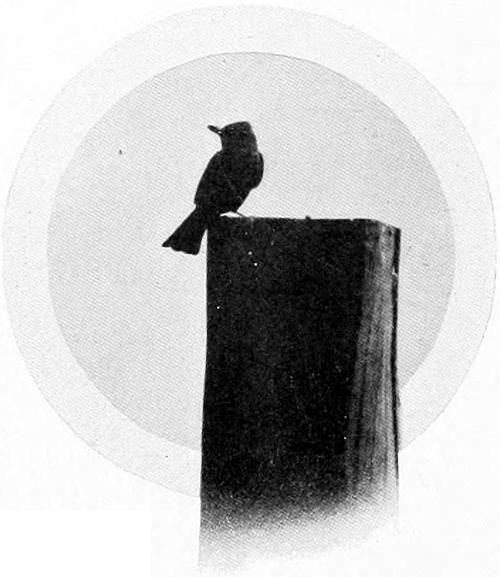
Photo by the Author. SAY’S PEWEE.
The males arrive in spring some days in advance of the females. Courtship is animated in spite of the melancholy proclivities of the bird; and the male achieves a sort of song by repeating ku-tew’s rapidly, on fluttering wing. Besides this, in moments of excitement, both birds cry Look at ’ere, with great distinctness.
Eggs are laid by the 10th of April and usually at least two broods are raised, in this latitude. In the natural state these Pewees nest about cliffs, at moderate heights, and in shallow caves. In selecting a site, they show a decided preference for a cliff which enjoys the protection of nesting Prairie Falcons. A stout bracket of twigs, weed-fibers, lichens, and other soft substances, is constructed, and a luxurious lining of wool and hair is supplied; but the whole must be partially shielded by some projecting tooth or facet of stone, or artificial construction.
The author in taking his first (and only) set of Say Pewee eggs selected a nest on the south wall of Brook Lake, reached only by canoe. The floor of an [380] old Cliff Swallow’s nest, placed in a shady niche at a height of some twelve feet, formed the support of the Pewee’s accumulations. The cliff was perfectly straight, but by dint of half an hour’s work piling lava blocks and securing footholds, with the aid of a double-bladed paddle he succeeded in reaching the nest. Requiring the use of both hands in descent, he placed the four fresh eggs in his hat, and the hat in his teeth, reaching the ground safely and depositing the hat carefully. Tired out by the exertion he flung himself down upon the narrow strip of shore and rested. Then noting the rising wind, he sprang up, seized the coat and hat and—Oh! Did something drop?!! Yes, gentle reader, the eggs were in it,—but only one was smashed. Only one! As perfect the arch without its keystone as a “set” of eggs with the guilty consciousness of one missing!
No. 146. OLIVE-SIDED FLYCATCHER.
A. O. U. No. 459. Nuttallornis borealis (Swains.)
Description.—Adult: Upperparts brownish slate with a just perceptible tinge of olivaceous on back; top of head a deeper shade, and without olivaceous; wings and tail dusky-blackish, the former with some brownish gray edging only on tertials; flank-tufts of fluffy, yellowish or white feathers, sometimes spreading across rump and in marked contrast to it, but usually concealed by wings; throat, belly and crissum, and sometimes middle line of breast, white or yellowish white; heavily shaded on sides and sometimes across breast with brownish gray or olive-brown,—the feathers with darker shaft-streaks; bill black above, pale yellow below; feet black. Immature: Similar to adult, but coloration a little brighter; wing-coverts fulvous or buffy. Length 7.00-8.00 (177.8-203.2); wing 4.16 (105.7); tail 2.64 (67.1); bill from nostril .53 (13.5); tarsus .59 (15).
Recognition Marks.—Sparrow to Chewink size; heavy shaded sides; bill yellow below; tew-tew note; keeps largely to summits of fir trees.
Nesting.—Nest: a shallow cup of twigs, bark-strips, etc., lined with coarse moss and rootlets; saddled upon horizontal limb of coniferous trees, often at great heights. Eggs: 3 or 4, creamy-white or pale buff, spotted distinctly with chestnut and rufous, and obscurely with purplish and lavender, chiefly in ring about larger end. Av. size, .85 × .63 (21.6 × 16). Season: June 1-15; one brood.
General Range.—North America, breeding from the northern and the higher mountainous parts of the United States northward to Hudson Bay and Alaska. Accidental in Greenland. In winter south to Central America, Colombia and northern Peru.
Range in Washington.—Summer resident in coniferous timber from sea level to limit of trees.
Migrations.—Spring: c. May 15.
Authorities.—Contopus borealis, Baird, Baird, Rep. Pac. R. R. Surv. IX. 1858, p. 189. Ibid C&S. 169. C&S. D¹. Kb. Ra. B. E.
Specimens.—U. of W. P¹. Prov. B. E.
[381]
Flycatchers belong to the sub-order Clamatores, that is to say, Shouters. Some few of our American Flycatchers lisp and sigh rather than cry aloud, but of those which shout the Olive-sided Flycatcher is easily dean. And it is as an elocutionist only that most of us know this bird, even tho our opportunities may have stretched along for decades. On a morning in mid May, as surely as the season comes around, one hears a strong insistent voice shouting, “See here!” There is not much to see, save a dun-colored bird seated at an impossible height on the summit of a tall fir tree. Its posture is that easy half-slouch which with the Flycatchers betokens instant readiness for action. While we are ogling, the bird launches from his post, seizes an insect some thirty feet distant, and is back again before we have recovered from surprise. “See here!” the bird repeats, but its accent is unchanged and there is really nothing more to see.
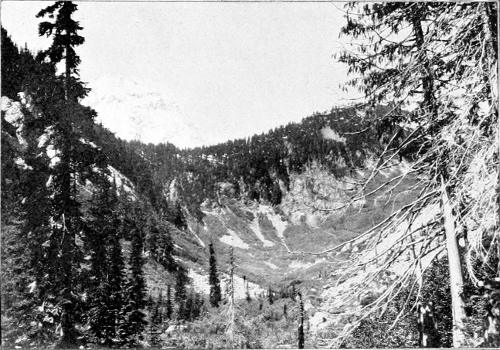
Taken in Chelan County. Photo by W. Leon Dawson. CASCADE PASS AND THE VALLEY OF THE STEHEKIN. A CHARACTERISTIC HAUNT OF THE OLIVE-SIDED FLYCATCHER.
An intimate acquaintance with the Olive-sided Flycatcher is not easily attained; but its characteristic cry carries to a distance of half a mile or [382] more, and is, fortunately, quite unforgettable. Both in accent and energy it seems to set the pace for several of the lesser Tyrants. Of course, like many another of the voices of Nature, its interpretation depends a good deal upon the mood of the listener. Heard on a dull day at sea-level it may sound dismal enough, but heard in the sharp air of the mountains it becomes an exultant note. There are miners in the heart of the Cascades who regard the brisk evening greeting of this Flycatcher as one of the compensations of solitude. “Three cheers!” the bird seems to say to one who returns from the silent bowels of the earth and grasps again the facts of outer life.
Borealis is a bird of the tree-tops and nearer you cannot come, save in nesting season, when caution is thrown to the winds and a study in morbid psychology is all too easy. The birds place a rustic saucer of interwoven black rootlets and mosses on the upper side of a horizontal branch, whether of hemlock, fir, or cedar, and, as often as otherwise, at moderate heights. They are very uneasy at the presence of strangers and flit about with a restless, tittering, cry, tew-tew, tew-tew, or tew-tew-tew, a sound which strangely excites the blood of the oölogist. Once the nesting tree is made out and the ascent begun, the birds are beside themselves with rage, and dash at the intruder with angry cries, which really stimulate endeavor where they are intended to discourage it.
How fatal is the beauty of an egg-shell! There be those of us who have drunk so oft of this subtle potion that the hand goes out instinctively to grasp the proffered cup. Besides, the product of an Olive-side’s skill is of a very special kind—a rich cream-colored oval, warmed by a hint of living flesh and splotched with saucy chestnut. It is irresistible! But, boys, don’t do it! We are old topers ourselves; public sentiment is against us, and our days are numbered. It is right that it should be so. Besides that, and speaking in all seriousness now, while it is desirable and necessary that a few representative collections of natural history should be built up for the public use, it does not follow that the public good is secured by the accumulation of endless private hordes of bird’s-eggs—whose logical end, in ninety-nine cases out of a hundred, is the scrap-heap. You are probably one of the ninety-nine. Think twice before you start a collection and then—don’t!
[383]
No. 147. WESTERN WOOD PEWEE.
A. O. U. No. 462. Myiochanes richardsonii (Swains.).
Synonyms.—Short-legged Pewee. Richardson’s Pewee.
Description.—Adults: Above deep grayish brown or grayish olive-brown; a lighter shade of same continued around sides and across breast, lightening on chin and throat, on remaining underparts becoming white or yellowish white; middle and greater coverts tipped with grayish; outer webs of tertials edged with grayish white. Bill black above, dusky (never light) below. Young birds have the middle and greater coverts tipped with buffy (forming two not inconspicuous bars), and some buffy edging on rump and upper tail-coverts. This species bears a curiously close resemblance to M. virens of the East, insomuch that it is not always possible to separate specimens in the cabinet; yet the two are perfectly distinct in note and habit and are not suspected of intergradation. Length of adult males 6.00-6.50 (152.4-165.1); wing 3.43 (87); tail 2.60 (66); bill .51 (13); tarsus .53 (13.4). Females a little smaller.
Recognition Marks.—Sparrow size; dark coloration (appearing blackish),—but much darker and a little larger than any of the Empidonaces. Meezeer note of animated melancholy distinctive.
Nesting.—Nest: a shallow cup of compacted moss, grasses, rootlets, etc., lined with fine grasses and wool or hair, and decorated externally, or not, with lichens; saddled midway or in fork of horizontal limb, chiefly at moderate heights. Eggs: usually 3, sometimes 4, creamy white, marked by largish spots of distinct and obscure rufous brown or umber, chiefly in open wreath about larger end. Av. size, .71 × .55 (18 × 14). Season: June 10-July 10; one brood.
General Range.—Western North America; breeding north to Alaska and Northwest Territory, east to Manitoba and western portion of Great Plains to Texas, south to northern Mexico; south in winter over Mexico and Central America to Equador, Peru, and Bolivia.
Range in Washington.—Common summer resident and migrant east of the Cascades, chiefly in coniferous forests, occasionally in open sage; less common west of the mountains.
Migrations.—Spring: c. May 15; Tacoma May 5, 1907; Yakima May 14, 1895, May 15, 1900; Newport May 20, 1906; Conconnully May 27, 1896. Fall: c. Sept. 1.
Authorities.—[“Western Wood Pewee,” Johnson, Rep. Gov. W. T. 1884 (1885), 22.] ? Muscicapa richardsonii, Aud. Orn. Biog. V. 1839, pl. 434. [Contopus richardsonii, Baird, Rep. Pac. R. R. Surv. IX. 1858, 189, 190. “Columbia River O. T. J. K. Townsend.”] Contopus richardsonii(?) Belding, L. B. P. D. 1890, p. 99 (Walla Walla, Dr. J. W. Williams). L¹. Rh. D¹. Kb. Ra. D². J. B. E.
Specimens.—U. of W. P¹. Prov. B. E.
[384]
The prey of gentle melancholy and the heir to gloom is this Pewee of the West. The day, indeed, is garish. The leaves of the fragrant cottonwoods glance and shimmer under the ardent sun; while the wavelets of the lake, tired of their morning romp, are sighing sleepily in the root-laced chambers of the overhanging shore. The vision of the distant hills is blurred by heat pulsations; the song of birds has ceased and the very caddis-flies are taking refuge from the glare. The sun is dominant and all Nature yields drowsy allegiance to his sway. All but Pewee. He avoids the sun, indeed, but from a sheltered perch he lifts a voice of protest, “Dear Me!”
It seems uncalled-for. The bird does not appear to be unhappy. Flycatching is good, and the Pewee cocks his head quite cheerfully as he returns to his perch after a successful foray. But, true to some hidden impulse, as you gaze upon him, he swells with approaching effort, his mandibles part, and he utters that doleful, appointed sound, dear me. His utterance has all the precision and finality of an assigned part in an orchestra. It is as if we were watching a single player in a symphony of Nature whose other strains were too subtle for our ears. The player seems inattentive to the music, he eyes the ceiling languidly, he notes a flashing diamond in the second box, he picks a flawed string absently, but at a moment he seizes the bow, gives the cello a vicious double scrape, dear me, and his task is done for that time.
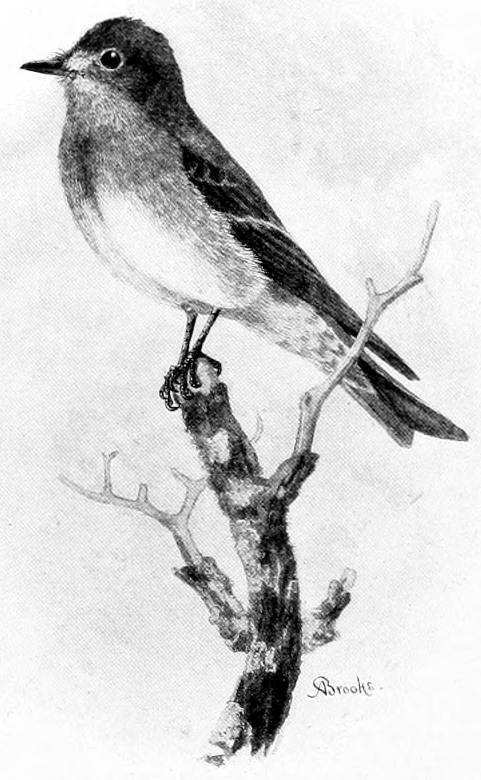
WESTERN WOOD PEWEE.
The Western Wood Pewee is a late migrant, reaching the middle of the State about the 15th of May, and the northern border from five to ten days later. It is found wherever there is timber, but is partial to half-open situations, and is much more in evidence East than West. It is especially fond of pine groves and rough brushy hillsides near water. Cannon Hill, in [385] Spokane, is a typical resort and a mere tyro can see three or four nests there on a June day.
The Pewee takes the public quite into her confidence in nest building. Not only does she build in the open, without a vestige of leafy cover, but when she is fully freighted with nesting material, she flies straight to the nest and proceeds to arrange it with perfect nonchalance. If a nest with eggs is discovered in the bird’s absence, she is quite likely to return and settle to her eggs without a troubled thought.
The nest is a moderately deep, well-made cup of hemp, fine bark-strips, grasses, and similar soft substances; and it is usually saddled upon a horizontal limb of pine, larch, maple, alder, oak, aspen, cottonwood, etc. But, occasionally, the nest is set in an upright crotch of a willow or some dead sapling. Nests having such support are naturally deeper than saddled nests, but the characteristic feature of both sorts is the choice of a site, quite removed from the protection of leaves. The grayish tone of the bark in the host tree is always accurately matched in the choice of nesting materials and, if the result can be secured in no other way, the exterior of the nest is elaborately draped with cobwebs.
All eggs appear beautiful to the seasoned oölogist, but few surpass in dainty elegance the three creamy ovals of the Pewee, with their spotting of quaint old browns and subdued lavenders. They are genuine antiques, and the connoisseur must pause to enjoy them even tho he honors the prior rights of Mr. and Mrs. M. Richardsonii.
No. 148. WESTERN FLYCATCHER.
A. O. U. No. 464. Empidonax difficilis Baird.
Synonym.—Western Yellow-bellied Flycatcher.
Description.—Adults: Above and on sides of breast olive or olive-green; a lighter shade of same color continued across breast; remaining underparts yellow (between sulphur and primrose), sordid on throat and sides, clearest on abdomen; bend of wing sulphur-yellow; a faint yellowish eye-ring; axillaries and lining of wings paler yellow; middle coverts and tips of greater coverts, continuous with edging of exposed secondaries, yellowish gray, forming two more or less conspicuous wing-bars. Bill brownish black above, yellow below; feet and legs brownish dusky; iris brown. Young birds are browner above and paler below; wing-bars cinnamon-buffy, (and not certainly distinguishable in color from young of E. traillii). Length 5.50-6.00 (139.7-152.4); wing 2.64 (67); tail 2.24 (57); bill .47 (12); tarsus.67 (17).
Recognition Marks.—Warbler size; characterized by pervading yellowness;—really [386] the easiest, because the most common of this difficult group; note a soft piswit; a woodland recluse. Adults always more yellow than E. traillii, from which it is not otherwise certainly distinguishable afield (save by note).
Nesting.—Nest: placed anywhere in forest or about shaded cliffs, chiefly at lower levels; usually well constructed of soft green moss, fine grasses, fir needles and hemp. Eggs: 3 or 4, dull creamy white, sparingly spotted and dotted or blotched with cinnamon and pinkish brown, chiefly about larger end. Av. size .66 × .52 (16.8 × 13.2). Season: May 1-July 1; one or two broods.
General Range.—Western North America from the eastern base of the Rocky Mountains to the Pacific, breeding north to Sitka and south chiefly in the mountains to northern Lower California and northern Mexico; south in winter into Mexico.
Range in Washington.—Common summer resident in timbered sections thruout the State.
Migrations.—Spring: Seattle-Tacoma, April 15. Fall: c. Sept. 1.
Authorities.—Empidonax difficilis, Baird, Rep. Pac. R. R. Surv. IX. 1858, p. 193 “Catal. No. 5920.” L. D¹. Ra. Ss¹. Ss². B. E.
Specimens.—(U. of W.) P. Prov. B. BN. E.
Please observe the scientific name, difficilis, that is, difficult. There is a delicate irony about the use of this term as a distinctive appellation for one of the “gnat kings,” for, surely, the plural, Empidonaces difficiles, would comprehend them all. There is something, indeed, to be learned from the notes of these little Flycatchers, and the first year the author studied them seriously he supposed he had a sure clew to their specific unraveling. But that was in the freshmen year of Empidonaxology. In coming up for “final exams.” he confesses to knowing somewhat less about them.
The bird, also, is well called Western; for however difficult the genus, we know at least that difficilis (speaking seriously now) is the commonest species; that it appears under more varied conditions and enjoys a more general distribution than any other species of Empidonax in the West. The bird is, also, the first to arrive in the spring, returning to the latitude of Seattle about the middle of April, or when the yellow-green racemes of the Large-leafed Maple (Acer macrophyllum) are first shaken out to the breeze. The little fay keeps well up in the trees, occupying central positions rather than exposed outposts; and so perfectly do his colors blend in with the tender hues of the new foliage that we hear him twenty times to once we see him.
The notes are little explosive sibilants fenced in by initial and final “p” or “t” sounds. If one prints them they are not at all to be vocalized, but only whispered or hissed, pssseet, pssseeit, psswit, or piswit. Other variations are sé a-wit, slowly and listlessly; cleotip, briskly; kushchtlip, a fairy sneeze in Russian. One becomes familiar with these tiny cachinations, and announces the Western Flycatcher unseen with some degree of confidence. But the way is beset with dangers and surprises. Once, in June, at a point on Lake Chelan, [387] after an hour’s discriminating study, I shot from practically the same stand, three birds which said swit, piswit, and pisoo respectively, and picked up a Wright’s Flycatcher (E. wrightii), a Western Flycatcher (E. difficilis) and a Trail Flycatcher (E. traillii). The same woods contained Hammond’s Flycatcher (E. hammondi), while the Western Wood Pewee (Myiochanes richardsonii), which has the same general economy, was abundant also. Difficilis? Etiam!
The Western Flycatcher inhabits the deepest woods and occurs thruout the State wherever sufficient shade is offered. It is rather partial to well-watered valleys, and will follow these well up into the mountains, but does not occur on the mountain-sides proper at any considerable altitude. Nor does it appear to visit, save during migrations, those green oases in the dry country which are the delight of E. traillii. It mingles with traillii in summer along the banks of streams and at the edges of swamps; with hammondi in the more open woods and along the lower hillsides; with wrightii along the margin of mountain lakes and streams; but in the forests proper it is easily dominant.
The Western Flycatcher is a catholic nester. It builds almost always a substantial cup of twigs, grasses, and hemp, lined with grass, hair or feathers. The outside is usually plentifully bedecked with moss, or else the whole structure is chiefly composed of this substance—not, however, unless the color-tone of the immediate surroundings will permit of it. In position it varies without limit. We find nests sunk like a Solitaire’s in a mossy bank, or set in a niche of a rocky cliff, on logs, stumps, or beams, in a clump of ferns, or securely lodged in a fir tree at a height of forty feet. One I found in a swamp was saddled on the stem of a slanting vine maple without a vestige of cover other than that afforded by the general gloom.
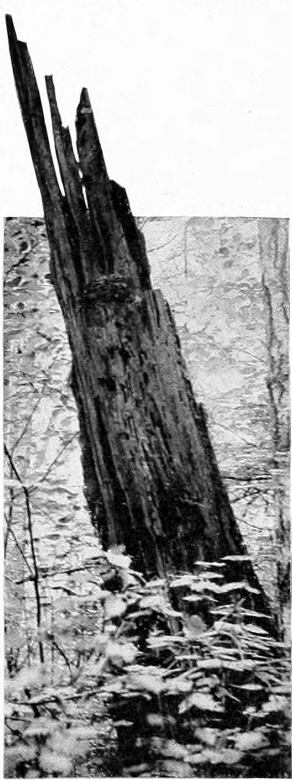
Taken near Tacoma. Photo by J. H. Bowles. NEST OF WESTERN FLYCATCHER.
Eggs to the number of three or four, rarely five, are deposited late in May or early in June, and only one brood is raised in a season. The eggs are of a dull creamy white color, spotted and blotched rather lightly with cinnamon brown and pinkish buff, easily distinguishable from all others save those of the Traill Flycatcher.
[388]
These Flycatchers in nesting time are very confiding and very devoted parents. One may sometimes touch the sitting bird, and, when off, she flutters about very close to the intruder, sneezing violently and snipping her mandibles like fairy scissors.
No. 149. TRAILL’S FLYCATCHER.
A. O. U. No. 466. Empidonax traillii (Aud.)
Synonyms.—Little Flycatcher. Little Western Flycatcher.
Description.—Plumage of upperparts very similar to that of E. difficilis, but olive inclining to brownish; wing-bars usually paler, more whitish; outer web of outer rectrix pale grayish white; sides of head and neck decidedly browner; underparts everywhere paler, nearly white on throat; breast sordid, scarcely olivaceous; lower abdomen and crissum pale primrose yellow; bend of wing yellow flecked with dusky; a faint eye-ring pale olive-gray. Bill black above, light brownish below (not so light in life as E. difficilis). Young: much as in preceding species, but averaging browner; more yellow below than adult. Length 5.50-6.00 (139.7-152.4); wing 2.76 (70); tail 2.25 (57); bill .49 (12.5); tarsus .65 (16.5).
Recognition Marks.—Warbler size; olivaceous coloration; not so yellow below as preceding species; brush-haunting habits; note a smart swit’choo.
Nesting.—Nest: a rather bulky but neatly-turned cup of plant-fibres, bark-strips, grass, etc., carefully lined with fine grasses; placed three to ten feet up, in crotch of bush or sapling of lowland thicket or swamp. Eggs: 3 or 4, not certainly distinguishable from those of preceding species. Av. size, .70 × .54 (17.8 × 13.7). Season: June; one brood.
General Range.—Western North America, breeding north to southern Alaska (Dyea), “east, northerly, to western portion of Great Plains, much farther southerly, breeding in Iowa(?), Missouri, southern Illinois, and probably elsewhere in central Mississippi Valley”; south in winter over Mexico to Colombia, etc.
Range in Washington.—Imperfectly made out—summer resident in thickets at lower levels thruout(?) the State.
Authorities.—Empidonax pusillus Cabanis, Baird, Rep. Pac. R. R. Surv. IX. 1858, p. 195. Ibid, C&S. 170. (T). C&S. L¹. D¹. Ra. B. E.
Specimens.—(U. of W.) Prov. B. E.
Discrimination is the constant effort of those who would study the Empidonaces, the Little Flycatchers. Comparing colors, Traill’s gives an impression of brownness, where the Western is yellowish green, Hammond’s blackish, and Wright’s grayish dusky. These distinctions are not glaring, but [389] they obtain roughly afield, in a group where every floating mote of difference is gladly welcomed. The Traill Flycatcher, moreover, is a lover of the half-open situations, bushy rather than timbered, of clearings, low thickets, and river banks. Unlike its congeners, it will follow a stream out upon a desert; and a spring, which gladdens a few hundred yards of willows and cratægi in some nook of the bunch-grass hills, is sure to number among its summer boarders at least one pair of Traill Flycatchers. This partiality for water-courses does not, however, prevent its frequenting dry hillsides in western Washington and the borders of mountain meadows in the Cascades.
Traill’s Flycatcher is a tardy migrant, for it arrives not earlier than the 20th of May, and frequently not before June 1st. In 1899, the bird did not appear at Ahtanum, in Yakima County, until the 14th of June; and it became common immediately thereafter. This bird is restless, energetic, and pugnacious to a fault. It posts on conspicuous places, the topmost twig of a syringa bush, a willow, or an aspen, making frequent outcries, if the mood is on, and darting nimbly after passing insects. During the nesting season it pounces on passing birds of whatever size and drives them out of bounds. It is not always so hardy in the presence of man, and if pressed too closely will whisk out of sight for good and all.
The notes of the Little Flycatcher, as it used to be called, are various and not always distinctive. Particularly, there is one style which cannot be distinguished from the commonest note of the Hammond Flycatcher, switchoo, sweéchew, or unblushingly, sweébew, sweébew, ssweet. Other notes, delivered sometimes singly and sometimes in groups, are pisoó; swit’oo, sweet, swit’oo; Swee, kutip, kutip; Hwit or hooit, softly.
Nesting begins late in June and fresh eggs may be expected about the 4th of July. Nests are placed characteristically in upright forks of willows, alder-berry bushes, roses, etc. They are usually compact and artistic structures of dried grasses, hemp (the inner bark of dead willows) and plant-down, lined with fine grasses, horse-hair, feathers and other soft substances. Not infrequently the nests are placed over water; and low elevations of, say, two or three feet from the ground appear to prevail westerly. A Yakima County nest, taken July 10th, containing two eggs, was half saddled upon, half sunk into the twigs of a horizontal willow branch one and a half feet above running water, and had to be reached by wading.
Incubation lasts twelve days, and the babies require as much more time to get a-wing. But by September 1st, tickets are bought, grips are packed—or, no! think of being able to travel without luggage—goodbyes are said; and it’s “Heighho! for Mexico!”
[390]
No. 150. HAMMOND’S FLYCATCHER.
A. O. U. No. 468. Empidonax hammondi (Xantus).
Synonym.—Dirty Little Flycatcher.
Description.—Adult: Above olive-gray inclining to ashy on foreparts,—color continued on sides, throat and breast well down, only slightly paler than back; remaining underparts yellowish in various degrees, or sometimes scarcely tinged with yellow[62]; pattern and color of wing much as in preceding species; outermost rectrix edged with whitish on outer web; bill comparatively small and narrow, black above, dusky or blackish below. Young birds present a minimum of yellow below and their wing-markings are buffy instead of whitish. Length about 5.50 (139.7); wing 2.80 (71); tail 2.29 (58); bill .41 (10.5); breadth of bill at nostril .19 (4.83); tarsus .63 (16). Females average a little smaller.
Recognition Marks.—Warbler size, the smallest of the four Washington Empidonaces, and possibly the most difficult (where all are vexing); olive-gray of plumage gives impression of blackish at distance; the most sordid below of the Protean quartette; nests high in coniferous trees; eggs white.
Nesting.—Nest: of fir-twigs, grasses and moss, lined with fine grasses, vegetable down and hair; placed on horizontal limb of fir tree at considerable heights. Eggs: 4, pale creamy white, unmarked. Av. size, .65 × .51 (16.5 × 12.7). Season: June; one brood.
General Range.—Western North America north to southeastern Alaska, the valley of the Upper Yukon and Athabasca, breeding south, chiefly in the mountains, to Colorado and California; south in winter thru Mexico to the highlands of Guatemala.
Range in Washington.—Summer resident in coniferous timber on both sides of the Cascades, irregularly abundant and local in distribution.
Authorities.—[“Hammond’s fly-catcher,” Johnson, Rep. Gov. W. T. 1884 (1885), 22.] Bendire, Life Hist. N. A. Birds, Vol. II. 1895, p. 315ff. D¹. Ra. D². B. E(H).
Specimens.—C.
Hammondi is the western analogue of minimus, the well-known Least Flycatcher of the East. It has not, however, attained any such distinctness in the public mind, nor is it likely to except in favored localities. These chosen stations are quite as likely to be in the city as elsewhere; but no sooner do we begin to arrive at conclusions as to its habits, notes, etc., than the bird forsakes the region and our work is all to do over again at some distant time.
In the summer of 1895 I found Hammond Flycatchers fairly abundant on Capitol Hill (which was then in its pin-feather stage). Twenty or thirty might have been seen in the course of a morning’s walk in June. Everywhere [391] were to be heard brisk Sewick’s in the precise fashion of eastern minimus; and at rarer intervals a more intense but still harsh and unresonant Sweé-chew. These observations were confirmed by the taking of several specimens; but elsewhere and in other seasons I have found the bird most unaccountably silent, and have been able to add little to its repertory of speech.
In the summer of 1906 we found these Flycatchers preparing nests on Cannon Hill in Spokane. In both instances the birds were building out in the open after the fashion of the Western Wood Pewee (Myiochanes richardsonii); one on the bare limb of a horse-chestnut tree some ten feet from the ground; the other upon an exposed elbow of a picturesque horizontal limb of a pine tree at a height of some sixty feet. Near Newport, in Stevens County, we located a nearly completed nest of this species on the 20th of May, and returned on the 1st of June to complete accounts. The nest was placed seven feet from the trunk of a tall fir tree, and at a height of forty feet. The bird was sitting, and when frightened dived headlong into the nearest thicket, where she skulked silently during our entire stay. The nest proved to be a delicate creation of the finest vegetable materials, weathered leaves, fibers, grasses, etc., carefully inwrought, and a considerable quantity of the orange-colored bracts of young fir trees. The lining was of hair, fine grass, bracts, and a single feather. In position the nest might well have been that of a Wood Pewee; but, altho it was deeply cupped, it was much broader, and so relatively flatter. The four fresh eggs which it contained were of a delicate cream-color, changing to pure white upon blowing.
The Hammond Flycatcher was also found to be a common breeder in the valley of the Stehekin, where Mr. Bowles has taken several sets in very similar situations, viz., upon horizontal branches of fir trees at considerable heights.
No. 151. WRIGHT’S FLYCATCHER.
A. O. U. No. 469. Empidonax wrightii Baird.
Synonym.—Little Gray Flycatcher.
Description.—Adult (gray phase): Above dull bluish gray or faintly olivaceous on back and sides; throat and breast pale gray to whitish with admixture of ill-concealed dusky; remaining parts, posteriorly, faintly tinged with pale primrose; a whitish eye-ring; wing-markings, of the same pattern as in other species, or more extensive on secondaries and outer webs of tertials, definitely white; outer web of outermost rectrix pale whitish. Adult (yellow-bellied phase): As in gray phase, but underparts strongly tinged with yellow and upperparts faintly tinged with olive-green; wing-markings less purely white. Bill blackish above, [392] more or less pale below and dusky tipped. Young birds are whitish below and the wing-bands are buffy as in other species. Length about 5.75 (146); wing 2.69 (68); tail 2.40 (61); bill .47 (12); tarsus .71 (18).
Recognition Marks.—Warbler size; prevailing gray coloration; whitish eye-ring; excessively retiring habits.
Nesting.—Nest: of hemp, bark-strips, etc., softly lined; built in upright crotch of bush. Eggs: 4 or 5, white, unmarked. Av. size, .68 × .52 (17.3 × 13.2). Season: June; one brood.
General Range.—Western United States and southern British Columbia, breeding in Transition and Canadian life-zones, south to southern Arizona and east to Rocky Mountains; south in winter thru southern California and Mexico.
Authorities.—Dawson, Auk, Vol. XIV. Apr. 1897, p. 176.
Specimens.—Prov. C.
Bird-afraid-of-his-shadow is the name this shy recluse deserves. The few seen in Washington have always been skulking in the depths of brush patches, or in clumps of thorn bushes, and they seem to dread nothing so much as the human eye. For all they keep so close to cover they move about restlessly and are never still long enough to afford any satisfaction to the beholder.
The only note I have ever heard it utter (and this repeatedly by different individuals) was a soft liquid swit. But Major Bendire says of its occurrence at Fort Klamath in Oregon; “I do not consider this species as noisy as the Little Flycatcher [E. traillii] which was nearly as common, but its notes are very similar; in fact they are not easily distinguishable, but are given with less vigor than those of the former, while in its actions it is fully as energetic and sprightly as any of the species of the genus Empidonax.”
Wright’s Flycatcher affects higher altitudes than do the other species during the nesting season. The nest is placed at heights ranging from two to twenty feet, and is built in upright forks of bushes, or against the trunks of small saplings. Willows, alders, aspens, buck-brush, and service berry are common hosts. Perhaps the only nesting record for Washington consists of a set of four fresh eggs taken by myself from a draw on the side of Boulder Mountain overlooking the Stehekin Valley, on May 30, 1896. The nest had been deserted because of a brush fire which had swept the draw, but it was uninjured; and the situation, an alder fork eight feet up, together with the white eggs, made identification certain.
[393]
Trochilidæ—The Hummingbirds
No. 152. BLACK-CHINNED HUMMINGBIRD.
A. O. U. No. 429. Trochilus alexandri Bourc. & Muls.
Synonyms.—Alexander Hummingbird. Sponge Hummer.
Description.—Adult male: Upperparts including middle pair of tail-feathers shining bronzy green; wing-quills and remaining rectrices fuscous with purplish reflections; tail double-rounded, its feathers broadly acuminate, and central pair of feathers about .12 shorter than the third pair, the outermost pair shorter than middle pair; the gorget chiefly opaque velvety black, on each side of the median line a small irregular patch of metallic orange, or else with various jewelled iridescence posteriorly; remaining underparts white, heavily tinged with greenish on sides, elsewhere lightly tinged with dusky and dull rufous; bill slender, straight. Adult female: Similar to male in coloration but without gorget, a few dusky specks instead; tail different, single-rounded, central feathers like back in coloration, and scarcely shorter than succeeding pairs, remaining feathers with broad subterminal space of purplish black, and tipped with white, lateral feathers scarcely acuminate, the outermost barely emarginate on inner web. Length of adult male: about 3.50 (88.9); wing 1.75 (44.5); tail 1.25 (31.8); bill .75 (19.1). Female, length about 4.00 (101.6); wing 1.95 (49.5).
Recognition Marks.—Pygmy size; black gorget of male distinctive; female larger than in Stellula calliope, with which alone it is likely to come into comparison.
Nesting.—Nest: Of plant down secured by cobwebs, saddled upon small descending branch at moderate height, or lashed to twigs of small fork. Eggs: 2 or, rarely, 3, pure white, elliptical oval in shape. Av. size, .50 × .33 (12.7 × 8.3). Season: May or June according to altitude; one brood.
General Range.—Western United States, except the northern Pacific coast district, north in the interior into British Columbia, breeding south to northern Lower California and east to the Rocky Mountains; south in winter into Mexico.
Range in Washington.—Not common summer resident east of the Cascades only.
Authorities.—? Bendire, Life Hist. N. A. Birds, Vol. II. 1895, p. 199 (inferential). Dawson, Auk, Vol. XIV. Apr. 1897, p. 175. Sr. Ss². J.
Specimens.—(U. of W.) P¹. C.
Those of us, who as children were taught to call lady-bugs “lady-birds,” might have been pardoned some uncertainty as to the whereabouts of the dividing line between insects and birds, especially if, to the vision of the “Hum-bird’s” wings shimmering by day above the flower bed, was added the twilight visits of the hawk-moths not a whit smaller. The Hummer is painted like a butterfly; its flight is direct and buzzing like a bee’s; it seeks its food at the flower’s brim by poising on rapidly vibrating wing like the hawk-moth; but there the resemblances cease. For the rest it is a bird, migrating, mating, and nesting quite like grown folks.
[394]
While more than five hundred species of Hummingbirds—and these all confined to the New World—are known to science, those which have looked northward at all have shown a decided preference for the Pacific Coast. Thus, we have four species in Washington, and we send our boldest member, Selasphorus rufus, as far north as the St. Elias range in Alaska, while our friends east of the Mississippi River know only one species, the Ruby-throat, Trochilus colubris, which is own cousin, and only own cousin to our T. alexandri.
Contrary to the popular belief Hummers do not feed largely upon nectar, but insert their needle-bills into the depths of flowers mainly for the purpose of capturing insects. This explains the otherwise puzzling habit the birds have of revisiting the same flower beds at frequent intervals. It is not to gather new-flowing sweets, but to see what flies the sweets themselves have gathered. If a Hummingbird extracted honey to any great extent—it does some—it would be rifling the bait from its own traps. Again, the bird is not footless, as some suppose, for it spends a good deal of time perching on exposed limbs, from which it may dart, Flycatcher fashion, after passing insects.
Nor is the bird quite songless. At La Claire’s, on the banks of the Pend d’Oreille River, we once witnessed a very pretty episode in the life of the Black-chinned Hummer. We were passing beside a brush-and-log fence in a clearing, when we noticed the rocking song-flight of a male Black-chin. The bird first towered to a height of forty feet, or such a matter, with loudly buzzing wing, then descended noisily in a great loop, passing under a certain projecting branch in the fence, and emitting along the lower segment of his great semicircle a low, musical, murmuring sound of considerable beauty. This note, inasmuch as we stood near one end of the fairy lover’s course, was raised in pitch a musical third upon each return journey. Back and forth the ardent hero passed, until he tired at length and darted off to tap a Canada lily for nourishment, or the pretense of it. Then he perched on a twig at ten feet and submitted to a most admiring inspection.
The Hummer’s back, well up on the neck, was of a dull green shade, the wings were dusky, and the head dusky, shading into the deep velvety brownish black of the throat. There was no lustrous sheen of the gorget in the dull light, but on each side of the median line of the throat lay an irregular patch of metallic orange. The underparts were tinged with dusky and dull rufous; and these modest vestments completed the attire of a plain-colored but very dainty bird.
Upon the passionate resumption of his courting dance we ordered an investigation, and succeeded in finding “the woman in the case.” She rose timidly from the thicket at the very lowest point of the male’s song circuit, but at sight of us quickly took to the brush again.
The fairy’s nest is commonly saddled to an obliquely descending branch of willow, alder, cottonwood, or young orchard tree. It is a tiny tuft of vegetable [395] down, bound together and lashed to its support by a wealth of spider-webbing. Unlike the nest of colubris, the nest of alexandri is not decorated with lichens; and it not infrequently resembles some small fine sponge, not only in its yellow-brown tint, but in the elastic texture of its walls, which regain their shape after being lightly squeezed. The eggs, two in number (but sometimes three in this species alone), look like homeopathic pills—so dainty, indeed, that the owner herself must needs dart off the nest every now and then and hover at some distance to admire them. The male deserts his mate as soon as she is well established, and the entire care of the little family falls upon her shoulders. The young are fed by regurgitation, “a frightful looking act,” as Bradford Torrey says.
No. 153. RUFOUS HUMMER.
A. O. U. No. 433. Selasphorus rufus (Gmel.).
Synonyms.—Red-backed Hummingbird. Nootka Hummer.
Description.—Adult male: In general above and below bright rufous or cinnamon-red, changing to bronzy green on crown, fading to white on belly and on chest, where sharply contrasting with gorget; wing-quills purplish-dusky on tips; the central pair of tail-feathers broadened and broadly acuminate; the succeeding pair with a deep notch on the inner web and a slighter emargination on the outer web; gorget somewhat produced laterally, of close-set rounded metallic scales, shining coppery-red, fiery red, or (varying with individuals) rich ruby-red. Bill slender and straight. Adult female: Above rufous overlaid with bronzy green, clear rufous on rump and tail-coverts; pattern of tail as in male but less decided; central tail-feathers green tipped with black; lateral feathers chiefly rufous, changing to black subterminally, and tipped with white; underparts whitish, shaded with rufous on sides; gorget wanting or represented by a small central patch. Young males: Like adult female but more extensively rufous above and throat flecked with reddish metallic scales. Young females: Like adult female but rump green and throat flecked with greenish scales. Length of adult male about 3.50 (88.9); wing 1.65 (41.91); tail 1.30 (33); bill .65 (16.5). Female: 3.70 (94); wing 1.75 (44.5); tail 1.28 (32.5); bill .68 (17.3).
Recognition Marks.—Pygmy size; abundant rufous of male distinctive; female requires careful discrimination from that of S. alleni and may be known certainly from it by notching of next central tail-feather, and by outer tail-feather more than .10 wide.
Nesting.—Nest: Of plant down and fine mosses bound together with cobwebs, and ornamented with lichens, placed on horizontal or declining stem of bush or tree. Eggs: 2, pure white, elliptical oval. Av. size, .50 × .33 (12.7 × 8.3). Season: April 15-July 10; two broods.
[396]
General Range.—Western North America from the Rocky Mountains to the Pacific, breeding south in mountainous regions to Arizona and north to Mount St. Elias and southwest Yukon Territory; south in winter over the tablelands of Mexico.
Range in Washington.—Common summer resident on the West-side from sea-level to timber-line; less common on the eastern slopes of the Cascades; rare in the mountains of eastern Washington.
Migrations.—Spring: March 15-April 15.
Authorities.—? Trochilus rufus, Aud. Orn. Biog. IV. 1838, 555, pl. 372. Selasphorus rufus Swains, Baird, Rep. Pac. R. R. Surv. IX. 1858, p. 135. T. C&S. L¹. Rh. D¹. Sr. Kb. Ra. Kk. J. B. E.
Specimens.—U. of W. P. Prov. B. BN. E.
These gaudily dressed little fellows, seemingly part and parcel of the sunshine itself, are by no means the delicate creations they appear to be. West of the Cascades they are, strange to say, among the very first of the spring arrivals from the South. The vanguard always arrives by the last week of March, and sometimes as early as the middle of that month. East of the Cascades they are considerably later, and are not found in nearly so large numbers. They are seldom to be seen in greatest abundance, however, much before the middle of April. At this season certain bushes flower in profusion, and in these flowers the hummers find unlimited food and drink,—honey, and the innumerable tiny insects which it attracts.
Wright Park, situated in the center of the city of Tacoma, has been very extensively planted with the decorative wild currant; and it is here that hummers may oftenest be seen in great numbers. It is not uncommon to see them by hundreds in this park, and often as many as twenty disport themselves in and around a single bush. They are the most pugnacious little creatures and are continually squabbling, the females being quite as quarrelsome as the males. Their war song is a penetrating squeak, or chirrup. The pausing of one of the birds to select some luscious insect from a cluster of flowers seems to be the signal for an onset from one or more of its fellows, when all squeak with greatest animation. One cannot help believing that this is more or less in the nature of play, for it is joined in by both the males and the females, and the one attacked never resents it in the least. Usually it describes a great circle in the air and descends into the center of some other bush, where it sits watching the others and occasionally preening its feathers. They are exceedingly tame at this season, and the bird-lover may seat himself under some flower-laden bush while these most beautiful little birds hover and perch within three or four feet of him.
What appears to be the only other vocal accomplishment of this hummer is a somewhat long-drawn, rasping note, very loud and harsh for so small a bird. This is made by the male, and, curiously enough, it is the love song [397] uttered while wooing his mate. She perches quietly in the center of some small tree, apparently quite insensible to his frenzied actions. These consist in flying up to a very considerable height, and then dropping in a circular course to within a few feet of where she sits. It is on the downward course that he makes his declaration of love, and if it is done to arouse her he ought to be successful. Certainly it is a sound most startling to a human being, when it explodes unexpectedly within a few feet of his head.
It is almost unnecessary to say that the nesting habits of these little birds are of unusual interest. The male is a disgracefully idle fellow, never doing a stroke of work while the female is building the nest, and leaving her as soon as the eggs are laid. It seems that at least he might feed her while she sits so patiently upon her eggs; but no, he retires to some warm, sunny gulch and spends his time in selfish enjoyment.
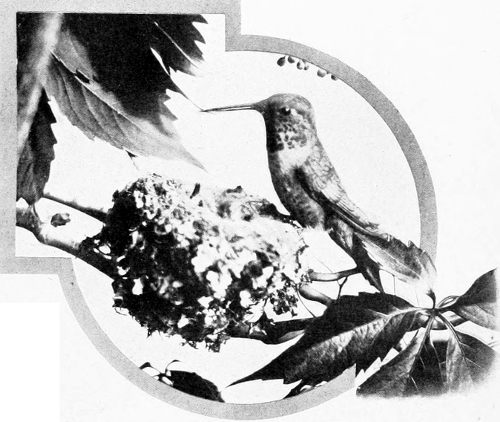
Taken in Oregon. Photo by Finley and Bohlman. RUFOUS HUMMER AT NEST.
Strange to say, the first nest-building occurs during the first week in April, at which season sleet and cold rains are of not infrequent occurrence. This is long before the majority of the species have arrived from the South, and it would lead one to think that the first comers are already paired when they arrive. A nest containing two fresh eggs was found on the 14th of April, the eggs hatching on the 26th. On this last date it was raining in torrents with a bitter cold wind, yet the tiny young did not seem to suffer in the least, altho frequently left for as long as fifteen or twenty minutes by [398] their mother. Indeed it was a mystery where she could possibly have found anything to eat. This nest was saddled upon a twig a few feet above the ground amidst the sheltering branches of a huge cedar, thus protecting the young from any direct contact with the rain.
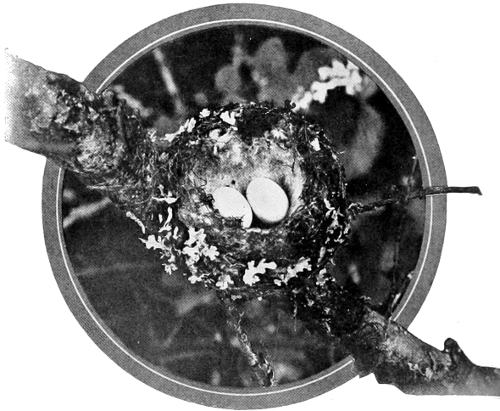
Taken near Tacoma. Photo by the Authors. NEST OF RUFOUS HUMMER ON FIR BRANCH.
There is scarcely a conceivable situation, except directly on the ground, that these birds will not select for a nesting site. Such odd places have been chosen as a knot in a large rope that hung from the rafters of a woodshed; and again, amongst the wires of an electric light globe that was suspended in the front porch of a city residence. It may be found fifty feet up in some huge fir in the depths of the forest, or on the stem of some blackberry bush growing in a city lot.
Very often they form colonies during the nesting season, as many as twenty nests being built in a small area. Some large fir grove is generally chosen for the colony, but a most interesting one was located on a tiny island in Puget Sound. This island has had most of its large timber cut away, and is heavily overgrown with huckleberry, blackberry, and small alders. In the center is the colony, the nests placed only a few yards apart on any vine or bush that will serve the purpose. Huckleberry bushes seem the favorites, but many nests are built in the alders and on the blackberry vines.
The nesting season is greatly protracted, for fresh eggs may be found from April till July. This makes it seem probable that each pair raises at least two broods during the spring and summer. After incubation is somewhat advanced, the female is most courageous, often permitting herself to be lifted off the nest before its contents can be examined. At such times the bird student must be on his guard, as the little mother will often resent the intrusion, and her attack is always made at the eyes.
[399]
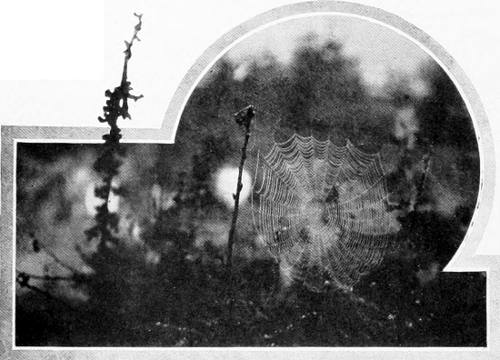
Taken near Tacoma. Photo by W. Leon Dawson. TREASURE TROVE FOR THE HUMMER. COBWEBS ARE LARGELY UTILIZED IN THE BUILDING OF A HUMMINGBIRD’S NEST.
The eggs, so far as has ever been recorded, are invariably two in number. They are immaculate milky white in color; and when freshly laid the yolk makes them look like little pink moonstones, such as one finds on the beach. In shape they are elliptical, and seem large for so small a bird, measuring .50 × .33 inches.
The young are fed by regurgitation. For several days after hatching their bills are little longer than those of any other young bird; but by the time they leave the nest, their sword-like beaks are nearly as long as those of their parents.
J. H. Bowles.
No. 154. ALLEN’S HUMMINGBIRD.
A. O. U. No. 434. Selasphorus alleni Hensh.
Synonym.—Green-backed Rufous Hummingbird.
Description.—Adult male: Similar to adult male of S. rufus, but upperparts shining bronzy green (duller on crown); underparts, including belly, cinnamon-rufous, changing to white on chest only; tail-feathers without notching or emargination, the two outer pairs smaller and very narrow, the outermost acicular. Adult female: Very similar to adult male of S. rufus, but with tail as in male S. alleni. Length of adult male: 3.25 (82.6); wing 1.52 (38.6); tail 1.17 (29.7); bill .63 (16). Female a little larger.
Recognition Marks.—Pygmy size; fiery gorget with green back of male unmistakable; female indistinguishable out of hand from that of S. rufus; outermost tail-feathers less than .10 wide.
Nesting.—As in preceding.
[400]
General Range.—Pacific Coast district north to southwestern British Columbia, east, southerly, to Arizona; south in winter to Lower California and Sonora.
Range in Washington.—Imperfectly made out; at least summer resident and migrant west of the Cascades; not yet reported from the East-side.
Authorities.—Lawrence, Auk, Vol. IX. Jan. 1892, p. 44. L. Ra. Kb. B. E.
Specimens.—C. E.
It is the misfortune of certain well-deserving mortals to be known to fame as the husbands or brothers or cousins of some celebrity. Allen’s Hummer is the daintier, as he is the rarer, of the summer Selasphori but we know him thus far only as a momentary vision. At each appearance we pause to assure ourselves that we really did see a Hummer with a green back and a red gorget, for otherwise, we have been duped again by one of those tiresome female Rufouses.
Mr. R. H. Lawrence records the Allen Hummer as a summer resident of the Gray’s Harbor country, and says of it[63]: “Perhaps as common as T. rufus, and frequenting similar places. First noted in 1891 on the East Humptulips, April 30. I had a good view of one on Quiniault Lake June 13.”
Mr. Chas. A. Allen, of Nicasio, Cal., who discovered this species and in whose honor it was named, says of these birds[64]: “Their courage is beyond question; I once saw two of these little warriors start after a Western Red-tailed Hawk, and they attacked it so vigorously that the Hawk was glad to get out of their way. But these little scamps were even then not satisfied, but helped him along after he had decided to go. Each male seems to claim a particular range which he occupies for feeding and breeding purposes, and every other bird seen by him encroaching on his preserve is at once so determinedly set upon and harassed that he is only too glad to beat a hasty retreat. During their quarrels these birds keep up an incessant sharp chirping, and a harsh rasping buzzing with the wings, which sounds very different from the low soft humming they make with these while feeding. * * * During the mating and breeding season the male frequently shoots straight up into the air and nearly out of sight, only to turn suddenly and rush headlong down until within a few feet of the ground. The wings during the downward rushes cut the air and cause a sharp, whistling screech, as they descend with frightful velocity, and should they strike anything in their downward course, I believe they would be instantly killed.”
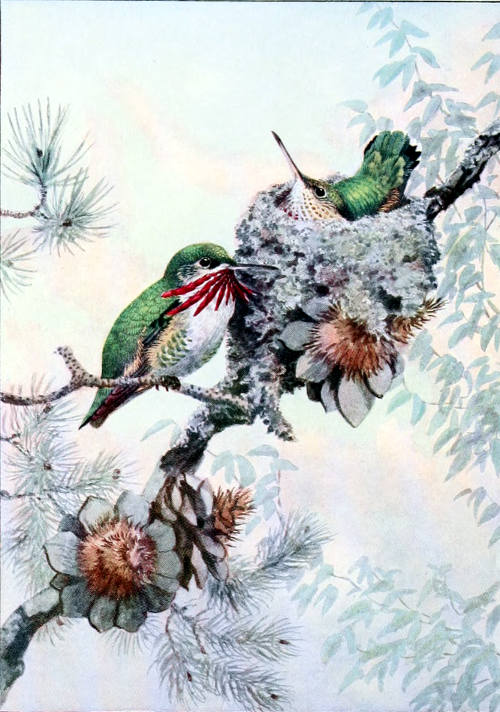
CALLIOPE HUMMERS MALE AND FEMALE, ⅚ LIFE SIZE From a Water-color Painting by Allan Brooks
[401]
[402]
No. 155. CALLIOPE HUMMINGBIRD.
A. O. U. No. 436. Stellula calliope Gould.
Synonyms.—Calliope Hummer. Star Hummer.
Description.—Adult male: Upperparts golden-green; tail chiefly dusky, rufous at base, paler on tips, slightly double-rounded, its feathers broadening distally and nearly round at tips; sides of throat and underparts white, washed with greenish and brownish on sides; gorget somewhat produced laterally, of lengthened acuminate feathers having white bases, rose-purple, or violet, with lilac reflections. Bill straight, black above, yellowish below. Adult female: Coloration of upperparts, save tail, as in male; central tail-feathers green tipped with dusky; remaining rectrices greenish gray mingled with rufous basally, crossed with black, and tipped with white. Young birds resemble adult female but are heavily washed with rufous below and have throat more or less specked with dusky. Length of adult male: 2.75-3.00 (69.9-76.2); wing 1.55 (39.4); tail 1.00 (25.4); bill .57 (14.5). Female much larger—up to 3.50 (88.9).
Recognition Marks.—Pygmy size; the smallest of the northern ranging species; gorget of male with radiating feathers of rose-purple hue distinctive, but female hard to discriminate afield.
Nesting.—Much as in other species. Av. size of Eggs: .47 × .30 (11.9 × 7.6). Season: June or July according to altitude; one brood.
General Range.—Breeding in the mountains of the West, north to central British Columbia; south in winter to the mountains of Mexico.
Range in Washington.—Summer resident, chiefly in Transition and Canadian zones, east of the Cascades, and in these mountains to the limit of trees. Mr. Lawrence’s record remains unique for the West-side, but the bird probably breeds in the Olympics also.
Authorities.—? Lawrence, Auk, Vol. IX. Jan. 1892, p.44. Bendire, Life Hist. N. A. Birds, Vol. II. 1895, p.219. L¹. D². J. B.
Specimens.—P¹. C.
Ornithologists have been hard put to it to provide names for these most exquisite of birds, the Hummers. The realms of callilithology, chromatics, esthetics, astronomy, history, classical mythology, and a score beside, have been laid under tribute to secure such fanciful and high-sounding titles as the Fiery Topaz, Ruby-and-Topaz, Allied Emerald, Red-throated Sapphire, Sparkling-tail, White-booted Racket-tail, Fork-tailed Rainbow, the Sappho Comet, the Circe, Rivoli and Lucifer Hummers, the Adorable Coquette, and, last but not least, the truly Marvelous Hummingbird (Loddigesia mirabilis). What wonder, then, that with so many children to provide for, Gould, the great monographer of the Trochilidæ, should have named [403] this nearly silent but always beautiful species after the muse of eloquence, Calliope?
While it is true that the species may be found in abundance thruout the higher Cascades, and especially along their eastern slopes, it is hardly just to say with Bendire, that “the Calliope Hummingbird is a mountain-loving species and during the breeding season is rarely met with below altitudes of 4,000 feet, and much more frequently between 6,500 to 8,000 feet.”[65] We have found it commonly in the northern and eastern portions of Washington at much lower altitudes, and have taken its nest in the burning gorge of the Columbia at an altitude of only six hundred feet. In the mountains the bird knows no restriction of range, save that it avoids the heavily timbered slopes of the West-side; and it is at least as common along the divide as is the Rufous Hummer.
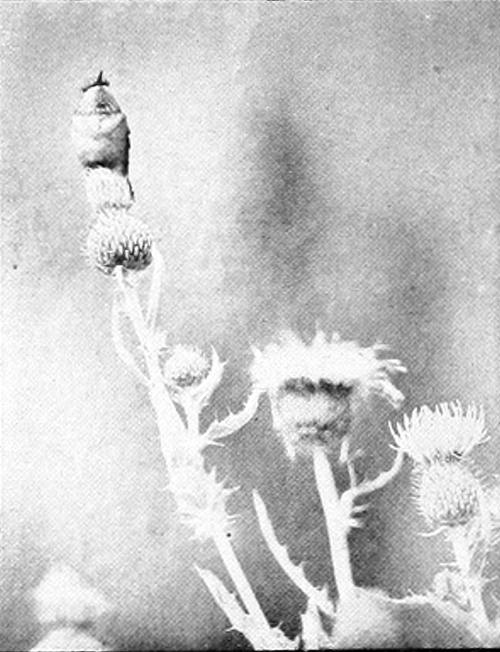
Taken in Spokane. Photo by F. S. Merrill. CALLIOPE HUMMER, FEMALE.
Without doubt the mind remembers longest those birds which visit the mountain heather beds, gorgeous with flowers, and varied beyond description. A bit of heather on Wright’s Peak at an elevation of 8,000 feet, yielded thirty-two species of plants in conspicuous bloom within a stone’s throw of camp. The Hummers appear to be attracted to the flower beds by color and position rather than by scent, and as sure as we neglected to rise with the sun, a troop of puzzled honey-hunters hovered by turns over our parti-colored blankets. Once a Hummer minutely inspected a red bandana handkerchief which graced the bird-man’s neck; and once, I regret to say it, fluttered for some moments before his nose (sunburned!).
The tower and dive of the Calliope Hummer produces at its climax a squeak of the tiniest and shrillest quality. It is a sight well worth seeing when one of these elfin gallants, flashing like a jewel and bursting with self-consciousness, mounts slowly upward on vibrating wings to a height of a hundred feet, then darts back with the speed of lightning to make an affectionate pass at the placid lady on the twig below. The same tactics are [404] pursued when the cat or a snooping chipmunk is the object of attention, but the change in temper is unmistakable. I do not feel sure that the spitfire will strike an enemy, but the sudden explosions of winged fury hard about the ears are quite sufficient to put a prowler in a panic.
The secret of nest-finding in the case of Hummingbirds lies in the tell-tale wing-buzz of the female as she quits her nest. In this way, on the 17th of June, 1906, we found the first Washington nest of the Calliope, in the dense greenery of La Chapelle’s Springs, on the Columbia River, near Chelan Falls. The nest was saddled on a slender descending branch of a red birch tree, at a point seven feet out from the trunk and twelve feet from the ground. It was overshadowed by a little canopy of leaves, and was held in place not only by its lashings of cobwebs, but by a drooping filament from a loftier branch.
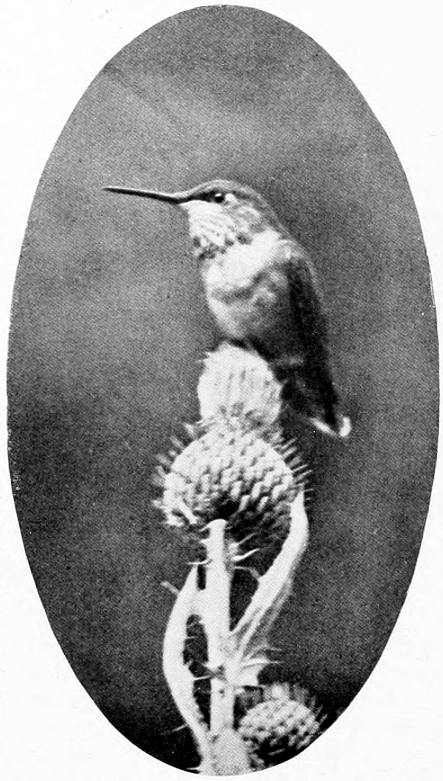
Taken in Spokane. Photo by F. S. Merrill. A NEARER VIEW.
In eastern Oregon Bendire found these birds nesting extensively in the pine trees. The nests were usually settled upon a cluster of pine cones, and so closely simulated their surroundings that detection would have been impossible save for the visits of their owners. Ridgway figures[66] a four-story nest taken at Baird, California, and believed to represent the occupation of successive seasons.
[405]
Caprimulgidæ—The Nighthawks (Goatsuckers, etc.)
No. 156. POORWILL.
A. O. U. No. 418. Phalænoptilus nuttallii (Aud.).
Description.—Adult: A narrow band of pure white across throat; below this in abrupt contrast a band of black; under tail-coverts clear creamy buff; the three outer pairs of rectrices tipped broadly with white or buffy white; remaining plumage an exquisite complex of skeletonized black centers of feathers with buffy and intermingled dusky marginings, the whole producing a frosted or tarnished silvery effect; black most conspicuously outcropping on back and on center of crown; buffy “silvering” most complete on sides of crown, wing-coverts, and upper surfaces of tail-feathers; black of underparts appearing chiefly as bars where also mingled with pale olivaceous; flight feathers finely and fully banded, ochraceous and blackish. Bill black; feet (drying) dark brown; iris brown. Length: 7.00-8.00 (177.8-203.2); wing 5.50 (139.7); tail 3.50 (88.9); tarsus .65 (16.5).
Recognition Marks.—Strictly Chewink size but appearing larger; smaller than a Nighthawk, which it superficially resembles in coloration. Poorwill cry heard a hundred times to once the bird is seen.
Nesting.—Eggs: 2 laid upon the bare ground, creamy white with a faint pinkish tinge, oval to blunt elliptical oval in shape. Av. size, .99 × .75 (25.2 × 19). Season: c. June 1st; one brood.
General Range.—Breeds from the western portions of the Great Plains west to the Cascade-Sierra Ranges, north into British Columbia, Alberta, etc.; south in winter thru Mexico to Guatemala.
Range in Washington.—Not common summer resident in treeless portions of eastern Washington.
Authorities.—Antrostomus nuttallii Cassin, “Illustrations,” (1856) p. 237. C&S. D¹. D². Ss¹. J.
Specimens.—Prov. C.
The sun has set and the last chore is done, all save carrying in the brimful pail of milk, which slowly yields tribute of escaping bubbles to the evening air. Sukey, with a vast sigh of relief, has sunk upon the ground, where, after summoning a consoling cud, she regards her master wonderingly. But the farmer boy is loath to quit the scene and to exchange the witching twilight for the homely glare of the waiting kerosene; so he lingers on his milk-stool watching the fading light in the western sky and dreaming, as only a boy can dream, of days which are yet to be. Every sense is lulled to rest, and the spirit comes forth to explore the lands beyond the hills, to conquer cities, discover poles, or scale the heights of heaven, when suddenly out of the stillness comes the plaintive cry of the Poor-will, Poor-will - poor-will. It is not a disturbing note, but rather the authentic voice of silence, the yearning [406] of the bordering wilderness made vocal in appeal to the romantic spirit of youth. Poor Will! Poor Will! you think upon cities, actions, achievements; think rather upon solitude, upon quietness, upon lonely devotions. Come, oh, come to the wilderness, to the mystic, silent, fateful wastes! And ever after, even tho duty call him to the city, to the stupid, stifling, roaring, (and glorious) city, the voice of the Poor-will has wrought its work within the heart of the exiled farmer boy, and he owns a reverence for the silent places, a loyalty of affection for the wilderness, which not all the forced subservience of things which creak or blare or shriek may fully efface.
The Poor-will spends the day sleeping on the ground under the shelter of a sage-bush, or close beside some lichen-covered rock, to which its intricate pattern of plumage marvelously assimilates. When startled, by day, the bird flits a few yards over the sage-tops and plumps down at haphazard. If it chances to settle in the full sunlight, it appears to be blinded and may allow a close approach; but if in the shade, one is not likely to surprise it again. Even after nightfall these fairy moth-catchers are much more terrestrial in their habits than are the Nighthawks. They alight upon the ground upon the slightest pretext and, indeed, appear most frequently to attain their object by leaping up at passing insects. They are more strictly nocturnal in habit, also, than the Night Jars, and we know of their later movements only thru the intermittent exercise of song. Heard in some starlit cañon, the passing of a Poor-will in full cry is an indescribable experience, producing feelings somewhere between pleasure and fear,—pleasure in the delightful melancholy of the notes heard in the dim distance, but something akin to terror at the near approach and thrilling climax of the portentous sounds.
Taken in the hand, one sees what a quiet, inoffensive fay the Poor-will is, all feathers and itself a mere featherweight. The silken sheen and delicate tracery of the frost-work upon the plumage it were hopeless to describe. It is as tho some fairy snowball had struck the bird full on the forehead, and from thence gone shivering with ever lessening traces all over the upperparts. Or, perhaps, to allow another fancy, the dust of the innumerable moth-millers, with which the bird is always wrestling, gets powdered over its garments. The large bristles which line the upper mandible, and which increase the catching capacity of the extensive gape by half, are seen to be really modified feathers, and not hairs, as might be supposed, for in younger specimens they are protected by little horny basal sheaths. With this equipment, and wings, our melancholy hero easily becomes the envy of mere human entomologists.
[407]
No. 157. PACIFIC NIGHTHAWK
A. O. U. No. 420 part. Chordeiles virginianus hesperis J. Grinnell.
Synonym.—Bull-bat.
Description.—Adult male: Mottled, black, gray and ochraceous, and with white in patches; above black predominates, especially on forehead and back, mottling falling into indistinct bars on upper tail-coverts and tail; anterior edge of wing white; the wing-quills dusky; a large, white, transverse patch about midway on the first five primaries, save on the outer web of the first; a large V-shaped throat-patch white; remaining underparts distinctly and finely barred, dusky and whitish with some faint ochraceous,—the latter found especially on the parts adjacent to the white throat-patch; the crissum sometimes pure white, usually barred, at greater intervals than on breast; a white band crossing tail near tip, except on central feathers. Bill without evident bristles, the horny part very small, but length of gape about an inch. Tarsus very short; the middle claw enlarged, and with a curious, horny, comb-like process on the inner edge. Adult female: Similar, but without white band on tail, and with white spots on primaries often much reduced; throat-patch tinged with ochraceous, and suffusion of underparts by this color more pronounced. Immature: More finely and heavily mottled than adults, and with upperparts more heavily marked, or even suffused with ochraceous-buff. Length 9.00-10.00 (228.6-254); wing 4.85 (123.2); tail 4.32 (109.7); bill from nostril .21 (5.3).
Recognition Marks.—To appearance “Little Hawk” size—really smaller; central white spot in long wing distinctive.
Nesting.—Eggs: 2, deposited on the bare ground, often among rocks, sometimes upon a flat rock, or on the gravel roof of a tall building; grayish white, or dull olive-buff marbled, mottled, or clouded and speckled with various shades of olive, and brownish- or purplish-gray. Av. size, 1.18 × .86 (30 × 21.8). Season: June; one brood.
General Range.—Pacific coast slope north to British Columbia.
Range in Washington.—West-side, summer resident in open situations.
Authorities.—Chordeiles popetue, Baird, Rep. Pac. R. R. Surv. IX. 1858, p. 153. T. C&S. B. E.
Specimens.—Prov.
The Nighthawk arrives so tardily—never before the middle of May and from that date to the middle of June—that he reminds us of the naughty child who has disregarded the parental summons and comes upon the scene sleepy and cross at 9.30 a. m., when all good little children are at school. We are sure, too, that it must be something like the necessity of eating cold victuals that makes the bird grumble bayard - bayard as it flits about discontentedly on the first morning. Moreover, there is always something incongruous about the appearance of this prairie species in the land of tall timber. He is like the [408] man from Kansas. He has a perfect right here and he is a very good fellow. Oh, to be sure!
The Pacific Nighthawk differs by scarcely assignable characters from the typical form of the eastern United States, but it is separated from it in distribution by two bleached phases, C. v. henryi and C. v. sennetti, of the desert and plain respectively; so we feel confident that it represents a resaturation of the intermediate stock rather than a division or colony of C. virginianus proper. Bird of the plains tho it be, it is pushing its way determinedly on the West-side wherever openings offer, and is as likely to occur upon the San Juan Islands or in some little clearing of the mountain valleys as upon the ampler reaches of the Chehalis prairies. Latterly, also, it has accommodated itself to the life of the city, and from the fearless way in which it appears over Pacific Avenue in Tacoma, or Second Avenue in Seattle, we judge that it must be following the well established eastern custom of laying its eggs on the flat roofs of down-town buildings.
No. 158. WESTERN NIGHTHAWK.
A. O. U. No. 420 a. Chordeiles virginianus henryi (Cass.).
Description.—Similar to C. v. hesperis, but paler thruout; areas of black reduced, white patches of throat, wing, and tail averaging larger; below more extensively tawny whitish.
Recognition Marks.—As in preceding.
Nesting.—Nest and Eggs not distinguishable from those of C. v. hesperis.
General Range.—Arid Transition and Canadian life-zones of the Western United States from the eastern slopes of the Rocky Mountains to the Cascade-Sierra ranges, north into British Columbia; south in winter to northern South America.
Range in Washington.—Common summer resident in open situations east of the Cascade Mountains.
Migrations.—Spring: Moses Lake, May 13, 1906; Chelan, May 29, 1905; Oro, May 29, 1896.
Authorities.—[“Western Nighthawk,” Johnson, Rep. Gov. W. T. 1884 (1885) 22]; Bendire, Life Hist. N. A. Birds, Vol. II., 1895, p. 168. D¹. Sr. Ra. D². Ss¹. Ss². Kk(?). J.
Specimens.—(U. of W.) P¹. Prov. E.
These Nighthawks are perfectly harmless except to moths, midges, and their ilk; and their uplifted wings half careened by the evening breeze furnish [409] one of the most pleasing adornments of lowland meadow or sage-covered upland. The birds “quarter the air” incessantly in a bat-like flight of irregular zigzags, often pouting as they go, bayard - bayard. They are not so strictly nocturnal as the Poor-wills, but put a liberal construction on “twilight,” being careful to avail themselves of all cloudy days, and, in fact, moving about at will whenever the sun slants fairly. The middle hours of the day are spent upon the ground, where their neutral tints serve a protective purpose and are almost implicitly relied on. During the mating season the males take great parabolic headers in the air, returning sharply and producing a loud booming daw-w—whether by the rushing of air thru the wings or across the opened mouth, will, perhaps, never be determined.
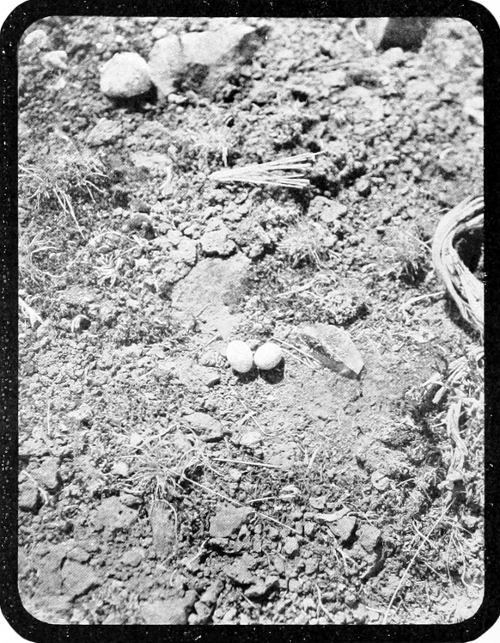
Taken near Spokane. Photo by F. S. Merrill. EGGS OF WESTERN NIGHTHAWK, IN SITU.
During migrations scores of these birds are sometimes seen moving aloft in loose array and, customarily at this season, silent. While not at any time strictly gregarious, favorable conditions are likely to attract considerable [410] numbers to a given spot. I have seen scores at a time winging noiselessly to and fro over the tranquil waters of Brook Lake, and once I saw a company of not less than two hundred executing a grand march with bewildering evolutions, in a Yakima pasture. The date in the last-mentioned instance was August 10th, and it is more likely that the birds had discovered some notable event in the insect world, than that they themselves were preparing to migrate.
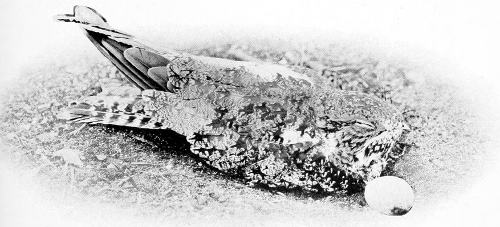
Taken near Spokane. Telephoto by W. H. Wright. WESTERN NIGHTHAWK AT MIDDAY.
The eggs of the Nighthawk are heavily mottled with slaty and other tints, which render them practically invisible to the searching eye, even tho they rest upon the bare ground or, as oftener, upon an exposed lava ledge. Except during the very warmest hours (when the sun’s rays might addle them) and the coolest (when they might become chilled), the sitting bird is likely to rest beside her eggs instead of on them. The young birds when hatched place great reliance upon their protective coloration, and even permit the fondling of the hand rather than confess the defect of their fancied security. The old bird, meanwhile has fluttered away over the ground with uncertain wing and drooping tail to drop at last on the very point of death. Or failing in this ruse, she is charging about in mid air with plaintive cries. Look upon the babies for the last time, for they will be spirited away before your return,—borne off, it is said, between the thighs of the parent bird.
[411]
Micropodidæ—The Swifts
No. 159. BLACK SWIFT.
A. O. U. No. 422. Cypseloides niger borealis (Kennerly).
Synonyms.—Cloud Swift. Northern Black Cloud Swift.
Description.—Adults: Sooty black; feathers of extreme chin, anterior portion of lores, forecrown, lining of wings, abdomen, sides, crissum, and under tail-coverts, narrowly skirted with white. Bill, feet, and eyes black. Length about 7.00 (177.8); wing 6.50 (165.1); tail 2.09 (53).
Recognition Marks.—Sparrow size but appearing larger; long wings and rapid flight, cloud-haunting habits with color and size distinctive.
Nesting.—Nest: in crannies of cliffs; reported by Bendire from the breaks of the Columbia in Douglas County. Eggs: unknown. Season: presumably June.
General Range.—Western North America from the Rocky Mountains to the Pacific, north thru British Columbia to southwestern Alaska; partially nomadic, erratic, and far-ranging; winters south to Central America.
Range in Washington.—Summer resident in the higher Cascades and (presumably) the Olympics; appears sporadically at lower levels, chiefly west of the Cascade Mountains.
Migrations.—Spring: Seattle, May 16, 1905. Fall: Seattle, September 20, 1907; October 7, 1905; Tatoosh Island, June 4, 1907.
Authorities.—Cypseloides borealis, Kennerly, Proc. Ac. Nat. Sci. Phila. IX., Nov. 1857, 202; fide Baird, Rep. Pac. R. R. Surv. IX., 1858, p. 143. Rh. D¹. Ra. B. E.
Specimens.—Prov. C. E.
No other bird of equal prominence in the North American ornis has so successfully eluded the investigation of the curious. Of equal prominence, I say, for on occasion the birds do exhibit themselves at close quarters with every appearance of frankness. And it is precisely because they do occasionally stoop to our level, that we long to follow them as they sweep the clouds or hasten back at a thought to their mountain fastnesses.
Cloud Swifts hunt in great straggling companies, and when one of them has attracted attention by swooping near the ground, and the eyes are lifted, a dozen others may be noted in the neighborhood, and a hundred more in the sky, up, up to the limit of vision. Certain atmospheric conditions, especially a drizzling rain, may impel the whole company to seek the lower levels, and hundreds may be seen at once hawking over the townsite, or, better yet, over the surface of a lake, as Whatcom, or [412] Washington. But on brighter days, and ordinarily, the passing throng occupies the whole heavens, and a bird seen darting across a distant cloud may in another instant descend to the tree-tops. Altho not quite so speedy as the White-throated Swift, there is no bird whose aerial evolutions convey such a sense of power and unfettered freedom as do those of this veritable sky-scraper.
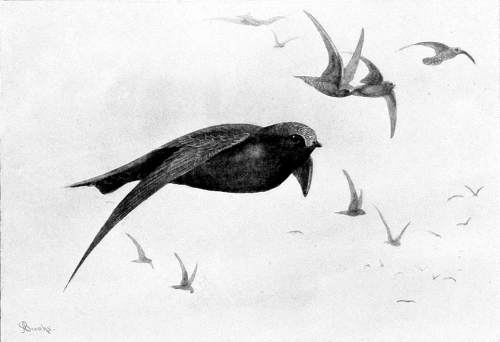
BLACK SWIFTS.
The extraordinary volitatorial powers possessed by the Cloud Swifts permit a breadth of daily range unmatched in the case of any other species. We suppose that the flocks which appear here and there at sea-level thruout the summer nest only in the Cascade Mountains; and it is easy to see that a hundred mile dash before breakfast would hardly figure in the day’s work. On this account, we may fairly presume that the Cloud Swifts are really less numerous than might be supposed from the analogy of other birds. Perhaps half a dozen roving bands would comprise the entire population of the State. A company nesting on Glacier Peak might elect to spend one day hawking over Gray’s Harbor, and the next in the Palouse country. Some such diurnal shifting does exist, for at Chelan I have seen the Swifts in June passing down the valley at early morning, and returning in the [413] evening for several successive days, after which they would absent themselves for a month. Again, at early morning, we have seen them filing thru Cascade Pass from west to east, hot-wing, as tho they had business in Idaho.
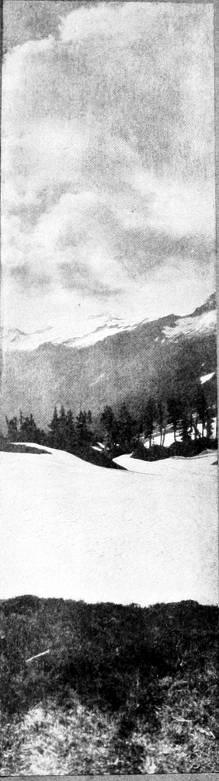
Taken in Chelan County. Photo by the Author. CASCADE PASS. WHERE BLACK SWIFTS HAVE BEEN SEEN.
These Black Swifts nest chiefly in the mountains upon the face of inaccessible cliffs. This much we know, but the nest and eggs are still unknown[67]. The closest call which these elusive fowls have had at nesting time is thus reported by Major Bendire[68]: “The only locality where I have observed this species was on the upper Columbia River, opposite Lake Chelan, Washington, in July, 1879. Here quite a colony nested in a high perpendicular cliff on the south side of and about a mile back from the river, and numbers of them flew to and from the valley below, where they were feeding. The day was a cloudy one, and the slow drizzling rain was falling nearly the entire time I was there; this caused the birds to fly low and they were easily identified. They evidently had young, and the twitterings of the latter could readily be heard as soon as a bird entered one of the numerous crevices in the cliff above. This was utterly [414] inaccessible, being fully 300 feet high and almost perpendicular; and without suitable ropes to lower one from above it was both useless and impracticable to make an attempt to reach the nests. These were evidently placed well back in the fissures, as nothing bearing a resemblance to one was visible from either above or below. In this locality I believe fresh eggs may be looked for about June 25.”
I had word of the nesting of these birds in the summer of 1906 upon a majestic rock wall overlooking the Sahale Glacier in the Upper Horseshoe Basin of Chelan County, but a visit paid to this scene the following season failed to discover either nests or birds, altho local miners were ready to confirm the report of their presence the previous season. Dr. Edward Hasell, of Victoria, informs me that they have nested about a certain cliff overlooking Cowichan Lake on Vancouver Island. The cliff referred to is about 1,600 feet high, and access was, therefore, out of the question. Mr. W. H. Wright, the well-known nature student and guide, of Spokane, tells me that he once saw these birds nesting among some cliffs called “The Chimneys,” which are five or six miles distant from Priest, Idaho. He saw the Swifts carrying twigs to the cliffs, but did not take further notice of their actions. He visited The Chimneys at the same time of year on each of two succeeding seasons, but saw nothing of the Swifts. From these reports, and from the fact that the country referred to by Bendire has been ransacked in vain, I conclude that the Black Swifts are continually shifting the scene of their annual nestings, being, in fact, as erratic in this regard as they are in the matter of their local appearances at the lower levels.
No. 160. VAUX’S SWIFT.
A. O. U. No. 424. Chætura vauxi (Townsend).
Description.—Adults: Above, sooty brown, lightening, nearly hair-brown, on rump and upper tail-coverts; below, light sooty gray, lightening, nearly white, on chin and throat; lores velvety black; shafts of tail-feathers denuded at tips a third of an inch. Length about 4.50 (114.3); wing 4.50 (114.3); tail 1.59 (40).
Recognition Marks.—Strictly “pygmy size,” but comparison misleading—to appearance, swallow size; rapid erratic flight and bow-and-arrow-shaped position in flight distinctive. Altho this species is only half the size of the preceding, careful discrimination is necessary while the birds are a-wing.
[415]
Nesting.—Nest: a shallow half-saucer of short twigs, glued together with the bird’s saliva and similarly cemented to the wood inside of a hollow tree. Eggs: 4-6, pure white. Av. size, .77 × .50 (19.6 × 12.7). Season: June; one brood.
General Range.—Pacific Coast States and British Columbia, breeding thruout its range; south in winter to Central America.
Range in Washington.—Not common summer resident in timbered sections and in mountain valleys; locally distributed.
Migrations.—Spring: Blaine, May 8, 1905. Fall: Seattle, September 20, 1907.
Authorities.—Cypselus vauxi Townsend, “Narrative,” 1839, 348. T. C&S. Rh. D¹. Ra. D². B. E.
Specimens.—Prov. C. E.
“The way of any bird in the air commands interest, but the way of the Swift provokes both admiration and astonishment. With volitatorial powers which are unequaled by any other land bird, this avian missile goes hurtling across the sky without injury, or else minces along slowly with pretended difficulty. Now it waddles to and fro in strange zigzags, picking up a gnat at every angle, and again it “lights out” with sudden access of energy and alternate wing strokes, intent on hawking in heaven’s upper story. At favorite seasons the birds cross and recross each other’s paths in lawless mazes and fill the air with their strident creakings, while here and there couples and even trios sail about in great stiff curves with wings held aloft. It is the only opportunity afforded for personal attentions, and it is probable that the sexes have no further acquaintance except as they pass and repass in ministering to the young.
“In nesting the Chimney ’Sweeps’ seek out the smaller chimneys of dwelling houses, and usually only one pair occupies a single shaft. Short twigs are seized and snapped off by the bird’s beak in midflight, and these, after being rolled about in the copious saliva, are made fast to the bricks, a neat and homogeneous bracket being thus formed. This will be sufficient to support the half dozen crystal white eggs and the hissing squabs which follow, unless a premature fire or a long-continued rain dissolves the glue and tumbles the fabric into the grate.
“Sitting birds, when discovered, oftenest drop below the nest and hide, clinging easily with the tiny feet supported by the spiny tail. The male bird seldom pays any attention unless there are young, in which case he even brushes past the intruder and enters the nest in his eagerness to share the hour of danger. The young are rather slow in development and it requires, according to Mr. Otto Widmann, two months to rear a family of them. Usually only one brood is raised, but a second nesting [416] is undertaken even as late as August if the first has proven unsuccessful” (Birds of Ohio).
Save in the matter of nesting, the Vaux Swift does not differ essentially in habit or appearance from the well-known Chimney Swift, referred to in the preceding paragraphs. It is, however, very much less common and is only of local distribution, chiefly in the lower mountain valleys. Local attachments are doubtless largely determined by the presence of large cottonwood timber, but the birds descend to the lowlands, especially after the close of the nesting season, in small roving parties, somewhat after the fashion of the Cloud Swifts, with which indeed they frequently associate. They have thus been regularly reported by West-side observers at Tacoma, Seattle, and Bellingham, and I have seen them at Blaine, and in the valleys of the Nooksack (at Glacier), Skagit, Nisqually (in Rainier National Park), and Quillayute Rivers. The only East-side records appear to be those from the north fork of the Ahtanum, in Yakima County, and the valley of the Stehekin, in Chelan County.
Vaux’s Swift with us nests only in the hollow recesses of tall dead cottonwood trees, where they glue a shallow bracket of broken twigs, cemented with hardened saliva, to the curving inner wall. In California, however, they are said to be adopting the ways of civilization, and are beginning to nest in chimneys, after the fashion of C. pelagica.
No. 161. WHITE-THROATED SWIFT.
A. O. U. No. 425. Aeronautes melanoleucus (Baird).
Synonyms.—Rock Swift. Mountain Swift. Rocky Mountain Swift. White-throated Rock Swift.
Description.—Adults: Plumage black (variable, sooty brown to glossy black); forehead and line over eye paler; lore velvety black; chin, throat, breast, and belly, centrally, white—also outer edge of outer primary, tips of secondaries, lateral tail-feathers, and a conspicuous patch on flank, sometimes nearly meeting fellow across rump; bill black. Length 7.00 (177.8) or under; wing 6.50-7.00 (165.1-177.8); tail 2.65 (67.3).
Recognition Marks.—Sparrow size but larger to appearance; exceedingly rapid flight with flashing white underparts and flank patches distinctive.
Nesting.—“The nest is securely placed far in holes or crevices of rocks or indurated earths, usually at a great height; it is a saucer-like structure, about 5 × 2 inches, with a shallow cavity, made of various vegetable materials well glued together with saliva, and lined with feathers. Eggs several, in one instance [417] 5, narrowly subelliptical, 0.87 × 0.52, white” (Coues). Season: May and June.
General Range.—Western United States from the Rocky Mountains to the Pacific, north to Montana, Idaho, and southern British Columbia (Okanagan Valley); south in winter to Guatemala.
Range in Washington.—Known only from the valley of the Columbia near Chelan, the Grand Coulee (near Cold Spring Lake), and the Cascade Pass.
Authorities.—Dawson, Auk, XIV., 1897, p. 175.
Specimens.—C.
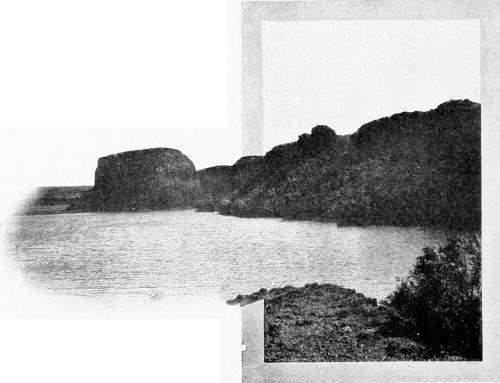
Photo by the Author. Taken in Douglas County. COLD SPRING LAKE. WHITE-THROATED SWIFTS NEST ON THE PRECIPITOUS WALLS OF THE BUTTE.
Swift, swifter, swiftest, will best express the relations of our Washington Cypseli, where the positive degree is represented by the Vaux Swift, the comparative by the Black Cloud Swift, and the superlative by the White-throat. No one who is troubled with acrophobia, the fear of high places, should attempt to spy upon the nesting haunts of these Swifts from above; for when to the ordinary terrors of a sheer cliff, say a thousand feet in height, is added the hurtling passage of resentful Swifts flashing about like hurled scimetars, the situation will try the strongest nerve. Viewed from below, in the open air, the evolutions of these birds may be regarded with some degree of equanimity; but when a Swift dips toward the ground, or measures its speed across the face of some frowning precipice, one sees what a really frightful velocity is attained. There is no exact way of measuring this, but an estimate of five miles per minute would be well within the mark, and six not unreasonable. The bird, that is, would require only [418] an hour to flit from Spokane to Aberdeen; or, it might breakfast at Osooyoos on the Forty-ninth Parallel, lunch in Chihuahua, and dine, a trifle late, in Panama.
This Rock Swift nests only in crevices and caves of the most inaccessible cliffs. Most of its hunting, however, is done in the upper air, where its lighter colors soon render it indistinguishable. It appears also to be less sociable than the other species upon the hunt, so that almost the only opportunities for careful study of it are afforded near the cliffs. Here there is much amorous pursuit, and the frequent sound of thrilling notes. The characteristic notes constitute a sort of war-cry, rather than song, and consist of a liquid descending scale of musical chuckling, or rubbing tones. The noise produced is much as if two pebbles were being fiercely rubbed together in a rapidly-filling jar of water.
The birds exhibit a preternatural cunning in the selection of nesting sites. Not only do they choose sheer walls, but those which, because of the fissures so afforded, are crumbling and dangerous to a degree. The butte shown in the illustration consists of a hard lava capping over a disintegrating bed of tufa, impossible of ascent and impracticable of descent. Here in some remotest crevice the birds affix a narrow shelf, of straws, bits of weed-stalks, and miscellaneous trash, agglutinated with saliva; and in this four or five narrowly elliptical white eggs are deposited late in June or early in July.
These interesting birds are newcomers within our borders, and their comings and goings are as yet little known. Bendire in 1895 remarked[69] their utter absence from Oregon and Washington. In 1896 I saw a single bird in the gorge of the Columbia near Chelan, and upon revisiting this scene in May, 1906, found that quite a colony of them were haunting a granite wall some 800 feet in height. Late in the same season, and in each succeeding year I have found them in the vicinity of Cold Spring Butte in Douglas County; and have every reason to suppose that other such colonies exist in the Grand Couleé. In the summer of 1906 Mr. Bowles and myself observed them crossing the Cascade Pass in company with Black Swifts; while still more recently, Mr. Charles De Blois Green announces[70] that they have extended their range up the valley of the Okanogan into British Columbia.
[419]
Picidæ—The Woodpeckers
No. 162. ROCKY MOUNTAIN HAIRY WOODPECKER.
A. O. U. No. 393 e. Dryobates villosus monticola Anthony.
Description.—Adult male: Above, in general, black,—glossy, at least on crown and cervix, dull on tail, fuscous on wings; a narrow scarlet band across the nape; broad white superciliary and rictal stripes separated by a black band thru eye (including lore), continuous with nape; a black malar stripe broadening behind; white nasal tufts; a lengthened white patch down middle of back; wing-coverts black, or sometimes lightly spotted with white; primaries and outer secondaries spotted with white on both webs (often very lightly on inner webs), the spots on the outer webs confluent in bars on the closed wing; tail black centrally, the two outer pairs of feathers white on exposed portions, the third pair white-tipped; entire underparts clear white; bill and feet light plumbeous. Adult female: Similar but without scarlet band on hindneck. Young birds have the crown chiefly red or bronzy or, rarely, yellowish. Length of adult: 10.00-11.00 (254-279.4); wing 5.20 (132); tail 4.20 (106.7); bill 1.50 (38).
Recognition Marks.—Robin size; black-and-white pattern of head (11 alternating areas of black and white, viewed anteriorly), with size, distinctive; lores black and underparts clear white, as compared with D. v. hyloscopus.
Nesting.—Nest: A hole excavated in tree, usually in dead portion, unlined. Eggs: 4-6, white. Av. size, 1.08 × .77 (27.4 × 19.6). Season: May 15-June 1; one brood.
General Range.—Rocky Mountain district of the United States from New Mexico north to Montana, west to Utah and eastern Washington.
Range in Washington.—Mountain districts of eastern Washington, intergrading with D. v. harrisii along eastern slopes of Cascades, especially northerly.
Authorities.—Not previously published. Based here on specimen taken May 23rd, 1906, at Usk, Wash. (Ident. by Biol. Surv., Washington, D. C.) J. (Open to question thru confessed lack of specimens).
Specimens.—B.
This form finally displaces Harris (D. v. harrisii, with which it intergrades on the eastern slopes of the Cascades) only in the northeastern corner of the State and in the Blue Mountains. It differs in no essential respect from the western variety in habit; but because of the more open character of the timber, is rather more in evidence thruout its range.
On the 22nd of May, 1906, a male of this species was sighted at Usk, on the banks of the Pend d’Oreille River, as he clung to the top of a forty-foot pine stub and delivered, rather gently, his rolling tattoo, or call-note. After repeating this several times he dropped down and entered a hole a few feet lower. We returned the following morning and found the male bird (distinguishable by his red nuchal patch) again on the nest. When I rapped gently [420] on the stub he emerged; and proceeding to his drumming ground above, he rolled repeatedly. By and by the female answered in the distance with the plimp or plick note. Soon she arrived upon the nesting stub, whereupon Mr. Hairy took himself off promptly, and Mrs. Hairy entered the nest and settled to her eggs. Or so you would have supposed, wouldn’t you? By the aid of sixteen spikes, “60’s,” and a rope, I climbed to the nest, thirty-five feet up. With a small hand-axe I enlarged the entrance (sacrificing incidentally a thumbnail, and giving sad evidence of the sway of “mortal mind”) to find only one fresh egg, fourteen inches down.
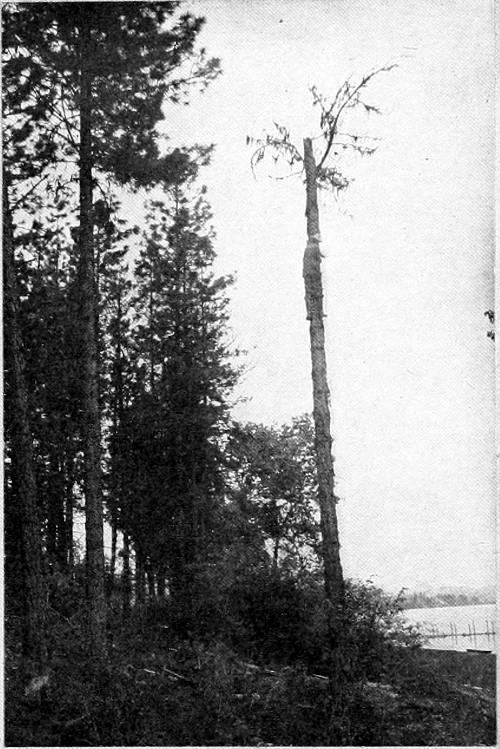
Taken in Stevens County. Photo by J. H. Bowles. NESTING SITE OF ROCKY MOUNTAIN HAIRY WOODPECKER.
Of course it was disappointing, but the egg was a pearl, so transparent that one could see the very outlines of the imprisoned yolk.
No. 163. CABANIS’S WOODPECKER.
A. O. U. No. 393 d. Dryobates villosus hyloscopus (Cab.).
Synonym.—Rocky Mountain Hairy Woodpecker (name now restricted to preceding form).
Description.—Similar to D. v. monticola but averaging smaller; lores chiefly or entirely white; underparts more or less soiled whitish; some few white spots [421] appearing on wing-coverts and upon inner secondaries (thus shading into eastern forms of the D. villosus group).
Recognition Marks.—As in preceding.
Nesting.—As in D. v. monticola.
General Range.—Imperfectly made out as regards that of D. v. monticola—“Western United States from the Rocky Mountains to the Pacific, excepting the special range of D. v. harrisii, and southward into Mexico” (Coues).
Range in Washington.—Undetermined; perhaps resident in eastern Washington between ranges of monticola and harrisii, perhaps only casual west of Cascades.
Authorities.—Bendire, Life Hist. N. A. Birds, Vol. II. 1895, p. 53. Puyallup, Wash., Dec. 25, 1895, by Geo. G. Cantwell (Ident. by Biol. Surv. Washington, D. C.).