Volume 1 — The Birds of Washington (continued 2)
Reading edition
General Range.—Western North America from the plains to the Pacific, and from the Saskatchewan region south to the highlands of Mexico to Oaxaca.
[46]
Range in Washington.—Of general distribution thruout the State but found chiefly in more open situations in vicinity of streams and ponds and in cultivated sections. Normally migratory but increasingly resident especially on West-side.
Authorities.—[Lewis and Clark, Hist. Ex. (1814) Ed. Biddle: Coues, Vol. II. p. 185.] Scolecophagus mexicanus, Newberry, Rep. Pac. R. R. Surv. VI. pt. IV. 1857, p. 86. (T) C&S. L¹. Rh. D¹. Ra. D². Ss¹. Ss². Kk. J. B. E.
Specimens.—U. of W. Prov. B. E. P.
“Blackbirds” are not usually highly esteemed in the East, where the memory of devastated cornfields keeps the wrath of the farmer warm; but if all species were as inoffensive as this confiding pensioner of the West, prejudice would soon vanish. He is a handsome fellow, our Washington grackle, sleek, vivacious, interesting, and serviceable withal. We know him best, perhaps, as an industrious gleaner of pastures, corrals, streets, and “made” lands. He is not only the farmer’s “hired man,” waging increasing warfare against insect life, especially in its noxious larval forms, but he has an accepted place in the economy of city and village as well.
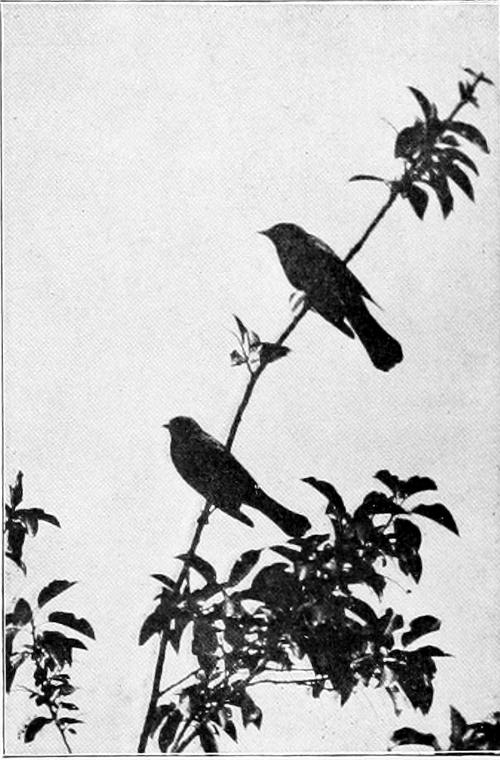
Taken in Douglas County. Photo by the Author. BREWER’S BLACKBIRDS.
As one approaches a feeding flock, he notes the eagerness with which the birds run forward, or rise and flit past their fellows, now diving at a nimble weevil, now leaping to catch a passing bug, but always pushing on until one perceives a curious rolling effect in the total movement.
As we draw near, some timid individual takes alarm, and instantly all are up, to alight again upon the fence or shrubbery where they clack and whistle, not so much by way of apprehension as thru sheer exuberance of nervous force. As we pass (we must not stop short, for they resent express attention) we note the droll white eyes of the males, as they twist and perk and chirp in friendly impudence; and the snuffy brown heads of the females with their soft hazel irides, as they give a motherly fluff of the feathers, or yawn with impatience over the interrupted meal. When we are fairly by, the most venturesome dives from his perch, and the rest follow by twos and tens, till the ground is again covered by a shifting, chattering band.
[47]
Like all Blackbirds, the Brewers are gregarious; but they are somewhat more independent than most, flocks of one or two score being more frequent than those of a hundred. During migrations and in autumnal flocking they associate more or less with Redwings; but, altho they are devoted to the vicinity of water, they care nothing for the fastnesses of reed and rush, which are the delight of Redwing and Yellowhead. Their preference is for more open situations, so that they are most abundant upon the East-side. Here a typical breeding haunt is a strip of willows fringing a swamp; or, better still, a line of dark green thorn-bushes clinging to the bank of the rolling Columbia.
Altho isolated nests may now and then be found, colonies are the rule; and I have found as high as forty nests in a single patch of greenery. There is room, of course, for individual choice of nesting sites, but the community choice is the more striking. Thus, one recalls the greasewood nesting, the rose-briar nesting, the thorn-bush nesting, where all the members of the colony conformed to the locally established rule in nest position. Mr. Bowles records the most remarkable instance of this: One season the nests of the South Tacoma colony were all placed in small bushes, the highest not over four feet from the ground; but in the season following the birds were all found nesting in cavities near the top of some giant fir stubs, none of them less than 150 feet from the ground. On the other hand, in the Usk nesting of 1906, on the placid banks of the Pend d’Oreille, one pair had recessed its nest in a stump at a height of eighteen feet, while three other pairs had sunk theirs into the ground at the base of bushes.
In construction the nest of the Brewer Blackbird varies considerably, but at its best it is quite a handsome affair. Composed externally of twigs, weed-stalks, and grasses, its characteristic feature is an interior mould, or matrix, of dried cow-dung or mud, which gives form and stability to the whole. The lining almost invariably includes fine brown rootlets, but horsehair is also welcomed wherever available.
The eggs of Brewer’s Blackbird are the admiration of oölogists. Ranging in color from clear greenish gray with scattered markings thru denser patterns to nearly uniform umber and chocolate, they are the natural favorites of “series” hunters. The range of variation is, indeed, curious, but it proves to be entirely individual and casual without trace of local or constant differences. Eggs from the same nest are usually uniform in coloration, but even here there is notable diversity. In some instances, after three or four eggs are laid, the pigment gives out, and the remainder of the set is lighter colored. Again, single eggs are heavily pigmented half way, and finished with a clear green ground-color.
[48]
Fresh eggs may be taken in the Yakima country during the last week in April, and in one case noted, deposition began on April 14th; but May 1st-15th is the usual rule there and elsewhere. Five eggs is the common set, but six to a clutch is not rare. Of twenty-eight nests examined in Yakima County, May 4, 1906, eleven contained six eggs each; while, of something over two hundred seen altogether, two nests contained seven each.
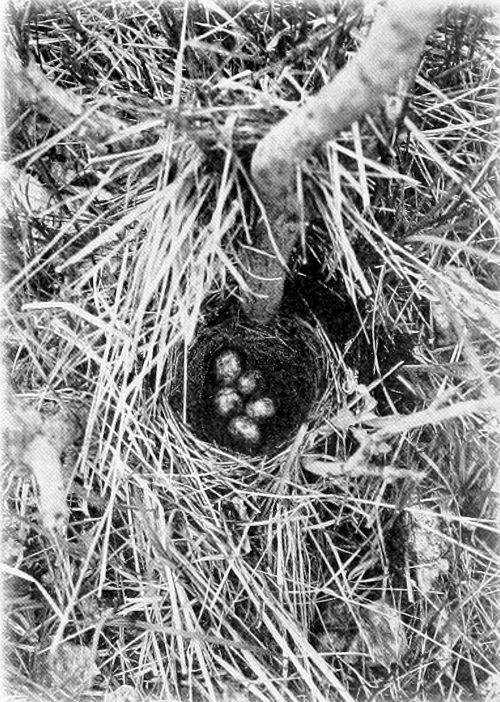
Taken in Stevens County. Photo by the Author. GROUND NEST OF BREWER BLACKBIRD.
It is in his notes that the Brewer Blackbird betrays his affinities best of all. The melodiously squeaking chatter of mating time is, of course, most like that of the Rusty Blackbird (S. carolinus), but it lacks the bubbling character. He has then the swelling note of the Grackles proper, fff-weet, the latter part rendered with something of a trill, the former merely as an aspirate; and the whole accompanied by expansion of body, slight lifting of wings, and partial spreading of tail. This note is uttered not only during the courting season, but on the occasion of excitement of any kind. Kooreé has a fine metallic quality which promptly links it to the Keyring note of the Redwing. Chup is the ordinary note of distrust and alarm, or of stern inquiry, as when the bird-man is caught fingering the forbidden ovals. A harsh low rattle, or rolling note, is also used when the birds are squabbling among themselves, or fighting for position.
Unquestionably this species has gradually extended its range within the borders of the State, for the earlier investigators did not regard it as resident on Puget Sound. It has profited greatly and deservedly by the spread of settlement everywhere, and this is especially true of the more open situations. Not a little it owes, also, to the introduction of cattle; for it is as great a rustler about corrals and stamping grounds as its renegade cousin, the Cowbird.
[49]
No. 17. BULLOCK’S ORIOLE.
A. O. U. No. 508. Icterus bullockii (Swainson).
Description.—Adult male: Black, white, and orange; bill, lore, a line thru eye, and throat (narrowly) jet black; pileum, back, scapulars, lesser wing-coverts, primary coverts, and tertials chiefly black, or with a little yellowish skirting; remiges black edged with white; middle and greater coverts continuous with edging of tertials and secondaries, white, forming a large patch; tail chiefly yellow but central pair of rectrices black terminally, and remaining pairs tipped with blackish; remaining plumage, including supraloral areas continuous with superciliaries, orange yellow, most intense on sides of throat and chest, shading thru cadmium on breast to chrome on rump, tail-coverts, etc. In young adults the orange is less intense and, encroaches upon the black of forehead, hind-neck, etc., altho the tail is more extensively black. Adult female: Above drab-gray, clearest on rump and upper tail-coverts; wings fuscous with whitish edging; pattern of white in coverts of male retained but much reduced in area; tail nearly uniform dusky chrome; underparts in general sordid white; chin and lores white; forehead, superciliary, (indistinct), cheeks, hind-neck and chest more or less tinged with chrome yellow. Young males resemble the female but soon gain in intensity of yellow on the foreparts, gradually acquiring adult black along median line of throat and in streaks on pileum. Length of adult male about 8.25 (209.5); wing 3.89 (99); tail 3.07 (78); bill .73 (18.5); tarsus .98 (25). Female a little smaller.
Recognition Marks.—Chewink size; black, white, and orange of male distinctive; slender blackish bill of female strongly contrasting with the heavy light-colored bill of female Western Tanager with which alone it is likely to be confused by the novice. General coloration of female ashy or drab rather than olivaceous, yellow of tail contrasting with whitish or light drab of tail-coverts.
Nesting.—Nest: a pouch of cunningly interwoven grasses, vegetable fibers, string, etc., 5 to 9 inches deep and lashed by brim to branches of deciduous tree. Eggs: usually 5, smoky white as to ground color, sometimes tinged with pale blue, more rarely with faint claret, spotted, streaked and elaborately scrawled with purplish black or dark sepia, chiefly about larger end. Elongate ovate; av. size .94 × .63 (23.9 × 16). Season: May 20-June 15; one brood.
General Range.—Western United States, southern British Provinces and plateau of Mexico; breeding north to southern British Columbia, Alberta and southern Assiniboia east to eastern border of Great Plains in South Dakota, Nebraska, etc., south to northern Mexico; in winter south to central Mexico.
Range in Washington.—Regular summer resident in eastern Washington thruout settled sections and along water courses; rare or casual west of Cascades.
Migrations.—Spring: Yakima County, May 2, 1900; Moses Lake, May 15, 1906; Chelan, May 21, 1896.
[50]
Authorities.—Icterus bullockii Bon., Baird, Rep. Pac. R. R. Surv. IX. pt. II. 1858, p. 550. T. C&S. D¹. D². Ss¹. Ss². J. B.
Specimens.—(U. of W.) Prov. C. P¹.
Bird of sunshine and good cheer, springtime’s ripest offering and emblem of summer achieved, is this happy-hearted creature who flits about the orchards and timber cultures of eastern Washington. The willows of the brook, the cottonwoods and the quaking asps, were his necessary home until the hand of the pioneer made ready the locust, the maple and the Lombardy poplars, which are now his favorite abiding places. And so, for many years, the droning of bees, the heavy-scented breath of the acacia, and the high, clear whistling of the Oriole have been associated memories.
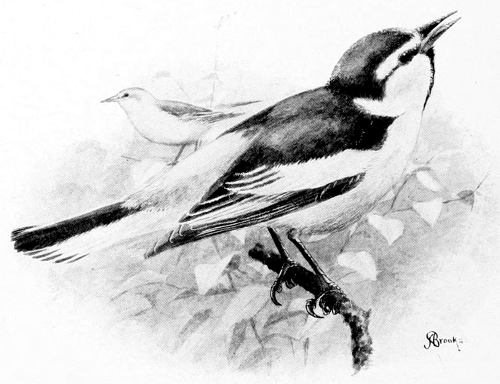
BULLOCK’S ORIOLE.
A little less dandified than his eastern cousin, the lordly Bird of Baltimore, the Bullock Oriole fulfills much the same economy in habit, song, and nesting as that well-known bird. He is, if anything, a little less musical, also, and not so conspicuous.
The males arrive a week or two in advance of their mates, and appear quite ill at ease until joined by their shy companions. Marriage compacts have to [51] be settled at the beginning of the season, but rivalry is chiefly between the under-colored young blades who must make their peace with the sweet girl graduates of the previous year. Orioles are very closely attached to a suitable locality, once chosen, and a group of nests in a single tree presenting successive annual stages of preservation, is fairly eloquent of conjugal fidelity.
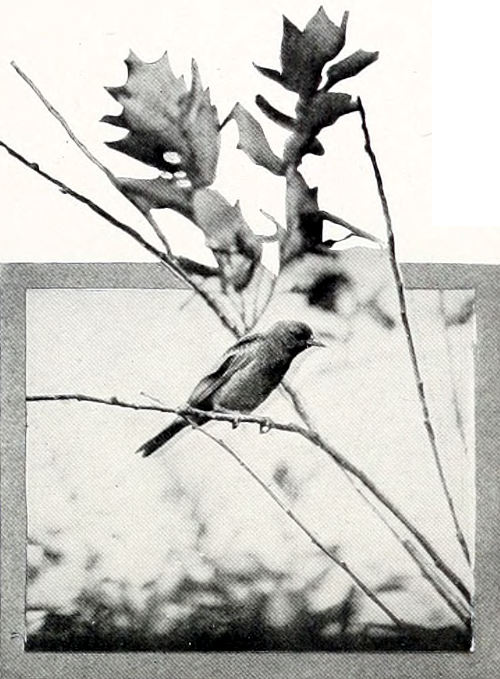
Taken near Spokane. Photo by F. S. Merrill. FEMALE BULLOCK ORIOLE.
The purse-shaped nest of the Bullock Oriole is a marvel of industry and skill, fully equal in these respects to that of the Baltimore Bird. A specimen before me, from a small willow on Crab Creek, in Lincoln County, taken just after its completion, is composed entirely of vegetable fibers, the frayed inner bark of dead willows being chiefly in evidence, while plant-downs of willow, poplar, and clematis are felted into the interstices of the lower portion. This pouch is lashed at the brim by a hundred tiny cables to the sustaining twigs, and hangs to a depth of six inches, with a mean diameter of nearly three, yet so delicate are the materials and so fine the workmanship, that the whole structure weighs less than half an ounce.
A more bulky, loose-meshed affair, taken at Brook Lake No. 4, in Douglas County, has a maximum depth of nine inches outside, a mean depth of six and a half inches inside, and a greater diameter of five inches.
Near farm houses or in town the birds soon learn the value of string, thread, frayed rope, and other waste materials, and nests are made entirely of these less romantic substances. Occasionally a bird becomes entangled in the coils of a refractory piece of string or horse-hair, and tragedies of Orioles hanged at their own doorstep are of record.
The eggs of this species, four to six in number, are usually of a pale smoky gray color, and upon this ground appear curious and intricate scrawlings of purplish black, as tho made by a fine pen, held unsteadily while the egg was twirled. The purpose of this bizarre ornamentation, if indeed it has any, may be thought to appear where scanty coils of black horse-hair in the lining of the nest show up in high relief against the normal white background [52] of vegetable felt. I can testify that under these circumstances the eggs are sometimes indistinguishable at first glance from their surroundings.
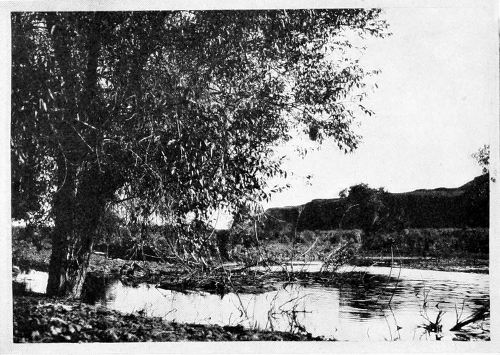
Taken in Douglas County. Photo by the Author. NESTING SITE OF THE BULLOCK ORIOLE.
The value of the pouch-shaped nest is less clear than in the case of the Baltimore Oriole, whose home is the pendant branch of the elm tree; for the nest of the Bullock Oriole is often attached to stocky branches, pines even, which yield little in the wind. Nor is there any such obvious attempt in the case of this bird to escape enemies by placing the eggs out of reach. The Magpie would search Sheol for a maggot, and any effort to best him would bankrupt the longest purse.
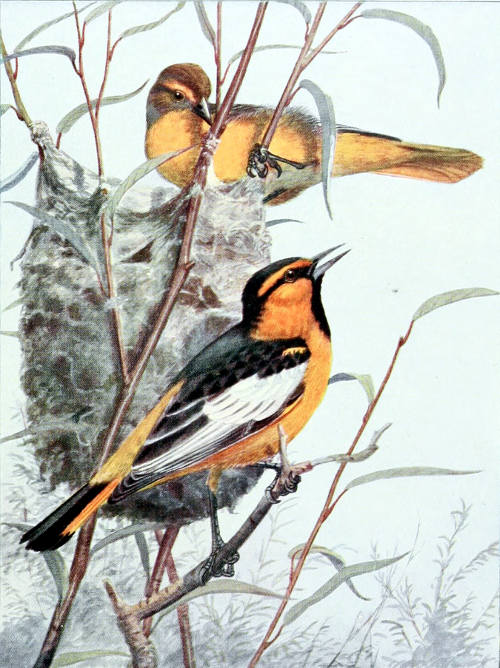
BULLOCK ORIOLES MALE AND FEMALE, ½ LIFE SIZE From a Water-color Painting by Allan Brooks
Tired of the confinement of the nest, the ambitious fledgelings clamber up the sides and perch upon the brim. From this less secure position they are not infrequently dislodged before they are quite ready to face the world. Some years ago a friend of mine, Mr. Chas. W. Robinson, of Chelan, secured a fledgeling Oriole which he rescued from the water of the lake where it had evidently just fallen from an overhanging nest. When taken home it proved a ready pet, and was given the freedom of the place. Some two weeks later my friend rescued a nestling from another brood under precisely similar circumstances, and put it in a cage with the older bird. The newcomer [53] had not yet learned to feed himself, but only opened his mouth and called with childish insistence. Judge of the owner’s delight, and mine as a witness, when the older bird, himself little more than a fledgeling, began to feed the orphan with all the tender solicitude of a parent. It was irresistibly cunning and heartsome too, for the bird to select with thoughtful, brotherly kindness, a morsel of food, and hop over toward the clamoring stranger and drop it into his mouth; after this to stand back as if to say, “There, baby! how did you like that?” This trait was not shown by a chance exhibition alone, but became a regular habit, which was still followed when the older bird had attained to fly-catching. It upset all one’s notions about instinct, and made one think of a golden rule for birds.
No. 18. CALIFORNIAN BICOLORED BLACKBIRD.
A. O. U. No. 499. Agelaius gubernator californicus Nelson.
Description.—Adult male: “Uniform deep black, with a faint bluish green gloss in certain lights; lesser wing-coverts rich poppy red or vermilion; middle coverts black, or (if not entirely black) at least broadly tipped with black, the basal portion tawny buff or ochraceous; bill, legs, and feet black; iris brown” (Ridgway). Adult female in breeding plumage: Dark sooty brown more or less streaked on crown and back; chin and throat whitish or pinkish buff streaked with brown; faint superciliary stripe composed of narrow whitish streaks on sooty ground. Adult female in winter: Feathers more or less edged with rusty. Immature male: Lesser wing-coverts partly black, the remaining red not clear, ochraceous-rufous or orange-tawny. Length of adult male: (skins) 8.62 (219); wing 5.78 (136.9); tail 3.67 (93.2); bill .84 (21.3); tarsus 1.28 (32.5). Adult female 6.93 (176); wing 4.27 (108.5); tail 2.82 (71.6); bill .72 (18.3); tarsus 1.10 (27.9).
Recognition Marks.—Like Redwing Blackbird but epaulets pure red without exposed buff.
Nesting.—Nest and Eggs like those of the Northwestern Red-wing. Said to be less prolific.
General Range.—Central and northern coast districts of California north to Washington; straggles irregularly eastward and southward in California in winter.
Range in Washington.—Recorded breeding at Cape Disappointment and may possibly extend north to Gray’s Harbor.
Authorities.—Agelaius gubernator Bonaparte, Baird, Rep. Pac. R. R. Surv. IX. 1858, p. 530 (Columbia River by J. K. Townsend). Allen, B. N. O. C. VI. p. 128. R. H. Lawrence, Auk IX. 1892, 45. Kobbé.
[54]
We accept this bird as a resident of this State chiefly on the testimony of William H. Kobbé, who listed it[10] as a breeding bird of Cape Disappointment. He found it closely associated with the Northwestern Red-wing (A. phœniceus caurinus) altho the latter frequently pursued it in the attempt to expel it from the small swamp which both were compelled to occupy. This probably represents the northernmost extension of this species, the Gray’s Harbor record of Mr. Lawrence[11] being at least open to question in the matter of identification.
The habits of the Bicolored Blackbird do not differ in any known particular from those of the familiar Red-wing, of which it is a discontinuous offshoot.
No. 19. COLUMBIAN RED-WING.
A. O. U. No. 498. Agelaius phœniceus neutralis Ridgway.
Synonyms.—San Diego Red-wing. Interior Red-wing. Red-winged Blackbird. Red-shouldered Blackbird. Swamp Blackbird.
Description.—Adult male in summer: Glossy black; lesser wing-coverts bright red (poppy-red, vermilion or scarlet); middle coverts buffy or ochraceous-buff—the two forming thus a conspicuous epaulet, or shoulder patch. Bill, legs, and feet horn black; irides brown. Adult male in winter: Middle wing-coverts more deeply buffy; scapulars and feathers of black more or less edged with rusty. In immature males the black of the plumage is more or less extensively margined with rusty-buffy or whitish; the wing-coverts have an admixture of black and the “red” of the lesser coverts is of a sickly hue (orange-tawny, etc.). Adult female in summer: Brownish gray, everywhere mottled and streaked, or striped, with dusky, finely on chin, cheeks, and superciliaries, where also more or less rubescent, heavily below, less distinctly above; lesser coverts brownish-gray or dull red; middle coverts black edged with buffy. Bill dusky lightening below; feet and legs dusky. Adult female in winter: Plumage of upperparts more or less margined with rusty or ochraceous; sides of head and underparts tinged with buffy. Length of adult males (skins): 8.39 (213.1); wing 4.84 (122.9); tail 3.57 (90.7); bill .90 (23.1); tarsus 1.19 (30.2). Adult females (skins): 7.11 (181.9); wing 3.98 (101.3); tail 2.85 (72.4); bill .77 (19.6); tarsus 1.06 (26.9).
Recognition Marks.—Chewink to Robin size; bright red epaulets of male; general streakiness of female. Female lighter-colored and not so heavily streaked as in A. p. caurinus.
Nesting.—Nest: a neatly woven but rather bulky basket of grasses, cat-tail leaves or hemp, usually lashed to upright stalks of cat-tail, occasionally on bushes, [55] as willow and the like; lining of fine grasses of uniform size. Eggs: 4-7, usually 4, light blue to dull grayish blue, scrawled, blotched or clouded with dark purple, purplish brown or black, chiefly about the large end. Av. size 1.04 × .70 (26.4 × 17.8). Season: last week in April, June; two broods.
General Range.—Western United States in the interior north to eastern British Columbia, restricted by Rocky Mountains and Cascades in northern portion of range but reaching coast in San Diego and Los Angeles Counties in California and breeding as far east as western Texas, southward to northern Chihuahua and northern Lower California; displaced in Lower Colorado Valley and southern Arizona by A. p. sonoriensis; south in winter to southern Texas, etc.
Range in Washington.—Found in all suitable localities east of the Cascades.
Migrations.—Irregularly resident but numbers always greatly augmented about March 1st.
Authorities.—Agelaius phœniceus Vieil., Cooper and Suckley, Rep. Pac. R. R. Surv. XII. pt. II. 1860, 207. Allen, Bull. Nutt. Orn. Club, VI. 1881, 128. D¹. D². Ss¹. Ss². J.
Specimens.—U. of W. C. P.
A meadowlark may pipe from a sunny pasture slope in early February, and a Merrill Song Sparrow may rehearse his cheerful message in midwinter, but it takes the chorus of returning Blackbirds to bring boisterous tidings of awakening spring. What a world of jubilation there is in their voluble whistlings and chirpings and gurglings, a wild medley of March which strikes terror to the faltering heart of winter. A sudden hush falls upon the company as the bird-man draws near the tree in which they are swarming; but a dusky maiden pouts, “Who cares?” and they all fall to again, hammer and tongs, timbrel, pipes, and hautboy. Brewer’s Blackbirds and Cowbirds occasionally make common cause with Red-wings in the northern migrations, but it is always the last-named who preponderate, and it is they who are most vivacious, most resplendent, and most nearly musical. The Red-wing’s mellow kongqueree or occasional tipsy whoop-er-way-up is the life of the party.
Almost before we know it our friends, to the number of a dozen pairs or more, have taken up their residence in a cat-tail swamp—nowhere else, if you please, unless driven to it—and here, about the third week in April, a dozen baskets of matchless weave are swung, or lodged midway of the growing plants. Your distant approach is commented upon from the tops of bordering willows by keyrings and other notes. At close range the lordly male, he of the brilliant epaulets and the proper military swagger, shakes out his fine clothes and says, Kongqueree, in a voice wherein anxiety is quite outweighed by vanity and proffered good-fellowship withal. But if you push roughly thru the outlying sedges, anxiety obtains the mastery. There is a hubbub in the marsh. Bustling, frowsy females appear and scold you roundly. The lazy gallants are all fathers now, and they join direful threats [56] to courteous expostulations, as they flutter wildly around the intruder’s head. To the mischievous boy the chance of calling out these frantic attentions is very alluring, even when no harm is intended.
I have said that the Red-wing prefers cat-tails for nesting; there is probably no undisturbed area of cat-tails in eastern Washington which does not harbor Columbian Red-wings; yet, even so, the cover does not suffice and they are impelled to occupy the extensive tulé beds which border the larger lakes. For the second nesting, which occurs in June, the Blackbirds are likely to try the willows, now covered with foliage; or, in default of these, may venture into any coarse vegetation which lines the swamp.
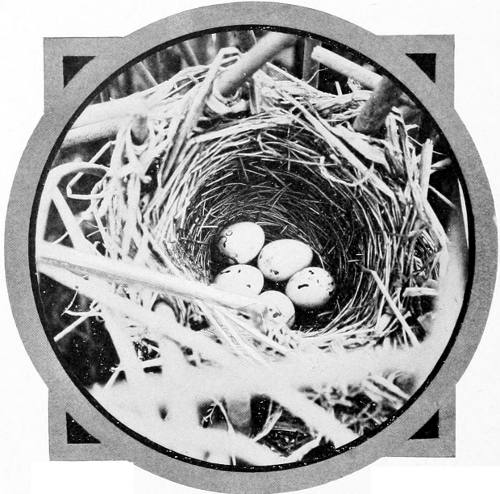
Taken near Spokane. Photo by F. S. Merrill. NEST AND EGGS OF THE COLUMBIAN REDWING.
Four or five eggs are commonly laid and sets of six are very rare. On the 18th of May, 1896, I took a set of eight eggs, all believed to be the product of one female, from a nest in Okanogan County, and this set is now in the Oberlin College Museum.
Of the economic value of the Red-wing there can be no question. The bird is chiefly insectivorous and destroys an immense amount of insect life, [57] particularly in the larval state, injurious to vegetation. Its single fault is a weakness for young corn, but as corn is not a staple crop in Washington, this fault may be readily condoned in view of the bird’s valuable services to stockman and orchardist.
No. 20. NORTHWESTERN RED-WING.
A. O. U. No. 498f. Agelaius phœniceus caurinus Ridgway.
Synonyms.—Red-winged Blackbird. Red-shouldered Blackbird. Marsh Blackbird. Swamp Blackbird.
Description.—Similar to A. p. neutralis but female much darker, heavily streaked with black below; in winter feather skirtings of female more extensively rusty. Measurements not essentially different.
Recognition Marks.—As in preceding. Female darker and more heavily streaked than in A. p. neutralis.
Nesting.—Nest: as in preceding; dimensions 5 in. wide by 6 in. deep outside, 3 × 3 inside. Eggs: 3 or 4, rarely 5, colored as before; dimensions varying from 1.05 × .76 (26.6 × 19.3) to 1.00 × .66 (25.4 × 16.7). Season: second to last week in April, June (Tacoma, April 6, 1906, 3 eggs); two broods.
General Range.—Northwest coast district from northern California north to British Columbia on Vancouver Island and mainland.
Range in Washington.—Common in suitable localities west of the Cascades. Irregularly resident.
Authorities.—Agelaius phœniceus Vieil, Baird, Rep. Pac. R. R. Surv. IX. 1858, 528. T. C&S. Rh. Kb. Ra. Kk. B. E.
Specimens.—(U. of W.) Prov. B. E.
The bird-man was sitting Turk-fashion on a great mossy log which ran far out into the rustling depths of the South Tacoma swamp. The April sun flooded the scene with warm light and made one blink like a blissful drowsy frog, while the marsh sent up a grateful incense of curling vapor. A pocket lunch of bread and cheese was the ostensible occasion of this noontide bliss, but victuals had small charms beside those of the sputtering Tulé Wrens who played hide and seek among the stems, or the dun Coots, who sowed their pulque pulque pulque notes along the reedy depths.
Upon this scene of marshy content burst a vision of Phœnician splendor, Caurinus I., the military satrap of South Tacoma, the authentic tyee of Blackbirds. He was a well-aged bird, and as is the proper way with feathered folk, resplendent in proportion to his years. His epaulets seemed a half larger again than others, and their scarlet was of the brightest [58] hue, contrasting with a black mantle which fairly shone. He appeared an amiable old fellow, and as he lighted ponderously on an uplifted branch of my tree, he remarked, “Whoo-kuswee-ung,” so hospitably that I felt impelled to murmur, “Thanks,” and assured him of my unhostile intent. “Conqueree?” he questioned, richly. “Er—well, yes, if you are the conqueror.”
But the general had other interests to watch. An upstart male of the second year with shoulder-straps of a sickly orange hue, was descried a rod away climbing hand-over-hand up a cat-tail stem. Keyring, keyring, the despot warned him; and because the presumptuous youth did not heed him quickly enough, he launched his splendor over the spot, whereat the youth sank in dire confusion. And next, our hero caught sight of a female fair to look upon peeping at him furtively from behind her lattice of reeds. To see was to act, he flung his heart at the maiden upon the instant, and followed headlong after, thru I know not what reedy mazes. Oh, heart ever young, and pursuit never wearying!
Northwestern Red-wings find rather restricted range thruout western Washington, but they appear wherever there are fresh-water marshes or reed-bordered lakes. In default of cat-tails they will accept the shelter of dwarf willows, or coarse dense grass of any sort.
Nesting is undertaken at Tacoma at least by the third week in April, and we have found eggs as early as the sixth of that month. The nest of the accompanying illustration (photogravure) is composed solely of the coiled stems of the dried bulrushes, amongst which it is placed, with a lining of clean dried grass-stems.
Few eggs exceed in beauty those of the Red-winged Black-bird. The background is a pale bluish green of great delicacy, and upon this occur sharply-defined spots, blotches, marblings, traceries, and “pen-work” of dark sepia, purplish black, drab, and heliotrope purple. Or a spot of color appears to be deeply imbedded in the fine, strong texture of the shell, and carries about it an aura of diminishing color. Occasionally, the whole egg is suffused with pale brownish, or, more rarely, it is entirely unmarked.
Incubation lasts fourteen days and the young are ready to leave the nest in a little over two weeks more. They are frizzly, helpless, complaining little creatures, but if they cannot fly well they can clamber, and they cling with the grip of terrified monkeys.
Our Northwestern Red-wings are normally migratory, but they also winter with us irregularly; and this habit appears to be gaining ground as the guarantee of food becomes more certain. Numbers of them subsist in both Seattle and Tacoma in the vicinity of grain elevators, where they will have comfortable sustenance until such time as the augmented English Sparrows decree death to all native birds.
[59]
No. 21. YELLOW-HEADED BLACKBIRD.
A. O. U. No. 497. Xanthocephalus xanthocephalus (Bonap.).
Description.—Adult male: Head, neck all around, and breast orange yellow; lores and feathers skirting eyes and bill, black; a double white patch on folded wing formed by greater and lesser coverts, but interrupted by black of bastard wing; usually a little yellow about vent and on tibiæ; the remaining plumage black, dull or subdued, and turning brown on wing-tips and tail. Female: Dark brown; line over eye, throat, and upper breast dull yellow. Length 10.00-11.00 (254-279.4); wing 5.30-5.60 (134.6-142.2); tail 4.00-4.50 (101.6-114.3); bill .90 (22); tarsus 1.25 (31.8). Female smaller, length 8.00-9.50 (203.2-241.3).
Recognition Marks.—Robin size; yellow head and breast; white wing-patches.
Nesting.—Nest: a bulky but usually neat fabric of dried grasses, reeds or cat-tails lashed to growing ones; 5-7 inches in diameter outside by 5-8 deep; inside deeply cupped. Eggs: 3-6, grayish green spotted or clouded with reddish brown, rarely scrawled as in Agelaius; elongate ovate in shape. Av. size, 1.10 × .75 (27.9 × 19). Season: May or June; one brood.
General Range.—Western North America from Wisconsin, Illinois and Texas to the Pacific Coast, and from British Columbia and the Saskatchewan River southward to the Valley of Mexico. Accidental in Middle and Atlantic States.
Range in Washington.—Of local distribution in eastern Washington chiefly east of the Columbia River. Rare or casual west of the Cascades. Summer resident.
Authorities.—[“Yellow-headed Blackbird,” Johnson, Rep. Gov. W. T. 1884 (1885), 22.] Bendire, Life Hist. N. A. Birds, Vol. II. 1895, p. 447. Ss^r. J.
Specimens.—Prov. C. P.
Oh, well for the untried nerves that the Yellow-headed Blackbird sings by day, when the sun is shining brightly, and there are no supporting signs of a convulsion of Nature! Verily, if love affected us all in similar fashion, the world would be a merry mad-house. The Yellow-head is an extraordinary person—you are prepared for that once you catch sight of his resplendent gold-upon-black livery—but his avowal of the tender passion is a revelation of incongruity. Grasping a reed firmly in both fists, he leans forward, and, after premonitory gulps and gasps, succeeds in pressing out a wail of despairing agony which would do credit to a dying catamount. When you have recovered from the first shock, you strain the eyes in astonishment that a mere bird, and a bird in love at that, should give rise to such a cataclysmic sound. But he can do it again, and his neighbor across the way can do as well—or worse. When your nerves have somewhat recovered, modesty [60] overcomes you, and you retire, not without a chastened sense of privilege that you have lived to hear the Yellow-head pop the question,—“and also you lived after.”
The expiring Romeo cry is quite the finest of the Xanthocephaline repertory, but there are others not devoid of interest. Ok-eh-ah-oh-oo is a musical series of startling brilliancy, comparable in a degree to the yodelling of a street urchin,—a succession of sounds of varying pitches, produced as tho by altering the oral capacity. It may be noted thus: The last note is especially mellow and pleasing, recalling to some ears the liquid gurgle of the Bobolink, to which, of course, our bird is distinctly related.
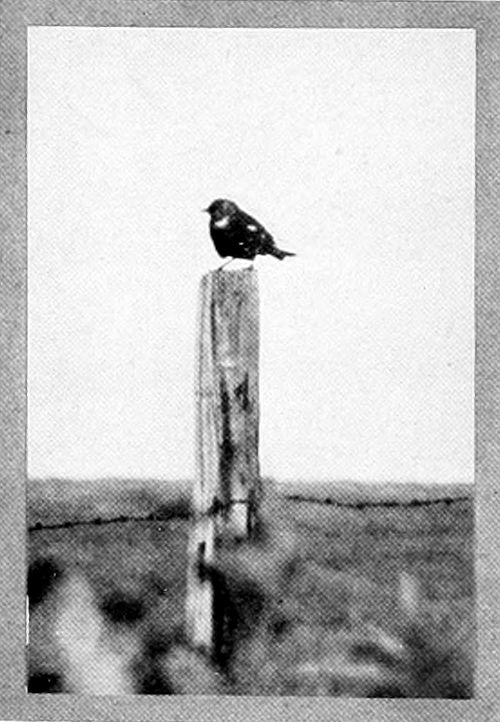
Photo by the Author. MALE YELLOW HEAD.
Alternating with the last named, and more frequently heard from the depths of the nesting swamp is gur, gurrl; or, as oftenest, yewi(nk), yewi(nk), gur-gurrl. In this phrase the gurrl is drawn out with comical effect, as tho the gallant were down on his knees before some unyielding maiden.
The Yellow-head’s ordinary note of distrust, equivalent to the dink note of the Red-wing, is kluck or koluck’. In flight this becomes almost invariably oo’kluk, oo’kluk.
At rest, again, this is sometimes prolonged into a thrilling passage of resonant “l” notes, probably remonstratory in character. The alarm cry is built upon the same basis, and is uttered with exceeding vehemence, klookoloy, klookoloy, klook ooooo.
Finally, if one may presume to speak finally of so versatile a genius, they have a harsh, rasping note very similar in quality to the scolding note of the Steller Jay, only lighter in weight and a little higher in pitch. This is the note of fierce altercation, or the distress cry in imminent danger. The last time I heard it was in the rank herbage bordering upon a shallow lake in Douglas County. I rushed in to find a big blow-snake coiling just below a nestful of young birds, while the agonized parents and sympathetic neighbors hovered over the spot crying piteously. To stamp upon the reptile was but the work of a moment; and when I dropped the limp ophidian upon the bare ground, all the blackbird population gathered about the carcass, shuddering but exultant, and—perhaps it was only fancy—grateful too.
For all the Yellow-head is so decided in utterance, in disposition he is somewhat phlegmatic, the male bird especially lacking the vivacity which characterizes the agile Brewer Blackbird. Except when hungry, or impelled [61] by passion, he is quite content to mope for hours at a time in the depths of the reeds; and even in nesting time, when his precincts are invaded, he oftener falls to admiring his own plumage in the flooding sunshine than tries to drive off the intruder. Let the homely and distrait female attend to that.
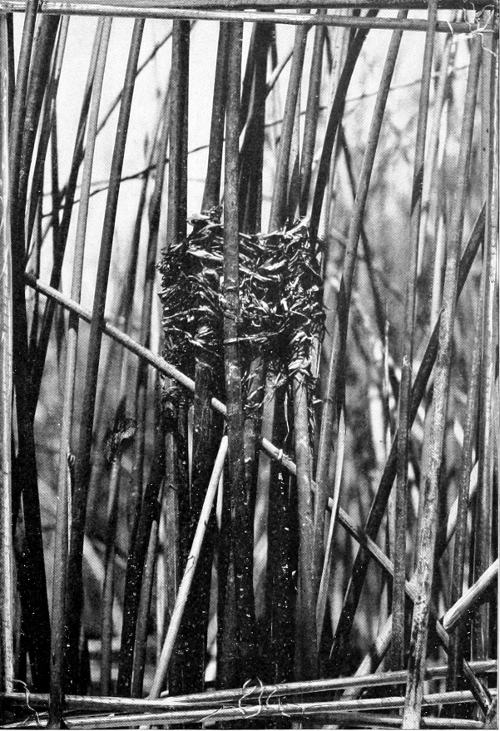
Taken in Douglas County. Photo by W. Leon Dawson. NEST OF YELLOW-HEADED BLACKBIRD IN TULES.
[62]
This bird is essentially a plains-loving species, and its favorite haunts with us are the reedy borders of the treeless lakes, and the upland sloughs of eastern Washington. It is highly gregarious, especially in the fall and early spring, but confesses to about the same degree of domesticity as the Red-wing, in late spring and early summer.
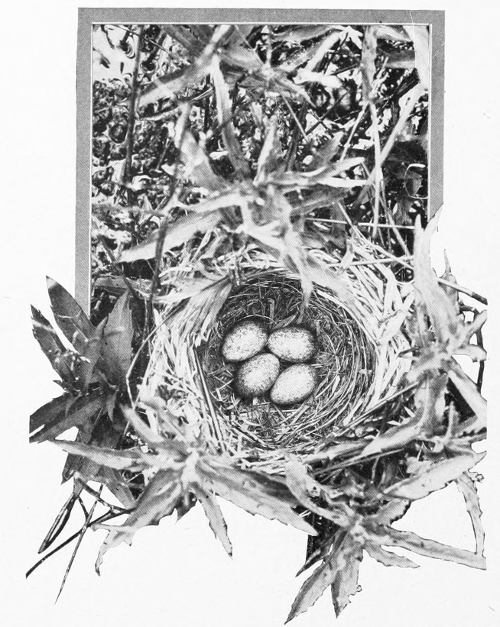
Taken in Douglas County. Photo by the Author. A STOUTLY-WOVEN BASKET.
The nests are stoutly-woven baskets of reeds and grasses, light and dry and handsome. No mud or other matrix material is used in construction, and the interior is always carefully lined with fine dry grass. The illimitable bulrushes are the favorite cover, but rank herbage of any sort is used if only it be near or over water. The most humble situations suffice; and the nest is often placed within a foot of the water, or its equivalent of black ooze.
[63]
No. 22. WESTERN MEADOWLARK.
A. O. U. No. 501.1. Sturnella neglecta Audubon.
Synonyms.—Field Lark. Old-field Lark. Medlark. Medlar (poetical). Mudlark (corruption).
Description.—Adult male: General color of upperparts brownish black modified by much tawny and buffy-gray edgings of the feathers which throw the black into stripes and bars with suggestion of herring-bone pattern; the tawny heaviest on secondaries and upper tail-feathers where taking the form of partial bands, a median crown stripe and posterior portion of superciliary sordid white or buffy; anterior portion of superciliary, cheeks, chin, upper throat, breast (broadly) and middle belly rich lemon yellow (inclining to orange in older specimens); a large black crescent on upper breast; sides and flanks black-streaked and spotted with pale brown on a buffy or whitish ground. Bill variegated, tawny, black and white. Female: Like male but smaller and paler with some substitutions of brown for black in streaking; black of jugulum veiled by grayish tips of feathers; yellow of breast duller, etc. The plumage of both sexes is duller in fall and winter, the normal colors being restrained by buffy overlay. Length of adult male: 10.00-11.00 (254-279.4); wing 4.85 (123.2); tail 3.00 (76.2); bill 1.30 (33); tarsus 1.46 (37.1). Female smaller.
Recognition Marks.—Robin size; yellow breast with black collar distinctive; general streaky appearance above; yellow cheeks as distinguished from the Eastern Meadowlark (Sturnella magna).
Nesting.—Nest: on the ground in thick grass or weeds; a slight depression lined (carefully or not) and usually overarched with dried grasses. Eggs: 4-6, white, speckled and spotted, sometimes very sparingly, with cinnamon brown or purplish; very variable in shape, elliptical ovate to almost round. Av. size, 1.12 × .80 (28.5 × 20.3). Season: April and June; two broods. Tacoma, April 5, 1906, 4 fresh eggs.
General Range.—Western United States, southwestern British Provinces, and northwestern Mexico, east to prairie districts of Mississippi Valley, Minnesota, Iowa, Missouri, etc., occasionally to Illinois and Michigan; breeding thruout its range.
Range in Washington.—Abundant east and west of the Cascades; largely resident on the West-side, partially on the East-side; numbers augmented from the south during last week in February.
Authorities.—[Lewis and Clark, Hist. Ex. (1814), Ed. Biddle: Coues. Vol II. p. 186.] Sturnella neglecta Aud., Baird, Rep. Pac. R. R. Surv. IX. 1858, 539. T. C&S. L². Rh. D¹. Sr. Ra. D². Ss¹. Ss². Kk. B. E.
Specimens.—(U. of W.) Prov. B. E. BN. P¹.
Summer silences the birds so gradually and we ourselves have become so much absorbed in business during the prosy days of September that we [64] have almost forgotten the choruses of springtime and have come to accept our uncheered lot as part of the established order of things. But on a nippy October morning, as we are bending over some dull task, there comes a sound which brings us to our feet. We hasten to the window, throw up the sash and lean out into the cool, fresh air while a Meadowlark rehearses, all at a sitting, the melodies of the year’s youth. It all comes back to us with a rush; the smell of lush grasses, the splendor of apple blossoms, the courage of lengthening days, the ecstacies of courtship—all these are recalled by the lark-song. It is as tho this forethoughted soul had caught the music of a May day, just at its prime, in a crystal vase, and was now pouring out the imprisoned sound in a gurgling, golden flood. What cheer! What heartening! Yea; what rejuvenation it brings! Wine of youth! Splashes of color and gay delight!
It is impossible not to rhapsodize over the Meadowlark. He is a rhapsodist himself. Born of the soil and lost in its embraces for such time as it pleases him, he yet quits his lowly station ever and again, mounts some fence-post or tree-top, and publishes to the world an unquenchable gladness in things-as-they-are. If at sunrise, then the gleams of the early ray flash resplendent from his golden breastplate,—this high-priest of morning; and all Nature echoes his joyous blast: “Thank God for sunshine!” Or if the rain begins to fall, who so quickly grateful for its refreshment as this optimist of the ground, this prophet of good cheer! There is even an added note of exultation in his voice as he shouts: “Thank God for rain!” And who like him can sing farewell to parting day! Piercing sweet from the meadows come the last offerings of day’s daysmen, peal and counterpeal from rival friendly throats, unfailing, unfaltering, unsubdued: “It is good to live. It is good to rest. Thank God for the day now done!”
The Meadowlark of the East has a poet’s soul but he lacks an adequate instrument of expression. His voice does not respond to his requirement. Perhaps his early education, as a species, was neglected. Certain it is that in passing westward across the prairies of Iowa or Minnesota one notices an instant change in the voices of the Meadowlarks. The song of the western bird is sweeter, clearer, louder, longer and more varied. The difference is so striking that we can explain it only upon the supposition of an independent development. The western bird got his early training where prairie wild flowers of a thousand hues ministered to his senses, where breath of pine mingled faintly with the aroma of neighboring cactus bloom, and where the sight of distant mountains fired the imagination of a poet race. At any rate we of the West are proud of the Western Meadowlark and would have you believe that such a blithe spirit could evolve only under such circumstances.
[65]
Bird song never exactly conforms to our musical notation, and there is no instrument save the human “whistle” which will even passably reproduce the quality of the Meadowlark’s song. Nevertheless, many interesting experiments have been made in recording these songs and a little attention will convince the least accomplished musician that there is a fascinating field for study here.
A formal song of the Western Meadowlark comprises from four to a dozen notes, usually six or seven. The song phrases vary endlessly in detail, yet certain types are clearly distinguishable, types which reappear in different parts of the country, apparently without regard to local traditions or suppositional schools of song. Thus a Chelan singer says, “Oku wheel′er, ku wheel′er”, and he may not have a rival in a hundred miles; yet another bird on the University campus in Seattle sings, Eh heu, wheel′iky, wheel′iky, or even Eh heu wheel′iky, wheel′iky, wheel′iky, and you recognize it instantly as belonging to the same type. In like manner Owy′hee, rec′itative was heard with perfect distinctness both at Wallula and in Okanogan County.
Each bird has a characteristic song-phrase by which he may be recognized and traced thru a season, or thru succeeding years. One boisterous spirit in Chelan I shall never forget for he insisted on shouting, hour after hour, and day after day, “Hip! Hip! Hurrah! boys; three cheers!” Yet, while this is true, no bird is confined to one style of song. An autumnal soloist in Ravenna Park rendered no less than six distinct songs or song-phrases in a rehearsal lasting five minutes. He gave them without regard to sequence, now repeating the same phrase several times in succession, now hurrying on to new forms, pausing only after each utterance for breath.
Nor is the effort of the Western Meadowlark confined to the formal song for he often pours out a flood of warbling, chattering and gurgling notes which at close range are very attractive. Not infrequently he will interrupt one of these meditative rhapsodies with the clarion call, and return immediately to his minor theme.
In the presence of a stranger the lark serves frequent notice of intended departure in a vigorous toop, or toob, accompanying the sound with an emphatic flirt of the wings and jerk of the tail. Now and then the actual departure is accompanied by a beautiful yodelling song. After several preliminary toobs the bird launches himself with fantastic exaggeration of effort and rolls out, O′ly o′ly o′ly o′ly o′ly, with ravishing sweetness.
At nesting time the parent birds have many causes for apprehension, and as they move about in search of food they give vent to the toob note of distrust in a fashion which soon becomes chronic. In Douglas County this note is doubled, two′ bit, or two′ whit, and one cannot recall the varied life of the sage in June without hearing as an undertone the half melancholy two′ bit of a mother Meadowlark as she works her way homeward by fearful stages.
[66]
At nesting time the Western Meadowlark enjoys a wide distribution in Washington. It is found not only on all grassy lowlands and in cultivated sections but in the open sage as well and upon the half-open pine-clad foothills up to an altitude of four thousand feet.
The Meadowlark is an assiduous nester. This not because of any unusual amativeness but because young Meadowlarks are the morceaux délicieux of all the powers that prey, skunks, weasels, mink, raccoons, coyotes, snakes, magpies, crows. Hawks and owls otherwise blameless in the bird-world err here—the game is too easy. Even the noble Peregrine does not disdain this humble, albeit toothsome, quarry, and the Least Falcon (Falco sparverius phalæna) will stoop for a young Meadowlark when all other avian offerings are virtuously passed by.
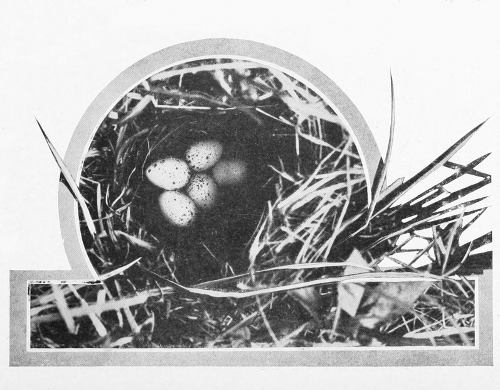
Taken in Stevens County. Photo by the Author. NEST AND EGGS OF THE WESTERN MEADOWLARK.
Fecundity then is the only recourse,—this, and concealment. Not relying altogether upon its marvelous protective coloration the lark exhibits great caution in approaching, and, if possible, in quitting its nest. In either case it sneaks along the ground for a considerable distance, threading the mazes of the grass so artfully that the human eye can follow with difficulty or not at all. At the approach of danger a sitting bird may either steal from her nest unobserved and rise at a safe distance or else seek to further her deception by feigning lameness after the fashion [67] of the Shore-birds. Or, again, she may cling to her charge in desperation hoping against hope till the last possible moment and taking chances of final mishap. In this way a friend of mine once discovered a brooding Meadowlark imprisoned underneath his boot—fortunately without damage for she occupied the deep depression of a cow-track.
To further concealment the grass-lined depression in which the Meadowlark places her four or five speckled eggs is almost invariably over-arched with dried grasses. This renders the eggs practically invisible from above, and especially if the nest is placed in thick grass or rank herbage, as is customary. Touching instances of blind devotion to this arch tradition were, however, afforded by a sheep-swept pasture near Adrian. Here the salt-grass was cropped close and the very sage was gnawed to stubs. But the Meadowlarks, true to custom, had imported long, dried grasses with which to over-arch their nests. As a result one had only to look for knobs on the landscape. By eye alone we located six of these pathetic landmarks in the course of a half-hour’s stroll.
One brood is usually brought off by May 1st and another by the middle of June. Altho Meadowlarks are classed as altricial, i. e. having young helpless when hatched and which require to be nurtured in the nest, the young Meadowlarks are actually very precocious and scatter from the nest four or five days after hatching, even before they are able to fairly stand erect. This arrangement lessens the chances of wholesale destruction but it would appear to complicate the problem from the parental standpoint. How would you, for instance, like to tend five babies, each in a separate thicket in a trackless forest, and that haunted by cougars, and lynxes, and boa-constrictors and things?
We cannot afford to be indifferent spectators to this early struggle for existence, for it is difficult to overestimate the economic value of the Meadowlark. The bird is by choice almost exclusively insectivorous. If, however, when hard pressed, he does take toll of the fallen wheat or alfalfa seed, he is as easily justifiable as is the hired man who consumes the farmer’s biscuits that he may have the strength to wield the hoe against the farmer’s weeds. Being provided with a long and sensitive bill, the Meadowlark not only gleans its insect prey from the surface of the ground, but works among the grass roots, and actually probes the earth in its search for wire- and cut-worms, those most dreaded pests. Besides devouring injurious grubs and insects of many kinds, the Lark has a great fondness for grasshoppers, subsisting almost entirely upon these in the season of their greatest abundance. In the matter of grasshopper consumption alone Meadowlarks of average distribution, are estimated by no less an authority than Professor Beal, to be worth about twenty-four dollars per month, per township, in saving the hay crop. To the individual farmer this may seem a small matter, but in [68] the aggregate the saving to the nation amounts to some hundreds of thousands of dollars each year. Even in winter, when a few individuals or occasional companies of Larks are still to be found, a large proportion of their food consists of hardy beetles and other insects, while weed-seed and scattering grain is laid under tribute, as it were, reluctantly.
It goes without saying that we cannot regard this bird as lawful game. We exempt the horse from slaughter not because its flesh is unfit for food—it is really very sapid—but because the animal has endeared itself to our race by generations of faithful service. We place the horse in another category, that of animal friend. And the human race, the best of it, has some time since discovered compunctions about eating its friends. Make friends with this bonny bird, the Meadowlark, and you will be ashamed thenceforth to even discuss assassination. Fricassee of prima donna! Voice of morning en brochette! Bird-of-merry-cheer on toast! Faugh! And yet that sort of thing passed muster a generation ago—does yet in the darker parts of Europe!
Fringillidæ—The Finches
No. 23. WESTERN EVENING GROSBEAK.
A. O. U. No. 514a. Hesperiphona vespertina montana Ridgway.
Description.—Adult male: Forehead and superciliaries gamboge yellow; feathers about base of bill, lores, and crown black; wings black with large white patch formed by tips of inner secondaries and tertials; tail black; remaining plumage sooty olive brown about head and neck, shading thru olive and olive-green to yellow on wing and under tail-coverts. Bill bluish horn-color and citron yellow; feet brownish. Adult female: General color deep smoky brownish gray or buffy brown, darker on the head, lighter on wings, lighter, more buffy, on sides, shading to dull whitish on throat and abdomen, tinged with yellowish green on hind-neck, clearing to light yellow on axillars and under wing-coverts; a small clear white patch at base of inner primaries; white blotches on tips of upper tail-coverts and inner webs of tail-feathers in varying proportions. Length about 8.00 (203.2); wing 4.39 (111.5); tail 2.42 (61.4); bill .82 (20.8); depth at base .62 (15.9); tarsus. 81 (20.3). Female very slightly smaller.
Recognition Marks.—Chewink size; olive-brown coloration with black and white in masses on wings; large, conical beak distinctive; high-pitched call note.
Nesting.—Has not yet been found breeding in Washington but undoubtedly does so. Nest (as reported from New Mexico): principally composed of fine rootlets with some Usnea moss and a few sticks, settled upon horizontal branches of pine or fir, near tip, and at considerable heights; in loose colonies. Eggs: 4, “in color, size, form, and texture indistinguishable from those of the Red-winged Blackbird” (Birtwell).
General Range.—Western United States and Northern Mexico; east to and including Rocky Mountains; north to British Columbia.
Range in Washington.—Co-extensive with evergreen timber and appearing irregularly elsewhere. Resident within State but roving locally. Winters regularly in parks of the larger cities.
Authorities.—? Fringilla vespertina Townsend, Journ. Ac. Nat. Sci. Phila. VIII. 1839, 154 (Columbia R.). Hesperiphona vespertina Baird, Rep. Pac. R. R. Surv. IX. 1858, 409. T. C&S. Ra. Kk. B. E.
Specimens.—U. of W. P¹. Prov. B. E.
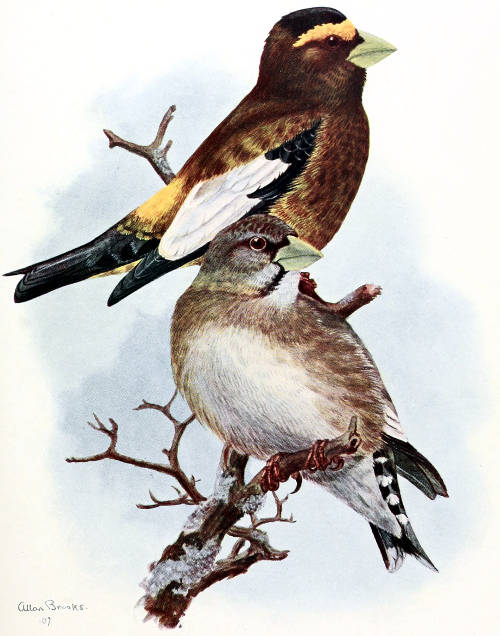
WESTERN EVENING GROSBEAKS MALE AND FEMALE, ¾ LIFE SIZE From a Water-color Painting by Allan Brooks
[69]
Sparrows are also called Cone-bills; it is, therefore, fair that the bird with the biggest cone should take precedence in a family history. But for this primacy there are damaging limitations. The Grosbeak is neither the most beautiful nor the most tuneful of the Fringillidæ, if he is by common consent rated the oddest. His garb is a patchwork; his song a series of shrieks; his motions eccentric; his humor phlegmatic; and his concepts beyond the ken of man. Altho at times one of the most approachable of birds, he is, on the whole, an avian freak, a rebus in feathers.
Perhaps we make too much of a mystery of him, just as we rate the owl highest in wisdom for the single discretion of silence, which any dunderhead may attain. But now take this group in the park; just what are they at? They sit there stolidly in the rowan tree where all the passersby may take note of them, giving vent ever and anon to explosive yelps, but doing nothing by the hour, until an insane impulse seizes one of their number to be off to some other scene no better, be it near or far, and the rest yield shrieking consent by default of alternative idea. It is all so unreasonable, so uncanny, that it irritates us.
Evening Grosbeaks are semi-gregarious the year around, but are seen to best advantage in winter or early spring, when they flock closely and visit city parks or wooded lawns. One is oftenest attracted to their temporary quarters by the startling and disconnected noises which are flung out broadcast. It may be that the flock is absorbed in the depths of a small fir, so that one may come up near enough to analyze the sound. Three sorts of notes are plainly distinguishable: a low murmuring of pure tones, quite pleasant to the ear; a harsh but subdued rattle, or alarm note, wzzzt or wzzzp, familiarly similar to that of the Crossbill; and the high-pitched shriek, which distinguishes the bird from all others, dimp. A little attention brings to light the fact that all the birds in the flock bring out this astonishing note at precisely the same pitch. Once distinguished, this note will serve again and again to draw attention to this uncanny fowl, as it passes overhead or loses itself in the bosom of some giant conifer.
[70]
It is not a little surprising at first thought, that the habits of these birds are best known in our larger cities, Seattle, Tacoma, Spokane, and Portland. Why they should be especially attracted to them, it is hard to say, unless it be that they love the din of urban life, which they help so valiantly to promote. But it is easy to see why they are more noticeable there; for their showy and patchy coloration marks them as distinguished visitors in town, whereas in the forest their colors so melt into and harmonize with their surroundings that it is difficult to follow their movements.
These Grosbeaks, or New World Hawfinches, are not to be commended as horticulturists. In winter they feed largely upon the ground, gleaning fallen seeds and fruits; and are especially fond of the winged key of the large-leafed maple (Acer macrophyllum). They drop down to such a feast one by one from the branches above, and it is amusing to note how the loud cracking of seeds is interspersed with music. A little later the birds devote themselves to swelling buds, and here too the maple is a favorite; tho ash, alder, flowering currant, and a dozen more are not disdained. The damage done is not considerable; for the birds, viewed in the large, are not numerous enough, all told, to be taken seriously; but viewed in the concrete, the snip, snip, of those mandibles in the lilac bushes is no idle joy.
It may be that the key of high C sharp, or whatever it be, staccato con moto, is the accepted love note, and that the green-liveried swain hurls declarations at his enamorata, like Samson in Handel’s oratorio, the live-long year. Anyway, his exertions are redoubled in early June, and he charges about in a reckless frenzy which should make the city gape. June, 1906, was memorable to us for the abundance of these Grosbeaks in the vicinity of Spokane. The very air of Cannon Hill and Hangman’s Creek seemed charged with expectation of Grosbeaks’ nests. But they were not for us. Nor has the nest yet been taken in Washington.
No. 24. ALASKAN PINE GROSBEAK.
A. O. U. No. 515c. Pinicola enucleator alascensis Ridgway.
Synonym.—Pine Bullfinch.
Description.—Adult male: In highest plumage rosy red (poppy red); back with dusky centers of feathers; lower belly and under tail-coverts ashy gray—this high plumage is the exception; in general the rosy gives place to ashy gray in varying proportions; wings and tail ashy dusky; tips of middle and greater coverts and outer edges of exposed tertials white (or rosy). Bill dusky; feet blackish. Adult female: Similar to male but rosy replaced by dingy yellow (varying [71] from olive-yellow, olive-tawny and ochraceous to bricky red) and chiefly confined to head, hind-neck and upper tail-coverts (where brightest); feathers of back frequently tipped with ochraceous and breast with an ochrey wash. Length about 8.60 (218.4); wing 4.60 (117); tail 3.66 (93); bill .57 (14.5); tarsus .89 (22.7).
Recognition Marks.—Chewink size; large, rounded conical beak; red and gray coloration for size distinctive.
Nesting.—“Nest, composed of a basement of twigs and rootlets within which is a more compact fabric of finer materials. Eggs, usually 4, pale greenish blue, spotted and blotched with dark brown surface markings and lilac shell-spots.” Av. size 1.05 × .74 (26.7 × 18.8). Season: About June 1st; one brood.
General Range.—“Northwestern North America, except Pacific Coast, breeding in interior of Alaska; south, in winter, to eastern British Columbia, Montana (Bitterroot Valley), etc.” (Ridgway).
Range in Washington.—Reported by Allan Brooks as breeding in the Mt. Baker district (as below); should occur upon the timbered lowlands in winter.
Authorities.—Allan Brooks in epist. Dawson, Auk Vol. XXV. Oct. 1908, p. 482.
Specimens.—Prov.
This large and handsome Finch is of very irregular occurrence in southern British Columbia excepting the higher mountain ranges, where it breeds. During some winters it is present in large numbers, while in others, equally severe, none are seen. The species was very common throughout the winter of 1906-1907, a very severe one; but in that of 1901-1902, which was notably mild, Pine Grosbeaks were noticed in considerable numbers as far south as Penticton, 40 miles north of the international boundary, and they undoubtedly occurred much farther south.
Their food in the winter months is principally berries, but, strange to say, they altogether refuse those of the mountain ash, both the introduced and indigenous species. The former is the favorite food of the Eastern Pine Grosbeak thruout the winter in Ontario, but trees loaded with fruit were passed by at Okanagan Landing in the winter of 1906-1907, even after the birds had eaten all the rose hips and snow berries and were reduced to eating weed seeds with the Leucostictes.
Either this sub-species or montana breeds on all the higher mountain ranges in British Columbia, occupying a zone from timber line downwards about 2,000 feet.
My first acquaintance with the Pine Grosbeak at its breeding grounds, was in the Cascade Mountains due north of Mt. Baker, on both sides of the Forty-ninth Parallel. Here the species was a somewhat sparing breeder close to timber line among the hemlock and balsam timber. They were feeding young on the 17th of July; at the same time Crossbills had fully [72] grown young in flocks. No red males were seen, though many gray males were singing in the early mornings from the topmost spray of some balsam.
In the writer’s opinion the red plumage in the male is acquired at the first moult or immediately after the juvenal dress, and is usually only retained for one season; in some males a duller red dress is carried through the second summer, or more rarely a salmon-pink one; but in most cases the dress of the second summer is a gray one like the females, with yellow head and rump. Females may sometimes be seen with decidedly red heads and rumps,—from the size and shape of the bill these seem to be very old birds. The above remarks as to the red dress in the male apply also, in the writer’s experience, to the genera Loxia, Carpodacus and Acanthis.
Allan Brooks.
No. 25. AMERICAN CROSSBILL.
A. O. U. No. 521. Loxia curvirostra minor (Brehm.).
Synonym.—Red Crossbill.
Description.—Adult male: Tips of mandibles crossed either way; plumage red, brightest on rump; feathers of back with brownish centers; wings and tail fuscous. Shade of red very variable,—orange, cinnabar, even vermilion, sometimes toned down by a saffron suffusion. Immature males sometimes present a curiously mottled appearance with chrome-green and red intermingled. Female and young: Dull olive-green, brighter and more yellow on head and rump; below gray overcast by dingy yellow. Adult male, length 5.50-6.25 (139.7-158.8); wings 3.40 (86.4); tail 2.05 (52.1); bill .70 (17.8) or under.
Recognition Marks.—Sparrow size; crossed mandibles; male red and female olive-green; both without white wing-bars.
“Nest: in forks or among twigs of tree, founded on a mass of twigs and bark-strips, the inside felted of finer materials, including small twigs, rootlets, grasses, hair, feathers, etc. Eggs: 3-4, 0.75 × 0.57, pale greenish, spotted and dotted about larger end with dark purplish brown, with lavender shell-markings” (Coues). Av. size, .85 × .53 (21.6 × 13.5) (Brewer). Season: erratic, Feb.-Oct.; one brood.
General Range.—Northern North America, resident sparingly south in the eastern United States to Maryland and Tennessee, and in the Alleghanies, irregularly abundant in winter. Of irregular distribution thruout the coniferous forests of the West, save in southern California, Arizona, and New Mexico, where replaced by L. c. stricklandi.
Range in Washington.—Found thruout the coniferous forests of the State; of irregular occurrence locally. Non-migratory but nomadic.
Authorities.—Curvirostra americana Wils. Baird, Rep. Pac. R. R. Surv. IX. pt. II. 1858, 426 part, 427. T. C&S. L¹. D¹. Ra. D². J. B. E.
Specimens.—U. of W. Prov. E. B.
[73]
When a bird’s pastures are the tree-tops it is possible for it to live a quite secluded life here in Washington. And, indeed, we know the Crossbill chiefly as a wandering voice or, rather, a vocal babel, passing from summit to summit in the grim fir forest. But on a rare day, it may be in Spokane, or it may be in Tacoma, the birds descend to human levels and are discovered feeding busily on their favorite pine cones. The birds are perfectly indifferent to equilibrium, and feed any side up without care. While thus engaged they may exhibit little fear of the beholder and sometimes venture within reach; but as often, for some whimsical reason they are up and away again as tho seized by evil spirits.
The Crossbill owes its peculiar mandibles to an age-long hankering for pine-seeds (using that word in the generic sense), a desire fully satisfied according to the fashion of that Providence which works so variously thru Nature, and whose method we are pleased to call evolution. The bill of the bird was not meant for an organ of prehension, and Buffon, the Deist, once won a cheap applause by railing at the Almighty for a supposed oversight in this direction; but as matter of fact, its wonderful crossed mandibles enable the Crossbill to do what no other bird can; viz., pry and cut open the scales of a fir cone, in order to extract the tiny seed with its tongue.
These birds are not entirely confined to a vegetable diet, for I once detected a group of them feeding industriously in a small elm tree which was infested with little gray insects, plant-lice or something of the sort. The presence of these insects, in colonies, caused the edges of the leaves to shrivel and curl tightly backward into a protective roll. Close attention showed that the Crossbills were feeding exclusively upon these aphides. They first slit open a leaf-roll with their scissor-bills, then extracted the insects with their tongues, taking care apparently to secure most of the members of each colony before passing to the next.
Crossbills also feed to some extent upon the ground, where they pick up fallen seeds and other tidbits. Mr. J. F. Galbraith, a ranger of the Washington Forest Reserve, first called my attention to another purpose which the birds have in visiting the ground. He had noticed how at certain places, and notably where dish-water was habitually thrown, the Crossbills were wont to congregate, and, turning the head sidewise, to thrust out the tongue along the bare ground in a most puzzling manner. Suspecting at last the real state of affairs, he sprinkled the ground with salt, and upon their return the birds licked it up with great avidity. Mr. Galbraith claims to have tried this experiment successfully upon numerous occasions. The birds do not appear to recognize the salt at first sight, but soon learn to resort to established salt-licks in open places. Rev. Fred M. McCreary also reports similar habits in connection with certain mineral springs in the Suiattle country. [74] When we recall that the normal food of the Crossbill is pine-seeds, this craving for Nature’s solvent is readily understandable.
Crossbills give out an intermittent rattling cry, or excited titter, tew, tew, tew, while feeding. They have also a flight note which consists of a short, clear whistle; and a flock composed of separately undulating individuals affords a pleasing sensation to both eye and ear, as it rapidly passes. The male is said to have sprightly whistling notes of a most agreeable character, generically related to that of the Pine Grosbeak, or Purple Finch, but their exhibition must be rather rare.
After all, there is something a bit uncanny about these cross-billed creatures, and their eccentricities show nowhere in greater relief than in their nesting habits. The quasi migrations of the bird are determined by the local abundance of fir (or pine) cones. Like their food supply, the birds themselves may abound in a given section one year and be conspicuously absent the next. Moreover, because there is no choice of season in gathering the seed crop, the birds may nest whenever the whim seizes them; and this they do from January to July, or even October. The communal life is maintained in spite of the occasional defection of love-lorn couples; and there is nothing in the appearance of a flock of Crossbills in April to suggest that other such are dutifully nesting.
Mr. Bowles has never taken the eggs near Tacoma, altho he has encountered half a dozen of their nests in twelve years, the only occupied one of which we have record being found by a friend on the 25th of April, 1899. It contained three half-incubated eggs, and was placed in one of a group of small firs in the prairie country, at an elevation of some twenty feet. The nest rather closely resembles that of the California Purple Finch, but is more compactly built and much more heavily lined. It is composed of twigs and rootlets closely interwoven, and boasts an inner quilt of felted cow-hair nearly half an inch in thickness. The female Crossbill exhibits a singular devotion to duty, once confessed, and in this case the collector had actually to lift her from the eggs in order that he might examine them.
No. 26. WHITE-WINGED CROSSBILL.
A. O. U. No. 522. Loxia leucoptera Gmel.
Description.—Male: Rosy-red or carmine all over, save for grayish of nape and black of scapulars, wings, and tail. The black of scapulars sometimes meets on lower back. Two conspicuous white wing-bars are formed by the tips of the middle and greater coverts. Bill slender and weaker than in preceding [75] species. Female and young: Light olive-yellow, ochraceous, or even pale orange over gray, clearer on rump, duller on throat and belly; most of the feathers with dusky centers, finer on crown and throat, broader on back and breast; wings and tail as in male, but fuscous rather than black; feather-edgings olivaceous. Very variable. Length 6.00-6.50 (152.4-165.1); wing 3.50 (88.9); tail 2.25 (57.2); bill .67 (17).
Recognition Marks.—Sparrow size; crossed bill; conspicuous white wing-bars of both sexes.
Nesting.—Nest has not yet been taken in Washington but bird undoubtedly breeds here. “Nest: of twigs and strips of birch-bark, covered exteriorly with moss (Usnea) and lined with soft moss and hair, on the fork of an evergreen, in deep forests. Eggs: 3(?), pale blue, spotted and streaked near larger end with reddish brown and lilac, .80 × .55 (20.3 × 1.4.)” (Chamberlain). Season: Feb.-March.
General Range.—Northern parts of North America and southern Greenland, south into the United States in winter. Resident in coniferous timber thru the entire northern tier of states and irregularly south in the mountains at least to Colorado. Casual in western Europe.
Range in Washington.—Several records of occurrences in northern Cascade Mountains. Doubtless regular and resident.
Authorities.—Dawson, Auk, Vol. XVII. Oct., 1901, p. 403. D².
Specimens.—(U. of W.) Prov. C. B.
To tell the truth, no one hereabouts appears to know much about the White-winged Crossbill. It is presumed to be common in the Cascade Mountains, but I have only thrice encountered it: once, May 15, 1891, in the mountains of Yakima County; again, July 23, 1900, on the slopes of Wright’s Peak near the head of Lake Chelan; and lastly, on the summit of Cascade Pass, June 25, 1906. There are no other records.[12] This species is quite as erratic as its more common cousin; and while it is, perhaps, more nearly confined to the mountains, it should be looked for wherever C. minor occurs, and especially in flocks of the latter species.
Of the bird’s occurrence in Alaska, where it is much more abundant, Nelson says[13]: “It is more familiar than the Grosbeak [i. e., Pinicola enucleator alascensis], frequently coming low down among the smaller growth, and it is a common sight to see parties of them swinging about in every conceivable position from the twigs on the tops of the cottonwoods or birch trees, where the birds are busily engaged in feeding upon the buds. They pay no heed to a passing party of sleds, except, perhaps, that an individual will fly down to some convenient bush, where he curiously examines the strange procession, and, his curiosity satisfied or confidence restored, back he goes to his companions and continues feeding. When fired at they utter [76] chirps of alarm and call to each other with a long, sweet note, something similar to that of the Goldfinch (Spinus tristis). They keep up a constant cheeping repetition of this note when feeding in parties, and if one of their number is shot the others approach closer and closer to the hunter, and gaze with mingled curiosity and sympathy upon their fluttering companion.”
No. 27. GRAY-CROWNED LEUCOSTICTE.
A. O. U. No. 524. Leucosticte tephrocotis Swains.
Synonyms.—Rosy Finch. Swainson’s Rosy Finch.
Description.—Adults: Similar to L. t. littoralis but ashy gray of head restricted to sides of crown and occiput—in worn plumages black of crown produced backward to meet brown of hind neck. Seasonal changes as in succeeding. Size of next.
Recognition Marks.—Sparrow size; warm brown plumage; ashy gray not encroaching upon sides of head as distinguished from L. t. littoralis.
Nesting.—Not known to breed in Washington. “Nest made of strips of bark and grass, built in a fissure of a rock at the side of a bunch of grass” (Reed). Eggs: 4 or 5, white. Season: June; one brood.
General Range.—Imperfectly made out—probably discontinuous. Reported breeding from such widely separated localities as the Rocky Mountains of British America and the Sierra Nevada and White Mountains of southern California; winters on the eastern slopes of the Rockies and irregularly eastward to western Nebraska, Manitoba, etc., westward to Cascade and Sierra Nevada ranges (Camp Harvey, Ore. Pullman, Wash. Chilliwhack, B. C.).
Range in Washington.—Probably of regular occurrence during migrations and in winter east of the Cascade Mountains only.
Authorities.—Not previously reported; W. T. Shaw in epistola, Dec. 31, 1908.
Specimens.—Pullman.
Mountain climbing as an art is still in its infancy in the Northwest and altho the Mountaineers and the Mazamas are attacking the situation vigorously we have yet much to learn of the wild life upon our Washington sierras. But what problem could be more fascinating to a lover of birds and mountains than that of working out accurately the distribution of the Rosy Finches in America? They are the mountaineers par excellence, they are the Jebusites of the untaken citadels, and our ignorance of their ways will ere long become a reproach to our vaunted western enterprise. As it stands, [77] however, only scanty crumbs of information have come to us concerning this most interesting and widely distributed race of Highlanders.
The Gray-crowned Leucosticte is considered the central figure of the genus, shading[14], as it does, into L. atrata of the Bitterroots and L. australis of Colorado, into L. t. littoralis of southern British Columbia, Washington and Oregon, and (perhaps thru littoralis) into griseonucha of the Aleutians. This assumes for the species a center of distribution in the Rocky Mountains of British Columbia, Alberta and Saskatchewan where the bird is known to occur. And so because of the greater severity of the winters in its normal haunts this form is found to be the greatest wanderer of its group, being frequently driven in the fall far out upon the central eastern plains or down the “inside passage” between the Rockies and Sierras.
It was in this fashion, probably, that a colony of this species became established in the southern Sierras of California, where it now maintains a vigorous existence separated, as we suppose, by at least a thousand miles from the parent stock in British Columbia.
No. 28. HEPBURN’S LEUCOSTICTE.
A. O. U. No. 524a. Leucosticte tephrocotis littoralis (Baird).
Synonyms.—Rosy Finch. Hepburn’s Rosy Finch. Baird’s Rosy Finch.
Description.—Adult male in summer: Forehead and fore-crown black; occiput, broadly, and sides of head, clear ashy gray, color sometimes encroaching on chin and throat; nasal plumules grayish white; remaining plumage in general chestnut, chocolate, or rich vandyke brown, sharply contrasting with ashy gray on hind-neck and sides of head, inclining to blackish on throat, streaked with dusky on back and with more or less admixture of dusky on feather tips, especially on wings and flanks; feathers of upper and under tail-coverts, rump and flanks broadly and distinctly tipped with pink (of variable shade); wings and tail blackish; lesser and middle coverts broadly tipped with pink, the greater coverts, primary coverts and part of the flight feathers edged with pink or light carmine; rectrices with more or less edging of pinkish gray or light brown; bill black; feet and legs black. Adult female: of somewhat paler and duller coloration. Adults in winter: Feathers of back and scapulars edged with light brown; pink edgings of wings, etc., paler, and body plumage, especially on breast, with more or less pale skirting; bill yellow with dusky tip (this character is assumed as early as September). Length of adult male: 6.15 (156.2); wing 4.00 (101.6); tail 2.60 (66); bill .45 (11.4); tarsus .75 (19).
Recognition Marks.—Sparrow size; plumage warm brown with rosy skirtings; ashy gray on sides of head as distinguished from L. tephrocotis.
[78]
Nesting.—Nest: a thick mat of dried grasses placed in sheltered crevice of rock at great altitude. Eggs: Not yet taken but doubtless like those of Leucosticte griseonucha, viz., 4 or 5, pure white; av. size .97 × .67 (24.6 × 17). Season: June; one brood.
General Range.—Summer haunts include the higher mountain ranges of southeastern Alaska, British Columbia (west of the Rockies?) and Washington (possibly Oregon as well); “in winter south to Nevada, Utah, and Colorado, and east to eastern base of Rocky Mountains (casually to Minnesota), and along the Pacific coast to Kodiak, Sitka, Vancouver Island, etc.” (Ridgway).
Range in Washington.—Breeds thruout the higher Cascades (Wright’s Peak, Sahale, Mt. Baker, Mt. Rainier, etc.) and, probably, the Olympics. Retreats in winter to the lowlands, chiefly east of the Cascade Mountains.
Authorities.—? J. K. Lord, Nat. in V. Id. & B. C. 1866, p. 154. [“Hopburn’s (sic) rosy finch,” Johnson, Rep. Gov. W. T. 1884 (1885), 22.] Dawson, Auk, XIV. 1897, 92, 177. J. E.
Specimens.—P. Prov. E. C.
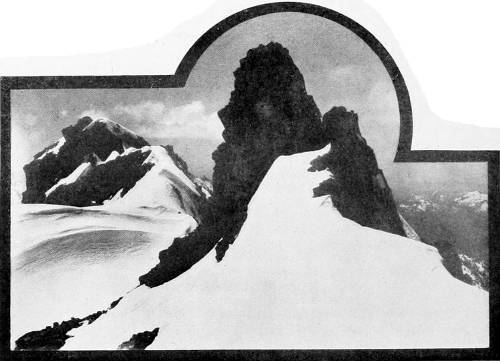
Taken in Chelan County. Photo by the Author. SHRECKLICH PINNACLES. DETAILS OF THE APPROACH TO MT. SAHALE.
Lives there a man so brutish that his heart does not kindle when he sees Rainier lit up with the ruddy glow of the evening sacrifice? If such there be, he is no bird-lover. Lives there a woman who can gaze upon the virgin snows of Kulshan, Shuksan, or Sahale, and not adore the emblem of eternal [79] purity thereon displayed? If so, she will not appreciate the Leucosticte. This bird is the vestal virgin of the snows, the attendant minister of Nature’s loftiest altars, the guardian of the glacial sanctuaries.
One who loves the mountains cannot measure his praise nor bound his enthusiasm. Their sublimity bids him forget his limitations; and if one happens also to care for birds, it is matter of small justice to laud a bird whose devotion to the peaks appears as boundless as his own, besides knowing neither admixture of caution nor limitation of opportunity. Here is the patron saint of mountaineers! He alone of all creatures is at home on the heights, and he is not even dependent upon the scanty vegetation which follows the retreating snows, since he is able to wrest a living from the very glaciers. Abysses do not appall him, nor do the flower-strewn meadows of the lesser heights alienate his snow-centered affections.
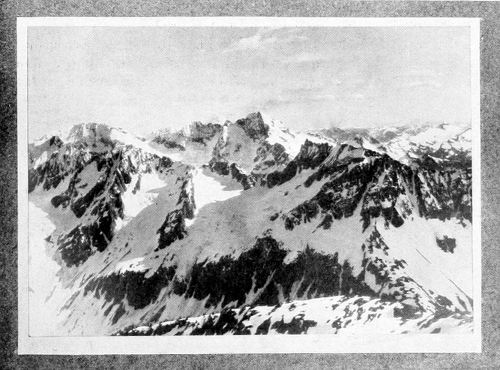
Taken in Chelan County. Photo by the Author. “THE CHILLY WILDERNESS OF SNOW-CLAD PEAKS.”
Looking out on the chilly wilderness of snow-clad peaks which confronts Leucosticte on an early day in June, one wonders what the bird sees to justify the assumption of family cares. Save for a few dripping south exposures of inhospitable rock, there is nothing visible which affords promise of food unless it be the snow itself. And when one sees a little company of the [80] finches moving about demurely upon the face of a choppy snowdrift, pecking at the surface here and there, he begins to harbor an uncanny suspicion that the birds do eat snow. Closer examination, however, shows that the surface of all snow-banks, not freshly covered, is sprinkled with insects,—midges, beetles, wasps, and the like—insects which the spring gales have swept up to uncongenial heights and dropped, benumbed or dead with cold. These battered waifs the Leucostictes gather with untiring patience, and they are thus able to subsist as no other species can, up to the very summits.
The eggs of the Hepburn Leucosticte have not to our knowledge yet been taken. Mr. D. E. Brown, then of Glacier, found these birds scooping hollows under grass tussocks on the middle slopes of Baker, above timber line, on the 7th of June, 1905. On the 20th of July, 1900, Professor Lynds Jones and myself found a thick-walled grass nest settled upon bare rock without protection, on the south slope of the aiguille of Wright’s Peak, at an elevation of some 9,000 feet, and within a hundred yards of the summit; this could hardly have belonged to any other species.
In July, 1907, knowing that it was too late for eggs, I yet spent several days searching the precipitous wall which separates the upper Horseshoe Basin from the glacier which heads Thunder Creek. Adult birds to the number of a dozen gleaned scraps from the dump of the Cascade Mine house; but, altho each made off in business-like fashion when “loaded,” the stretch of the wall was too vast and its recesses too mazy to permit of exact work in tracing. I therefore examined carefully but with difficulty several of the weathered fissures, or couloirs, which ran perpendicularly up the face of the cliff. Here, under cover of rocks which had lodged in the throat of the fissure, or which had weathered out unevenly, old nests were found, simple affairs of coiled grasses, and too dilapidated for exact measurement. From one of these sites a pebble snapped from the finger must have fallen three hundred feet before striking the glacier below.
Now and then a passing bird, suspicious of my intent, stopped on some projecting point of rock, to utter the sole note which does duty for every mood, churkk or schthub, a sound comparable only to the concussion of a small taut rope on a flag-pole. Finally, near the top of the Sahale Glacier, I got a line at two hundred yards on an occupied fissure, and traced both parent Leucostictes into its distant recesses. Climbing cautiously up a sharp slope of ice, my footsteps were guided by the almost incessant clamor of young birds. Arrived at the upper lip of the glacier, however, I found that it stood away from the rock-wall some fifteen feet, and that a chasm some forty feet in depth yawned beneath. Into this forbidding bergschrund, one of the fledgling Leucostictes had tumbled. He was not more than two-thirds grown (July 18th) and down feathers still fluttered from his cheeks, but he was a plucky little fellow, and had managed to scramble up off the ice onto a piece [81] of flat rock which caught a bit of the afternoon sun. Here, to judge from his lusty yelping, there could be no doubt that his parents would notice him, altho they would be powerless to secure his further release until his wings were grown. A Carnegie medal hovered suggestively over the spot, I know; but pray, consider,—the rock wall was perpendicular and smooth as glass, the ice-wall I stood on was undercut. No; even philornithy has its limits!
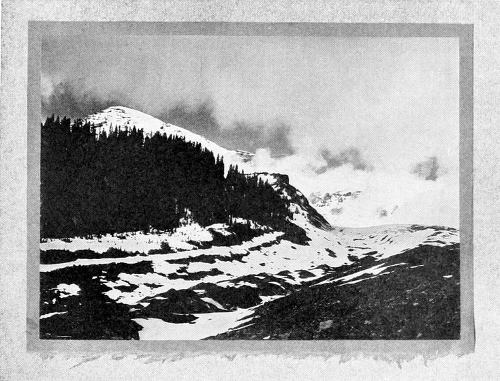
Taken in the Rainier National Park. From a Photograph Copyright, 1908, by W. L. Dawson. A GLIMPSE OF MT. RAINIER FROM THE NISQUALLY GLACIER. A FAVORITE HAUNT OF THE HEPBURN LEUCOSTICTE.
The nest containing the remaining youngsters was set well back in a rock fissure, concealed by projections eighty feet above the fallen first-born, and inaccessible to man from above or below. With the possible exception of the Black Cloud Swifts (Cypseloides niger borealis), who are reported to share at times these same cliffs, it is safe to say that the Leucostictes are the highest nesters on the continent.
[82]
No. 29. REDPOLL.
A. O. U. No. 528. Acanthis linaria (Linn.).
Synonyms.—Common Redpoll. Lesser Redpoll. Linnet. Lintie.
Description.—Adult male: Crown crimson; breast and shoulders crimson in varying proportions according to season; frontlet, lores, and throat-patch sooty black; remaining lower parts white, flanks and crissum streaked with dusky; above, variegated dusky, flaxen-brown and whitish, the feathers having dusky centers and flaxen edgings; rump dusky and white in streaks, tinged with rosy; wings and tail dusky with flaxen or whitish edgings; two inconspicuous wing-bars formed by white tips of middle and greater coverts. Female: Similar but without red on rump and breast, the latter suffused with buffy instead; sides heavily streaked with dusky. Immature: Like female but without crimson crown. Length 5.50 (139.7) or less; wing 2.80 (71.1); tail 2.30 (58.4); bill .34 (8.6); depth at base .23 (5.8).
Recognition Marks.—Warbler to Sparrow size; crimson crown-patch in adults; no dusky spot on breast.
Nesting.—Does not breed in Washington. Nest: a bulky affair of twigs and grasses, lined with feathers and placed in trees and bushes. Eggs: 4-6, pale blue, dotted and speckled with reddish brown or umber. Av. size, .65 × .50 (16.5 × 12.7).
General Range.—Northern portions of northern hemisphere, south irregularly in winter, in North America to the Middle States, and southern Oregon.
Range in Washington.—Winter resident, abundant on East-side, infrequent or casual west of the Cascades.
Migrations.—Nov. 1-Dec. 15. Feb. 15-March 15. Yakima Co. Oct. 31, 1899. Chelan March 19, 1896.
Authorities.—Ægiothus linaria Cab. Cooper and Suckley, Rep. Pac. R. R. Surv. Vol. XII. pt. ii, 1860, 198. C&S. D¹. Ra. D². Kk. J. B.
Specimens.—(U. of W.) Prov. B. C. P.
Those who count themselves familiar with the Goldfinch are apt to let the first few flocks of Redpolls pass unquestioned. When, however, in late November, a norther brings down some thousands of these Alaskan waifs, the bird student is roused to attention. The resemblance between the two species is most striking in form and appearance as well as in habit and note. But once the eyes have been assured by a near revelation of convincing red, that Acanthis linaria is before them, the ears remark also a slight foreign accent in the sweetie call and in the rattling flight notes.
Redpolls summer abundantly along the coasts of Alaska, and along the higher levels down thru British Columbia. The winter movements of this species are irregular and somewhat confusing. According to Nelson, the [83] western residents retire into the interior of Alaska to winter, where they are able to withstand the fiercest cold. The interior birds retire largely to the south, and under the urgency of bad weather sweep into or thru eastern Washington in immense numbers. There is also a small movement setting in a southwesterly direction, so that some birds winter regularly on Vancouver Island, and a few straggle thru the Puget Sound country.
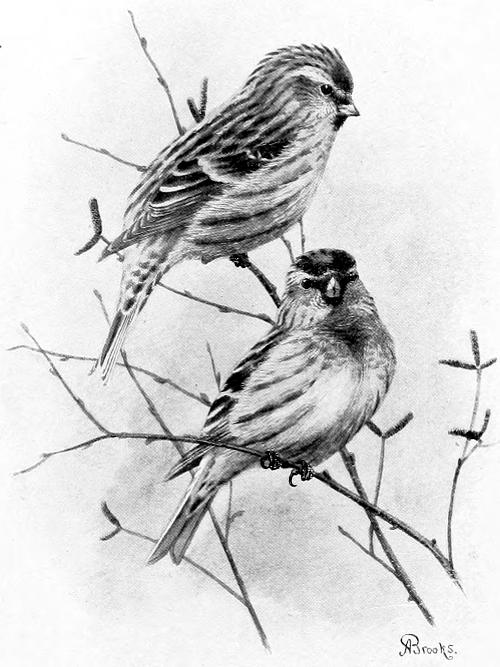
REDPOLLS IN WINTER.
While with us, the Redpoll is nowise dependent upon the forests, but appears to seek the more open country by preference. It subsists chiefly upon seeds, gleaning them from the ground with much pleasant chatter, or seeking them in their winter receptacles. Redpoll again proves kinship with Goldfinch by eating thistle seeds, and with Siskin by his extravagant fondness for the alder catkin. Redpoll’s manner is very confiding; and we are sure that he would not begrudge us a share of his winter viands, if we cared for them. The author is no vegetarian, but he is bound to admit that a “simple diet of grains, fruits and nuts” makes for contentment among the birds, even at forty below zero.
As spring comes on, and the gentle hyperboreans prepare to return to their native heather, we see the deep-dyed crimson of full regalia on crown and breast. But during the actual breeding season, we are told by a competent [84] observer in Greenland, Holboell, the male not only becomes exceedingly shy but loses his rosy coloring. It is hardly to be supposed that this loss of color is a protective measure, but rather that it is the result of the exhaustive labors incident to the season. Nature, in that forbidding clime, cannot afford to dress a busy workman in fine clothes. It is noteworthy in this connection, also, that caged Redpolls lose their rosy tints never to regain them.
No. 30. PINE SISKIN
A. O. U. No. 533. Spinus pinus (Wils.).
Synonyms.—American Siskin. Pine Finch. Pine Linnet.
Description.—Adult male and female: Above brownish buffy; below creamy-buff and whitish; everywhere streaked with dusky or dark olive-brown; the streakings are finer on the head and foreparts, coarser on back and breast; wings fuscous, the flight feathers sulphur-yellow at the base, and the primaries edged with the same color; tail fuscous, all but the middle feathers sulphur-yellow at base. Bill comparatively slender, acute. Length 4.75-5.00 (120.6-127); wing 2.75 (69.9); tail 1.80 (45.7); bill .43 (10.9).
Recognition Marks.—Warbler size; conspicuous general streakiness, sulphur-yellow markings of wings and tail, most noticeable in flight.
Nesting.—Nest: saddled upon horizontal limb of evergreen tree, well concealed from below, usually at moderate heights; very variable in structure, flimsy to massive and ornate; composed of small twigs (usually fir), and tree-moss, with a lining of fine rootlets and horse- or cow-hair, rarely feathers. An average nest measures externally 4½ inches wide by 2¼ in. deep; internally 2 in. wide by 1 in. deep. Eggs: 1-4, usually 3 or 4, pale bluish green lightly dotted with rufous and blackish, chiefly about larger end. Av. size .67 × .48 (17 × 12.2). Season: March-September, but most abundant in April; one brood.
General Range.—North America at large, breeding in higher latitudes, and in coniferous forests of the West to southern boundary of United States; also sparingly in northeastern United States; irregularly south in winter to Gulf of Mexico.
Range in Washington.—In summer coextensive with evergreen timber, but especially common in mountains just below limit of trees; in winter more localized, or irregularly absent.
Authorities.—Chrysomitris pinus Bonap. Baird, Rep. Pac. R. R. Surv. IX. pt. II. 1858, p. 425. T. C&S. L². Rh. D¹. D². Kk. J. B. E.
Specimens.—U. of W. Prov. B. E. P.
In designing the Siskin, Nature achieved another triumph in obscurities. The heavy streaky pattern, worked out in dusky olive on a buffy brown [85] base, prepares the bird for self-effacement in any environment; while the sulphur-colored water-mark of the outspread wings barely redeems its owner from sheer oblivion. This remark applies, however, only to plumage. In behavior the Siskin is anything but a forgettable bird-person.
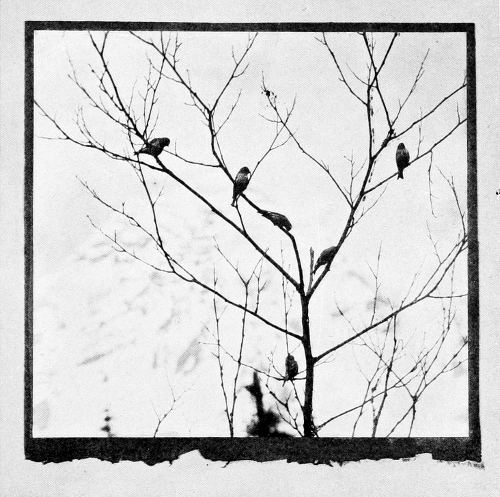
Taken at Longmire’s Springs. From a Photograph Copyright, 1908, by W. L. Dawson. SIX LITTLE SISKINS. “THE MOUNTAIN” AS A BACKGROUND.
Whatever be the time of year, Siskins roam about in happy, rollicking bands, comprising from a score to several hundred individuals. They move with energy in the communal flight, while their incessant change of relative positions in flock suggests those intramolecular vibrations of matter, which [86] the “new physicists” are telling us about. When a bird is sighted alone, one sees that it is the graceful, undulatory, or “looping,” flight of cousin Goldfinch which the social Siskin indulges so recklessly.
Many of the notes, too, remind us of the Goldfinch. There are first those little chattering notes indulged a-wing and a-perch, when the birds are not too busy feeding. The koodayi of inquiry or greeting is the same. But there is another note quite distinctive. It is a labored, but singularly penetrating production with a peculiar vowel sound (like a German umlauted u), züm or zzeem. So much effort does the utterance of this note cost the bird, that it always occasions a display of the hidden sulphur markings of wings and tail.
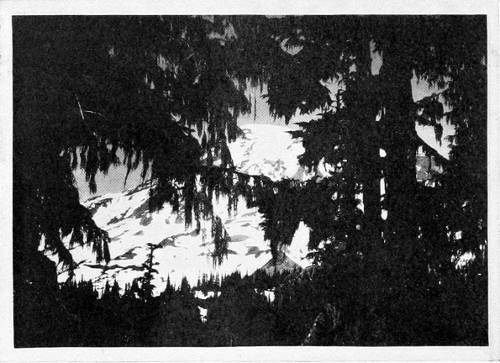
Photo by W. Leon Dawson. THE DRAPERIES OF PARADISE. RAINIER AS SEEN BY THE SISKIN.
When fired by passion the Siskin is capable, also, of extended song. This daytime serenade is vivacious, but not loud except in occasional passages,—a sort of chattering, ecstatic warble of diverse elements. The bird has, besides its own peculiar notes, many finch-like phrases and interpolations, reminding one now of the Goldfinch, and now of the California Purple Finch. The most striking phrase produced in this connection is a triple shriek of the Evening Grosbeak, subdued of course, but very effective.
Tho perhaps not numerically equal to the Western Golden-crowned Kinglet, nor to the Western Winter Wren, there is not another bird in Washington which enjoys a more nearly uniform distribution than the Pine [87] Siskin. Its breeding range coincides with the distribution of evergreen timber; its feeding forays include all alder trees; and roving bands are likely to turn up anywhere in eastern Washington, if there is shrubbery larger or greener than sage-brush at hand.
Much of Siskin’s food is obtained upon the ground. City lawns are favorite places of resort; these birds, together with California Purple Finches, appearing to derive more benefit from grass plots, whether as granaries or insectaria, than does any other species. They share also with Crossbills a strong interest in the products of fir trees, whether in cone or leaf. Their peculiar province, however, is the alder catkin, and the tiny white seeds obtained from this source are the staple supply of winter. Mr. Brown, of Glacier, has examined specimens in which the crops were distended by these seeds exclusively. While the observer is ogling, it may be an over-modest Townsend Sparrow, a flock of Pine Siskins will charge incontinently into the alders above his very head. With many zews and zeems they fall to work upon the stubborn catkins, poking, twisting, prying, standing on their heads if need be, to dig out the dainty dole. Now and then, without any apparent reason, one detachment will suddenly desert its claim and settle upon another, precisely similar, a few feet away; while its place will be taken, as likely as not, by a new band, charging the tree like a volley of spent shot.
Nesting time with the Siskin extends from March to September, and the parental instinct appears in the light of an individual seizure, or decimating epidemic, rather than as an orderly taking up of life’s duties. Smitten couples drop out from time to time from the communal groups, and set up temporary establishments of their own; but there is never any let-up in the social whirl on the part of those who are left; and a roistering company of care-free maids and bachelors en fete may storm the very tree in which the first lullabies are being crooned by a hapless sister. Once in a while congenial groups agree to retire together, and a single tree or a clump of neighbors may boast a half-a-dozen nests; tho which is which and what is whose one cannot always tell, for the same intimacy which suggested simultaneous marriage, allows an almost unseemly interest in the private affairs of a neighbor.
Once embarked upon the sea of matrimony, the female is a very determined sitter, and the male is not inattentive. In examining the nest of a sitting bird one may expect the mother to cover her eggs at a foot’s remove, without so much as by-your-leave.
The nest, in our experience, is invariably built in an evergreen tree, usually a Douglas spruce (Pseudotsuga mucronata), and is commonly saddled upon a horizontal or slightly ascending limb at some distance from the tree trunk. Viewed from below, it appears merely as an accumulation of material at the base of divergent twigs, where moss and waste is wont to gather. [88] As to distance from the ground, it may vary from four to a hundred feet. The latter is the limit of investigation, but there is no particular reason to suppose they do not go higher. Most of the nests are placed at from eight to twenty feet up.
The materials used in construction are dead fir-twigs, weed-stalks, strips of cedar-bark, mosses of several sorts, grass, fir, hair, plant downs, etc. The interior may be carefully lined with fine rootlets, fur, horse-hair, feathers, altho there is great variation both in material and workmanship. Some nests appear little better than those of Chipping Sparrows; while the best cannot certainly be distinguished (without the eggs) from the elegant creations of the Audubon Warbler. One nest found near Tacoma in April, 1906, was allowed to pass for two weeks as that of a Western Golden-crowned Kinglet; it was built in characteristic Kinglet fashion, chiefly of moss, and was lashed midway of drooping twigs four inches to one side and below the main stem of the sustaining branch, near its end.