Volume 1 — The Birds of Washington (continued 5)
Reading edition
The male birds precede the dull-colored females by several days, and at such times only may be found in companies. One windy afternoon in May, the 20th it was, while the Columbia River steamer doddered with its freight, I took a turn ashore and explored a tiny oasis of willows which lined a neighboring brook. I soon caught the pitic or pititic of newly-arrived Tanagers. Judge of my delight upon beholding, not one, but eight of these beauties, all old males, as they filed out of a willow clump, where they had evidently taken refuge for the day. A week or so later I saw Tanagers at home in the meager willow fringes of Crab Creek, in Lincoln County; and while we were in camp at Brook Lake in Douglas County, one came out thru the sage, hopping and flitting from bush to bush, to bring me friendly greetings. It was like meeting a king in a millet field.
The song of the Louisiana Tanager—pardon the lapse; habit is stronger than reason—the song of the Crimson-headed Tanager is an étude in R. “It is remotely comparable to that of the Robin, but it is more stereotyped in form, briefer, and tittered at intervals rather than continuously sustained. The notes are sharp-edged and rich in r’s, while the movement of the whole, tho deliberate, is varied, and the tone cheerful”[24]. I can detect no constant difference between the song of the Crimson-headed Tanager and that of the Scarlet Tanager (P. erythromelas), save that that of the former is oftener prefaced with the call note, thus: Piteric whew, we soor a-ary e-erie witooer. This song, however, is less frequently heard than that of the Scarlet Tanager, East. Its perfect rendition, moreover, argues the near presence of a demure little lady in olive, a person who looks like nobody in particular to our undiscriminating gaze, but who exerts a strange fascination over our brilliant squire. Young males of the second summer sing hopefully, but they are less often successful in love than their ruddier rivals.
[172]
It behooves the Tanager maiden to be exacting in her choice, for all the help she will get out of him at best will be sympathy and song. When it comes to real work, like nest building, she must do it. He will graciously advise as to the situation, some horizontal branch of fir or pine, from six to fifty feet high, and from three to twenty feet out. He will even accompany her on her laborious trips after nesting material, cooing amiable nothings, and oozing approval at every joint,—but help her—nevaire!
The nest is quite a substantial affair tho rather roughly put together, of fir twigs, rootlets, and moss, with a more or less heavy lining of horse- or cow-hair, and other soft substances. The four eggs of greenish blue, dotted and spotted with lavender and dark greenish slate, appear especially handsome from above, when viewed against the dark brown nest. But, as everybody knows, the red fir (Pseudotsuga mucronata) is a tree of moods and tenses. You may dangle with impunity from the very tips of the branches of some fir trees, while a step from the trunk is fatal in others of the same general appearance. The Tanagers are quite as apt to patronize the brittle kind.
Mniotiltidæ—The Wood Warblers
No. 70. ORANGE-CROWNED WARBLER.
A. O. U. No. 646. Helminthophila celata (Say).
Description.—Adult male: Above ashy olive-green, clearing and brighter on rump; crown largely ochraceous but color partly veiled by olive tips of feathers; wings and tail fuscous with some olive edging; below greenish-yellow, dingy, or vaguely streaked with blue on breast and sides. Adult female: Similar to male but duller, with ochraceous crown-patch restricted or wanting. Immature: Without ochraceous crown; more ashy above; duller below save that abdomen is white; eyelids often whitish. Length about 5.00 (127); wing 2.40 (61); tail 1.95 (49.5); bill .42 (10.7); tarsus .70 (17.8).
Recognition Marks.—Small warbler size; ochraceous (“orange”) crown-patch distinctive from all except H. c. lutescens, which is the common bird; duller. See next (sub)species.
Nesting.—Not known to nest in Washington but may do so. As next.
General Range.—Summer resident in western British America and Alaska (save in Pacific coast district), south thru Rocky Mountain district to New Mexico; migrating across Central States and casually(?) New England, Middle Atlantic States, Pacific States, etc., to Mexico.
Range in Washington.—Probably common migrant but passing undistinguished among more abundant lutescens.
Authorities.—Bowles and Dawson, Auk, Vol. XXV., Oct. 1908, p. 483.
Specimens.—Bowles. Prov. P.
[173]
Most Alaskan species, even of those which retire in winter to South Carolina, Florida, and the Antilles, may be expected to drift thru our borders sooner or later. Typical H. celata was first caught in the act by Mr. Bowles in May, 1907, but we have no means of knowing that the northern form is not a frequent trespasser. Kermode gives it as a common summer resident east and west of the Cascades in British Columbia, and it is not impossible that our northern Cascade records should be referred to this type.
No. 71. LUTESCENT WARBLER.
A. O. U. No. 646a. Helminthophila celata lutescens Ridgway.
Description.—Adults:—Similar to H. celata but brighter. Above bright olive-green; below definitely yellow—olive-yellow, gamboge, or even canary (on under tail-coverts). Immature: Above plain olive-green (not ashy, as in H. celata); below buffy yellow tinged with olive on breast and sides. Measurements as in preceding.
Recognition Marks.—Small warbler size; perhaps the most abundant of the eight or nine “yellow” warblers of the State; ochraceous crown-patch, of course, distinctive; not so bright as the Pileolated Warblers (W. p. pileolata and W. p. chryseola).
Nesting.—Nest: on the ground sunk in bed of moss, under protection of bush or weed, or in shelving bank, of coiled dry grasses, lined with finer; 1¾ inches wide by 1 inch deep inside. Eggs: 4, rarely 5, dull white marked with dots and a few small blotches of yellowish brown and lavender; in shape long to short ovate, rarely oval. Av. size .67 × .51 (17 × 12.9). Season: May 1 and June 1; two broods.
General Range.—Summer resident in Pacific Coast district from Cook Inlet to southern California, east to western ranges of Rocky Mountain System, where intergrading with H. celata; south in winter to western Mexico and Guatemala.
Range in Washington.—Of general occurrence thruout the lower levels; abundant in Puget Sound region.
Migrations.—Spring: April 3, 6, 7 (Seattle). April 24 (Chelan). March 28, 1908 (Seattle).
Authorities.—(?) Townsend, Journ. Ac. Nat. Sci. Phila., VIII., 1839, 153 part (Columbia River). Cooper and Suckley, Rep. Pac. R. R. Surv., XII., pt. II., 1860, 178. (T.) C&S. L¹, Rh. D¹. Kb. Ra. D². Kk. B. E.
Specimens.—U. of W. Prov. B. BN. E.
Yellow appears to be the prevailing color among our Washington Wood Warblers; and even of those which are not frankly all over yellow, [174] as this one is, there are only two which do not boast a conspicuous area of this fashionable shade. And of all yellows, yellow-green, as represented by the back of this bird, is the commonest,—so common, indeed, as to merit the facetious epithet “museum color.” It is all very well in the case of the male, for he comes back (to Seattle) during the first week in April, before the leaves are fully out; and he is so full of confidence at this season that he poses quite demurely among the swelling buds of alder, maple, and willow. He is proud of his full crown-patch of pale orange, contrasting as it does with the dull yellowish green of the upperparts and the bright greenish yellow of the underparts,—and he lets you get a good view of it at twenty yards with the glasses. Besides that, he must stop now and then to vent his feelings in song. But the case of the female is almost hopeless—for the novice.
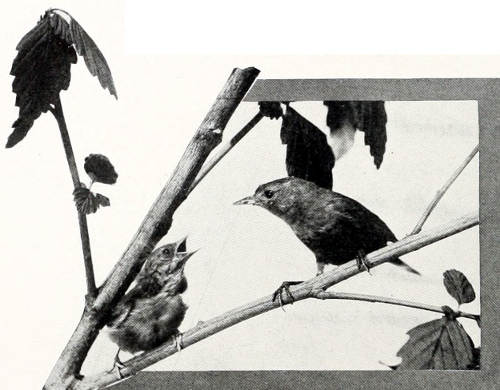
Taken in Oregon. Photo by Bohlman and Finley. A HUNGRY CHICK. LUTESCENT WARBLER, FEMALE AND YOUNG.
The song of the Lutescent Warbler appears to have been very largely overlooked, but it was not the bird’s fault. While waiting for his tardy mate, he has rehearsed diligently from the taller bushes of the thicket, or else from some higher vantage point of maple, dogwood, or fir tree. The burden is intended for fairy ears, but he that hath ears to hear let him hear a curious vowel scale, an inspirated rattle or trill, which descends and ends in a simple warble of several notes. The trill, brief as it is, has three qualities of change which make it quite unique. At the opening the notes are full and slow, but in the instant necessary to the entire recital the pace accelerates, the pitch rises slightly, and the component notes decrease in volume, or size. At the climax the tension breaks unexpectedly in the gentle, musical cadence of the concluding phrases, whose notes much resemble certain of the Yellow Warbler’s. The opening trill carries to a considerable distance, but the sweetness of the closing warble is lost to any but near listeners. The whole [175] may be rendered graphically somewhat as follows; O-o-ā-ā-i-i-é-é-é-é-é-é wichy, wichy, wichy.
In the brush and under alarm these birds utter a brusque, metallic scolding note, which is perfectly distinctive locally, altho it much resembles that of the Oporornis group East. By this mark alone may the mere greenish female be certainly discerned.
Lutescent Warblers abound thruout western Washington, and easterly, when the Cascades are well passed, as upon the Pend d’Oreille. Jungle of any kind suits them, whether it be a thicket of young firs at Tacoma, an overgrown burn at Snoqualmie, a willow swamp in Yakima County, or a salmon-berry tangle on Destruction Island. Nests are of dead grasses well knitted and sunk flush with the ground, or below it, in some moss bed, at the base of a bush, or on some sloping hillside. Rarely the structure may be taken up into a bush. The female is a close sitter, but once flushed shows implacable resentment. She summons her mate to assist in the gentle art of exorcism, or else turns the tables and deserts outright. The latter, you understand, is quite the subtlest and most baffling form of revenge which a bird may compass in the case of an oölogist anxious to identify his find.
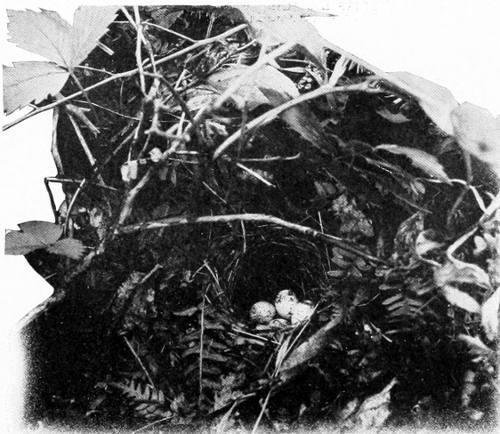
Taken near Tacoma. Photo by J. H. Bowles. NEST AND EGGS OF LUTESCENT WARBLER.
[176]
No. 72. CALAVERAS WARBLER.
A. O. U. No. 645a. Helminthophila rubricapilla gutturalis (Ridgw.).
Description.—Adult male: Head above and on sides bluish ash with a partially concealed crown-patch of bright chestnut; a whitish eye-ring; remaining upperparts bright olive-green becoming yellowish green on rump and upper tail-coverts; underparts including crissum, bright yellow, but whitening on belly; bill small, short, acute, blackish above, brownish below; feet brown. Adult female: Like male but somewhat duller below; ashy of head less pure, glossed with olivaceous and not so abruptly contrasting with yellow of throat; chestnut crown-patch less conspicuous or wanting. Immature: Olive-green of upperparts duller; head and neck grayish brown instead of ashy; below dull olive-yellow, clearing on belly and crissum. Length of male (skins) 4.05-4.75 (103-121); wing 2.35 (60); tail 1.75 (45); bill .38 (9.6); tarsus .63 (16). Female smaller.
Recognition Marks.—Smaller; bright yellow of throat (and underparts), contrasting with ashy of head, distinctive.
Nesting.—Nest: usually sunk well into ground or moss at base of bush-clump or rank herbage, well made of fine bark-strips and grasses, lined with finer grasses, horse-hair and, occasionally, feathers; outside, 3 in. wide by 2 in. deep; inside 1¾ wide by 1¼ deep. Eggs: 3-5, usually 4, dull white as to ground-color, but showing two distinct types of markings: one heavily sprinkled with fine dots of reddish brown, nearly uniform in distribution, or gathered more thickly about larger end; the other sparingly dotted, and with large blotches or “flowers” of the same pigment. Av. size .64 × .49 (16.3 × 12.5). Season: May 20-July 20, according to altitude; two broods. Chelan Co. July 22, 1900, 3 fresh eggs.
General Range.—The Pacific States and British Columbia south to Calaveras County, California, and east (at least) to northern Idaho; found chiefly in the higher mountains; in migrations to Lower California and western Mexico.
Range in Washington.—Summer resident on brushy slopes and in timbered valleys of the higher ranges thruout the State, and irregularly at lower levels, at least on Puget Sound (Tacoma).
Migrations.—Spring: Wallula, April 23, 1905; Benton County, May 4, 1907; Chelan, May 21, 1896; Tacoma, April 24, 1897. Fall: Last week in August (Blaine).
Authorities.—Dawson, Auk, XVIII. Oct. 1901, 463. (D¹). J. B.
Specimens.—B.
There is something distinct and well-bred about this demure exquisite, and the day which discovers one searching the willow tops with genteel aloofness is sure to be underscored in the note-book. The marks of the spring male are as unmistakable as they are regal: a bright yellow breast and throat contrasting with the ashy of cheeks and head, the latter shade relieved by a white eye-ring, and surmounted by a chestnut crown-patch. If you stumble upon a company of them at play among the thorn bushes, [177] you are seized, as like as not, with a sense of low birth, and feel like retiring in confusion lest you offend royalty.
These gentle despots are bound for the mountains; and since their realms are not prepared for them till June, they have ample leisure to discuss the fare of wayside stations. They enter the State from the South during the last week in April—Wallula, April 23d, is my earliest record; but May 21st records an unanxious company at the foot of Lake Chelan. As the season advances they take up quarters on brushy mountain sides, or in the deciduous skirts of fierce mountain torrents. Here while the female skurries about thru the buck-brush or vine-maple thickets in search of a suitable nesting site, the male mounts a fir tree and occupies himself with song.
If you are spying on this sacred function, the bird first peers down at you uneasily, then throws his head back and sings with great animation: Choopy, choopy, choopy churr (tr). The trill is composed of a dozen or so of large notes which the ear can easily distinguish, but which because of the vivacious utterance one cannot quite count. The pitch of the finale is sustained, but there is a slight decrease in volume. If forced to descend, the singer will join his mate in sharp chips of protest, somewhat similar to those of the Audubon Warbler, altho not quite so clear-cut or inflexible.
While the Calaveras Warbler is a bird of the mountains and lives at any height where suitable cover is afforded, it is a curious fact that it sometimes prefers the timbered lowlands of Puget Sound, and may be found in some seasons in considerable numbers about the southern prairies. Mr. Bowles has found them commonly in scrub-oak patches which border the fir groves and timbered lakes; and yet during some years they have been unaccountably absent from the entire region.
Near Tacoma this Warbler places its nest at the base of a young oak or fir tree, where the spreading branches have protected the grass and gathered weeds. The nest is sunk well into the ground or moss, and is so well concealed as to defy discovery unless the bird is flushed. When frightened from the nest the female instantly disappears, and returns only after some considerable interval. Then she approaches with the greatest caution, ready to dart away again upon the first sign of movement on the part of the intruder. The male, if he happens to be about at all, neither joins the defense nor consoles his mate in misfortune, but sets upon her furiously and drives her from bush to bush, as tho she had wilfully deserted their treasures.
At sea-level two sets of eggs are laid in a season, one fresh about May 18th, the other about June 25th. In the mountains, however, the second nesting, if indulged in at all, is thrown very late. I took a set of three fresh eggs from a carelessly constructed nest placed in the top of an elk-weed (Echinopanax horridum) at a height of three feet, on the 22d day of July, 1900.
[178]
No. 73. YELLOW WARBLER.
A. O. U. No. 652. Dendroica æstiva (Gmel.).
Synonyms.—Summer Yellow-bird. Summer Warbler. Wild Canary.
Description.—Adult male: Forehead and fore-crown bright yellow with an orange tinge; back bright olive-green; rump greenish yellow; wings and tail blackish with greenish yellow edgings, the wing quills edged on both webs, the tail-feathers—except middle pair—almost entirely yellow on inner webs; sides of head and entire underparts golden yellow, the breast and sides heavily streaked with chestnut; bill black; feet pale. Adult female: Like male but duller; olive-green on back, not brighter on forehead; paler yellow below, obscurely or not at all streaked with chestnut. Young males resemble the adult female. Young female still duller; dusky yellow below. Length 4.75-5.25 (120.6-133.3); wing 2.51 (63.8); tail 1.68 (42.7); bill .40 (10.2); tarsus .73 (18.61).
Recognition Marks.—Medium size; golden yellow coloration; chestnut streaks on breast of male; after the Lutescent the commonest of the resident Warblers; chiefly confined to the banks of streams and ponds.
Nesting.—Nest: a compact cup of woven “hemp” and fine grasses, lined heavily with plant-down, grasses, and, occasionally, horse-hair, fastened to upright branch in rose-thickets and the like. Eggs: 4 or 5, white, bluish-, creamy-, or grayish-white, speckled and marked with largish spots of reddish brown, burnt umber, etc., often wreathed about the larger end. Av. size, .70 × .50 (17.8 × 12.7). Season: May 20-June 20; one brood.
General Range.—North America at large, except southwestern part, giving place to D. æ. rubiginosa in extreme northwest. South in winter to Central America and northern South America. Breeds nearly thruout its North American range.
Range in Washington.—Summer resident in deciduous timber, and shrubbery lining streams, thruout the State from sea-level to 4,000 feet.
Migrations.—Spring: Tacoma, April 24-30; Yakima, April 30, 1900; Chelan, May 21, 1896. Fall: First week in September.
Authorities.—Cooper and Suckley, Rep. Pac. R. R. Surv., XII., pt. II., 1860, p. 181. T. C&S. L¹. Rh. D¹. Ra. D². Ss¹. Ss². Kk. J. B. E.
Specimens.—B. BN. E. P¹.
The Summer Warbler’s gold is about as common as that of the dandelion, but its trim little form has not achieved any such distinctness in the public mind. Most people, if they take notice at all of anything so tiny, dub the birds “Wild Canaries,” and are done. The name as applied to the Goldfinch may be barely tolerated, but in the case of the Warbler it is quite inappropriate, since the bird has nothing in common with the Canary except littleness and yellowness. Its bill is longer and slimmer, for it feeds exclusively on insects instead of seeds; and its pure yellow and olive-green [179] plumage knows no admixture, save for the tasty but inconspicuous chestnut stripes on the breast of the adult male. These stripes are lacking in males of the second year, whence Audubon was once led to elaborate a supposed new species, which he called the “Children’s Warbler.” The name is not ill-fitting, even tho we know that it applies only to the Warbler’s children.
The Yellow Warbler is peculiarly a bird of sunshine, and is to be found chiefly in open situations. It swarms thru the orchards and gardens, frequents the wayside thickets, and in town takes possession of the shrubbery in lawn or park. It is abundant in swampy places, and is invariably present in season along the banks of streams which are lined with willows, alders, and wild rose bushes.
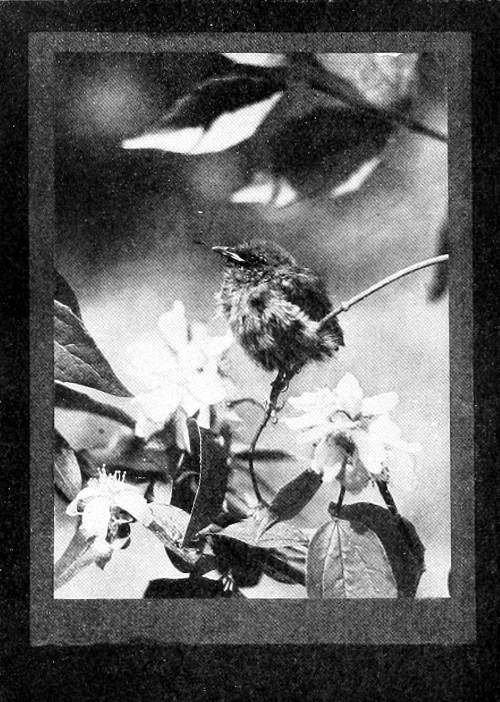
Taken in Oregon. Photo by Finley and Bohlman. A CONTENTED BABY.
The song is sunny, too, and while not elaborate, makes substantial contribution to the good cheer of spring. Heard in the boskage it sounds absurdly as if some wag were shaking an attic salt-cellar on a great green salad. The notes are almost piercing, and sound better perhaps from across the river than they do in the same tree. Individual variation in song is considerable, but the high pitch and vigor of delivery are distinctive. Certain common types may be syllabized as follows: Sweet, sweet, sweet, sweetie; tsee, tsee, tsit-a-wee, tsee; wee-chee, chee, chee wee-i-u; tsu, tsu, tsu, tsu, tseéew. From its arrival sometime during the last week in April, until near the close of its second nesting, late in July, the bird may be found singing thruout the sunlit hours.
The date of this bird’s annual advent in Washington is far less nearly [180] fixed than in the East. April 19th is my earliest date, recorded in Yakima County, but Dr. Cooper once saw large numbers (possibly D. a. rubiginosa) “at the Straits of De Fuca,” on April 8. On the west side of the mountains this Warbler may not often nest more than once in a season, but on the East-side it usually raises two broods.
The nest of the Yellow Warbler is quite common, especially easterly, where its cover is more restricted; and no special pains is taken at concealment. Nests may be placed at any height in orchard trees, alders, willows, or even fir saplings; but, without doubt, the most acceptable site is that afforded by dense thickets of the wild rose (Rosa pisocarpa) wherever found.
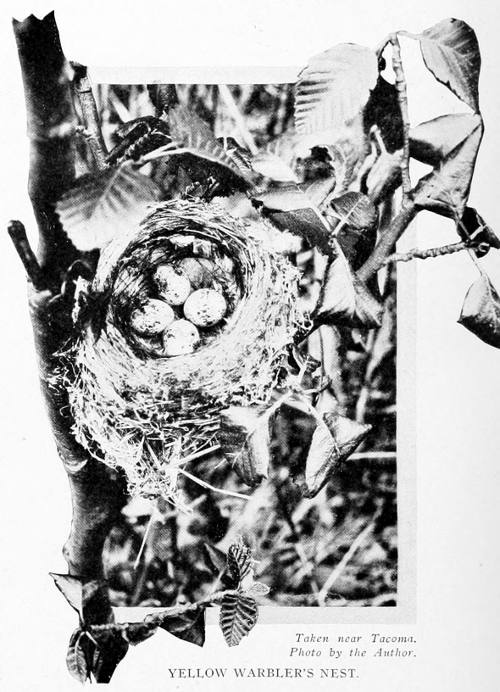
Taken near Tacoma. Photo by the Author. YELLOW WARBLER’S NEST.
The cradle of this bird is of exquisite fabrication. The tough inner bark of certain weeds—called indiscriminately “hemp”—together with grasses and other fibrous materials in various proportions, is woven into a compact cup around, or settled into, some stout horizontal or ascending fork of bush or tree. As a result the bushes are full of Warblers’ nests, two or more seasons old. A fleecy lining, or mat, of plant-down is a more or less conspicuous feature of every nest. Upon this as a background a scanty horse-hair lining may exhibit every one of its strands; or again, as in the case of a nest taken on the Chelan River, the eggs themselves may be thrown into high relief by a coiled black mattress.
[181]
The male Yellow is very domestic in his tastes, insomuch that, quite unlike other Warblers, he will often venture to sing from the very bush in which his mate is sitting. Unless well accustomed to the presence of humans, the female will not sit patiently under the threat of close approach. She slips off quickly and her vigorous complaints serve to summon her husband, when both flit about close to the intruder, and scold roundly in fierce, accusing notes, which yet have a baby lisp about them.
No. 74. MYRTLE WARBLER.
A. O. U. No. 655. Dendroica coronata (Linn.).
Synonym.—Yellow-rumped Warbler.
Description.—Adult male in spring: Above slaty blue with black streaks, smaller on sides of crown and nape, broader on back; below white, with black on upper breast, sides of middle breast, and sides in endless variety of patterns; a large patch on each side of breast, a partially concealed patch in center of crown, and rump, bright yellow (lemon or canary); superciliary line white; a deep black patch on side of head; wings fuscous; tail darker; middle and greater coverts narrowly tipped with white, forming two rather conspicuous bars; three outer pairs of tail-feathers with white blotches on inner webs, decreasing centrally; bill black; feet dark. Female in spring, and both sexes in fall: Duller; the blue of upperparts overlaid with brownish; a brownish wash on sides of breast and flanks; black of breast obscure,—restricted to centers of feathers; yellow of breast-spots pale or wanting. Immature: Brownish above; whitish below with a few obscure dusky streaks. Length 5.25-5.75 (133.3-146.1); av. of five males: wing 2.98 (75.7); tail 2.22 (56.4); bill .38 (9.7); tarsus .78 (20).
Recognition Marks.—Larger; white throat as distinguished from D. auduboni, which it otherwise closely resembles.
Nesting.—Not known to breed in Washington. Nest as in next species. Eggs indistinguishable.
General Range.—“Eastern North America chiefly, straggling more or less commonly to the Pacific; breeds from the northern United States northward, and winters from southern New England and the Ohio Valley southward to the West Indies, and through Mexico to Panama” (A. O. U. ’95). “An abundant summer resident on Vancouver Island and mainland (B. C.), chiefly west of Cascades” (Kermode).
Range in Washington.—Spring and fall migrant, probably of regular occurrence east and west of the Cascades.
Migrations.—Spring: Tacoma, Apr. 27, 1906, 1907; Seattle, May 3, 1908; Chelan, May 22, 1905; Yakima, Apr. 30, 1891.
Authorities.—Baird, Rep. Pac. R. R. Surv. IX. pt. II., 1858, 272, 273. C&S. Rh. Ra. D². Kk. B. E.
Specimens.—U. of W. Prov. C.
[182]
While only a little less lovely than its local kinsman, the Audubon Warbler, by as much as it has four patches of gold instead of five, this beautiful migrant appears to have been very largely lost to sight in the throng of its more brilliant relatives. Rathbun, writing from Seattle, says of it: “A regular and not uncommon spring migrant, associating with D. auduboni. Have no fall record.” Bowles from Tacoma says: “An irregular fall migrant, very numerous some years, the fall of 1905 for example. Have never seen it in spring.” Yakima, April 30, 1891; Chelan, May 22, 1905; Tacoma, April 27, 1907, are some of my own records. Fannin gives the species as “An abundant summer resident, chiefly west of the Cascades,” in British Columbia, and it should occur regularly within our borders during migration.
The tchip note of the Myrtle Warbler is indistinguishable from that of D. auduboni, but a single glimpse of the white throat is sufficient to establish identity. Those seen have necessarily been at close quarters and ranging low, in willow thickets, along the margins of ponds, etc., but it is altogether possible for a migrant troop to hold to the tree-tops in passing and so elude observation from “Forty-nine” to the Columbia.
No. 75. AUDUBON’S WARBLER.
A. O. U. 656. Dendroica auduboni (Towns.)
Synonym.—Western Yellow-rumped Warbler.
Description.—Adult male: Similar to D. coronata but throat rich gamboge yellow; auriculars bluish gray instead of black; a large white wing patch formed by tips of middle and outer edges of greater coverts; tail with white blotches on inner webs of four or five outer feathers; usually more extensively black on breast. Adult female: Similar to adult male but duller (differences closely corresponding with those in D. coronata); the white of wing patch nearly obsolete; the yellow of throat paler and often, especially on chin, more or less displaced by white (young females even of the second summer are sometimes absolutely without yellow on throat but the more abundant white on rectrices is distinctive as compared with D. coronata). Seasonal changes follow very closely those of D. coronata but yellow of throat is usually retained in winter save in young females and (occasionally) young-males. Length of adult about 5.50 (139.7); wing 3.00 (76); tail 2.45 (57); bill .41 (10.4); tarsus .80 (20.3).
Recognition Marks.—Warbler size; five spots of yellow; extensive white blotching of tail; yellow rump distinctive in any plumage save as compared with D. coronata, from which it is further distinguished (usually) by yellow or yellowish of throat (If this character fails, the more extensive white on tail will always hold).
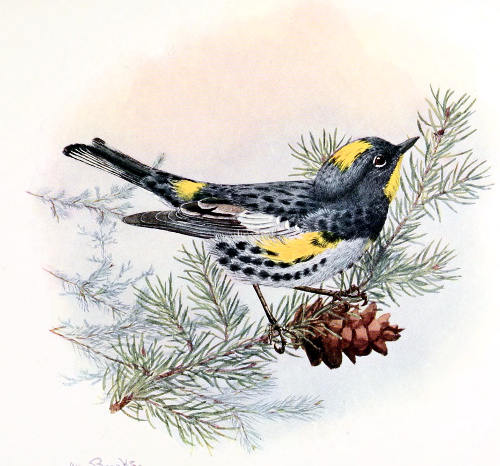
AUDUBON WARBLER MALE, ⅚ LIFE SIZE From a Water-color Painting by Allan Brooks
[183]
Nesting.—Nest: a well built, bulky structure of fir twigs, weed stems, rootlets, etc., heavily lined with horse-hair and feathers; placed usually on branch of conifer from four to fifty feet up, sometimes in small tree close against trunk, measures 4 inches in width outside by 2¾ in depth; inside 2 by 1½. Eggs: 3-5, usually 4, dull greenish white sparingly dotted with blackish or handsomely ringed, spotted and blotched with reddish brown, black and lavender. Av. size, .71 × .54 (18 × 13.7). Season: April-June; two broods. Tacoma, April 9, 1905, 4 eggs half incubated.
General Range.—Western North America, north to British Columbia, east to western border of the Great Plains, breeding thruout its range (in higher coniferous forests of California, northern Arizona, etc.) wintering in lower valleys and southward thruout Mexico. Accidental in Massachusetts and in Pennsylvania.
Range in Washington.—Common resident and migrant on West-side from tidewater to limit of trees; less common migrant and rare winter resident (?) east of the Cascades.
Migrations.—Spring: East-side: Yakima, March 11, 1900 (probably winter resident); Yakima, April 13, 1900; Chelan, April 20-24, 1896. West-side: Tacoma, April 24, 1906.
Authorities.—Sylvia auduboni Townsend, Journ. Ac. Nat. Sci. Phila. VII. 1837, 191 (“forests of the Columbia River”). C&S. L¹. Rh. D¹. Kb. Ra. D². Kk. B. E.
Specimens.—U. of W. P¹. Prov. B. BN. E.
As one considers the Thrushes, Wrens, and Sparrows of our northern clime, he is apt to grumble a little at the niggardliness of Mother Nature in the matter of providing party clothes. The dark mood is instantly dispelled, however, at the sight of this vision of loveliness. Black, white, and gray-blue make a very tasty mixture in themselves, as the Black-throated Gray Warbler can testify, but when to these is added the splendor of five golden garnishes, crown, gorget, epaulets, and culet, you have a costume which Pan must notice. And for all he is so bedecked, auduboni is neither proud nor vain,—properly modest and companionable withal.
Westerly, at least, he is among the first voices of springtime, and by the 10th of March, while all other Warblers are still skulking silently in the Southland, this brave spirit is making the fir groves echo to his melody. The song is brief and its theme nearly invariable, as is the case with most Warblers; but there is about it a joyous, racy quality, which flicks the admiration and calls time on Spring. The singer posts in a high fir tree, that all may hear, and the notes pour out rapidly, crowding close upon each other, till the whole company is lost in a cloud of spray at the end of the ditty. At close quarters, the “filling” is exquisite, but if one is a little way removed, where he catches only the crests of the sound waves, it is natural to call the effort a trill. At a good distance it is even comparable to the pure, monotonous tinkling of Junco.
I once heard these two dissimilar birds in a song contest. The Warbler stood upon a favorite perch of his, a spindling, solitary fir some hundred feet [184] in height, while the Junco held a station even higher on the tip of another fir a block away. Here they had it back and forth, with honors surprisingly even, until both were tired, whereupon (and not till then) an Oregon Towhee ventured to bring forth his prosy rattle. It was like Sambo and his “bones” after an opera.
The range of Audubon’s Warbler is about coextensive with that of evergreen timber in Washington. It does not, however, frequent all the more open pine woods of the lower foot-hills in the eastern part of the State, nor does it occur habitually in the deeper solitudes of the western forests. Considered altitudinally, its range extends from sea-level to timber-line. And altho it is at home in the highest mountains, it is equally so in the city park and in the shade trees about the house. Under such varied conditions, therefore, its habits must vary widely.
We do not know to what extent it is resident, that is, present the year around, but believe that it is quite extensively so. One may be in the woods for a dull week in January, and see never a Warbler; but on a bright day in the same region he may encounter numbers of them. I have seen them playing about the dense firs on Semiahmoo Point (Lat. 49°) on Christmas Day, and I feel sure that large numbers of them spend the winter in the tree-tops, possibly moping, after the well known fashion of the Sooty Grouse.
It is these winter residents which become active in early spring. In the vicinity of Tacoma, where they have been studied most carefully, it is found that April is the typical nesting month, and one at least of the four eggs of a nest found April 9th, 1905, must have been deposited in March. Along about the 25th of April great numbers of Audubons arrive from the South, and one may see indolent companies of them lounging thru the trees, while resident birds are busy feeding young. These migrants may be destined for our own mountains as well as British Columbia. East-side birds are likewise tardy in arrival, for pine trees are inadequate shelter for wintry experiments.
The absorbing duty of springtime is nesting, and to this art the Audubons give themselves with becoming ardor. The female does the work, while the male cheers her with song, and not infrequently trails about after her, useless but sympathetic. Into a certain tidy grove near Tacoma the bird-man entered one crisp morning in April. The trees stood about like decorous candlesticks, but the place hummed with Kinglets and clattered with Juncoes and Audubons. One Audubon, a female, advertised her business to all comers. I saw her, upon the ground, wrestling with a large white chicken-feather, and sputtering excitedly between tussles. The feather was evidently too big or too stiff or too wet for her proper taste; but finally she flew away across the grove with it, chirping merrily. And since she repeated her precise course three times, it was an easy matter to trace her some fifteen rods straight to her nest, forty feet up on an ascending fir branch.
[185]
When the nest was presumed to be ripe, I ascended. It was found settled into the foliage and steadied by diverging twigs at a point some six or seven feet out along the limb. None of the branches in the vicinity were individually safe, but by dint of standing on one, sitting on another, and clinging to a third, I made an equitable distribution of avoirdupois and grasped the treasure. Perhaps in justice the supporting branches should have broken just here, but how could you enjoy the rare beauty of this handsome structure unless we brought it to you?
The nest is deeply cup-shaped, with a brim slightly turned in, composed externally of fir twigs, weed-tops, flower-pedicels, rootlets, catkins, etc., while the interior is heavily lined with feathers which in turn are bound and held in place by an innermost lining of horse-hairs. One feather was left to curl daintily over the edge, and so partially conceal the eggs,—four spotted beauties.
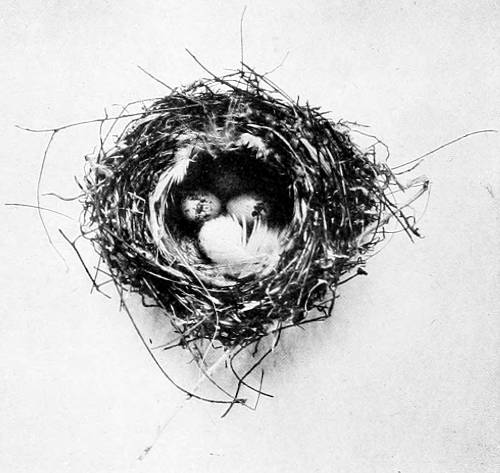
Taken in Tacoma. Photo by the Author. NEST AND EGGS OF AUDUBON WARBLER.
These Warblers are connoisseurs in feathers, and if one had all their nests submitted to him, he could make a rough assignment of locality for each according to whether feathers of Oregon Ruffed Grouse, Franklin Grouse, Ptarmigan, or domestic fowls were used.
In the wet region the birds appear to nest in fir trees only, and they are as likely to use the lowermost limb as any. There is little attempt at concealment, and Bowles reports a nest only ten feet high over a path used daily by hundreds of people in Tacoma. On the dry side of the mountains the Warblers avail themselves freely of deciduous trees and bushes for nesting sites. A nest on Cannon Hill in Spokane was placed at the lowermost available crotch of a young elm tree near the sidewalk and not ten feet up—as bold as a Robin!
[186]
According to Mr. Bowles, Audubon Warblers evince a great fondness for their chosen nesting haunts, and will return to them year after year, often to the same tree, and sometimes to the same branch. “They are the most solicitous of all the Washington Warblers concerning their eggs, sometimes coming to meet the intruder as he climbs toward the nest. At such times the alarm note of the female soon brings the male, when, should the nest contain incubated eggs or young, both birds crawl among the branches, frequently within reach, with wings and tail spread, in absolute forgetfulness of their own safety.”
Incubation is accomplished in twelve days; and one or two broods are raised, according to locality and length of season.
We lose sight of most of the birds, especially the smaller ones, after the heyday of springtime, but here is one who, because he has forsworn wandering, is making delicate overtures of confidence toward mankind. This year, especially, now that the dense tract of woods north of the University has been cut out, they linger about our neighborhood with the matter-of-factness of Bluebirds. The young ones play about the eaves or make sallies at passing flies from the window-sills, and yawn with childish insouciance if mamma suggests, by a sharp tchip, that enemies may lurk behind the curtains. They know it’s only habit with her, and she doesn’t believe it herself. The adult attire is duller now, and only the yellow rump-patch remains for recognition by a friend. The year is waning, no doubt of that, but October sunshine is good enough for us—or November rains. Let them flit who will! Washington is good enough for us, you in your fir house and I in mine.
No. 76. BLACK-THROATED GRAY WARBLER.
A. O. U. No. 665. Dendroica nigrescens (Towns.).
Description.—Adult male in spring and summer: A supraloral spot of yellow; remaining plumage black, white and blue-gray; head, throat and chest black interrupted by superciliary stripes and broad malar stripes of white; remaining upperparts blue-gray, marked with black in inverted wedge-shaped spots on back, scapulars and upper tail-coverts; wings and tail black edged with bluish ash, the middle and greater coverts tipped with white, forming two conspicuous wing-bars, the four outer rectrices blotched with white on inner webs in sharply decreasing area, the outermost chiefly white, the fourth merely touched; sides white streaked with black or striped black-and-white; remaining underparts white. Adult female: Like male but duller, the black of crown partly veiled by blue-gray skirting, that of throat reduced by white tips of feathers. Young birds resemble the female but the black of crown and throat is almost entirely hidden by blue-gray and white respectively, and the area of the tail blotches is much reduced. Length about 5.00 (127); wing 2.44 (62); tail 1.97 (50); bill .36 (9.2); tarsus .69 (17.5).
[187]
Recognition Marks.—Warbler size; black and white and blue-gray coloration distinctive.
Nesting.—Nest: a rather loosely built structure of dead grasses, silky plant fibers, moss, etc., placed midway on horizontal limb of conifer 25-50 feet from ground; measures, externally, 3 inches wide by 2 deep, internally 1¾ wide by 1 deep. Eggs: 4, creamy white, marked, chiefly about the larger end with spots and small blotches of varying shades of brown, lavender and black. Av. size, .83 × .63 (21 × 16). Season: last week in May and first week in June; one brood.
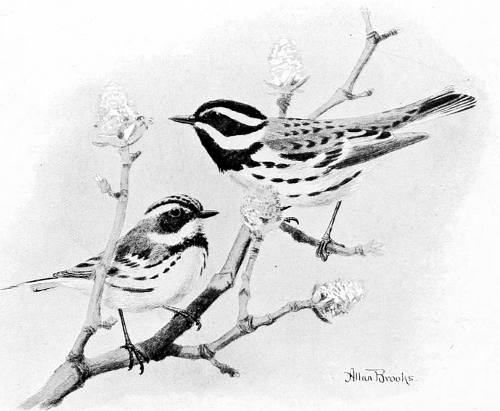
BLACK-THROATED GRAY WARBLERS, MALE AND FEMALE.
General Range.—Western United States (north to Colorado, Utah and Washington), and British Columbia west of the Cascades; breeding southward to Southern California, southern Arizona and Lower California; south in winter thru Mexico and States of Oaxaca and Vera Cruz.
Range in Washington.—Summer resident and migrant west of the Cascade Mountains.
Migrations.—Spring: Seattle-Tacoma c. April 12. Fall: c. Sept. 1 (Blaine).
Authorities.—Sylvia nigrescens Townsend, Journ. Ac. Nat. Sci. Phila. VII. 1837, 191 (“forests of the Columbia River”). C&S. L¹. D¹(?). Ra. Kk. B. E.
Specimens.—U. of W. Prov. B. E.
[188]
Black and white and gray are sober colors in themselves, but a skillful arrangement of all three has produced a handsome bird, and one whose dainty dignity requires no meretricious display of gaudy reds and yellows. Warblers are such tiny creatures at best that Nature has given little thought to their protective coloration. This plain-colored bird does not, therefore, shun the greenery of fir and fern, and yet we feel a peculiar fitness when he chooses for a song station some bare dead limb, gray and sober like himself.
Last year the first arrival in Seattle seated himself upon a projecting limb of a dead cedar which commanded the quiet sylvan depths of Cowan Park, and left him fairly abreast of the Fifteenth Avenue viaduct. Here he divided his time between song and enjoyment of the scene, sparing a friendly glance now and then for the admiring bird-man. His manner was complaisant and self-contained, and I felt that his little vocal offerings were a tribute to the perfect morning rather than a bid for applause.
The song of the Black-throated Gray is quite unpretentious, as Mrs. Bailey says,[25] “a simple warbler lay, zee-ee-zee-ee, ze, ze, ze, with the quiet woodsy quality of virens and cœrulescens, so soothing to the ear.” It is this droning, woodsy quality alone which must guide the ear of a listener in a forest, which may be resounding at the same time to the notes of the Hermit, Townsend, Audubon, Lutescent, and Tolmie Warblers. Occasionally even this fails. An early song which came from a young male feeding patiently among the catkins of some tall, fresh-budding alders, had some of the airy qualities of the Kinglet’s notes, “Deo déopli, du du du, deo déo pli, deo deo pli, deo deo pli”—a mere fairy sibilation too fine for mortal ears to analyze. Another said boldly, “Heo flidgity; heo flidgity,” and “Heo flidgity, chu wéo.”
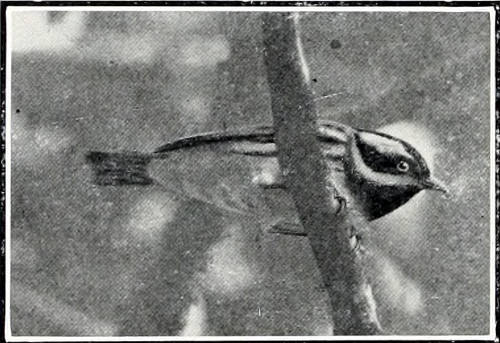
Taken near Blaine. Photo (retouched) by the Author. “UPON THE OVERHANGING LIMB OF AN APPLE TREE.”
This Warbler is of rather irregular distribution in the western part of the State, where alone it is found. A preference is shown for rather open woodland or dense undergrowth with wooded intervals. The fir-dotted prairies of the Steilacoom area are approved, and the oak groves have their patronage. During the August migration I have found the bird almost abundant at Blaine. They are curious, too, and by judicious screeping I succeeded in calling the bird of the accompanying illustration down within five feet upon the overhanging limb of an apple tree.
[189]
Of their nesting Mr. Bowles says: “In Washington these Warblers are strictly confined to the large coniferous timber of the prairie country, during the breeding season placing their nests midway out on a fir limb, at from 25 to 50 feet above the ground. Strangely enough, however, in Oregon they almost always nest low down in the deciduous trees, sometimes only three or four feet up in a bush. In Washington the nests are always placed directly on a limb, while in Oregon my brother, Mr. C. W. Bowles, found them mostly in upright crotches.
“The nest is rather a loosely-built little structure, measuring externally three inches wide by two inches deep, internally one and three-quarters inches wide by one deep. It is composed of dead grass, silky plant fibers, moss, etc., with an ample lining of different kinds of hair and feathers;—a pretty little nest, tho scarcely as artistic as that of the Audubon Warbler.
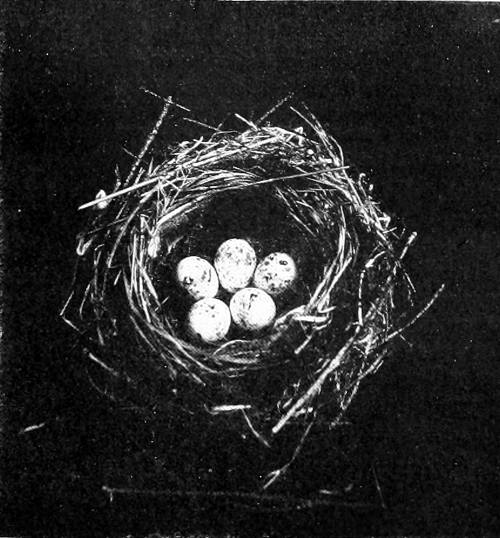
Taken in Tacoma. Photo by J. H. Bowles. NEST AND EGGS OF THE BLACK-THROATED GRAY WARBLER.
“The eggs are laid during the last week in May and the first week in June, and are invariably four in number. They are creamy white in color, marked chiefly around the larger end, with spots and small blotches of varying shades of brown, lavender, and black. Eggs in my collection from Washington average .83 × .63 inches in dimensions, while eggs from Oregon average .67 × .50 inches, the largest egg from Oregon being smaller than the smallest Washington egg. In shape the eggs vary from long to short ovate, and only one set is laid in a season.
“The parent birds are very shy in the vicinity of the nest, the female leaving at the first sign of danger and keeping out of sight.
“In Oregon, my brother noted that the male often accompanied the female while she was collecting building material, continuously scolding, but never assisting her in any way. In that section the nests were greatly preyed upon by that prince of egg-robbers, the California Jay.”
[190]
No. 77. TOWNSEND’S WARBLER.
A. O. U. No. 668. Dendroica townsendi (Towns.).
Description.—Adult male: Pileum, hindneck, lores and auriculars, chin, throat and upper chest black; supraloral region continuous with broad superciliary, a spot under eye and a malar stripe broadening behind (and nearly meeting end of superciliary on side of neck) yellow, breast yellow heavily streaked on sides with black, the black streaks thickening and merging with black of chest in front, scattering on flanks and reappearing on under tail-coverts; upper sides and flanks and remaining underparts posteriorly white as to ground; back, scapulars and rump yellowish olive-green streaked with black shading into black of head on hindneck; upper tail-coverts abruptly bluish gray; wings and tail blackish with some edgings of light gray; two white wing-bars formed by tips of middle and greater coverts; three outer pairs of tail feathers blotched with white on inner webs in descending ratio. Bill black with paler tomia; feet and legs brown; iris brown. Adult male in fall and winter: Areas and intensity of black much reduced, pileum and hindneck with much skirting of olive green thru which black appears mesially on feathers; auriculars entirely concealed by olive green feather-tips; black of chin and throat nearly concealed by yellow and streaks of sides reduced; black streaks of upperparts more or less concealed; upper tail-coverts color of back. Adult female: Very similar in coloration to adult male in fall; throat often more or less black, pileum sometimes more extensively black but black streaking of upperparts still further reduced. Young birds in first autumnal plumage have no clear black, and the yellow of throat and underparts is paler. Length about 5.00 (127); wing 2.64 (67); tail 1.97 (50); bill .34 (8.6); tarsus .74 (18.8).
Recognition Marks.—Warbler size; black on crown, cheeks and throat in high plumage; in low plumage extensively yellow on sides of head enclosing area of darker (olive-green)—yellow of throat combined with this character may afford clew to identification of winter specimens.
Nesting.—Nest: a well built, bulky but rather shallow structure, chiefly of cedar bark with a few slender fir twigs interwoven; lined with stems of moss flowers; placed at moderate heights in young fir trees well out on limb or settled against trunk. Eggs: 4, white, wreathed and speckled with brownish and lilac. Av. size, .61 × .51 (15.5 × 12.9). Season: first week in June; one brood.
General Range.—Western North America breeding from the mountains of southern California north to Alaska and east to Idaho; during migrations eastward to Rocky Mountains and southward to Guatemala, Lower California, etc.
Range in Washington.—Not uncommon spring and fall migrant on both sides of the Cascade Mountains, summer resident in coniferous timber, probably thruout the State; partially resident in winter on Puget Sound.
Migrations.—Spring: Seattle April 20, 1907; Ahtanum (Yakima Co.) May 4, 1906, June 5, 1899; Chelan May 25, 1905. Fall: August. Winter records: Seattle Dec. 31, 1905; Tacoma Dec. 4, 13, 15, 21 and 29, 1906.
[191]
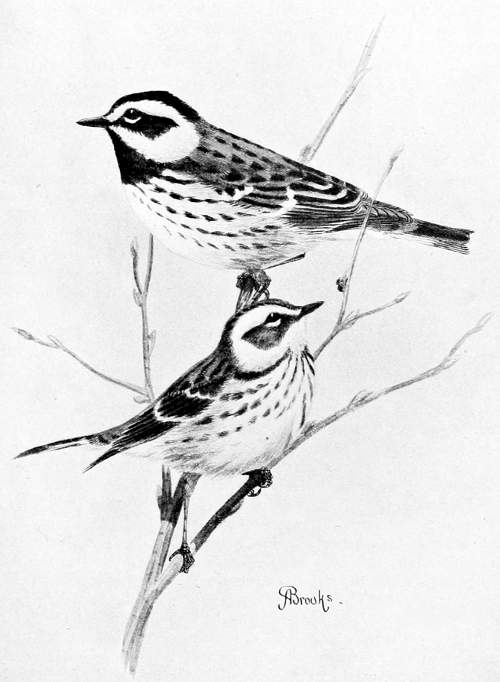
TOWNSEND WARBLERS, MALE AND FEMALE.
[192]
Authorities.—Sylvia townsendi “(Nuttall),” Townsend, Journ. Ac. Nat. Sci. Phila. VII. pt. II. 1837, 191 (“forests of the Columbia River”). C&S. Rh. Ra. D². B. E.
Specimens.—U. of W. Prov. C. E.
What a morning that was at the old parsonage in the Ahtanum valley, when the shade trees of the five acre enclosure were lit up by the presence of a dozen of these fairies! Waste acres of sage lay around, or fields of alfalfa and growing wheat, hardly more inviting, but the eye of the leader, winging languidly from the South, at early dawn had spied a patch of woodsy green, and had ordered a halt for the day in our comfortable-looking box-elders and insect-harboring apple trees. To be sure it was absurdly late for migrants, June 5th, but they appeared more like an embassage of foreign grandees, who deigned to make requisition upon our hospitality, than mere birds with threats of family cares ahead. So while they sought breakfasts of aphis and early worm, or disported among the branches in the growing sunshine, I attended their movements in rustic wonder. Now and then a member of the party paused to adjust his golden trappings, or to settle the black head-piece with a dainty shake. It was, indeed, a notable occasion for the bird-man, inasmuch as these dandies were in “higher” plumage than any yet recognized by the best bird-books of the day,[26] in that the shining black, supposedly confined to the lower throat, now occupied the very chin as well.
There was a little conversational lisping in a foreign tongue, in which the ladies of the party were included; and after breakfast the males ventured song.
Seventy-eight days later, viz., on the 23d of August, a southward bound party visited our orchard. The males were still in song, and it was difficult to believe that all the joys and sorrows of wedlock and child-rearing had intervened; yet such was probably the case.
A bird sighted at Chelan on the 25th day of May, 1905, haunted a pine and a balm tree at the foot of the Lake, singing constantly. The song ran, dzwee, dzwee, dzwee, dzwee, dzweetsee, the first four notes drowsy and drawling, the fourth prolonged, and the remainder somewhat furry and squeaky. The bird hunted patiently thru the long needles of the pine, under what would seem to an observer great difficulties. Once he espied an especially desirable tidbit on the under side of a needle-beset branch. The bird leaned over and peered beneath, until he quite lost his balance and turned a somersault in the air. But he returned to the charge again and again, now creeping cautiously around to the under side, now clinging to the pine needles themselves and again fluttering bravely in the midst, until he succeeded in exhausting the little pocket of provender, whatever it was.
[193]
In June, 1906, we found these birds in the valley of the Stehekin, and again in the valley of the Cascade River, near Marblemount, breeding, undoubtedly, in both places. Here we allowed the notes, oozi, woozi lêooli to pass for some time, unchallenged, as those of the Hermit Warbler, but finally caught a townsendi in the act at fifteen feet. There is, to be sure, a lisping, drawling, obstructed quality in the opening notes not found in the typical Hermit song, and possibly not at all, but the lilt at the end, lêooli, is inseparable from the Hermit Warbler, and I do not take it kindly of townsendi to mix up the game so.
Upon returning to the valley of the Stehekin in June, 1908, Mr. Bowles found the Townsend Warbler a not uncommon breeder. On the 20th of that month he discovered two nests, each containing four newly hatched young. Both were placed about twelve feet up in young fir trees, one about five feet out on a limb, the other close against the main trunk. In each instance the brooding female allowed a close approach; then dropped straight to the ground and disappeared. The birds were extremely shy at first but after an hour or so became sufficiently accustomed to the human presence to return to their duties within a few minutes after being flushed. But repeated visits failed to discover the males in the vicinity of their nests, and, indeed, they seemed to be wholly occupied with minstrelsy in the tree-tops.
On the 31st of December, 1905, I saw a Townsend Warbler in the pale winter plumage in Madrona Park, on the border of Lake Washington. He was with a group of Audubon Warblers feeding in the alders, but attention was instantly attracted to the tsip note, which was sharper and more clear-cut than that of the Audubon; and it had, moreover, a sort of double quality, or central turn, tsiip or chiip. This record of winter residence was further confirmed by specimens taken at Tacoma by Mr. Bowles the following December.
No. 78. HERMIT WARBLER.
A. O. U. No. 669. Dendroica occidentalis (Townsend).
Synonym.—Western Warbler.
Description.—Adult male in breeding plumage: Forehead, crown and sides of head and neck, broadly, rich lemon yellow, sharply defined below by black of chin, throat and upper chest, less sharply above by black of occiput or hindneck; this in turn shading thru mingled olive and black into gray of remaining upperparts; upper plumage more or less tinged with olive-green and streaked more or less broadly with black; wings and tail black with grayish edgings; middle and greater coverts tipped with white forming two conspicuous wing-bars,—outermost part of tail-feathers chiefly white on both webs, next pair white on terminal half of inner web and third pair marked with longitudinal spot near tip; black of chest with convex posterior outline sharply defined from white of [194] remaining underparts. Bill black; legs and feet dark brown; iris brown. Adult male in fall and winter: Yellow of crown veiled by olive green; black of throat veiled by whitish tips; black streaking of upperparts less conspicuous. Adult female in spring: Like male in spring but duller, yellow of head less extensive, gray of upperparts dominating; black streaks reduced or obsolete; black of throat, etc., absent, white or dull yellowish instead; sometimes dusky spot of various proportions on chest. Young birds like adult female but yellow of crown veiled by olive and sides washed with brownish. Length of adult about 4.90 (124.4); wing 2.65 (67.3); tail 2.20 (55.9); bill .40 (10.2); tarsus .44 (11.3).
Recognition Marks.—Smaller Warbler size; yellow mask of male outlined against black of throat and hind neck distinctive—female and young more difficult but distinctive pattern of mask with white wing-bars usually suggestive.
Nesting.—Nest: saddled on horizontal branch of fir tree at a good height; a compact structure of fir twigs, mosses and vegetable down, lined with fine grass and horse-hair; measures, outside, 4 wide by 2¾ deep, inside, 2 wide by 1¼ deep. Eggs: 4 or 5, dull white heavily blotched and spotted with various shades of red-brown and lavender. Av. size, .69 × .53 (17.5 × 13.5). Season: c. June 1; one brood.
General Range.—Pacific coast district and Cascade-Sierra system with its outliers north to British Columbia; “in winter south into Lower California and through Arizona over Mexican plateau to highlands of Guatemala.”
Range in Washington.—Not common summer resident, in heavier coniferous timber only.
Authorities.—Sylvia occidentalis Townsend, Journ. Ac. Nat. Sci. Phila. VII. 1837, 190 (“forests of the Columbia River”). C&S. L¹. D¹. B.
Specimens.—C.
There is a piece of woodland south of Tacoma which we call the Hermit Woods, because here on any May day may be heard the voice of this exalted Warbler. The proper hour in which to approach this forest is early morning, before the winds have begun to stir in its dim aisles, and while the hush of its nightly peace is upon everything—save the birds. The soft moss muffles the footsteps, so that the devotee may move about unheralded from shrine to shrine, as he pays silent homage to each, in turn, of those morning stars of song, the Wood Warblers. There is Audubon with his hastening melody of gladness. There is Black-throated Gray with his still drowsy sonnet of sweet content. Then there is Hermit hidden aloft in the shapeless greenery of the under-dawn,—his note is sweetest, gladdest, most seraphic of them all, Lilly, lilly, lilly, leê o leet. It is almost sacrilege to give it form—besides it is so hopeless. The preparatory notes are like the tinkle of crystal bells and when our attention is focused, lo! the wonder happens,—the exquisite lilt of the closing phrase, leê-oleet.
In broad daylight it is the same. The singers remain in the tree-tops and tease the imagination with thoughts of a domestic life lived upon a higher plane than that of earth, an exalted state where all is beatific and serene. And try you never so hard, with glasses of a high power, it is a good hour’s work to obtain a satisfactory sight of one of the uplifted creatures.
[195]
In despair, one day, I determined to penetrate this supramundane region where the Hermit is at home, and selected for the purpose a well branched tree in the center of the forest and some hundred and fifty feet in height. The tree was, fortunately, of the tougher sort, and permitted ascent to a point where the stem might be grasped with the finger and thumb of one hand. It was a treat to see the forest as a bird does. The surface viewed from above was surprisingly uneven. Here and there strong young trees, green and full of sap, rose to the level of mine, but the majority were lower, and some appeared like green rosettes set in a well of green. Others still, rugged and uneven as to limb, towered above my station by fifty or seventy-five feet. My first discovery upon reaching the top was that the bulk of the bird chorus now sounded from below. But a few singing Hermits did occupy stations more lofty than mine. One I marked down—rather, up—fifty feet above and a hundred yards away. He sang away like a contented eremite from a single twig, and I was reverently constructing his high biography and trying to pick out his domicile from the neighboring branches, when flash! he pitched headlong two hundred feet and was seen no more.
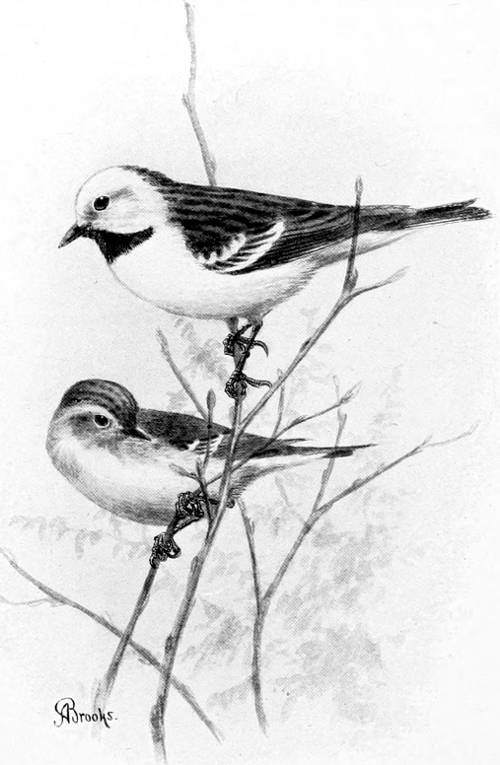
HERMIT WARBLERS.
[196]
Mr. Bowles has hit upon a clever scheme for decoying the haughty Hermits. He resorts to the vicinity of some Cassin Vireo’s nest containing young, and studies the throng of small birds, which the masterly scolding of the Vireos invariably attracts. Upon one such occasion, having lured down an inquisitive pair, he noticed a peculiar trait: “After examining me closely and apparently deciding that I was a new kind of stump, the female commenced feeding; but her attention was soon attracted to a last year’s nest of a Russet-backed Thrush. She at once flew to it and, hopping in, crouched down and commenced trampling the bottom, turning around, putting the material on the sides into shape with her bill, and altogether acting as tho she had nest-building well under way. This was about the middle of May, and, as I subsequently discovered, almost a month too early for her to lay her eggs.”[27]
The nest of this species is still rare. The only one taken in Washington was found by Mr. Bowles, June 11, 1905, in a fir tree near Tacoma, and contained five eggs, the only set of five yet recorded. The nest was placed at a height of twenty feet on a horizontal limb six feet from the trunk of the tree. Mr. Bowles had seen the tail of the bird from below as it projected over the brim of the nest, and prepared himself to inspect “another of those Audubons.” When, instead of the yellow crown-patch of an Audubon, he saw the lemon-yellow head of a Hermit, the oölogist nearly fainted from surprise and joy. The bird sat so close that the collector was obliged to lift her from the nest, and she then flew only a few feet, where she remained, chipping and spreading her wings and tail. The male at no time put in an appearance.
The nesting range of this species is still imperfectly made out. We found it common at Newport in Stevens County, and among the pines and larches of the Calispell range. We counted them common in the valley of the Stehekin also, but soon encountered that peculiar plagiarism of song, on the part of the Townsend Warbler, which queered all our local conclusions. In order, therefore, to guide the student in further investigations. I record a few variant song forms which I have clearly traced to the Hermit Warbler: Zeegle, zeegle, zeegle, zeet, fuzzy and low like that of D. nigrescens—this was heard at Tacoma and is recognized by C. W. Bowles as being the type form of southern Oregon songs; dzee dzeé, tzibid-zeedzeé, dzee dzeé, in a sort of sing-song rollick: dzudzudzudzudzeêo zeêo zeet—first syllables very rapid, musical; nasal turn to accented notes very like the “ping” note of the Creeper song, and occupying much the same position save that it is repeated; days, days, days, days zeêt—the first notes lisping, with slight accelerando, and the nasal ringing quality reserved for the last.
[197]
No. 79. TOLMIE’S WARBLER.
A. O. U. No. 680. Oporornis tolmiei (Townsend).
Synonym.—Macgillivray’s Warbler.
Description.—Adult male in spring and summer: Fore-parts in general, including head and neck all around and chest, blackish slate or slate gray; extreme forehead and lores jet black; feathers of lower chest slate-black narrowly fringed with ashy gray; extreme chin usually white; a sharp touch of white on upper eyelid behind and a longer one on lower lid; remaining plumage bright greenish yellow to olive-green, clearest yellow, canary to olive-yellow, on breast and remaining underparts, centrally, and on bend of wing, shading thru yellowish olive green on sides to olive-green of upperparts; outer primary edged with white on outer web. Bill dusky brown above, paler below; feet and legs light brown; iris brown. Adult male in fall and winter:: Similar but feathers of auriculars and hindneck and sometimes crown tipped with dull brown; ashy skirtings of throat and chest more extensive, sometimes nearly concealing the black. Adult female in spring: Like male but slate of hood replaced by dull brownish gray (mouse gray) above and by pale brownish gray on chin, throat and chest. In fall plumage still more extensively gray below. Young females lack the hood altogether being simply olive green on crown, yellow on throat, etc. Length about 5.50 (139.7); wing 2.44 (62); tail 2.16 (55); bill .45 (11.4); tarsus .85 (21.6).
Recognition Marks.—Warbler size; slaty hood of male distinctive; contrast of color between chest and breast usually apparent. A frequenter of thickets, with a sharp tsick or chuck note of alarm.
Nesting.—Nest: in thickets in upright crotch of bush from six inches to three feet from ground; a bulky affair of coarse dead grass, rootlets and trash, lined with fine black rootlets and horse-hair; measures, outside, 4½, wide by 2½ deep, inside, 2½, wide by 1¼ deep. Eggs: 3-5, usually 4, dull white, heavily marked around larger end with reddish browns and lavender. Av. size, .70 × .54 (17.8 × 13.7). Season: first week in June; one brood.
General Range.—Western United States and British Columbia breeding south to Arizona and western Texas; east during migrations to western Nebraska, etc.; south in winter to Cape St. Lucas and over whole of Mexico and Central America to Colombia (Bogota).
Range in Washington.—Summer resident in dense thickets thruout the State from sea level to about 2,000 feet elevation.
Authorities.—Sylvia tolmiei Townsend, Narrative, April 1839, 343 (Columbia River). C&S. L¹. Rh. D¹. Sr. Ra. D². Ss². Kk. J. B. E.
Specimens.—U. of W. P. Prov. B. E.
We shall have to import the word “chaparral” if we are to characterize with any brevity the sort of cover this Warbler loves. A great confusion of willow, alder, dogwood, syringa, ocean-spray, and huckleberry is his delight. [198] It matters not whether it be a hillside in King County, a lonesome spring draw in the hills of Klickitat, or the borders of a swamp in Okanogan, if only there be cover and plenty of it. No more persistent skulker haunts the shrubbery than this wary, suspicious, active, and very competent Wood Warbler. Yet even he, when he thinks no one is looking, emerges from his shrubbery depths, selects a topmost twig and breaks out in song,—a song which is neither diffident nor uncertain. Sheep sheep sheep shear shear sheep, he announces in a brisk, business-like tone, totally devoid of musical quality. And when you have heard him once, or, say, a hundred times, you have learned all that may be known of the Tolmie Warbler—out of cover. Those who know the Dickcissel of the middle West will at once be struck with the close similarity of its song, altho it must be admitted that the Warbler’s is lighter in quality and less wooden. Practically, the only variety is in the number of syllables and in the number and distribution of the r’s; thus, Sheep, sheep, shear, shear, sheep; Sheep, sheep, shear, shear, sheep, sheep; and, a shade more emphatic, Jick, jick, jick, jick, shear, sheep.
For all we see so little of the Tolmie Warbler, the converse is by no means true. That is to say, the bird does see a great deal of us if we frequent the thickets. Whenever there is anything doing in his vicinity, the Warbler promptly and silently threads the intervening mazes, takes observations of the disturber from every angle, and retires with, at most, a disapproving chuck. In the fall of the year discipline is somewhat relaxed, and a little judicious screeping in the shrubbery will call up platoons of these inquisitive Warblers.
Owing partly to the caution of the sitting female, and more to the density of its cover, the nest of the Tolmie Warbler is not often found. When approached the bird glides away silently from her nest, and begins feeding ostentatiously in the neighboring bushes. This of itself is enough to arouse suspicion in an instructed mind, for the exhibition is plainly gratuitous. But the brush keeps the secret well, or, if it is forced, we find a bulky, loose-built affair of coarse dead grasses and rootlets, lined with black rootlets or horse-hair, and placed either in an upright fork of a bush, or built around the ascending stems of rank herbage at a few inches or at most two or three feet from the ground. Eggs, usually four in number, are deposited about the first week in June, and Tolmie babies swarm in July and August, quite beyond the expectation of our oölogical fore season.
A word of explanation regarding the change of name from Macgillivray to Tolmie is in order. Townsend discovered the bird and really published it first, saying,[28] “I dedicate the species to my friend, W. T. Tolmie, Esq. of Fort Vancouver.” Audubon, being entrusted with Townsend’s specimens, but disregarding the owner’s prior rights, published the bird independently, and tardily, as it happened, as Sylvia macgillivrayi, by which specific name it was long known to ornithologists. Macgillivray was a Scotch naturalist who never saw America, but Tolmie was at that time a surgeon and later a factor of “the Honorable the Hudson Bay Company,” and he clearly deserves remembrance at our hands for the friendly hospitality and coöperation which he invariably extended to men of science.
[199]
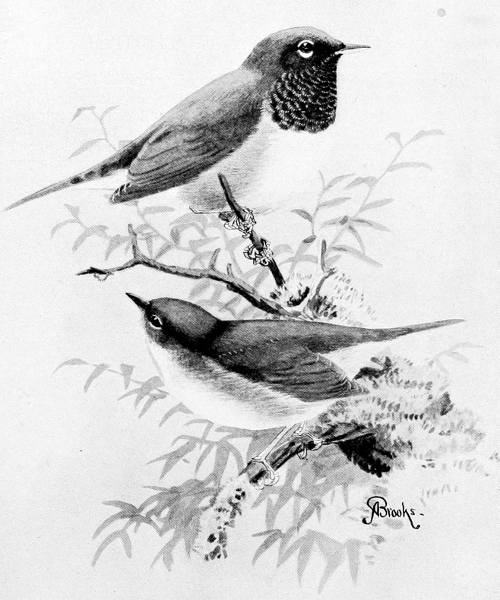
TOLMIE WARBLERS.
[200]
No. 80. GRINNELL’S WATER-THRUSH.
A. O. U. No. 675 a. Seiurus noveboracensis notabilis Ridgw.
Description.—Adults: Above sooty olive-brown, singularly uniform; below white or tinged with pale yellow, everywhere (save on abdomen, centrally, under tail-coverts and extreme chin) streaked with sooty olive, the streaks small and wedge-shaped on throat, increasing in size posteriorly on breast, sides and flanks (where nearly confluent on buffy ground); a superciliary stripe continuous to nostril pale buffy; a crescent-shaped mark of same shade on lower eyelid; cheeks and auricular region finely streaked with pale buffy and color of back. Bill dark brown above, lighter below; feet pale; iris brown. Young birds are finely barred with buffy above and have two buffy wing-bars; underparts heavily and indistinctly streaked with dusky on pale yellow ground. Length 6.00 (152) or over; wing 3.00 (76); tail 2.10 (53.3); bill .53 (13.5); tarsus .85 (21.7).
Recognition Marks.—Warbler size; plain brown above; white (or pale yellow) heavily streaked with dusky below; a prominent buffy stripe over eye.
Nesting.—Does not breed in Washington. Nest: on the ground or in roots of upturned tree; of moss and leaves, lined with fine rootlets and tendrils. Eggs: 4 or 5, white or creamy white, speckled, spotted or wreathed with reddish browns. Av. size, .80 × .60 (20.3 × 15.2). Season: May 20-June 10; one brood.
General Range.—Western North America; breeding from Minnesota, western Nebraska and the northern Rocky Mountains north to Alaska and Siberia (East Cape); southward during migrations over Western States and Mississippi Valley, less commonly thru Atlantic coast States, to West Indies, Mexico, Central America and Colombia.
Range in Washington.—Conjectural—should be not uncommon migrant.
Authority.—S. noveboracensis, Baird, Review Am. Birds, 1865, 215 (“Camp Moogie, Washington”).
Specimens.—P (Alaskan). Prov.
While we have only one record, and that an old one, there is every reason to suppose that this species traverses our borders annually, since it breeds in the middle mountain districts of British Columbia (Rhoads), is abundant in Alaska (Nelson), and migrates southward thru the western United States (Ridgway). The Water-thrush should be looked for in May [201] along the shaded banks of streams, but may possibly be found along more open margins, consorting with Pipits, with which it shares a restless habit of jetting, or curtseying, whimsically.
No. 81. WESTERN YELLOW-THROAT.
A. O. U. No. 681 a. Geothlypis trichas occidentalis Brewster.
Description.—Adult male in spring and summer: Above grayish olive-green, brighter (less gray) on upper tail-coverts and tail, inclining to brownish on crown and hindneck; an obliquely descending facial mask of black involving forehead, lores, space about eyes, cheeks and (more narrowly) sides of neck; along the posterior margin of this mask a narrow sharply contrasting area of clear ash or white; chin, throat and breast rich yellow (inclining to gamboge); sides of breast and sides heavily shaded with olive-gray and breast more or less washed with same; lower breast and below between yellow and palest olive-gray; under tail-coverts and bend of wing clear yellow. Adult male in autumn: Occiput more decidedly brown; upperparts clearer olive-green. Young male in first autumn: Mask of adult merely indicated by black underlying sooty-brown on sides of head; coloration of underparts duller. Adult female in spring: Like adult male but without black mask and ashy edging; crown and sides of head olive gray; forehead tinged with brown; region above and about eye notably paler; coloration of underparts duller and paler, sometimes clearly yellow on under tail-coverts alone. Young female in first autumn: Similar to adult but underparts still duller and dingier, breast and sides heavily washed with brownish olive. Length of adult about 5.00 (127); wing 2.26 (57.5); tail 2.19 (55.8); bill .44 (11.3); tarsus .83 (21).
Recognition Marks.—Warbler size; black mask and white fillet of male distinctive. The female is a much more difficult bird to recognize—perhaps best known by peculiar sordid olive-brownish-yellow shade of underparts. The pale orbital area also assists, but one must live with these birds to know them infallibly.
Nesting.—Nest: of coarse grasses lined with fine grass and horse-hair; placed 1-2 feet high in tussock of grass or rank herbage, usually near water; outside 4½ wide by 3½ deep, inside 2¼ by 1½. Eggs: 4 or 5, dotted and spotted or, rarely, streaked with blackish and lavender. Av. Size, .70 × .56 (17.8 × 14.2). Season: May 20-June 10; one brood.
General Range.—Western United States and British Columbia, except Pacific coast district, east to western portions of the Great Plains; breeding southward into Mexico and northern Lower California; in winter south to Cape St. Lucas and western Mexico.
Range in Washington.—Summer resident east of the Cascade Mountains; found chiefly in rye-grass districts and in vicinity of water.
[202]
Migrations.—Spring: Ahtanum (Yakima Co.) March 29, 1900.
Authorities.—Dawson, Auk, XIV. April, 1897, 179. D². Ss¹. Ss². J.
Specimens.—U. of W. P. Prov.
Coarse grass, stunted bushes, water, and sunshine seem to be the chief requirements of this very individual bird. To obtain the first-named, especially if represented by his favorite rye-grass, he will forsake water within reasonable limits; but his preference is for a grassy swamp clotted with bushes, and he does not overlook any considerable area of cat-tails and tulés. Yellow-throat is a restless, active little body, and he is among the first to come forward when you enter the swamp. His method is hide-and-seek and the game would all be his, if he did not reveal his presence from time to time by a harsh accusing note, a sort of Polish, consonantal explosion, wzschthub,—a sound not unlike that made by a guitar string when struck above the stop. If you attempt to follow the bird, the game ends in disappointment. But if the observer pauses, curiosity gets the better of the bird, and he is soon seen peering out from a neighboring bush, roguery only half hidden by his highwayman’s mask.
The female, having no mask, keeps to the background, but she is not less interested than her mate in the progress of events. When the scout returns to report, there is often a curious outbreak of discussion, in which the husband, as like as not, finds it necessary to defend his opinion with a perfect torrent of wzschthubs.
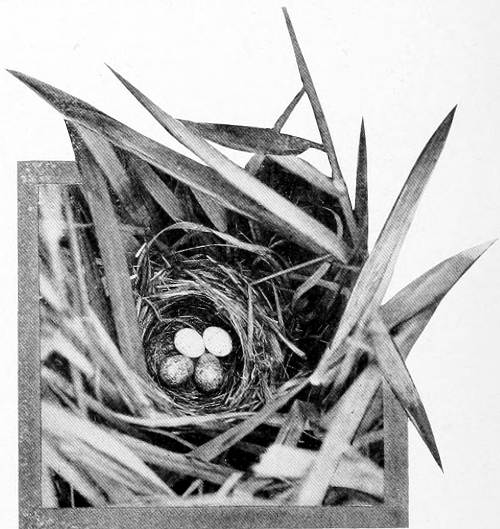
Taken in Douglas County. Photo by the Authors. A WESTERN YELLOW-THROAT’S NEST. NEST CONTAINS TWO EGGS OF THE YELLOW-THROAT AND TWO OF THE COWBIRD.
Yellow-throat’s song is one of the few explicit things in the swamp. Mounting a weed-stalk, he rubs out, Witchity, witchity, witchity, or “I beseech you, I beseech you, I beseech.” Rhythm is the chief characteristic of this song, and altho a given bird appears to be confined to a single type, the variety of “feet” offered by a swamp is most entertaining. Reésiwitte, reésiwitte, rit’, was the cadence of a Douglas County bird; while chitooreet’, chitooreet’, chitooreet’, chu, heard at Chelan, reminded me of the Kentucky [203] Warbler (Oporornis formosa). The bird has also an ecstacy song, “a confused stuttering jumble of notes” poured out in hot haste in mid-air.
Like an echo from “the different world” came the song of a bird at Brook Lake. We had just been listening to the unwonted notes of a Desert Sparrow (Amphispiza bilineata deserticola) some hundreds of miles out of its usual range, and were not unprepared for shocks, when Hoo hee, chink i woo chu tip fell upon the ear. What! a Slate-colored Sparrow here in the sage brush! Or is it, maybe, a Vesper, grown precise? Again and again came the measured accents, clear, strong, and sweet. Not till I had seen the mandibles of a Western Yellow-throat, and that repeatedly, moving in perfect rhythm to the music, could I believe so small a bird the author of this song. For fifteen minutes the Warbler brought forth this alien strain, Hee-o chiti wo, chu tip or Hee oo chitiwew chu tipew without once lapsing into ordinary dialect. Wherever did he get it?
My nests have nearly all been found in June and, I guess, they may have contained second sets, for the bird sometimes reaches Yakima County as early as March 29th. One was sunk in a tussock of grass within eight inches of the swamp water, and I nearly stepped on the female before she flew. Another was lashed at a height of two feet to a group of rank weeds, some forty feet removed from a lazy brook. A third, shown in the illustration, we found while dragging over a dense patch of rye-grass, some three hundred yards from water. The nest was composed entirely of the flattened and macerated leaves of old rye-grass gleaned from the ground, with a scanty lining of horse-hair. It was simply set, or wedged, in between the stiff, upgrowing stalks of grass at the height of a foot, and was not attached in any manner to its supports. The male bird, strange to say, was covering the eggs, of which two belonged to that contemptible shirk, the Cowbird.
No. 82. THE PACIFIC YELLOW-THROAT.
A. O. U. No. 681 c. Geothlypis trichas arizela Oberholser.
Synonym.—Puget Sound Yellow-throat.
Description.—Adults: Very similar to G. t. occidentalis and with corresponding changes but throat, etc., rich lemon yellow (inclining to greenish, whereas occidentalis inclines to orange); more yellow in grayish olive green of upperparts; ashy border of mask said to average more narrow (very doubtful). Alleged differences in measurements are inconsequential.
Recognition Marks.—As in preceding.
Nesting.—Much as in preceding form but birds more nearly confined to [204] vicinity of water. Eggs: 4. Av. size, .76 × .53 (19.3 × 13.5). Season: first week in May, first week in June; two broods.
General Range.—“Pacific coast district, from British Columbia southward; breeding southward to Los Angeles County, California, and eastward to Fort Klamath, Oregon; during migration to Cape St. Lucas” (Ridgw.).
Range in Washington.—Summer resident in fresh and salt water marshes west of the Cascades.
Migrations.—Spring: Tacoma, April 12, 1905, April 6, 1906.
Authorities.—? Audubon, Orn. Biog. V. 1839, 463, part (Columbia River). Geothlypis trichas, Baird, Rep. Pac. R. R. Surv. IX, 1858, 241, part. (T). C&S. L². Ra. B. E.
Specimens. Prov. B. E.
In our younger days some of us were taught to be seen and not heard. Among the Yellow-throats the children are taught the opposite. A bird that can call “Witch-et-y! Witch-et-y! Witch-et-y!” in a dozen different places thru the swale and in the meantime can keep out of sight while you are looking for him, is a well brought-up Yellow-throat. We were taught to tell the truth, but deceit is drilled into the Yellow-throat children from the time they leave the egg. A human mother insists upon your looking at her children, but at the approach of a visitor the Yellow-throat mother sneaks off the nest and away thru the bushes for the sole purpose of persuading you the home is in the reeds on the other side of the creek. This may be wrong according to our teaching, but it is perfectly right according to the Yellow-throat’s code of morals.
If you want to see Yellow-throat, you must go down along the swale or visit some damp thicket or swamp. He likes the rushes and the reeds where the Red-winged Blackbird and the Tule Wren live. I once found a Red-wing’s nest and a Yellow-throat’s home within a few feet of each other. If you want to see this ground warbler, go to his haunt. He will see you first but lie down quietly among the bushes. He will likely get curious and hop up out of the reeds. You may get just one good look before he darts away into the bushes again.
The male Yellow-throat always wears plain marks of recognition on his face. He has a black mask extending across his forehead and back on the sides of his head. The female goes without a mask and is clothed in subdued tints of yellow and brown.
When the Yellow-throat seeks a home, he finds a thick tussock of grass and hides his nest well in the middle. It is my experience that when you want to find his home, it is better not to look for it. If you keep on tramping thru the swamps and swales, some day you will stumble on one when you least expect it. Once I hunted for several days about a swampy place where I heard the Yellow-throats singing. Not a sign of a nest did I find. Whenever I appeared the birds were on hand as if [205] very anxious to aid me in finding their home. After tiring me with their deceit, they sneaked away fifty yards to the nest. A little later in the season I happened to see the father carrying worms and discovered the young Yellow-throats just about to leave home. William L. Finley.
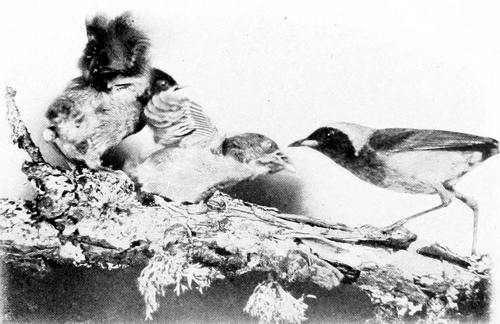
Taken in Oregon. Photo by H. T. Bohlman and W. L. Finley. AN ENTHUSIASTIC RECEPTION. MALE PACIFIC YELLOW-THROAT FEEDING YOUNG.
No. 83. WESTERN CHAT.
A. O. U. No. 683 a. Icteria virens longicauda (Lawrence).
Synonym.—Long-tailed Chat.
Description.—Adult male: Above grayish olive-green; fuscous on exposed inner webs of wings and tail; a prominent line above lores and eye, a short malar stripe, and eye-ring, white; enclosed space black on lores, less pure behind; throat, breast, lining of wings, and upper sides rich gamboge yellow; lower belly and crissum abruptly white; sides washed with brownish; bill black; feet plumbeous. Adult female: Very similar; bill lighter; lores and cheek-patch dusky rather than black; black appreciably lighter. Young: Dull olive above; head markings of adult faintly indicated; below grayish white, darker on breast, buffier behind. [206] Length 6.75-7.50 (171.5-190.5); wing 3.07 (78); tail 3.01-3.39 (76.5-86); bill .57 (14.5); tarsus 1.04 (26.5).
Recognition Marks.—Strictly “Sparrow” size, but because of bright color having nearer the size value of Chewink;—the largest of the Warblers. Bright yellow breast with contrasting white below, with size, distinctive.
Nesting.—Nest: a bulky and often careless structure, 7 inches wide and 4 inches deep outside, 3 inches wide and 1½ deep inside; of coarse grasses and weed-stems, lined with finer grasses or rootlets, placed in upright fork of bush or small tree in thicket. Eggs: 4, white, somewhat glossed and marked irregularly with spots and dots of lavender and rufous, most heavily, or not, about larger end. Av. size, .89 × .68 (22.6 × 17.3). Season: first week in June; one brood.
General Range.—Western United States from near eastern border of Great Plains west to the Pacific Coast, breeding north into south-central British Columbia southward to valley of Mexico; in migration south in winter to Mexico
Range in Washington.—Summer resident in thickets about springs and streams of eastern Washington; does not deeply invade mountains; rare or casual west of Cascades (Tacoma, June 4, 1905, by J. H. Bowles; Sumas, B. C., May 26, 1897, by Allan Brooks).
Migrations.—Spring: May 18, 1900 (Yakima county).
Authorities.—? Icteria viridis (Bonap.), Townsend, Journ. Ac. Nat. Sci., Phila., VII., 1839, 153 (N. W. United States) Auct. Cooper and Suckley, Rep. Pac. R. R. Surv. p. 288 (“Towns. and Nuttall. Seen at Walla-Walla, Washington Territory”). Dawson, Auk, XIV., 1897, p. 179. (T). D¹. D². Ss¹. Ss². B.
Specimens.—(U. of W.) P¹. Prov. B.
Structurally allied to the Wood Warblers, the Chat has yet such a temperamental affinity with the Catbird, that it is difficult, for me, at least, to dissociate the two birds in thought. Both love the thickets; both excel in song; both plague their neighbors by mimicry; and both alike are dearly provoking bundles of contradictions. The Chat is, perhaps, the greater buffoon, as he is certainly the more handsomely dressed of the two. Beyond this we must consider him on his own merits.
Ten to one you know him, if at all, only as a voice, a tricksy bushwhacker of song, an elusive mystery of the thicket; or you have unconsciously ascribed his productions to half a dozen mythical birds at once. But look more closely. It is well worth the quest to be able to resolve this genius of roguery. Be assured he knows you well enough by sight, for he does not poke and pry and spy for nothing, in the intervals of song. He has still the proverbial curiosity of woman. Seat yourself in the thicket, and when you hear the mellow, saucy Kook, with its whistled vowel, bounded by consonants barely thought of, imitate it. You will have the bird up in arms at once. Kwook, returns the bird, starting toward you. Repeat it, and you have won. The bird scents a rival and he will leave no stem unclasped but he finds him. As the bird alternately squints and stares from the brush, note the rich warbler olive of his upperparts, the gorgeous yellow of the throat and breast, [207] the white brow-stripe and the malar dash, offset by black and darker olive. It is a warbler in color-pattern, a Yellow-throat done larger, but waggish, furtive, impudent, and resourceful beyond any other of his kind.
The full song of the Chat is usually delivered from some elevation, a solitary tree rearing itself above dense cover. The music almost defies analysis, for it is full of surprises, vocal somersaults, and whimsy turns. Its cadence is ragtime, and its richest phrases are punctuated by flippant jests and droll parentheses. Even in the tree-top the singer clings closely to the protecting greenery, whence he pitches headlong into the thicket at the slightest intimation of approach.
The love song of the Chat, the so-called “dropping song,” is one of the choicest of avian comedies, for it is acted as well as sung. The performer flings himself into mid-air, flutters upward for an instant with head upraised and legs abjectly dangling, then slowly sinks on hovering wing, with tail swinging up and down like a mad pump-handle. Punch, as Cupid, smitten with the mortal sickness. And all this while the zany pours out a flood of tumultuous and heart-rending song. He manages to recover as he nears the brush, and his fiancée evidently approves of this sort of buffoonery.
The Chat is a skilled mimic. I have traced the notes of such diverse species as Bullock Oriole, Slender-billed Nuthatch, and Magpie to his door. Once, down on the Rio Grande, we rapped on a vine-covered cottonwood stump to dislodge a Flicker that had been shrieking Klyak at us for some minutes past, and we flushed a snickering Chat.
The Western Chat, like the eastern bird, has small taste for architecture. A careless mass of dead leaves and coarse grasses is assembled in a bush at a height of three or four feet, and a lining of finer grasses, when present at all, is so distinct as to permit of removal without injury to the bulk of the structure. From three to five eggs are laid and so jealously guarded that the birds are said to destroy the eggs once visited by man. So cautious are the Chats that even after the young have hatched out, they take care not to be seen in the vicinity of their nest, but a low, anxious chuck sometimes escapes from the harassed mother in a neighboring thicket.
Chats will follow suitable cover into most desolate places. On the other hand they do not discriminate against civilization per se, and the Chats of Cannon Hill, in Spokane, are as grateful to the good sense of its citizens as are the Catbirds and two score other resident species of songsters. They are, however, birds of the sunshine belt, and West-side records are very few.
[208]
No. 84. PILEOLATED WARBLER.
A. O. U. No. 685 a. Wilsonia pusilla pileolata (Pallas).
Description.—Adult male: Above bright olive green; forehead, sides of head, and underparts bright greenish yellow, tinged on sides with olive-green; crown, or “cap,” lustrous black; wings and tail fuscous and olive-edged without peculiar marks; bill dark above, light below; feet light brown. Adult female: Similar, but the black cap wanting, or, if present, less distinct. Immature: Like female without cap. Length about 4.75; wing 2.20 (56); tail 1.97 (50); bill .38 (8.5); tarsus .75 (18.8).
Recognition Marks.—Least,—pygmy size; black cap of male distinctive; recognizable in any plumage by small size and greenish yellow coloration. Brighter than W. pusilla; not so bright as W. p. chryseola.
Nesting.—As next.
General Range.—Western North America, breeding thruout the Rocky Mountain district, north to Alaska, west to Cascade Range in Oregon and Washington and to Vancouver Island; during migrations over the entire western United States, and east irregularly to the Mississippi; south in winter over Mexico and Central America.
Range in Washington.—Not common resident and abundant migrant on East-side; migrant only west of Cascades.
Migrations.—Spring: May 1-15.
Authorities.—Dawson, Auk XIV., 1897, 180. (T). (C&S). D¹. Kb. D². J. E.
Specimens.—B. BN. E. P.
The pervading yellowness of this little bush-ranger will hardly serve to distinguish it from the equally common Lutescent Warbler, unless you are able to catch sight of its tiny silken crown-patch of black, the “little cap” which gives the bird its Latin-sounding name. With chryseola it is the smallest of our warblers, and it is one of the commonest, during migrations, on the East-side. The thickets have taken on full leaf before the bird arrives from the South, along about the 10th of May, and the northward march is often prolonged till the first of June. So expert is the little Black-cap at threading briary tangles, that a meeting here depends upon the bird’s caprice rather than the astuteness of the observer. Willow trees are favorite stations during the spring movement, and these because of their scantier foliage afford the best opportunities for study.
My impression is that the Pileolated Warbler must breed sparingly in eastern Washington. There is, however, only one summer record to substantiate this belief,—a bird seen in the valley of the Stehekin, June 22nd, 1906. The only song I have heard differed from the abruptly terminated crescendo of W. p. chryseola, being rather a well modulated swell, chip chip! chip!! chip!!! chip!!! chip!! chip! chip.
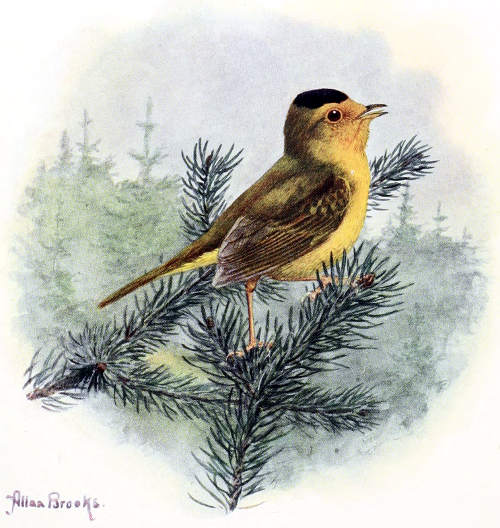
GOLDEN WARBLER MALE, ⅘ LIFE SIZE From a Water-color Painting by Allan Brooks
[209]
No. 85. GOLDEN WARBLER.
A. O. U. No. 685 b. Wilsonia pusilla chryseola Ridgw.
Synonym.—Golden Pileolated Warbler (properly so-called, but the bird, because of its local abundance deserves the shorter name. Moreover, altho “golden” is the commonest color among the Warblers, the name has not been pre-empted).
Description.—“Similar to W. p. pileolata, but slightly smaller and much more brightly colored; olive-green of upperparts much more yellowish, almost olive-yellow in extreme examples; yellow of forehead and superciliary region (especially the former) inclining more or less to orange; yellow of underparts purer, more intense” (Ridgway). Length of adult males (skins) 4.35 (110); wing 2.18 (55.4); tail 1.93 (49.1); bill .33 (8.3); tarsus .72 (18.2).
Recognition Marks.—As in preceding; brighter.
Nesting.—Nest: a shapely and thick-walled mass of dead leaves, grasses and vegetable fibers, lined with coiled grasses or hair, on the ground or concealed at moderate heights in weeds, bushes, evergreen saplings, etc. Eggs: 3-5, white or creamy white, speckled and spotted with reddish brown markings, well distributed or gathered about larger end. Av. size .59 × .48 (15 × 12.2). Season: May 15-30; one brood.
General Range.—Pacific Coast district from southern California to southern British Columbia.
Range in Washington.—Summer resident in western Washington; common in well-watered forests at lower levels and in thickets from sea-level to higher mountain valleys.
Migrations.—Spring: Arrives Puget Sound April 25-May 5. Fall: Blaine, Sept. 15.
Authorities.—Myiodioctes pusillus Bonap., Baird, Rep. Pac. R. R. Surv. IX. pt. II., 1858, p. 294 (part). C&S. L¹. Ra. B. E.
Specimens.—U. of W. E.
This dainty little Warbler is one of the most characteristic and well distributed birds of western Washington. Its summer range embraces all shady and moist woods having varied undergrowth; and it is at home alike on the sides of the western Cascades, in the swampy bottoms tributary to Puget Sound, or under the dense spruce forests of the Pacific slope. It is certainly one of the most abundant birds in the last-named section, and its golden flittings not only dominate the fern levels but extend upward into the mossy arms of the evergreens. A brilliant dress does not appear to endanger the life of this little despot, for he is quite too insignificant for notice among the Knights of Claw and Jaw, and so he flashes in and out, scolds, sings, and meditates, by turns, without molestation. [210] Nor is there any lack of interest in the life of this golden midget. Have you never wished that you were tiny—oh, teeny—with beady black eyes, that you might explore the mysteries of a moss forest? that elderberries might look to you like great blue pippins? and madrone berries like luscious fiery pumpkins? that you might pluck a thousand sapid meats at first hand where now you know only a few “staples,” disguised by the meretricious arts of cookery? That you might—Ah, here I have you!—that you might pantingly pursue a golden maiden down dim forest aisles, over plunging billows of spiræa blossoms, past corridors of giant sword-fern, into—Oh, where is that maddening creature! She’s given me the slip again! Never mind; I’ll pause and sing: oooooééééééééooooo.
Truth to tell, the song just recorded is one of the rarest, a perfectly modulated swell of sharp staccato notes of little resonance but greater power and intensity. The ordinary song is a series of monosyllables uttered with increasing emphasis, chip chip CHIP CHIP CHIP CHIP. The singer is very much in earnest, and compels attention in spite of his utter lack of musical ability. Late in August, the 26th it was, I provoked a Black-cap at Blaine by screeping, until he sang merely to relieve his feelings, chip CHIP CHIP CHIP chip chip chip, the precise type of the Pileolated Warbler, W. p. pileolata proper. The only other variant in my collection is tsew tsew tsew tsee tsee tsee, whhhackity,—the last note, somewhat whimsically represented here, being an intense guttural trill very difficult to characterize.
Messrs. Rathbun and Renick, of Seattle, have made a special study of the nesting habits of this dainty wood nymph, and they report a marked partiality in its nesting for the vicinity of woodland paths, log-roads, and the smaller openings in the logged-off sections. The favorite host is a cedar sapling, a mere baby tree with stem only half an inch or so in diameter. Of nine nests examined only one, in a bracken, was more than two feet above the ground, and none were less than ten inches. The nest is quite a bulky affair, yet compact centrally, composed externally of copious dried leaves and twigs; internally of fine grasses and interwoven rootlets. The birds quit the nest unobserved and the finding of one of their domiciles is a matter of hard work.
No. 86. AMERICAN REDSTART.
A. O. U. No. 687. Setophaga ruticilla (Linn.).
Description.—Adult male: Head and neck all around and breast shining black; remaining upperparts dull black with glossy patches, changing to brownish black or fuscous on wings; a large salmon-colored patch at base of secondaries; a smaller, nearly concealed patch of same color at base of primaries; the outer [211] web of the outer primary salmon nearly thruout its length; the tail feathers, except the two middle pairs, salmon-colored on both webs for the basal two-thirds; two large patches of reddish salmon on the sides of the breast; the lining of the wings and the sides extensively tinged with the same color, occasionally a few touches across the chest below the black; lower breast, belly, and crissum, white; bill black; feet dark brown; black in variable amounts on sides of breast between the orange red spots; lower tail-coverts sometimes broadly tipped with blackish. Adult female: Above, brownish ash with an ochraceous or olive tinge on back; salmon parts of male replaced by yellow (Naples yellow), and the reddish salmon of sides by chrome yellow; remaining underparts dull whitish, sometimes buffy across chest. Immature male: Similar to adult female, but duller the first year; the second year mottled with black; does not attain full plumage until third season. Length 5.00-5.75 (127-146.1); av. of five males: wing 2.59 (65.8); tail 2.17 (55.1); bill .36 (9.1); tarsus .70 (18).