Volume 1 — The Birds of Washington (continued 4)
Reading edition
Whatever the weather, Chippy returns to us about the 12th day of April, posts himself on the tip of a fir branch, like a brave little Christmas candle, and proceeds to sputter, in the same part. Of all homely sounds the monotonous trill of the Western Chipping Sparrow is the most homely,—and the most easily forgivable. As music it scarcely ranks above the rattle of castanets; but the little singer pours out his soul full earnestly, and his ardor often leads him to sustained effort thruout the sultry hours when more brilliant vocalists are sulking in the shade; and for this we come to prize his homely ditty like the sound of plashing waters.
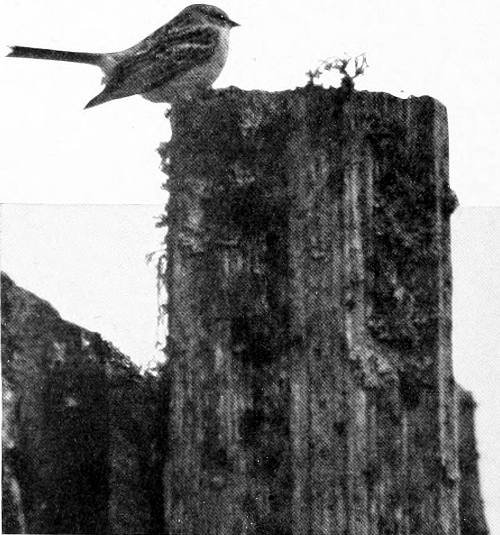
Taken in Pierce County. Photo by the Author. JUST ARRIVED. WESTERN CHIPPING SPARROW, ADULT MALE.
Two Chipping Sparrow songs heard near Tacoma deserve special mention. One likened itself in our ears to a tool being ground on a small emery wheel. The wheel has a rough place on its periphery which strikes [129] against the tool with additional force and serves to mark a single revolution, but the continuous burr which underlies the accented points, or trill-crests, is satisfied by this comparison alone. The other effort, a peculiar buzz of varying intensity, carries forward the same idea of continuous sound, but the comparison changes. In this the song appears to pour from the tiny throat without effort, and its movement is as tho an unseen hand controlled an electric buzz, whose activity varies with the amount of “juice” turned on: zzzzzzzzzzt, zzzzzzzzzzt, zzzzzzzzzzt, ZZZZZZZZZZT, ZZZZZZZZZZT.
Chippy’s nest is a frail affair at best, altho often elaborately constructed of fine twigs, rootlets and grasses with a plentiful lining of horse-hair. In some instances the last-named material is exclusively employed. A sage-bush is the favorite situation on the plains of the Columbia, a horizontal fir branch in the wet country. Rose thickets are always popular, and where the bird frankly forsakes the wilds, ornamental shrubbery and vines are chosen. The nests are often so loosely related to their immediate surroundings as to give the impression of having been constructed elsewhere, and then moved bodily to their present site. Some are set as lightly as feathers upon the tips of evergreen branches, and a heavy storm in season is sure to bring down a shower of Chippies’ nests.
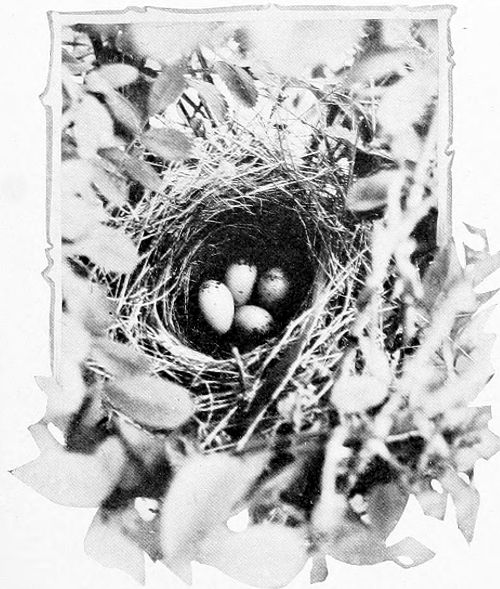
Taken near Chelan. Photo by the Author. “FOUR OF THE CUTEST——.”
Eggs are laid during the first or second week of May in the vicinity of American Lake and from one to three weeks earlier in the sage country. They are among the most familiar objects in Nature, and particular description of them ought to be unnecessary. But every person who knows that we are interested in birds has to stop us on the street to tell about the “cunningest little nest, you know, with four of the cutest——” “Hold on,” we say; “were the eggs blue?” “Yes,” “With dots on them?” “Why, yes; how did you know?”
Incubation lasts only ten days and two broods are raised in each season. [130] Chipping Sparrows are very devoted parents and the sitting female will sometimes allow herself to be taken in the hand. The male bird is not less sedulous in the care of the young, and he sometimes exercises a fatherly oversight of the first batch of babies, while his mate is preparing for the June crop.
No. 51. BREWER’S SPARROW.
A. O. U. No. 562. Spizella breweri Cassin.
Description.—Adults: Upperparts grayish brown, brightest brown on back, everywhere (save on remiges and rectrices) streaked with black or dusky, narrowly on crown, more broadly on back and scapulars, less distinctly on rump; wing-coverts and tertials varied by edgings of brownish buff; flight-feathers and rectrices dark grayish brown or dusky with some edging of light grayish brown; a broad pale buffy superciliary stripe scarcely contrasting with surroundings; underparts dull whitish tinged on sides and across breast by pale buffy gray. Bill pale brown darkening on tip and along culmen; feet pale brown, iris brown. Young birds are less conspicuously streaked above; middle and greater coverts broadly tipped with buffy forming two distinct bands; breast streaked with dusky. Length 5.30 (1.35); wing 2.44 (62); tail 2.38 (60.5); bill .38 (8.8); tarsus .68 (17.4).
Recognition Marks.—Warbler size; general streaked appearance; absence of distinguishing marks practically distinctive; sage-haunting habits.
Nesting.—Nest: of small twigs and dried grasses, lined with horse-hair, set loosely in sage-bush. Eggs: 4 or 5, greenish blue, dotted and spotted, sometimes in ring about larger end, with reddish brown. Av. size .67 × .49 (17 × 12.4). Season: April, June; two broods.
General Range.—Sage-brush plains of the West, breeding from Arizona to British Columbia and east to western Nebraska and western Texas; south in winter to Mexico and Lower California.
Range in Washington.—Open country of the East-side, abundant summer resident; occasionally invades Cascade Mountains (only in late summer?).
Migrations.—Spring: Yakima March 29, 1900.
Authorities.—[“Brewer’s sparrow,” Johnson, Rep. Gov. W. T. 1884 (1885), 22]. Dawson, Auk, XIV, 1897, 178. D². Ss¹. Ss².
Specimens.—U. of W. P. C.
It is never quite fair to say that Nature produces a creature which harmonizes perfectly with its surroundings, for the moment we yield tribute of admiration to one creature, we discover amid the same circumstances another as nearly perfect but entirely different. When we consider the Sage Sparrow we think that Nature cannot improve much upon his soft grays by way of fitness for his desert environment; but when we come upon the Brewer Sparrow, we are ready to wager that here the dame has done her [131] utmost to produce a bird of non-committal appearance. Mere brown might have been conspicuous by default, but brownish, broken up by hazy streakings of other brownish or dusky—call it what you will—has given us a bird which, so far as plumage is concerned, may be said to have no mark of distinction whatever—just bird.
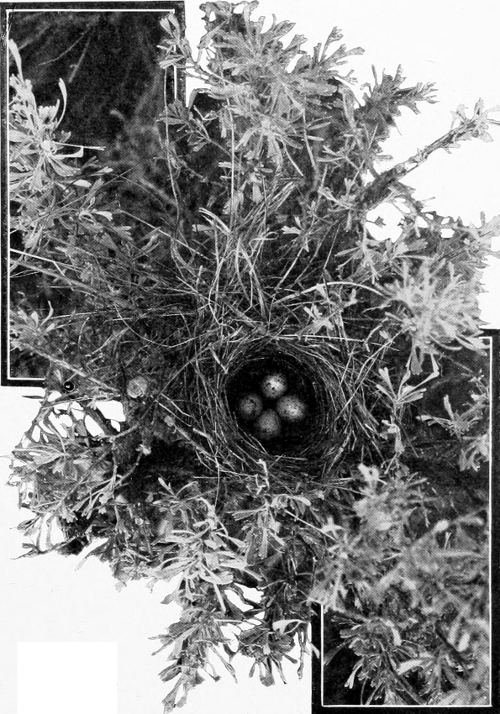
Taken in Douglas County. Photo by the Author. NEST AND EGGS OF BREWER SPARROW.
[132]
The Sage Sparrow fits into the gray-green massy scheme of color harmony in the artemisia, while Brewer’s fits into the somber, brown-and-streaky scheme of its twigs and branches. To carry out the comparison, do not look for breweri early in the season, when the breath of the rain rises from the ground and the air is astir: he is there, of course, but disregard him. Wait, rather, until the season is advanced, when the incomparable sun of Yakima has filled the sage-brush full to overflowing, and it begins to ooze out heat in drowsy, indolent waves. Then listen: Weeeezzz, tubitubitubitubitub, the first part an inspired trill, and the remainder an exquisitely modulated expirated trill in descending cadence. Instantly one conceives a great respect for this plain dot in feathers, whose very existence may have passed unnoticed before. The descending strain of the common song has, in some individuals, all the fine shading heard in certain imported canaries. Pitch is conceded by infinitesimal gradations, whereby the singer, from some heaven of fancy, brings us down gently to a topmost twig of earthly attainment. Nor does the song in other forms lack variety. In fact, a midday chorus of Brewer Sparrows is a treat which makes a tramp in the sage memorable.
Brewer’s Sparrow is of the sage sagey, and its range in Washington is almost exactly co-extensive with the distribution of that doughty shrub; but it is of record that Spizella breweri indulges in some romantic vacations, a specimen being once taken by me (July 25, 1900) at 8000 feet, upon the glacier levels of Wright’s Peak.
No. 52. GOLDEN-CROWNED SPARROW.
A. O. U. No. 557. Zonotrichia coronata (Pall.).
Description.—Adults: A broad crown stripe gamboge-yellow, changing abruptly to ashy gray on occiput; this bounded on each side by broad stripe of silky black meeting fellow on forehead; remaining upperparts grayish brown, broadly streaked with black on back, more or less edged with dull chestnut on back, wing-coverts and tertials, glossed with olive on rump and tail; middle and greater coverts tipped with white forming conspicuous bars; chin, throat and sides of head ashy gray with obscure vermiculations of dusky; remaining underparts washed with buffy brown, darkest on sides and flanks, lightest, to dull white, on belly, obsoletely and finely barred on breast. Bill blackish above, paler below; feet pale; iris brown. Immature: Without definite head-stripe; crown broadly dull olive-yellow, clearest on forehead, elsewhere sharply flecked with blackish in wedge-shaped marks, giving way to grayish brown or dull chestnut behind and to blackish on sides (variably according to age?). Length 7.20 (182.8); wing 3.28 (83.3); tail 3.06 (77.7); bill .48 (12.2); tarsus .96 (24.3).
Recognition Marks.—Sparrow size; yellow of crown distinctive in any plumage.
Nesting.—Does not breed in Washington. Nest and eggs said to be very similar to those of Z. l. nuttalli.
[133]
General Range.—Pacific Coast and Bering Sea districts of Alaska; south in winter thru the Pacific States to Lower California; occasionally straggles eastward.
Range in Washington.—Spring and fall migrant both sides of the Cascades, more common westerly.
Migrations.—Spring: c. April 21 (West-side); c. May 20 (Chelan).
Authorities.—?Emberiza atricapilla Aud. Orn. Biog. V. 1839, 47; pl. 394. Baird, Rep. Pac. R. R. Surv. Vol. IX. 1858, 462. C&S. L². D¹. Kb. Ra. Kk. B. E.
Specimens.—U. of W. Prov. E.
Regal tho he be, this sparrow is discreet in the matter of appearances, and does not cultivate the public eye. Washington is only a way-station in his travels, and the splendors and liberties of court life are reserved for Alaska. Appearing at Tacoma during the last week in April, demure companies of Golden-crowns may not infrequently be seen associated with migrating Nuttalls. They are in no hurry, or perhaps the haste of midnight flight is over when we see them yawning sleepily in the bushes of a morning. They are languid too as they deploy upon the park lawns, always within reach of cover, in search of fallen seeds or lurking beetles. Their leisurely movements contrast strongly with the bustling activities of the local Nuttalls; for the latter are burdened with the care of children, before the Alaskan migrants have forsworn bachelorhood. East of the Cascade Mountains the northward movement of this species is even more tardy, and May 18-22 are the dates at which I have recorded it at Chelan.
Migrating Zonotrichias are all coquettishly retiring, and the first hint of danger sends them scuttling into the bushes. If one presses up to the edge of the brush, he may hear an uncanny rustling among the leaves and branches as the birds retreat, but not a single note is uttered. Left to themselves, the birds become sociable with many zinks common to the genus; and, if unusually merry, the Golden-crowns indulge a sweet, preparatory hoo hee which reminds one of both the White-crowned (Z. leucophrys) and White-throated (Z. albicollis) Sparrows of the East; but the song has never been completed here to our knowledge.
Suckley said that Golden-crowned Sparrows were abundant in summer both at Fort Dalles and Fort Steilacoom, but this was undoubtedly a mistake, as the records of alleged nesting in California proved to be. On the other hand they may winter with us to some extent, since Mr. Bowles took a specimen on December 16, 1907, in the Puyallup Valley.
[134]
No. 53. GAMBEL’S SPARROW.
A. O. U. No. 554 a. Zonotrichia leucophrys gambelii (Nuttall).
Synonyms.—Intermediate-crowned Sparrow. Intermediate Sparrow.
Description.—Adults: Crown pure white, becoming gray behind; lateral crown-stripes meeting in front, and post-ocular stripes, jet black, separated by white stripe continuous with lore; remainder of head, neck all around, and entire underparts slaty gray, darkest on nape, whitening on chin and belly, with a tawny wash on flanks and crissum; back and scapulars brown (burnt umber) edged with gray; rump and upper tail-coverts tawny olivaceous; wings and tail fuscous, the tertials dark-centered with edgings of bay and white; middle and greater coverts tipped with white, forming two inconspicuous wing-bars; rectrices with brown shafts and tawny edgings, bill reddish brown above, saffron yellow below, with tip of maxilla black. Young of the year have the black of head replaced by light chestnut, and the white by ochraceo-fuscous or gray; in general darker and browner above than adult. Length 6.50-7.00 (165-180); wing 3.07 (78); tail 2.76 (70); bill .42 (10.7); tarsus .89 (22.5).
Recognition Marks.—Sparrow size; broad white crown and jet black lateral stripes strongly contrasting; slightly larger and general coloration lighter than in Z. l. nuttalli; white crown-stripe broader.
Nesting.—As next; not known to breed in Washington but probably does so.
General Range.—Western North America, breeding from Montana, eastern Oregon, etc., northward between coast mountains of British Columbia and Alaska and the interior plains to the lower Mackenzie and Anderson River Valleys, thence westward thruout Alaska to the coast of Bering Sea; in winter southward across western United States into Mexico and Lower California, straggling eastward across the Great Plains.
Range in Washington.—Abundant spring and fall migrant on the East-side, possibly summer resident; doubtless migrant west of Cascades, but no specimens taken.
Migrations.—Spring: April 20-May 20. Wallula, April 24, 1905; Chelan, April 24, 1896; Brook Lake, June 7, 1908.
Authorities.—Fringilla gambelii Nuttall, Man. Orn. U. S. & Canada, 2d Ed., 1, 1840, 556. Z. gambeli intermedia Brewster, B. N. O. C. VII. 1882, p. 227. D¹. Sr. D². Kk. J.
Specimens.—U. of W. C. P.
It is probably safe to say that during the height of their spring migrations, viz., April 15th to May 15th, these birds exceed in numbers all the other sparrows of eastern Washington combined. Indeed, on certain occasions, it would seem that they are more numerous than all other birds combined. And this altho they do not move in great flocks in the open, like Redpolls, but flit and skulk wherever there is show of cover. Wayside thickets, spring draws, and the timbered banks of streams are favorite places. The more isolated the cover the more certain it is to be held as a Zonotrichian [135] stronghold, and they are sometimes so hard put to it for shelter that they resort in numbers to the sage-brush, where they affect great secretiveness.
These handsome and courtly gentlemen with their no less interesting, if somewhat plainer, wives are far more reserved than their talents would warrant. Our approach has sent a score of them scurrying into cover, a neglected rose-briar patch which screens a fence, and now we cannot see one of them. An occasional sharp dzink of warning or protest comes out of the screen, or a suppressed titter of excitement, as two birds jostle in their effort to keep out of sight. We are being scrutinized, however, by twenty pairs of sharp eyes, and when our probation is ended, now one bird and now another hops up to an exposed branch to see and be seen.
What distinguished foreigners they are, indeed, with their white crowns, slightly raised and sharply offset by the black stripes which flank them,—Russians, perhaps, with shakos of sable and ermine. The bird has an aristocratic air which is unmistakable; and, once he has deigned to show himself, appears to expect deference as his due. What a pity they will not make their homes with us, but must needs go further north!
As diligently as I have searched for this species, I have never found a specimen in the summer months[17], nor is there any record of the bird’s nesting in Washington. This is the more remarkable in that the type form (Z. leucophrys) breeds extensively “thruout the high mountain districts of the western United States” (Ridgway), exclusive of Washington and Oregon, southward to the San Francisco Mountains of Arizona, “northward to northern California (Mount Shasta, etc.).” In view of this, one may feel free to suggest that the Camp Harney record[18], referred to gambelii, is really referable to the typical form, and that as such it represents a northern extension of leucophrys, rather than a southern extension of gambelii.
No. 54. NUTTALL’S SPARROW.
A. O. U. No. 554 b. Zonotrichia leucophrys nuttalli Ridgw.
Synonyms.—Formerly called Gambel’s Sparrow, White-crowned Sparrow (name properly confined to Z. leucophrys). Crown Sparrow.
Description.—Adults: Like preceding but general tone of coloration much darker; streaks of back and scapulars deepest brown or blackish; general ground-color of upperparts light olive-gray; median crown-stripe narrower, dull white; [136] underparts more strongly washed with brownish gray; axillaries and bend of wing more strongly yellow; bill yellowish with dark tip. Immature: Similar to that of preceding form, but underparts yellowish; upperparts light olive buff; crown-stripe cinnamomeous, or pale chestnut. Very young birds are more extensively black-streaked above, and finely streaked below on chin, throat, chest, and sides; bill brighter yellow; feet paler. Length of adult males, 5.90-6.70 (150-170); wing 2.95 (75); tail 2.83 (72); bill .43 (11); tarsus .93 (23.5). Females smaller.
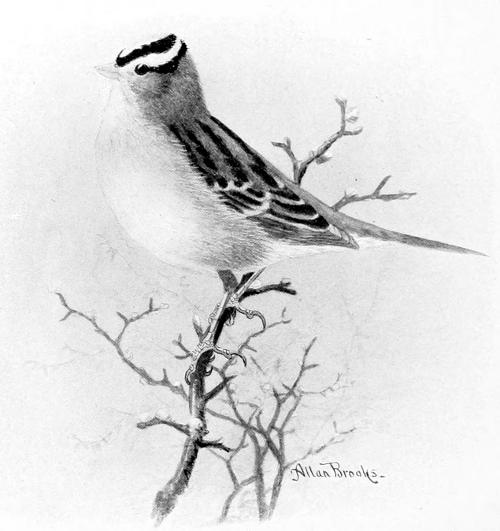
“A MILITARY GENTLEMAN IN A GRAY CLOAK.”
Recognition Marks.—Sparrow size; black-and-white striping of crown distinctive in range; much darker than preceding.
Nesting.—Nest: on ground or low in bushes; rarely in trees up to 25 feet; a rather pretentious structure of bark-strips, dead grass, and rootlets, with a [137] lining of fine dead grass and horse-hair; measures externally 6 in. wide by 4 deep; internally 2½, wide by 1 deep. Eggs: 4 or 5, pale bluish white, profusely dotted and spotted, or blotched, with varying shades of reddish brown. Av. size .86 × .64 (21.8 × 16.3). Season: Last week in April, and May 25-June 10; two broods.
General Range.—Pacific Coast district, breeding from Monterey, California, to Fort Simpson, British Columbia; south in winter to San Pedro Martir Mountains, Lower California.
Range in Washington.—Of general distribution west of the Cascade Mountains at lower altitudes; casually winter resident.
Migrations.—Spring: March 25-April 1.
Authorities.—Z. gambelii Gambel, Baird, Rep. Pac. R. R. Surv. IX. 1858, 461. (T.) C&S. L¹.(?) L². Rh. Kb. Ra. Kk. B. E.
Specimens.—U. of W. P. B. BN. E.
When you enter a bit of shrubbery at the edge of town in May or June, your intrusion is almost sure to be questioned by a military gentleman in a gray cloak with black-and-white trimmings. Your business may be personal, not public, but somehow you feel as if the authority of the law had been invoked, and that you would better be careful how you conduct yourself in the presence of this military person. Usually retiring, the Nuttall Sparrow courts exposure where the welfare of his family is in question, and a metallic scolding note, zink, or dzink, is made to do incessant service on such occasions. A thoroly aroused pair, worms in beak, and crests uplifted, may voice their suspicions for half an hour from fir-tip and brush-pile, without once disclosing the whereabouts of their young.
Nuttall’s Sparrow is the familiar spirit of brush-lots, fence tangles, berry patches, and half-open situations in general. He is among the last to quit the confines of the city before the advancing ranks of apartment houses and sky-scrapers, and he maintains stoutly any vantage ground of vacant lot, disordered hedge-row, or neglected swamplet left to him. After the Rusty Song Sparrow, he is perhaps the commonest Sparrow in western Washington—unquestionably so within the borders of settlement.
As a songster this Sparrow is not a conspicuous success, altho he works at his trade with commendable diligence. He chooses a prominent station, such as the topmost sprig of a fir sapling, and holds forth at regular intervals in a prosy, iterative ditty, from which the slight musical quality vanishes with distance. Hee ho, chee weé, chee weé chee wééé and Hee, wudge, i-wudge i-wudge i-wéééé are vocalized examples. The preliminary hee ho is sometimes clear and sweet enough to prepare one’s ear for the Vesper Sparrow’s strain, but the succeeding syllables are tasteless, and the trill with which the effort concludes has a wooden quality which we may overlook in [138] a friend but should certainly ridicule in a stranger. We are humbled in view of the vocal limitations of this bird when we recall that the voice of the White-crowned Sparrow (Z. leucophrys), of which ours is a local race, is noted for its sweet, pure quality. Surely our bird has caught a bad cold.
In selecting a nesting site, the Nuttall displays a marked difference of taste from the Rusty Song Sparrow, in that it selects a dry situation. The first nest, prepared during the third week in April, is almost invariably built upon the ground. A slight hollow is scratched at the base of a bush or sapling, and a rather pretentious structure of bark strips, dried grasses and rootlets is reared, with a lining of fine grass and horse-hair. A nest found on Flat-top was set in high grass at the foot of a tiny oak sapling, and was composed externally of dried yarrow leaves with a few coarse grasses; internally of fine coiled grass of a very light color, supplemented by four or five white gull feathers. The eggs, four or five in number, are of a handsome light green or bluish green shade, and are heavily dotted, spotted, or blotched with reddish brown.
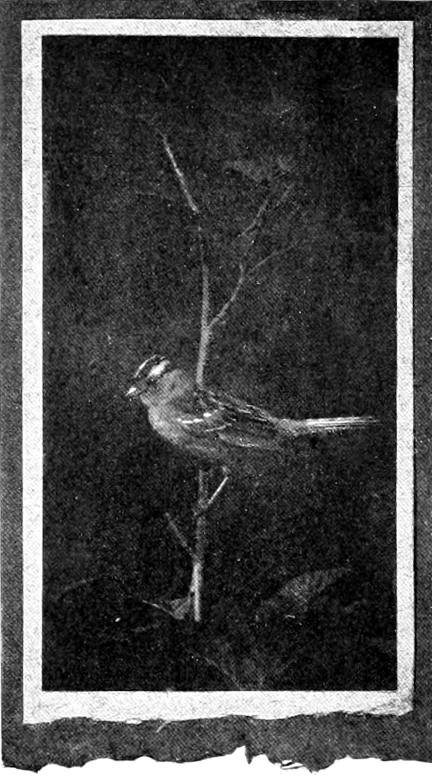
Taken in Seattle. Photo by the Author. FEMALE NUTTALL SPARROW.
A second set is prepared a month or so later than the first, and occasionally a third. Second nests are built, as likely as not, in bushes or trees; and Mr. Bowles has taken them as high as twenty-five feet from the ground.
Young birds lack the parti-colored head-stripes of the adult, altho the pattern is sketched in browns; and they are best identified by the unfailing solicitude of the parents, which attends their every movement. They are rather bumptious little creatures for all; a company of them romping about a pasture fence brings a wholesome recollection of school-boy days, and there are girls among them, too, for my! how they giggle!
[139]
No. 55. MOUNTAIN SONG SPARROW.
A. O. U. No. 581 b. Melospiza melodia montana (Henshaw).
Description[19].—Adults: Crown dull bay streaked with black and divided by ashy-gray median stripe; rufous brown post-ocular and rictal stripes, enclosing grayish-brown auriculars; remaining upperparts ashy-gray varied by reddish brown, the gray due to broad edgings of feathers and occupying from one-half to two-thirds the total area according to season, feathers of back and scapulars sharply streaked with blackish centrally; wings and tail brown varied by minor markings and edgings of dusky, brownish gray and ashy-gray; below white, or sordid, heavily streaked on sides of throat, breast and sides by blackish and rufous, markings wedge-shaped, tear-shaped or elongated, confluent on sides of throat as maxillary stripes and often on center of breast as indistinct blotch. Bill horn-color above, lighter below; feet pale brown, toes darker; iris brown. Young: Like adults but duller, all markings less sharply defined, streaks of underparts narrower. Length of adult male (skins): 6.00 (150); wings 2.73 (69.3); tail 2.74 (69.6); bill .48 (12.2); tarsus .88 (22.4).
Recognition Marks.—Sparrow size; heavy streaking of breast and back, with varied head markings, distinctive; lighter, grayer and more sharply streaked as compared with M. m. merrilli.
Nesting.—As next.
General Range.—“Rocky Mountain district of the United States west to and including the Sierra Nevada, in California; north to eastern Oregon, southern Idaho and southern Montana; south in winter to western Texas and northern Mexico” (Ridgway). Probably also north into British Columbia and southwestern Alberta.
Range in Washington.—Migrant and winter resident along eastern borders.
Authorities.—? Snodgrass, Auk, XX. 1903, 207. W. T. Shaw in epist., Dec. 31, 1908. Sr?
Specimens.—P¹ (32 spec.).
Whether or not the Song Sparrows of northern Montana and eastern British Columbia are typical montana, the doctors must settle; but certain it is that sparrows of a type decidedly lighter, that is, ashier, in coloration, than our merrilli, pass thru our eastern borders during migrations. Of such a bird, examined narrowly at Spokane on November 4, 1905, my note-book says (comparing at every point with merrilli): “Ashy gray and brown of head strongly contrasting; ashy of back and scapulars very extensive, brown areas of feathers not exceeding one-third their total width; underparts clearer white; streaking lighter rusty and more sharply defined, more narrow on sides.”
[140]
No. 56. MERRILL’S SONG SPARROW.
A. O. U. No. 581 k. Melospiza melodia merrilli (Brewster).
Synonyms.—Dusky Song Sparrow. Silver-tongue.
Description.—Characters intermediate between those of M. m. montana and M. m. morphna. In general, darker than preceding with plumage more blended, proportion of gray in back about one-third; lighter than next, not so brown, streakings more distinct.
Nesting.—Nest: a substantial structure of twigs, grasses, coiled bark-strips, dead leaves, etc.; lined carefully with fine dead grass, rootlets or horse-hair, placed indifferently in bushes or on the ground. Eggs: 4-6, usually 5, greenish-, grayish-, or bluish-white, heavily spotted and blotched with reddish browns which sometimes conceal the background. Av. size .83 × .61 (21 × 15.5). Season: April-July; two or three broods.
General Range.—The eastern slopes of the Cascades from northern California to southern British Columbia, east (at least) to northern Idaho.
Range in Washington.—East-side—theoretically inclusive. Specimens from the central valleys of the Cascades may be called morphna and those from the Palouse country montana, at pleasure.
Authorities.—M. fasciata guttata, Brewster, Bull. Nutt. Orn. Club, VII. 1882, 227, 229. D¹. Ss¹. J.
Specimens.—P¹.
This, the connecting link between montana and morphna, is the characteristic Song Sparrow of eastern Washington, and abounds along timbered water courses and in all cultivated districts. While closely resembling the Rusty Song Sparrow of the West-side, it may be distinguished from it by the sharper color pattern of its plumage; and the points of divergence from montana are maintained with substantial uniformity, at least along the eastern slopes of the Cascades, and in the northern tier of counties.
Altho subjected to considerable rigors in winter, this species is partially resident, being largely confined during the cold season to the shelter of tule beds, wild rose thickets, clematis bowers, and the like. Nesting begins about the second week in April and continues with undiminished ardor till July or August. Incubation requires twelve days, and the young are ready to fly in as many more, so that a devoted pair is able to raise three and sometimes four broods in a season.
At this rate we should be overrun with Song Sparrows if there were not so many agencies to hold the species in check. A young Song Sparrow [141] is the choice morsel of everything that preys,—cats, skunks, weasels, chipmunks, Sharp-shinned Hawks, Crows, Magpies, Black-headed Jays, and garter snakes. How would this motley company fare were it not for the annual crop of Song Sparrows? And the wonder of it is that the brave heart holds out and sings its song of trust and love with the ruins of three nests behind it and the harvest not yet past.
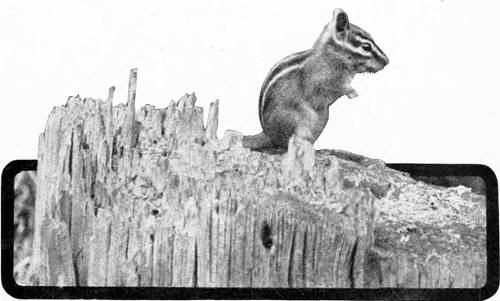
Taken in Oregon. Photo by A. W. Anthony. A PROFESSIONAL OOLOGIST.
A little glimpse of Nature’s prodigality in this regard was afforded by a pair which nested on my grounds in the Ahtanum Valley. On the 4th of June I came upon a nest in a rose bush, containing four young just hatched, and these almost immediately disappeared—a second, or possibly a third, attempt for the season. On July 4th in an adjoining clump the same pair was discovered with three well-fledged young, which, for aught I know, reached days of self-dependence. On July 24th a nest was found some twenty feet away containing four eggs, which I knew, both by the familiar notes and by elimination, to belong to this pair; but the nest was empty on the day following.
At the beginning of the season nests are frequently made upon the ground under cover of old vegetation, or at the base of protecting bush clumps in swamps. Occasional ground nests may also be found thruout the season. One seen at Stehekin on August 3d was nestled loosely in a recumbent potato vine. At other times any situation in bush or tree, up to twenty feet, is acceptable, if only within convenient reach of water. A [142] favorite building site is amid the debris of last year’s flood water, caught in the willow clumps of creek or lagoon. With high boots one may wade the bed of a brushy creek near Yakima and count certainly on finding a Merrill Song Sparrow’s nest every five or ten rods.
No. 57. RUSTY SONG SPARROW.
A. O. U. No. 581 e. Melospiza melodia morphna Oberholser.
Description.—Adults: Somewhat like M. m. montana but coloration much more rufescent, general color of upperparts rich rusty brown, ashy gray of M. m. montana represented by rusty olive and this reduced or (in some plumages) almost wanting; black mesial streaks of scapulars, etc., much reduced, indistinct or sometimes wanting; underparts heavily and broadly streaked with chestnut usually without black shaft lines; sides and flanks washed with olivaceous. “Young, slightly rufescent bister brown above, the back streaked with blackish, beneath dull whitish or very pale buffy grayish, the chest, sides and flanks more or less tinged with buffy or pale fulvous and streaked with sooty brownish” (Ridgway). Length about 6.40 (162.5); wing 2.60 (66); tail 2.56 (65); bill .50 (12.7); tarsus .67 (17).
Recognition Marks.—Sparrow size; rusty brown coloration; heavily spotting of underparts distinctive save for the Passerella iliaca group from which it is further distinguished by smaller size and varied head markings.
Nesting.—Nest: As in preceding. Eggs: usually 4, averaging darker in coloration and larger than in M. m. merrilli. Av. size, .87 × .63 (22.1 × 16). Season: second week in April to July; two or three broods.
General Range.—“Breeding from extreme southern portion of Alaska through British Columbia (including Vancouver Island) to western Oregon (north of Rogue River Mountains); in winter, south to southern California (Fort Tejon, etc.)” (Ridgway).
Range in Washington.—Common resident west of the Cascades; found chiefly in vicinity of water.
Authorities.—? Audubon, Orn. Biog. V. 1839, 22. M. rufina, Baird, Rep. Pac. R. R. Surv. IX. 1858, p. 481. (T). C&S. L¹. Rh. Kb. Ra. Kk. B. E.
Specimens.—U. of W. P. Prov. B. BN. E.
If one were to write a book about the blessings of common things, an early chapter must needs be devoted to the Song Sparrow. How blessed a thing it is that we do not all of us have to go to greenhouses for our flowers, nor to foreign shores for birds. Why, there is more lavish loveliness in a dandelion than there is in an imported orchid; and I fancy we should tire of the Nightingale, if we had to exchange for him our sweet poet of common day, the Song Sparrow.
[143]
Familiar he certainly is; for while he has none of the vulgar obtrusiveness of Passer domesticus, nor confesses any love for mere bricks and mortar, there is not a weedy back lot outside of the fire limits which he has not gladdened with his presence, nor a disordered wood-pile or brush-heap which he has not explored. Much lurking under cover in time of rain has darkened his plumage beyond that of the eastern bird, and close association with the fallen monarchs of the forest has reddened it, until he himself looks like a rusty fragment of a mouldering fir log.
It is as a songster, however, that we know this sparrow best. Silver-tongue’s melody is like sunshine, bountiful and free and ever grateful. Mounting some bush or upturned root, he greets his childish listeners with “Peace, peace, peace be unto you, my children.” And that is his message to all the world, “Peace, and good-will.” Once we sat stormbound at the mouth of our tent, and, mindful of the unused cameras, grumbled at the eternal drizzle. Whereupon the local poet flitted to a favorite perch on a stump hard by, and, throwing back his head, sang, with sympathetic earnestness, “Cheer up! Cheer up! Count your many mercies now.” Of course he did say exactly that, and the childish emphasis he put upon the last word set us to laughing, my partner and me, until there was no more thought of complaint.
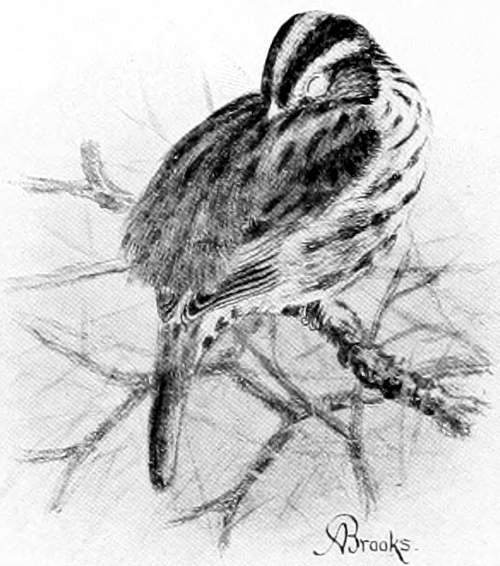
SONG SPARROW ASLEEP.
Even in winter the brave-hearted bird avails himself of the slightest pretext—an hour of sunlight or a rise of temperature—to mount a bush and rehearse his cheerful lay. The song is not continuous, but it is frequently repeated thru periods of several minutes, and is followed by little intervals of placid contemplation.
But no matter how gentle a bird’s disposition may be, there is ample use, alack! for the note of warning and distrust. When, therefore, the Song Sparrow’s nesting haunts are invaded, the bird emits a chip or chirp, still musical, indeed, but very anxious. In winter the resident birds deny themselves even this characteristic cry; and, except for the occasional outbursts of full song, they are limited to a high nasal tss, which seems to serve the purpose of a flocking, or recognition, call. Song Sparrows are not really gregarious birds; nor are they even seen in close proximity save [144] in mating time; but they like to assure themselves, nevertheless, that a dozen of their fellows are within call against a time of need.
Silver-tongue is a bird of the ground and contiguous levels. When hiding, he does not seek the depths of the foliage in trees, but skulks among the dead leaves on the ground, or even threads his way thru log heaps. If driven from one covert, the bird dashes to another with an odd jerking flight, working its tail like a pump-handle, as tho to assist progress. Ordinarily the bird is not fearful, altho retiring in disposition. Apart from the haunts of men the Song Sparrow of western Washington is closely attached to the water; and is not to be looked for save in damp woods, in swamps, in the vicinity of open water, whether of lake or ocean, or along the brushy margins of streams. Indeed, its habits are beginning to assume a slightly aquatic character. Not only does it plash about carelessly in shallow water, but it sometimes seizes and devours small minnows.
Save in favored localities, such as the margins of a tule swamp, nests of the Rusty Song Sparrow are not obtrusively common. “Back East,” in a season of all around nesting, about one-fifth of the nests found would be those of the Song Sparrow. Not so on Puget Sound; for, altho the birds are common, heavy cover is ten times more common, and I would sooner undertake to find a dozen Warblers’ nests than as many Song Sparrows’. Nesting begins about April 1st, at which time nests are commonly built upon the ground or in a tussock of grass or tules. The end of a log, overshadowed by growing ferns, is a favorite place later in the season; while brush-heaps, bushes, fir saplings, trees, or clambering vines, such as ivy and clematis, are not despised.
The eggs, Mr. Bowles finds, are almost invariably four in number, as in a very large number of sets examined only one contained five eggs. They are of a light greenish blue in ground color, and are spotted and blotched heavily and irregularly with reddish browns, especially about the larger end. Several broods are raised each season.
The Rusty Song Sparrow, because of its abundance in winter, affords the impression of being strictly a resident bird in western Washington. Such may be the case with a majority of the individuals, but there is still evidence of a southward movement of the race, the place of local birds being supplied in winter partly by British Columbia birds, which show a heavier and more uniformly blended type of plumage, approaching that of M. c. rufina.
[145]
No. 58. SOOTY SONG SPARROW.
A. O. U. No. 581 f. Melospiza melodia rufina (Bonap.).
Description.—Similar to M. m. morphna but larger and with coloration darker, more blended; general color of upperparts deep sooty brown or bister, brightening on greater wing-coverts and tertials; back obscurely streaked with darker; median crown-stripe obsolete or at least indistinct; streaking of underparts dark brown. Length 6.50 (165) or over; wing 2.75 (70); tail 2.64 (67); bill .48 (12.3); tarsus .92 (23.5).
Recognition Marks.—Sparrow size; dark brown coloration; plumage of upperparts blended, almost uniform. Requires careful distinction from Passerella but is smaller and variegation of head still traceable.
Nesting.—As in preceding. Does not breed in Washington.
General Range.—“Southern Alaska (islands and coast); north to Cross Sound, Glacier Bay, Lynn Canal, etc.; south to north side of Dixon Entrance, in winter to coast of British Columbia, Vancouver Island, and northwestern Washington (Olympic Mountains)” (Ridgway).
Range in Washington.—Winter resident in northwestern portion of State—not common.
Authorities.—M. cinerea rufina (Brandt), Ridgway, Birds of North and Middle America, Vol I. p. 374. E.
Specimens.—Prov. E.
These larger and darker birds reach our northern borders in winter only, having retired thus far from their home in southern Alaska. Their demeanor while with us is even more modest than that of the local Silver-tongue; and when one is stalking the dank woods of Whatcom County on the qui vive for varieties, it requires a second glance to distinguish this Song Sparrow, with its softly blended plumage, from a winter Fox Sparrow.
No. 59. LINCOLN’S SPARROW.
A. O. U. No. 583. Melospiza lincolnii (Aud.).
Synonyms.—Lincoln’s Song Sparrow. Lincoln Finch.
Description.—Adults: Above, much like M. melodia montana, but crown brighter rufous, and with more decided black markings: back browner and more broadly and smartly streaked with black; the gray of back sometimes with a bluish and sometimes with an olivaceous tinge; below, throat and belly white, the former never quite immaculate, but with small arrow-shaped black marks; sides [146] of head and neck and remaining underparts creamy buff, everywhere marked by elongated and sharply defined black streaks; usually an abrupt dusky spot on center of breast; bill blackish above, lighter below, feet brownish. Length about 5.75 (146.1); av. of six specimens; wing 2.48 (63); tail 2.11 (53.6); bill .40 (10.2).
Recognition Marks.—Warbler size; bears general resemblance to Song Sparrow, from which it is clearly distinguished by buffy chest-band, and by narrow, sharp streaks of breast and sides.
Nesting.—Nest: much like that of Rusty Song Sparrow, of dried grasses, etc., usually on ground, rarely in bushes. Eggs: 3 or 4, greenish white spotted and blotched with chestnut and grayish. Av. size, .80 × .58 (20.3 × 14.7). Season: June, July; two (?) broods.
General Range.—North America at large breeding chiefly north of the United States (at least as far as the Yukon Valley) and in the higher parts of the Rocky Mountains and the Cascade-Sierras; south in winter to Panama.
Range in Washington.—Imperfectly made out—probably not rare spring and fall migrant, at least west of the Cascades; found breeding in the Rainier National Park.
Authorities.—[“Lincoln’s Finch,” Johnson, Rep. Gov. W. T. 1884 (1885), 22.] Bowles and Dawson, Auk, XXV. Oct. 1908, p. 483.
Specimens.—(U. of W.) Prov. B.
Modesty is a beautiful trait, and, I suppose, if we had always to choose between the brazen arrogance of the English Sparrow and the shy timorousness of this bird-afraid-of-his-shadow, we should feel obliged to accept the latter. But why should a bird of such inconspicuous color steal silently thru our forests and slink along our streams with bated breath as if in mortal dread of the human eye? Are we then such hobgloblins?
Thrice only have I seen this bird, and then in northern Ohio. On the first occasion two of us followed a twinkling suspicion along a shadowy woodland stream for upwards of a hundred yards. Finally we neared the edge of the woods. There was light! exposure! recognition! With an inward groan the flitting shape quitted the last brush-pile and rose twenty feet to a tree-limb. Just an instant—but enough for our purpose—and he had whisked over our heads, hot-wing upon the dusky back trail. That same May day we came upon a little company of these Sparrows halted by the forbidding aspect of Lake Erie, and dallying for the nonce in the dense thickets which skirted a sluggish tributary. Here they skulked like moles, and it was only by patient endeavor that we were able to cut out a single bird and constrain it to intermittent exposure at the edge of the stream. Here, at intervals, from the opposite bank, we eagerly took note of its head-stripes, pale streaked breast, and very demure airs, and listened to snatches of a sweet but very weak song, with which the bird favored us in spite of [147] our “persecution.” Is it any wonder that the Lincoln Sparrow is so little known to fame?
While rated a regular summer resident of British America and Alaska, Lincoln’s Sparrow has also been found breeding in the mountains of eastern Oregon, California, Utah, and Colorado. It ought, therefore to occur in Washington; but we have only to shrug our shoulders and say with the lawyer, non est inventus. Indeed, the only positive record we have of the bird’s occurrence at any season is that of a specimen taken by A. Gordon Bowles, Jr., in Wright’s Park, Tacoma, May 22, 1906.
So much penned in good faith in April, 1908. In June of the same year the good fairy of the bird-man piloted him to a spot where the Lincoln Sparrows were so numerously and so thoroly at home, that he began to wonder whether he might not have been dreaming after all for the past quarter of a century. Ten or a dozen pairs were found occupying the well-known swamp at Longmire’s Springs. On the 30th of June they were much more in evidence than the Rusty Song Sparrows, which occupied the same grassy fastnesses; and altho the females were not done waiting on overgrown babies, the males were loudly urging their second suits.
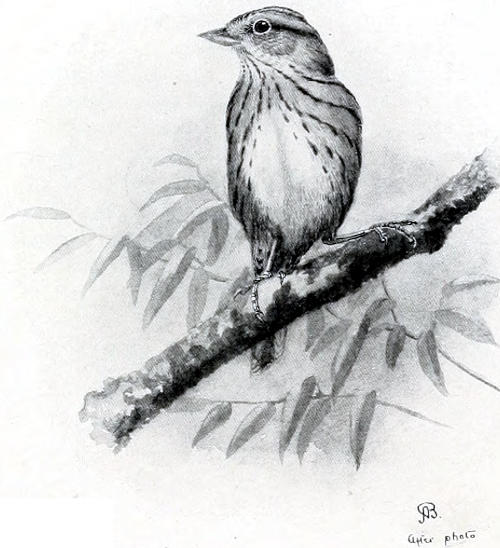
Taken at Longmire’s Springs. LINCOLN’S SONG SPARROW. ALLAN BROOKS AFTER PHOTO BY THE AUTHOR.
The song of the Lincoln Sparrow is of a distinctly musical order, being gushing, vivacious, and wren-like in quality, rather than lisping and wooden, like so many of our sparrow songs. Indeed, the bird shows a much stronger relationship in song to the Purple Finch than to its immediate congeners, the Song Sparrows. The principal strain is gurgling, rolling, and spontaneous, and the bird has ever the trick of adding two or three inconsequential notes at [148] the end of his ditty, quite in approved Purple Finch fashion. “Linkup, tinkup perly werly willie willie weeee (dim.)” said one; “Riggle, jiggle, eet eet eet eer oor,” another. “Che willy willy willy che quill”; “Lee lee lee quilly willy willy,” and other such, came with full force and freshness at a hundred yards to the listeners on the back porch at Longmire’s.
When studied in the swamp, the Lincoln Finches were found to be more reluctant than Song Sparrows to expose themselves, but one pair, anxious for their young, sat out against a clear sky again and again. The bird was seen occasionally to erect its crown feathers in inquiry or excitement, as do Chipping Sparrow, Nuttall Sparrow, et al. A Yellow Warbler, stumbling into the manorial bush, was set upon furiously; but she made off philosophically, knowing that her punishment was after the accepted code. A Rusty Song Sparrow, however, was allowed to sit quietly at a foot’s remove, not, apparently, because he was so much bigger, nor even because nearer of kin, but rather because of common parental anxiety. The contrast here was instructive; the Lincoln Sparrow being not only smaller but more lightly colored and with a sharp-cut streakiness of plumage. A comparison of many examples showed the similarity of head pattern between the two Sparrows to be very noticeable, while the buffy tinge of the Lincoln’s breast would appear to be one of its least constant marks.
An alleged sub-species, Forbush’s Sparrow, M. l. striata, “Similar to M. lincolni but superciliary stripes and upperparts more strongly olivaceous, and dark streaks especially on back and upper tail-coverts, coarser, blacker, and more numerous,” has been ascribed to British Columbia and western Washington, but the material at hand is meager and inconclusive, and the proposed form has been passed upon adversely by Ridgway.
No. 60. KADIAK FOX SPARROW.
A. O. U. No. 585 a (part). Passerella iliaca insularis Ridgway.
[Description of Passerella iliaca unalaschensis (Shumagin Fox Sparrow).—Adults: “Pileum and hindneck brownish gray or grayish brown (nearly hair brown) passing into clear gray (mouse gray or smoke gray) on superciliary region and sides of neck; auricular region brownish gray, with narrow and indistinct shaft streaks of whitish; back, scapulars, and rump plain hair brown; greater wing-coverts, tertials and upper tail-coverts dull cinnamon brown, the rest of wings intermediate between the last named color and color of back, except edges of outermost primaries, which are pale hair brown; underparts white, the foreneck, sides of throat (submalar region), chest, and sides of breast marked with triangular spots of deep grayish brown or drab; the flanks broadly streaked or striped with the same (both sides and flanks mostly grayish brown laterally); [149] malar region white flecked with grayish brown; under tail-coverts grayish brown centrally, broadly margined with white or buffy white; middle of throat and breast usually with a few small spots of brown; maxilla dusky on culmen, paler on tomia; mandible pale colored (yellowish in winter, pinkish or liliaceous in summer); iris brown; legs and feet brown” (Ridgway).]
Description.—“Similar to P. i. unalaschensis but much browner and more uniform in color above (back, etc., warm sepia brown instead of grayish brown or brownish gray); spots on chest, etc., larger and deeper brown; under tail coverts more strongly tipped with buff” (Ridgway). Length of adult male (skins): 6.78 (172.5); wing 3.30 (83.8); tail 2.92 (74.1); bill .50 (12.7); tarsus 1.02 (25.9).
Recognition Marks.—Sparrow size; uniform brownish coloration of back; underparts heavily spotted with brown; browner than unalaschensis but duller than townsendi; larger than annectens; color of crown unbroken as compared with Rusty Song Sparrow (Melospiza melodia morphna), also bird larger.
General Range.—“Kadiak Island, Alaska, in summer; in winter south along the coast slope to southern California.”
Range in Washington.—Winter resident and migrant west of Cascades.
Authorities.—Passerella townsendii Baird, Rep. Pac. R. R. Surv. IX. 1858. p. 489 part (Whitbeys Id., winter).—Fide Ridgway.
A singular fatality (or, more strictly, want of fatality) has attended our efforts to secure a representative series of migrating Fox Sparrows on Puget Sound. The birds have only revealed themselves in city parks or otherwise in the absence of a gun. It is practically certain that all the Alaskan forms described by Mr. Ridgway occur here regularly in winter and during migrations but so unobtrusive are the birds and so dense the cover afforded that we have been completely baffled in our attempts, and find ourselves obliged, at the last moment, to fall back upon Mr. Ridgway’s original descriptions in Birds of North and Middle America, Vol. I. (p. 389 ff), and for the use of these we desire again to express our grateful obligations.
For additional remarks on the Shumagin Fox Sparrow (P. i. unalaschensis) and the Yakutat Fox Sparrow (P. is annectens) see Hypothetical List in Volume II. of this work.
Field identification of the Fox Sparrows by means of binoculars may not command the respect of precise scientists. But there he sat, placid, at twenty feet, in a well-lighted grove on the Nisqually Flats, on the 10th day of February, 1906. See; twenty divided by eight (the magnifying power of the glasses) equals two and a half. At arm’s length I held him, while I noted that the upperparts were dull hair-brown thruout, not noticeably brightening on wings and tail but perhaps a shade darker on the crown; underparts heavily but clearly spotted with a warmer brown—so, obviously and indisputably, neither a Sooty nor a Townsend. Shumagin (P. i. unalaschensis) perhaps; but Ridgway[20] enters all Puget Sound winter records as Kadiaks, and we must follow the gleam until we are able to perfect the light of our own little lanterns by the flash of a shot-gun.
[150]
No. 61. TOWNSEND’S SPARROW.
A. O. U. No. 585 a (part). Passerella iliaca townsendi (Audubon).
[Description of P. i. annectens (Yakutat Fox Sparrow).—“Similar to P. i. insularis but smaller (the bill especially) and coloration slightly browner” (Ridgw.).]
Description.—Adults: Similar to P. i. annectens but coloration darker and richer (inclining to chestnut brown); spots on chest, etc., larger. “Above deep vandyke brown, duller (more sooty) on pileum, more reddish (inclining to burnt umber or dark chestnut brown) on upper tail-coverts and tail; sides of head deep sooty brown, the lores dotted, the auricular region finely streaked, with dull whitish; general color of underparts white, but everywhere spotted or streaked with deep chestnut brown or vandyke brown, the spots mostly of triangular (deltoid and cuneate) form, very heavy and more or less confluent on chest, smaller on throat and breast; sides and flanks almost uniform deep brown, the latter tinged with buffy or pale tawny, under tail-coverts deep olive or olive-brown broadly margined with buffy or pale fulvous.” Length of adult male (skins): 6.67 (169.4); wing 3.17 (80.5); tail 2.78 (70.6); bill .47 (11.9); tarsus 1.00 (25.4).
Recognition Marks.—Sparrow size; warm brown (nearly uniform) coloration of upperparts; heavy spotting of chest, etc. Absence of distinctive head markings will distinguish bird from local Song Sparrows, and robust form with conical beak from migrating Hermit Thrushes.
Nesting.—As next. Does not breed in Washington.
General Range.—“Coast district of southern Alaska (islands and coast of mainland from southern side of Cross Sound, Lynn Canal, etc., to north side of Dixon Entrance); in winter, south to northern California” (Ridgway).
Range in Washington.—Common migrant and (possibly) winter resident west of Cascades.
Authorities.—? Fringilla townsendi Audubon, Orn. Biog. V. 1839, 236, pl. 424, fig. 7 (Columbia River). Townsend, Narrative (1839), p. 345. Passerella townsendii, Baird, Rep. Pac. R. R. Surv. IX. 1858, p. 489. C&S. Ra. Kk. B. E(H).
Specimens.—(U. of W.) Prov. B. C.
Time was when all the various Fox Sparrows of the Pacific Northwest were lumped together under the name Townsend’s Sparrow. A more critical age, however, under the leadership of Professor Ridgway, has resolved the bewildering array of shifting browns into five forms, or subspecies, assigning to each summer quarters according to the dullness or brightness of its coat. The end is not yet, of course, but the distinctions already made are sufficiently attenuated to cause the public to yawn. Suffice it to say, that this is one of the plastic species long resident on the Pacific [151] Coast; and that the varying conditions of rainfall and temperature, to which the birds have been subjected thruout the greater portion of the year, have given rise to five recognizable forms of the Townsend Sparrow.
Probably all forms are migratory, but the northernmost member of the group, the Shumagin Fox Sparrow (P. i. unalaschensis) has not been taken except in its summer home, the Alaska Peninsula, Unalaska, and the Shumagins. The remaining four are known to retire in winter as far south as California; but whether they preserve the 2, 3, 4, 5, arrangement in winter, or whether the order is roughly reversed (as is true in the case of certain other species), so that number 2 goes farthest south, while number 5, less anxious as to the severities of winter, migrates, as it were, half-heartedly, and becomes for a time the northernmost form, we cannot tell. However this may be, Townsend’s Sparrow proper (P. i. townsendi) appears to outnumber any of the remoter forms during at least the spring migrations; and because it is our next neighbor on the north, should be entitled to more consideration than plain heathen birds.
At no time does the absorptive power of our matchless Puget Sound cover appear to greater advantage than during the migration of the Fox Sparrows. However they may choose to move at night, by day they frequent the dense tangles of salal and salmon brush, or skulk about in cedar swamps. To search for them is useless, but if you are much out-of-doors the time will come, while you are footing it softly along some woodland path, that a demure brown bird will hop out in front of you and look unconcernedly for tid-bits before your very eyes. The bird is a little larger than a Song Sparrow, but you will require a second glance to note that the colors of the upperparts are smoothly blended, that the head lacks the vague stripiness of Melospiza, and that the underparts are spotted instead of streaked. Or, it may be, that you chance upon him as he is busily scratching among the fallen alder leaves. Scratching is hardly the word tho, for the bird leaps forward and executes an extravagant double kick backward, landing invariably at the edge of the cleared space. Here, without a moment’s delay, he proceeds to glean busily, whereas you rather expected him to pause at the end of his stunt, like the acrobat, awaiting the conventional burst of applause. If you must needs pursue the path, he hops back into the thicket and you have seen, perhaps, your last Fox Sparrow for this year, altho his migrating kinsmen must number millions.
[152]
No. 62. SOOTY FOX SPARROW.
A. O. U. No. 585 a (part). Passerella iliaca fuliginosa Ridgway.
Description.—Adults: Upperparts, sides of head, neck, and lateral underparts nearly uniform dark brown (sepia brown—“sooty” not inappropriate), warming slightly upon exposed surfaces of wings and upon rump and outer edges of rectrices; below white save for under tail-coverts, which have clear buffy wash, everywhere save on middle belly heavily marked with large, chiefly triangular, spots of the color of back or darker—spotting heaviest on breast where nearly confluent. Bill black above shading on sides into yellow of lower mandible; feet pale ruddy brown or wine-color. Length (of a single fresh specimen) 7.45 (191.7); wing (av.) 3.21 (81.5); tail 2.91 (77); bill .48 (12.2); tarsus 1.02 (25.9).
Recognition Marks.—Sparrow to Chewink size; uniform sooty brown coloration of head and upperparts; heavily spotted below with sepia or blackish; darker above and more heavily spotted below than any migrant form of the P. i. unalaschensis group.
Nesting.—Nest: a bulky structure with a broad, flat brim, of mosses, grasses, twigs, woody fibers, weed-stalks, often heavily lined with fine dry grass of contrasting color and with an inner mat of fur, hair or feathers; placed at moderate heights in thickets or saplings; measures externally 6 inches across by 3 deep, internally 2⅛ across by 1⅝ deep. Eggs: 4, greenish blue, spotted, or spotted and clouded, with reddish brown. Av. size, .94 × .68 (23.8 × 17.3). Season: May-July; two broods.
General Range.—Summer resident in coast region of British Columbia and northwestern Washington; in winter south along the coast to San Francisco.
Range in Washington.—Breeding on the San Juan Islands and upon the northern and western shores of the Olympic Peninsula; not uncommon migrant on Puget Sound.
Authorities.—(?) Baird, Rep. Pac., etc., 489 part; (?) Cooper and Suckley Rep. Pac., etc., 204 part; (?) Sclater Cat. Am. Birds, 1862, 119 part (Simiahmoo [sic]); Ridgway, Auk, XVI. Jan. 1899, 36 (Neah Bay). Kb. E.
Specimens.—Prov. BN. E.
The mystery of the Fox Sparrow clears a little as we move northward on Puget Sound, and may even resolve itself one day as we spend a lazy July in camp on one of the San Juan islands. We are puzzled, as the tent pegs are being driven, by certain sprightly songs bursting out now here, now there, from the copse. We labor under a sense of avian surveillance as we gather fuel from the beach, but the songs are too joyous and limpid to make precise connections with anything in previous experience. It is not till the cool of the evening, when we seek the spring, back in the depths of the thicket, that we come upon a fair birdmaiden slyly regaling herself upon a [153] luscious salmon-berry, flushed to the wine-red of perfection, while three of her suitors peal invitations to separate bowers in the neighboring tangles. She flees guiltily on detection, but the secret is out; we know now where these shy wood nymphs keep themselves in summer.
The male bird is sometimes emboldened by the moment of song to venture into the tops of willows or alders, but even here he hugs the screen of leaves and is ready in a trice to dive into the more familiar element of bushes. Once under cover of the protecting salal, or among the crowding ferns, the Fox Sparrows are excelled by none in their ability to get about with a modicum of disturbance; and the longest journeys, such as are made necessary in the time of clamoring young, appear to be made by slipping and sliding thru the maze of intersecting stems. The song is varied and vivacious; but, save for the opening notes, is neither very strong nor very brilliant. The opening phrase, however, Pewit, heu, comes as a tiny bugle call into which is distilled the essence of all dank hollows, of all rustling leaves, of all murmuring tides, and of all free-blowing breezes. It is the authentic voice of the little wild.
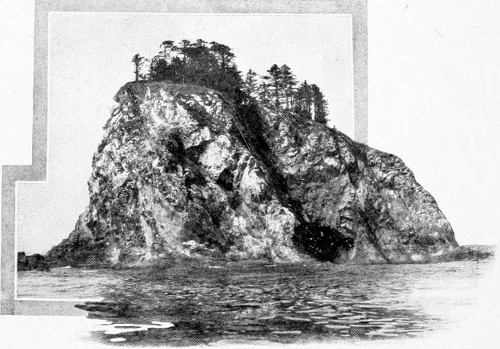
From a Photograph Copyright, 1907, by W. L. Dawson. CARROLL ISLET—SOUTH EXPOSURE. WHERE THE FIRST NEST OF THE SOOTY FOX SPARROW WAS FOUND.
On a July day a trio of Indian boys, Quillayutes, were showing the bird-man a round of belated nesters, while he was looking for opportunities to photograph eggs, and also recording Quillayutan bird names in passing. A Rusty Song Sparrow’s nest held only weanlings, mildly hideous, and the leader, a lad of ten, expressed regret that he could not show me the nest of another kind of Song Sparrow. With excess of Caucasian pride I assured him that there was only one species of Song Sparrow to be found locally, but my learned statements drew forth only puzzled and unconvicted glances. Some days later when I had taken a set of Sooty Fox Sparrow’s eggs from a neighboring islet, the boys clamored in triumph, “That’s it; [154] those are the eggs of Tahbahlilchteh, the other Song Sparrow we told you about.” The boys were near enough right; the Fox Sparrow is for all the ordinary world like a Song Sparrow; and I venture that not a dozen white boys in Washington ever saw the bird itself, let alone distinguishing it by name.
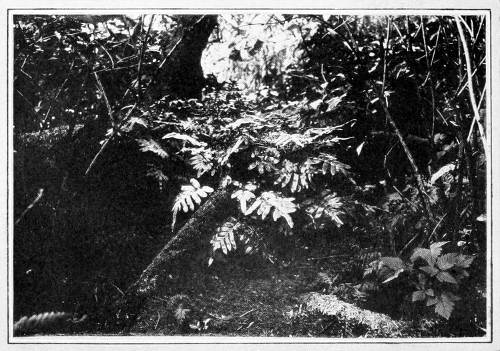
Taken on Carroll Islet. Photo by the Author. NEST OF SOOTY FOX SPARROW IN FERN CLUMP. THE NEST ITSELF IS ALMOST INVISIBLE BECAUSE BURIED IN MOSS AND FERN LEAVES.
The eggs referred to were found amid most romantic surroundings, on a sea-girt islet a mile or two out from the Pacific shore. The island is given over to sea-birds, and these nest upon its precipitous sides to the number of thousands; but the center of the rock is crowned with a grove of spruce trees, which overshadow a dense growth of salmon-berry bushes. In a clump of the latter at a height of six feet was placed a very bulky but unusually handsome nest, which held, in the really tiny cup which occupies the upper center of the structure, three eggs of a greenish blue color heavily spotted and marbled with warm browns. The nest measures externally eight and ten inches in width, internally two; in depth four inches outside and only one and a half inside. It is composed chiefly of green mosses set in [155] dead spruce twigs with a few twisted weed stalks; while the lining is of a light-colored, fine, dead grass, very loosely arranged, and a few breast-feathers of the Glaucous-winged Gull. A nest full of young Peregrine Falcons were conversing in screams with their doting parents in the spruce trees overhead, and terrorizing the island thereby; but the Sooty Fox Sparrows stepped forward modestly to claim ownership in the nest which “Science” unfortunately required. The date was July 21, 1906, and the eggs were nearly upon the point of hatching.
Thus, the north and west slopes of the Olympic Mountains, together with the islands of lower Puget Sound, appear to mark the southern breeding range of the coastal Fox Sparrows. This form has not been reported breeding upon the mainland east of Puget Sound, but it is difficult to see why it should not do so. It is rather the commonest form during the spring and fall migrations, and there is no evidence as yet that it tarries with us in winter.
No. 63. SLATE-COLORED SPARROW.
A. O. U. No. 585 c. Passerella iliaca schistacea (Baird).
Synonym.—Slate-colored Fox Sparrow.
Description.—Adults: Upperparts slaty gray tinged with olivaceous, changing abruptly to russet brown on upper tail-coverts, and tail; wings brown brightening, more rusty, on edges of greater coverts and secondaries; some white fleckings below eye, and supraloral spot dull whitish; underparts white shaded with color of back on sides; the sides of throat, chest, and sides of breast heavily and distinctly marked with triangular spots of sepia; lower breast (and sometimes middle of throat) flecked, and sides and flanks striped, with the same shade; under tail-coverts grayish brown centrally edged broadly with buffy. Young birds are tinged with brown above and are duller white below with less distinct markings. Length of adult male 7.00-7.50 (177.8-190.5); wing 3.15 (80); tail 3.15 (80); bill .47 (12); tarsus .92 (23.3).
Recognition Marks.—Sparrow to Chewink size; slaty gray and brown coloration above with heavy spotting on breast distinctive; gray instead of brown on back as compared with the five members of the unalaschensis group.
Nesting.—Nest: a bulky affair of twigs, weed-stalks, grasses, etc., placed on ground or low in bushes of thicket. Eggs: 3-5, usually 4, greenish brown sharply spotted or (rarely) blotched with chestnut. Av. size .85 × .65 (21.6 × 16.5). Season: May-July; two broods.
General Range.—Rocky Mountain district of United States and British Columbia west to and including the Cascade Mountains, the White Mountains [156] of southeastern California, and the mountains of northeastern California; south in winter to New Mexico, Arizona, etc.
Range in Washington.—Summer resident in the timbered districts of the East-side and in the Cascade Mountains (west to Mt. Rainier).
Authorities.—[“Slate-colored sparrow,” Johnson, Rep. Gov. W. T. 1884 (1885), 22]. Bendire, Life Hist. N. A. Birds, Vol. II., p. 435.
The residents of Cannon Hill, in Spokane, are to be congratulated, not alone for their wealth, for Nature is not curious as to bank accounts, but for the rare good taste which has been displayed in utilizing the largess of Nature. Instead of going in with axe and shovel and fire-brand, first to obliterate the distinctive features of Nature and then rear mocking platitudes in mortar and stone upon her pale ashes, they have accepted the glory of her grim lava bastions and the grace of her unhewn pines; nor have they even despised the tangles of wild shrubbery, those decent draperies without which both tree and cliff would be overstark. To be sure the landscape artist with consummate skill has said to the piny sentinel, “Stand here!” and to the copse, “Sit there!” but he has not forgotten withal the primeval rights of the feathered aborigines. As a result the birds approve. What higher meed could mortal ask? Or where is there a better criterion of taste? Taken all in all I doubt if there is a more delightful spot in Washington in which to study bird life, certainly not within municipal bounds, than Cannon Hill affords.
Here, for instance, is this wood sprite, the very genius of the unravished wild; no one would think of looking for him in a city, yet of an early morning as the bird-man was passing along Seventh Avenue, he was arrested by the crisp and hearty notes of a Slate-colored Sparrow, coming from a bush in an artistically unkempt corner of the adjoining yard. In the half light, nothing in the pose and appearance of this bird would have induced an ornithologist to bestow a second glance upon the evident Song Sparrow, had it not been for the sweet and powerful challenge which poured from his earnest beak. Ooree, rickit, loopiteer, it said, with varied cadence and minor change, which gave evidence of no mean ability. There is something so forthright and winsome about the song of this modest bird, that the listener promptly surrenders “at discretion,” and begins to ask eager questions of his dainty captor.
A few yards further on three of these Sparrows were seen feeding on a well-kept lawn, but ready to skurry at a breath to the shelter of bush-clumps, thoughtfully provided. And all this in the first week in June, the very height of nesting time! With this as an example, what need to speak of Hammond Flycatchers, Mountain Chickadees, Catbirds, Pine Siskins, Audubon Warblers, Shufeldt Juncoes, Cassin Finches, Pygmy Nuthatches, American Crossbills, Cassin Vireos, Louisiana Tanagers, Ruby-crowned [157] Kinglets, Olive-sided Flycatchers, Evening Grosbeaks, Violet-green Swallows, Black-chinned Hummingbirds, Bobwhites, and a host of commoner sorts, all residents of the same demesne? “Unto him that hath shall be given.” Unto these who have shown appreciation and consideration, has been given the friendship of the birds, and they deserve their good fortune.
On the 5th of June we visited a nest which had been located a few days before in a little aspen grove beyond Garden Springs. The nest was placed upon the ground at the base of a small tree, and it sat so high, without pretense of concealment, that it was plainly visible with all its contents two rods away.
The female was brooding, but upon our approach she slipped quietly off and left her three callow young to the tender mercies of the bird-man and his big glass eye, set at four feet, while she began searching for food upon the ground a yard or two away.
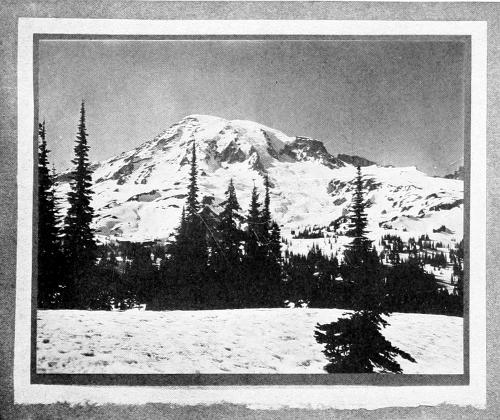
Taken in Rainier National Park. From a Photograph Copyright, 1908, by W. L. Dawson. WITH UNCLOUDED BROW. A HAUNT OF THE SLATE-COLORED SPARROW.
[158]
The male bird appeared, once, upon a bush some twenty feet away, making no hostile demonstration but beaming rather a hearty confidence, as who should say, “Well, I see you are getting along nicely at home; that’s right, enjoy yourselves, and I’ll finish up this bit of hoeing before supper.”
The mother bird, meanwhile, was uttering no complaint of the strange presence, preferring instead to glean food industriously from under the carpet of green leaves. Soon she returned, hopping up daintily. Standing upon the elevated brim of her nest she carefully surveyed her brood without proffer of food, as tho merely to assure herself of their welfare. I “snapped” and she retreated, not hastily, as tho frightened, but quietly as matter of reasonable prudence. Again and again during the hour I had her under fire, she returned to her brood. Each time she retired before the mild roar of the curtain shutter, never hastily or nervously, but deliberately and demurely. Thrice she fed her brood, thrusting her beak, which bore no external signs of food, deep down into the upturned gullets of the three children. Thrice she attempted to brood her babes, and very handsome and very motherly she looked, with fluffed feathers and mildly inquisitive eye; but the necessary movement following an exposure sent her away for a season.
When absent she neither moped nor scolded, but discreetly set about scratching for food, always within a range of ten or fifteen feet of the nest. At such times she would look up trustfully and unabashed. Upon the return she never flew, and there was nothing to advise the waiting camerist of her approach, save the rustle of leaves as she came hop, hopping, until she stood upon the familiar brim.
The opportunities for picture-making were simply unlimited, save for the weakness of the leaf-diluted light. Seldom have I been stirred to such admiration as in the case of this gentle mother Schistacea. So demure, so even-tempered, and so kindly a bird-person, with such a preserving air of gentle breeding, I have not often seen. It was an hour to be long remembered.
No. 64. GREEN-TAILED TOWHEE.
A. O. U. No. 592.1. Oreospiza chlorura (Aud.).
Synonyms.—Green-tailed Finch. Blanding’s Finch.
Description.—Adults: Crown and occiput rich chestnut; forehead blackish gray with whitish loral spot on each side; remaining upperparts olive-gray tinged more or less with bright olive-green; wings and tail with brighter greenish edgings; bend of wing, axillaries and under coverts yellow; chin and throat [159] white bordered by dusky submaxillary stripe; sides of head and neck and remaining underparts ashy gray, clearing to white on abdomen, tinged with buffy or brownish on sides, flanks and crissum. Bill blackish above, paler below; legs brown, toes darker; irides cinnamon. Young birds are brown above tinged with greenish and streaked with dusky but with wings and tail much as in adult. Length of adult about 7.00 (177.8); wing 3.15 (80); tail 3.30 (84); bill .50 (12.7); tarsus .94 (24).
Recognition Marks.—Sparrow size; rufous crown, white throat; greenish coloration of upperparts.
Nesting.—“Nest: in bush or on the ground. Eggs: .90 × .68 (22.8 × 17.2); pale greenish or grayish white, freckled all over with bright reddish brown, usually aggregating or wreathing at the larger end” (Coues).
General Range.—“Mountain districts of western United States, from more eastern Rocky Mountain ranges to coast range of California; north to central Montana and Idaho and eastern Washington” (Ridgway). South in winter to Mexico and Lower California.
Range in Washington.—Presumably summer resident in the Blue Mountains.
Authorities.—[“Green-tailed towhee,” Johnson, Rep. Gov. W. T. 1884 (1885), 22]. Ridgway, Birds of North and Middle America, Part I, 401. T(?).
Not having ourselves encountered this species we are not able to comment on Prof. Ridgway’s inclusion[21] of eastern Washington in the bird’s breeding range. The Green-tailed Towhee appears to be essentially a mountain-loving species, and if it occurs within our borders, will be nearly confined to the Blue Mountains of the southeastern corner.
Mr. Trippe, writing from Idaho Springs, Colorado, says of this bird[22]: “It arrives at Idaho early in May, and soon becomes abundant, remaining till the close of September or early part of October. It is a sprightly, active little bird with something wren-like in its movements and appearance. It is equally at home among the loose stones and rocks of a hill-side (where it hops about with all the agility of the Rock Wren), and the densest thickets of brambles and willows in the valleys, amidst which it loves to hide. It is rather shy, and prefers to keep at a good distance from any suspicious object; and if a cat or dog approaches its nest, makes a great scolding, like the Cat-bird, and calls all the neighbors to its assistance; but if a person walks by, it steals away very quietly and remains silent till the danger is passed. It has a variety of notes which it is fond of uttering; one sounds like the mew of a kitten, but thinner and more wiry; its song is very fine, quite different from the Towhee’s and vastly superior to it. It builds its nests in dense clumps of brambles, and raises two broods each season, the first being hatched about the middle of June.”
[160]
No. 65. SPURRED TOWHEE.
A. O. U. No. 588 a. Pipilo maculatus montanus Swarth.
Synonyms.—Chewink. “Catbird.”
Description.—Adult male: Head and neck all around, chest and upperparts black, glossy anteriorly, duller on back; elongated white spots on scapulars, on tips of middle and greater coverts and on outer web of exposed tertials; edge of wing white and succeeding primaries white on outer web; outermost pair of rectrices edged with white on outer web; the three outermost pairs terminally blotched with white on inner web and the fourth pair touched with same near tip; breast and belly white; sides, flanks and crissum light cinnamon rufous, bleaching on under tail-coverts to light tawny. Bill black; feet brownish; iris red. Adult female: Similar to male but duller; black of male replaced by slaty with an olivaceous cast. Length of adult males: 7.50-8.50 (190.5-215.9); wing 3.17 (86); tail 3.93 (100); bill .53 (13.5); tarsus 1.07 (27.7); hind claw .48 (12.2). Female a little less.
Recognition Marks.—Standard of “Chewink” size; black, white and cinnamon-rufous unmistakable; heavily spotted with white on scapulars and wing as compared with P. m. oregonus.
Nesting.—Nest: on the ground in thicket or at base of small sapling, a bulky collection of bark-strips, pine needles, coarse dead grass, etc., carefully lined with fine dry grass; measures 5 inches in width and 3 in depth externally by 2½ wide and 1½ deep inside. Eggs: 3-5, usually 4, grayish white or pinkish white as to ground, heavily and uniformly dotted with light reddish brown. Av. size, .93 × .70 (23.6 × 17.8). Season: last week in April, last week in May and first week in June; two broods.
General Range.—Breeding in Upper Sonoran and Transition zones from the Rocky Mountains to the Cascade-Sierras and in the Pacific coast district of central California, and from Lower California and Northern Mexico north into British Columbia; retiring from northern portion of range in winter.
Range in Washington.—Common summer resident east of the Cascades, found in foothills and mountain valleys up to 3,000 feet; casually resident in winter.
Authorities.—P. m. megalonyx, Brewster, B. N. O. C. VII. Oct. 1892, p. 227. D². Ss¹. Ss². J.
Specimens.—(U. of W.) P¹. Prov. C.
Altho of Mexican stock, our western Towhee does not differ greatly in appearance from the familiar bird (P. erythrophthalmus) of the East; and its habits so closely resemble that of the eastern bird as hardly to require special description. The Spurred Towhee is a lover of green, thickety hillsides and brushy draws, such cover, in short, as is lumped together under [161] the term “chaparral” further south. It is, therefore, narrowly confined to the vicinity of streams in the more open country, but it abounds along the foothills and follows up the deeper valleys of the Cascades nearly to the divide.
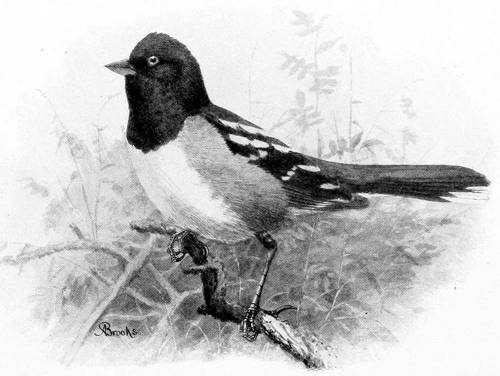
SPURRED TOWHEE, MALE.
Tow’hee, as a name, is a manifest corruption of tow heé, or to-hwi′, an imitative word, after the bird’s most familiar note. Chewink′ is an attempt along the same line, but Marié is what the bird seems to me to say. It is on this account alone that the bird is said to “mew” and is called “Catbird.” The true Catbird, however, always says Ma-á ry, and there is no cause for confusion. During excitement or alarm the Towhee’s note is always shortened and sharpened to Mrie, with a flirt and jet, and a flash of the eye. The song variously rendered as “Chee-terr, pilly, willy, willy,” “Chip, ah, tow-hee-ee” and “Yang, kit-er-er,” is delivered from the top of a bush or the low limb of a tree; and while monotonous and very simple, it retains the pleasing quality of that of the eastern bird. The singer will not stand for close inspection, for, as Jones says of its cousin[23]: “He is a nervous fellow, emphasizing his disturbance at your intrusion with a nervous [162] fluff, fluff of the short wings, and a jerk and quick spreading of the long, rounded tail, as if he hoped that the flash of white at its end would startle the intruder away.”
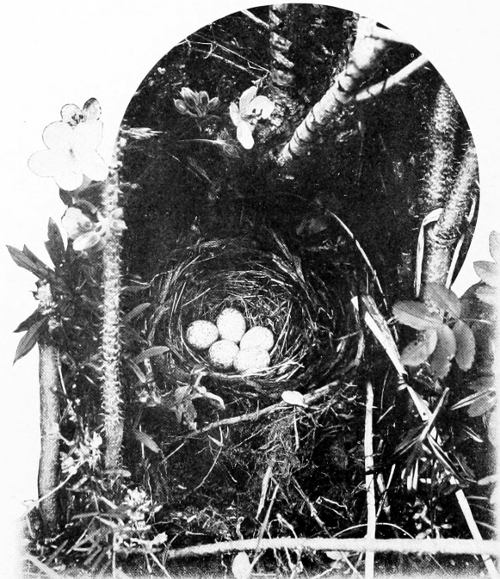
Taken in Oregon. Photo by A. W. Anthony. NEST AND EGGS OF THE SPURRED TOWHEE.
For a nest the Spurred Towhee scratches a hollow at the base of a bush or clump in some dry situation, and lines this carefully, first with leaves, bark-strips and plant stems, then with fine grasses or rootlets. The eggs, commonly four in number, are deposited the last week in April or first in May, and the female clings to her treasures until the crushing footstep is very imminent. Once flushed, however, she keeps to the background, scolding intermittently, and she will not return until long after the excitement has died down.
Two broods are raised each season, and the first one, at least, must early learn to shift for itself. The young birds are obscure, dun-colored creatures, quite unlike their parents in appearance, and by July they infest the buck-brush of the more open mountain sides in such numbers and apparent variety as to start a dozen false hopes in the ornithologist’s breast each day.
[163]
No. 66. OREGON TOWHEE.
A. O. U. No. 588 b. Pipilo maculatus oregonus (Bell).
Synonyms.—“Catbird.” Chewink.
Description.—Adult male: Similar to P. m. montanus but darker, the white spotting of wing and blotches on tail much reduced; two outer pairs of rectrices blotched and the third touched with white near tip; cinnamon-rufous of sides, etc., richer and deeper. Adult female: Like male but black veiled by deep reddish brown (clove brown) skirtings of feathers. Length about 8.50 (216); wing 3.33 (84.6); tail 3.69 (93.7); bill .57 (14.5); tarsus 1.10 (27.9); hind claw .43 (10.9). Female a little smaller.
Recognition Marks.—“Chewink” size; black (with white spotting on wings) above; white of breast; deep reddish brown of sides; mewing cry.
Nesting.—Like that of preceding species. Eggs a little larger: Av. size, 1.04 × .74 (26.4 × 18.8).
General Range.—Pacific coast district from British Columbia (including Vancouver Id.) south to central California; chiefly resident thruout its range.
Range in Washington.—Of general occurrence, save at higher levels, west of the Cascades; resident.
Authorities.—? Fringilla arctica, Aud. Orn. Biog. V. 1839, 49; pl. 394. P. oregonus, Bell, Baird, Rep. Pac. R. R. Surv. IX. 1858, pp. 513, 514. (T). C&S. L². Rh. Kb. Ra. Kk. B. E.
Specimens.—U. of W. P. Prov. B. BN. E.
Perhaps no bird is better known by voice and less by plumage than this shy recluse of the under forest. Swampy thickets, brush-piles, log-heaps, and the edges of clearings are his special delight. Hence it is that the newcomer, taking up quarters at the edge of town, hears this mysterious, questioning voice, me-aý? meaý uh? rising from the depths of the brush-lot opposite. He reports the sound under the name of “Catbird,” and asks the bird-man’s opinion. Or, if the newcomer has been persistent enough, he has a glowing account to give of a handsome black bird with red on its sides, “like a Robin,” and some white below. The bird would only show himself for a moment at a time, and then he flitted and flirted restlessly before he dived into cover again, so that the fine points of white spotting on the wing and white tips on the outer tail feathers were lost out of account.
Of course it is the Oregon Towhee, and the half pleasant, half complaining notes will insure him notice forever after. The bird is strictly resident wherever found, and the unmistakable blackness of his plumage is due rather to the age-long endurance of rain than to any chance association with blackened logs and stumps, as might be supposed. Towhee is prince [164] of the underworld, not, of course, in the Mephistophelian sense, but as the undoubted aristocrat among those humble folk who skulk under dark ferns, thread marvelous mazes of interlacing sticks and stalks, explore cavernous recesses of moss-covered roots, and understand the foundations of things generally.
The handsome bird is a little impatient of the company of his own kind, his faithful spouse always excepted; but he quite appreciates the mild deference of Rusty Song Sparrows, the bustling sociability of Western Winter Wrens, or even the intermittent homage of Seattle Wrens. In winter the Fox Sparrows attach themselves to this humble itinerant court, but they are a dozen times more bashful than their chief even.
Only at mating time does Towhee throw caution to the winds. Then he mounts a sapling and drones away by the hour. The damps of ten thousand winters have reduced his song to a pitiful wheeze, but he holds forth as bravely as any of his kin, whééééé whééééé, and again, whééééé. In winter the birds employ a peculiar hissing sound, pssst or bzzzt, not I believe, as a warning—rather as a keep-in-touch call. It was rather heartening tho to hear the full song of Towhee on the 29th of December at Blaine. Comparisons were unnecessary, and the homely trill stood out like a benediction against the dripping silence.
In feeding, Towhees resort chiefly to the ground. They are not careful to observe quiet, and one may follow their movements by the attendant rustling of leaves. Scratching for food is a favorite employment, and this they pursue not by the methodical clutch and scrape of the old hen, but by a succession of spirited backward kicks executed by both feet at once, and assisted by the wings. By this method, not only fallen seeds are laid bare but lurking insects of many sorts, which the bird swiftly devours.
No. 67. LAZULI BUNTING.
A. O. U. No. 599. Passerina amœna (Say).
Synonyms.—Lazuli Finch.
Description.—Adult male: Head and neck all around cerulean blue; this color carried over upperparts but pure only on rump, elsewhere appearing as skirting of feathers; middle coverts broadly and greater coverts narrowly tipped with white; wings and tail otherwise black; some skirting of ochraceous on back, scapulars and tertials; lores black; chest ochraceous sharply defined from blue above but shading gradually into white of remaining underparts; sides and flanks with outcropping bluish dusky. Bill black above, pale bluish below; feet brownish dusky; iris brown. Adult female: Above grayish brown, the color of male [165] recalled by dull greenish blue of rump and upper tail-coverts and by skirtings of wing- and tail-feathers; middle and greater coverts tipped with light buffy; underparts washed with buffy, most strongly on chest and sides, fading to whitish on belly and under tail-coverts. Young birds resemble the female but lack the bluish-gray of rump and skirtings, and are usually more or less streaked below on chest and sides. Length of adult male: 5.25-5.50 (133.3-139.7); wing 2.87 (73); tail 2.08 (53); bill .39 (9.9); tarsus .67 (17). Female smaller.
Recognition Marks.—Warbler size; color pattern of male distinctive,—female not so easy; in general distinguishable by a softness and uniformity of the grayish brown.
Nesting.—Nest: a loosely constructed, bulky structure made chiefly of dead grasses and strips of soft bark, with a heavy inner lining of hair; placed about three feet up in fork of weed, bush or sapling; measures, outside, 4¼ inches across by 3 in depth, inside, 2½ wide by 1½ deep. Eggs: 4, very pale blue unmarked or, rarely, dotted with reddish brown. Av. size .76 × .56 (19.3 × 14.2). Season: first week in June; one brood.
General Range.—Western United States from eastern border of Great Plains to the Pacific (less common on Pacific slope) north to southern British Columbia (chiefly east of the Cascades); south, in winter, to Cape St. Lucas and the Valley of Mexico.
Range in Washington.—Common summer resident east of Cascade Mountains; less common and of irregular distribution in the Puget Sound region; breeds in Cascades up to 3,000 feet.
Migrations.—Spring: Yakima County May 5, 1906; Chelan May 21, 1896.
Authorities.—? Fringilla amœna, Audubon, Orn. Biog. V. 1839, 64, 230; plates 398, 424. Cyanospiza amœna Baird, Baird, Rep. Pac. R. R. Surv. IX. 1858, p. 505. T. C&S. D¹. Ra. D². Ss¹. Ss². J. B. E.
Specimens.—U. of W. P¹. Prov. B. E.
One can scarcely believe his eyes as this jewel flashes from a thicket, crosses a space of common air, and disappears again all in a trice. Either there has been some optical illusion, or Nature has grown careless to fling her turquoises about in such fashion. We must investigate. Upon arrival, somewhere about the 10th of May, and before the return of his dun-colored mate, the male Lazuli is quite conscious of his prominence in the landscape. He avoids notice and goes bounding away if closely pressed; but love soon makes him bold, and he will pursue the object of his affections into the very thicket where you stand. Then, while the female lurks timidly within, he mounts a spray and yields an outburst of music, piercing and earnest, if not too sweet. We see that his blue is deep azure, or turquoise, rather than that of the lapis lazuli from which he is named. The red of his breast is nearly that of the Robin’s, while the pure white of the remaining underparts completes a patriotic study in red, white, and blue. The female shows something of the color pattern of her mate, with the important exception that dull brown supplants the royal blue of head and back. After all, then, they are fitted [166] for separate spheres: she to skulk and hide and escape the hostile eye in the discharge of her maternal duties; he to lose himself against the blue of heaven, as he sings reassuringly from a tree-top, or sends down notes of warning upon the approach of danger.
The song of the Lazuli Bunting is a rambling warble, not unlike that of the Indigo Bunting (C. cyanea), but somewhat less energetic. Its brief course rises and falls in short cadences and ends with a hasty jumble of unfinished notes, as tho the singer were out of breath. Moreover, the bird does not take his task very seriously, and he does not burden the mid-day air with incessant song, as does his tireless cousin.
Somewhere in the shrubbery and tangle, whether of saplings, berry-bushes, roses, ferns, or weeds, a rather bulky nest is built about an upright fork, at a height of two or three feet from the ground. A nest observed in Yakima County was begun on the 19th of June and practically completed by the afternoon of the following day,—this altho the first egg was not laid until the 26th. “Hemp,” milkweed fibers, and dried grasses were used in construction, and there was an elaborate lining of horse-hair (poor dears; what will they do when the automobile has fully supplanted the horse?).
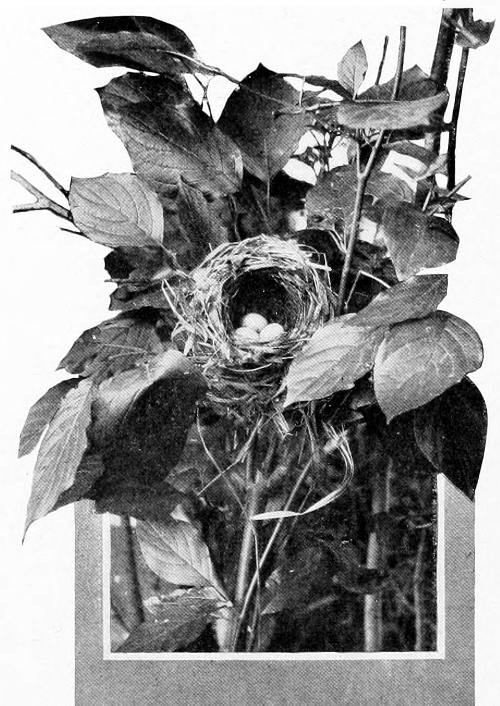
Taken near Spokane. Photo by Fred S. Merrill. A LAZULI BUNTING’S NEST.
Amœna means pleasant, but the female amenity is anything else, when her fancied rights of maternity are assailed. Her vocabulary is limited, to be sure, to a single note, but her repeated chip is expressive of all words in dis from distrust to distress and violent disapprobation.
[167]
No. 68. BLACK-HEADED GROSBEAK.
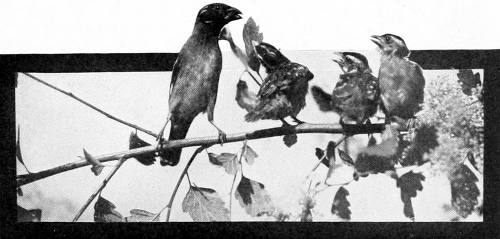
Taken in Oregon. Photo by Finley and Bohlman. ANTICIPATION.
A. O. U. No. 596. Zamelodia melanocephala (Swains).
Description.—Adult male: General coloration black and tawny varied with white and yellow; head glossy black, narrowly on chin, and with irregular invasion of tawny behind; back, scapulars, wings, and tail chiefly black; middle of back with much admixture of tawny; scapulars narrowly tipped with yellowish buffy or white, two conspicuous white wing patches formed by tips of middle coverts and basal portion of primaries; touches of white on tips of greater coverts and secondaries, and on outer edge of primaries; touches of yellow (in highest plumage) bordering white of wing-coverts, etc.; terminal third of two outer pairs of rectrices white on inner webs; lining of wings and breast centrally rich lemon yellow; remaining plumage tawny, brightest on throat and chest, with admixture of black on sides of neck; nearly as bright on rump, but veiled by lighter tips of feathers; lightening posteriorly on remaining underparts; nearly white on under tail-coverts; bill bluish gray, darker above; feet plumbeous. Adult female: Like male, but tawny of underparts paler; upperparts dark olivaceous brown with admixture of white and pale tawny; head blackish with white or brownish median and superciliary stripes; wings and tail fuscous, white markings restricted, those on tail reduced or wanting; sides and flanks streaked with dusky. Length 7.75-8.50 (196.85-215.90); wing 3.9 (99); tail 3.15 (80); bill .71 (18); depth of bill at base .59 (15); tarsus .95 (24).
Recognition Marks.—Chewink size; black head and variegated plumage of male; large beak, with haunts, distinctive.
Nesting.—Nest: a careless but often bulky collection of twigs or weed-stalks, [168] lined, or not, with fine dead grasses; set loosely in branches of bush or sapling, 6 to 20 feet up. Eggs: 4, greenish blue, boldly spotted or blotched with reddish brown, dusky brown and lavender, most heavily about larger end. Av. size 1.00 × .68 (25.4 × 17.27). Season: East-side, May 20; West-side, May 25; one brood.
Authorities.—? “Fringilla melanocephala, Audubon, Orn. Biog. IV. 1838, 519; pl. 373 (Col. Riv.)”: Baird, 499. Cooper and Suckley, Rep. Pac. R. R. Surv. XII. pt. II. 1860, 206. T(?). C&S. Rh. D¹. Ra. D². Ss². J. B. E.
Specimens.—P. B. E.
Those who complain of our lack of song-birds should make the acquaintance of this really skilled musician. He will not often be found in the city parks, nor yet in the fir forests; but wherever there are deciduous trees, not too dense, or tall thickets of willow and alder beside some lake or sluggish stream, there will this minstrel hold forth. The Grosbeak’s song is not unlike the longer lay of the Robin, but it is richer and rounder as well as more subdued. There is about it all a lingering languor of the Southland; and if the gentleman addressed you, you would expect him to say “Sah,” with a soft cadence.
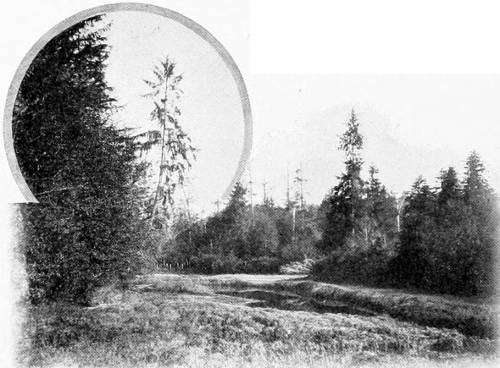
Taken in Clallam County. Photo by the Author. THE GROSBEAK’S CONCERT HALL.
The bird’s carol has the rolling quality which serves to connect it with that of the eastern Rose-breasted Grosbeak, but it is sweeter, more varied, and shows, if anything, a still more strongly marked undertone of liquid harmonics.
The male Grosbeak is, moreover, an indefatigable singer, choosing for his purpose the topmost sprays of alder or cottonwood, and taking pains to give all intruders a wide berth during the concert hours. His attachment to a given locality becomes apparent only after he has been pursued from tree to tree in a wide circuit which brings up at the original station. And [169] yet his shyness is not inspired by caution, for he will sing upon the nest when he spells his wife at the hopeful task of incubation.
The more matter-of-fact female has no word of greeting for the stranger beyond a sharp kimp, a beak-clearing note, not unlike that of a chicken with a crumb in its throat. This the male repeats also, with all shades of emphasis when the home is beset, or, as a last resort, he breaks into song at close quarters,—an ample price, surely, for the fullest immunity.
It is the nest which confirms the southern origin of these gentle birds. It is a flimsy affair of twigs, grass-stems, or weed-stalks carelessly interlaced, and caught in the crotch of a sapling at a height of from five to fifteen feet. The construction is so open, that the blue eggs with their dark brown and lavender spottings may be counted from below. The birds, you see, have been accustomed to a warmer climate, to a tropical range, in fact, where warmth of bedding is no object.
If found upon the nest, the brooding bird cannot think ill of you; or, if there is ground for misgiving, seeks to disarm hostility by a display of gentle confidence. Instances are of record where the sitting bird has been stroked with the hand, and a little discretion will usually insure a lasting friendship.
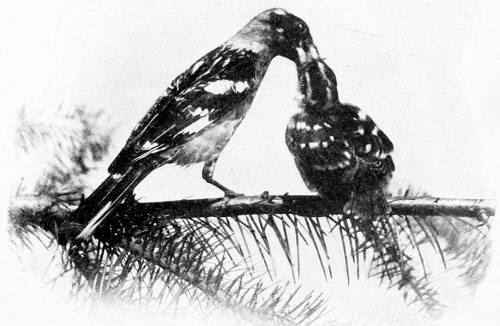
Taken in Oregon. Photo by Finley and Bohlman. REALIZATION.
This species enjoys a wide range in Washington, being found from tide-water to the upper reaches of the deeper mountain valleys; but it is nowhere common enough, let alone abundant.
[170]
Tanagridæ—The Tanagers
No. 69. CRIMSON-HEADED TANAGER.
A. O. U. No. 607. Piranga ludoviciana (Wils.).
Synonyms.—Louisiana Tanager. Western Tanager.
Description.—Adult male: Back, wings, and tail black; middle coverts and tips of greater coverts yellow; remaining plumage rich gamboge yellow; clearest (lemon-yellow) on rump and upper tail-coverts, darkest (live-yellow to wax-yellow) on breast, changing on head and throat to bright carmine or poppy-red. The red increases both in extent and intensity with age and is always brightest anteriorly. Bill horn color; feet and legs bluish dusky; iris brown. Adult female: General plumage dingy olive-yellow; darker, nearly olive, above; lighter and clearer on under tail-coverts; wings and tail dusky with olivaceous wing markings as in male but yellow paler. Young males resemble the adult female and only gradually acquire the clearer brighter plumage of maturity. Length about 7.00 (177.8); wing 3.75 (95); tail 2.80 (71); bill .59 (15); tarsus .80 (20.5).
Recognition Marks.—Sparrow size; sedate ways; pittic note. Black and yellow with crimson head of male distinctive; dull olive of female not likely to be confused when size is discriminated.
Nesting.—Nest: of rather rough, “tropical” construction, composed of twigs, rootlets and moss, lined with horse- or cow-hair; measures externally 7 inches across by 3 in depth, internally 2¾ wide by 1½ deep. Eggs: 3-5, usually 4, pale greenish blue to deep blue, dotted and spotted sparingly with lavender and dark greenish slate, sometimes in wreath about larger end; surface heavily glossed; long ovate in shape. Av. size .92 × .64 (23.3 × 16.2). Season: June; one brood.
General Range.—Western United States from eastern base of Rocky Mountains to Pacific Coast, northward to British Columbia and Athabasca; south in winter to Mexico and Guatemala; straggling eastward during migrations—has been several times taken in New England.
Range in Washington.—Common summer resident in timbered sections, migrant in open country of East-side.
Migrations.—Spring: East-side: Yakima, May 4, 1906, May 9, 1900; Chelan, May 19, 1896, May 20, 1905; West-side: Tacoma, April 27, 1906.
Authorities.—Piranga ludoviciana Bonap., Baird, Rep. Pac. R. R. Surv. IX. 1858, p. 304. T. C&S. Rh. D¹. Ra. D². Ss¹. Ss². Kk. J. B. E.
Specimens.—U. of W. P¹. Prov. B. E.
This handsome Tanager is one of the most characteristic birds of the more open forest areas of Washington, whether east or west. It is one of the three species discovered by the intrepid explorers, Lewis and Clark; and since the Lewis Woodpecker bears the name of one, and the Clark Nutcracker of the other, there was nothing for it but to call the Tanager after the region [171] “Louisiana,” whose further reaches they were then exploring. But we are no longer a part of Louisiana, and we prefer a color-name for one of our few brilliant birds of plumage.
In the hand, the bright yellow of the male Tanager, shading into the bright crimson upon the head, would seem to assure a very conspicuous bird, but afield it is not so. Seen against the changing green of maples, pines, or fir trees, these brilliant colors are lost to any but the most attentive eye. A resplendent male does not hesitate to stand quietly upon the end of a branch and survey you until his curiosity is fully satisfied. This quiet attitude of genteel curiosity seems to be characteristic of all Tanagers. Apart from its psychological bearings, sedateness would seem to play an effective part in modifying the attractions of bright plumage.