Part 3 — CHAPTER VI.
Reading edition
THE INVERSE PROBLEM.
534. Nature of the Inverse Problem.—By the inverse problem is here meant a certain problem so-called by Jevons. Its nature will be indicated by the following extracts, which are from the Principles of Science and the Studies in Deductive Logic respectively.
“In the Indirect process of Inference we found that from certain propositions we could infallibly determine the combinations of terms agreeing with those premisses. The inductive problem is just the inverse. Having given certain combinations of terms, we need to ascertain the propositions with which they are consistent, and from which they may have proceeded. Now if the reader contemplates the following combinations,—
ABCabC
aBCabc,
he will probably remember at once that they belong to the premisses A = AB, B = BC. If not, he will require a few trials before he meets with the right answer, and every trial will consist in assuming certain laws and observing whether the deduced results agree with the data. To test the facility with which he can solve this inductive problem, let him casually strike out any of the possible combinations involving three terms, and say what laws the remaining combinations obey. Let him say, for instance, what laws are embodied in the combinations,—
ABCaBC
AbcabC,
“The difficulty becomes much greater when more terms enter into the combinations. It would be no easy matter to point out the complete conditions fulfilled in the combinations,—
ACe
aBCe
aBcdE
abCe
abcE.
After some trouble the reader may discover that the principal laws are C = e, and A = Ae ; but he would hardly discover the remaining law, namely that BD = BDe” (Principles of Science, 1st ed., vol. I., p. 144; 2nd ed., p. 125).
“The inverse problem is always tentative, and consists in inventing laws, and trying whether their results agree with those before us” (Studies in Deductive Logic, p. 252).
The problem may preferably be stated as follows:— Given a complex proposition of the form
Everything is P1P2 … or Q1Q2 … or …,
to find a set of propositions not involving any alternative combination of terms, which shall together be equivalent to it.520
The inverse problem is in a sense indeterminate, for we may find a number of sets of propositions, not involving any alternative combination of terms, which are precisely equivalent in logical force, and hence any inverse problem may admit of a number of solutions. But it is not necessary to have recourse to a series of guesses in order to solve any inverse problem, nor need the method of solution be described as wholly tentative. Several systematic methods of solution applicable to any inverse problem are formulated in the following sections. Since, however, more solutions than one are possible, some of which are simpler than others, the process may be regarded as more or less tentative in so far as we seek to obtain the most satisfactory solution.
The following may be taken as our criterion of simplicity. Comparing two equivalent sets of propositions, not involving any alternative combination of terms, that set may be regarded as the simpler which contains the smaller number of propositions. If each set contains the same number of propositions, then we may count the number of terms involved in their subjects and predicates taken together, and regard that one as the simpler which involves the fewer terms.
535. A General Solution of the Inverse Problem.—Let us suppose, then, that we are given a complex proposition involving alternative combination, and that we are to find a set of propositions, not involving alternative combination, which shall together be equivalent to it.
The data may be written in the form
Everything is P or Q or S or T or &c.,
where P, Q, &c., are themselves complex terms involving conjunctive, but not alternative, combination.521
By contraposition one or more of these complex terms may be brought over from the predicate into the subject, so that we have
Whatever is not either P or S or &c. is Q or T or &c.
The selection of certain terms for transposition in this way is arbitrary (and it is here that the indeterminateness of the problem becomes apparent); but it will generally be found best to take two or three which have as many common determinants as possible.
What is not either P or S or &c. is Q or T or &c.
will, when the subject is written in the affirmative form, be immediately resolvable into a series of propositions, which taken together give all the information originally given.522 Any of these propositions which still involve alternative combination may be dealt with in the same way, until no alternative combination remains.
We shall now be left with a set of propositions which will satisfy the required conditions. The possibility of various simplifications has, however, to be considered. Thus, it will be necessary to make sure that each of the propositions is itself expressed in its simplest form;523 and to observe whether any two or more of the propositions admit of a simple recombination.524 It may also be found that some of the propositions can be altogether omitted, inasmuch as they add nothing to the information jointly afforded by the remainder; or that, considered in their relation to the remaining propositions, they may, at any rate, be simplified by the omission of one or more of the terms which they contain.525 When these simplifications have been carried as far as is possible we shall have our final solution.526
The solution may, if we wish, be verified by recombining into a single complex proposition the propositions that have been obtained, an operation by which we shall arrive again at a series of alternants substantially identical with those originally given us. Such verification is, however, not essential to the validity of our process, which, if it has been correctly performed, contains no possible source of error.
The following examples will serve to illustrate the above method.
I. For our first example we may take one of those chosen by Jevons in the extract quoted in the preceding section.
Given the proposition, Everything is either ABC or Abc or aBC or abC, we are to find a set of propositions not involving alternative combination which shall be equivalent to it. By the reduction of aBC or abC to aC, followed by contraposition, we have What is neither ABC nor Abc is aC ; therefore, What is a or Bc or bC is aC ; and this may be resolved into the three propositions:—
⎧All a is C,
⎨Bc is non-existent,
⎩All bC is a.
Bc is non-existent is reducible to All B is C ; and this proposition and All a is C may be combined into All c is Ab.
Hence we have for our solution the two propositions:—
⎰All c is Ab,
⎱All bC is a.
It will be found that by the recombination of these propositions we regain the original proposition.
II. We may next take the more complex example contained in the same extract from Jevons.
The given alternants are ACe, aBCe, aBcdE, abCe, abcE ; and by the reduction of dual terms, they become aBcdE, abcE, Ce. Therefore, What is not aBcdE or abcE is Ce ; and this proposition may be resolved into the four propositions:—
⎧ ⎨ ⎩All A is Ce ;(1)
All BD is Ce ;(2)
All C is e ;(3)
All e is C.(4)
But since by (3) All C is e, (1) may be reduced to All A is C ; and this proposition may be combined with (4) yielding All c is aE. Also by (3), (2) may be reduced to All BD is C.
Hence our solution becomes
⎧All BD is C,
⎨All C is e,
⎩All c is aE.
This solution may be shewn to be equivalent to the solution given by Jevons himself.
III. The following problem is from Jevons, Principles of Science, 2nd ed., p. 127 (Problem v).
The given alternants are ABCD, ABCd, ABcd, AbCD, AbcD, aBCD, aBcD, aBcd, abCd.
By the reduction of duals these alternants may be written as follows: ABC or ABcd or AbD or aBCD or aBc or abCd.
Therefore, by contraposition, Whatever is not ABC or AbD or aBc is ABcd or aBCD or abCd.
But Whatever is not ABC or AbD or aBc is equivalent to Whatever is ABc or aBC or ab or bd. Hence we have for our solution the following set of propositions:
(1) All ABc is d, (2) All aBC is D,
(3) All ab is Cd, (4) All bd is a.527
This is equivalent to the solution given by Jevons, Studies, p. 256.
IV. The following example is also from Jevons, Principles of Science, 2nd edition, p. 127 (Problem viii). In his Studies, p. 256, he speaks of the solution as unknown. A fairly simple solution may, however, be obtained by the application of the general rule formulated in this section.
The given alternants are ABCDE, ABCDe, ABCde, ABcde, AbCDE, AbcdE, Abcde, aBCDe, aBCde, aBcDe, abCDe, abCdE, abcDe, abcdE.
By the reduction of duals these alternants may be written: ABCe or ABcde or Abcd or ACDE or aBCde or abdE or aDe.
Therefore, by contraposition, Whatever is not either ABCe or ABcde or Abcd or abdE or aDe is ACDE or aBCde.
But it will be found that, by the application of the ordinary rule for obtaining the contradictory of a given term, Whatever is not either ABCe or ABcde or Abcd or abdE or aDe is equivalent to Whatever is AbC or ade or BE or AcD or DE.
Hence our proposition is resolvable into the following:
(i) All AbC is DE ;
(ii) All ade is BC ;
(iii) All BE is ACD ;
(iv) AcD is non-existent ;
(v) All DE is AC.
But by (v) All BE is AC or d ; therefore, (iii) may be reduced to All BE is D. Again by (iv), All DE is a or C ; therefore, (v) may be reduced to All DE is A.
Hence we have the following as our final solution:—
(1) All AbC is DE ;
(2) All ade is BC ;
(3) All BE is D ;
(4) All cD is a ;
(5) All DE is A.
536. Another Method of Solution of the Inverse Problem.—Another method of solving the inverse problem, suggested to me by Dr Venn, is to write down the original complex proposition in the negative form, i.e., to obvert it, before resolving it. It has been already shewn that a negative proposition with an alternative predicate may be immediately broken up into a set of simpler propositions.
In some cases, especially where the number of destroyed combinations as compared with those that are saved is small this plan is of easier application than that given in the preceding section.
To illustrate this method we may take two or three of the examples already discussed.
I. Everything is ABC or Abc or aBC or abC ; therefore, by obversion, Nothing is AbC or ac or Bc ; and this proposition is at once resolvable into
⎰All Ab is c,
⎱All c is Ab.528
II. Everything is ACe or aBCe or aBcdE or abCe or abcE ; therefore, by obversion, Nothing is Ac or BcD or CE or ce.
This proposition may be successively resolved as follows:
⎧No c is A or e,
⎨No E is C,
⎩No BD is c.
⎧All c is aE,
⎨All E is c,
⎩All BD is C.
III. Everything is ABCD or ABCd or ABcd or AbCD or AbcD or aBCD or aBcD or aBcd or abCd ; therefore, by obversion, Nothing is ABcD or Abd or aBCd or abc or abD ; and this proposition may be successively resolved as follows:
⎧ ⎨ ⎩No ABc is D ;
No bd is A ;
No aBC is d ;
No ab is c or D.
⎧ ⎨ ⎩All ABc is d ;
All bd is a ;
All aBC is D ;
All ab is Cd.
It is rather interesting to find that notwithstanding the indeterminateness of the problem we obtain by independent methods the same result in each of the above cases.
537. A Third Method of Solution of the Inverse Problem.—The following is a third independent method of solution of the inverse problem, and it is in some cases easier of application than either of the two preceding methods.
Any proposition of the form
Everything is ……
may be resolved into the two propositions:
⎰All A is ……
⎱All a is ……
which taken together are equivalent to it; similarly All A is …… may be resolved into the two All AB is ……, All Ab is …… and it is clear that by taking pairs of contradictories in this way we may resolve any given complex proposition into a set of propositions containing no alternative terms. Redundancies must of course as before be as far as possible avoided.
To illustrate this method we may again take the first three examples given in section 535.
I. Everything is ABC or Abc or aBC or abC may be resolved successively as follows:
⎰All C is AB or aB or ab ;
⎱All c is Ab.
⎰All bC is a ;529
⎱All c is Ab.
II. Everything is ACe or aBCe or aBcdE or abCe or abcE may be resolved successively as follows:
⎰All C is Ae or aBe or abe ;
⎱All c is aBdE or abE.
⎧All C is e ;
⎨All c is aE ;
⎩All c is Bd or b.
⎧All C is e ;
⎨All c is aE ;
⎩All Bc is d.
III. Everything is ABCD or ABCd or ABcd or AbCD or AbcD or aBCD or aBcD or aBcd or abCd may be resolved successively as follows:
⎰All B is ACD or ACd or Acd or aCD or acD or acd ;
⎱All b is ACD or AcD or aCd.
⎰All B is AC or aD or cd ;
⎱All b is AD or aCd.
⎧ ⎨ ⎩All BC is A or aD ;
All Bc is aD or d ;
All Ab is D ;
All ab is Cd.
⎧ ⎨ ⎩All BCd is A ;
All ABc is d ;
All Ab is D ;
All ab is Cd.
The above solutions are practically the same as those obtained in the two preceding sections.
538. Mr Johnson’s Notation for the Solution of Logical Problems.—In his articles on the Logical Calculus Mr Johnson proposes a notation by the aid of which the solution of inverse problems may be facilitated. It consists in representing conjunctive combination by horizontal juxtaposition, and alternative combination by vertical juxtaposition. A bar—drawn horizontally or vertically—serves the purpose of a bracket where necessary. Thus, represents AB or CD; represents (A or C) and (B or D). These two forms are of course not equivalent to each other. But if contradictories are placed in a pair of diagonally opposite corners, then the combination is the same in whichever way we read it. Thus, represents AB or aC ; represents (A or C) and (a or B). But these are equivalent to each other; for (A or C) and (a or B) is equivalent to AB or aC or BC, and—since BC by development is ABC or aBC—this is equivalent to AB or aC. Mr Johnson continues as follows:—“By adopting the plan of placing successive letter-symbols in opposite corners we may solve the inverse problem with surprising ease. The method of solution closely resembles the third of those adopted by Dr Keynes, and it was this that suggested mine. I will, therefore, illustrate by taking Dr Keynes’s three examples which are the following:—


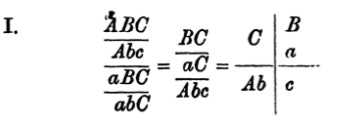
Here the columns or determinants may be read off:—
(C or Ab) and (B or a or c) = (If c, then Ab) and (If AC, then B).
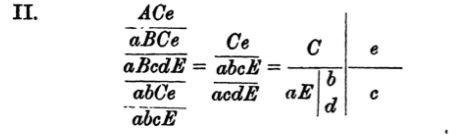
This is read: (If c, then aE) and (If BD, then C) and (If C, then e).
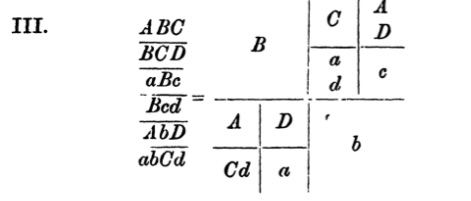
That is: (If ab, then Cd) and (If bd, then a) and (If ABD, then C) and (If BCd, then A). In this last problem, we first place B and b opposite; then for the B alternants, we place C and c opposite, and for the b alternants A and a. To get the simplest result, we should aim at dividing the columns into as equal divisions as possible.
The notation thus explained enables us to solve any problems in a simple manner. The expression in its final form may be read equally well in columns or in rows, i.e., as a determinative or as an alternative synthesis. Of course, a precisely similar process may be used, if we started with determinatively given or mixed data” (Mind, 1892, p. 351).
539. The Inverse Problem and Schröder’s Law of Reciprocal Equivalences.—The inverse problem may also be solved, though somewhat laboriously, by the aid of the reciprocal relation between the laws of distribution given in section 428, this reciprocal relation depending upon the law that to every equivalence there corresponds another equivalence in which conjunctive combination is throughout substituted for alternative combination and vice versâ. Thus, by the first law of distribution, (A or B) and (C or D) = AC or AD or BC or BD, and hence follows the corresponding equivalence AB or CD = (A or C) and (A or D) and (B or C) and (B or D). In this way any inverse problem may be practically resolved into the more familiar problem of conjunctively combining a series of alternative terms.530
Taking as an example the first problem given in section 535, we may proceed as follows: (A or B or C) and (A or b or c) and (a or B or C) and (a or b or C) = (A or Bc or bC) and (a or C) = AC or aBc or bC. Therefore, we have the corresponding equivalence ABC or Abc or aBC or abC = (A or C) and (a or B or c) and (b or C). Hence the proposition Everything is ABC or Abc or aBC or abC may be resolved into the three propositions, Everything is A or C, Everything is a or B or c, Everything is b or C ; and we have for our solution of the inverse problem: All c is A, All bC is a, All c is b ; or, combining the first and last of these propositions, All c is Ab, All bC is a.
Similarly, the second problem in section 535 may be solved as follows:—(A or C or e) (a or B or C or e) (a or B or c or d or E) (a or b or C or e) (a or b or c or E) = aC or bCd or CE or ce. Hence the corresponding equivalence ACe or aBCe or aBcdE or abCe or abcE = (a or C) (b or C or d) (C or E) (c or e); and we have for our solution of the inverse problem, All A is C, All BD is C, All c is E, All C is e ; or, combining the first and third of these propositions, All c is aE, All BD is C, All C is e.
EXERCISES.
540. Find propositions that leave only the following combinations, ABCD, ABcD, AbCd, aBCd, abcd. [Jevons, Studies, p. 254.]
Jevons gives this as the most difficult of his series of inverse problems involving four terms. It may be solved as follows:— Everything is ABCD or ABcD or AbCd or aBCd or abcd ; therefore, by contraposition and the reduction of dual terms, Whatever is not either AbCd or aBCd is ABD or abcd. Therefore, Whatever is AB or ab or c or D is ABD or abcd ; and this is resolvable into the four following propositions:
⎧ ⎨ ⎩All AB is D, (1)
All ab is cd, (2)
All c is ABD or abd, (3)
All D is AB. (4)
Since by (4) All D is AB, and by (2) All ab is d, (3) may be reduced to All c is D or ab, and therefore to All cd is ab. Also, by (4) All ab is d, and hence (2) may be reduced to All ab is c.
Our set of propositions may therefore be expressed as follows:—
⎧ ⎨ ⎩All AB is D,
All ab is c,
All cd is ab,
All D is AB.531
541. Resolve the proposition Everything is ABCDeF or ABcDEf or AbCDEF or AbCDeF or AbcDeF or aBCDEf or aBcDEf or abCDeF or abCdeF or abcDef or abcdef into a conjunction of relatively simple propositions.
[Jevons, Principles of Science, 2nd ed., p. 127 (Problem x.)]
The following is a solution:—
(1) All A is D ;
(2) All ABC is e ;
(3) All aF is bCe ;
(4) All Bf is DE ;
(5) All bf is ace ;
(6) All cF is be.
This is somewhat less complex than the solution by Dr John Hopkinson given in Jevons, Studies in Deductive Logic, p. 256, namely:—
(i) All d is ab ;
(ii) All b is AF or ae ;
(iii) All Af is BcDE ;
(iv) All E is Bf or AbCDF ;
(v) All Be is ACDF ;
(vi) All abc is ef ;
(vii) All abef is c.
542. How many and what non-disjunctive propositions are equivalent to the statement that “What is either Ab or bC is Cd or cD, and vice versâ”? [Jevons, Studies, p. 246.]
The given statement is at once resolvable into the four following propositions:
⎧ ⎨ ⎩All Ab is Cd or cD, (i)
All bC is Cd or cD, (ii)
All Cd is Ab or bC, (iii)
All cD is Ab or bC. (iv)
(i) may be resolved into⎰All Abc is D, (v)
⎱All AbD is c. (vi)
But (vi) is inferable from (ii); and observing some other obvious simplifications we obtain immediately the following solution:
(1) All Abc is D ;
(2) All bC is d ;
(3) All Cd is b ;
(4) All cD is Ab.
543. Shew the equivalence between the two sets of propositions given in section 541. [K.]
544. Find which of the following propositions may be omitted without affecting the information given by the propositions as a whole: All Ab is cDE ; All Ac is bDE ; All Ad is BCe ; All Ae is BCd ; No aE is B or C ; No B is c ; All Bd is ACe ; No bD is C or e ; No bE is Ad or C ; All C is B ; All Cd is ABe ; All cD is bE ; All cE is AbD or ab ; All de is ABC or abc. [K.]
545. Resolve each of the following complex propositions into a conjunction of propositions not containing any alternative combination of terms:
(1) Everything is ABCD or AbCd or aBcD or abcd ; (2) Everything is AbCD or AbCd or Abcd or aBcd or abCD or abCd or abcd ; (3) Everything is AbcDE or aBCd or aBCE or aBcd or aBde or abCe or abce or abDe or abde or BcdE or bCDe ; (4) Everything is ABCE or ABcd or ABcE or ABde or Abcd or abCE or abcE or abdE or abde or BCde ; (5) Everything is ABCDE or ABCdE or ABcDE or ABcDe or ABcde or AbCdE or Abcde or aBCDE or aBCde or abCDE or abcDe ; (6) Everything is ABDe or ABDF or AcDe or Acef or aBDe or aBDF or abCD or abCd or abcD or abcd or aCDE or aCDe or aCdE or aCde or acDe or aDEF or aDEf or aDeF or aDef or BcDF or bceF or bcef ; (7) Everything is AbdE or Abef or AbF or Acdef or aBDF or abCF or aCdE or ade or bCDe or bCdf or bDEF ; (8) Everything is ABCEf or Abe or aBCdf or aBcdE or aBcdeF or abef or bceF. [K.]
546. Express the following proposition in as small a number as you can of propositions in which no alternative combination of terms occurs: Everything is ABCDe or ABCdE or ABcDe or AbCdE or AbCde or aBCdE or aBcDE or aBcde or aBcdE or abCde or abCdE. [J.]
547. Solve the fourth problem given in section 535, (α) by the method described in section 536, (β) by that described in section 537. [K.]
548. Solve the problem given in section 540 and also the fourth problem given in section 535 by aid of the notation described in section 538. [K.]
549. Solve the third and fourth problems given in section 535 by the method described in section 539. [K.]
550. Shew that any universal complex proposition may be resolved into a set of propositions in which no conjunctive combination of terms occurs. [K.]
INDEX.
Abscissio infiniti, 316.
Absolute Name, 63.
Absorption, Laws of, 475.
Abstract Names, 16–19; can the distinction between generals and singulars be applied to them, 19–21.
Accidental Proposition, 49.
Acquired Perceptions, 414.
Added Determinants, Immediate Inference by, 148, 9.
Addition, sign of, in symbolic logic, 468 n.
Aequipollence, 133 n.
Affirmative Proposition, 92.
All, as a sign of quantity, 97–100.
Alternant, 277; 468; 479.
Alternative Combination of Terms, 468, 9; of Propositions, 479.
Alternative Judgments and Propositions, 84, 275; two types, 276, 7; their import, 277–82; their reduction to the form of conditionals or hypotheticals, 282–4.
Alternative Syllogisms, 359–62.
Alternative Terms, 276; 468.
Ambiguous Middle, 288.
Ambiguous Term, Fallacy of, 288.
Ampliative Proposition, 49.
Analytic Propositions, 50–2; nature of the analysis involved in them, 53–6.
And, its logical signification, 469.
Antecedent, 250.
Antilogism, 332; 334; 335; 336 n.
Apodeictic Judgments and Propositions, 86–91; 98–100. See also Modal Propositions.
Argument à fortiori, 384–6; 467.
Aristotelian doctrine of Modals, 85, 6.
Aristotelian Sorites, 370–3.
Aristotle, 130; 329; 367; 396.
Assertoric Judgments and Propositions, 86–91; scheme of assertoric and modal propositions, 282.
Attributive Term, 180.
Bain, A., on general and singular names, 12, 14 n. ; on connotation, 26 n. ; on verbal propositions, 50 n. ; on definition, 55; 126 n. ; on conversion, 131 n., on obversion, 133 n. ; on syllogisms with two singular premisses, 298, 9; on the mixed hypothetical syllogism, 354, 5; 426 n. ; 442; 457 n.
Barbara, Celarent, &c., 319–22.
Baynes, T. S., 96; 129 n. ; on the quantification of the predicate, 196, 199.
Benecke, E. C., 25; 44.
Bentham, Jeremy, 445.
Boole, Laws of Thought, 192; 210 n. ; 299 n. ; 453; 456; 470 n. ; 473 n. ; 475 n. ; 476 n. ; 506; 508; 510 n. ; 512, 13; 515, 16.
Bosanquet, B., on the parts of logic, 8; on logical meaning and psychical idea, 28; on language, 29; on parts in intension, 36 n. ; on the connotation of proper names, 45 n. ; 46 n. ; on the reference to time in judgments, 77; his classification of judgments, 80; on the particular proposition, 101; on the nature of significant denial, 122–4; 259 n. ; on the reciprocal character of conditionals and hypotheticals, 270–3; on the import of disjunctives, 280, 283; on conversion, 422; 451 n.
Bowen, F., 133 n. ; 201; 328.
Categorical Propositions, 82; see also Propositions.
Categorical Syllogism, see Syllogism.
Change of Relation, Inference by, 148; 260, 1.
Class mode of interpreting propositions, 181–4.
Classification, 447.
Co-division, 443.
Collective Names, 14, 15.
Collective use of names, 15, 16; of the word all, 97, 8.
Combination of Complex Propositions, 498–501
Commutativeness, Law of, 470 n.
Complementary Names, 62.
Complementary Propositions, 132; 143, 4; 161.
Complex Conception, Immediate Inference by, 149.
Complex Constructive Dilemma, 364.
Complex Destructive Dilemma, 364.
Complex Propositions, 478; their opposition, 478; their simplification, 481–3; resolution into equivalent compound propositions, 483–5; omission of terms, 485; introduction of terms, 485, 6; interpretation of anomalous forms, 486, 7; their obversion, 488, 9; their conversion, 489, 90; their contraposition, 490–3; their combination, 498–502; inferences from their combination, 504–8; elimination from complex propositions, 508–12.
Complex Terms, 468–477; order of their combination, 469, 70; their opposition, 470–2; their simplification, 472–6; summary of formal equivalences, 476.
Composition, Fallacy of, 16 n.
Compound Judgments and Propositions, 82–4; their modality, 90, 1; 478–80; their opposition, 480; their formal equivalences, 480, 1.
Comprehension, 26, 7; 30; 31–3; law of variation with exemplification, 37; relation to denotation, 38, 9; reading of propositions in comprehension, 187, 8.
Concept, not the logical unit, 9.
Concepts, empirical, metaphysical, and logical, 27, 8.
Concepts and names, 10.
Conceptualist treatment of Logic, 4, 5; 10, 11; 66–8.
Concrete Names, 16–19.
Conditional Propositions, distinguished from hypothetical propositions, 249–52; their import, 252–6; their relation to categoricals, 253–6; their opposition, 256–8; immediate inferences from them, 259–61; their alleged reciprocal character, 270–3.
Conditional Syllogisms, 348–51.
Conjunctive combination of terms, 468; of propositions, 478, 9.
Conjunctive Judgments and Propositions, 83.
Conjunctive Terms, 468.
Connotation, 24–7; distinguished from etymology, 28; how far variable, 28, 9; 31–3; law of variation with denotation, 37.
Connotative mode of interpreting propositions, 184–6.
Connotative Names, 40–7.
Consequent, 250.
Constructive Dilemma, 363, 4.
Constructive Hypothetical Syllogism, 352.
Contingent Judgments, 85.
Continuous Questioning, Fallacy of, 372 n.
Contra-complementary Propositions, 132; 143, 4; 161.
Contradiction, Law of, 147; 454–8; 474.
Contradiction in terms, 53 n.
Contradictory Opposition, 109; 111–14; 119; 121; how affected by the existential import of propositions, 227–32.
Contradictory Propositions, see Contradictory Opposition.
Contradictory Terms, 61, 2; 470, 1.
Contraposition of Propositions, 134–7; attempts to reduce contraposition to syllogistic form, 151–3; illustrated by Euler’s diagrams, 161; how affected by the existential import of propositions, 223–7; of conditionals, 259, 60; of hypotheticals, 268–70; is contraposition a process of inference, 422, 3; of complex propositions, 490–3.
Contraposition per accidens, 136.
Contrapositive, see Contraposition.
Contrary Opposition, 119; 114, 5; 118; how affected by the existential import of propositions, 227–32.
Contrary Propositions, see Contrary Opposition.
Contrary Terms, 62, 3.
Conventional Intension, 23; 26, 7.
Converse, 127.
Converse Relation, Immediate Inference by, 149–51.
Conversion by Contraposition, see Contraposition.
Conversion by Limitation, 129.
Conversion by Negation, 134 n.
Conversion of Propositions, 126–130; legitimacy of the process, 130–2; attempts to reduce conversion to syllogistic form, 152; illustrated by Euler’s diagrams, 160, 1; how affected by the existential import of propositions, 223–7; of conditionals, 259, 60; of hypotheticals, 268, 9; is conversion a process of inference, 422, 3; not to be based exclusively on the three laws of thought, 465, 6; of complex propositions, 489, 90.
Conversion per accidens, 128, 9.
Conversio pura et impura, 129 n.
Conversio Syllogismi, 322.
Convertend, 127.
Convertible Copula, 388.
Copula, 93.
Correlative Name, 63.
Criterion of Consistency, Jevons’s, 217 n. ; 219; 232, 3.
Deductio ad impossibile, or ad absurdum, 319.
Definition by type, 34.
De Morgan, A., use of the terms contrary and contradictory, 62 n. ; 101 n. ; 104; 104 n. ; on conversion, 126 n. ; 133 n. ; on contraposition, 136; 153 n. ; on the proposition ω, 206, 7; 210 n. ; 217 n. ; on the existential import of propositions, 219, 232; on the syllogistic rules, 290, 292; 314; on the mnemonic verses, 319; on the numerically definite syllogism, 377; on the argument à fortiori, 385, 6; on the logic of relatives, 387, 8; on immediate inferences and the laws of thought, 466; 495.
Denial, Nature of, 119–24.
Denotation, 29–31; 31–3; law of variation with connotation, 37; relation to comprehension, 38, 9.
Destructive Dilemma, 363, 4.
Destructive Hypothetical Syllogism, 352.
Determinant, 468; 479.
Determination, 468.
Development of Terms, 474.
Diagrams, their use in Logic, 156, 7; Euler’s, 157–62; Lambert’s, 163–6; Venn’s, 166–8; development of Euler’s diagrams, 170–4; of Lambert’s diagrams, 174–6; application of diagrams to syllogistic reasonings, 341–6.
Dichotomy, see Division by Dichotomy.
Dicta for the second, third, and fourth figures, 337, 8.
Dictum de diverso, 337 n.
Dictum de excepto, 338 n.
Dictum de omni et nullo and the ordinary rules of the syllogism, 301, 2.
Dictum de reciproco, 338.
Dilemma, 363–6.
Direct reduction, 318; of Baroco and Bocardo, 323, 4.
Disjunctive Judgments and Propositions, 83, 4; 275–84.
Disjunctive Syllogisms, 359–62.
Disjunctive Terms, see Alternative Terms.
Distinction, 443.
Distribution, Laws of, 472, 3.
Distribution of terms in a proposition, 95, 6; illustrated by Euler’s diagrams, 159, 60.
Distributive use of names, 15, 16; of the word all, 97, 8.
Division, see Logical Division, Metaphysical Division, Division by Dichotomy, &c.
Division by Dichotomy, 445; all valid division reducible to dichotomy, 445, 6; is division by dichotomy a formal process, 447–9.
Division, Fallacy of, 16 n.
Dixon, E. T., 237 n.
Double Negation, Principle of, 459.
Duality, Law of, 460.
Duality of Formal Equivalences, 472.
Dual Terms, 475.
Eduction, 127 n.
Elimination, involved in syllogistic reasoning, 300; the problem of elimination in logic, 508, 9; rules for elimination, 509–12.
Empirical Concepts, 27, 8.
Empirically Universal Propositions, 99.
Enthymeme, 367, 8.
Enumeration, 441.
Enumerative Universal Propositions, 98.
Epicheirema, 369.
Episyllogism, 369.
Equality, Symbol of, 189–91.
Equations in Logic, 189–91; their types, 191–4;.expression of propositions as equations, 194.
Equipollent Propositions, 117.
Equivalent Propositions, 117; tables of equivalent propositions, 141; 146; 208; 481.
Equivalent Terms, Table of, 476.
Equivocal Term, 65.
Essential Proposition, 50.
Etymology and Connotation, 28.
Euclid, 136; 420; 430.
Euler’s diagrams, five-fold scheme, 157–62; seven-fold scheme, 170–4; their application to the quantification of the predicate, 200–4; to syllogistic reasonings, 288, 341–4.
Eversion, 127 n.
Excluded Middle, Law of, 61 n. ; 147; 458–63; 474.
Exclusion, Law of, 475.
Exclusive Figure, 316.
Exclusive Proposition, 205.
Exemplification, 31–5; law of variation with comprehension, 37.
Exemplicative Name, 41.
Existence and the Universe of Discourse, 210–13.
Existential Import of Propositions, nature of the questions involved, 214; how far formal logic concerned with them, 215–17; various suppositions, 218–20; bearing on immediate inferences, 223–7; on the doctrine of opposition, 227–32; existential import of the propositions included in the traditional schedule, 234–44; of modal propositions, 244, 5; of conditional propositions, 255, 6; problem in connexion with hypotheticals, 256, 7; bearing of the existential import of propositions upon the validity of syllogistic reasonings, 390–4.
Existential Propositions, 218; their relation to the traditional forms of proposition, 221–3.
Explicative Proposition, 50.
Exponible Proposition, 104 n.
Extension of Names and Concepts, 22; distinguished from denotation, 29, 30; how related to intension, 31–40; propositions in extension and intension, 177–88.
Extensive Definition, 31–5.
Extensively Verbal Proposition, 51 n.
Few, as a sign of quantity, 103, 4.
Figures of the Syllogism, 300; their special rules, 309–13; their peculiarities and uses, 315–17; equivalence of the special rules of the first three figures, 335; schemes of valid moods in figures 1, 2, and 3, 336–8; dicta for figures 2, 3, and 4, 337, 8; figures of the conditional syllogism, 349, 50; of the hypothetical syllogism, 349, 50; of the hypothetico-categorical syllogism, 352, 3.
Folk-lore, Universe of, 213 n.
Form of a Proposition, 3; 92; 150, 1.
Form and Matter, 2, 3.
Formal Contradictories, 62 n.
Formal Logic, 1–3.
Formal Obversion, 133 n.
Formal Propositions, 52, 3.
Fourth Figure, 328, 9; its moods regarded as indirect moods of the first figure, 329–31; moods of the fourth figure, 334, 5; dictum, 338.
Fowler, T., 133 n. ; 205; 325, 6; 349; 365.
Fundamental Syllogism, 314 n.
Fundamentum divisionis, 441.
Fundamentum relationis, 64.
Galenian Figure, 328.
General Names, 11–13.
General Propositions, 103.
Goclenian Sorites, 370–3.
Grammatical Analysis of a Proposition, 92 n.
Greek Mythology, Universe of, 213 n.
Ground or reason of a belief, distinguished from cause of a belief, 414.
Hamilton, Sir W., on singular propositions, 102, 3; 104; 105; his scheme of diagrams, 156 n. ; his use of Euler’s diagrams, 159; on judgments in extension and intension, 184 n. ; his doctrine of the quantification of the predicate, 195 ff.; his fundamental postulate of logic, 195, 6; on the interpretation of some, 200, 1; 321 n. ; 326 n. ; on the doctrine of reduction, 327 n. ; on the mixed hypothetical syllogism, 354–6; 368 n. ; 371 n. ; on figure of sorites, 373 n. ; on ultra-total distribution of the middle term, 377; on the unfigured syllogism, 378 n. ; 396 n. ; on the law of contradiction, 455; 462; bases formal inferences on the three laws of thought, 464, 5.
Hamiltonian scheme of propositions, 79; 195 ff.
Hobhouse, L. T., 69 n.
Hypothetical Dilemma, 363 n.
Hypothetical Judgments and Propositions, 83, 4; distinguished from conditional propositions, 249–52; their import, 261–4; their opposition, 264–8; immediate inferences from them, 268–70; their relation to categoricals, 270; their alleged reciprocal character, 270–3.
Hypothetical Syllogisms, 348–57.
Hypothetico-Categorical Syllogism, 348, 9; 352–7.
Identity, Law of, 147; 451–4.
Illicit major and illicit minor, 289; involve indirectly undistributed middle, 298; apparent exceptions to the rule against illicit major, 298.
Immediate Inferences, 126–53; how affected by the existential import of propositions, 223–7; from conditional propositions, 259–61; from hypothetical propositions, 268–70; can they be based exclusively on the three laws of thought, 464–6; from complex propositions, 488–494.
Imperfect Figures, 330.
Implication and Meaning, 71, 2; 177; 178 n. ; 421–3.
Import of Propositions, nature of the enquiry, 70–4.
Inclusion, Law of, 475.
Indefinite Name, 59–61.
Indefinite Proposition, 105.
Independent Propositions, 118.
Indesignate Proposition, 105.
Indirect Moods, 329–31.
Indirect Reduction, 318, 9; 331–7.
Individual Name, 11.
Individual Proposition, 102.
Inequality, Symbols of, 193.
Inference, nature of, 413, 4; paradox of, 414, 5; conclusion in what sense different from premisses, 415–20; limiting cases, 422, 3; is conversion a process of inference, 422, 3; is contraposition a process of inference, 422, 3; is syllogism a process of inference, 423–30.
Infinitation, 133 n.
Infinite Name, 59–61.
Infinite Proposition, 106, 7.
Integration, 201 n.
Intension of Names and Concepts, 22; conventional, subjective, and objective, 23–7; how related to extension, 31–40; propositions in intension and extension, 177–88.
Intensive Definition, 32–5.
Intensively Verbal Proposition, 51 n.
Inverse, 139.
Inverse Problem, 525–535.
Inversion of Propositions, 137–9; validity of the process, 139, 40; illustrated by Euler’s diagrams, 161; how affected by the existential import of propositions, 223–7; of hypotheticals, 269.
Invertend, 139.
Jevons, W. S., 12 n. ; 19 n. ; 20 n. ; his use of the term connotation, 26; 37 n. ; regards proper names as connotative, 41–3; on relative names, 63, 4; on contradictory opposition, 111–14; on conversion, 130; 133 n. ; on contraposition, 136 n. ; 139; 152 n. ; his use of Euler’s diagrams, 159; on types of logical equations, 191, 2; on the interpretation of some, 202; 205 n. ; 210 n. ; on questions about existence in logic, 217 n. ; his criterion of consistency, 217 n., 219, 232, 3; 220 n. ; on the import of disjunctives, 279; on the order of premisses in a syllogism, 287; on negative premisses, 295; on the ordinary syllogistic conclusion, 300; 349; 365; 366; 416; on division by dichotomy, 445, 6; 449; his principle of the substitution of similars, 453, 4; on the law of duality, 460; 470 n. ; 472 n. ; 473; 475; 495; on Boole’s System of Logic, 506 n. ; 507 n. ; on the inverse problem, 525, 6, 529, 30.
Johnson, W. E., 31 n. ; on the import of propositions, 70 n. ; on the formulation of propositions, 72; on multiple quantification, 106 n. ; 132 n. ; 144 n. ; on the proposition ω, 206 n. ; on the distinction between conditional and hypothetical propositions, 249 n. ; 265 n. ; 293 n. ; on the special rules of the syllogistic figures, 311 n. ; on dicta for the third and fourth figures, 338; 388; 469 n. ; on the analysis of ordinary categorical propositions, 479, 80; on the synthesis of propositions, 481 n. ; his notation for the solution of inverse problems, 533, 4.
Jones, Miss E. E. C., 126 n. ; 134 n. ; 148 n. ; 151; 190 n. ; on the existential import of propositions, 244 n. ; on conditional propositions, 256 n. ; 260; on hypothetical propositions, 264 n. ; on the use of the term alternative, 275; on the nature of inference, 416 n. ; 418 n. ; on division and classification, 447.
Judgment, the logical unit, 8, 9.
Judgments, as related to propositions, 66–8; their essential characteristics, 70; their objective reference, 74–6; their universality, 76, 7; their reference to time, 76, 7; their necessity, 77, 8; their classification, 79–81; their division according to relation, 82; into simple and compound, 82–4; their modality, 84–91; their quantity and quality, 91, 2. See also Propositions.
Judgments of actuality, 88.
Judgments of necessity, 88.
Judgments of possibility, 88.
Kant, his classification of judgments, 81; his doctrine of modality, 86; 91, 2; 104 n. ; 106; on the figures of the syllogism, 327 n. ; on the mixed hypothetical syllogism, 354, 5.
Ladd Franklin, Mrs, on negative terms, 60 n. ; 142 n. ; 147 n. ; on the import of propositions, 179 n. ; on the existential import of propositions, 218 n. ; 231 n., 241 n., 242 n. ; 323 n. ; on the antilogism, 332; 510 n.
Lambert, J. H., his diagrammatic scheme, 163–6, 174–6; on the uses of the different syllogistic figures, 316, 7; 326 n. ; on dicta for the different figures, 337 n., 338; application of his diagrammatic scheme to syllogistic reasonings, 344, 5.
Language as the instrument of thought, 3–5.
Laws of Thought, 147; 450, 1; law of identity, 451–4; law of contradiction, 454–8; law of excluded middle, 458–63; are the laws of thought also laws of things, 463, 4; their mutual relations, 464; how far they establish immediate inferences, 464–6; mediate inferences, 466, 7.
Lewis Carroll, Game of Logic, 219 n.
Liar, Sophism of the, 457, 8.
Limitative Proposition, 106.
Limited Identities, 192.
Lindsay, T. M., 201 n.
Logic, definition of, 1; formal and material, 1–3; its connexion with language, 3–5; its relation to psychology, 5, 6; its utility, 6, 7; its abstract character, 68–70.
Logical Division, 441, 2; its rules, 443–5; all valid division reducible to dichotomy, 445, 6; place of the doctrine of division in logic, 446–9; division and classification, 447.
Logical Concepts, 27, 8.
Logical Doctrine, its three parts, 8, 9.
Lotze, H., on negative terms, 59 n., 61 n. ; on general and universal judgments, 99 n. ; 126 n. ; 129 n. ; on negative premisses, 296 n. ; criticism of Jevons, 300; 424 n. ; 425 n.
McColl, H., 263 n.
Mackenzie, J. S., 322 n.
Major Premiss, 287; Mill’s view of its function, 429.
Major Term, 285, 6.
Mansel, H. L., 51 n. ; on opposition, 109 n. ; 115; on conversion per accidens, 129 n. ; 130 n. ; on contraposition, 134 n. ; on material consequence, 150; 152 n. ; on the import of disjunctives, 279 n. ; 319 n. ; on indirect moods, 330 n. ; 337 n. ; 357 n. ; on the dilemma, 365; 367; 368 n. ; on the argument à fortiori, 385 n., 386; 424 n. ; 443; on the place of division in logic, 446–8; on the law of identity, 454; bases syllogistic inferences on the laws of thought, 466, 7.
Material Consequence, 150; 386.
Material Contradictories, 62 n.
Material Contrariety, 115 n.
Material Obversion, 133 n.
Matter of a Proposition, 3; 92; 150, 1.
Meaning and Implication, 71, 2; 177; 178 n. ; 421–3.
Mediate Inference, 151; and the laws of thought, 466, 7.
Membra dividentia, 441.
Metaphysical Concepts, 27, 8.
Metaphysical Division, 412, 3.
Metaphysical Universality, 105 n.
Metathesis praemissarum, 321.
Middle Term, 285, 6; its ultra-total distribution, 376–8.
Mill, J. S., on names, 9 n. ; 20 n. ; on connotation, 24, 5; on connotative names, 40; regards proper names as non-connotative, 41, 2; his distinction between real and verbal propositions, 54 n. ; on negative names, 61 n. ; his classification of propositions, 80, 1; on the import of propositions, 182; 186 n. ; on the quantification of the predicate, 198; on the existential import of propostions, 219; 243 n. ; on figure of sorites, 373, 4; 378 n. ; 387; 414; on immediate inferences, 419; his doctrine that in every syllogism there is a petitio principii, 424–30; on division and classification, 446; on the law of identity, 452; 466; on the law of contradiction, 455, 6; on the law of excluded middle, 461–3.
Minor Premiss, 287.
Minor Term, 285, 6.
Minto, W., 134 n.
Mixed Hypothetical Syllogism, 348, 9; 352–7.
Mnemonics for the valid moods of the syllogism and their redaction to the first figure, 319–22; for the direct reduction of Baroco and Bocardo, 323, 4; for the indirect moods of the first figure, 329, 30.
Modal Consequence, Immediate Inference by, 151.
Modal Propositions, 90 n. ; their opposition, 116, 7; 231, 2; their existential import, 244, 5; 258; 266, 7; distinctive symbols for them, 258; scheme of assertoric and modal propositions, 282. See also Conditional Propositions and Hypothetical Propositions.
Modality of Judgments, 84–91.
Modus ponendo ponens, 352 n. ; 362.
Modus ponendo tollens, 361, 2.
Modus ponens, 352.
Modus tollendo ponens, 360; 362.
Modus tollendo tollens, 352 n. ; 362.
Modus tollens, 352; its reduction to the modus ponens, 354.
Moods of the Syllogism, 309; what moods are legitimate in each figure, 309–13; subaltern moods, 313, 14; strengthened moods, 314, 15; equivalence of the moods of the first three figures, 333, 4; moods of figure 4, 334, 5; scheme of valid moods of figure 1, 336; of figure 2, 336, 7; of figure 3, 337, 8; moods of the conditional syllogism, 349, 50; of the hypothetical syllogism, 349, 50; of the hypothetico-categorical syllogism, 352, 3; of the disjunctive syllogism, 359–62.
Moral Universality, 105 n.
Most, as a sign of quantity, 103, 4; effect of its recognition as a sign of quantity on the rules of the syllogism, 376, 7.
Multiple Quantification, 105, 6; 265 n.
Multiplication, sign of, in symbolic logic, 468 n.
Musschenbroek, P. van, Institutiones Logicae, 322.
Names and Concepts, 10, 11.
Necessary Judgments, 85–91.
Necessity of Judgments, 77, 8.
Negative Premisses, 289; 292, 3; 295–7.
Negative Propositions, 92.
Negative Terms, 57–61; their elimination from propositions, 144–6.
Nominalist treatment of Logic, 4, 5; 10, 11; 66–8.
Numerically definite Propositions, 104.
Numerically definite Syllogism, 377, 8.
Numeerical Moods of the Syllogism, 400–3.
Objective distinctions of Modality, 87–90.
Objective Extension, 30.
Objective Intension, 24; 26, 7.
Objective reference in Judgments, 74–6.
Obverse, 133.
Obversion of Propositions, 133, 4; how affected by the existential import of propositions, 223–7; of hypothetical propositions, 269; of complex propositions, 488, 9.
Obvertend, 133.
Octagon of Opposition, 144.
Opposition of Complex Terms, 470–2.
Opposition of Propositions, 109–19; illustrated by Euler’s diagrams, 160; how affected by the existential import of propositions, 227–31; of modal propositions, 231, 2; of conditional propositions, 256–8; of hypothetical propositions, 264–8; of complex propositions, 478; of compound propositions, 480.
Or, its logical signification, 469.
Ostensive Reduction, 318.
Partial Identities, 192.
Particular Propositions, 100–2; their existential import, 238, 9; 245, 6.
Partition, 442.
Peirce, C. S., 336 n.
Perfect Figure, 329, 30.
Permutation, 133 n.
Petitio Principii and the Syllogism, 424–30.
Petrus Hispanus, 290, 1; 329 n.
Physical Definition, 442.
Physical Division, 442, 3.
Plurative Propositions, 103.
Polylemma, 363 n.
Polysyllogism, 368, 9.
Pope John XXI, 291; 329 n.
Porphyry, Tree of, 35 n. ; 445.
Positive Name, 57.
Postulate of Logic, Hamilton’s, 195, 6.
Predicate of a Proposition, 92; how to be distinguished from the subject, 96, 7.
Predicative Interpretation of Propositions, 179-81.
Principium divisionis, 441.
Privative Conception, Immediate Inference by, 133 n.
Problematic Judgments, 86–91. See also Modal Propositions.
Progressive Argument, 369.
Proper Names, 13, 14; 15 n. ; have no corresponding abstracts, 17 n. ; are non-connotative, 41–7; have subjective intension and comprehension, 42; may become connotative when used to designate a certain type of person, 45.
Propositio secundi adjacentis, 93; tertii adjacentis, 93.
Propositional forms, 53; their interpretation, 70–2.
Propositions, as related to Judgments, 66–8; their interpretation, 68, 70–2; problem of their import, 70–4; their formulation, 72, 3; their classification, 79–81; their division according to relation, 82; their division into simple and compound, 82–4; their division according to modality, 84–91; their division according to quantity, 91, 2; their division according to quality, 92; the traditional scheme, 92–95; their opposition, 109–19; their mutual relations, 117–19, 142–4; connecting two terms, 132; connecting two terms and their contradictories, 141, 146; their diagrammatic representation, 156–76; in extension and in intension, 177–88; predicative mode of interpretation, 179–81; class mode of interpretation, 181–4; connotative mode of interpretation, 184–6; subject interpreted in connotation and predicate in denotation, 186, 7; in comprehension, 187, 8; propositions expressed as equalities and inequalities, 193, 4; sixfold schedule including Y and η, 207–9; existential import of propositions, 234–45; direct import and implications of a proposition, 420–3. See also Complex Propositions, Conditional Propositions, Judgments, &c.
Prosyllogism, 369.
Psychology, its relation to Logic, 5, 6.
Quality of Propositions, 92; 106; of conditional propositions, 257, 8; of hypothetical propositions, 264, 5.
Quantification of the Predicate, 195–209; its application to the syllogism, 378–84.
Quantity of Propositions, 91, 2; how affected by their quality, 95 n. ; of conditional propositions, 257, 8; of hypothetical propositions, 265.
Quaternio terminorum, 288.
Ramean Tree, 445.
Ray, P. K., 356 n.
Real Propositions, 49.
Reciprocal Equivalences, Schröder’s Law of, 472; bearing of this law on the inverse problem, 534.
Reductio ad impossibile or per impossibile, 319.
Reduction of Dual Terms, 474, 5.
Reduction of Syllogisms, nature of the process, 318; direct and indirect reduction, 318, 9; direct reduction of Baroco and Bocardo, 323, 4; extension of the doctrine of reduction, 324, 5; is reduction an essential part of the doctrine of the syllogism, 325–8; indirect reduction, 331–7; reduction of conditional and hypothetical syllogisms, 351, 2; of mixed hypothetical syllogisms, 354.
Regressive Argument, 369.
Relation, Division of propositions according to, 82.
Relative Names, 63–5.
Relatives, Logic of, 149–51; 387, 8.
Relativity, Law of, 456.
Remotive Propositions, 84.
Repugnant Terms, 63; 471.
Robertson, G. C., 357.
Rogers, R. A. P., 294.
Ross, G. R. T., 280.
Secondary Opposition, 115.
Secondary Quantification, 105; 116.
Self-contradiction, 457.
Sextus Empiricus, 424; 426.
Shyreswood, W., 329 n.
Sigwart, on empirical, metaphysical, and logical concepts, 27, 8; on the names of ultimate elements, 34; on apparently tautologous propositions, 52 n. ; on negative names, 57–60; on the reference to time in judgments, 77; on compound judgments, 82 n., 83 n. ; on modality, 86, 7; on universal judgments, 99 n. ; on negative judgments, 120 n. ; on the grounds of denial, 121; 128 n. ; on contraposition, 136; 234 n. ; on hypotheticals, 264, 5; on figures 2 and 3 of the syllogism, 366 n. ; 349; on the value of the syllogism, 427 n., 428 n. ; on the laws of thought, 451; on the law of identity, 461, 2; on the law of contradiction, 455; on the law of excluded middle and the law of twofold negation, 459, 60.
Simple Constructive Dilemma, 364.
Simple Contraposition, 136.
Simple Conversion, 128.
Simple Destructive Dilemma, 364.
Simple Identities, 191.
Simple Judgments and Propositions, 82; their modality, 86–90.
Simple Term, 468.
Simplicity, Law of, 473.
Singular Names, 11–13; may be connotative, 41, 2.
Singular Propositions, 102, 3; their opposition, 115, 16; as premisses in a syllogism, 298, 9.
Some, as a sign of quantity, 100, 1; in the doctrine of the quantification of the predicate, 199–204.
Sophisma polyzeteseos, 372 n.
Sorites, 370–6.
Spencer, H., 378 n.
Square of Opposition, 110.
Strengthened Syllogism, 314, 15.
Subaltern Moods, 313, 14.
Subaltern Opposition, 110; 117, 18; how affected by the existential import of propositions, 227–31.
Subalternant and Subalternate, Propositions, 110.
Sub-complementary Propositions, 132; 143, 4; 161.
Subcontrary Opposition, 110; 118; how affected by the existential import of propositions, 227–31.
Sub-division, 443.
Subject of a Proposition, 92; how to be distinguished from the predicate, 96, 7.
Subjective distinctions of Modality, 86, 7; 90 n.
Subjective Extension, 30.
Subjective Intension, 23, 4; 26, 7; 29.
Syllogism, 285; its terms and propositions, 285–7; its rules as ordinarily stated, 287–9; corollaries from the rules, 289–91; restatement of the rules, 291; their dependence upon one another, 291–3; statement of the independent rules, 293, 4; proof of the rule of quality, 294, 5; apparent exceptions to the rules, 295–8; syllogisms with two singular premisses, 298, 9; is the ordinary syllogistic conclusion open to the charge of incompleteness, 300; figures and moods, 309–17; reduction of syllogisms, 318–38; diagrammatic representation of syllogisms, 341–6; syllogisms with quantified predicates, 378–84; are all formal inferences reducible to ordinary syllogistic form, 384–8; validity of syllogistic reasonings how far affected by the existential import of propositions, 390–4; true conclusion obtainable from false premisses, 394–6; numerical moods, 400–3; syllogisms and immediate inferences, 423, 4; syllogistic reasoning and the charge of petitio principii, 424–30. See also Conditional Syllogism, Figures of the Syllogism, &c.
Symbolic Logic, 189–94; 468 n.
Symbols for Propositions, 93, 4.
Synonymous Proposition, 50.
Synthetic Chain of Reasoning, 369.
Synthetic Proposition, 49.
Tarbell, F. B., 349 n.
Tautology, Laws of, 473.
Terms, Logic of, 11.
Tetralemma, 363 n.
Time of predication and time in predication, 77; 451 n.
Totum divisum, 441.
Traditional Scheme of Propositions, 79; 92–5; 234–44.
Transitive Copula, 388.
Trilemma, 363 n.
Twofold Negation, Principle of, 459.
Ueberweg, P., on opposition, 109 n. ; on conversion, 126 n. ; 133 n. ; 136 n. ; 151 n. ; on Euler’s diagrams, 162 n. ; on the existential import of propositions, 219 n. ; 255 n. ; on negative premisses, 297 n. ; 316; form in which he gives the mnemonic verses, 322 n. ; on the reduction of Baroco and Bocardo, 323 n. ; 326; 344 n. ; 349; 352 n. ; 366 n. ; 369 n. ; 371 n. ; 424 n. ; 457 n.
Ultra-total distribution of the middle term, 376–8.
Unconditionally Universal Propositions, 99.
Undistributed Middle, Fallacy of, 288; involves indirectly illicit process of major or minor, 293; apparent exception to the rule against undistributed middle, 297, 8.
Unfigured Syllogism, 378 n.
Unity, Law of, 473.
Universal Propositions, 97–100; their existential import, 235–8.
Universality of Judgments, 76, 7.
Universe of Attributes, 31 n.
Universe of Discourse, 29, 30; 75, 6; 210–13; 226 n. ; 234, 5.
Univocal Name, 65.
Venn, J., 15 n. ; 30 n. ; 44 n. ; on verbal disputes, 50 n. ; on contradictory terms, 62 n. ; 96 n. ; on Hamilton’s geometric scheme, 156 n. ; on Euler’s diagrams, 159, 162 n. ; on Lambert’s diagrams, 165 n. ; his own scheme of diagrams, 166–8; on the predicative mode of interpreting propositions, 179, 180; 185 n. ; 193 n. ; 200 n. ; 210 n. ; on the existential import of propositions, 220 n. ; on the inference of particulars from universals, 226 n. ; 235; 237; 238; application of his diagrammatic scheme to syllogistic reasonings, 345, 6; on the logic of relatives, 387, 8; 424 n. ; 506; 507 n. ; 530.
Verbal Dispute, 50 n.
Verbal Division, 443.
Verbal Propositions, 49–52.
Wallis, Institutio Logicae, 322 n. ; 330.
Weakened Conclusion, 313, 14.
Weakened Syllogism, 313, 14.
Weaker Premiss, 289 n.
Whately, R., 297 n. ; 323, 4; on the doctrine of reduction, 325; on the dilemma, 365; holds that all valid reasoning is reducible to syllogistic form, 387; his definition of petitio principii, 425; 433, 4.
CAMBRIDGE: PRINTED BY JOHN CLAY, M.A. AT THE UNIVERSITY PRESS.
Transcriber’s Note
This text was prepared from materials kindly provided by the Internet Archive. There are a few changes from the appearance of the original text. In the original, footnotes are numbered consecutively on each page. The superscripted numbers for them are usually placed before, rather than after, punctuation marks. Ellipses are often used without any spacing. In the Exercises, the difference in font size between questions and sample answers is not always adhered to. The formatting of arguments and some proofs is not always copied exactly in this version.
I have put page numbers into the text in red. Footnotes are placed after the paragraphs to which they connect. I have inserted hyperlinks for most cross-references in the text and am responsible for any errors this may have introduced.
The very few typographical errors are corrected and marked with dashed red underlining. In one case, on page 530, I have preferred the wording of the 3rd edition.