Part 3 — CHAPTER IV.
Reading edition
THE DIAGRAMMATIC REPRESENTATION OF SYLLOGISMS.
288. The application of the Eulerian diagrams to syllogistic reasonings.—In shewing the application of the Eulerian diagrams to syllogistic reasonings we may begin with a syllogism in Barbara:
All M is P,
All S is M,
therefore, All S is P.
The premisses must first be represented separately by means of the diagrams. Each yields two cases; thus,—
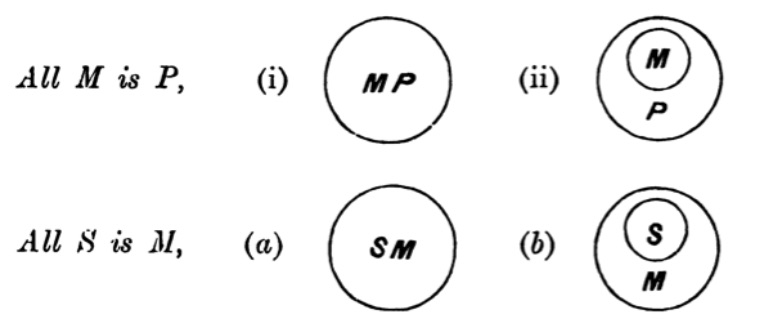
To obtain the conclusion, each of the cases yielded by the major premiss must now be combined with each of those yielded by the minor. This gives four combinations,373 and whatever is true of S in terms of P in all of them is the conclusion required.
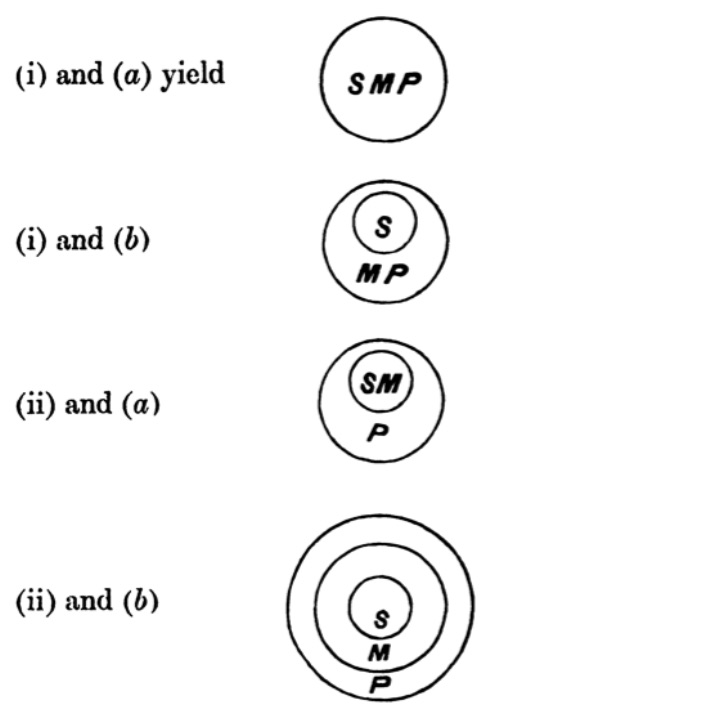
In each case S either coincides with P or is included within P ; hence all S is P may be inferred from the given premisses.
Next, take a syllogism in Bocardo. The application of the diagrams is now more complicated. The premisses are
Some M is not P,
All M is S.
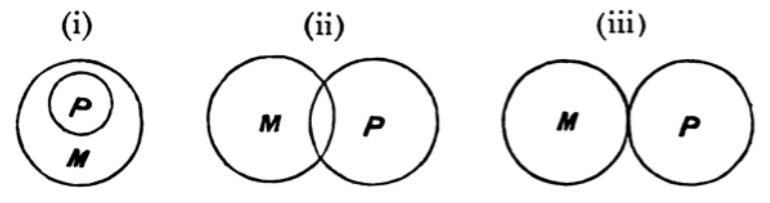
The major premiss yields three cases, namely,
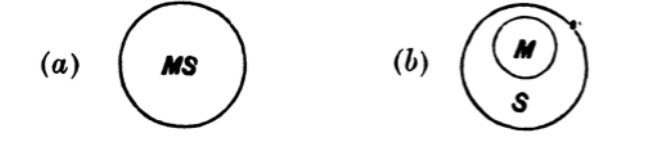
and the minor premiss two cases, namely,
Taking them together we have six combinations, some of which themselves yield more than one case:—
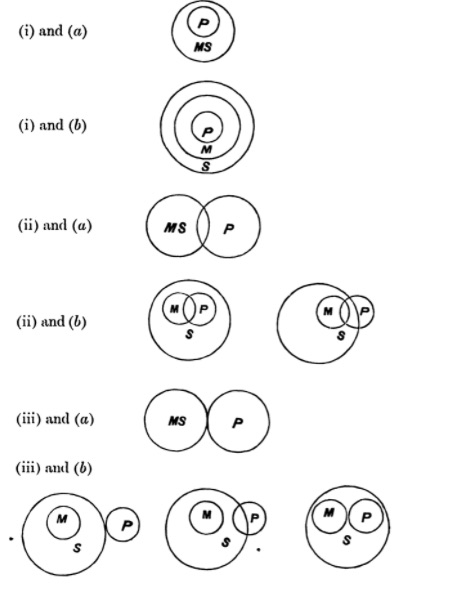
So far as S and P are concerned (M being left out of account) these nine cases are reducible to the following three:
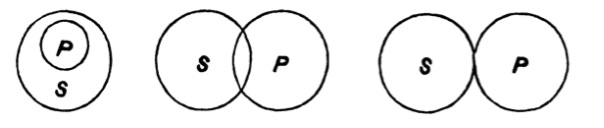
The conclusion, therefore, is Some S is not P.
It must be admitted that this is very complex, and that it would be a serious matter if in the first instance we had to work through all the different moods in this manner.374 Still, for purposes of illustration, this very complexity has a certain advantage. It shews how many relations between three terms in respect of extension are left to us, even with two premisses given.
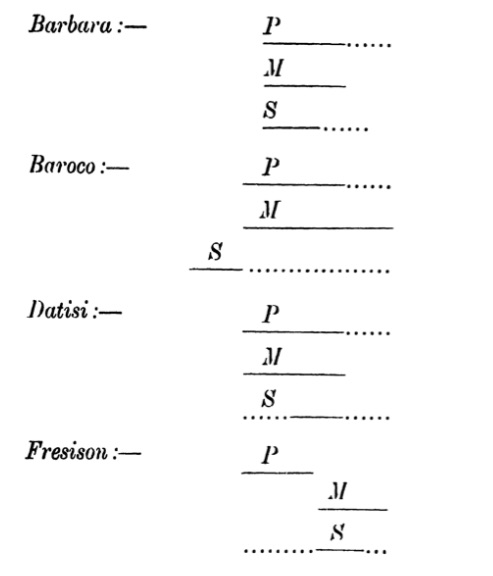
289. The application of Lambert’s diagrammatic scheme to syllogistic reasonings.—As applied to syllogisms, Lambert’s lines are much less cumbrous than Euler’s circles. The main point to notice is that it is in general necessary that the line standing for the middle term should not be dotted over any part of its extent.375 This condition can be satisfied by selecting the appropriate alternative form in the case of A, I, and O propositions, as given in section 127. As examples we may represent Barbara, Baroco, Datisi, and Fresison by Lambert’s method.
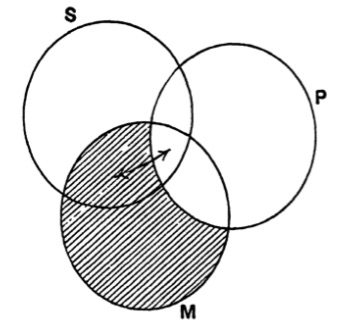
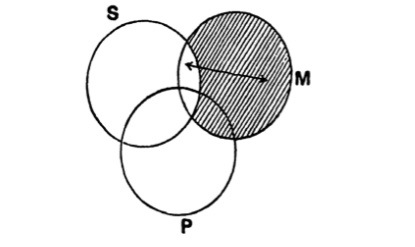
290. The application of Dr Venn’s diagrammatic scheme to syllogistic reasonings.—Syllogisms in Barbara, Camestres, Datisi, and Bocardo may be taken in order to shew how Dr Venn’s diagrams can be used to illustrate syllogistic reasonings.
The premisses of Barbara,
All M is P, All S is M,
exclude certain compartments as shewn in the following diagram:
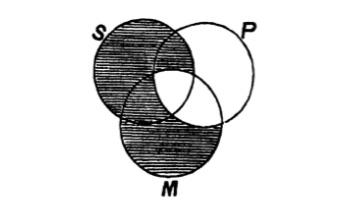
This yields at once the conclusion All S is P.
Similarly for Camestres we have the following:
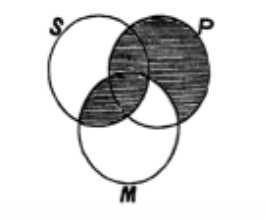
For Datisi we have
Bocardo yields
It will be remembered that this scheme is based upon a particular interpretation of propositions as regards their existential import. The student will find it useful to attempt to represent by Dr Venn’s diagrams a mood containing a strengthened premiss, for example, Darapti.
EXERCISES.
291. Represent Celarent by the aid of Euler’s diagrams. Will the same set of diagrams serve for any other of the syllogistic moods? [K.]
292. Represent by means of the Eulerian diagrams the moods Festino, Datisi, and Bramantip. [K.]
293. Determine (i) by the aid of Euler’s diagrams, (ii) by ordinary syllogistic methods, what is all that can be inferred about S and P in terms of one another from the following premisses, Some M is P, Some M is not P, Some P is not M, Some S is not M, All M is S. [K.]
294. Represent in Lambert’s scheme the moods Darii, Cesare, Darapti, Bocardo, Fesapo. [K.]
295. Represent in Dr Venn’s diagrammatic scheme the moods Ferio, Cesare, Baroco, Dimaris. [K.]
296. Shew (i) by means of Euler’s diagrams, (ii) by means of Dr Venn’s diagrams, that IE yields no conclusion in any figure. [K.]
297. Shew diagrammatically that no conclusion can be obtained from IA in figure 1, from AA in figure 2, from AE in figure 3, from AO in figure 4. [K.]
298. Determine, by the aid of Euler’s diagrammatic scheme, all the relations that are à priori possible between three classes S, M, P. [K.]
299. Test the following argument (i) by Dr Venn’s diagrammatic scheme, (ii) by ordinary syllogistic methods: “All brave persons are well-disciplined; no patriots are mercenary; but some mercenary persons have been found to be brave, and not all patriots can be considered well-disciplined; it follows that some brave and well-disciplined persons have been both mercenary and unpatriotic, while others that have been patriotic and unmercenary were but ill-disciplined cowards.” [C.]
300. Given All X is Y or Z, All Y is Z or X, All Z is X or Y, All YZ is X, All ZX is Y, All XY is Z, prove (a) by the aid of Dr Venn’s diagrammatic scheme, (b) without the aid of diagrams, that X, Y, Z are coextensive. [RR.]