Part 2 — CHAPTER VII.
Reading edition
LOGICAL EQUATIONS AND THE QUANTIFICATION OF THE PREDICATE.
137. The employment of the symbol of Equality in Logic.—The symbol of equality (=) is frequently used in logic to express the identity of two classes. For example, Equilateral triangles = equiangular triangles ; Exogens = dicotyledons ; Men = mortal men.
It is, however, important to recognise that in thus borrowing a symbol from mathematics we do not retain its meaning unaltered, and that a so-called logical equation is, therefore, something very different from a mathematical equation. In mathematics the symbol of equality generally means numerical or quantitative equivalence. But clearly we do not mean to express mere numerical equality when we write equilateral triangles = equiangular triangles. Whatever this so-called equation signifies, it is certainly something more than that there are precisely as many triangles with three equal sides as there are triangles with three equal angles. It is further clear that we do not intend to express mere similarity. Our meaning is that the denotations of the terms which are equated are absolutely identical; in other words, that the class of objects denoted by the term equilateral triangle is absolutely identical with the class of objects denoted by the term equiangular triangle.186 It may, however, be objected that, if this is what our equation comes to, then inasmuch as a statement of mere identity is empty and meaningless, it strictly speaking leaves us with nothing at all; it contains no assertion and can represent no judgment. The answer to this objection is that whilst we have identity in a certain respect, it is erroneous to say that we have mere identity. We have identity of denotation combined with diversity of connotation, and, therefore, with diversity of determination (meaning thereby diversity in the ways in which the application of the two terms identified is determined).187 The meaning of this will be made clearer by the aid of one or two illustrations. Taking, then, as examples the logical equations already given, we may analyse their meaning as follows. If out of all triangles we select those which possess the property of having three equal sides, and if again out of all triangles we select those which possess the property of having three equal angles, we shall find that in either case we are left with precisely the same set of triangles. Thus, each side of our equation denotes precisely the same class of objects, but the class is determined or arrived at in two different ways. Similarly, if we select all plants that are exogenous and again all plants that are dicotyledonous, our results are precisely the same although our mode of arriving at them has been different. Once more, if we simply take the class of objects which possess the attribute of humanity, and again the class which possess both this attribute and also the attribute of mortality, the objects selected will be the same; none will be excluded by our second method of selection although an additional attribute is taken into account.
Since the identity primarily signified by a logical equation is an identity in respect of denotation, any equational mode of reading propositions must be regarded as a modification of the “class” mode. What has been said above, however, will make it clear that here as elsewhere denotation is considered not to the exclusion of connotation but as dependent upon it; and we again see how denotative and connotative readings of propositions are really involved in one another, although one side or the other may be made the more prominent according to the point of view which is taken.
Another point to which attention may be called before we pass on to consider different types of logical equations is that in so far as a proposition is regarded as expressing an identity between its terms the distinction between subject and predicate practically disappears. We have seen that when we have the ordinary logical copula is, propositions cannot always be simply converted, the reason being that the relation of the subject to the predicate is not the same as the relation of the predicate to the subject. But when two terms are connected by the sign of equality, they are similarly, and not diversely, related to each other; in other words, the relation is symmetrical. Such an equation, for example, as S = P can be read either forwards or backwards without any alteration of meaning. There can accordingly be no distinction between subject and predicate except the mere order of statement, and that may be regarded as for most practical purposes immaterial.
138. Types of Logical Equations188—Jevons (Principles of Science, chapter 3) recognises three types of logical equations, which he calls respectively simple identities, partial identities, and limited identities.
Simple identities are of the form S = P ; for example, Exogens = dicotyledons. Whilst this is the simplest case equationally, the information given by the equation requires two propositions in order that it may be expressed in ordinary predicative form. Thus, All S is P and All P is S ; All exogens are dicotyledons and All dicotyledons are exogens. If, however, we are allowed to quantify the predicate as well as the subject, a single proposition will suffice. Thus, All S is all P, All exogens are all dicotyledons. We shall return presently to a consideration of this type of proposition.
Partial identities are of the form S = SP, and are the expression equationally of ordinary universal affirmative propositions. If we take the proposition All S is P, it is clear that we cannot write it S = P, since the class P, instead of being coextensive with the class S, may include it and a good deal more besides. Since, however, by the law of identity All S is S, it follows from All S is P that All S is SP. We can also pass back from the latter of these propositions to the former. Hence the two propositions are equivalent. But All S is SP may at once be reduced to the equational form S = SP. For this breaks up into the two propositions All S is SP and All SP is S, and since the second of these is a mere formal proposition based on the law of identity, the equation must necessarily hold good if All S is SP is given. To take a concrete example, the proposition All men are mortal becomes equationally Men = mortal men. Similarly the universal negative proposition SeP may be expressed in the equational form S = Sp (where p = not-P).
Limited identities are of the form VS = VP, which may be interpreted “Within the sphere of the class V, all S is P and all P is S,” or “The S’s and P’s, which are V’s, are identical.” So far as V represents a determinate class, there is little difference between these limited identities and simple identities. This is shewn by the fact that Jevons himself gives Equilateral triangles = equiangular triangles as an instance of a simple identity, whereas its proper place in his classification would appear to be amongst the limited identities, for its interpretation is that “within the sphere of triangles—all the equilaterals are all the equiangulars.”
The equation VS = VP is, however, used by Boole—and also by Jevons subsequently—as the expression equationally of the particular proposition, and if it can really suffice for this, its recognition as a distinct type is justified. If we take the proposition Some S is P, we find that the classes S and P are affirmed to have some part in common, but no indication is given whereby this part can be identified. Boole accordingly indicates it by the arbitrary symbol V. It is then clear that All VS is VP and also that All VP is VS, and we have the above equation.
It is no part of our present purpose to discuss systems of symbolic logic; but it may be briefly pointed out that the above representation of the particular proposition is far from satisfactory. In order to justify it, limitations have to be placed upon the interpretation of V which altogether differentiate it from other class-symbols. Thus, the equation VS = VP is consistent with No S is P (and, therefore, cannot be equivalent to Some S is P) provided that no V is either S or P, for in this case we have VS = 0 and VP = 0. V must, therefore, be limited by the antecedent condition that it represents an existing class and a class that contains either S or P, and it is in this condition quite as much as in the equation itself that the real force of the particular proposition is expressed.189
If particular propositions are true contradictories of universal propositions, then it would seem to follow that in a system in which universals are expressed as equalities, particulars should be expressed as inequalities. This would mean the introduction of the symbols > and <, related to the corresponding mathematical symbols in just the same way as the logical symbol of equality is related to the mathematical symbol of equality; that is to say, S > SP would imply logically more than mere numerical inequality, it would imply that the class S includes the whole of the class SP and more besides. Thus interpreted, S > SP expresses the particular negative proposition, Some S is not P.190 If we further introduce the symbol 0 as expressing nonentity, No S is P may be written SP = 0, and its contradictory, i.e., Some S is P, may be written SP > 0. We shall then have the following scheme (where p = not-P):
All S is Pexpressed by S = SP or by Sp = 0;
Some S is not P ″ ″ S > SP ″ Sp > 0;
No S is P ″ ″ SP = 0 ″ S = Sp ;
Some S is P ″ ″ SP > 0 ″ S > Sp.
This scheme, it will be observed, is based on the assumption that particulars are existentially affirmative while universals are existentially negative. This introduces a question which will be discussed in detail in the following chapter. The object of the present section is merely to illustrate the expression of propositions equationally, and the symbolism involved has, therefore, been treated as briefly as has seemed compatible with a clear explanation of its purport. Any more detailed treatment would involve a discussion of problems belonging to symbolic logic.
139. The expression of Propositions as Equations.—There are rare cases in which propositions fall naturally into what is practically an equational form; for example, Civilization and Christianity are co-extensive. But, speaking generally, the equational relation, as implicated in ordinary propositions, is not one that is spontaneously, or even easily, grasped by the mind. Hence as a psychological account of the process of judgment the equational rendering may be rejected. It is, moreover, not desirable that equations should supersede the generally recognised propositional forms in ordinary logical doctrine, for such doctrine should not depart more than can be helped from the forms of ordinary speech. But, on the other hand, the equational treatment of propositions must not be simply put on one side as erroneous or unworkable. It has been shewn in the preceding section that it is at any rate possible to reduce all categorical propositions to a form in which they express equalities or inequalities; and such reduction is of the greatest importance in systems of symbolic logic. Even for purposes of ordinary logical doctrine, the enquiry how far propositions may be expressed equationally serves to afford a more complete insight into their full import, or at any rate their full implication. Hence while ordinary formal logic should not be entirely based upon an equational reading of propositions, it cannot afford altogether to neglect this way of regarding them.
We may pass on to consider in somewhat more detail a special equational or semi-equational system—open also to special criticisms—by which Hamilton and others sought to revolutionise ordinary logical doctrine.
140. The eight propositional forms resulting from the explicit Quantification of the Predicate.—We have seen that in the ordinary fourfold schedule of propositions, the quantity of the predicate is determined by the quality of the proposition, negatives distributing their predicates, while affirmatives do not. It seems a plausible view, however, that by explicit quantification the quantity of the predicate may be made independent of the quality of the proposition, and Sir William Hamilton was thus led to recognise eight distinct propositional forms instead of the customary four:—
All S is all P, U.
All S is some P, A.
Some S is all P, Y.
Some S is some P, I.
No S is any P, E.
No S is some P, η.
Some S is not any P, O.
Some S is not some P, ω.
The symbols attached to the different propositions in the above schedule are those employed by Archbishop Thomson,191 and they are those now commonly adopted so far as the quantification of the predicate is recognised in modern text-books.
The symbols used by Hamilton were Afa, Afi, Ifa, Ifi, Ana, Ani, Ina, Ini. Here f indicates an affirmative proposition, n a negative; a means that the corresponding term is distributed, i that it is undistributed.
For the new forms we might also use the symbols SuP, SyP, SηP, SωP, on the principle explained in section 62.
141. Sir William Hamilton’s fundamental Postulate of Logic.—The fundamental postulate of logic, according to Sir William Hamilton, is “that we be allowed to state explicitly in language all that is implicitly contained in thought”; and we may briefly consider the meaning to be attached to this postulate before going on to discuss the use that is made of it in connexion with the doctrine of the quantification of the predicate.
Giving the natural interpretation to the phrase “implicitly contained in thought,” the postulate might at first sight appear to be a broad statement of the general principle underlying the logician’s treatment of formal inferences. In all such inferences the conclusion is implicitly contained in the premisses; and since logic has to determine what inferences follow legitimately from given premisses, it may in this sense be said to be part of the function of logic to make explicit in language what is implicitly contained in thought.
It seems clear, however, from the use made of the postulate by Hamilton and his school that he is not thinking of this, and indeed that he is not intending any reference to discursive thought at all. His meaning rather is that we should make explicit in language not what is implicit in thought, but what is explicit in thought, or, as it may be otherwise expressed, that we should make explicit in language all that is really present in thought in the act of judgment.
Adopting this interpretation, we may come to the conclusion that the postulate is obscurely expressed, but we can have no hesitation in admitting its validity. It is obviously of importance to the logician to clear up ambiguities and ellipses of language. For this reason it is, amongst other things, desirable that we should avoid condensed and elliptical modes of expression. But whether Hamilton’s postulate, as thus interpreted, supports the doctrine of the quantification of the predicate is another question. This point will be considered in the next two sections.
142. Advantages claimed for the Quantification of the Predicate.—Hamilton maintains that “in thought the predicate is always quantified,” and hence he makes it follow immediately from the postulate discussed in the preceding section that “in logic the quantity of the predicate must be expressed, on demand, in language.” “The quantity of the predicate,” says Dr Baynes in the authorised exposition of Hamilton’s doctrine contained in his New Analytic of Logical Forms, “is not expressed in common language because common language is elliptical. Whatever is not really necessary to the clear comprehension of what is contained in thought, is usually elided in expression. But we must distinguish between the ends which are sought by common language and logic respectively. Whilst the former seeks to exhibit with clearness the matter of thought, the latter seeks to exhibit with exactness the form of thought. Therefore in logic the predicate must always be quantified.” It is further maintained that the quantification of the predicate is necessary for intelligible predication. “Predication is nothing more or less than the expression of the relation of quantity in which a notion stands to an individual, or two notions to each other. If this relation were indeterminate—if we were uncertain whether it was of part, or whole, or none—there could be no predication.”
Amongst the practical advantages said to result from quantifying the predicate are the reduction of all species of the conversion of propositions to one, namely, simple conversion; and the simplification of the laws of syllogism. As regards the first of these points, it may be observed that if the doctrine of the quantification of the predicate is adopted, the distinction between subject and predicate resolves itself into a difference in order of statement alone. Each propositional form can without any alteration in meaning be read either forwards or backwards, and every proposition may, therefore, rightly be said to be simply convertible.
It is further argued that the new propositional forms resulting from the quantification of the predicate are required in order to express relations that cannot otherwise be so simply expressed. Thus, U alone serves to express the fact that two classes are co-extensive; and even ω is said to be needed in logical divisions, since if we divide (say) Europeans into Englishmen, Frenchmen, &c., this requires us to think that some Europeans are not some Europeans (e.g., Englishmen are not Frenchmen).
143. Objections urged against the Quantification of the Predicate.—Those who reject Hamilton’s doctrine of the quantification of the predicate deny at the outset the fundamental premiss upon which it is based, namely, that the predicate of a proposition is always thought of as a determinate quantity. They go further and deny that it is as a rule thought of as a quantity, that is, as an aggregate of objects, at all. We have already in section 135 indicated grounds for the view that, while in the great majority of instances the subject of a proposition is in ordinary thought naturally interpreted in denotation, the predicate is naturally interpreted in connotation. This psychological argument is valid against Hamilton, inasmuch as he really bases his doctrine upon a psychological consideration; and it seems unanswerable.
Mill (in his Examination of Hamilton, pp. 495-7) puts the point as follows: “I repeat the appeal which I have already made to every reader’s consciousness: Does he, when he judges that all oxen ruminate, advert even in the minutest degree to the question, whether there is anything else which ruminates? Is this consideration at all in his thoughts, any more than any other consideration foreign to the immediate subject? One person may know that there are other ruminating animals, another may think that there are none, a third may be without any opinion on the subject: but if they all know what is meant by ruminating, they all, when they judge that every ox ruminates, mean exactly the same thing. The mental process they go through, so far as that one judgment is concerned, is precisely identical; though some of them may go on further, and add other judgments to it. The fact, that the proposition ‘Every A is B’ only means ‘Every A is some B,’ so far from being always present in thought, is not at first seized without some difficulty by the tyro in logic. It requires a certain effort of thought to perceive that when we say, ‘All A’s are B’s,’ we only identify A with a portion of the class B. When the learner is first told that the proposition ‘All A’s are B’s’ can only be converted in the form ‘Some B’s are A’s,’ I apprehend that this strikes him as a new idea; and that the truth of the statement is not quite obvious to him, until verified by a particular example in which he already knows that the simple converse would be false, such as, ‘All men are animals, therefore, all animals are men.’ So far is it from being true that the proposition ‘All A’s are B’s’ is spontaneously quantified in thought as ‘All A is some B.’”
A word may be added in reply to the argument that if the quantity of the predicate were indeterminate—if we were uncertain whether the reference was to the whole or part or none—there could be no predication. This is perfectly true so long as we are left with all three of these alternatives; but we may have predication which involves the elimination of only one of them, so that there is still indeterminateness as regards the other two. To argue that unless we are definitely limited to one of the three we are left with all of them is practically to confuse contradictory with contrary opposition.
A further objection raised to the doctrine of the quantification of the predicate is that some of the quantified forms are composite not simple predications. Thus All S is all P is a condensed mode of expression, which may be analysed into the two propositions All S is P and All P is S. Similarly, if we interpret some as exclusive of all, a point to which we shall presently return, All S is some P is an exponible proposition resolvable into All S is P and Some P is not S. As a rule, however, the use of exponible forms tends to make the detection of fallacy the more difficult, and this general consideration applies with undoubted force to the particular case of the quantification of the predicate. The bearing of the quantification doctrine upon the syllogism will be briefly touched upon subsequently, and it will be found that the problem of discriminating between valid and invalid moods is rendered more complex and difficult. It may indeed be doubted whether any logical problem, with the one exception of conversion, is really simplified by the introduction of quantified predicates.
Even apart from the above objections, the Hamiltonian doctrine of quantification is sufficiently condemned by its want of internal consistency. Its unphilosophical character in this respect will be shewn in the following sections.
144. The meaning to be attached to the word “some” in the eight propositional forms recognised by Sir William Hamilton.—Professor Baynes, in his authorised exposition of Sir William Hamilton’s doctrine, would at the outset lead us to suppose that we have no longer to do with the indeterminate some of the Aristotelian Logic, but that this word is now to be used in the more definite sense of some, but not all. He argues, as we have seen, that intelligible predication requires an absolutely determinate relation in respect of quantity between subject and predicate, and that this ought to be clearly expressed in language. Thus, “if the objects comprised under the subject be some part, but not the whole, of those comprised under the predicate, we write All X is some P, and similarly with other forms.”
But if it is true that we know definitely the relative extent of subject and predicate, and if some is used strictly in the sense of some but not all, we should have but five propositional forms instead of eight, namely,—All S is all P, All S is some P, Some S is all P, Some S is some P,192 No S is any P.
We have already seen (in section 126) that the only possible relations between two terms in respect of their extension are given by the following five diagrams,—
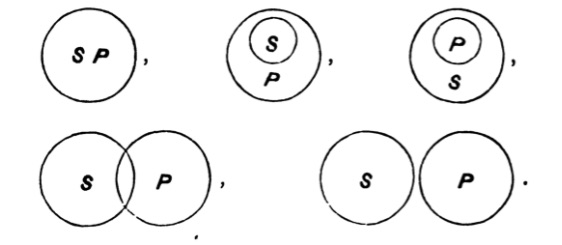
These correspond respectively to the five propositional forms given above;193 and it is clear that on the view indicated by Dr Baynes the eight forms are redundant.194
It is altogether doubtful whether writers who have adopted the eightfold scheme have themselves recognised the pitfalls surrounding the use of the word some. Many passages might be quoted in which they distinctly adopt the meaning—some but not all. Thus, Thomson (Laws of Thought, p. 150) makes U and A inconsistent. Bowen (Logic, pp. 169, 170) would pass from I to O by immediate inference.195 Hamilton himself agrees with Thomson and Bowen on these points; but he is curiously indecisive on the general question here raised. He remarks (Logic, II. p. 282) that some “is held to be a definite some when the other term is definite,” i.e., in A and Y, η and O: but “on the other hand, when both terms are indefinite or particular, the some of each is left wholly indefinite,” i.e., in I and ω.196 This is very confusing, and it would be most difficult to apply the distinction consistently. Hamilton himself certainly does not so apply it. For example, on his view it should no longer be the case that two affirmative premisses necessitate an affirmative conclusion; or that two negative premisses invalidate a syllogism.197 Thus, the following should be regarded as valid:
All P is some M,
All M is some S,
therefore, Some S is not any P.
No M is any P,
Some S is not any M,
therefore, Some or all S is not any P.
Such syllogisms as these, however, are not admitted by Hamilton and Thomson; and, on the other hand, Thomson admits as valid certain combinations which on the above interpretation are not valid. Hamilton’s supreme canon of the categorical syllogism is:—“What worse relation198 of subject and predicate subsists between either of two terms and a common third term, with which one, at least, is positively related; that relation subsists between the two terms themselves” (Logic, II. p. 357). This clearly provides that one premiss at least shall be affirmative, and that an affirmative conclusion shall follow from two affirmative premisses. Thomson (Laws of Thought, p. 165) explicitly lays down the same rules; and his table of valid moods (given on p. 188) is (with the exception of one obvious misprint) correct and correct only if some means “some, it may be all.”
145. The use of “some” in the sense of “some only.”—Jevons, in reply to the question, “What results would follow if we were to interpret ‘Some A’s are B’s’ as implying that ‘Some other A’s are not B’s’?” writes, “The proposition ‘Some A’s are B’s’ is in the form I, and according to the table of opposition I is true if A is true; but A is the contradictory of O, which would be the form of ‘Some other A’s are not B’s.’ Under such circumstances A could never be true at all, because its truth would involve the truth of its own contradictory, which is absurd” (Studies in Deductive Logic, 151). It is not, however, the case that we necessarily involve ourselves in self-contradiction if we use some in the sense of some only. What should be pointed out is that, if we use the word in this sense, the truth of I no longer follows from the truth of A; and that, so far from this being the case, these two propositions are inconsistent with each other.
Taking the five propositional forms, All S is all P, All S is some P, Some S is all P, Some S is some P, No S is P, and interpreting some in the sense of some only, it is to be observed that each one of them is inconsistent with each of the others, whilst at the same time no one is the contradictory of any one of the others. If, for example, on this scheme we wish to express the contradictory of U, we can do so only by affirming an alternative between Y, A, I, and E. Nothing of all this appears to have been noticed by the Hamiltonian writers. Thus, Thomson (Laws of Thought, p. 149) gives a scheme of opposition in which E and I appear as contradictories, but A and O as contraries.
One of the strongest arguments against the use of some in the sense of some only is very well put by Professor Veitch, himself a disciple of Sir William Hamilton. Some only, he remarks, is not so fundamental as some at least. The former implies the latter; but I can speak of some at least without advancing to the more definite stage of some only. “Before I can speak of some only, must I not have formed two judgments—the one that some are, the other that others of the same class are not? …… The some only would thus appear as the composite of two propositions already formed…… It seems to me that we must, first of all, work out logical principles on the indefinite meaning of some at least…… Some only is a secondary and derivative judgment.” (Institutes of Logic, p. 308).
If some is used in the sense of some only, the further difficulty arises how we are to express any knowledge that we may happen to possess about a part of a class when we are in ignorance in regard to the remainder. Supposing for example, that all the S’s of which I happen to have had experience are P’s, I am not justified in saying either that all S’s are P’s or that some S’s are P’s. The only solution of the difficulty is to say that all or some S’s are P’s. The complexity that this would introduce is obvious.
146. The interpretation of the eight Hamiltonian forms of proposition, “some” being used in its ordinary logical sense.199—Taking the five possible relations between two terms, as illustrated by the Eulerian diagrams, and denoting them respectively by α, β, γ, δ, ε, as in section 126, we may write against each of the propositional forms the relations which are compatible with it, on the supposition that some is used in its ordinary logical sense, that is, as exclusive of none but not of all:—200
U α
A α, β
Y α, γ
I α, β, γ, δ
E ε
η β, δ, ε
O γ, δ, ε
ω α, β, γ, δ, ε
We have then the following pairs of contradictories—A, O; Y, η; I, E. The contradictory of U is obtained by affirming an alternative between η and O.
Without the use of quantified predicates, the same information may be expressed as follows:—
U = SaP, PaS ;
A = SaP ;
Y = PaS ;
I = SiP ;
E = SeP ;
η = PoS ;
O = SoP.
What information, if any, is given by ω will be discussed in section 149.
147. The propositions U and Y.—It must be admitted that these propositions are met with in ordinary discourse. We may not indeed find propositions which are actually written in the form All S is all P ; but we have to all intents and purposes U, whenever there is an unmistakeable affirmation that the subject and the predicate of a proposition are co-extensive. Thus, all definitions are practically U propositions; so are all affirmative propositions of which both the subject and the predicate are singular terms.201 Take also such propositions as the following: Christianity and civilization are co-extensive; Europe, Asia, Africa, America, and Australia are all the continents;202 The three whom I have mentioned are all who have ever ascended the mountain by that route; Common salt is the same thing as sodium chloride.203
Such propositions as the following, sometimes known as exclusive propositions, may be given as examples of Y: Only S is P ; Graduates alone are eligible for the appointment; Some passengers are the only survivors. These propositions may be interpreted as being equivalent to the following: Some S is all P ; Some graduates are all who are eligible for the appointment; Some passengers are all the survivors.204 This is, indeed, the only way of treating the propositions which will enable us to retain the original subjects as subjects and the original predicates as predicates.
We cannot then agree with Professor Fowler that the additional forms “are not merely unusual, but are such as we never do use” (Deductive Logic, p. 31). Still in treating the syllogism &c. on the traditional lines, it is better to retain the traditional schedule of propositions. The addition of the forms U and Y does not tend towards simplification, but the reverse; and their full force can be expressed in other ways. On this view, when we meet with a U proposition, All S is all P, we may resolve it into the two A propositions, All S is P and All P is S, which taken together are equivalent to it; and when we meet with a Y proposition, Some S is all P or S alone is P, we may replace it by the A proposition All P is S, which it yields by conversion.
148. The proposition η.—This proposition in the form No S is some P is not I think ever found in ordinary use. We may, however, recognise its possibility; and it must be pointed out that a form of proposition which we do meet with, namely. Not only S is P or Not S alone is P, is practically η, provided that we do not regard this proposition as implying that any S is certainly P.
Archbishop Thomson remarks that η “has the semblance only, and not the power of a denial. True though it is, it does not prevent our making another judgment of the affirmative kind, from the same terms” (Laws of Thought, § 79). This is erroneous; for although A and η may be true together, U and η cannot, and Y and η are strictly contradictories.205 The relation of contradiction in which Y and η stand to each other is perhaps brought out more clearly if they are written in the forms Only S is P, Not only S is P, or S alone is P, Not S alone is P. It will be observed, moreover, that η is the converse of O, and vice versâ. If, therefore, η has no power of denial, the same will be true of O also. But it certainly is not true of O.
149. The proposition ω.—The proposition ω, Some S is not some P, is not inconsistent with any of the other propositional forms, not even with U, All S is all P. For example, granting that “all equilateral triangles are all equiangular triangles,” still “this equilateral triangle is not that equiangular triangle,” which is all that ω asserts. Some S is not some P is indeed always true except when both the subject and the predicate are the name of an individual and the same individual.206 De Morgan207 (Syllabus, p. 24) observes that its contradictory is—“S and P are singular and identical; there is but one S, there is but one P, and S is P.”208 It may be said without hesitation that the proposition ω is of absolutely no logical importance.
150. Sixfold Schedule of Propositions obtained by recognising Y and η, in addition to A, E, I, O.209—The schedule of propositions obtained by adding Y and η to the ordinary schedule presents some interesting features, and is worthy of incidental recognition and discussion.210 It has been shewn in section 100 that in the ordinary scheme there are six and only six independent propositions connecting any two terms, namely, SaP, PaS, SeP (= PeS), SiP (= PiS), PoS, SoP. If we write the second and the last but one of these in forms in which S and P are respectively subject and predicate, we have the schedule which we are now considering, namely,
SaP = All S is P ;
SyP = Only S is P ;
SeP = No S is P ;
SiP = Some S is P ;
SηP = Not only S is P ;
Sop = Some S is not P.
It will be observed that the pair of propositions, SyP and SηP, are contradictories; so that we now have three pairs of contradictories. There are of course other additions to the traditional table of opposition, and some new relations will need to be recognised, e.g., between SaP and SyP. With the help, however, of the discussion contained in section 107, the reader will have no difficulty in working out the required hexagon of opposition for himself.
As regards immediate inferences, we cannot in this scheme obtain any satisfactory obverse of either Y or η, the reason being that they have quantified predicates, and that, therefore, the negation cannot in these propositions be simply attached to the predicate. We have, however, the following interesting table of other immediate inferences:—211
Converse. Contrapositive. Inverse.
SaP = PyS = PʹaSʹ = SʹyPʹ
SyP = PaS = PʹySʹ = SʹaPʹ
SeP = PeS = PʹyS = SʹyP
SiP = PiS = PʹηS = SʹηP
SηP = PoS = PʹηSʹ = SʹoPʹ
SoP = PηS = PʹoSʹ = SʹηPʹ
The main points to notice here are (1) that each proposition now admits of conversion, contraposition, and inversion; and (2) that the inferred proposition is in every case equivalent to the original proposition, so that there is not in any of the inferences any loss of logical force. In other words, we obtain in each case a simple converse, a simple contrapositive, and a simple inverse.
EXERCISES.
151. Explain precisely how it is that O admits of ordinary conversion if the principle of the quantification of the predicate is adopted, although not otherwise. [K.]
152. Draw out a table, corresponding to the ordinary Aristotelian table of opposition, for the six propositions, A, Y, E, I, η, O (some being interpreted in the sense of some at least). [K.]