Part 2 — CHAPTER IV.
Reading edition
IMMEDIATE INFERENCES.122
96. The Conversion of Categorical Propositions.—By conversion, in a broad sense, is meant a change in the position of the terms of a proposition.123 Logic, however, is concerned with conversion only in so far as the truth of the new proposition obtained by the process is a legitimate inference from the truth of the original proposition. For example, the change from All S is P to All P is S is not a legitimate logical conversion, since the truth of the latter proposition does not follow from the truth of the former. In other words, logical conversion is a case of immediate inference, which may be defined as the inference of a proposition from a single other proposition.124
The simplest form of logical conversion, and that which is understood in logic when we speak of conversion without further qualification, may be defined as a process of immediate inference in which from a given proposition we infer another, having the predicate of the original proposition for subject, and its subject for predicate. Thus, given a proposition having S for its subject and P for its predicate, our object in the process of conversion is to obtain by immediate inference a new proposition having P for its subject and S for its predicate. The original proposition may be called the convertend, and the inferred proposition the converse.
The process will be valid if the two following rules are observed: (1) The converse must be the same in quality as the convertend (Rule of Quality); (2) No term must be distributed in the converse unless it was distributed in the convertend (Rule of Distribution).
Applying these rules to the four fundamental forms of proposition, we have the following table:—
Convertend. Converse.
All S is P. A. Some P is S. I.
Some S is P. I.Some P is S. I.
No S is P. E.No P is S. E.
Some S is not P. O.(None)
It is desirable at this stage briefly to call attention to a point which will receive fuller consideration later on in connexion with the reading of propositions in extension and intension, namely, that, generally speaking, in any judgment we have naturally before the mind the objects denoted by the subject, but the qualities connoted by the predicate. In the process of converting a proposition, however, the extensive force of the predicate is made prominent, and an import is given to the predicate similar to that of the subject. At the same time the distribution of the predicate has to be made explicit in thought. It is in passing from the predicative to the class reading (e.g. from all men are mortal to all men are mortals), that the difficulty sometimes found in correctly converting propositions probably consists. We shall at any rate do well to recognise that conversion and other immediate inferences usually involve a distinct mental act of the above nature.
It follows from what has been said above that some propositions lend themselves to the process of conversion much more readily than others. When the predicate of a proposition is a substantive little or no effort is required in order to convert the proposition; more effort is necessary when the predicate is an adjective; and still more when in the original proposition the logical predicate is not expressed separately at all, as in propositions secundi adjacentis. Compare for purposes of conversion the propositions, Whales are mammals, Lions are carnivorous, A stitch in time saves nine. In some cases, in consequence of the awkwardness of changing adjectives and verbal predicates into substantives, the conversion of a proposition appears to be a very artificial production.125
97. Simple Conversion and Conversion per accidens.—It will be observed that in the case of I and E, the converse is of the same form as the original proposition; moreover we do not lose any part of the information given us by the convertend, and we can pass back to it by re-conversion of the converse. The convertend and its converse are accordingly equivalent propositions. The conversion under these conditions is said to be simple.
In the case of A, it is different; we cannot pass by immediate inference from All S is P to All P is S, inasmuch as P is distributed in the latter of these propositions but undistributed in the former. Hence, although we start with a universal proposition, we obtain by conversion a particular proposition only,126 and by no means of operating upon the converse can we regain the original proposition. The convertend and its converse are accordingly non-equivalent propositions. The conversion in this case is called conversion per accidens,127 or conversion by limitation.128
For concrete illustrations of the process of conversion we may take the propositions,—A stitch in time saves nine; None but the brave deserve the fair. The first of these may be written in the form,—All stitches in time are things that save nine stitches. This, being an A proposition, is only convertible per accidens, and we have for our converse,—Some things that save nine stitches are stitches in time. The second of the given propositions may be written,—No one who is not brave is deserving of the fair. This, being an E proposition, may be converted simply, giving, No one deserving of the fair is not brave. Our results may be expressed in a more natural form as follows: One way of saving nine stitches is by a stitch in time; No one deserving of the fair can fail to be brave.
No difficulty ought ever to be found in converting or performing other immediate inferences upon any given proposition when once it has been brought into the traditional logical form, its quantity and quality being determined, its subject, copula, and predicate being definitely distinguished from one another, and its predicate as well as its subject being read in extension. If, however, this rule is neglected, mistakes are pretty sure to follow.
98. Inconvertibility of Particular Negative Propositions.—It follows immediately from the rules of conversion given in section 96 that Some S is not P does not admit of ordinary conversion; for S which is undistributed in the convertend would become the predicate of a negative proposition in the converse, and would therefore be distributed.129 It will be shewn presently, however, that although we are unable to infer anything about P in this case, we are able to draw an inference concerning not-P.
Jevons considers that the fact that the particular negative proposition is incapable of ordinary conversion “constitutes a blot in the ancient logic” (Studies in Deductive Logic, p. 37). There is, however, no sufficient justification for this criticism. We shall find subsequently that just as much can be inferred from the particular negative as from the particular affirmative (since the latter unlike the former does not admit of contraposition). No logic, symbolic or other, can actually obtain more from the given information than the ancient logic does. It has been suggested that what Jevons means is that the inconvertibility of O results in a want of symmetry and that logicians ought specially to aim at symmetry. With this last contention we may heartily agree. The want of symmetry, however, in the case before us is apparent only and results from taking an incomplete view. It will be found that symmetry reappears later on.130
99. Legitimacy of Conversion.—Aristotle proves the conversion of E indirectly, as follows;131 No S is P, therefore, No P is S ; for if not, Some individual P, say Q, is S ; and hence Q is both S and P ; but this is inconsistent with the original proposition.
Having shewn that the simple conversion of E is legitimate, we can prove that the conversion per accidens of A is also legitimate. All S is P, therefore, Some P is S ; for, if not, No P is S, and therefore (by conversion) No S is P ; but this is inconsistent with the original supposition. The legitimacy of the simple conversion of I follows similarly.
The above proof appears to involve nothing beyond the principles of contradiction and excluded middle. The proof itself, however, is not satisfactory; for it practically assumes the validity of the very process that it seeks to justify, that is to say, it assumes the equivalence of the propositions S is Q and Q is S.
A better justification of the process of conversion may be obtained by considering the class relations involved in the propositions concerned. Thus, taking an E proposition, it is self-evident that if one class is entirely excluded from another class, this second class is entirely excluded from the first.132 In the case of an A proposition it is clear on reflection that the statement All S is P is consistent with either of two relations of the classes S and P, namely, S and P coincident, or P containing S and more besides, and further that these are the only two possible relations with which it is consistent. It is self-evident that in each of these cases Some P is S ; and hence the inference by conversion from an A proposition is shewn to be justified.133 In the case of an O proposition, if we consider all the relationships of classes in which it holds good, we find that nothing is true of P in terms of S in all of them. Hence O is inconvertible.134 The inconvertibility of O can also be established by shewing that Some S is not P is compatible with every one of the following propositions—All P is S, Some P is S, No P is S, Some P is not S.
100. Table of Propositions connecting any two terms.—There are—connecting any two terms S and P—eight propositions of the forms A, E, I, O, namely, four with S as subject, and four with P as subject. The results at which we have arrived concerning the conversion of propositions shew that of these eight, the two E propositions are equivalent to one another, and that the same is true of the two I propositions, E and I being simply convertible; also that these are the only equivalences obtainable. We have, therefore, the following table of propositions connecting any two terms S and P:—
SaP,
PaS,
SeP = PeS,
SiP = PiS,
SoP,
PoS.
The pair of propositions SaP and PaS are independent (see section 84); and the same is true of the pairs SoP and PoS, SaP and PoS, PaS and SoP. The first pair taken together indicate that the classes S and P are coextensive, and they may be called complementary propositions. The second pair taken together indicate that the classes S and P are neither coextensive nor either included within the other; they may be called sub-complementary propositions. The third pair taken together indicate that the class S is included within the class P but that it does not exhaust that class; they may be called contra-complementary propositions. The fourth pair taken together indicate that the class P is included within the class S but that it does not exhaust that class; they are, therefore, also contra-complementary.135
The above table will be supplemented in section 106 by a table of propositions connecting any two terms and their contradictories, S, P, not-S, not-P. It will then be found that we have a symmetry that is at present wanting.
101. The Obversion of Categorical Propositions.136—Obversion is a process of immediate inference in which the inferred proposition (or obverse), whilst retaining the original subject, has for its predicate the contradictory of the predicate of the original proposition (or obvertend). This process is legitimate for a proposition of any form if at the same time the quality of the proposition is changed. The inferred proposition is, moreover, in all cases equivalent to the original proposition, so that we can always pass back from the obverse to the obvertend.
We have the following table:—
Obvertend.Obverse.
All S is P. A.No S is not-P. E
Some S is P. I.Some S is not not-P. O.
No S is P. E.All S is not-P. A.
Some S is not P. O.Some S is not-P. I.
It will be observed that the obversion of All S is P depends upon the principle of contradiction, which tells us that if anything is P then it is not not-P; but that we pass back from No S is not-P to All S is P by the principle of excluded middle, which tells us that if anything is not not-P then it is P. The remaining inferences by obversion also depend upon one or other of these two principles.
102. The Contraposition of Categorical Propositions.137—Contraposition may be defined as a process of immediate inference in which from a given proposition another proposition is inferred having for its subject the contradictory of the original predicate. Thus, given a proposition having S for its subject and P for its predicate, we seek to obtain by immediate inference a new proposition having not-P for its subject.
It will be observed that in the above definition it is left an open question whether the contrapositive of a proposition has the original subject or the contradictory of the original subject for its predicate; and every proposition which admits of contraposition will accordingly have two contrapositives, each of which is the obverse of the other. For example, in the case of All S is P there are the two forms No not-P is S and All not-P is not-S. For many purposes the distinction may be practically neglected without risk of confusion. It will be observed, however, that when not-S is taken as the predicate of the contrapositive, the quality of the original proposition is preserved and there is greater symmetry.138 On the other hand, if we regard contraposition as compounded out of obversion and conversion in the manner indicated in the following paragraph, the form with S as predicate is the more readily obtained. Perhaps the best solution (in cases in which it is necessary to mark the distinction) is to speak of the form with not-S as predicate as the full contrapositive, and the form with S as predicate as the partial contrapositive.139
The following rule may be adopted for obtaining the full contrapositive of a given proposition:—Obvert the original proposition, then convert the proposition thus obtained, and then once more obvert. For given a proposition with S as subject and P as predicate, obversion will yield an equivalent proposition with S as subject and not-P as predicate; the conversion of this will make not-P the subject and S the predicate; and a repetition of the process of obversion will yield a proposition with not-P as subject and not-S as predicate.
Applying this rule, we have the following table:—
Original Proposition ObversePartial ContrapositiveFull Contrapositive
All S is P. A. No S is not-P. E. No not-P is S. E. All not-P is not-S A.
Some S is P. I. Some S is not not-P. O. (None.)(None.)
No S is P. E. All S is not-P. A. Some not-P is S. I. Some not-P is not not-S. O.
Some S is not P. O. Some S is not-P. I. Some not-P is S. I. Some not-P is not not-S. O.
It will be observed that in the case of A and O, the contrapositive is equivalent to the original proposition, the quantity being unchanged, whereas in the case of E we pass from a universal to a particular.140 In order to emphasize this difference, and following the analogy of ordinary conversion, the contraposition of A and O has been called simple contraposition, and that of E contraposition per accidens.141
That I has no contrapositive follows from the inconvertibility of O. For when Some S is P is obverted it becomes a particular negative, and the conversion of this proposition would be necessary in order to render the contraposition of the original proposition possible.
As regards the utility of the investigation as to the inferences that can be drawn from given propositions by the aid of contraposition, De Morgan142 points out that the recognition that Every not-P is not-S follows from Every S is P, whatever S and P may stand for, renders unnecessary the special proofs that Euclid gives of certain of his theorems.143
In consequence of his dislike of negative terms Sigwart regards the passage from All S is P to No not-P is S as an artificial perversion. But he recognises the value of the inference from If anything is S it is P to If anything is not P it is not S. This distinction seems to be little more than verbal. It is to be observed that we can avoid the use of negative terms without having recourse to the conditional form of proposition: for example, Whatever is S is P, therefore, Whatever is not P is not S ; Anything that is S is P, therefore, Anything that is not P is not S.
103. The Inversion of Categorical Propositions.—In discussing conversion and contraposition we have enquired in what cases it is possible, having given a proposition with S as subject and P as predicate, to infer (a) a proposition with P as subject, (b) a proposition with not-P as subject. We may now enquire further in what cases it is possible to infer (c) a proposition with not-S as subject.
If such a proposition can be inferred at all, it will be obtainable by a certain combination of the more elementary processes of ordinary conversion and obversion.144 We will, therefore, take each of the fundamental forms of proposition and see what can be inferred (1) by first converting it, and then performing alternately the operations of obversion and conversion; (2) by first obverting it, and then performing alternately the operations of conversion and obversion. It will be found that in each case the process can be continued until a particular negative proposition is reached whose turn it is to be converted.
(1) The results of performing alternately the processes of conversion and obversion, commencing with the former, are as follows:— (i) All S is P, therefore (by conversion), Some P is S, therefore (by obversion), Some P is not not-S. Here comes the turn for conversion; but as we have to deal with an O proposition, we can proceed no further.
(ii) Some S is P, therefore (by conversion), Some P is S, therefore (by obversion), Some P is not not-S ; and again we can go no further.
(iii) No S is P, therefore (by conversion), No P is S, therefore (by obversion), All P is not-S, therefore (by conversion), Some not-S is P, therefore (by obversion), Some not-S is not not-P. In this case either of the propositions in italics is the immediate inference that was sought.
(iv) Some S is not P. In this case we are not able even to commence our series of operations.
(2) The results of performing alternately the processes of conversion and obversion, commencing with the latter, are as follows:— (i) All S is P, therefore (by obversion), No S is not-P, therefore (by conversion), No not-P is S, therefore (by obversion), All not-P is not-S, therefore (by conversion), Some not-S is not-P, therefore (by obversion), Some not-S is not P. Here again we have obtained the desired form.
(ii) Some S is P, therefore (by obversion), Some S is not not-P.
(iii) No S is P, therefore (by obversion), All S is not-P, therefore (by conversion), Some not-P is S, therefore (by obversion), Some not-P is not not-S.
(iv) Some S is not P, therefore (by obversion), Some S is not-P, therefore (by conversion), Some not-P is S, therefore (by obversion), Some not-P is not not-S.
We can now answer the question with which we commenced this enquiry. The required proposition can be obtained only if the given proposition is universal; we then have, according as it is affirmative or negative,— All S is P, therefore, Some not-S is not P (= Some not-S is not-P); No S is P, therefore, Some not-S is P (= Some not-S is not not-P).
This form of immediate inference has been more or less casually recognised by various logicians, without receiving any distinctive name. Sometimes it has been vaguely classed under contraposition (compare Jevons, Elementary Lessons in Logic, pp. 185, 6), but it is really as far removed from the process to which that designation has been given as the latter is from ordinary conversion. The term inversion was suggested in an earlier edition of this work, and has since been adopted by some other writers. Inversion may be defined as a process of immediate inference in which from a given proposition another proposition is inferred having for its subject the contradictory of the original subject. Thus, given a proposition with S as subject and P as predicate, we obtain by inversion a new proposition with not-S as subject. The original proposition may be called the invertend, and the inferred proposition the inverse.
In the above definition it is not specified whether the inverse is to have for its predicate P or not-P. Hence two forms (each being the obverse of the other) have been obtained as in the case of contraposition. So far as it is necessary to mark the distinction, we may speak of the form in which P is the predicate as the partial inverse, and of that in which not-P is the predicate as the full inverse.
104. The Validity of Inversion.—It will be remembered that we are at present working on the assumption that each class represented by a simple term exists in the universe of discourse, while at the same time it does not exhaust that universe; in other words, we assume that S, not-S, P, not-P, all represent existing classes. This assumption is perhaps specially important in the case of inversion, and it is connected with certain difficulties that may have already occurred to the reader. In passing from All S is P to its inverse Some not-S is not P there is an apparent illicit process, which it is not quite easy either to account for or explain away. For the term P, which is undistributed in the premiss, is distributed in the conclusion, and yet if the universal validity of obversion and conversion is granted, it is impossible to detect any flaw in the argument by which the conclusion is reached. It is in the assumption of the existence of the contradictory of the original predicate that an explanation of the apparent anomaly may be found. That assumption may be expressed in the form Some things are not P. The conclusion Some not-S is not P may accordingly be regarded as based on this premiss combined with the explicit premiss All S is P ; and it will be observed that, in the additional premiss, P is distributed.145
105. Summary of Results.—The results obtained in the preceding sections are summed up in the following table:—
A.E.I.O.
iOriginal propositionSaP SiPSePSoP
iiObverseSePʹSoPʹ SaPʹSiPʹ
iiiConversePiSPiSPeS
ivObverted ConversePoSʹPoSʹ PaSʹ
vPartial Contrapositive146 PʹeS PʹiSPʹiS
viFull Contrapositive146 PʹaSʹPʹoSʹPʹoSʹ
viiPartial Inverse146SʹoPSʹiP
viii Full Inverse146 SʹiPʹ SʹoPʹ
It may be pointed out that the following rules apply to all the above immediate inferences:— Rule of Quality.—The total number of negatives admitted or omitted in subject, predicate, or copula must be even. Rules of Quantity.—If the new subject is S, the quantity may remain unchanged; if Sʹ, the quantity must be depressed;147 if P, the quantity must be depressed in A and O; if Pʹ, the quantity must be depressed in E and I.
106. Table of Propositions connecting any two terms and their contradictories.—Taking any two terms and their contradictories, S, P, not-S, not-P, and combining them in pairs, we obtain thirty-two propositions of the forms A, E, I, O. The following table, however, shews that only eight of these thirty-two propositions are non-equivalent.
(i)(ii)(iii)(iv)
Universals
ASaP= SePʹ=PʹeS= PʹaSʹ
AʹSʹaPʹ = SʹeP = PeSʹ = PaS
E SaPʹ = SeP = PeS = PaSʹ
Eʹ SʹaP = SʹePʹ = PʹeSʹ = PʹaS
Particulars
O SoP = SiPʹ = PʹiS = PʹoSʹ
Oʹ SʹoPʹ = SʹiP = PiSʹ = PoS
I SoPʹ = SiP = PiS = PoSʹ
Iʹ SʹoP = SʹiPʹ = PʹiSʹ = PʹoS
In this table, columns (i) and (ii) contain the propositions in which S or Sʹ is subject, and columns (iii) and (iv) the propositions in which P or Pʹ is subject. In columns (i) and (iv) we have the forms which admit of simple contraposition (i.e., A and O), and in columns (ii) and (iii) those which admit of simple conversion (i.e., E and I). Contradictories are shewn by identical places in the universal and particular rows. We pass from column (i) to column (ii) by obversion; from column (ii) to column (iii) by simple conversion; and from column (iii) to column (iv) by obversion.
The forms in black type shew that we may take for our eight non-equivalent propositions the four propositions connecting S and P, and a similar set connecting not-S and not-P.148 To establish their non-equivalence we may proceed as follows: SaP and SeP are already known to be non-equivalent, and the same is true of SʹaPʹ and SʹePʹ ; but no universal proposition can yield a universal inverse; therefore, no one of these four propositions is equivalent to any other. Again, SiP and SoP are already known to be non-equivalent, and the same is true of SʹiPʹ and SʹoPʹ ; but no particular proposition has any inverse; therefore, no one of these propositions is equivalent to any other. Finally, no universal proposition can be equivalent to a particular proposition.149
107. Mutual Relations of the non-equivalent Propositions connecting any two terms and their contradictories.150—We may now investigate the mutual relations of our eight non-equivalent propositions. SaP, SeP, SiP, SoP form an ordinary square of opposition; and so do SʹaPʹ, SʹePʹ, SʹiPʹ, SʹoPʹ. Reference to columns (iii) and (iv) in the table will shew further that SaP, SʹePʹ, SʹiPʹ, SoP are equivalent to another square of opposition; and that the same is true of SʹaPʹ, SeP, SiP, SʹoPʹ. This leaves only the following pairs unaccounted for: SaP, SʹaPʹ ; SeP, SʹePʹ ; SoP, SʹoPʹ ; SiP, SʹiPʹ ; SaP, SʹoPʹ ; SʹaPʹ, SoP ; SeP, SʹiPʹ ; SʹePʹ, SiP ; and it will be found that in each of these cases we have an independent pair.
SaP and SʹaPʹ (which are equivalent to SaP, PaS, and also to PʹaSʹ, SʹaPʹ) taken together serve to identify the classes S and P, and also the classes Sʹ and Pʹ. They are therefore complementary propositions, in accordance with the definition given in section 100. Similarly, SeP and SʹePʹ (which are equivalent to SaPʹ, PʹaS, and also to PaSʹ, SʹaP) are complementary; they serve to identify the classes S and Pʹ, and also the classes Sʹ and P. It will be observed that the complementary of any universal proposition may be obtained by replacing the subject and predicate respectively by their contradictories. A not uncommon fallacy is the tacit substitution of the complementary of a proposition for the proposition itself.
The complementary relation holds only between universals. Particulars between which there is an analogous relation (the subject and predicate of the one being respectively the contradictories of the subject and predicate of the other) will be found to be sub-complementary in accordance with the definition in section 100; this relation holds between SoP and SʹoPʹ, and between SiP and SʹiPʹ. SoP and SʹoPʹ (which are equivalent to SoP, PoS, and also to PʹoSʹ, SʹoPʹ) indicate that the classes S and P are neither coextensive nor either included within the other, and also that the same is true of Sʹ and Pʹ ; SiP and SʹiPʹ (which are equivalent to SoPʹ, PʹoS, and also to PoSʹ, SʹoP) indicate the same thing as regards S and Pʹ, Sʹ and P.
The four remaining pairs are contra-complementary, each pair serving conjointly to subordinate a certain class to a certain other class; or, rather, since each such subordination implies a supplementary subordination, we may say that each pair subordinates two classes to two other classes. Thus, SaP and SʹoPʹ (which are equivalent to SaP, PoS, and also to PʹaSʹ, SʹoPʹ) taken together shew that the class S is contained in but does not exhaust the class P, and also that the class Pʹ is contained in but does not exhaust the class Sʹ ; SʹaPʹ and SoP (which are equivalent to SʹaPʹ, PʹoSʹ, and also to PaS, SoP) yield the same results as regards the classes Sʹ and Pʹ, and the classes P and S ; SeP and SʹiPʹ (which are equivalent to SaPʹ, PʹoS, and also to PaSʹ, SʹoP) as regards S and Pʹ, and P and Sʹ ; and SʹePʹ and SiP (which are equivalent to SʹaP, PoSʹ, and also to PʹaS, SoPʹ) as regards Sʹ and P, Pʹ and S.
Denoting the complementaries of A and E by Aʹ and Eʹ, and the sub-complementaries of I and O by Iʹ and Oʹ, the various relations between the non-equivalent propositions connecting any two terms and their contradictories may be exhibited in the following octagon of opposition:
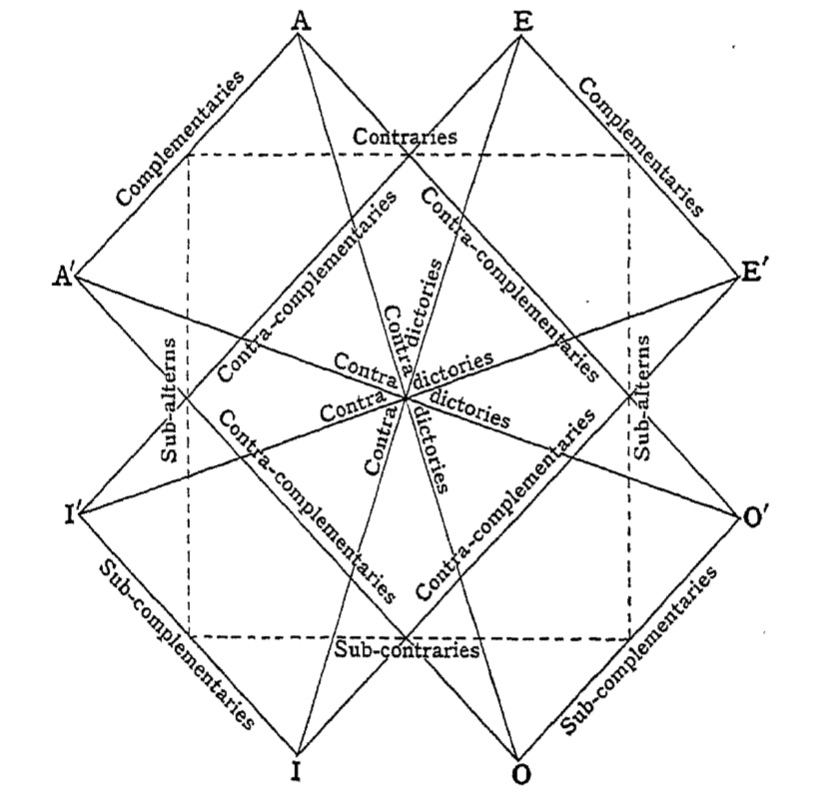
Each of the dotted lines in the above takes the place of four connecting lines which are not filled in; for example, the dotted line marked as connecting contraries indicates the relation between A and E, A and Eʹ, Aʹ and E, Aʹ and Eʹ.151
108. The Elimination of Negative Terms.152—The process of obversion enables us by the aid of negative terms to reduce all propositions to the affirmative form; and the question may be raised whether the various processes of immediate inference and the use, where necessary, of negative propositions will not equally enable us to eliminate negative terms.
It is of course clear that by means of obversion we can get rid of a negative term occurring as the predicate of a proposition. The problem is more difficult when the negative term occurs as subject, but in this case elimination may still be possible; for example, SʹiP = PoS. We may even be able to get rid of two negative terms; for example, SʹaPʹ = PaS. So long, however, as we are limited to categorical propositions of the ordinary type we cannot eliminate a negative term (without introducing another in its place) where such a term occurs as subject either (a) in a universal affirmative or a particular negative with a positive term as predicate, or (b) in a universal negative or a particular affirmative with a negative term as predicate.
The validity of the above results is at once shewn by reference to the table of equivalences given in section 106. At least one proposition in which there is no negative term will be found in each line of equivalences except the fourth and the eighth, which are as follows:
SʹaP = SʹePʹ = PʹeSʹ = PʹaS ;
SʹoP = SʹiPʹ = PʹiSʹ = PʹoS.
In these cases we may indeed get rid of Sʹ (as, for example, from SʹaP), but it is only by introducing Pʹ (thus, SʹaP = PʹaS); there is no getting rid of negative terms altogether. We may here refer back to the results obtained in sections 100 and 106; with two terms six non-equivalent propositions were obtained, with two terms and their contradictories eight non-equivalent propositions. The ground of this difference is now made clear.
If, however, we are allowed to enlarge our scheme of propositions by recognising certain additional types, and if we work on the assumption that universal propositions are existentially negative while particular propositions are existentially affirmative,153 then negative terms may always be eliminated. Thus, No not-S is not-P is equivalent to the statement Nothing is both not-S and not-P, and this becomes by obversion Everything is either S or P. Again, Some not-S is not-P is equivalent to the statement Something is both not-S and not-P, and this becomes by obversion Something is not either S or P, or, as this proposition may also be written, There is something besides S and P. The elimination of negative terms has now been accomplished in all cases. It will be observed further that we now have eight non-equivalent propositions containing only S and P—namely, All S is P, No S is P, Some S is P, Some S is not P, All P is S, Some P is not S, Everything is either S or P, There is something besides S and P.
Following out this line of treatment, the table of equivalences given in section 106 may be rewritten as follows [columns (ii) and (iii) being omitted, and columns (v) and (vi) taking their places]:
(i)(iv)(v)(vi)
SaP= PʹaSʹ=Nothing is SPʹ=Everything is Sʹ or P.
SʹaPʹ = PaS = Nothing is SʹP = Everything is S or Pʹ.
SaPʹ =PaSʹ = Nothing is SP =Everything is Sʹ or Pʹ.
SʹaP =PʹaS = Nothing is SʹPʹ =Everything is S or P.
SoP =PʹoSʹ = Something is SPʹ =There is something besides Sʹ and P.
SʹoPʹ =PoS =Something is SʹP =There is something besides S and Pʹ.
SoPʹ =PoSʹ = Something is SP =There is something besides Sʹ and Pʹ.
SʹoP = PʹoS = Something is SʹPʹ =There is something besides S and P.
Taking the propositions in two divisions of four sets each, the two diagonals from left to right give propositions containing S and P only.154
The scheme of propositions given in this section may be brought into interesting relation with the three fundamental laws of thought.155 The scheme is based upon the recognition of the following propositional forms and their contradictories:
Every S is P ;
Every not-P is not-S ;
Nothing is both S and not-P ;
Everything is either P or not-S ; and these four propositions have been shewn to be equivalent to one another.
If in the above propositions we now write S for P, we have the following:
Every S is S ;
Every not-S is not-S ;
Nothing is both S and not-S ;
Everything is either S or not-S.
But the first two of these propositions express the law of identity, with positive and negative terms respectively, the third is an expression of the law of contradiction, and the fourth of the law of excluded middle. The scheme of propositions with which we have been dealing may, therefore, be said to be based upon the recognition of just those propositional forms which are required in order to express the fundamental laws of thought.
Since the propositional forms in question have been shewn to be mutually equivalent to one another, the further argument may suggest itself that if the validity of the immediate inferences involved be granted, then it follows that the fundamental laws of thought have been shewn to be mutually inferable from one another. But it may, on the other hand, be held that this argument is open to the charge of involving a circulus in probando on the ground that the validity of the immediate inferences themselves requires that the laws of thought be first postulated as an antecedent condition.
109. Other Immediate Inferences.—Some other commonly recognised forms of immediate inference may be briefly touched upon.
(1) Immediate inferences based on the square of opposition have been discussed in the preceding chapter.
(2) Immediate inference by change of relation is the process whereby we pass from a categorical proposition to a conditional or a disjunctive, or from a conditional to a disjunctive or a categorical, or from a disjunctive to a categorical or a conditional.156 For example, All S is P, therefore, If anything is S it is P ; Every S is P or Q, therefore, Any S that is not P is Q. References have been already made to inferences such as these, and they will be further discussed later on.
(3) Immediate inference by added determinants is a process of immediate inference which consists in limiting both the subject and the predicate of the original proposition by means of the same determinant. For example,—All P is Q, therefore, All AP is AQ ; A negro is a fellow creature, therefore, A suffering negro is a suffering fellow creature. The formal validity of the reasoning may be shewn as follows: AP is a subdivision of the class P, namely, that part of it which also belongs to the class A ; and, therefore, whatever is true of the whole of P must be true of AP ; hence, given that All P is Q, we can infer that All AP is Q ; moreover, by the law of identity, All AP is A ; therefore, All AP is AQ.157
The formal validity of immediate inference by added determinants has been denied on the ground of the obvious fallacy of arguing from such a premiss as an elephant is an animal to the conclusion a small elephant is a small animal, or from such a premiss as cricketers are men to the conclusion poor cricketers are poor men. In these cases, however, the fallacy really results from the ambiguity of language, the added determinant receiving a different interpretation when it qualifies the subject from that which it has when it qualifies the predicate. A term of comparison like small can indeed hardly be said to have an independent interpretation, its force always being relative to some other term with which it is conjoined. While then the inference in its symbolic form (P is Q, therefore, AP is AQ) is perfectly valid, it is specially necessary to guard against fallacy in its use when significant terms are employed. All that we have to insist upon is that the added determinant shall receive the same interpretation in both subject and predicate. There is, for example, no fallacy in the following: An elephant is an animal, therefore, A small elephant is an animal which is small compared with elephants generally; Cricketers are men, therefore, Poor cricketers are men who in their capacity as cricketers are poor.
(4) Immediate inference by complex conception is a process of immediate inference which consists in employing the subject and the predicate of the original proposition as parts of a more complex conception. Symbolically we can only express it somewhat as follows: P is Q, therefore, Whatever stands in a certain relation to P stands in the same relation to Q. The following is a concrete example: An elephant is an animal, therefore, the ear of an elephant is the ear of an animal. A systematic treatment of this kind of inference belongs to the special branch of formal logic known as the logic of relatives, any detailed consideration of which is beyond the scope of the present work. Attention may, however, be called to the danger of our committing a fallacy, if we perform the process carelessly. For example, Protestants are Christians, therefore, A majority of Protestants are a majority of Christians; A negro is a man, therefore, the best of negroes is the best of men. The former of these fallacies is akin to the fallacy of composition (see section 11), since we pass from the distributive to the collective use of a term.
(5) Immediate inference by converse relation is a process of immediate inference analogous to ordinary conversion but belonging to the logic of relatives. It consists in passing from a statement of the relation in which P stands to Q to a statement of the relation in which Q consequently stands to P. The two terms are transposed and the word by which their relation is expressed is replaced by its correlative. For example, A is greater than B, therefore, B is less than A ; Alexander was the son of Philip, therefore, Philip was the father of Alexander; Freedom is synonymous with liberty, therefore, Liberty is synonymous with freedom.
Mansel gives the first two of the above as examples of material consequence as distinguished from formal consequence. “A Material Consequence is defined by Aldrich to be one in which the conclusion follows from the premisses solely by the force of the terms. This in fact means from some understood Proposition or Propositions, connecting the terms, by the addition of which the mind is enabled to reduce the Consequence to logical form…… The failure of a Material Consequence takes place when no such connexion exists between the terms as will warrant us in supplying the premisses required; i.e., when one or more of the premisses so supplied would be false. But to determine this point is obviously beyond the province of the Logician. For this reason, Material Consequence is rightly excluded from Logic…… Among these material, and therefore extralogical, Consequences, are to be classed those which Reid adduces as cases for which Logic does not provide; e.g., ‘Alexander was the son of Philip, therefore, Philip was the father of Alexander’; ‘A is greater than B, therefore, B is less than A.’ In both these it is our material knowledge of the relations ‘father and son,’ ‘greater and less,’ that enables us to make the inference” (Aldrich, p. 199).
The distinction between what is formal and what is material is not in reality so simple or so absolute as is here implied.158 It is usual to recognise as formal only those relations which can be expressed by the ordinary copula is or is not ; and there is very good reason for proceeding upon this basis in the greater part of our logical discussions. No other relation is of the same fundamental importance or admits of an equally developed logical superstructure. But it is important to recognise that there are other relations which may remain the same while the things related vary; and wherever this is the case we may regard the relation as constituting the form and the things related the matter. Accordingly with each such relation we may have a different formal system. The logic of relatives deals with such systems as are outside the one ordinarily recognised. Each immediate inference by converse relation will, therefore, be formal in its own particular system. This point is admirably put by Miss Jones: “A proposition containing a relative term furnishes—besides the ordinary immediate inferences—other immediate inferences to any one acquainted with the system to which it refers. These inferences cannot be educed except by a person knowing the ‘system’; on the other hand, no knowledge is needed of the objects referred to, except a knowledge of their place in the system, and this knowledge is in many cases coextensive with ordinary intelligence; consider, e.g., the relations of magnitude of objects in space, of the successive parts of time, of family connexions, of number” (General Logic, p. 34).
(6) Immediate inference by modal consequence or, as it is also called, inference by change of modality, is somewhat analogous to subaltern inference. It consists in nothing more than weakening a statement in respect of its modality; and hence it is never possible to pass back from the inferred to the original proposition. Thus, from the validity of the apodeictic judgment we can pass to the validity of the assertoric, and from that to the validity of the problematic; but not vice versâ. On the other hand, from the invalidity of the problematic judgment we can pass to the invalidity of the assertoric, and from that to the invalidity of the apodeictic; but again not vice versâ.159
110. Reduction of immediate inferences to the mediate form160—Immediate inference has been defined as the inference of a proposition from a single other proposition; mediate inference, on the other hand, is the inference of a proposition from at least two other propositions.
We may briefly consider various ways of establishing the validity of immediate inferences by means of mediate inferences.
(1) One of the old Greek logicians, Alexander of Aphrodisias, establishes the conversion of E by means of a syllogism in Ferio.
No S is P,
therefore, No P is S ;
for, if not, then by the law of contradiction, Some P is S ; and we have this syllogism,—
No S is P,
Some P is S,
therefore, Some P is not P,
a reductio ad absurdum.161
(2) It may be plausibly maintained that in Aristotle’s proof of the conversion of E (given in section 99), there is an implicit syllogism: namely,—Q is P, Q is S, therefore, Some S is P.
(3) The contraposition of A may be established by means of a syllogism in Camestres as follows:—
Given All S is P,
we have also No not-P is P,by the law of contradiction,
therefore, No not-P is S.162
(4) We might also obtain the contrapositive of All S is P as follows:—
By the law of excluded middle, All not-P is S or not-S, and, by hypothesis, All S is P,
therefore, All not-P is P or not-S ;
but, by the law of contradiction,No not-P is P,
therefore, All not-P is not-S.163
(5) The contraposition of A may also be established indirectly by means of a syllogism in Darii:—
All S is P,
therefore, No not-P is S ;
for, if not, Some not-P is S ; and we have the following syllogism,—
All S is P,
Some not-P is S,
therefore, Some not-P is P,
which is absurd.164
All the above are interesting, as illustrating the processes of immediate inference; but regarded as proofs they labour under the disadvantage of deducing the less complex by means of the more complex.
EXERCISES.
111. Give all the logical opposites of the proposition,—Some rich men are virtuous; and also the converse of the contrary of its contradictory. How is the latter directly related to the given proposition? Does it follow that a proposition admits of simple conversion because its predicate is distributed? [K.]
112. Point out any ambiguities in the following propositions, and give the contradictory and (where possible) the converse of each of them:—(i) Some of the candidates have been successful; (ii) All are not happy that seem so; (iii) All the fish weighed five pounds. [K.]
113. State in logical form and convert the following propositions:—(a) He jests at scars who never felt a wound; (b) Axioms are self-evident; (c) Natives alone can stand the climate of Africa; (d) Not one of the Greeks at Thermopylae escaped; (e) All that glitters is not gold. [O.]
114. “The angles at the base of an isosceles triangle are equal.” What can be inferred from this proposition by obversion, conversion, and contraposition respectively? [L.]
115. Give the obverse, the contrapositive, and the inverse of each of the following propositions:—The virtuous alone are truly noble; No Athenians are Helots. [M.]
116. Give the contrapositive and (where possible) the inverse of the following propositions:—(i) A stitch in time saves nine; (ii) None but the brave deserve the fair; (iii) Blessed are the peacemakers; (iv) Things equal to the same thing are equal to one another; (v) Not every tale we hear is to be believed. [K.]
117. If it is false that “Not only the virtuous are happy,” what can we infer (a) with regard to the non-virtuous, (b) with regard to the non-happy? [J.]
118. Write down the contradictory, and also—where possible—the converse, the contrapositive, and the inverse of each of the following propositions: A bird in the hand is worth two in the bush; No unjust acts are expedient; All are not saints that go to church. [K.]
119. Give the contrapositive and the inverse of each of the following propositions,—They never fail who die in a great cause; Whom the Gods love die young. If A is either B or else both C and D, what do we know about that which is not D? [K.]
120. Take the following propositions in pairs, and in regard to each pair state whether the two propositions are consistent or inconsistent with each other; in the former case, state further whether either proposition can be inferred from the other, and, if it can be, point out the nature of the inference; in the latter case, state whether it is possible for both the propositions to be false:—(a) All S is P ; (b) All not-S is P ; (c) No P is S ; (d) Some not-P is S. [K.]
121. Transform the following propositions in such a way that, without losing any of their force, they may all have the same subject and the same predicate:—No not-P is S ; All P is not-S ; Some P is S ; Some not-P is not not-S. [K.]
122. Describe the logical relations, if any, between each of the following propositions, and each of the others:— (i) There are no inorganic substances which do not contain carbon; (ii) All organic substances contain carbon; (iii) Some substances not containing carbon are organic; (iv) Some inorganic substances do not contain carbon. [C.]
123. “All that love virtue love angling.” Arrange the following propositions in the three following groups:—(α) those which can be inferred from the above proposition; (β) those which are consistent with it, but which cannot be inferred from it; (γ) those which are inconsistent with it. (i) None that love not virtue love angling. (ii) All that love angling love virtue. (iii) All that love not angling love virtue. (iv) None that love not angling love virtue. (v) Some that love not virtue love angling. (vi) Some that love not virtue love not angling (vii) Some that love not angling love virtue. (viii) Some that love not angling love not virtue. [K.]
124. Determine the logical relation between each pair of the following propositions:— (1) All crystals are solids. (2) Some solids are not crystals. (3) Some not crystals are not solids. (4) No crystals are not solids. (5) Some solids are crystals. (6) Some not solids are not crystals. (7) All solids are crystals. [L.]