Note 169 — Chapter V
Reading edition
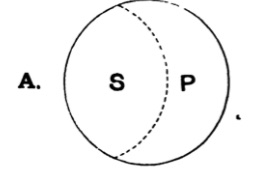
Dr Venn writes in criticism of Euler’s scheme, “A fourfold scheme of propositions will not very conveniently fit in with a fivefold scheme of diagrams… What the five diagrams are competent to illustrate is the actual relation of the classes, not our possibly imperfect knowledge of that relation” (Empirical Logic, p. 229). The reply to this criticism is that inasmuch as the fourfold scheme of propositions gives but an imperfect knowledge of the actual relation of the classes denoted by the terms, the Eulerian diagrams are specially valuable in making this clear and unmistakeable. By the aid of dotted lines it is indeed possible to represent each proposition by a single Eulerian figure; but the diagrams then become so much more difficult to interpret that the loss is considerably greater than the gain. The first and second of the following diagrams are borrowed from Ueberweg (Logic, § 71). In the case of O, Ueberweg’s diagram is rather complicated; and I have substituted a simpler one.
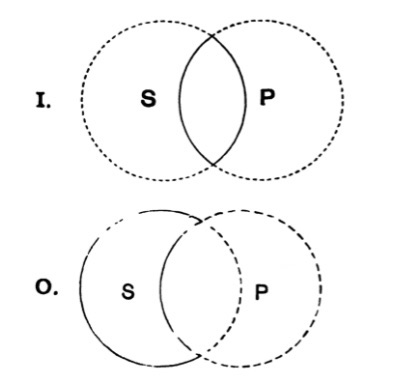
In the last of these diagrams we get the three cases yielded by an O proposition by (1) filling in the dotted line to the left and striking out the other, (2) filling in both dotted lines, (3) filling in the dotted line to the right and striking out the other. These three cases are respectively those marked γ, δ, ε, on page 158.