WONDERS OF THE ALPHABET.
Reading edition
By Henry Eckford.
Sixth Paper.
You must have noticed the difference in your own handwriting, when you are using a pen that does not suit you, and when you have one to which you are accustomed. Similarly, when you are writing on a slate—a sharp slate-pencil makes a clear, thin mark, a blunt pencil makes a broad mark with uneven edges. When the pencil is worn down on one side, if you turn it over, it makes another sort of a mark. The writing done with a quill differs from that made with a steel pen. And the differences between the writings of certain nations of the Old World—which at one time puzzled people very much—were often caused by their use of different writing materials, such as: paper and pencils; paper and brushes; bricks and metal pens; wax and metal nails; wood and knife-blades.
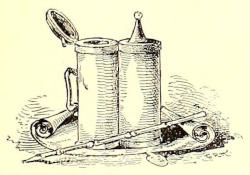
REED AND PEN-CASE OF ANCIENT EGYPT.
The Egyptians, you remember, had two kinds of writing: one called hieroglyphs, used mainly on monuments, for sentences of sacred history, names of kings, and short prayers; the other called hieratic, used on papyrus paper, chiefly for general and quicker writing. Both these terms signify that writing was sacred and connected with the priests. Religion entered very largely into the life of the people of Egypt, and the priests, who formed the most powerful class, held all the learning, and, before the Greeks flourished, were the wisest men in the world. The differences between the rough little sketches that formed the letters of the hieratic or swift hand and the laborious pictures called hieroglyphs, arose originally, and kept growing greater and greater, because of the different materials used in making them. It was natural to work very slowly and carefully on the hieroglyphs which were carved on royal monuments; while the scribes who wrote the hieratic characters on smooth papyrus with a reed pen and thick ink were obliged to disregard the smaller angles and finer outlines, and were satisfied if their work conveyed the meaning they intended. There is a fantastic and not inelegant writing used by the Burmese, a people to the north-east of India, and south of China. This script is very rounded and is made up of fine lines. The letters have been found to belong to an alphabet that looks entirely different; and the difference arose from the custom of writing on palm-leaves with a fine needle. It was difficult to make the plain up-and-down strokes without splitting the leaf, so these strokes were made in curves in circles and half circles.

PORTION OF THE BURMESE ALPHABET.
The alphabet of the Goths, before and about the time they embraced Christianity, was formed on a contrary system. All the strokes were straight, either up and down, or crosswise, or slanting. Many persons have thought this arose because the Goths lacked a feeling for grace and beauty. But that was not the reason. When these forefathers of ours invented or borrowed their runes, and later when they borrowed a true alphabet from the Greeks, they cut their letters on sticks of wood or on smooth lengths of bark. Most boys know by experience how difficult it is to cut a round O on a smooth stick on account of the grain of the wood. This led to peculiar shapes in the letters.
In the earliest known Runic alphabet, the letters do not stand in the order of our letters; and they differ so greatly in other ways from the ordinary Greek alphabet, that it is probable they were borrowed long before the Christian era, and afterward became greatly changed. This Runic alphabet was called the “Futhorc,” from the first six letters, ᚠᚢᚦᚯᚱᚴ—f, u, th, o, r, c. The third rune, ᚦ (th), which came from the Greek Δ, delta, or d, survived in English literature until the last century, and is occasionally used to-day when people wish to write in an old-fashioned style. And they are apt to make a curious mistake in its pronunciation. The rune ᚦ remained in Irish and Anglo-Saxon for the sound th, and in English it was preserved longest in the word “the,” because that word occurs very often, and it was easier to write one letter than two. But in the course of time it came to be mistaken for y; and although our ancestors knew better than to pronounce it like y, their descendants do not, but usually give this apparent y the sound of the real y, making ye’s out of all the the’s. They do not know that this is a survival of a rune almost to the present generation. The fifth rune of the “futhorc” is our r, and the sixth is our k without the tail. The Goths, Angles, and Scandinavians used twenty-four such runes or closely similar letters. You will notice that the Goth, like an unskillful schoolboy who carves his initials on wood, and is bothered by the circle of the o, has solved the difficulty by the bold move of cutting one downward and two cross strokes. Sometimes, however, the o was made by four strokes forming a lozenge ᛜ. They usually cut their down strokes across the grain; and they gave all their cross lines a slant, in order not to bury the point of the knife too deep, and splinter the wood, in cutting with the grain. That is the reason that the cross lines of the letters are rarely horizontal.
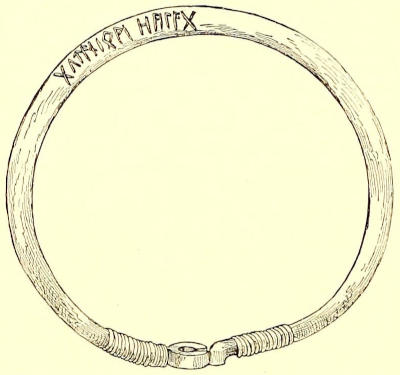
THE BUZEO TORQUE.[4]
Some of our words that are in constant use can be traced back to this period. The word book was originally the same as the word beech, and reminds us of the time when our forefathers carved their records on beech-wood or beech-bark. The similarity of the two words has remained much closer in German; Buch (book) being almost exactly the same as Buche (beech). To sing from a stave is the same as to sing from a staff, because in runic writing the old chants were noted down with a knife on sticks or pieces of bark, and read from these by the singers. The Ojibway Indians, though they had not an alphabet like the runes, until recently had similar staves which they brought out when they chanted their songs; certain marks on the wood served to remind them of what they were to sing.
You may remember my telling you how hard it is to distinguish some of the letters of the Hebrew alphabet from one another, and how the same difficulty is experienced in the case of the Arabic and Persian alphabets. This is due to various reasons, among which was the employment by those nations of pen, paper, and ink for perpetuating records. This tended to make their writing less and less easy to read; and as inscriptions on stone were not common, people did not have the ancient models of letters before their eyes to refer to.
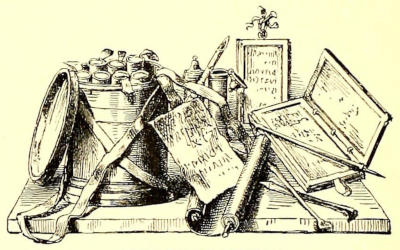
ROMAN WRITING MATERIALS.
The capital letters of our own alphabet, however, are easily distinguishable from one another. We owe this fact largely to the Romans, a clear-headed, practical people, who used for every-day writing slates or boards covered with a thin film of wax, on which the letters were engraved, or furrowed, by a sharp-pointed instrument called a stylus, from which we derive the term “style,” in literature. The yielding quality of the wax encouraged the use of fine, open and legible characters, and the Romans handed down to us an alphabet improved in many ways.
But the most curious example of the modifying influence of the writing materials upon the writing is seen in the cuneiform characters. If, on a hot summer’s day, you should walk between the long lines of bricks in one of the many brickyards that line certain sections of the Hudson river, you would find the fresh-made bricks quite soft, and steaming under the direct rays of the sun. If one of those soft bricks were given into your hand and you were asked to draw a rebus on it, and given a nail with which to do it, you would meet with this difficulty: If, in drawing the outlines of your pictures, you should press equally along the whole length of every line, you would raise small ridges on each side; or, as you became more expert, one ridge on one side, as a plow does when drawing a furrow. And when you should come to draw one line across another, there would be two ugly interfering ridges.
But if you should stop your cross line just before you come to the other, and skip it, beginning again on the other side, your picture would be smoother and the surface of the brick less uneven. You would succeed still better if you should not try to draw continuous lines, but should indicate them with a series of dots made by dabbing the soft brick with a corner of the iron nail. Now, imagine the Hudson to be the Euphrates, and yourself a Babylonian of ten thousand years ago, and the nail a little, smooth, square-pointed piece of copper, iron, tin, or silver, and the pictures conventional signs representing the various sounds of the language, and you would be writing cuneiform. The old Babylonians, in writing, engraved soft bricks with regular and evenly placed dabs. These hardened quickly under the hot sun of Mesopotamia, or were baked in ovens, and so preserved the inscribed characters. Very often a coat of soft clay was wrapped about the original brick, and the same inscription made on the outside. This was done to prevent forgeries, and to make it easier to restore the meaning, if part of the brick were destroyed or lost. Whole libraries of these strange books have been found under the ruins of the palaces of the old kings of Assyria. Still other libraries are lying there waiting for their discoverer.
Did you ever try to make an alphabet of your own? I can distinctly remember inventing one, with a favorite sister, when I was about seven years old. Great was our diligence while at work on it, and great was our secrecy! We used to hide it away so carefully that it was easy to forget about it for weeks at a time. We never learned it well enough to write the simplest sentences in it off-hand,—and for a very good reason: We had too recently learned an alphabet infinitely better than any that a child could think out—one which had been tested and changed and improved by ages of use. I do not doubt that many other children have tried to construct private systems of writing. It has never been uncommon for men to attempt to use secret alphabets. In this respect, the ancient people of Asia somewhat resembled children; and thousands of alphabets and syllabaries were invented in those old days. It is rare, however, that one has been handed down, and only when the people for whom it was devised had a much poorer system or none at all.
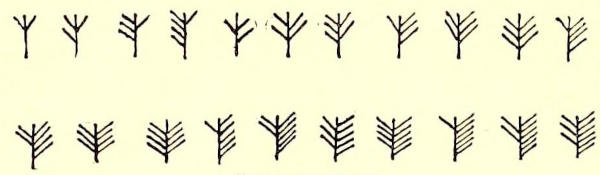
A “TREE ALPHABET.”
Sequoiah, an intelligent Cherokee Indian, contrived more recently a syllabary of eighty-five signs, comprising all the sounds in his language, using the English alphabet as a basis on which to form his characters. This syllabary is in use to-day by the Cherokees, and books and newspapers are printed in it. Botanists have given the name, Sequoiah, to the gigantic trees of California, in perpetual memory of his genius.
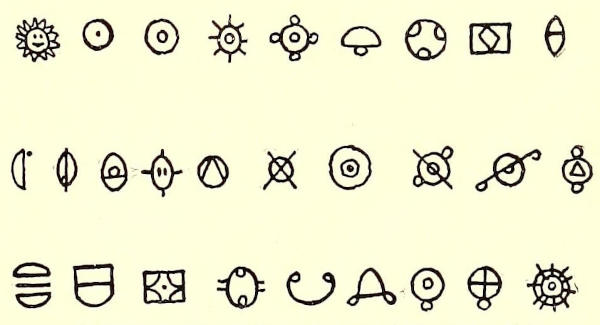
SPECIMENS OF OLD ASIATIC ALPHABETS. (SEE NEXT PAGE.)
Long ago, when it was dangerous but very profitable to be thought a wizard, it was customary for any wise man who wished to be feared, and to keep his wisdom confined to himself and a few chosen disciples, to write his books in an alphabet or cipher of his own invention. Generally he took some existing alphabet as a foundation, and made variations on it, somewhat as Sequoiah did. I have in my possession a queer little treatise in Arabic, which claims to have been written after a labor of twenty years, and solemnly deposited in the royal treasury, during the reign of a certain Caliph who lived in Palestine more than one thousand years ago. It professes to give a key to the hieroglyphs of Egypt, but its greatest interest lies in the fact that the author has here brought together, in an amusing medley, all the alphabets and ciphers that he has ever heard of; perhaps some that he made up. Here in the upper wood-cut, for example, is a curious tree alphabet. The letters follow the regular order of the Arabic alphabet, each letter varying from the others by the arrangement of the branches on one side or the other of the trunk. Placing these in regular order with the corresponding Arabic letters underneath, the Arab had a simple cipher which the ordinary Oriental who only knows his own letters could scarcely read without the key. Another alphabet, as shown in the second wood-cut on p. 773, is evidently based upon a picture of the sun for alif, or A; while B, C, D, and the following letters are made by varying the first character. Remember that these, being Asiatic alphabets, are written so as to be read from right to left; but the letters are here placed in reverse order to be read like our own alphabet from left to right. This book contains also alphabets founded on the signs for the moon, and on those for the planets, Jupiter, Saturn, Mars, Mercury, and Venus. The one shown on this page is still another, which the author calls the “oldest Chaldean Alphabet.” And one can really trace a resemblance to Phœnician letters in some of these old signs. In fact, it is easy to invent fancy alphabets, as soon as the idea of an alphabet is familiar to the mind; but it is not so easy to induce people to use them. The alphabets actually used by the various nations of the world have been brought to their present state of perfection, as you have seen, by a slow process of growth, one step at a time, and each step the product of intense thought and ingenuity. The Cherokee is an interesting exception to this rule. Of late centuries, there have been few, almost no improvements in our alphabet. This is partly because it is so well adapted to our use, but principally because the invention of printing has tended to fix the style of printed type in one fashion. It is true that when books were first printed in England, the characters used were the indistinct so-called Gothic, or black-letter; but printers soon saw the advantages of the later Italian, or Roman, styles, and have kept to them ever since. The people of Germany are troubled to-day with near-sightedness. It has been claimed, with a great show of truth, that this is largely owing to the fact that the Germans still retain the old black-letter of the early Irish and the Anglo-Saxons. But every year the Germans are printing more and more books in Roman type, and for generations Roman type and Roman script have been taught in their schools, together with the angular Gothic.
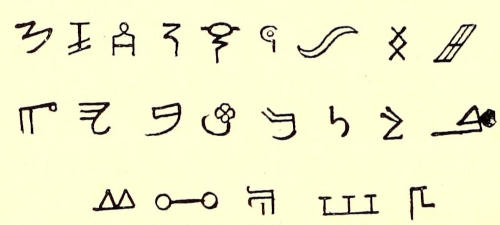
THE OLDEST CHALDEAN ALPHABET.
Among the half-civilized nations which are now being taught our wisdom, many are learning to use our alphabet; and it seems almost certain that in time the whole world, excepting perhaps the Mohammedan nations, will express their thoughts in our version of the letters that came down from the Phœnicians. What a glory for that strange old folk of the Mediterranean Sea!