JACK-IN-THE-PULPIT.
Reading edition
Try not to mind it, dearly beloveds. It is merely “the sensation caused by caloric, or the principle of heat, in excess; the bodily feeling experienced on exposure to the sun’s rays; the reverse of cold.” What is there to grumble about in so simple a thing as that? And yet that is all that makes these sunny days uncomfortable. Just fan yourselves with that fact, my dears. I’m assured you have the highest authority for it—a big, wise book named Webster.
And now that your thoughts are cooled and refreshed, you’re ready for this communication which the Little School-ma’am wishes to lay before you.
LONGFELLOW’S FIRST LETTER.
My Dear Little School-ma’am: My mamma has found in a new book (the “Life of Henry W. Longfellow,” edited by his brother Samuel), a copy of the very first letter ever written by the poet. We reckoned his age, and found that he was six years and eleven months old when he wrote it. It interested my brother Kit and me so much that Mother said we could copy it for you to show the St. Nicholas boys and girls. I think it was very nice in him to put his sister Ann in first, and Kit says I ought to explain that a billet was sometimes good to get.
This is the letter:
“Portland, 1814.
“Dear Papa,—Ann wants a little Bible like little Betsey’s. Will you please buy her one, if you can find any in Boston. I have been to school all the week, and got only seven marks. I shall have a billet on Monday. I wish you to buy me a drum.
“Henry W. Longfellow.”
As some one may wish you to tell whether Henry got the drum or not, I think I’ll copy next a part of the father’s answer to the letter. He was in Boston at the time, and he wrote:
... “I have found a very pretty drum, with an eagle painted on it, but the man asks two dollars for it; and they do not let any vessels go from Boston to Portland now. But if I can find any opportunity to send it down, I shall buy it. And if I cannot, I shall buy something else which will please you as well. I am glad to hear that you have been a good boy at school, and are likely to get a billet. You must save all your billets till I get home.” ...
P. S.—What do you think my father says? He says Henry’s letter was pretty hard on Boston.
Your little friend and admirer,
Dorothy G——.
THE WATER-SNAKE AS A FISHERMAN.
Dear Jack: I once had some tame fish in a lake at the foot of my garden,—or, rather, some fish that came every afternoon about five o’clock to be fed. My children were in the habit of taking bread daily and throwing it into the lake for them to eat. The fish became so tame that they would eat out of our hands, and when a foot-fall was heard coming down the terrace that leads into the small flower-garden by the lakeside, the fish would rush through the water by hundreds, expecting their food. They were of many kinds,—from the large catfish, or bullpout, weighing three or four pounds, to the small minnow.
Once, while I was feeding them from my hand, a water-snake suddenly caught one of the fish by the head, and, as a snake always must do after catching his prey under water, he held the fish up out of the water for a moment while he took breath. I instantly caught the fish, and attempted to pull it out of the snake’s mouth, but the snake as quickly twisted his tail around a root under the water and resisted my attempt to deprive him of his expected dinner. With all the strength I could exert, I could neither pull the fish out of the snake’s mouth nor tear loose his hold upon the root.
While I continued to pull, I very soon found that the snake was beginning to swallow the fish, and was visibly sucking it in. Notwithstanding all my efforts to wrench it from his grasp, the fish gradually disappeared into the snake’s mouth until I felt my thumb and finger touch against the jaws of the reptile, and even then they were irresistibly pushed back until my grasp was only upon the tip end of the fish’s tail. Then the snake, with a sudden jerk, pulled it quite out of my hand and swam away. I was defeated, and the snake had gained the victory.
Yours truly,
H. E. S.
MORE ANIMAL WEATHER-PROPHETS.
It never rains but it pours! as I’ve often heard the Deacon say. We have lately been discussing the habits of some animal weather-prophets, but we have considered them one at a time. Now, lo and behold!—my young friend Ida G. Egerton sends me this letter and a newspaper extract, which describes a long list of such weather-prophets.
Boonville, N. Y.
Dear Jack: Seeing your readers are interested in living barometers, I thought I would send you this paper. From
Ida G. Egerton.
“I do not know of any surer way of predicting the changes in the weather, says a correspondent, than by observing the habits of the snail. They do not drink, but they imbibe moisture during a rain, and exude it afterward. The snail is never seen abroad except before a rain, when you will see it climbing the bark of trees and getting on the leaves. The tree-snail, as it is called, two days before rain, will climb up the stems of plants, and if the rain is going to be a hard and long one, it gets on the sheltered side of a leaf, but if a short rain, on the outside. Then there are other species that before a rain are yellow in color, and after rain blue.
“Take the ants, too; have you ever noticed the activity they display before a storm—hurry, scurry, rushing hither and yon, as if they were letter-carriers making six trips a day, or expressmen behind time? Dogs grow sleepy and dull, and like to lie before a fire, as rain approaches; chickens pick up pebbles, fowls roll in the dust, flies sting and bite more viciously, frogs croak more clamorously, gnats assemble under trees, and horses display restlessness.
“When you see a swan flying before the wind, spiders crowding on a wall, toads coming out of their holes in unusual numbers in the evening, worms, slugs, and snails appearing, robin-redbreasts pecking at the windows, pigeons coming to the dovecotes earlier than usual, peacocks squalling at night, mice squeaking, or geese washing, you can put them down as rain-signs. Nearly all the animals have some way of telling the weather in advance. It may be that the altered condition of the atmosphere with regard to electricity, which generally accompanies changes of the weather, makes them feel disagreeable or pleasant. The fact that a cat licks herself before a storm is urged by some naturalists as proof of the special influences of electricity. Man is not so sensitive. Yet many persons feel listless before a storm, to say nothing of aggravated headaches, toothaches, and rheumatic pains.”
It appears, from this, that even boys and girls may sometimes be classed among the animal weather-prophets. But, as they seem to have a rather painful way of indicating storms, I hope none of you excel in prophesying.
A USEFUL BIRD WITH AN ARISTOCRATIC NAME.
Warwarsing, N. Y.
Dear Jack: We were lately much interested in watching a family of Baltimore orioles that lived in a nest in a tree near our house. There were several young birds in the nest, that kept their father and mother busy all day long feeding them. The nest was rather small for its inmates, and some time ago a little bird fell out. Though the nest is about fifteen feet above the ground, it did not hurt itself. We saw it fall, and put it on a small tree near by, where its mother could see it. Afterward I climbed a ladder and put it in the nest. Then the mother bird arrived and hunted all over the small tree, trying to find it and give it something to eat, and seemed very anxious about it. It was a very pretty sight to watch her.
This oriole’s nest has been in the tree for some years. It hangs from one of the highest limbs, to which it is fastened by strong cords made from the material of which the nest is built. We are glad to have orioles about, for they feed the young birds with insects injurious to the garden and orchard. Insects seem to be their principal food; and I have seen them eat hornet’s eggs.
The name “oriole” is from the old French “oriol,” which is derived from the Latin “aureolus,” meaning golden. They are sometimes called “golden robins.” The orchard oriole, which we occasionally see, is of a pure yellow color, with stripes of black on its back, and is about the size of a canary-bird. The colors of the Baltimore oriole are orange and black. They are so called because orange and black were the colors of the coat of arms of Lord Baltimore, who was Governor of Maryland under King Charles I.
Respectfully,
Norman T. Saunders.
A WISE HUMMING-BIRD.
Wisdom does not depend on size, as you all know, my dears. The ant and the bee, in fact, often seem to know more than some of the largest animals. The humming-bird, too, though the smallest of birds, is not lacking in intelligence. A friend of the Deacon tells a pleasant little story of one that was trying to secure the honey from a flower with a deep cup, and at the same time was plainly very tired. The flower grew near a porch where a family was sitting, and seeing the trouble of the bird, a young girl walked slowly toward him, holding out her finger. The tired bird looked sharply at her and then accepted the offered perch, alighted on the finger, and, when it was held close to the flower, returned to his work of honey-gathering. The girl stood quietly, and he used her finger as a resting-place till he had finished his meal, when he flew away home. A wise humming-bird that, say I,—and a wise girl, too.
THE PITCHER PLANT.
You were lately told in St. Nicholas, I hear, about a curious lace-leaf that grows in a far-off corner of the world called Madagascar. Well, the Little School-ma’am asks me to show you now this picture of another queer plant, which, she says, is a near neighbor to the lace-leaf, for it is found in the marshes along the coast of Madagascar, and it is known as the pitcher plant.
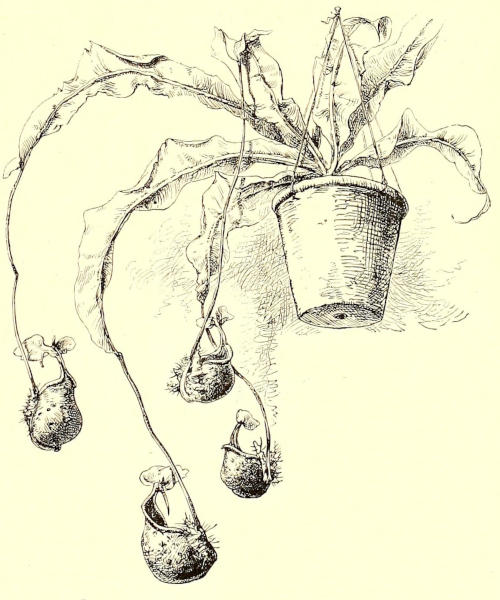
At the end of each leaf, which narrows to a mere stalk at the tip, it carries a little vegetable vase very like a pitcher with lid and all complete. And this curious cup is indeed a pitcher, given to the plant for the express purpose of keeping its leaves well supplied with moisture; for travelers report that they have frequently found quite a quantity of water in those queer little natural cups. Besides, they have big ears, so of course they’re little pitchers.
The Deacon says that, according to all accounts, Madagascar must be a sort of palace of the vegetable kingdom.