REGATTA. A GAME FOR THE LAWN OR PARLOR.
Reading edition
By Frank Bellew.
Perhaps you have never heard of a yacht-race ashore, yet that term might almost be applied to this picturesque game, which will be found not only exciting, but a source of great fun. It can be played out-of-doors on the lawn or in a large room.
Two players are required for each “yacht”—the “captain,” who directs the course of the vessel, and the “crew,” who carries the boat in his cap or “helmet,” and obeys the orders of the captain.
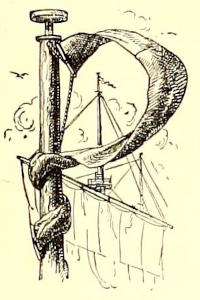
To play the game, it is first necessary to lay out the “course” on the lawn or the floor, which represents the sheet of water that is to be the scene of the regatta. Any convenient objects can be taken for the “stake-boats” and “turning-buoy,” and the course can be made as difficult as desired by placing obstacles, such as chairs, boxes, or cushions, in the way, to represent “rocks,” “reefs,” “shoals,” and “islands.” The crews that are to compete are first allowed to sail over the course to inspect it, and are then drawn up in line at the start, where each puts on his “yacht-rig,” and is carefully blindfolded by the captain of a rival yacht. At the “first gun,” or signal to make ready, each crew turns around three times. At the “second gun,” or signal to start, they all proceed, under command of their respective captains, to go over the course, keeping always in “deep water” and avoiding the reefs and other obstacles, around the turning-buoy, and back to the starting-point. The yacht which is the first to come in wins the race.
A captain must always address his crew by the name of his yacht, and must give his orders in nautical terms. If he fail to do so, his yacht must stop, and turn once around before going on. The same penalty is exacted if the crew does not understand an order and asks for an explanation; and also whenever, through the unskillful management of the captain or the poor sailing of the crew, the yacht runs into any of the obstacles or into one of the other yachts.
Of course, unless the players know how to sail real boats, the orders will often be very ridiculous; but as long as they are given in nautical language, and the crew understands what they mean, it makes no difference, except to add to the fun.
For instance, let us imagine the Genesta to be racing the Puritan. The orders might sound something like this:
“Steady, Genesta, steady!” from the captain of the English cutter.
“Keep her off about two points to starboard, Puritan—steady!” from the American skipper.
But such a command as “Hard a-port, Genesta—no, no, the other way, you goose!” would compel the captain of that craft to stop his yacht and make it turn once around; while, if on receiving the order, “Shake out a reef, Puritan, and head her nor’-nor’east!” the crew should ask, “Oh, I say, Billy, what do you mean by ‘shake out a reef’?” or “‘Which direction is nor’-nor’east’?” then the Puritan would have to stop and turn around. And if the captain of the Genesta, wishing to take advantage of his rival’s set-back, should exclaim, “Now, Sam, let her go!” the English boat would have to pay the same penalty.
Many modifications of this game will naturally suggest themselves to those who understand sailing. The sport can be made much more difficult and interesting by supposing the wind to blow directly up the course, so that the yachts will have to beat down to the turning-buoy and then come home before the wind. When the game is played out-of-doors and there is a breeze blowing, a great deal of skill and ingenuity can be exercised in keeping the yachts in the courses they would have to take if they were actually propelled by the wind.
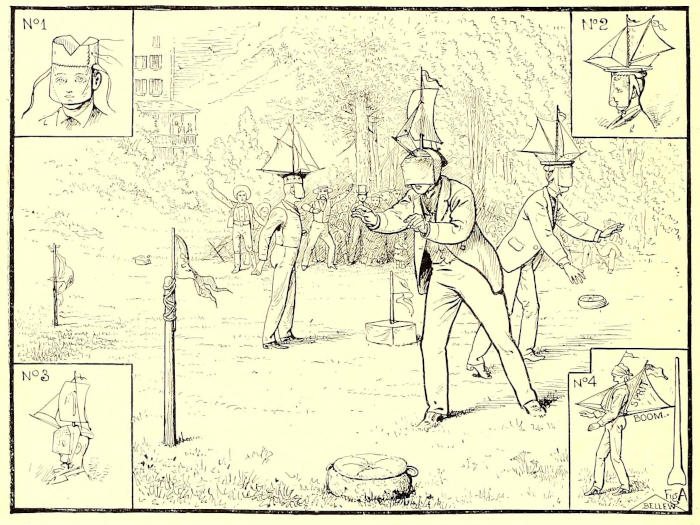
The nattiest yacht-rig is made of a square piece of cardboard that will go just around the head of the crew. The two edges are then stitched together to form a “helmet,” like a high hat without crown or brim. Two notches should be cut in the top of the helmet, as shown in Fig. 1, to receive the hull of a small toy yacht, such as can be bought cheaply at any toy shop. The yacht is held in place by lashings passing through holes made in the helmet. Strings should be fastened to the sides of the helmet to tie under the chin, and a curtain of some thick, close material may be sewed on in front, as a blindfold. The cardboard should be colored blue to represent waves; but the curtain, flags, and strings should be of some distinctive tint, so that each vessel can sail under its own colors.
A simpler form of yacht-rig (Fig. 2) consists of a roll of cloth about twenty inches long, the ends of which are sewed together, forming a ring-shaped pad to rest upon the head. The yacht, a home-made affair, cut out of a shingle or a piece of board, is fastened upon the pad. This helmet also has the blindfold, and strings to tie under the chin. A third style of helmet (Fig. 3) was once formed by scooping out the end of a watermelon to fit the crew’s head, and rigging it up with a twig mast and a brown-paper sail. It was cheap, ingenious, and uncomfortable, and is not recommended. There is a fourth and entirely different rig, which consists in fastening the sails directly to the crew’s body. (See Fig. 4.) The spars—boom, sprit, and bowsprit—are of wood, shaped as in A, and are fastened to the body by strings run through holes in the broad ends. The sails should be attached to the spars as in real boats. A small flagstaff in the front of the cap bears the pennant, and completes the rig.
For the benefit of those who are not familiar with sea terms, a few of the more common directions used in this game of Regatta are here given with their explanations:
“Port” means the left side of the yacht. “Starboard” means the right side. To “luff” means to bring the yacht so that it will point more toward the direction from which the wind is blowing. To “luff a-lee” is to point the yacht directly at the wind, in the “wind’s eye.” To “tack” is to change the course of the yacht so that it receives the wind on the other side. The maneuver is accomplished by “luffing a-lee,” and keeping on until the yacht presents its other side to the wind. To “fall off” is the opposite of to “luff.” Experienced yachtsmen will know and use many other terms, but these are sufficient for conducting a game. Stories and books about the sea will suggest other useful words, and any one who plays the game often will soon gain an ample vocabulary.