ON THE WILLEY-BROOK TRESTLE.
Reading edition
By Willis Boyd Allen.
There had been rain among the mountains for almost a week. Every day the newspapers brought reports of clear, warm weather in Boston and New York, while the Crawford House guests gathered in shivering groups around their open fires and applied themselves to indoor occupations, discontentedly or cheerily, according to their various dispositions. Among the most impatient in the hotel was a group of young people, who, as the season drew to its close, were more eager than ever to improve each shining hour. The hours, however, refusing to shine on any terms, that gloomy September week, the bees were left “to hum,” as Lou Elwin plaintively remarked.
When, therefore, the sun at last looked over the mountain-tops one cool, delicious morning, and with his shining fingers gently drew aside the misty draperies that had so long overhung the little valley of the Notch, great was the delight of old and young at Crawford’s, and it was an eager company of boys and girls that assembled about the big parlor fireplace after breakfast. As soon as they were fairly together, half a dozen were chattering at once.
“Isn’t it glorious?”
“What shall we do——?”
“Where shall——?”
“Fabyan’s!”
“Tennis!”
“Bugle Cliff!”
“A walk down the track.”
A shout of laughter greeted this last proposal, which was offered by a delicate-looking youth of about eighteen.
“Fred is afraid that he’ll rub the shine off his boots!” cried one of his companions, slapping him on the shoulder.
“Or tear that tennis suit on the rocks,” suggested Lou Elwin, with a toss of her pretty head, as she leaned back in her chair and planted her own stout little boots emphatically on the hearth. Lou was the acknowledged leader among her set at Crawford’s, that season, in all the jaunts and good times that were planned. She was a Boston girl, and she had her full share of the independent spirit that characterized her ancestors. Whenever the party set out on a scramble over the rough mountain-paths, her joyous laugh was sure to be heard far in advance of the rest; it was always her tennis-racket that met and returned the ball when the play was apparently lost; it was Lou Elwin whose name zigzagged all over the cards of the best partners an hour before dancing began.
Fred Seacomb did not quail, however, before her little broadside of irony, but just looked straight into her eyes for a moment, and said quietly, “You know better, Lou.” And then he proceeded to argue his proposal, with such effect that in five minutes more the whole party of young folks were racing down the plank walk toward the railroad.
At the little rustic shop beyond the station, the girls stopped for caramels, packages of which the sterner element dutifully tucked into their coat-pockets, ready for instant use. Thus provisioned, they all struck off in the direction of the Notch, walking in twos and threes, on the railroad ties, or balancing with little shrieks and a great deal of laughter on the narrow rails. Lou, as usual, was ahead, but Fred soon caught up and took his place at her side.
For several minutes, nothing was said by either. Then Lou exclaimed, almost pettishly:
“Why do you try to be so quiet, and exact, and—and different?”
“You know, Lou, I can’t stand quite so much as some of the other fellows. The doctor——”
“Oh, yes, I know. You’re up here for your health, and all that; but you might ‘fly around’ a little more, get a little bit—just the least little bit—rumpled, once in a while, like the rest of us!”
Fred laughed now, merrily enough, and perhaps would have defended himself, had not another boy of about his own age joined them at that moment, having caught the import of the girl’s words.
“If you think Seacomb can’t ‘fly around,’ Miss Elwin, you ought to see him in the gymnasium, at Harvard! He’s the best man on the bars in the Freshman class, and he can——”
“There, there, Arthur!” interrupted Fred, “girls don’t care about such affairs as that. My blackest sin, just now, is the shine on my boots, isn’t it, Lou?”
Fred had known her long, and as an intimate friend, and so he used her first name easily—a liberty rather envied by some of the later comers.
At the end of the Crawford plateau, they all turned away from the track for a few moments, to visit “The House that Jack Built.” Of the mysterious “Jack,” who was popularly believed to subsist on toads and snakes, the girls stood rather in awe, and so they left the boys to do the talking. Somewhat to Lou’s surprise, Fred Seacomb seemed to be on excellent terms with the bluff Jack, who had been an English sailor. The party soon chorused good-bye, and ran back down the path to the track, to resume their excursion. They now entered the Notch itself, and for a few minutes even their gay laughter was hushed in the presence of those gray cliffs towering high, high above their heads. It seemed as if they were leaving the land of sunshine behind them, and were entering the very home of storm and avalanche. The iron track, clinging to the crumbling slope, gave no sense of security or conquest over the terrible forces of nature; rather, it was a frightened thing, like each one of themselves, at the mercy of the stern, granite-browed hills overhanging it.
They emerged from the dark ravine, and gazed on the fair valley opening before them, with a keen sense of relief which showed itself in a renewed chorus of happy, thoughtless talk and laughter. Once they sprang aside, and stood in a gay-colored group against the embankment, to let the nine o’clock Portland train pass. Then they went on, more merrily than ever, the girls gathering clusters of brilliant golden-rod and purple asters for their hats and belts. It was Fred who discovered a single blue violet blossoming serenely and cheerfully at that late day directly between the iron rails, and with all the desolateness of Mount Willard stretching up into the sky above it.
Lou took the offered flower without a word, and—wished it had been golden-rod.
“Isn’t there any manliness about him?” she thought fretfully. “That was just like a girl. I believe I’m more a boy than he is, now!”
She saved the violet, however, and tucked it away carefully, where it could not be injured or lost.
About a mile below the Notch, a small house stood beside the track, occupied by a young married couple and their two children, who were held up to the open window to look at the strangers. Fred handed in a spray of asters to the baby, and the bashful little mother took them with a nod and a pleased expression in her face. Lou had started to do the same thing, but drew back sharply, vexed again, when she saw Fred step forward with his flowers. The woman, however, had noticed her movement, and after a moment’s hesitation beckoned to the girl. Lou was by this time some distance down the track, and shook her head, pleasantly enough; for, however much out of sorts, she rarely forgot herself so far as to be really rude to any one. The woman seemed anxious, as Lou was about to join her party, and leaned out of the window, pointing up the track and making gestures which were quite incomprehensible. But Lou was in no mood for trifling or lingering. She gave the baby a parting wave of her hand, and ran off after the rest, who had not noticed this little episode. Fred Seacomb was just in front, provokingly unconscious of her unfavorable opinion, and—what? yes, actually racing with one of the girls! Well, the morning was so bright, and Lou’s own nature so like it, that the clouds soon blew away, and she was one of the merriest of the party as they drew near the agreed limit of their excursion.
The sun was well up over the mountains when they reached the upper end of the trestle-bridge which spans the deep chasm of Willey Brook. It was an uncanny sort of place, and as the girls crept up to the edge and looked down at the jagged bowlders eighty feet below, they shuddered and shrank back, with their hands over their eyes. One or two proposed starting for home at once, and the whole party probably would have begun the homeward march, had not one of the boys in an unlucky moment remarked in a loud whisper to his neighbor:
“’Twould be just like Lou Elwin to propose to go across.”
“I think she’s scared, though, this time,” replied his companion with a laugh.
Lou stopped short, and the others with her. She had caught a part of the foolish words, and guessed the rest. Turning squarely about, she surveyed the yawning gulf, and the slender road across it, with shining eyes and flushed cheeks. Her breath came quickly. She was afraid, but should the others know it—especially Fred Seacomb, whom she had been taunting with weakness?
Without otherwise announcing her intention, she walked deliberately toward the trestle, and stepped upon the narrow line of boards which were placed across the ties for a foot-way. Fred sprang forward and laid his hand on her arm.
“Lou! Surely you’ll not attempt——”
“Fred Seacomb, I’m going across this bridge. If you don’t wish to go,” she added, in a tone which implied more contempt than she meant,—she was so excited,—“you can sit down here and wait till we come back. Who’s going to follow?” she cried, raising her voice and glancing over her shoulder. She looked very pretty, standing there with a great cluster of asters in her belt, her eyes sparkling, and little wisps of hair blowing about her face. Two or three stout fellows came forward eagerly enough, and one of the girls. Fred had not moved. Lou could feel his fingers tremble on her arm. Now he tried to speak again, but she shook off his hand impatiently, and turned away.
“But, Miss Elwin—Lou——” No, she would not listen. Already she was well out upon the trestle, and the wind, drawing down through the ravine, had begun to buffet her slender figure.
“Lou—you’ve forgotten—the train!”
She could not hear now, if she would. The wind caught the words and hurled them away down the valley after the brook.
The boards were wet from the recent rains, and to her dismay she began to find it difficult to keep a steady footing. One moment, the wind would howl in her ears, and seize upon her fluttering dress with its powerful grasp until she was obliged to lean against it with her whole force; the next, the gust would die away, withdrawing its support so suddenly that she nearly fell. She could not turn, but she knew that those who had foolishly started after her must be some distance in the rear, for she heard nothing from them. She did not know that they had given up the perilous task and gone back at Fred’s first warning.
Once, and only once, she ventured to look down through the trestle work. Far, oh! so far below, she could see the waters of the little stream as it lay among the rocks with no sound, but moving on its white way silently. At the same moment, a blast of wind grasped and shook her so fiercely that she well-nigh lost her balance on the uneven boards. There was no rail or support of any kind on either side or overhead; only space, space, whirling in the wind, and below, the rocks and the white brook.
Giddy, half fainting, she paused irresolutely, attempted, perhaps, to turn back, and sank upon the bridge with a sob of genuine terror, clinging to the smooth iron track and hiding her face in her hands.
As she did so, she heard a peculiar, vibrating hum in the rail that sent the blood to her heart. Behind her, in their safe position on the embankment, the rest heard it, too, and, looking up, saw what was coming. The Boston express, with a long and heavily loaded train, was at that very moment rounding a curve not a mile above the trestle, and rushing upon them, a roaring, resistless avalanche of iron.
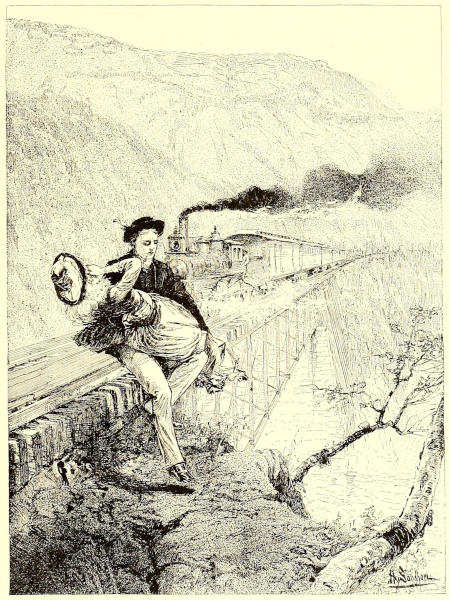
“THE TRAIN, TOO, WAS ON THE BRIDGE.”
Lou felt as if she were in a nightmare. She tried to move, but was as motionless as if she were lashed to the bridge. As if in a bewildering dream, she faintly caught the sound of her companions’ cries of terror and warning; in a bewildering dream, she heard two shrill notes echoing and re-echoing from the mountains far and near, and knew it was the agonized shriek of the great, laboring locomotive, powerless to prevent what the rocks below were waiting for. She had read in books of people who, in extreme peril, saw the details of their past life like a flash; with the wet iron rails quivering and twanging more and more loudly under her hands, she knew what it meant. But even while the last accents of the whistle were sobbing themselves away in the distance, there came a sound of footsteps, light and swift. Two strong arms seized the girl about the waist, and, still, as if in a strange dream, she knew it was the languid, delicate Fred who was running with her in his arms along that fearful height.
A few moments later, a hollow roar and tremulous movement under his feet told that the train, too, was on the bridge.
When Fred leaped from the track, upon the farther side, the locomotive was not forty feet behind them. The engineer’s pale face stared at them an instant from the cab; then the train, with groaning brakes, smoking axles, and a shower of cinders, thundered past and was gone. Not one of the passengers knew of the escape, or even of the danger.
It was afterward learned, however, that the appliances of the air-brake on the engine would not work that day, and the train, with its tremendous acquired momentum, ran to Bemis station, nine miles below, before it could be brought to a standstill.
With half-closed eyes, Lou lay helplessly on the mossy plot where Fred had placed her, and, in the slow waking from her dream, she watched him as he went to and fro, at first beckoning and making motions for the rest to join him by crossing the bed of the brook, and then confining his attention entirely to her.
His face was almost as white as her own, as he approached, but she gave him a smile and a grateful look that seemed to reassure him; and, after seeing that her position was as comfortable as circumstances would permit, he took off his thick jacket and laid it over her, in spite of a feeble protest,—for the September morning was still cool, and the wind whistled sharply through the ravine.
Next, Fred busied himself in gathering sticks, and, wet as they were, he succeeded, with the aid of several matches, in coaxing a blaze out of them, almost at her feet. By the time the rest of the company came panting up the steep slope, she had so far recovered as to sit up and hold out her cold hands to the cheery little fire which crackled and snapped merrily against a big bowlder.
Many were the clumsy inquiries of the boys, and the caresses of the girls as they came upon her sitting there, with Fred standing silently at one side—no longer jacketless, for she had pleaded so hard that he had put it on again.
There was some discussion as to what action should now be taken, some favoring a slow return to Crawford’s by the road, some by the track, and some, a short walk further down the valley to the Willey House, where they could obtain rest and refreshment. After many sober arguments, quite different from the eager propositions in the parlor that morning, they decided to return at once to the hotel, and not by the track.
It was a very silent and nervous little group of young people that made its way down to the wagon road at the bottom of the valley. Fred had been nearly exhausted, after all, by his efforts, and Lou was so prostrated that they feared she could not get home at all. But the spirits and strength of the young are elastic, and by the time they repassed the Notch, one would hardly know, to look at them, that anything unusual had happened. It was agreed that all should say as little about the affair as possible. Accordingly, nearly all the party were in the parlor that night, dancing, chatting, and laughing as usual.
For the next few days, it was observed that Fred Seacomb did not play tennis, and that Lou Elwin never again chid him for his mild ways and moderate excursions. Report says that she told him, in her own frank way, that she was ashamed of her former treatment of him; at any rate, she will not hear a word said against him, among her friends; and not once since that day has she been known to accuse him of unmanliness.