A ROYAL FISH.
Reading edition
By Ripley Hitchcock.
When the Hudson River was first seen by St. Nicholas, or rather by his image, which was the figure-head of the Dutch ship Goode Vrouw, there were more salmon in the water than there were wild grapes about the Indian wigwams which stood where New York City stands to-day. That was a few years after the rediscovery of the river by Henry Hudson in 1609.[2] But, in course of time, the salmon went the way of the Indians. The last native Hudson River salmon was caught in a net in New York bay about 1844; but, more recently, attempts have been made artificially to stock that river and others with this fish, and within two years a few have been caught, the only salmon taken from the Hudson in forty years.[3] When St. Nicholas made his first visit to our shores, there were salmon in every river along the Atlantic coast, north of the Delaware. But, as fishermen became numerous, as dams were built across the rivers, and as the water was made impure by town and city drainage, the salmon were driven northward, just as the Indians were driven westward. The salmon were forced to leave the Connecticut—another river into which there has been hope of introducing them again; they left the Merrimac when it was given over to manufactories; and now few salmon are to be found south of the rivers of eastern Maine. Beyond, they visit the rivers of the British Provinces, Labrador, the Hudson Bay country, and even Greenland,—for one variety of salmon is a fearless Arctic explorer, and penetrates the Arctic Circle. The salmon is as much at home in Iceland and Norway as in England, Scotland, and Ireland. On the north-western American coast, from northern California, Oregon, and Washington, to Alaska and beyond, there have always been vast numbers of this wonderful fish.
I say wonderful, because the salmon is the king of all game fishes, and because he goes under so many names, and has habits so curious that he has puzzled naturalists for hundreds of years. And his pink flesh is so prized that the salmon fisheries on this continent alone yield millions of dollars every year.

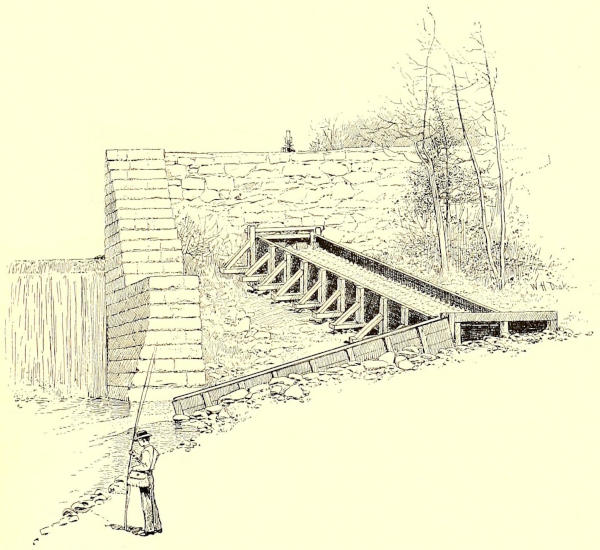
The gamy qualities of the salmon, which cause the fly-fisherman to rate him above all other fishes, are his enduring strength and his great activity. The salmon and the blue-fish are the strongest game fishes known, and the former reaches a far larger size than the latter. According to one writer, “the salmon and the sword-fish are the fastest swimmers of all the forked-tail fishes.” Only a fast running-horse could outstrip a salmon; for it is estimated that the salmon swims a mile in less than two minutes. But the horse would be left behind in a long race, for the fish can cover thirty miles in an hour. When leisurely ascending rivers, with frequent rests in attractive pools, the salmon averages from fifteen to twenty-five miles a day. In leaping, the salmon can easily beat the horse, for salmon have leaped up waterfalls twelve feet high. It was formerly supposed that the salmon, when about to jump, bent himself double, and took his tail in his mouth, so that he was like an elastic bow drawn tight. Then it was thought that he suddenly let go, his tail striking the water with great force, and away he went through the air. But now we know that the salmon prepares for a leap just as a boy does, with a short, sharp run. If the water at the foot of the dam or fall is not deep enough to allow this preparatory run, the salmon can not jump. If there is water enough, he starts from the bottom, his powerful tail working as rapidly as the propeller-screw of a steamship. Aided by the pectoral fins, the upward movement grows quicker and quicker, until with a last muscular effort the salmon shoots from the water, his tail still vibrating for an instant, then becoming motionless, as the fish curves through the air and comes down above the obstacle. If a dam be built so high as to be impassable, the salmon will leave the river altogether, for instinct always leads them to the head-waters, where they lay their eggs. So fish-ladders and fish-ways of various kinds have been invented to help salmon and other fishes to surmount natural or artificial barriers. Fish-ladders have been constructed by the aid of which salmon ascend falls over thirty feet high. As soon as salmon enter rivers on their way from the sea they begin to jump, like a crowd of boys just let out of school. Standing on the shore of a salmon river in June or July, you will every now and then see the fish leap four or five feet out of water, glistening like polished silver, then curving over and falling with a heavy splash. Or sometimes their back fins will roll lazily out of the water, and you will be reminded of a school of porpoises. But there is nothing lazy about the salmon when once he is hooked. If there is a twenty-five pound salmon at the end of your line, jumping nearly as high as your head in his struggles to rid himself of the hook, you will be sure to think of nothing except that fish.
SALMON FLIES.
But before the salmon reaches a weight of twenty-five pounds, he appears in so many and so different forms that very wise men have been unable to recognize him. When the salmon is just hatched, he is known as fry, or fingerling. Then he becomes a parr, or samlet, also called pink, or brandling, on some foreign rivers. The parr changes to a smolt, the smolt to a grilse, and the grilse finally develops into the salmon. The latter, when running fresh from the sea, are called white salmon, and when they are descending rivers after spawning, they are termed kelts, or black salmon. Other names given to salmon after spawning-time are kippers and baggits, or shedders. So the salmon, like the royal fish that he is, has as many names as a prince of one of the royal families of Europe. The alevin, or baby salmon, is hatched in from thirty to one hundred days after the eggs are laid in furrows in gravelly beds which are scooped out by the parent fish, near the head-waters of cold, clear rivers. Presently the alevin grows into the fry, or pink, which is an absurd little fish about an inch long, goggle-eyed, and with dark bars on its sides. When some three months old, the fry makes a change like that of a chrysalis into a butterfly. It becomes a shapely little fish with a forked tail, and brilliant carmine spots shine out on its sides. Its back is of a dark slaty color, and the bars are less strongly marked as the parr grows older. The greediest of trout is not more hungry and active. I have often seen a dozen tiny parr jump from the water at my flies. Once, when coming down the Restigouche in a canoe, with our rods laid aside, and the flies dangling just over the water, two parr leaped together and hooked themselves, although they were hardly four inches long. These pretty little fishes, which one might readily mistake for trout, were once supposed to belong to a species entirely distinct from the salmon. Naturalists were also puzzled by finding that some parr remain for nearly three years in fresh water. So they concluded that these latter parr never went to sea at all, and considered them a species by themselves, which they called Salmo samulus. But nature was finally seen to be wiser than the naturalists. Nature has decreed that only half the parr hatched in a given winter shall go down to the sea at one time, and in this way protects the race from the chance of wholesale destruction. So we are now told that some of the parr develop more rapidly than others, and migrate to the sea in their second spring, while others remain in the river a year longer, and some for still another year.
A FISH-LADDER AROUND A DAM.
When the time for this migration approaches, the parr, which has been steadily growing plumper, undergoes another curious change. The carmine spots fade out, and the soft skin becomes covered with silvery scales which obscure the dark bars on the sides, although the scales can easily be rubbed away. At this period the young salmon is called a smolt, and the smolt was also a riddle to wise men, for a long time. It was thought that smolts which went down to the sea weighing three or four ounces, returned to the rivers in three months weighing six or eight pounds. Of course, such a gain as this was a very wonderful, indeed an unequaled performance, like the “swellin’ wisibly” of the Fat Boy in the “Pickwick Papers.” It is now believed, however, that the smolt requires a year or fifteen months at sea for this great gain in weight. Then he returns to his native river, no longer an insignificant smolt, but a vigorous, beautiful grilse. The grilse is more slender than the salmon, the tail more forked, the scales more easily removed, and the top of the head and of the fins is not quite so black. But the grilse’s sheeny, satiny sides are even more brilliant than the salmon’s, and it is more playful and active, although its strength is less enduring. After the grilse has frolicked its way to the head of the river and spawned, it returns to the sea. When it visits the river again, the next year, it has become a full-grown salmon. These are the successive stages of the salmon’s life.
But, even in the last and most familiar stage, the salmon’s habits are not fully understood. It is known that both young and old salmon, after descending a river, remain for a time in the brackish water at the river’s mouth, where they get rid of fresh-water parasites which have become attached to their sides, and where their scales are hardened by a diet of small fish; but where in the sea salmon go, no one knows. After leaving the coast, they disappear. They have been found in very deep water hundreds of miles from any salmon river; but their marine feeding-grounds are still undiscovered. In the spring they suddenly re-appear at the mouths of rivers, where they linger to free themselves from marine parasites. While in salt water, they will never jump at a fly; but as soon as they enter the fresh water of the Canadian rivers, in June, the waiting Indians and fishermen see them rising freely out of the water. Yet much of this leaping is plainly only for sport, and many people claim that salmon actually eat nothing at all during the time that they are going up rivers. These rivers offer a succession of pools and rapids. In almost every pool, during the day-time in summer, there are salmon resting from the labor of stemming the current. It is said that at night they are often to be found on the bars in the shallow rapids above the pools. If the water is low they ascend very slowly, but any rise in the river stimulates them into a rapid movement upward. When they descend rivers, they fall back much of the way tail foremost, although the distance may be over a hundred miles. Even a salmon can be drowned in swiftly running water. Often they make short runs down river, but they quickly wheel about and usually lie with their heads to the current. When they are descending, they are thin and ravenous; but they rapidly gain in plumpness after reaching the sea. In weight the salmon of the Canadian rivers average between twenty and twenty-five pounds. I suppose a season’s catch would hardly average more than twenty pounds, for it would include many grilse of from eight to ten pounds weight, and salmon weighing only five or six pounds more. A thirty-pound salmon is very large, and a forty-pound fish will be talked of throughout the season, although it is said that salmon weighing fifty pounds have been caught in the Restigouche,—one, indeed, was said to weigh fifty-four pounds. The Princess Louise, the daughter of the Queen of England and the wife of the Marquis of Lorne, the former Governor-general of Canada, caught a forty-pound salmon in the Causapscal river, in the province of Quebec, a few years ago. Last summer I employed one of the two canoe-men who were with the Princess at the time, and he had a great deal to say about her skill in handling that salmon. I don’t think he cared much about other members of the royal family, but “The Princess, sir, she was a good un with the rod.” Salmon weighing sixty pounds are taken now and then in Scotch rivers, and a few rivers in England still yield large fish. Sir John Hawkins speaks of a salmon caught in an English river in April, 1789, which was four feet long, three feet around the body, and weighed seventy pounds. There is a story told of a Highlander who hooked a salmon in the River Awe, and played the fish for hours, until night came on without his being able to tire it out. Then, as the fish was sulking quietly at the bottom, he lay down, took the line in his teeth, that any motion might waken him, and went to sleep. The Highlander slept and the salmon sulked until three o’clock in the morning, when some friends of the former came to look for him. With their help he managed to land the fish about daybreak, and it weighed seventy-three pounds. That was certainly a giant, but a salmon weighing eighty-three pounds is reported once to have been sent to the London market. It would be a serious matter for any of St. Nicholas’s readers to make fast to a salmon as large as that. But it will not happen on this side of the ocean.
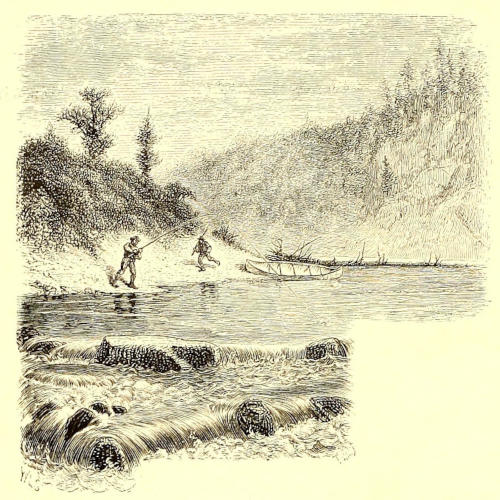
A SALMON POOL.
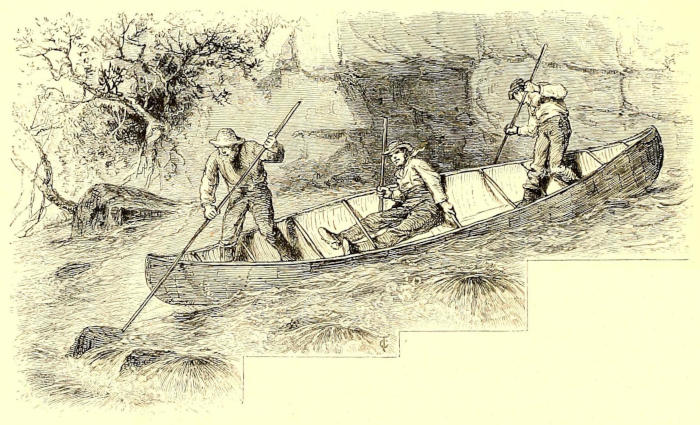
SHOOTING THE RAPIDS.
There is only one way in which a true sports-man will catch a salmon, and that is by fly-fishing. But there are a great many other ways, some of which, although unfair, are rather curious. Salmon have been caught with an ax, with a pitchfork, with a wheel, with many forms of nets and spears, by trolling, and by still-bait fishing. Captain Charles Kendall, an old Boston sailor, used to say that he once explored a Canadian salmon river nearly to its head and met a multitude of salmon coming down in water so shallow that their backs were exposed, and he killed scores with an ax, as they tried to rush between his legs. The poor fishes were also attacked by birds of prey. This is the only instance recorded of killing salmon with an ax, but when I visited the valley of the Puyallup River, in Washington Territory, three years ago, I was assured that salmon sometimes crowded that shallow stream so thickly that farmers lifted them out with pitchforks and used them as fertilizers on the field. These, however, were an inferior kind of salmon. One of the most cruel and destructive methods of catching salmon was by water-wheels, at the cascades of the Columbia River. In former times, the Indians gathered at the cascades at certain seasons, picketed their ponies, built wigwams, and remained for days, and often weeks, spearing and netting the ascending salmon all along the shores. But white men found a way of destroying a far larger number of these noble fish. Salmon when coming up the rapids swim near shore. Wheels were built, and suspended partly in the water so that the paddles were rapidly turned by the swift current. The salmon swimming against these paddles were struck with great force, lifted clear of the water, and thrown into tanks arranged near by. The murderous wheels kept on revolving, throwing up every fish within reach, and there was nothing for the owners to do but to gather the quantities of salmon out of the tanks and use them in their salmon-canning establishment. It is not strange that a strong popular feeling soon grew up against this wholesale slaughter.
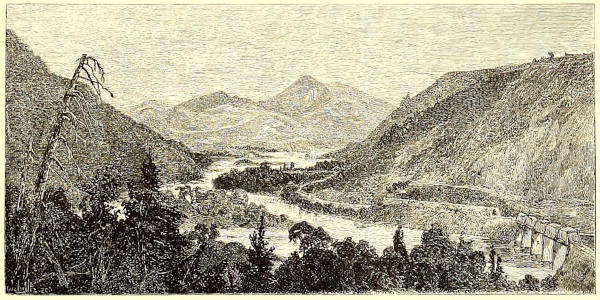
JUNCTION OF THE METAPEDIA AND RESTIGOUCHE RIVERS,—A FAMOUS SALMON POOL.
At the mouth of the same river, the Columbia, net-fishing for salmon is carried on in a larger way than anywhere else on this continent. In the fisheries and canneries nearly seven thousand men are employed—Swedes, Russians, Norwegians, Finns, Italians, Portuguese, Greeks, and Chinamen, a curious mingling of races. Much of this net-fishing is done at night, the sail boats starting from Astoria toward evening and returning in the morning. Sometimes the capsized boats drift ashore alone, for the breakers where the currents of river and ocean meet frequently swamp them, and each season many men are drowned. Between three and four million dollars’ worth of salmon have been sent from the Columbia in a year. In the North-east a great many salmon are caught in nets at the mouths of the St. Lawrence and other Canadian rivers, many more indeed than anglers would allow if they could control the net-fishing. Most of these salmon are artificially frozen and sent to our Eastern markets, where they now have to compete with Oregon salmon. Spearing salmon is very properly forbidden by law in Canada. I have read an account of an odd method of harpooning salmon, which was practiced on a river in the Inverness district in Scotland. At one spot the river falls in a cascade through a narrow cleft in the rocks. Sitting beside this, the fisherman, who had a line attached to his spear, struck a salmon as it tried to leap up, let go his spear, keeping hold of the line, and then, climbing down to the pool below, drew in the exhausted fish at his leisure. This reminded me of an Indian on the Restigouche, who, I was told, used to throw his short spruce pole into the water after hooking a salmon, and paddle after it in his canoe, until the fish was so wearied by dragging the pole about, that the fisherman could easily land it. Still more curious is Sir Walter Scott’s account in his novel, “Red Gauntlet,” of salmon-spearing on the Solway Frith, an arm of the sea between England and Scotland. He describes a company of horsemen riding over the sands and striking with their spears at the salmon which darted about in the pools, where they had been left by the ebbing tide. This kind of salmon-fishing on horseback must have been very like “pig-sticking” in India.
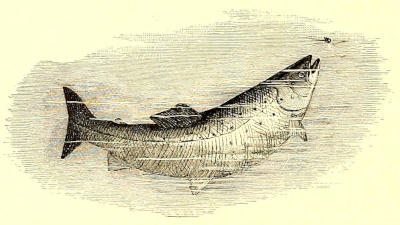
A SALMON RISING TO THE FLY.
On this side of the ocean, trolling for salmon is unknown; there is very little, if any, bait-fishing, and a salmon-spear, in the North-east at least, is only to be found in the hands of a red or white poacher. Poaching on Canadian rivers has diminished, but the law is still broken on the sly; and many odd stories are told of poachers’ tricks. Nearly all these rivers are watched by two sets of wardens. There are the Government wardens appointed to prevent illegal fishing with nets or spears, or out of season, and there are wardens employed by private persons to watch the water which they lease; for every pool in a salmon river is valuable property. Once the Government claimed the fishing privileges, but it was decided that the owners of lands along the rivers controlled the water; and now the farmer’s income from his water is sometimes larger than that from his land; and the limits of each ownership are as carefully marked off as are limits of farms or of town lots. The unlawful act which the wardens most carefully guard against is “drifting.” One or two poachers will steal out at night carrying a peculiarly made net in their canoes. They stretch this across the head of a pool; and it is so weighted and buoyed that it stands upright, reaching nearly to the bottom. As the current causes the net to drift down stream, one canoe stays at each end to keep it straight. There is usually a white rope at the bottom of the net. Seeing this, the salmon raise themselves a little, only to be caught by the gills in the meshes. When the shaking of the net shows that one is caught, the poacher quickly paddles to the spot, raises the net, kills the fish with a blow on its head, and throws it into the canoe. In this sneaking way, nearly all the salmon in a pool may be netted out in a night. If the wardens happen to come along in their dug-outs, they try to seize the net and identify the poachers. Then there may be a fight, and perhaps a canoe will be sunk, and a poacher or a warden will get a cold bath. On one river, the poachers used to station a boy on an island below them, with a horn which he blew whenever the wardens approached. One of the latter was so active that the poachers resolved to punish him. They took an old worthless net and stretched it out into the river from a rock on the bank. A rope was rove through the net and the shore end made fast over a pulley to the traces of a horse. A boy stood beside the horse, and two poachers in a canoe held the outer end of the net. Down came the warden, poling along in his dug-out, and pulled the end of the net away from the seemingly unwilling poachers. He began taking it into his dug-out, congratulating himself on his prize, and had hauled it halfway in, when the boy on shore struck the horse, which started on a full gallop up the bank, jerking the net after it. In a flash the net was pulled out of the dug-out, the latter upset, and the astonished warden pitched into the river. But I hope the poachers were punished in their turn. For if these lawless men had their way, there would be no salmon left in the rivers, and no such glorious sport as fly-fishing.
It is for this that hundreds of Americans go away down East every summer. At the junction of the Metapedia and Restigouche rivers are the comfortable buildings of the Restigouche Salmon Club, which is composed of New York gentlemen. In front of the club-house is the finest pool on the river, and the club owns land and water for some miles above. Below, several pools are leased by a small American club, and Americans pay thousands of dollars for fishing privileges on rivers all the way from Nova Scotia to Labrador. Some of my boy readers may have accompanied their fathers or big brothers to Canadian salmon rivers, and themselves landed salmon. If not, I hope they may do so soon.
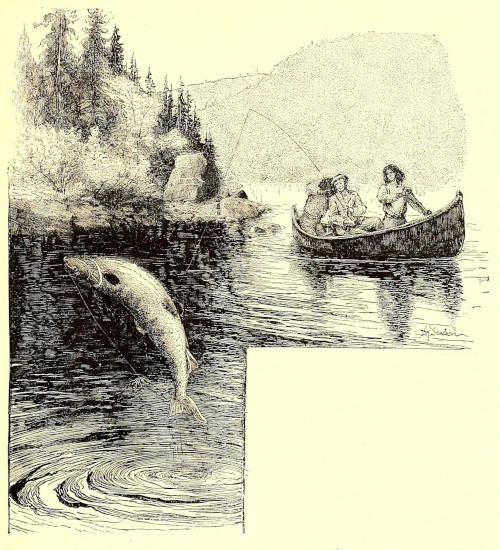
“RIGHT BEFORE YOUR EYES, THE GREAT FISH LEAPS FOUR FEET FROM THE WATER.”
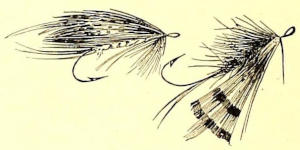
For this fishing, a boy should use a rod not over sixteen feet long, and weighing about twenty-seven ounces. Split bamboo is the finest material, but satisfactory rods are made of ash and lancewood or greenheart. The heavy reel holds a hundred or a hundred and fifty yards of braided silk line. Usually a gut leader, also called a casting-line, which is about nine feet long, is fastened directly to the silk line. Only one of the large gaudy salmon flies is used on the leader at one time. Suppose yourself thus equipped, sitting in the middle of a cranky birch-bark canoe, on the Restigouche, with an Indian at the bow and another at the stern, paddling to the head of a salmon pool, as the morning mists rise from the mountains. Just below the rapids, the Indians turn the canoe into midstream and drop the anchor, which clinks musically upon the stones of the bottom. You take up the rod, which will seem awkward if you have been using a seven or eight ounce trout-rod, and holding it in both hands, one above and one below the reel, begin to make short casts in front and on either side. It is always well to whip the water near the canoe, for there is no telling where a salmon may be. Once I looked down over the side of my canoe into the very eyes of a large salmon. He lay at the bottom, looking up at me for a moment, then flirted his tail scornfully and disappeared. I should like to have seen more of him. You will lengthen out the line a few feet at a time, as you continue casting, and you will always keep the point of your rod moving a little up and down, so that your fly shall be in motion in the water. Possibly the longed-for salmon will jump out of water at the fly. If so, he will probably miss it. More likely, you will suddenly see a mighty swirl in the water, catch a glimpse of a head, perhaps, and feel a tug—at least you are likely to, if you “strike” when you see the swirl.
Then all in the same instant the reel begins to scream and your heart to beat like a trip-hammer. Up comes the anchor, the Indians paddle over to one side of the river, and you manfully keep the rod pointing upward, clutching it with your left hand above the reel, the end of the butt pressed against your waistcoat buttons, and your right hand ready to reel in line if the fish comes toward you or sulks at the bottom.
All at once something happens which takes away your breath. Right before your eyes the great fish leaps four feet from the water, his writhing body curved like a silver bow, and glistening in the sunlight until he falls back with a splash that almost makes your heart stop beating, for fear he has broken loose. But no! You instinctively lowered the tip of your rod when he jumped, and he did not fall upon a taut line, as he hoped, and break away. The reel screams again as the salmon darts off down river; and as the canoe-men paddle after, you think of the Indian who lassoed the locomotive. Perhaps he will rush through the lower rapids into the pool below. Never fear! He is well hooked, and the strain of the rod is telling. Backward and forward he darts, while the line cuts the water, now sulking quietly, again startling you by a wild leap. At last he begins to yield. The canoe-men paddle you to a beach where you cautiously step out, keeping your face to the foe. Slowly, carefully you reel in line, straining the fish toward you. The Indians wait with the gaff, a large steel hook in the end of a stout pole. Now the salmon makes a despairing run, then, growing weaker, he obeys your strain. You can see him plainly as he comes into shallow water. What if you should lose him now! The Indians, bent double, ankle-deep in water, watch his every motion. One strikes at him, but misses, and the gallant fish makes another fight for life. But now he is within reach. The gaff is raised carefully, you hold your breath, and this time the steel pierces that silvery side, and out of the foaming water the gaff draws a noble salmon, your first—and let me hope a forty-pounder. Perhaps twenty minutes have passed since you hooked him,—perhaps an hour; but you have lived an age.
May all the boy readers of St. Nicholas some time know such thrilling sport as this! And the girls, too, may emulate their brothers, and each some time land a salmon. At least they can have the sport without holding the rod. One of the prettiest sights which I saw on the Restigouche was the eager face of a little girl in a canoe, with her father, who was fighting a twenty-five-pound salmon. Looking at her parted lips and wide-open eyes, I felt sure that girls as well as boys could feel the fascination of that most exciting of all forms of angling, salmon-fishing.