Chapter XXI · WASHINGTON RESIGNS HIS COMMISSION.
Reading edition
After the surrender of Yorktown and the departure of the French, Washington established his headquarters at Newburgh on the Hudson. There he remained with the army until it was disbanded; and the house in which he lived is carefully preserved and shown as an historical museum.
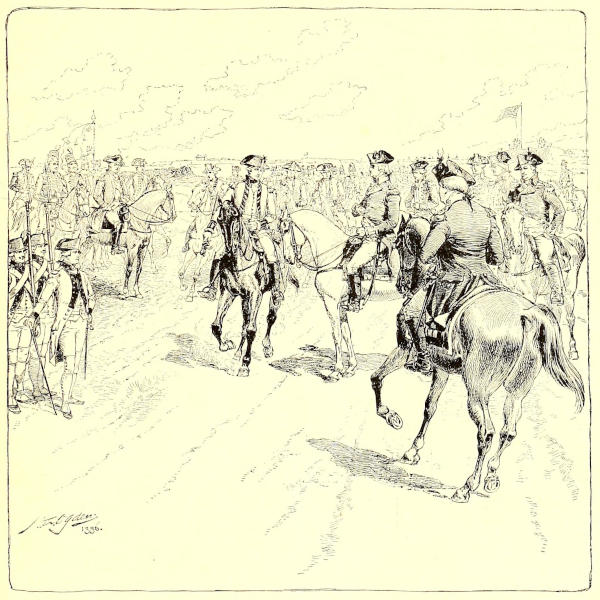
SURRENDER OF LORD CORNWALLIS.
There is a pleasant story of La Fayette’s affectionate remembrance of the life there. Just before his death, which occurred in 1834, he gave a dinner party in Paris to the American Minister and some friends who had been old associates. Later in the evening, when it came time for supper, the guests were ushered into a room which was in strange contrast with the elegance of the apartments they had been in. The ceiling was low, with large beams crossing it; there was a single small, uncurtained window, and several small doors. It looked more like an old-fashioned Dutch kitchen than a room in a French house. A long, rough table was meagerly set. A dish of meat stood on it, some uncouth-looking pastry, and wine in decanters and bottles, ready to be poured out into glasses and camp-mugs.
“Do you know where we are now?” asked La Fayette as his companions looked about puzzled, and as if in a dream. “Ah! the seven doors and one window! and the silver camp-goblets! We are at Washington’s headquarters on the Hudson, fifty years ago!” He had reproduced the room as a surprise to his friends.
Peace did not come at once after Yorktown; there was still fighting in a desultory way, but all knew that the end was not far off. Yet the soldiers could not go back to their homes, and Congress was shamefully remiss about paying them. Murmurs deep and loud arose, and Washington suffered keenly from the neglect shown to the army. It required all his patience and tact to keep the murmurs from breaking out into violent action. With no military duty to perform, and with the impatience of men who were suffering injustice, the officers and men began to form all sorts of plans.
One of the officers—and how many agreed with him is not known, but the sentiment easily took this form—one of the officers wrote to Washington that it was clear that Congress was a failure. The army had won independence, but no reliance could be placed on the Government. How much more stable was the Government of England! Would not such a government be after all the best for America? It might not be necessary to call the head of the government a king, though even that title many would prefer, but the head ought to have the power of a king. There was much more to the same effect, and the letter was really a feeler to see how Washington would look upon such a movement, which, of course, aimed to make him the monarch of the new nation. Washington did not hesitate a moment, but wrote a letter which must have made the officer’s ears tingle, however honest he may have been in his opinion. Washington said:
“With a mixture of great surprise and astonishment, I have read with attention the sentiments you have submitted to my perusal. Be assured, sir, no occurrence in the course of the war has given me more painful sensations than your information of there being such ideas existing in the army as you have expressed and I must view with abhorrence and reprehend with severity. For the present, the communication of them will rest in my own bosom, unless some further agitation of the matter shall make a disclosure necessary. I am much at a loss to conceive what part of my conduct could have given encouragement to an address, which, to me, seems big with the greatest mischief that can befall any country. If I am not deceived in the knowledge of myself, you could not have found a person to whom your schemes are more disagreeable. At the same time, in justice to my own feelings, I must add, that no man possesses a more sincere wish to see ample justice done to the army than I do; and as far as my powers and influence in a constitutional way extend, they shall be employed to the utmost of my abilities to effect it, should there be any occasion. Let me conjure you, then, if you have any regard for your country, concern for yourself or posterity, or respect for me, to banish these thoughts from your mind, and never communicate, as from yourself or any one else, a sentiment of the like nature.”
A graver peril arose, and Washington redeemed his promise to stand by the army. In spite of the united effort of the army and its friends in Congress, no satisfactory arrangement was made for paying the long-delayed wages due to the soldiers. On March 10, 1783, a notice was issued in the camp at Newburgh, calling a meeting of the officers. The notice was not signed by any name, and with it was sent out an address which rehearsed the wrongs suffered by the army and hinted that the time had come when the soldiers must take matters into their own hands and compel Congress to attend to their demands. It was an appeal to which the officers were ready to listen, and every one was in so excited a condition that it was impossible to say what might not be done.
Washington, at any rate, saw there was great danger, and he at once seized the occasion. He issued an order calling attention to the address, and asking that the meeting should be postponed four days and then should convene at his invitation. This was to give the men time to cool off. When the day came, Washington, as soon as the meeting was called to order, made a long and powerful speech. He was not a ready speaker, and so, feeling the importance of the occasion, he had written out what he had to say, and he began to read it to the officers. He had read only a sentence, when he stopped, took out his spectacles, and said, as he put them on:
“Gentlemen, you will pardon me for putting on my glasses. I have grown gray in your service, and I now find myself growing blind.”
It was a simple thing to say, and simply said, but it touched the soldiers, and made them very tender to their commander, and more ready even than before to listen to his counsel. Washington went on to say:
“If my conduct heretofore has not evinced to you that I have been a faithful friend to the army, my declaration of it at this time would be equally unavailing and improper. But, as I was among the first who embarked in the cause of our common country; as I have never left your side one moment, save when called from you on public duty; as I have been the constant companion and witness of your distresses, and not among the last to feel and acknowledge your merits; as I have considered my own military reputation as inseparably connected with that of the army; as my heart has ever expanded with joy, when I have heard its praises, and my indignation has arisen, when the mouth of detraction has been opened against it; it can scarcely be supposed, at this late stage of the war, that I am indifferent to its interests.”
He used all his personal influence to heal the breach between the army and Congress, and he brought the officers back to a more reasonable mind. All the while he was writing to members of Congress and doing his utmost to bring about a just treatment of the army.
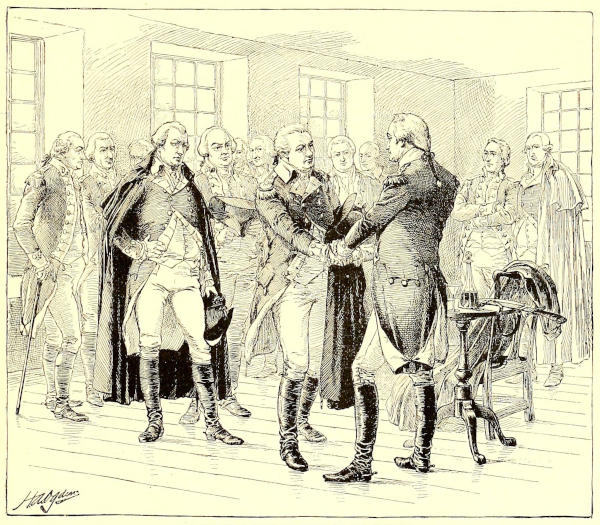
WASHINGTON BIDDING FAREWELL TO HIS GENERALS.
When the time came to disband the army, Washington, ready as he was to go back to his home, could not forget that the work of the past seven years would not be completed until the people which had become independent was united under a strong government. He was the foremost man in the country; he was also profoundly aware of the difficulties through which they were yet to pass, and he addressed a long letter to the governors of the several States. Congress was weak and unable to take the lead. The States were each provided with governments, and were the real powers, but Washington saw clearly that it would not do to have thirteen independent governments in the country, each looking only after its own interests. So in this letter he tried to show the States the importance of four things:
1. An indissoluble union of the States under one head.
2. The payment of all the debts contracted by the country in the war.
3. The establishment of a uniform militia system throughout the country.—He did not advise having a standing army, but he thought all the men should be drilled in their neighborhoods, formed into companies, and be ready in any peril to take up arms again.
4. The cultivation of a spirit of confidence between different parts of the country. He had seen so much jealousy and prejudice that he knew how dangerous these were to the peace of the country.
At last the time came when the army was disbanded. A few of the troops only and their officers went with Washington to New York when the British left the city. There was rejoicing everywhere; but it was a sorrowful moment when Washington took leave in person of the officers who had stood by him through the long, dreary years of the war. He was about to leave the city to be ferried across the North River to the Jersey shore, and his old friends gathered to say good-bye at Fraunces’ Tavern, in Broad street. When he entered the room he could scarcely command his voice. He said a word or two, and they all drank a farewell toast, as the custom was in those days. Then Washington said: “I can not come to each of you to take my leave, but shall be obliged if each of you will come and take me by the hand.”
General Knox stood nearest, and he held out his hand. The tears were in Washington’s eyes as he turned to his old comrade and grasped his hand. He drew the strong man to him—Knox was nearly twenty years younger than Washington, and very dear to him—and kissed him. Not a word could either of them speak. Another general followed and another, each greeted with the same affection; and then Washington left the room, passed through the corps of infantry which stood on guard, and walked to Whitehall, followed by the whole company, a silent procession. He entered the barge, turned as the boat pushed off, and waved his hat in silent adieu. The officers returned the salute in the same way, and then turned and in silence marched back to Fraunces’.
Washington went to Philadelphia. Congress was in session at Annapolis, but the Treasury was in Philadelphia. On receiving his commission as Commander-in-Chief, Washington had announced that he would receive no money for services, but would keep an exact account of all his expenses. That account he had kept as carefully and scrupulously as any book-keeper in a bank, and he now rendered it to the Comptroller of the Treasury. It was in his own handwriting, every item set down and explained. I know of few incidents in Washington’s career which show the character of the man better than this. He held that a sacred trust had been reposed in him, and he meant to be faithful in the least particular.
On December 23, 1783, Congress was assembled at Annapolis. The gallery was filled with ladies. The Governor, Council, and Legislature of Maryland, several officers, and the Consul-General of France were on the floor. The Members of Congress were seated and wore their hats to signify that they represented the Government. The spectators stood with bare heads. General Washington entered and was conducted by the Secretary of Congress to a seat. When all was quiet, General Mifflin, who was then President of Congress, turned to Washington and said:
“The United States, in Congress assembled, is prepared to receive the communications of the Commander-in-Chief.”
Washington rose and read a short address, in which he resigned his commission. He delivered the paper into the hands of the President, who replied with a little speech; and Washington was now a private citizen. The next day he left Annapolis, and made all haste to return to his beloved Mount Vernon.
(To be continued.)