THE GIRAFFE.
Reading edition
Many years ago, a young Italian lad named Gordian, who had been proclaimed, when but fifteen years old, Emperor of Rome, gave the people of his native city a splendid entertainment or “triumph.” And among the many strange and terrible beasts that passed in procession around his amphitheater, were ten curious animals—long-necked, long-legged, and small-headed, with tufted tails and queer little horns. They were of a tawny orange color, beautifully spotted and marked. They were driven around the arena in gilded chariots by their Ethiopian drivers, and were such an odd combination of the body of a camel and the spots of a leopard that the people, who gazed upon them in wonder and surprise, gave to the strange beasts the name of “Camelopardus,” or camel-leopard.
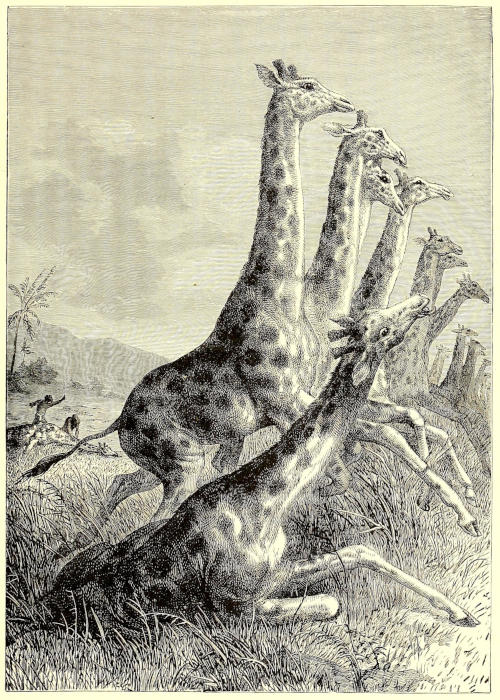
A HERD OF GIRAFFES.
This singular animal, however, had long been known to the Arabians, under the name of “Xirapha,” or “the long-necked.” And from this title comes our word “giraffe,” the popular name now given to the odd-looking beast that the boy-emperor exhibited in his circus sixteen centuries ago.
It is indeed a curious animal. Its chief characteristics are its length of neck and its high fore-quarters. The head is sometimes seventeen feet from the ground, and specimens have been found measuring over twenty feet from hoof to nose. The apparent height of the fore-quarters is not due, as is supposed, to a greater length of the fore-legs, but to the extraordinary height of the withers or shoulder-bones. The tongue of the giraffe is long and prehensile—that is, it is adapted to seize and entwine; it can be tapered so small as to enter the ring of a small key. This long neck and prehensile tongue, which are found in no other animal, enable this giant browser to feed with ease upon the foliage and tender branches of trees.
The eyes of the giraffe are very large, soft, and beautiful, and one would suppose that their mild, imploring expression would restrain the hunters from shooting down so attractive-looking and inoffensive a creature. But the same willful and cruel desire for what is wrongly called “sport,” that has exterminated the buffalo of our Western plains, is killing off the giraffe of Africa. Its strong-tasting flesh is not enjoyable eating, and its hide is of little use; its capture alive is of no value to man, save as a gratification of curiosity; it can not, like the camel, be used as a beast of burden; nor does it, like the ostrich or the elephant, provide either feather or ivory for commerce. In fact, this curious animal is of no practical use to man, and should be left free to roam the plains and forests of its African home, unmolested and unharmed, save for the occasional capture of such living specimens as may help boys and girls to study and admire one of the most singular and graceful of the creatures of the earth.