THE LETTER-BOX.
Reading edition
Contributors are respectfully informed that, between the 1st of June and the 15th of September, manuscripts can not conveniently be examined at the office of St. Nicholas. Consequently, those who desire to favor the magazine with contributions will please postpone sending their MSS. until after the last-named date.
The explanation of “curving” in base-ball pitching has been discussed at length in this volume of St. Nicholas, and we now present to our older boy-readers, as a final contribution on the subject, these three letters from three widely separated localities. The first comes from the far West:
Pinole, Cal., 1886.
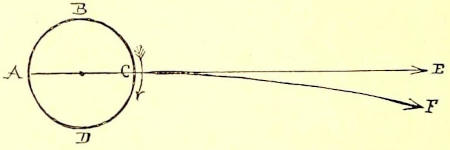
Dear St. Nicholas: The explanation of “curving” suggested in your April number is ingenious, but unfortunately it makes the ball curve the wrong way. The anonymous explanation in February has the same defect, though it narrowly misses being correct. I ask your readers to look over that explanation again, and they will see that the ball, under the extraordinary conditions imposed upon it, instead of “curving,” as the writer says, to the right, will not advance at all, but will revolve around the point D to the left.
There can be no doubt about the possibility of “curving” a base-ball. The subject is an old one in gunnery, and has been thoroughly investigated by various experimenters. When spherical projectiles were the only ones in vogue, the matter was one of vital interest to artillerists. When such a ball is thrown, it is acted upon by two forces—the resistance of the air and the force of gravity. The normal path for a given velocity and angle of projection is a plane curve, because both these forces act in the vertical plane of fire—the force of gravity vertically and the resistance of the air tangentially to the curve. When, in addition to the motion of translation, the ball is given a motion of rotation about its center of inertia, the latter will no longer describe the normal path, but will deviate from it by “curving” to the right or left, up or down, depending upon the direction of the rotation. This is because the resultant of the air-resistances will no longer act in the line of the tangent in the general case, but at an angle with it. The general effect will be an increase or diminution of the normal range or deviation to the right or left of the plane of fire.
Now, it is almost impossible to project a spherical ball from a smooth-bore gun without giving it a rotation the direction of which it is difficult to predict; hence the inaccuracy of that kind of fire. Spherical balls are not homogeneous, as a rule. If the center of figure and center of inertia do not coincide, the ball will rotate when fired—unless so placed in the gun that these points are both in the axis of the piece. Taking advantage of these principles, Major Wade, of our army, years ago managed to make an eccentric shell curve so as to fall fifty yards to the right or left of the plane of fire. The “curving” due to rotation is in the direction in which the front of the ball rotates. Perhaps the explanation accepted by artillerists can be best understood by the aid of a figure. Let the ball be moving in the direction AE and be rotating at the same time in the direction BCD about an axis vertical to the plane of the paper. AE will be the projection of the plane of fire—which plane will divide the ball into two hemispheres. Now, the half of the ball on the side B will be moving forward by the rotation, or in the same direction as the center, while the other half D will be moving backward, or in opposition to the motion of the center. The side B will have a greater velocity than the side D. The resistance of the air upon any surface moving through it varies with the amount and form of the surface. In these regards, the two sides are alike, but the resistance also varies with the velocity of the moving surface, increasing with some power greater than the square, and in this regard the two sides are different. The side B will experience a greater resistance than the side D, or, what is the same thing, the resultant of all the pressures on all points of the hemisphere. B is greater than the corresponding resultant on D, and the ball will yield toward the side D, describing a curve C F.
The deviation of oblong rifle projectiles which rotate about their axes of figure is called “drift.” This is a very interesting phenomenon, but it should not be confounded with the “curving” or deviation by rotation of spherical projectiles, as it is to be explained very differently. Yours truly,
W. R. Quinan.
The next letter is sent from Chicago, and the writer’s theory is comparatively a simple one:
Chicago, 1886.
Dear St. Nicholas: I have been much interested in the letters on the subject of curve-pitching, and since I have taken you for eleven years, I hope you will publish my theory, that it may be picked to pieces, and I may be set right on the subject. My theory is as follows:
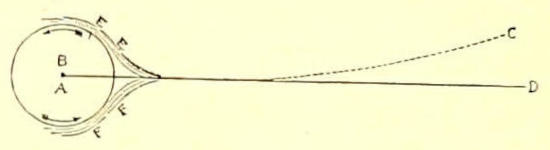
Let A B be a ball moving toward D, and rotating in the direction shown by the arrows.
As the ball flies along, it pushes the air aside, as shown by the lines F E; the air thus rubs against the sides of the ball. But as the half of the ball called B is revolving with the air as shown by the arrow, there is much less friction on that side than on the half called A, which is revolving against the air.
Therefore, as motion is always in the direction of least resistance, the ball must curve in the direction C.
If any of the readers of the St. Nicholas can not understand my explanation, let them imagine, for example (instead of a regular ball), a ball covered with paddles, and they will then readily understand it. If they think it not a good simile, let them look at the surface of a ball through a microscope and their doubts will not last long.
Your friend,
W. H.
Finally, from Boston, comes this rather formidable-looking explanation, which will interest those of our boy-readers who are accustomed to take their recreation and fun in the form of mathematical problems. [But doesn’t it make the ball curve in the wrong direction?]
Boston, Mass.
Dear St. Nicholas: Let the line A B, Fig. 1, represent in length and direction a given force acting on the point B. Draw any parallelogram, as A C B D, having A B for a diagonal; then the lines C B and D B represent in length and direction two forces acting on B, which, together, are equivalent to A B, A B is the resultant of C B and D B, C B and D B are components of A B.
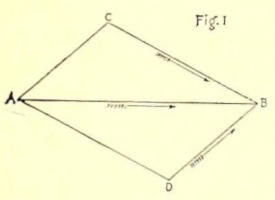
Fig. 1
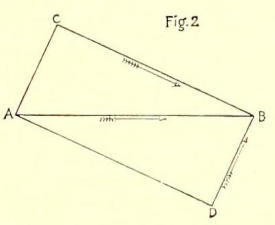
Fig. 2
If the parallelogram, A C B D, Fig. 2, is a rectangle, the components C B and D B are known as right components. The force represented by D B has no effect in the direction C B, and the force represented by C B has no effect in the direction D B.
Let Fig. 3 represent a ball revolving about its center O, in the direction indicated by the arrows, but the ball, as a whole, not moving in any direction. Let BB, BB, be lines at right angles to each other. Let the resistance of the atmosphere be represented by lines AB, AB, AB, AB, and AB′, AB′, AB′, AB′, running in a direction opposite to the revolution of the ball. The lines AB, AB, AB, AB are already perpendicular to BB, BB, and need not be changed. But the lines AB′, AB′, AB′, AB′ must be resolved into components perpendicular to BB, BB. This has been done in one case, the components being CB′ and DB′. But the force CB′ acting on the point B is equivalent to the force EF acting on BB, and the force DB is equivalent to the force GH acting on the other BB.
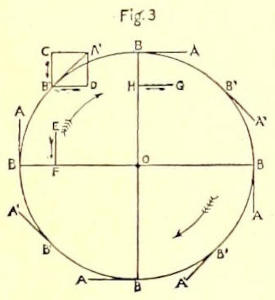
Fig. 3
In a similar manner all the other forces, A′B′ may be resolved into forces perpendicular to the lines BB, BB.
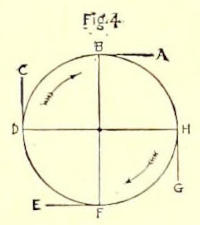
Fig. 4
If, in Fig. 3, all the forces acting on each of the lines OB, be represented by a single line, we have as the result the four equal lines AB, CD, EF, GH, Fig. 4 representing the total force acting on the ball.
Now, suppose the ball to move in the direction indicated by the large arrow, Fig. 5, then the resistance on the side B would increase, that on the side F would decrease, hence AB would increase, while EF decreased proportionately. Again, the air in front of the ball at H is condensed, that in the rear at D is rarefied, hence the resistance at H is increased, that at D being lessened, and GH is increased, while CD is lessened.
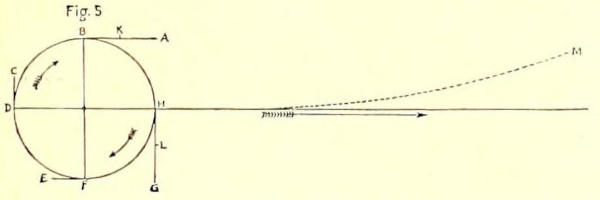
Fig. 5
Set off on AB, AK equal to EF; AK will balance EF, and we have only the force KB acting on the line BF. Making GL equal, CD, in the same manner, we have only the force LH acting the line HD.
Now, the force represented by the line BK can not do any work in the directions BF or FB, and therefore merely slows the ball. But the force LH, although it can not do any work in the directions HD or DH, can do work in the direction LH, and causes the ball to follow the curve HM.
Of course, all the forces, AB, CD, EF, GH, tend to stop the rotation of the ball, but the forces KB and LH are the only ones which change the motion of the ball as a whole.
F. H. C.
The following verses were written by a young poet of eleven, who began making rhymes at the rather early age of three.
Consolation.
By Ethel S. K. Packard.
The waves of the coming tide Crept gently along the beach, With musical, silv’ry plash, As if they broke into speech. And when my sweet joy was dead, The sound of the heaving sea, Like gentle breath of sleepers, Was a soothing balm to me.
Dear St. Nicholas: I suppose you know that many girls have a poor opinion of boys. Well, my sister and her girl-friends were going to have a fair in my mother’s parlors. I wanted to be in it, but they laughed, and asked me “if I could dress a doll, or make a needle-book?” While they were joking, Mamma whispered something in my ear, and we had a secret together, and we kept it till the night of the fair, and then we astonished my sister in this way. There is a long hall opening out of our back parlor. Mamma had it brightly lighted, that night, and about the middle of the evening Papa opened the door which led into the hall, and hung a large card over the door, on which was written: “Target-Shooting.”
I was in there with my new air-pistol, and the target was at the other end of the hall. I loaded the pistol, and another boy took the money. We charged two cents for a shot, and we had all we could do to load fast enough, so many people wanted to shoot. Some took ten shots. When I handed the money to my sister, she said I was “a daisy,”—I think I had the best of the joke that time,—don’t you?
Yours,
Jamie H.
Yes, Jamie,—but we think also that some of the credit belongs to Mamma. Don’t you?
A friend of St. Nicholas sends to the “Letter-box” this illustrated jingle:
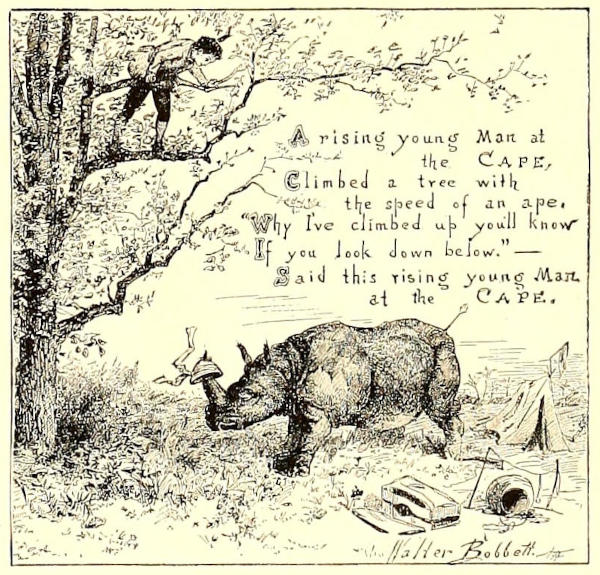
A rising young Man at the Cape, Climbed a tree with the speed of an ape. “Why I’ve climbed up you’ll know If you look down below.”— Said this rising young Man at the Cape.
The Children’s Ride.
Once there were two little girls. Their names were Rosy and Alice. They had a little brother whose name was Robbie. Once when they were in the woods they saw a creature with eyes of flame, whistling as it went through the air, and it said in a gruff voice, “I am a Jabberwock.”
“What kind of a creature under the sun are you?” said Robbie; “what flashing eyes you have! You look rather kind, though very frightful. Please take me up to the moon on your back and give me some cheese when you get there.”
Robbie had heard that there was cheese in the moon, but he did not really think so; only for a joke he said that.
“Oh! you soft little pussy thing!” said Rosy, as they rode away up to the moon. Pretty soon they went bump against something which was shiny and yellow. It was the moon. Then Jabberwock let the children get off her back, and asked the Man in the Moon if he would please get from his closet some cheese. “Why!” said Robbie, “I didn’t know there was really any cheese up in the moon!”
“Then,” said the Jabberwock, “why did you ask for it?”
“For a joke,” said Robbie.
“Well, here now,” said the Man in the Moon, “eat your cheese.”
“Why, how nice!” said Alice, as she took a large bite out of the cheese. “I think it would be nice to live up in the moon altogether, though I am afraid Mamma would not let us.”
“Well, I suppose she wouldn’t,” said the Jabberwock. After they had had some cheese they went down again.
“Oh, thank you,” said Rosy, as they got down to the earth. “Jabberwock, I think you are the loveliest creature in the world—except Mamma!”
“Oh,” said Alice, “I wish you would stay with us a few days—I suppose you will if we ask you to.”
“Yes,” said Jabberwock, “I would love to. Should you like to see my baby? It is a sweet little thing.”
She led them to a hole in a tree, where they saw the tiniest little baby Jabberwock you ever saw.
“What a cunning little thing!” said Rosy; “but has it not got any fur on?”
“No,” said Jabberwock; “but still it is pretty, is it not?”
“Of course it is,” said Rosy.
“But come,” said Alice, “this is the time Mamma wanted us to be home.”
“Is it?” said the Jabberwock. “Well, I will come.” So away they went.
Written by Mary Constance Du Bois (at the age of 5 years and 10 months).
We acknowledge with thanks the receipt of pleasant letters from the following young friends: Frank Taylor, Harry Armstrong, Katie P. Peabody, Alice Conway, Robert A. Provan, Fay Taylor, Pussy and Leuce, Josie Irwin, Agnes F. Conwell, W. H., Allmond McKay Griggs, Hugh P. Yiemann, Katie, Dorothea Nimzer, Anna Wetmore, Edith M., H. L. M., “Venus,” Celia Loeb, Francis E. L., Florence E. Gaffield, Marion S. Dumont, Lee A. Miller, M. C. H., Evelyn Knight, Pansy, Luckett & Miriam I., F. W. Horninghouse, Hattie Frost, Emily E. Warner, “Alice, Annie, Gracie, Florence, Jessie, Marion,” “Three Rebels,” K., H. S. M., Bessie Maud Bowsher, Jerry Richter, Walter S. H., Nettie Rychen, Allan C. Rowe, May Singleton, Philip A. M., William B. Judson, Minnie W., C. E. Lankford, Ida E., Annie B. Sargent, Nellie P. Clark, Alex. D., Helen W., J. Henry Warren, F. W. Lodge, Grace Coburn, Harriet F. Lightfoot, Edith S. Clark, Fred B. W., Sadie Furman, Ellen S. Congdon, Gertrude, Emily Belton, Grace Vandever, Helen Crane, Alex. Evans, Kate Morris, Belle B. Anderson, Mabel B., M. B. P., Mabel Carrington, Cora L. Witherspoon, Gertrude M., Eugene Kell, C. G. Elmore, Willie Pettigrew, Willie J. Spear, Jeannette G., Jessamine C., Albert L. Scoullar, Albertie Russell, George Emerson, Helen A. Polsley, Ed. H. B., Elizabeth Butler and Elizabeth Wright, P. N. S., Ethel Grey, Rebecca K. Allison, Burton P. Thoms, Amy H., Florence Rawson Greer, Stella A. Goodell, S. W. Bridgham, Jenny Wren, Anna L. L., R. E. B., Maude F. Helen, W. M., Mary Weller, Buddie Holt, Daisey Higham, Sadie, Lyra and Silvia, M. G. Waring, E. H. Smalley, Annetta Reese, Anna May Peaslee, Florence Langton, Bessie P., Howard Butcher, Jr.
Mr. Culmer Barnes contributes to the “Letter-box” this month a timely picture:
“JUST MY LUCK! LAST WINTER ’TWAS STRAW HATS ALL THE TIME, AND NOW I GET NOTHIN’ BUT FUR GOODS!”