THE RIDDLE-BOX.
Reading edition
ANSWERS TO PUZZLES IN THE JULY NUMBER.
Numerical Enigma. “Our country! In her intercourse with foreign nations, may she always be in the right; but our country, right or wrong.”
Stephen Decatur.
Cube. 1 to 2, mother; 2 to 6, repose; 5 to 6, needle; 1 to 5, Marion; 3 to 4, eating; 4 to 8, greedy; 7 to 8, nimbly; 3 to 7, ensign; 1 to 3, mite; 2 to 4, rung; 6 to 8, easy; 5 to 7, noon.
Anagrams. 1. Don Quixote. 2. Oliver Twist. 3. The Virginians. 4. Guy Mannering. 5. Old Curiosity Shop. 6. Uncle Tom’s Cabin. 7. The Woman in White. 8. The Last Days of Pompeii. 9. The Vicar of Wakefield. 10. Quentin Durward.
Pi. “Angling may be said to be so like the mathematics that it can never be fully learnt.”
Izaak Walton.
Metamorphoses. 1. Cow; row, rot, rat. 2. Hard; harm, farm, form, fort, sort, soft. 3. Left; lest, vest, vast, east. 4. Hit; nit, not, now, low. 5. Long; lone, lose, lost, lest, west.
Rhomboids. I. Across: 1. Venom. 2. Damon. 3. Bales. 4. Resin. 5. Strop. II. Across. 1. Nabob. 2. Mason. 3. Danes. 4. Remit. 5. Donor.—Charade. Par-son-age.
Zigzag. Independence Day. Cross-words: 1. Ivy. 2. aNt. 3. liD. 4. fEd. 5. Put. 6. nEd. 7. paN. 8. aDd. 9. End. 10. aNd. 11. roC. 12. lEd. 13. Dig. 14. mAy. 15. laY.
Hour-glass. Centrals, straw-hats; from 1 to 2, saltwater; from 3 to 4, stopwatch. Cross-words: 1. Spinsters. 2. Apitpat. 3 Largo. 4. Tap. 5. W. 6. Aha. 7. Trait. 8. Centime. 9. Handsomer.
To Our Puzzlers: In sending answers to puzzles, sign only your initials or use a short assumed name; but if you send a complete list of answers you may sign your full name. Answers should be addressed to St. Nicholas “Riddle-box,” care of The Century Co., 33 East Seventeenth street, New York City.
Answers to all the Puzzles in the May Number were received, before May 20, from Maud E. Palmer—Annette Fiske—Philip S. Fiske—“B. L. Z. Bub, No. 1”—Maggie T. Turrill—Paul Reese—San Anselmo Valley—Arthur and Bertie Knox—“Betsy Trotwood”—B. L. Z. Bub, No. 2—“May and 79”—Sallie Viles—The Melvilles—Blithedale—Mamie R.—Madge and the Dominie—Carrie S. Seaver and Alice M. Young—The Spencers—“Francesca”—“Clifford and Coco”—Bertha Z. Gerhard—“Sisters Twain”—“R. U. Pert”—“Hazel, Laurel, and Olive”—“Theo. Ther.”
Answers to Puzzles to the May Number were received, before May 20, from M. L. B., 1—M. S. Dumont, 1—W. B. R.—M. L. D. and others, 2—Pelham, 1—Two Fs., 5—The Peraults—C. D. Mason, 1—“Miss Ouri,” 5—“Tigers,” 2—Stella Mendel, 1—Johnny, 1—Dixie, 1—“Tigers,” 1—Maud F., 1—Lucy Jones, 1—J. Schlussel, 1—Laura G. Levy, 9—Buttercup and Daisy, 1—Helena Hellwig, 2—Madge Fursman, 1—Florence Althaus, 7—Thyrza Thornton, 5—C. S. H., 2—Mrs. Sippi, 5—Mary, Jennie and Mother, 6—Grace Cameron, 2—Effie K. Talboys, 8—“Yum Yum,” 1—Pepper and Maria, 12—Papa and Daisy, 1—Ned Mitchell, 5—Emma W. and Katie B. Knight, 2—T. L. and L. Cozzens, 1—Lucy M. Bradley, 12—Lizzie Wainman, 1—Geo. H. English, 1—“Chrysanthemum,” 1—Mary P. Fan, 1—“Jack Sprat and Pa,” 6—H. and L., 9—Clarence Brothers, 1—L. Reeves, 9—Eugene Kell, 1—No Name, N. Y., 9—W. R. M., 11—Bertha H., 12—“Rags and Tags,” 1—Nellie and Reggie, n—S. B. Bissell, 8—“Avis” and Grace Davenport, 10—“Mohawk Valley”—“Rasco,” 2—S. L. Meeks, 9—Belle Murdock, 12—No Name, Chicago, 10—B. B. Y., 11—“The Girls, Mabel, John, and Chickadee,” 11—R. B. C., 2—Original Puzzle Club, 10—“Geo. M. Ebry,” 2—Harrison Allen, Jr., 1—R. Lloyd, 1—“Blank” and Ulysees, 12—Dash, 12—Francis W. Islip, 12—Eleanor, Maude, Louise, Bertie and Nanno Peart, 7—Ida and Edith Swanwick, 8—Geo. S. Seymour, 8—Lulu May, 11—Frank M. Crispen, 1—Puzzled Family in Paris, 8—Esther Reid, Merton House, 1.
CHARADE.
My dear, this whole I send to you, A token of my friendship true; I trust you’ll first it,—hold it fast, And prize it if but for my last.
“MYRTLE GREEN.”
OCTAGON.
1. A gentle blow. 2. The Christian name of the heroine of a novel by Theodore Winthrop. 3. To bleach. 4. The herb wolf’s-bane. 5. Pertaining to the bile. 6. A fruit which was said to make strangers who ate of it forget their native land. 7. Musical syllables.
EDWARD ROBERT B.
GREEK CROSS.

I. Upper Square: 1. Proportion. 2. To affirm. 3. Familiar beverages. 4. Formerly.
II. Left-hand Square: 1. Rent. 2. A Hebrew measure. 3. Fabrics of a certain kind. 4. Formerly.
III. Central Square: 1. Formerly. 2. A large bird of South America. 3. Bodies of water. 4. Labor.
IV. Right-hand Square: 1. Labor. 2. Surface. 3. Abode. 4. A feminine name.
V. Lower Square: 1. Labor. 2. A feminine name. 3. To break suddenly. 4. Retained.
MURRAY AND PERCY.
INVERTED PYRAMIDS.
I. Across: 1. Eloquence. 2. To eat into. 3. Part of a cat’s foot. 4. In eloquence.
Downward: 1. In Troy. 2. A musical note. 3. Skill. 4. An implement. 5. A lyric poem. 6. A musical note. 7. In Troy.
II. Across: 1. Pertaining to the craft of Freemasons. 2. A wooden shoe. 3. To cut the grass from. 4. In ceramic.
Downward: 1. In ceramic. 2. Similar to. 3. A boy’s nickname. 4. A hautboy. 5. At this moment. 6. A pronoun. 7. In ceramic.
“LOU C. LEE.”
ILLUSTRATED CENTRAL ACROSTICS.
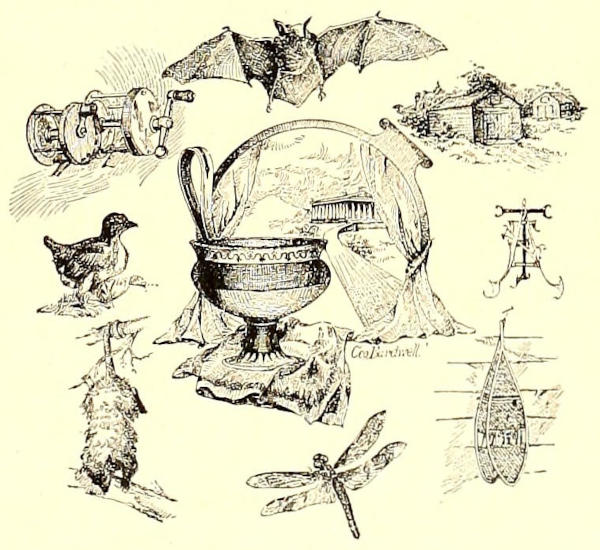
All of the cross-words of the above central acrostic are grouped around the central picture, and answer to the following definitions.
1 (nine letters). A contrivance useful in winter. 2 (nine letters). A swift-flying insect. 3 (seven letters). A young fowl. 4 (five letters). Familiar objects in rural districts. 5 (three letters). A winged animal. 6 (three letters). Consumed. 7 (five letters). Useful to fishermen. 8 (seven letters). An animal.
The central letters of the words described will spell the name of a great Athenian philosopher, and the central picture will suggest what is usually associated with his last moments.
AN EGYPTIAN PUZZLE.
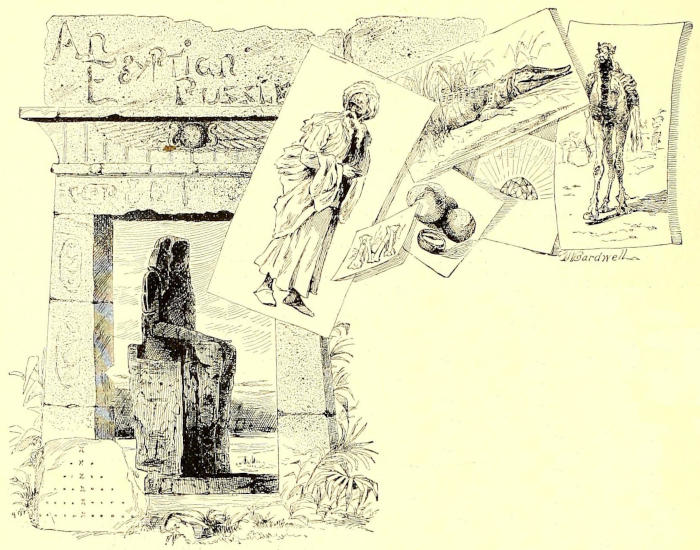
The above Egyptian puzzle is an illustrated pyramid, as the diagram in the lower left-hand corner indicates. When rightly guessed, the central letters (indicated by crosses) will spell the name of a famous statue that is said to emit sounds like those of a harp as the sun rises. The illustrations answer to the following definitions.
1. A letter. 2. A precious stone. 3. An animal. 4. Tropical fruit. 5. An animal. 6. A native of a certain Egyptian city.
RIMLESS WHEELS.
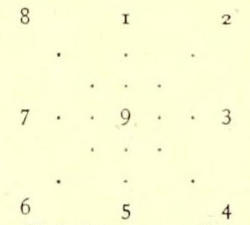
I. From 1 to 9, the Christian name of an English queen; from 2 to 9, a famous river; from 3 to 9, a cupola; from 4 to 9, the name of a large lake; from 5 to 9, to scale; from 6 to 9, magnitude; from 7 to 9, the margin; from 8 to 9, a number.
The letters represented by the figures from 1 to 8 spell the name of a Danish author who died August 4, 1875.
II. From 1 to 9, part of a watch; from 2 to 9, qualified; from 3 to 9, matured; from 4 to 9, uncommon; from 5 to 9, 43,560 square feet; from 6 to 9, to stare; from 7 to 9, to incite; from 8 to 9, a specimen.
The letters represented by the figures from 1 to 8 spell the name of a famous American who died August 14, 1870.
HONORA N.
DIAMOND.
1. In telephone. 2. One of the smaller sails on a ship. 3. A small but famous country. 4. A Spanish nobleman. 5. A favorite. 6. Era. 7. In telephone.
“ŒDIPUS.”
DOUBLE ACROSTIC.
In each of the following sentences a word is concealed, the definition to which is given in the same sentence. When rightly selected and placed one below the other in the order here given, the primals and finals will each form the name of a distinguished poet who was born in August. The cross-words are all of the same length.
1. It is hard, in essays, to avoid assurance.
2. Mary has gone to Salem; Bell is home, and the latter will adorn the book she is composing.
3. In an oration, a legate gave the detail of reasons for making it.
4. Clare hears a little rumor that there will be a recital this evening.
5. This incident I call the same as that in the other story.
6. On Mount Carmel I temporized with one of the friars.
7. When I look now in glyphs, I feel their beauty understandingly.
CYRIL DEANE.
CUBE.
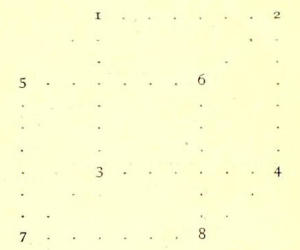
From 1 to 2, royal; from 2 to 4, a long-tailed species of hawk, found in Europe; from 3 to 4, a dealer in precious stones; from 1 to 3, eternal; from 5 to 6, a two-masted vessel; from 6 to 8, becoming circular; from 7 to 8, a method of securing a good draught in chimneys; from 5 to 7, the name of one of the three persons thrown into the fiery furnace of Nebuchadnezzar; from 1 to 5, the flower-deluce; from 2 to 6, an affected cast of countenance; from 4 to 8, a kind of seaweed; from 3 to 7, to scourge.
“ROSE MADDER.”
BEHEADINGS.
1. Behead withered and leave part of the head. 2. Behead dry and leave to free from. 3. Behead flexible and leave a demon. 4. Behead to sulk and leave to unfold. 5. Behead surrounded by and leave in the center of. 6. Behead joyful and leave a young boy. 7. Behead an ornament worn by Jewish priests and leave an edge. 8. Behead a short piece of iron and leave to be ill. 9. Behead the fraction of an ounce and leave an ancient instrument of war. 10. Behead a character in the play of “Othello” and leave gone.
The words described are of equal length. The beheaded letters, read in the order here given, will spell the name of one of Washington Irving’s earliest works.
“FRANCESCO AND CO.”
ZIGZAG.
Each of the words described contains the same number of letters, and the zigzag, beginning at the upper left-hand letter, will spell an important event that occurred on August 5, 1856.
Cross-words: 1. Certain. 2. An exhibition. 3. Merriment. 4. Festivity. 5. To satisfy. 6. To strike. 7. A minute particle. 8. Formerly. 9. Recent. 10. Half. 11. Nationality. 12. Pain. 13. Dry. 14. Capable. 15. An elevation. 16. To engage. 17. Hearty. 18. To salute. 19. Want. 20. Notion. 21. To cook slowly. 22. To twist.
“KATASHAW.”