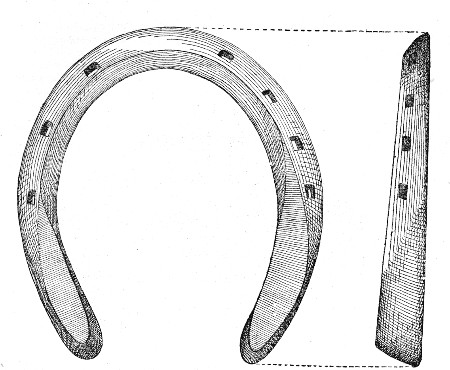
HORSESHOEING.
Reading edition
By John W. Adams, A. B., V. M.,
Professor of Surgery and Lecturer on Shoeing, Veterinary Department, University of Pennsylvania.
Bad and indifferent shoeing so frequently leads to diseases of the feet and in irregularities of gait, which may render a horse unserviceable, that it has been thought appropriate to conclude this book with a brief chapter on the principles involved in shoeing healthy hoofs.
In unfolding this subject in the limited space at my disposal, I can only hope to give the intelligent horse owner a sufficient number of facts, based on experience and upon the anatomy and physiology of the foot and leg, to enable him to avoid the more serious consequences of improper shoeing.
Let us first examine this vital mechanism, the foot, and learn something of its structure and of the natural movements of its component parts, that we may be prepared to recognize deviations from the normal and to apply the proper corrective.
GROSS ANATOMY OF THE FOOT.
(Pls. XXXII-XXXIV.)
The bones of the foot are four in number, three of which—the long pastern, short pastern, and coffin bone, placed end to end—form a continuous straight column passing downward and forward from the fetlock joint to the ground. A small accessory bone, the navicular, or "shuttle," bone, lies crosswise in the foot between the wings of the coffin bone and forms a part of the joint surface of the latter. The short pastern projects about 1-/2 inches above the hoof and extends about an equal distance to it. (See also page 395.)
The pastern and the coffin bone are held together by strong fibrous cords passing between each two bones and placed at the sides so as not to interfere with the forward and backward movement of the bones. The joints are therefore hinge joints, though imperfect, because, while the chief movements are those of extension and flexion in a single plane, some slight rotation and lateral movements are possible.
The bones are still further bound together and supported by three long fibrous cords, or tendons. One, the extensor tendon of the toe, passes down the front of the pasterns and attaches to the coffin bone just below the edge of the hair; when pulled upon by its muscle this tendon draws the toe forward and enables the horse to place the hoof flat upon the ground. The other two tendons are placed behind the pasterns and are called flexors, because they flex, or bend, the pasterns and coffin bone backward. One of the tendons is attached to the upper end of the short pastern, while the other passes down between the heels, glides over the under surface of the navicular bone, and attaches itself to the under surface of the coffin bone. These two tendons not only flex, or fold up, the foot as the latter leaves the ground during motion, but at rest assist the suspensory ligament in supporting the fetlock joint.
The foot-axis is an imaginary line passing from the fetlock joint through the long axes of the two pasterns and coffin bone. This imaginary line, which shows the direction of the pasterns and coffin bone, should always be straight—that is, never broken, either forward or backward when viewed from the side, or inward or outward when observed from in front. Viewed from one side, the long axis of the long pastern, when prolonged to the ground, should be parallel to the line of the toe. Viewed from in front, the long axis of the long pastern, when prolonged to the ground, should cut the hoof exactly at the middle of the toe.
Raising the heel or shortening the toe not only tilts the coffin bone forward and makes the hoof stand steeper at the toe, but slackens the tendon that attaches to the under surface of the coffin bone (perforans tendon), and therefore allows the fetlock joint to sink downward and backward and the long pastern to assume a more nearly horizontal position. The foot-axis, viewed from one side, is now broken forward; that is, the long pastern is less steep than the toe, and the heels are either too long or the toe is too short. On the other hand, raising the toe or lowering the heels of a foot with a straight foot-axis not only tilts the coffin bone backward and renders the toe more nearly horizontal, but tenses the perforans tendon, which then forces the fetlock joint forward, causing the long pastern to stand steeper. The foot-axis, seen from one side, is now broken backward—an indication that the toe is relatively too long or that the heels are relatively too low.
The elastic tissues of the foot are preeminently the lateral cartilages and the plantar cushion. The lateral cartilages are two irregularly four-sided plates of gristle, one on either side of the foot, extending from the wings of the coffin bone backward to the heels and upward to a distance of an inch or more above the edge of the hair, where they may be felt by the fingers. When sound, these plates are elastic and yield readily to moderate finger pressure, but from various causes may undergo ossification, in which condition they are hard and unyielding. The plantar cushion is a wedge-shaped mass of tough, elastic, fibro-fatty tissue filling all the space between the lateral cartilages, forming the fleshy heels and the fleshy frog, and serving as a buffer to disperse shock when the foot is set to the ground. It extends forward underneath the navicular bone and perforans tendon, and protects these structures from injurious pressure from below. Instantaneous photographs show that at speed the horse sets the heels to the ground before other parts of the foot—conclusive proof that the function of this tough, elastic structure is to dissipate and render harmless violent impact of the foot with the ground.
The horn-producing membrane, or "quick," as it is commonly termed, is merely a downward prolongation of the "derm," or true skin, and may be conveniently called the pododerm (foot skin). The pododerm closely invests the coffin bone, lateral cartilages, and plantar cushion, much as a sock covers the human foot, and is itself covered by the horny capsule, or hoof. It differs from the external skin, or hair skin, in having no sweat or oil glands, but, like it, is richly supplied with blood vessels and sensitive nerves. And, just as the derm of the hair skin produces upon its outer surface layer upon layer of horny cells (epiderm), which protect the sensitive and vascular derm, so, likewise, in the foot the pododerm produces over its entire surface soft cells, which, pushed away by more recent cells forming beneath, lose moisture by evaporation and are rapidly transformed into the corneous material which we call the hoof. It is proper to regard the hoof as a greatly thickened epiderm having many of the qualities possessed by such epidermal structures as hair, feathers, nails, claws, etc.
The functions of the pododerm are to produce the hoof and to unite it firmly to the foot.
There are five parts of the pododerm, easily distinguishable when the hoof has been removed, namely: (1) The perioplic band, a narrow ridge from one-sixteenth to one-eighth of an inch wide, running along the edge of the hair from one heel around the toe to the other. This band produces the perioplic horn, the thin varnishlike layer of glistening horn, which forms the surface of the wall or "crust," and whose purpose seems to be to retard evaporation of moisture from the wall. (2) The coronary band, a prominent fleshy cornice encircling the foot just below and parallel to the perioplic band. At the heels it is reflected forward along the sides of the fleshy frog, to become lost near the apex of this latter structure. The coronet produces the middle layer of the wall, and the reflexed portions produce the "bars," which are, therefore, to be regarded merely as a turning forward of the wall. (3) The fleshy leaves, 500 to 600 in number, parallel to one another, running downward and forward from the lower edge of the coronary band to the margin of the fleshy sole. They produce the soft, light-colored horny leaves which form the deepest layer of the wall, and serve as a strong bond of union between the middle layer of the wall and the fleshy leaves with which they dovetail. (4) The fleshy sole, which covers the entire under surface of the foot, excepting the fleshy frog and bars. The horny sole is produced by the fleshy sole. (5) The fleshy frog, which covers the under surface of the plantar cushion and produces the horny frog.
The horny box or hoof consists of wall and bars, sole and frog. The wall is all that part of the hoof which is visible when the foot is on the ground (see fig. 8). As already stated, it consists of three layers—the periople, the middle layer, and the leafy layer.
The bars (see fig. 1c) are forward prolongations of the wall, and are gradually lost near the point of the frog. The angle between the wall and a bar is called the "buttress." Each bar lies against the horny frog on one side and incloses a wing of the sole on the other, so that the least expansion or contraction of the horny frog separates or approximates the bars, and through them the lateral cartilages and the walls of the quarters. The lower border of the wall is called the "bearing edge," and is the surface against which the shoe bears. By dividing the entire lower circumference of the wall into five equal parts, a toe, two side walls, and two quarters will be exhibited. The "heels," strictly speaking, are the two rounded soft prominences of the plantar cushion, lying one above each quarter. The outer wall is usually more slanting than the inner, and the more slanting half of a hoof is always the thicker. In front hoofs the wall is thickest at the toe and gradually thins out toward the quarters, where in some horses it may not exceed one-fourth of an inch. In hind hoofs there is much less difference in thickness between the toe, side walls, and quarters. The horny sole, from which the flakes of old horn have been removed, is concave and about as thick as the wall at the toe. It is rough, uneven and often covered by flakes of dead horn in process of being loosened and cast off. Behind the sole presents an opening into which are received the bars and horny frog. This opening divides the sole into a body and two wings.
The periphery of the sole unites with the lower border of the wall and bars through the medium of the white line, which is the cross section of the leafy horn layer of the wall and of short plugs of horn which grow down from the lower ends of the fleshy leaves. This white line is of much importance to the shoer, since its distance from the outer border of the hoof is the thickness of the wall, and in the white line all nails should be driven.
The frog, secreted by the pododerm covering the plantar cushion or fatty frog, and presenting almost the same form as the latter, lies as a soft and very elastic wedge between the bars and between the edges of the sole just in front of the bars. A broad and shallow depression in its center divides it into two branches, which diverge as they pass backward into the horny bulbs of the heel. In front of the middle cleft the two branches unite to form the body of the frog, which ends in the point of the frog. The bar of a bar shoe should rest on the branches of the frog. In unshod hoofs the bearing edge of the wall, the sole, frog, and bars are all on a level; that is, the under surface of the hoof is perfectly flat, and each of these structures assists in bearing the body weight.
With respect to solidity, the different parts of the hoof vary widely. The middle layer of the wall is harder and more tenacious than the sole, for the latter crumbles away or passes off in larger or smaller flakes on its under surface, while no such spontaneous shortening of the wall occurs. The white line and the frog are soft-horn structures, and differ from hard horn in that their horn cells do not under natural conditions become hard and hornlike. They are very elastic, absorb moisture rapidly, and as readily dry out and become hard, brittle, and easily fissured. Horn of good quality is fine grained and tough, while bad horn is coarse grained and either mellow and friable or hard and brittle. All horn is a poor conductor of heat, and the harder (drier) the horn the more slowly does it transmit extremes of temperature.
THE PHYSIOLOGICAL MOVEMENTS OF THE HOOF.
A hoof while supporting the body weight has a different form, and the structures inclosed within the hoof have a different position than when not bearing weight. Since the amount of weight borne by a foot is continually changing, and the relations of internal pressure are continuously varying, a foot is, from a physiological viewpoint, never at rest. The most marked changes of form of the hoof occur when the foot bears the greatest weight, namely, at the time of the greatest descent of the fetlock. Briefly, these changes of form are: (1) An expansion or widening of the whole back half of the foot from the coronet to the lower edge of the quarters. This expansion varies between one-fiftieth and one-twelfth of an inch. (2) A narrowing of the front half of the foot, measured at the coronet. (3) A sinking of the heels and a flattening of the wings of the sole. These changes are more marked in the half of the foot that bears the greater weight.
The changes of form occur in the following order. When the foot is set to the ground the body weight is transmitted through the bones and sensitive and horny leaves to the wall. The coffin bone and navicular bone sink a little and rotate backward. At the same time the short pastern sinks backward and downward between the lateral cartilages and presses the perforans tendon upon the plantar cushion. This cushion being compressed from above and being unable to expand downward by reason of the resistance of the ground acting against the horny frog, acts like any other elastic mass and expands toward the sides, pushing before it the yielding lateral cartilages and the wall of the quarters. This expansion of the heels is assisted and increased by the simultaneous flattening and lateral expansion of the resilient horny frog, which crowds the bars apart. Of course, when the lateral cartilages are ossified, not only is no expansion of the quarters possible, but frog pressure often leads to painful compression of the plantar cushion and to increase of lameness. Frog pressure is therefore contraindicated in lameness due to sidebones (ossified cartilages). Under the descent of the coffin bone the horny sole sinks a little; that is, the arch of the sole around the point of the frog and the wings of the sole become somewhat flattened. All these changes of form are most marked in sound unshod hoofs, because in them ground pressure on the frog and sole is pronounced; they are more marked in fore hoofs than in hind hoofs.
The movement of the different structures within the foot and the changes of form that occur at every step are indispensable to the health of the hoof, so that these elastic tissues must be kept active by regular exercise, with protection against drying out of the hoof. Long-continued rest in the stable, drying out of the hoof, and shoeing decrease or alter the physiological movements of the hoof and sometimes lead to foot diseases. Since these movements are complete and spontaneous only in unshod feet, shoeing must be regarded as an evil, albeit a necessary one, and indispensable if we wish to keep horses continuously serviceable on hard, artificial roads. However, if in shoeing we bear in mind the structure and functions of the hoof and apply a shoe whose branches have a wide and level bearing surface, so as to interfere as little as may be with the expansion and contraction of the quarters, in so far as this is not hindered by the nails, we need not be apprehensive of trouble, provided the horse has reasonable work and his hoofs proper care.
GROWTH OF THE HOOF.
All parts of the hoof grow downward and forward with equal rapidity, the rate of growth being largely dependent upon the amount of blood supplied to the pododerm, or "quick." Abundant and regular exercise, good grooming, moistness and suppleness of the hoof, going barefoot, plenty of good feed, and at proper intervals removing the overgrowth of hoof and regulating the bearing surface, by increasing the volume and improving the quality of the blood flowing into the pododerm, favor the rapid growth of horn of good quality; while lack of exercise, dryness of the horn, and excessive length of the hoof hinder growth.
The average rate of growth is about one-third of an inch a month. Hind hoofs grow faster than fore hoofs and unshod ones faster than shod ones. The time required for the horn to grow from the coronet to the ground, though influenced to a slight degree by the precited conditions, varies in proportion to the distance of the coronet from the ground. At the toe, depending on its height, the horn grows down in 11 to 13 months, at the side wall in 6 to 8 months, and at the heels in 3 to 5 months. We can thus estimate with tolerable accuracy the time required for the disappearance of such defects in the hoof as cracks, clefts, etc.
Irregular growth is not infrequent. The almost invariable cause of this is an improper distribution of the body weight over the hoof—that is, an unbalanced foot. Colts running in soft pasture or confined for long periods in the stable are frequently allowed to grow hoofs of excessive length. The long toe becomes "dished"—that is, concave from the coronet to the ground—the long quarters curl forward and inward and often completely cover the frog and lead to contraction of the heels, or the whole hoof bends outward or inward, and a crooked foot, or, even worse, a crooked leg, is the result if the long hoof be allowed to exert its powerful and abnormally directed leverage for but a few months upon young plastic bones and tender and lax articular ligaments. All colts are not foaled with straight legs, but failure to regulate the length and bearing of the hoof may make a straight leg crooked and a crooked leg worse, just as intelligent care during the growing period can greatly improve a congenitally crooked limb. If breeders were more generally cognizant of the power of overgrown and unbalanced hoofs to divert the lower bones of young legs from their proper direction, and, therefore, to cause them to be moved improperly, with loss of speed and often with injury to the limbs, we might hope to see fewer knock-kneed, bow-legged, "splay-footed," "pigeon-toed," cow-hocked, interfering, and paddling horses.
If in shortening the hoof one side wall is, from ignorance, left too long or cut down too low with relation to the other, the foot will be unbalanced, and in traveling the long section will touch the ground first and will continue to do so till it has been reduced to its proper level (length) by the increased wear which will take place at this point. While this occurs rapidly in unshod hoofs, the shoe prevents wear of the hoof, though it is itself more rapidly worn away beneath the high (long) side than elsewhere, so that by the time the shoe is worn out the tread of the shoe may be flat. If this mistake be repeated from month to month, the part of the wall left too high will grow more rapidly than the low side whose pododerm is relatively anemic as a result of the greater weight falling into this half of the hoof, and the ultimate result will be a "wry," or crooked foot.
THE CARE OF UNSHOD HOOFS.
The colt should have abundant exercise on dry ground. The hoofs will then wear gradually, and it will only be necessary from time to time to regulate any uneven wear with the rasp and to round off the sharp edge about the toe in order to prevent breaking away of the wall.
Colts in the stable can not wear down their hoofs, so that every four to six weeks they should be rasped down and the lower edge of the wall well rounded to prevent chipping. The soles and clefts of the frog should be picked out every few days and the entire hoof washed clean. Plenty of clean straw litter should be provided. Hoofs that are becoming "awry" should have the wall shortened in such a manner as to straighten the foot-axis. This will ultimately produce a good hoof and will improve the position of the limb.
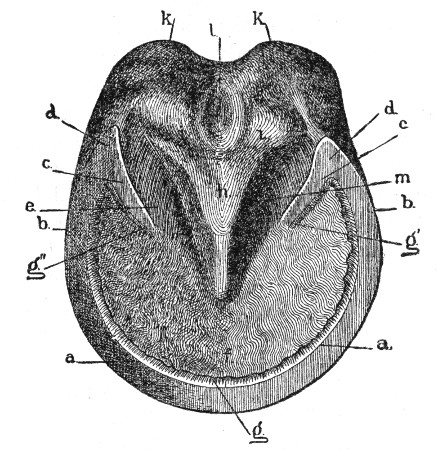
Fig. 1.—Ground surface of a right fore hoof of the regular form: a, a, wall; a-a, the toe; a-b, the side walls; b-d, the quarters; c, c, the bars; d, d, the buttress; e, lateral cleft of the frog; f, body of the sole; g, g', g", leafy layer (white line) of the toe and bars; h, body of the frog; i, i, branches of the frog; k, k, horny bulbs of the heels; l, middle cleft of the frog.
CHARACTERISTICS OF A HEALTHY HOOF.
A healthy hoof (figs. 1 and 8) is equally warm at all parts, and is not tender under pressure with the hands or moderate compression with pincers. The coronet is soft and elastic at all points and does not project beyond the surface of the wall. The wall (fig. 8) is straight from coronet to ground, so that a straightedge laid against the wall from coronet to ground parallel to the direction of the horn tubes will touch at every point. The wall should be covered with the outer varnishlike layer (periople) and should show no cracks or clefts. Every hoof shows "ring formation," but the rings should not be strongly marked and should always run parallel to the coronary band. Strongly marked ring-formation over the entire wall is an evidence of a weak hoof, but when limited to a part of the wall is evidence of previous local inflammation. The bulbs of the heels should be full, rounded, and of equal height. The sole (fig. 1) should be well hollowed out, the white line solid, the frog well developed, the middle cleft of the frog broad and shallow, the spaces between the bars and the frog wide and shallow, the bars straight from the buttress toward the point of the frog, and the buttresses themselves so far apart as not to press against the branches of the frog. A hoof can not be considered healthy if it presents reddish discolored horn, cracks in the wall, white line, bars, or frog, thrush of the frog, contraction or displacement of the heels. The lateral cartilages should yield readily to finger pressure.
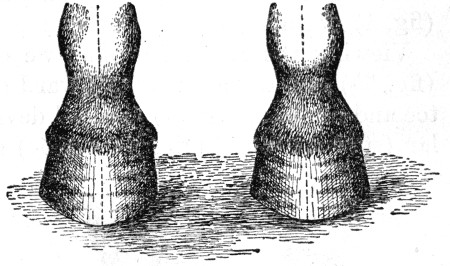
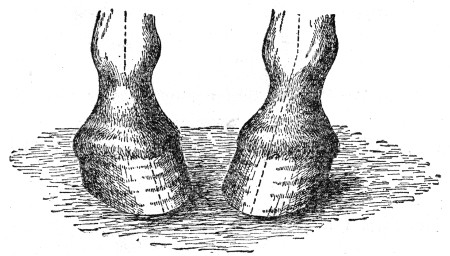
Fig. 2.—Pair of fore feet of regular form in regular standing position.
VARIOUS FORMS OF HOOFS.
As among a thousand human faces no two are alike, so among an equal number of horses no two have hoofs exactly alike. A little study of different forms soon shows us, however, that the form of every hoof is dependent in great measure on the direction of the two pastern bones as viewed from in front or behind, or from one side; and that all hoofs fall into three classes when we view them from in front and three classes when we observe them in profile. Inasmuch as the form of every foot determines the peculiarities of the shoe that is best adapted to it, no one who is ignorant of, or who disregards the natural form of, a hoof can hope to understand physiological shoeing.
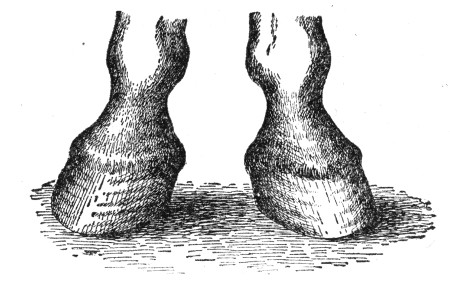
Fig. 3.—Pair of fore feet of base-wide form in toe-wide standing position.
FORMS OF FEET VIEWED FROM IN FRONT AND IN PROFILE.
Whether a horse's feet be observed from in front or from behind, their form corresponds to, or at least resembles, either that of the regular position (fig. 2), the base-wide or too-wide position (fig. 3), or the base-narrow position (fig. 4).
By the direction of the imaginary line passing through the long axes of the two pasterns (figs. 2, 4, 5) we determine whether or not the hoof and pasterns stand in proper mutual relation.
In the regular standing position (fig. 2) the foot-axis runs straight downward and forward; in the base-wide position (fig. 3) it runs obliquely downward and outward, and in the base-narrow position (fig. 4) it runs obliquely downward and inward.
Fig. 4.—Pair of fore feet of base-narrow form in toe-narrow standing position.
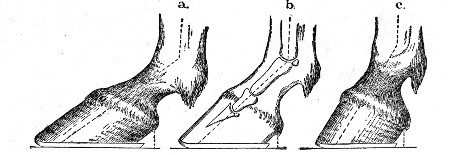
Viewing the foot in profile, we distinguish the regular position (fig. 5b) and designate all forward deviations as acute-angled (long toe and low heel, fig. 5a), and all deviations backward from the regular (steep toe and high heel, fig. 5c) as steep-toed, or stumpy. When the body weight is evenly distributed over all four limbs, the foot-axis should be straight; the long pastern, short pastern, and wall at the toe should have the same slant.
Fig. 5.—a, Side view of an acute-angled fore foot (shod); b, side view of a regular fore foot, showing the most desirable degree of obliquity (34°); c, side view of a stumpy, or "upright," fore foot; obliquity above 50°. In a, b, c, note particularly the relation between the length of the slope and the overhanging of the heels. Note also the toe roll of the shoes.
A front hoof of the regular standing position.—The outer wall is a little more slanting and somewhat thicker than the inner. The lower border of the outer quarter describes the arc of a smaller circle—that is, is more sharply bent than the inner quarter. The weight falls near the center of the foot and is evenly distributed over the whole bottom of the hoof. The toe forms an angle with the ground of 45° to 50° and is parallel to the direction of the long pastern. The toe points straight ahead, and when the horse is moving forward in a straight line the hoofs are picked up and carried forward in a line parallel to the middle line of the body, and are set down flat. Coming straight toward the observer the hoofs seem to rise and fall perpendicularly.
A hoof of the base-wide position is always awry. The outer wall is more slanting, longer, and thicker than the inner, the outer quarter more curved than the inner, and the outer half of the sole wider than the inner. The weight falls largely into the inner half of the hoof. In motion the hoof is moved in a circle. From its position on the ground it breaks over the inner toe, is carried forward and inward close to the supporting leg, thence forward and outward to the ground, which the hoof meets first with the outer toe. Horses that are toe-wide ("splay-footed"—toes turned outward) show all these peculiarities of hoof-form and hoof-flight to a still more marked degree and are therefore more prone to "interfere" when in motion.
A hoof of the base-narrow position is awry, but not to so marked a degree as the base-wide hoof. The inner wall is usually a little more slanting than the outer, the inner half of the sole wider than the outer, and the inner quarter more curved than the outer. The outer quarter is often flattened and drawn in at the bottom. The weight falls largely into the outer half of the hoof. In motion the hoof breaks over the outer toe, is carried forward and outward at some distance from the supporting leg, thence forward and inward to the ground, which it generally meets with the outer toe. The foot thus moves in a circle, whose convexity is outward, a manner of flight called "paddling." A base-narrow horse, whose toes point straight ahead, frequently "interferes," while a toe-narrow (pigeon-toed) animal seldom does.
A regular hoof (fig. 5b), viewed from one side, has a straight foot-axis inclined to the horizon at an angle of 45° to 50°. The weight falls near the center of the foot and there is moderate expansion of the quarters.
An acute-angled hoof (fig. 5a) has a straight foot-axis inclined at an angle less than 45° to the horizon. The weight falls more largely in the back half of the hoof and there is greater length of hoof in contact with the ground and greater expansion of the heels than in the regular hoof.
Upright or stumpy hoof.—In the upright or stumpy hoof (fig. 5c) the foot-axis is straight and more than 55° steep. The hoof is relatively short from toe to heel, the weight falls farther forward, and there is less expansion of the heels than in the regular hoof.
Wide and narrow hoofs.—Finally, there are wide hoofs and narrow hoofs, dependent solely upon race and breeding. The wide hoof is almost circular on the ground surface, the sole but little concave, the frog large, and the quality of the horn coarse. The narrow hoof has a strongly "cupped" sole, a small frog, nearly perpendicular side walls, and fine-grained, tough horn.
Hind hoofs are influenced in shape by different directions of their pasterns much as front feet are. A hind hoof is not round at the toe as a front hoof is, but is more pointed. Its greatest width is two-thirds of the way back from toe to heel, the sole is more concave, the heels relatively wider, and the toe about 10° steeper than in front hoofs.
EXAMINATION PRELIMINARY TO SHOEING.
The object of the examination is to ascertain the direction and position of the limbs, the shape, character, and quality of the hoofs, the form, length, position, and wear of the shoe, the number, distribution, and direction of the nails, the manner in which the hoof leaves the ground, its line of flight, the manner in which it is set to the ground, and all other peculiarities, that at the next and subsequent shoeings proper allowances may be made and observed faults corrected. The animal must, therefore, be observed both at rest and in motion.
At rest, the observer should stand in front and note the slant of the long pasterns. Do they drop perpendicularly, or slant downward and outward (base-wide foot), or downward and inward (base-narrow foot)? Whatever be the direction to the long pastern, an imaginary line passing through its long axis, when prolonged to the ground, should apparently pass through the middle of the toe. But if such line cuts through the inner toe the foot-axis is not straight, as it should be, but is broken inward at the coronet, an indication that either the outer wall of the hoof is too long (high) or that the inner wall is too short (low). On the contrary, if the center line of the long pastern falls through the outer toe the foot-axis is broken outward at the coronet, an indication that either the inner wall is too long or the outer wall too short.
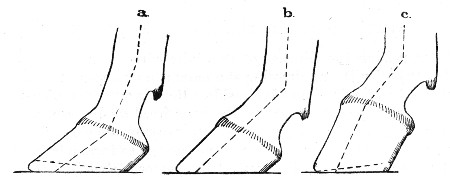
The observer should now place himself at one side, two or three paces distant, in order to view the limb and hoof in profile. Note the size of the hoof in relation to the height and weight of the animal, and the obliquity of the hoof. Is the foot-axis straight—that is, does the long pastern have the same slant as the toe, or does the toe of the hoof stand steeper than the long pastern (fig. 6c)? In which case the foot-axis is broken forward at the coronet, an indication, usually, that the quarters are either too high or that the toe is too short.
If the long pastern stands steeper than the toe (fig. 6a) the foot-axis is broken backward, in which case the toe is too long or the quarters are too low (short). In figures 6a and 6c the dotted lines passing from toe to quarters indicate the amount of horn which must be removed in order to straighten the foot-axis, as shown in figure 6b. Note also the length of the shoe.
Next, the feet should be raised and the examiner should note the outline of the foot, the conformation of the sole, form and quality of the frog, form of the shoe, wear of the shoe, and the number and distribution of the nails. Does the shoe fully cover the entire lower border of the wall? or is it too narrow, or fitted so full on the inside that it has given rise to interfering? or has the shoe been nailed on crooked? or has it become loose and shifted? is it too short, or so wide at the ends of the branches as not to support the buttresses of the hoof? Does the shoe correspond with the form of the hoof? Are the nails distributed so as to interfere as little as possible with the expansion of the quarters? are there too many? are they too large? driven too "fine" or too high? These are questions which the observer should put to himself.
Fig. 6.—a, Side view of foot with the foot-axis broken backward as a result of too long a toe. The amount of horn to be removed from the toe in order to straighten the foot-axis is denoted by a dotted line; b, side view of a properly balanced foot, with a straight foot-axis of desirable slant; c, side view of stumpy foot with foot-axis broken forward, as a result of overgrowth of the quarters. The amount of horn to be removed in order to straighten the foot-axis is shown by a dotted line.
Note carefully the wear of the old shoe. It is the unimpeachable evidence of the manner in which the hoof has been set to the ground since the shoe was nailed to it, and gives valuable "pointers" in leveling the hoof. Wear is the effect of friction between the shoe and the ground at the moment of contact. Since the properly leveled hoof is set flat to the ground, the "grounding wear" of a shoe should be uniform at every point, though the toe will always show wear due to scouring at the moment of "breaking over." Everything which tends to lengthen the stride tends also to make the "grounding wear" more pronounced in the heels of the shoe, while all causes which shorten the stride—as stiffening of the limbs through age, overwork, or disease—bring the grounding wear nearer the toe.
An exception should be noted, however, in founder, in which the grounding wear is most pronounced at the heels.
If one branch of the shoe is found to be worn much thinner than the other, the thinner branch has either been set too near the middle line of the foot (fitted too close), where it has been bearing greater weight while rubbing against the ground, or, what is much more often the case, the section of wall above the thinner branch has been too long (too high), or the opposite section of wall has been too short (too low). "One-sided wear, uneven setting down of the feet, and an unnatural course of the wall are often found together." How much an old shoe can tell us, if we take time and pains to decipher its scars!
The horse should next be observed at a walk and at a trot or pace, from in front, from behind, and from the side, and the "breaking over," the carriage of the feet, and the manner of setting them to the ground carefully noted and remembered. A horse does not always move just as his standing position would seem to imply. Often there is so great a difference in the form and slant of two fore hoofs or two hind hoofs that we are in doubt as to their normal shape, when a few steps at a trot will usually solve the problem instantly by showing us the line of flight of the hoofs and referring them to the regular, base-wide, or base-narrow form.
No man is competent either to shoe a horse or to direct the work till he has made the precited observations.
PREPARATION OF THE HOOF FOR THE SHOE.
After raising the clinches of the nails with a rather dull clinch cutter ("buffer") and drawing the nails one at a time, the old shoe is critically examined and laid aside. Remaining stubs of nails are then drawn or punched out and the hoof freed of dirt and partially detached horn. The farrier has now to "dress" the overgrown hoof to receive the new shoe; in other words, he has to form a base of support so inclined to the direction of the pasterns that in motion this surface shall be set flat upon the ground. He must not rob the hoof nor leave too much horn; either mistake may lead to injury. If he has made a careful preliminary examination he knows what part of the wall requires removal and what part must be left, for he already knows the direction of the foot axis and the wear of the old shoe and has made up his mind just where and how much horn must be removed to leave the hoof of proper length and the foot axis straight.
A greatly overgrown hoof may be quickly shortened with sharp nippers and the sole freed of semidetached flakes of horn. The concave sole of a thick-walled, strong hoof may be pared out around the point of the frog, but not so much as to remove all evidences of exfoliation. The wall should be leveled with the rasp till its full thickness, the white line, and an eighth of an inch of the margin of the sole are in one horizontal plane, called the "bearing surface of the hoof." The bars, if long, may be shortened, but never pared on the side. The branches of the sole in the angle between the bars and the wall of the quarters should be left a little lower than the wall, so as not to be pressed upon by the inner web of the shoe. "Corns," or bruises of the pododerm, are usually a result of leaving a thick mass of dry, unyielding horn at this point. The frog should not be touched further than to remove tags or layers that are so loose as to form no protection. A soft frog will shorten itself spontaneously by the exfoliation of superficial layers of horn, while if the frog is dry, hard, and too prominent it is better to soften it by applying moisture in some form, and to allow it to wear away naturally than to pare it down. It is of advantage to have the frog project below the level of the wall an amount equal to the thickness of a plain shoe, though we rarely see frogs of such size except in draft horses. The sharp lower border of the wall should be rounded with the rasp to prevent its being bent outward and broken away. Finally, the foot is set to the ground and again observed from all sides to make sure, that the lines bounding the hoof correspond with the direction of the long pastern.
THE SHOE.
The shoe is an artificial base of support, by no means ideal, because it interferes to a greater or less degree with the physiology of the foot, but indispensable except for horses at slow work on soft ground. Since a proper surface of support is of the greatest importance in preserving the health of the feet and legs, it is necessary to consider the various forms of shoes best adapted to the different forms of hoofs. Certain properties are common to all shoes and may be considered first. They are form, width, thickness, length, surfaces, borders, "fullering," nail holes, and clips.
Form.—Every shoe should have the form of the hoof for which it is intended, provided the hoof retains its proper shape; but for every hoof that has undergone change of form we must endeavor to give the shoe that form which the hoof originally possessed. Front shoes and hind shoes, rights and lefts, should be distinctly different and easily distinguishable.
Width.—All shoes should be wider at the toe than at the ends of the branches. The average width should be about double the thickness of the wall at the toe.
Thickness.—The thickness should be sufficient to make the shoe last about four weeks and should be uniform except in special cases.
Length.—This will depend upon the obliquity of the hoof viewed in profile. The acute-angled hoof (fig. 5a) has long overhanging heels, and a considerable proportion of the weight borne by the leg falls in the posterior half of the hoof. For such a hoof the branches of the shoe should extend back of the buttresses to a distance nearly double the thickness of the shoe. For a hoof of the regular form (figs. 5b and 8) the branches should project an amount equal to the thickness of the shoe. In a stumpy hoof (fig. 5c) the shoe need not project more than one-eighth of an inch. In all cases the shoe should cover the entire "bearing surface" of the wall.
Surfaces.—The surface that is turned toward the hoof is known as the "upper," or "hoof surface," of the shoe. That part of the hoof surface which is in actual contact with the horn is called the "bearing surface" of the shoe. The "bearing surface" should be perfectly horizontal from side to side, and wide enough to support the full thickness of the wall, the white line, and about an eighth of an inch of the margin of the sole. The bearing surface should also be perfectly flat, except that it may be turned up at the toe ("rolling-motion" shoe, fig. 5 a, b, c.) The surface between the bearing surface and the inner edge of the shoe is often beaten down or concaved to prevent pressure too far inward upon the sole. This "concaving," or "seating," should be deeper or shallower as the horny sole is less or more concave. As a rule, strongly "cupped" soles require no concaving (hind hoofs, narrow fore hoofs).
Borders.—The entire outer border should be beveled under the foot. Such a shoe is not so readily loosened, nor is it so apt to lead to interfering.
Fullering.—This is a groove in the ground surface of the shoe. It should pass through two-thirds of the thickness of the shoe, be clean, and of uniform width. It is of advantage in that it makes the shoe lighter in proportion to its width and, by making the ground surface somewhat rough, tends to prevent slipping.
Nail holes.—The shoe must be so "punched" that the nail holes will fall directly on the white line. They should be confined to the fore half of front shoes, but may occupy the anterior two-thirds of hind shoes. For a medium-weight shoe three nail holes in each branch are sufficient, but for heavier shoes, especially those provided with long calks, eight holes are about right, though three on the inside and four on the outside may do.
Clips.—These are half-circular ears drawn up from the outer edge of the shoe either at the toe or opposite the side wall. The height of a clip should equal the thickness of the shoe, though they should be even higher on hind shoes and when a leather sole is interposed between the shoe and hoof. Clips secure the shoe against shifting. A side clip should always be drawn up on that branch of the shoe that first meets the ground in locomotion.
SPECIAL FEATURES AND FITTING THE SHOES.
A shoe for a regular hoof (figs. 7 and 8) fits when its outer border follows the wall closely in the region of the nail holes and from the last nail to the end of the branch gradually projects beyond the surface of the wall to an eighth of an inch and extends back of the buttresses an amount equal to the thickness of the shoe. The shoe must be straight, firm, air-tight, its nail holes directly over the white line, and its branches far enough from the branches of the frog to permit the passage of a foot pick. Branches of the shoe must be of equal length.
In fitting a shoe to a hoof of regular form we follow the form of the hoof, but in base-wide and base-narrow hoofs, which are of irregular form, we must pay attention not only to the form of the hoof but also to the direction of the pasterns and the consequent distribution of weight in the hoof, because where the most weight falls the surface of support of the foot must be widened, and where the least weight falls (opposite side of the hoof) the surface of support should be narrowed. In this way the improper distribution of weight within the hoof is evenly distributed over the surface of support.
Fig. 7.—Left fore hoof of regular form, shod with a plain "fullered" shoe. Note the distribution of the nails, length of the fuller (crease), and the closeness of the ends of the shoe to the branches of the frog.
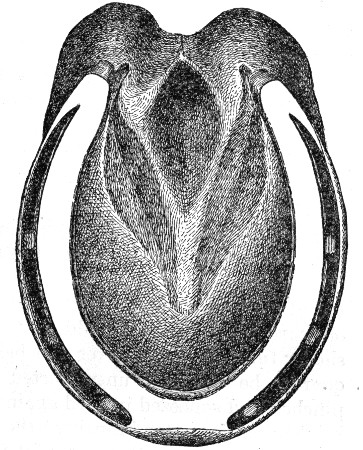
A shoe for a base-wide hoof should be fitted full on the inner side of the foot and fitted close on the outer side, because the inner side bears the most weight. The nails in the outer branch are placed well back, but in the inner branch are crowded forward toward the toe.
Fig. 8.—Side view of hoof and shoe shown in fig. 7. Note the straight toe, weak ring formation running parallel to the coronet, clinches low down and on a level, length of the shoe, and the under-bevel at the toe and heel.
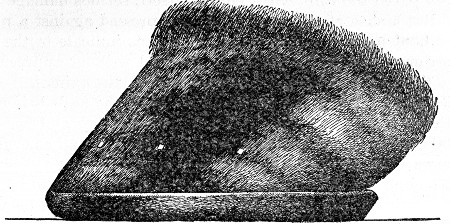
A shoe for a base-narrow hoof should be just the reverse of the preceding. The outer branch should be somewhat longer than the inner.
A shoe for an acute-angled hoof should be long in the branches, because most of the weight falls in the posterior half of the foot. The support in front should be diminished either by turning the shoe up at the toe or by beveling it under the toe (fig. 5a).
A shoe for a stumpy hoof should be short in the branches, and for pronounced cases should increase the support of the toe, where the most of the weight falls, by being beveled downward and forward.
In many cases, especially in draft horses, where the hoofs stand very close together, the coronet of the outer quarter is found to stand out beyond the lower border of the quarter. In such cases the outer branch of the shoe from the last nail back must be fitted so full that an imaginary perpendicular dropped from the coronet will just meet the outer border of the shoe. The inner branch, on the other hand, must be fitted as "close" as possible. The principal thought should be to set the new shoe farther toward the more strongly worn side. Such a practice will render unnecessary the widespread and popular fad of giving the outer quarter and heel calk of hind shoes an extreme outward bend. Care should be taken, however, that in fitting the shoe "full" at the quarter the bearing surface of the hoof at the quarter be not left unsupported or incompletely covered, to be pinched and squeezed inward against the frog. This will be obviated by making the outer branch of the shoe sufficiently wide and punching it so coarse that the nails will fall upon the white line.
Hot fitting.—Few farriers have either the time or the skill necessary to adjust a cold shoe to the hoof so that it will fit, as we say, "air-tight." Though the opponents of hot fitting draw a lurid picture of the direful consequences of applying a hot shoe to the hoof, it is only the abuse of the practice that is to be condemned. If a heavy shoe at a yellow heat be held tightly pressed against a hoof which has been pared too thin, till it embeds itself, serious damage may be done. But a shoe at a dark heat may be pressed against a properly dressed hoof long enough to scorch, and thus indicate to the farrier the portions of horn that should be lowered without appreciable injury to the hoof and to the ultimate benefit of the animal.
Nailing.—The horse owner should insist on the nails being driven low. They should pierce the wall not above an inch and five-eighths above the shoe. A nail penetrating the white line and emerging low on the wall destroys the least possible amount of horn, has a wide and strong clinch, rather than a narrow one, which would be formed near the point of the nail, and, furthermore, has the strongest possible hold on the wall, because its clinch is pulling more nearly at a right angle to the grain (horn tubes) of the wall than if driven high. Finally, do not allow the rasp to touch the wall above the clinches.
THE BAR SHOE.
The bar shoe (fig. 9) has a variety of uses. It enables us to give the frog pressure, to restore it to its original state of activity and development when, by reason of disuse, it has become atrophied. It gives the hoof an increased surface of support and enables us to relieve one or both quarters of undue pressure that may have induced inflammation and soreness. The bar of the shoe should equal the average width of the remainder of the shoe and should press but lightly on the branches of the frog. The addition of a leather sole with tar and oakum sole-packing allows us to distribute the weight of the body over the entire ground surface of the hoof.
Fig. 9.—An acute-angled left fore hoof shod with a bar shoe. Note the width and position of the bar and the fact that the nails are placed well toward the toe, so as not to interfere with the expansion of the quarters.
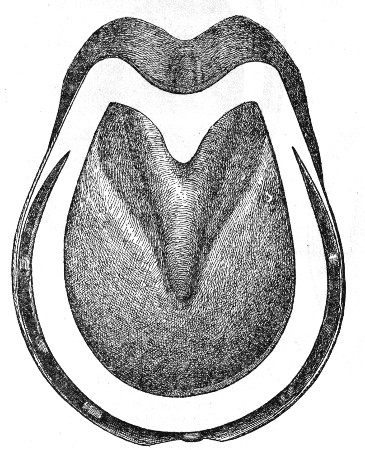
Fig. 10.—A fairly formed right fore ice shoe for a roadster. The top and outer-heel calks cut at right angles, and the inner-heel calk is slender and blunt. The back surface of the toe calk should be perpendicular.
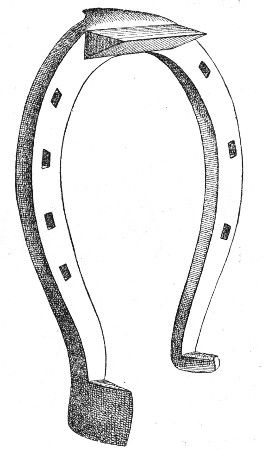
THE RUBBER PAD.
Various forms of rubber pads, rubber shoes, rope shoes, fiber shoes, and other contrivances to diminish shock and prevent slipping on the hard and slippery pavements of our large cities are in use in different parts of the world. In Germany the rope shoe (a malleable-iron shoe with a groove in its ground surface in which lies a piece of tarred rope) is extensively used with most gratifying results. It is cheap, durable, easily applied, and effective.
In the large cities of England and the United States rubber pads are extensively used. They are rather expensive, but are quite efficient in preventing slipping on polished and gummy pavements, though not so effective on ice. Figure 11 is an illustration of one of the best of many rubber pads. The rubber is stitched and cemented to a leather sole and is secured by the nails of a three-quarter shoe. Such a pad will usually last as long as two shoes. They may be used continuously, not only without injury to the hoof, but to its great benefit. The belief, unsupported by evidence, that rubber pads "draw the feet" keeps many from using them. A human foot encased in a rubber boot may eventually be blistered by the sweat poured upon the surface of the skin and held there by the impervious rubber till decomposition takes place with the formation of irritating fatty acids; but there is no basis for an analogy in the hoof of a horse.
Fig. 11.—Left fore hoof of regular form shod with a rubber pad and "three-quarter" shoe. (Ground surface.)
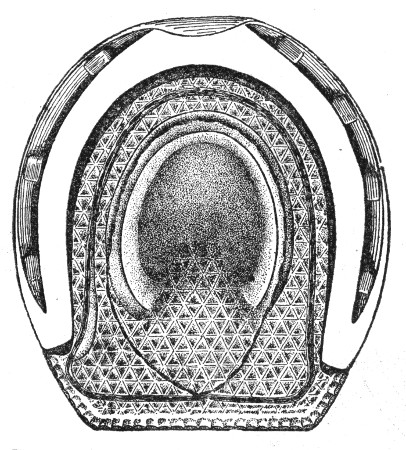
Fig. 12.—A narrow right fore hoof of the base-wide (toe-wide) standing position, shod with a plain "dropped-crease" shoe to prevent the toe cutting (interfering). The dotted line at the inner toe indicates the edge of the wall which was rasped away in order to narrow the hoof along the striking section. Note the inward bevel of the shoe at this point, the dropped crease, the distribution of the nails, the long "full" inner branch, and the short "close" outer branch.
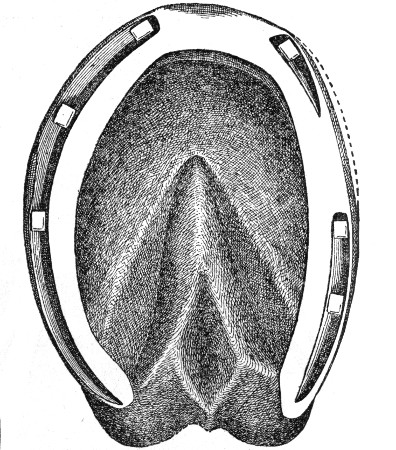
OTHER SPECIAL FORMS.
Some drawings, designed to illustrate shoeing in connection with "interfering" and "forging," and other special conditions, are shown in figures 13 to 18.
Fig. 13.—Hoof surface of a right hind shoe to prevent interfering. The inner branch has no nail holes and is fitted and beveled under the hoof. Note the number and position of the nail holes, the clip on the outer side wall, and the narrowness and bend of the inner branch.
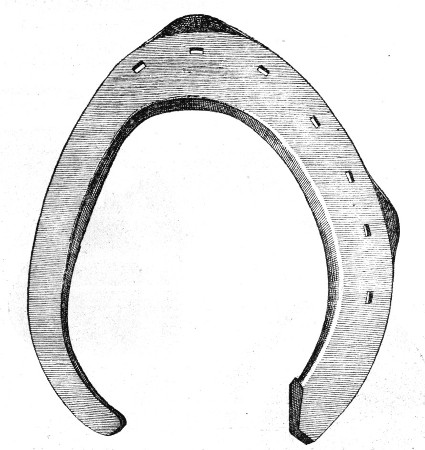
Fig. 14.—Ground surface of shoe shown in the previous figure. The inner, nailless branch has the thickness of the outer branch plus its calk, so that the inner and outer quarters of the hoof are equidistant from the ground.
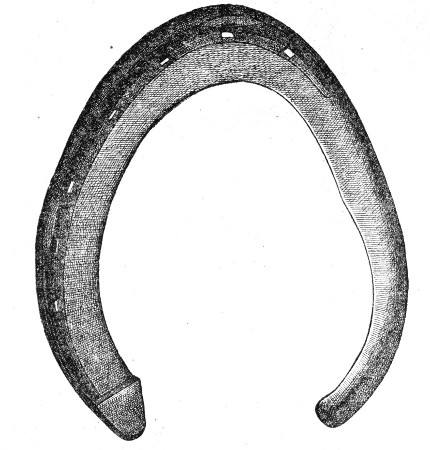
Fig. 15.—Side view of a fore hoof shod so as to quicken the "breaking over" (quicken the action) in a "forger." Note the short shoe, heel calks inclined forward, and the rolled toe.
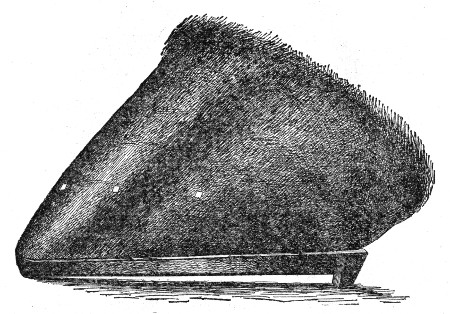
Fig. 16.—Side view of a short-toed hind hoof of a forger, shod to slow the action and to prevent injury to the fore heels by the toe of the hind shoe. Note the elevation of the short toe by means of a toe calk and the projection of the toe beyond the shoe. When such a hoof has grown more toe, the toe calk can be dispensed with and the shoe set farther forward.
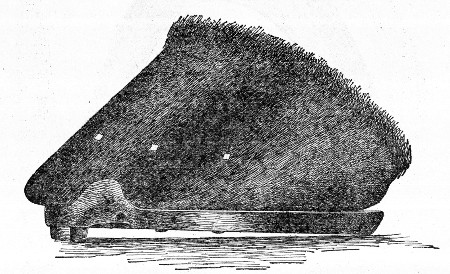
Fig. 17.—A toe-weight shoe to increase the length of stride of fore feet. The nails are placed too far back, and the shoe has no characteristic form but the weight is properly placed.
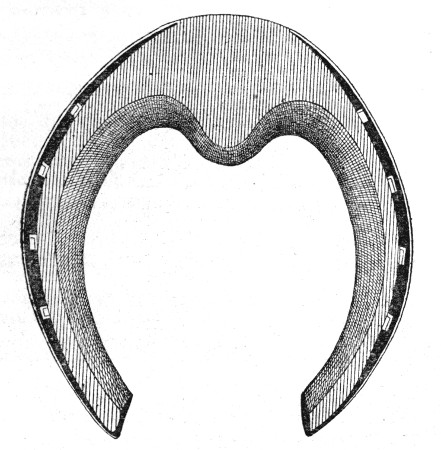
Fig. 18.—Most common form of punched heel-weight shoe to induce high action in fore feet. The profile of the shoe shows a "roll" at the toe and "swelled" heels. The weight is well placed, but "rolling" the toe and raising the heels lower action. The shoe would be much more effective if of uniform thickness and with no roll at the toe.