DISEASES OF THE URINARY ORGANS.
Reading edition
By James Law, F. R. C. V. S.,
Formerly Professor of Veterinary Science, etc., in Cornell University.
USES OF THE URINARY ORGANS.
The urinary organs constitute the main channel through which are excreted the nitrogenous or albuminoid principles, whether derived directly from the feed or from the muscular and other nitrogenized tissues of the body. They constitute, besides, the channel through which are thrown out most of the poisons, whether taken in by the mouth or skin or developed in connection with faulty or natural digestion, blood-forming, nutrition, or tissue destruction; or, finally, poisons that are developed within the body, as the result of normal cell life or of the life of bacterial or other germs that have entered the body from without. Bacteria themselves largely escape from the body through the kidneys. To a large extent, therefore, these organs are the sanitary scavengers and purifiers of the system, and when their functions are impaired or arrested the retained poisons quickly show their presence in resulting disorders of the skin and connective tissue beneath it, of the nervous system, or other organs. Nor is this influence one-sided. Scarcely an important organ of the body can suffer derangement without entailing a corresponding disorder of the urinary system. Nothing can be more striking than the mutual balance maintained between the liquid secretions of the skin and kidneys during hot and cold weather. In summer, when so much liquid exhales through the skin as sweat, comparatively little urine is passed, whereas in winter, when the skin is inactive, the urine is correspondingly increased. This vicarious action of skin and kidneys is usually kept within the limits of health, but at times the draining off of the water by the skin leaves too little to keep the solids of the urine safely in solution, and these are liable to crystallize out and form stone and gravel. Similarly the passage, in the sweat, of some of the solids that normally leave the body, dissolved in the urine, serves to irritate the skin and produce troublesome eruptions.
PROMINENT CAUSES OF URINARY DISORDERS.
A disordered liver contributes to the production under different circumstances of an excess of biliary coloring matter which stains the urine; of an excess of hippuric acid and allied products which, being less soluble than urea (the normal product of tissue change), favor the formation of stone, of taurocholic acid, and other bodies that tend when in excess to destroy the blood globules and to cause irritation of the kidneys by the resulting hemoglobin excreted in the urine, and of glycogen too abundant to be burned up in the system, which induces saccharine urine (diabetes). Any disorder leading to impaired functional activity of the lungs is causative of an excess of hippuric acid and allied bodies, of oxalic acid, of sugar, etc., in the urine, which irritate the kidneys, even if they do not produce solid deposits in the urinary passages. Diseases of the nervous system, and notably of the base of the brain and of the spinal cord, induce various urinary disorders, prominent among which are diabetes, chylous urine, and albuminuria. Certain affections, with imperfect nutrition or destructive waste of the bony tissues, tend to charge the urine with phosphates of lime and magnesia and endanger the formation of stone and gravel. In all extensive inflammations and acute fevers the liquids of the urine are diminished, while the solids (waste products), which should form the urinary secretion, are increased, and the surcharged urine proves irritant to the urinary organs or the retained waste products poison the system at large.
Diseases of the heart and lungs, by interfering with the free, onward flow of the blood from the right side of the heart, tend to throw that liquid back on the veins, and this backward pressure of venous blood strongly tends to disorders of the kidneys. Certain poisons taken with the feed and water, notably that found in magnesian limestone and those found in irritant, diuretic plants, are especially injurious to the kidneys, as are also various cryptogams, whether in musty hay or oats. The kidneys may be irritated by feeding green vegetables covered with hoar frost or by furnishing an excess of feed rich in phosphates (wheat bran, beans, peas, vetches, lentils, rape cake, cottonseed cake) or by a privation of water, which entails a concentrated condition and high density of the urine. Exposure in cold rain or snow storms, cold drafts of air, and damp beds are liable to further disorder an already overworked or irritable kidney. Finally, sprains of the back and loins may cause bleeding from the kidneys or inflammation.
The right kidney, weighing 23-1/2 ounces, is shaped like a French bean, and extends from the loins forward to beneath the heads of the last two ribs. The left kidney (Pl. VIII) resembles a heart of cards, and extends from the loins forward beneath the head of the last rib only. Each consists of three distinct parts—(a) the external (cortical), or vascular part, in which the blood vessels form elaborate capillary networks within the dilated globular sacs which form the beginnings of the secreting (uriniferous) tubes and on the surface of the sinuous, secreting tubes leading from the sacs inward toward the second, or medullary, part of the organ; (b) the internal (medullary) part, made up in the main of blood vessels, lymphatics, and nerves extending between the notch on the inner border of the kidney to and from the outer vascular portion, in which the secretion of urine is almost exclusively carried on; and (d) a large, saccular reservoir in the center of the kidney, into which all uriniferous tubes pour their secretions and from which the urine is carried away through a tube g (ureter), which passes out of the notch at the inner border of the kidney and which opens by a valve-closed orifice into the roof of the bladder just in front of its neck. The bladder is a dilatable reservoir for the retention of the urine until the discomfort of its presence causes its voluntary discharge. It is kept closed by circular, muscular fibers surrounding its neck or orifice, and is emptied by looped, muscular fibers extending in all directions forward from the neck around the blind anterior end of the sac. From the bladder the urine escapes through a dilatable tube (urethra) which extends from the neck of the bladder backward on the floor of the pelvis, and in the male through the penis to its free end, where it opens through a pink, conical papilla. In the mare the urethra is not more than an inch in length, and is surrounded by the circular, muscular fibers closing the neck of the bladder. Its opening may be found directly in the median line of the floor of the vulva, about 4-1/2 inches from its external opening.
GENERAL SYMPTOMS OF DISEASE.
These apply especially to acute inflammations and the irritation caused by stone. The animal moves stiffly on the hind limbs, straddles, and makes frequent attempts to pass urine, which may be in excess, deficient in amount, liable to sudden arrest in spite of the straining, passed in driblets, or entirely suppressed. Again, it may be modified in density or constituents. Difficulty in making a sharp turn, or in lying down and rising with or without groaning, dropping the back when mounted or when pinched on the loins is suggestive of kidney disease, and so to a less extent are swelled legs, dropsy, and diseases of the skin and nervous system. The oiled hand introduced through the rectum may feel the bladder beneath and detect any overdistention, swelling, tenderness, or stone. In ponies the kidneys even may be reached.
EXAMINATION OF THE URINE.
In some cases the changes in the urine are the sole sign of disease. In health the horse's urine is of a deep amber color and has a strong odor. On a feed of grain and hay it may show a uniform transparency, while on a green ration there in an abundant white deposit of carbonate of lime. Of its morbid changes the following are to be looked for: (1) Color: White from deposited salts of lime; brown or red from blood clots or coloring matter; yellow or orange from bile or blood pigment; pale from excess of water; or variously colored from vegetable ingredients (santonin makes it red; rhubarb or senna, brown; tar or carbolic acid, green). (2) Density: The horse's urine may be 1.030 or 1.050, but it may greatly exceed this in diabetes and may sink to 1.007 in diuresis. (3) Chemical reaction, as ascertained by blue litmus or red test papers. The horse on vegetable diet has alkaline urine turning red test papers blue, while in the sucking colt and the horse fed on flesh or on his own tissue (in starvation or abstinence during disease) it is acid, turning blue litmus red. (4) Organic constituents, as when glairy from albumen coagulable by strong nitric acid and boiling, when charged with microscopic casts of the uriniferous tubes, with the eggs or bodies of worms, with sugar, blood, or bile. (5) In its salts, which may crystallize out spontaneously, or on boiling, or on the addition of chemical reagents.
PLATE VIII. LONGITUDINAL SECTION THROUGH KIDNEY.
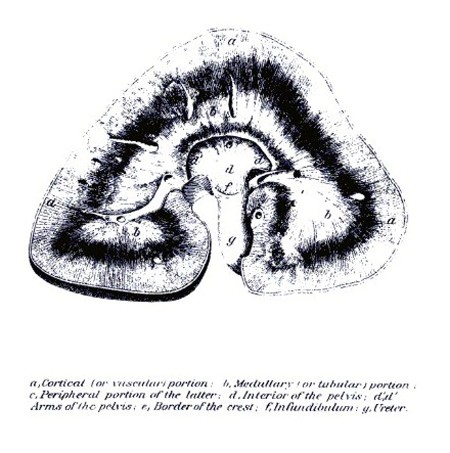
PLATE IX. MICROSCOPIC ANATOMY OF KIDNEY.
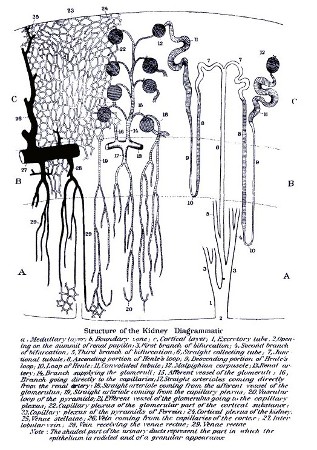
PLATE X. MICROSCOPIC ANATOMY OF KIDNEY.
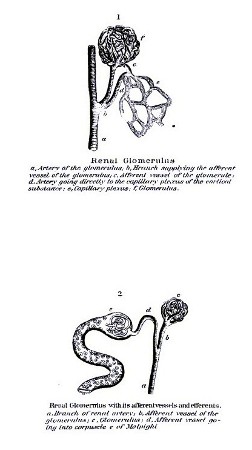
Albuminous urine in the horse is usually glairy, so that it may be drawn out in threads, but its presence can always be tested as follows: If the liquid is opaque, it may be first passed through filter paper; if very dense and already precipitating its salts, it may be diluted with distilled water; add to the suspected liquid acetic acid drop by drop until it reddens the blue litmus paper; then boil gently in a test tube; if a precipitate is thrown down, set the tube aside to cool and then add strong nitric acid. If the precipitate is not dissolved, it is albumen; if dissolved it is probably urate or hippurate of ammonia. Albumen is normally present in advanced gestation; abnormally it is seen in diseases in which there occurs destruction of blood globules (anthrax, low fevers, watery states of the blood, dropsies), in diseases of the heart and liver which prevent the free escape of blood from the veins and throw back venous pressure on the kidneys, in inflammation of the lungs and pleuræ, and even tympany (bloating), doubtless from the same cause, and in all congestive or inflammatory diseases of the kidneys, acute or chronic.
Casts of the uriniferous tubes can be seen only by placing the suspected urine under the microscope. They are usually very elastic and mobile, waving about in the liquid when the cover glass is touched, and showing a uniform, clear transparency (waxy) or entangled circular epithelial cells or opaque granules or flattened, red-blood globules or clear, refrangent oil globules. They may be even densely opaque from crystals of earthy salts.
Pus cells may be found in the urine associated with albumen, and are recognized by clearing up, when treated with acetic acid, so that each cell shows two or three nuclei.
DIURESIS (POLYURIA, DIABETES INSIPIDUS, OR EXCESSIVE SECRETION OF URINE).
This consists in an excessive secretion of a clear, watery urine of a low specific gravity (1.007) with a correspondingly ardent thirst, a rapidly advancing emaciation, and great loss of strength and spirit.
Causes.—Its causes may be any agent—medicinal, alimentary, or poisonous—which unduly stimulates the kidneys; the reckless administration of diuretics, which form such a common constituent of quack horse powders; acrid diuretic plants in grass or hay; new oats still imperfectly cured; an excess of roots or other very watery feed; a full allowance of salt to animals that have become inordinately fond of it; but, above all, feeding on hay, grain, or bran which has not been properly dried and has become musty and permeated by fungi. Thus hay, straw, or oats obtained in wet seasons and heating in the rick or stack is especially injurious. Hence this malady, like coma somnolentum (sleepy staggers), is widespread in wet seasons, and especially in rainy districts.
Symptoms.—The horse drinks deep at every opportunity and passes urine on every occasion when stopped, the discharge being pale, watery, of a low density, and inodorous; in short, it contains a great excess of water and a deficiency of the solid excretions. So great is the quantity passed, however, that the small amount of solids in any given specimen amounts in 24 hours to far more than the normal—a fact in keeping with the rapid wasting of the tissues and extreme emaciation. The flanks become tucked up, the fat disappears, the bones and muscles stand out prominently, the skin becomes tense and hidebound, and the hair erect, scurfy, and deficient in luster. The eye becomes dull and sunken, the spirits are depressed, the animal is weak and sluggish, sweats on the slightest exertion, and can endure little. The subject may survive for months, or may die early of exhaustion. In the slighter cases, or when the cause ceases to operate, a somewhat tardy recovery may be made.
Treatment consists in stopping the ingestion of the faulty drugs, poisons, or feed, and supplying sound hay and grain free from all taint of heating or mustiness. A liberal supply of boiled flaxseed in the drinking water at once serves to eliminate the poison and to sheathe and protect the irritated kidneys. Tonics like sulphate or phosphate of iron (2 drams morning and evening) and powdered gentian or Peruvian bark (4 drams) help greatly by bracing the system and hastening repair. To these may be added agents calculated to destroy the fungus and eliminate its poisonous products. In that form which depends on musty food nothing acts better than large doses of iodid of potassium (2 drams), while in other cases creosote, carbolic acid (1 dram), or oil of turpentine (4 drams), properly diluted, may be resorted to.
SACCHARINE DIABETES (DIABETES MELLITUS, GLYCOSURIA, OR INOSURIA).
This is primarily a disease of the nervous system or liver rather than of the kidneys, yet, as the most prominent symptom is the sweet urine, it may be treated here.
Causes.—Its causes are varied, but resolve themselves largely into disorder of the liver or disorder of the brain. One of the most prominent functions of the liver is the formation of glycogen, a principle allied to grape sugar, and passing into it by further oxidation in the blood. This is a constant function of the liver, but in health the resulting sugar is burned up in the circulation and does not appear in the urine. On the contrary, when the supply of oxygen is defective, as in certain diseases of the lungs, the whole of the sugar does not undergo combustion and the excess is excreted by the kidneys. Also in certain forms of enlarged liver the quantity of sugar produced is more than can be disposed of in the natural way, and it appears in the urine. A temporary sweetness of the urine often occurs after a hearty meal on starchy feed, but this is due altogether to the super-abundant supply of the sugar-forming feed, lasts for a few hours only, and has no pathological significance. In many cases of fatal glycosuria the liver is found to be enlarged, or at least congested, and it is found that the disorder can be produced experimentally by agencies which produce an increased circulation through the liver. Thus Bernard produced glycosuria by pricking the oblong medulla at the base of the brain close to the roots of the pneumogastric nerve, which happens to be also the nerve center (vasomotor) which presides over the contractions of the minute blood vessels. The pricking and irritation of this center leads to congestion of the liver and the excessive production of sugar. Irritation carried to this point through the pneumogastric nerve causes saccharine urine, and, in keeping with this, disease of the pancreas has been found in this malady. The complete removal of the pancreas, however, determines glycosuria, the organ having in health an inhibitive action on sugar production by the liver. The same result follows the reflection of irritation from other sources, as from different ganglia (corpora striata, optic thalami, pons, cerebellum, cerebrum) of the brain. Similarly it is induced by interruption of the nervous control along the vasomotor tracts, as in destruction of the upper or lower cervical sympathetic ganglion, by cutting the nervous branch connecting these two, in injury to the spinal marrow in the interval between the brain and the second or fourth dorsal vertebra, or in disease of the celiac plexus, which directly presides over the liver. Certain chemical poisons also cause saccharine urine, notably woorara, strychnia, morphia, phosphoric acid, alcohol, ether, quinia, chloroform, ammonia, arsenic, and phlorizin.
Symptoms.—The symptoms are ardent thirst and profuse secretion of a pale urine of a high density (1.060 and upward), rapid loss of condition, scurfy, unthrifty skin, costiveness or irregularity of the bowels, indigestion, and the presence, in the urine, of a sweet principle—grape sugar or inosite, or both. This may be most promptly detected by touching the tip of the tongue with a drop. Sugar may be detected simply by adding a teaspoonful of liquid yeast to 4 ounces of the urine and keeping it lightly stopped at a temperature of 70° to 80° F. for 12 hours, when the sugar will be found to have been changed into alcohol and carbon dioxid. The loss of density will give indication of the quantity of sugar transformed; thus a density of 1.035 in a urine which was formerly 1.060 would indicate about 15 grains of sugar to the fluid ounce.
Inosite, or muscle sugar, frequently present in the horse's urine, and even replacing the glucose, is not fermentable. Its presence may be indicated by its sweetness and the absence of fermentation or by Gallois's test. Evaporate the suspected urine at a gentle heat almost to dryness, then add a drop of a solution of mercuric nitrate and evaporate carefully to dryness, when a yellowish residue is left that is changed on further cautious heating to a deep rose color, which disappears on cooling and reappears on heating.
In advanced diabetes, dropsies in the limbs and under the chest and belly, puffy, swollen eyelids, cataracts, catarrhal inflammation of the lungs, weak, uncertain gait, and drowsiness may be noted.
Treatment is most satisfactory in cases dependent on some curable disease of liver, pancreas, lungs, or brain. Thus, in liver diseases, a run at pasture in warm weather, or in winter a warm, sunny, well-aired stable, with sufficient clothing and laxatives (sulphate of soda, 1 ounce daily) and alkalies (carbonate of potassium, one-fourth ounce) may benefit. To this may be added mild blistering, cupping, or even leeching over the last ribs. Diseases of the brain or pancreas may be treated according to their indications. The diet should be mainly albuminous, such as wheat bran or middlings, peas, beans, vetches, and milk. Indeed, an exclusive milk diet is one of the very best remedial agencies. It may be given as skimmed milk or butter-milk, and in the last case combines an antidiabetic remedy in the lactic acid. Under such an exclusive diet recent and mild cases are often entirely restored, though at the expense of an attack of rheumatism. Codeia, one of the alkaloids of opium, is strongly recommended by Tyson. The dose for the horse would be 10 to 15 grains thrice daily. In cases in which there is manifest irritation of the brain, bromid of potassium, 4 drams, or ergot one-half ounce, may be resorted to. Salicylic acid and salicylate of sodium have proved useful in certain cases; also phosphate of sodium. Bitter tonics (especially nux vomica one-half dram) are useful in improving the digestion and general health.
HEMATURIA (BLOODY URINE).
Cause.—As seen in the horse, bloody urine is usually the direct result of mechanical injuries, as sprains and fractures of the loins, lacerations of the sublumbar muscles (psoas), irritation caused by stone in the kidney, ureter, bladder, or urethra. It may, however, occur with acute congestion of the kidney, with tumors in its substance, or with papilloma or other diseased growth in the bladder. Acrid diuretic plants present in the feed may also lead to the escape of blood from the kidney. The predisposition to this affection is, however, incomparably less than in the case of the ox or the sheep, the difference being attributed to the greater plasticity of the horse's blood in connection with the larger quantity of fibrin.
The blood may be present in small clots or in more or less intimate admixture with the urine. Its condition may furnish some indication as to its source; thus, if from the kidneys it is more liable to be uniformly diffused through the urine, while as furnished by the bladder or passages clots are more liable to be present. Again, in bleeding from the kidney, minute, cylindrical clots inclosing blood globules and formed in the uriniferous tubes can be detected under the microscope. Precision also may be approximated by observing whether there is coexisting fracture, sprain of the loins, or stone or tumor in the bladder or urethra.
Treatment.—The disease being mainly due to direct injury, treatment will consist, first, in removing such cause whenever possible, and then in applying general and local styptics. Irritants in feed must be avoided, sprains appropriately treated, and stone in bladder or urethra removed. Then give mucilaginous drinks (slippery elm, linseed tea) freely, and styptics (tincture of chlorid of iron 3 drams, acetate of lead one-half dram, tannic acid one-half dram, or oil of turpentine 1 ounce). If the discharge is abundant, apply cold water to the loins and keep the animal perfectly still.
HEMOGLOBINURIA (AZOTURIA, AZOTEMIA, POISONING BY ALBUMINOIDS).
Like diabetes, this is rather a disease of the liver and blood-forming functions than of the kidney, but as prominent symptoms are loss of control over the hind limbs and the passage of ropy and dark-colored urine, the vulgar idea is that it is a disorder of the urinary organs. It is a complex affection directly connected with a plethora in the blood of nitrogenized constituents, with extreme nervous and muscular disorder and the excretion of a dense reddish or brownish urine. It is directly connected with high feeding, especially on highly nitrogenized feed (oats, beans, peas, vetches, cottonseed meal), and with a period of idleness in the stall under full rations. The disease is never seen at pasture, rarely under constant daily work, even though the feeding is high, and the attack is usually precipitated by taking the horse from the stable and subjecting it to exercise or work. The poisoning is not present when taken from the stable, as the horse is likely to be noticeably lively and spirited, but he will usually succumb under the first hundred yards or half mile of exercise. It seems as if the aspiratory power of the chest under the sudden exertion and accelerated breathing speedily drew from the gorged liver and abdominal veins (portal) the accumulated store of nitrogenous matter in an imperfectly oxidized or elaborated condition, and as if the blood, surcharged with these materials, were unable to maintain the healthy functions of the nerve centers and muscles. It has been noticed rather more frequently in mares than horses, attributable, perhaps, to the nervous excitement attendant on heat, and to the fact that the unmutilated mare is naturally more excitable than the docile gelding.
Lignières has found in hemoglobinuria a streptococcus which produced nephritis, bloody urine, and paraplegia in experimental animals, including horses.
Symptoms.—In the milder forms this affection may appear as a lameness in one limb, from indefinite cause, succeeding to some sudden exertion and attended by a dusky-brown color of the membranes of the eye and nose and some wincing when the last ribs are struck. The severe forms come on after one or two days of rest on a full ration, when the animal has been taken out and driven one hundred paces or more: The fire and life with which he had left the stable suddenly give place to dullness and oppression, as shown in heaving flanks, dilated nostrils, pinched face, perspiring skin, and trembling body. The muscles of the loins or haunch become swelled and rigid, the subject moves stiffly or unsteadily, crouches behind, the limbs being carried semiflexed, and he soon drops, unable to support himself. When down, the body and limbs are moved convulsively, but there is no power of coordination of movement in the muscles. The pulse and breathing are accelerated, the eyes red with a tinge of brown, and the urine, if passed, is seen to be highly colored, dark brown, red, or black, but it contains neither blood clots nor globules. The color is mainly due to hemoglobin and other imperfectly elaborated constituents of the blood.
It may end fatally in a few hours or days, or a recovery may ensue, which is usually more speedy and perfect if it has set in at an early stage. In the late and tardy recoveries a partial paralysis of the hind limbs may last for months. A frequent sequel of these tardy cases is an extensive wasting of the muscles leading up from the front of the stifle (those supplied by the crural nerve) and a complete inability to stand.
Prevention.—The prevention of this serious affection lies in restricting the diet and giving daily exercise when the animal is not at work. A horse that has had one attack should never be left idle for a single day in the stall or barnyard. When a horse has been condemned to absolute repose on good feeding he may have a laxative (one-half to 1 pound Glauber's salt), and have graduated exercise, beginning with a short walk and increasing day by day.
Treatment.—The treatment of the mild cases may consist in a laxative, graduated daily exercise, and a daily dose of saltpeter (1 ounce). Sudden attacks will sometimes promptly subside if taken on the instant and the subject kept still and calmed by a dose of bromid of potassium (4 drams) and sweet spirits of niter (1 ounce). The latter has the advantage of increasing the secretion of the kidneys. Iodid of potassium in one-half ounce doses every four hours has succeeded well in some hands. In severe cases, as a rule, it is desirable to begin treatment by a dose of aloes (4 to 6 drams) with the above-named dose of bromid of potassium, and this latter may be continued at intervals of four or six hours, as may be requisite to calm the nervous excitement. Fomentations with warm water over the loins are always useful in calming the excitable conditions of the spinal cord, muscles, liver, and kidneys, and also in favoring secretion from the two latter. On the second day diuretics may be resorted to, such as saltpeter one-half ounce, and powdered colchicum, one-half dram, to be repeated twice daily. A laxative may be repeated in three or four days should the bowels seem to demand it, and as the nervous excitement disappears any remaining muscular weakness or paralysis may be treated by one-half dram doses of nux vomica twice a day and a stimulating liniment (aqua ammonia and sweet oil in equal proportions) rubbed on the torpid muscles.
During the course of the disease friction to the limbs is useful, and in the advanced paralytic stage the application of electricity along the line of the affected muscles. When the patient can not stand he must have a thick, soft bed, and should be turned from side to side at least every twelve hours. As soon as he can be made to stand he may be helped up and even supported in a sling.
ACUTE INFLAMMATION OF THE KIDNEYS, OR ACUTE NEPHRITIS.
Inflammations of the kidneys have been differentiated widely, according as they were acute or chronic, parenchymatous or tubal, suppurative or not, with increased or shrunken kidney, etc. In a work like the present, however, utility will be consulted by classing all under acute or chronic inflammation.
Causes.—The causes of inflammation of the kidneys are extremely varied. Congestion occurs from the altered and irritant products passed through these organs during recovery from inflammations of other organs and during fevers. This may last only during the existence of its cause, or may persist and become aggravated. Heart disease, throwing the blood pressure back on the veins and kidneys, is another cause. Disease of the ureter or bladder, preventing the escape of urine from the kidney and causing increased fullness and tension in its pelvis and tubes, will determine inflammation. Decomposition of the detained urine in such cases and the production of ammonia and other irritants must also be named. In elimination of bacteria through the kidney, the latter is liable to infection with consequent inflammation. The advance of bacteria upward from the bladder to the kidneys is another cause. The consumption in hay or other fodder of acrid or irritant plants, including fungi, the absorption of cantharidine from a surface blistered by Spanish flies, the reckless administration of diuretics, the presence of stones in the kidney, exposure of the surface to cold and wet, and the infliction of blows or sprains on the loins, may contribute to its production. Liver disorders which throw on the kidneys the work of excreting irritant products, diseases of the lungs and heart from which clots are carried, to be arrested in the small blood vessels of the kidney, and injuries and paralysis of the spinal cord, are additional causes.
Symptoms.—The symptoms are more or less fever, manifest stiffness of the back and straddling gait with the hind limbs, difficulty in lying down and rising, or in walking in a circle, the animal sometimes groaning under the effort, arching of the loins and tucking up of the flank, looking back at the abdomen as if from colicky pain, and tenderness of the loins to pinching, especially just beneath the bony processes 6 inches to one side of the median line. Urine is passed frequently, a small quantity at a time, of a high color, and sometimes mixed with blood or even pus. Under the microscope it shows the microscopic casts referred to under general symptoms. If treated by acetic acid, boiling and subsequent addition of strong nitric acid, the resulting and persistent precipitate indicates the amount of albumen. The legs tend to swell from the foot up, also the dependent parts beneath the belly and chest, and effusions of liquid may occur within the chest or abdomen. In the male the alternate drawing up and relaxation of the testicles in the scrotum are suggestive, and in small horses the oiled hand introduced into the rectum may reach the kidney and ascertain its sensitiveness.
Treatment demands, first, the removal of any recognized cause. Then, if the suffering and fever are high, 2 to 4 quarts of blood may be abstracted from the jugular vein; in weak subjects or unless in high fever this should be omitted. Next relieve the kidneys so far as possible by throwing their work on the bowels and skin. A pint of castor oil is less likely than either aloes or salts to act on the kidneys. To affect the skin a warm stall and heavy clothing may be supplemented by dram doses of Dover's powder. Pain may be soothed by dram doses of bromid of potassium. Boiled flaxseed may be added to the drinking water, also thrown into the rectum as an injection, and blankets saturated with hot water should be persistently applied to the loins. This may be followed by a very thin pulp of the best ground mustard made with tepid water, rubbed in against the direction of the hair and covered with paper and a blanket. This may be kept on for an hour, or until the skin thickens and the hair stands erect. It may then be rubbed or sponged off and the blanket reapplied. When the action of the bowels has been started it may be kept up by a daily dose of 2 or 3 ounces of Glauber's salt.
During recovery a course of bitter tonics (nux vomica 1 scruple, ground gentian root 4 drams) should be given. The patient should also be guarded against cold, wet, and any active exertion for some time after all active symptoms have subsided.
CHRONIC INFLAMMATION OF THE KIDNEYS.
Causes.—Chronic inflammation of the kidneys is more commonly associated with albumen and casts in the urine than the acute form, find in some instances these conditions of the urine may be the only prominent symptoms of the disease. Though it may supervene on blow, injuries, and exposures, it is much more commonly connected with faulty conditions of the system—as indigestion, heart disease, lung or liver disease, imperfect blood formation, or assimilation; in short, it is rather the attendant on a constitutional infirmity than on a simple local injury.
It may be associated with various forms of diseased kidneys, as shrinkage (atrophy), increase (hypertrophy), softening, red congestion, white enlargement, etc., so that it forms a group of diseases rather than a disease by itself.
Symptoms.—The symptoms may include stiffness, weakness, and increased sensibility of the loins, and modified secretion of urine (increase or suppression), or the flow may be natural. Usually it contains albumen, the quantity furnishing a fair criterion of the gravity of the affection, and microscopic casts, also most abundant in bad cases. Dropsy, manifested in swelled legs, is a significant symptom, and if the effusion takes place along the lower line of the body or in chest or abdomen, the significance is increased. A scurfy, unthrifty skin, lack-luster hair, inability to sustain severe or continued exertion, poor or irregular appetite, loss of fat and flesh, softness of the muscles, and pallor of the eyes and nose are equally suggestive. So are skin eruptions of various kinds. Any one or more of these symptoms would warrant an examination of the urine for albumen and casts, the finding of which signifies renal inflammation.
Treatment of these cases is not always satisfactory, as the cause is liable to be maintained in the disorders of important organs elsewhere. If any such coincident disease of another organ or function can be detected, that should be treated first or simultaneously with this affection of the kidneys. In all cases the building up of the general health is important. Hence a course of tonics may be given (phosphate of iron 2 drams, nux vomica 20 grains, powdered gentian root 4 drams, daily) or 60 drops of sulphuric acid or nitrohydrochloric acid may be given daily in the drinking water. If there is any elevated temperature of the body and tenderness of the loins, fomentations may be applied, followed by a mustard pulp, as for acute inflammation, and even in the absence of these indications the mustard may be resorted to with advantage at intervals of a few days. In suppression of urine, fomentations with warm water or with infusion of digitalis leaves is a safer resort than diuretics, and cupping over the loins may also benefit. To apply a cup, shave the skin and oil it; then take a narrow-mouthed glass, rarify the air within it by introducing a taper in full flame for a second, withdraw the taper and instantly apply the mouth of the glass to the skin and hold it closely applied till the cooling tends to form a vacuum in the glass and to draw up the skin, like a sucker.
As in the acute inflammation, every attention must be given to secure warm clothing, a warm stall, and pure air.
TUMORS OF THE KIDNEYS.
Tumors, whether malignant or simple, would give rise to symptoms resembling some form of inflammation, and are not liable to be recognized during life.
PARASITES.
To parasites of the kidney belong the echinococcus, the larval, or bladder worm, stage of the small echinococcus tapeworm of the dog. Dioctophyme renale, the largest of roundworms, has been found in the kidney of the horse. Its presence can be certified only by the passage of its microscopic eggs or of the entire worm. Immature stages of roundworms, either Strongylus equinus or a related species, may be found in the renal artery or in the kidney itself.
SPASM OF THE NECK OF THE BLADDER.
This affection consists in spasmodic closure of the outlet from the bladder by tonic contraction of the circular muscular fibers. It may be accompanied with a painful contraction of the muscles on the body of the bladder; or, if the organ is already unduly distended, these will be affected with temporary paralysis. It is most frequent in the horse, but by no means unknown in the mare.
Causes.—The causes are usually hard and continuous driving without opportunity for passing urine, cold rainstorms, drafts of cold air when perspiring and fatigued, the administration of Spanish fly or the application of extensive blisters of the same, abuse of diuretics, the presence of acrid, diuretic plants in the fodder, and the presence of stone in the bladder. As most mares refuse to urinate while in harness, they should be unhitched at suitable times for urination. Spasms of the bowels are always attended by spasm of the bladder, hence the free passage of water is usually a symptom of relief.
Symptoms.—The symptoms are frequent stretching and straining to urinate, with no result or a slight dribbling only. These vain efforts are attended by pain and groaning. On resuming his natural position the animal is not freed from the pain, but moves uneasily, paws, shakes the tail, kicks at the abdomen with his hind feet, looks back to the flank, lies down and rises, arches the back, and attempts to urinate as before. If the oiled hand is introduced into the rectum the greatly distended bladder may be felt beneath, and the patient will often shrink when it is handled.
It is important to notice that irritation of the urinary organs is often present in impaction of the colon with solid matters, because the impacted intestine under the straining of the patient is forced backward into the pelvis and presses upon and irritates the bladder. In such cases the horse stands with his fore limbs advanced and the hind ones stretched back beyond the natural posture and makes frequent efforts to urinate, with varying success. Unpracticed observers naturally conclude that the secondary urinary trouble is the main and only one, and the intestinal impaction and obstruction is too often neglected until it is irremediable. In cases in which the irritation has caused spasm of the neck of the bladder and overdistention of that organ, the mistake is still more easily made; hence it is important in all cases to examine for the impacted bowel, forming a bend or loop at the entrance of the pelvis and usually toward the left side. The impacted intestine feels soft and doughy and is easily indented with the knuckles, forming a marked contrast with the tense, elastic, resilient, overdistended bladder.
It remains to be noted that similar symptoms may be determined by a stone or sebaceous mass, or stricture obstructing the urethra, or in the newborn by thickened mucus in that duct and by the pressure of hardened, impacted feces in the rectum. In obstruction, the hard, impacted body can usually be felt by tracing the urethra along the lower and posterior surface of the penis and forward to the median line of the floor of the pelvis to the neck of the bladder. That part of the urethra between the seat of obstruction and the bladder is usually distended with urine and feels enlarged, elastic, and fluctuating.
Treatment.—Treatment may be begun by taking the animal out of harness. This failing, spread clean litter beneath the belly or turn the patient out on the dung heap. Some seek to establish sympathetic action by pouring water from one vessel into another with dribbling noise. Others soothe and distract the attention by slow whistling. Friction of the abdomen with wisps of straw may succeed, or it may be rubbed with ammonia and oil. These failing, an injection of 2 ounces of laudanum or of an infusion of 1 ounce of tobacco in water may be tried. In the mare the neck of the bladder is easily dilated by inserting two oiled fingers and slightly parting them. In the horse the oiled hand introduced into the rectum may press from before backward on the anterior or blind end of the bladder. Finally, a well-oiled gum-elastic catheter may be entered into the urethra through the papilla at the end of the penis and pushed on carefully until it has entered the bladder. To effect this the penis must first be withdrawn from its sheath, and when the advancing end of the catheter has reached the bend of the urethra beneath the anus it must be guided forward by pressure with the hand, which guidance must be continued onward into the bladder, the oiled hand being introduced into the rectum for this purpose. The horse catheter, 3-1/2 feet long and one-third inch in diameter, may be bought of a surgical-instrument maker.
PARALYSIS OF THE BLADDER.
Paralysis of the body of the bladder with spasm of the neck has been described under the last heading, and may occur in the same way from overdistention in tetanus, acute rheumatism, paraplegia, and hemiplegia, in which the animal can not stretch himself to urinate, and in cystitis, affecting the body of the bladder but not the neck. In all these cases the urine is suppressed. It also occurs as a result of disease of the posterior end of the spinal marrow and with broken back, and is then associated with palsy of the tail, and, it may be, of the hind limbs.
Symptoms.—The symptoms are a constant dribbling of urine when the neck is involved, the liquid running down the inside of the thighs and irritating the skin. When the neck is unaffected the urine is retained until the bladder is greatly overdistended, when it may be expelled in a gush by the active contraction of the muscular walls of the abdomen; this never empties the bladder, however, and the oiled hand introduced through the rectum may feel the soft, flabby organ still half full of urine. This retained urine is liable to decompose and give off ammonia, which dissolves the epithelial cells, exposing the raw, mucous membrane and causing the worst type of cystitis. Suppression and incontinence of urine are common also to obstruction of the urethra by stone or otherwise; hence this source of fallacy should be excluded by manual examination along the whole course of that duct.
Treatment.—Treatment is only applicable in cases in which the determining cause can be abated. In remedial sprains of the back or disease of the spinal cord these must have appropriate treatment, and the urine must be drawn off frequently with a catheter to prevent overdistention and injury to the bladder. If the paralysis persists after recovery of the spinal cord, or if it continues after relief of spasm of the neck of the bladder, apply a pulp of mustard and water over the back part of the belly in front of the udder, and cover with a rug until the hair stands erect. In the male the mustard may be applied between the thighs from near the anus downward. Daily doses of 2 drams extract of belladonna or of 2 grains powdered Spanish fly may serve to rouse the lost tone. These failing, a mild current of electricity daily may succeed.
INFLAMMATION OF THE BLADDER (CYSTITIS, OR UROCYSTITIS).
Cystitis may be slight or severe, acute or chronic, partial or general. It may be caused by abuse of diuretics, especially such as are irritating (cantharides, turpentine, copaiba, resin, etc.), by the presence of a stone or gravel in the bladder, the irritation of a catheter or other foreign body introduced from without, the septic ferment (bacterium) introduced on a filthy catheter, the overdistention of the bladder by retained urine, the extrication of ammonia from retained decomposing urine, resulting in destruction of the epithelial cells and irritation of the raw surface, and a too concentrated and irritating urine. The application of Spanish flies or turpentine over a too extensive surface, sudden exposure of a perspiring and tired horse to cold or wet, and the presence of acrid plants in the fodder may cause cystitis, as they may nephritis. Finally, inflammation may extend from a diseased vagina or urethra to the bladder.
Symptoms.—The symptoms are slight or severe colicky pains; the animal moves his hind feet uneasily or even kicks at the abdomen, looks around at his flank, and may even lie down and rise frequently. More characteristic are frequently repeated efforts to urinate, resulting in the discharge of a little clear, or red, or more commonly flocculent urine, always in jets, and accompanied with signs of pain, which persist after the discharge, as shown in continued straining, groaning, and perhaps in movements of the feet and tail. The penis hangs from the sheath, or in the mare the vulva is frequently opened and closed, as after urination. The animal winces when the abdomen is pressed in the region of the sheath or udder, and the bladder is found to be sensitive and tender when pressed with the oiled hand introduced through the rectum or vagina. In the mare the thickening of the walls of the bladder may be felt by introducing one finger through the urethra. The discharged urine, which may be turbid or even oily, contains an excess of mucus, with flat shreds of membrane, with scaly epithelial cells, and pus corpuscles, each showing two or more nuclei when treated with acetic acid, but there are no microscopic tubular casts, as in nephritis. If due to stone in the bladder, that will be found on examination through rectum or vagina.
Treatment implies, first, the removal of the cause, whether poisons in feed or as medicine, the removal of Spanish flies or other blistering agents from the skin, or the extraction of stone or gravel. If the urine has been retained and decomposed it must be completely evacuated through a clean catheter, and the bladder thoroughly washed out with a solution of 1 dram of borax in a quart of water. This must be repeated twice daily until the urine no longer decomposes, because so long as ammonia is developed in the bladder the protecting layer of epithelial cells will be dissolved and the surface kept raw and irritable. The diet must be light (bran mashes, roots, fresh grass), and the drink impregnated with linseed tea, or solution of slippery elm or marsh mallow. The same agents may be used to inject into the rectum, or they may even be used along with borax and opium to inject into bladder (gum arabic 1 dram, opium 1 dram, tepid water 1 pint). Fomentations over the loins are often of great advantage, and these may be followed or alternated with the application of mustard, as in paralysis; or the mustard may be applied on the back part of the abdomen below or between the thighs from the anus downward. Finally, when the acute symptoms have subsided, a daily dose of buchu 1 dram and nux vomica one-half dram will serve to restore lost tone.
IRRITABLE BLADDER.
Some horses, and especially mares, show an irritability of the bladder and nerve centers presiding over it by frequent urination in small quantities, though the urine is not manifestly changed in character and no more than the natural quantity is passed in the twenty-four hours. The disorder appears to have its source quite as frequently in the generative or nervous system as in the urinary. A troublesome and dangerous form is seen in mares, which dash off and refuse all control by the rein if driven with a full bladder, but usually prove docile if the bladder has been emptied before hitching. In other cases the excitement connected with getting the tail over the reins is a powerful determining cause. The condition is marked in many mares during the period of heat.
An oleaginous laxative (castor oil 1 pint) will serve to remove any cause of irritation in the digestive organs, and a careful dieting will avoid continued irritation by acrid vegetable agents. The bladder should be examined to see that there is no stone or other cause of irritation, and the sheath and penis should be washed with soapsuds, any sebaceous matter removed from the bilocular cavity at the end of the penis, and the whole lubricated with sweet oil. Irritable mares should be induced to urinate before they are harnessed, and those that clutch the lines under the tail may have the tail set high by cutting the cords on its lower surface, or it may be prevented from getting over the reins by having a strap carried from its free end to the breeching. Those proving troublesome when "in heat" may have 4-dram doses of bromid of potassium, or they may be served by the male or castrated. Sometimes irritability may be lessened by daily doses of belladonna extract (1 dram), or a better tone may be given to the parts by balsam copaiba (1 dram).
DISEASED GROWTHS IN THE BLADDER.
These may be of various kinds, malignant or simple. In the horse I have found villous growths from the mucous membrane especially troublesome. They may be attached to the mucous membrane by a narrow neck or by a broad base covering a great part of the organ.
Symptoms.—The symptoms are frequent straining, passing of urine and blood with occasionally gravel. An examination of the bladder with the hand in the rectum will detect the new growth, which may be distinguished from a hard, resistant stone. In mares, in which the finger can be inserted into the bladder, the recognition is still more satisfactory. The polypi attached by narrow necks may be removed by surgical operation, but for those with broad attachments treatment is eminently unsatisfactory.
DISCHARGE OF URINE BY THE NAVEL, OR PERSISTENT URACHUS.
This occurs only in the newborn, and consists in the nonclosure of the natural channel (urachus), through which the urine is discharged into the outer water bag (allantois) in fetal life. At that early stage of the animal existence the bladder resembles a long tube, which is prolonged through the navel string and opens into the outermost of the two water bags in which the fetus floats. In this way the urine is prevented from entering the inner water bag (amnion), where it would mingle with the liquids, bathing the skin of the fetus and cause irritation. At birth this channel closes up, and the urine takes the course normal to extra-uterine life. Imperfect closure is more frequent in males than in females, because of the great length and small caliber of the male urethra and its consequent tendency to obstruction. In the female there may be a discharge of a few drops only at a time, while in the male the urine will be expelled in strong jets coincidently with the contractions of the bladder and walls of the abdomen.
The first care is to ascertain whether the urethra is pervious by passing a human catheter. This determined, the open urachus may be firmly closed by a stout, waxed thread, carried with a needle through the tissues back of the opening and tied in front of it so as to inclose as little skin as possible. If a portion of the naval string remains, the tying of that may be all sufficient. It is important to tie as early as possible so as to avoid inflammation of the navel from contact with the urine. In summer a little carbolic-acid water or tar water may be applied to keep the flies off.
EVERSION OF THE BLADDER.
This can occur only in the female. It consists in the turning of the organ outside in through the channel of the urethra, so that it appears as a red, pear-shaped mass hanging from the floor of the vulva and protruding externally between its lips. It may be a mass like the fist, or it may swell up to the size of an infant's head. On examining its upper surface the orifices of the urethra maybe seen, one on each side, a short distance behind the neck, with the urine oozing from them drop by drop.
This displacement usually supervenes on a flaccid condition of the bladder, the result of paralysis, overdistention, or severe compression during a difficult parturition.
The protruding organ may be washed with a solution of 1 ounce of laudanum and a teaspoonful of carbolic acid in a quart of water, and returned by pressing a smooth, rounded object into the fundus and directing it into the urethra, while careful pressure is made on the surrounding parts with the other hand. If too large and resistant it may be wound tightly in a strip of bandage about 2 inches broad to express the great mass of blood and exudate and diminish the bulk of the protruded organ so that it can be easily pushed back. This method has the additional advantage of protecting the organ against bruises and lacerations in the effort made to return it. After the return, straining may be kept in check by giving laudanum (1 to 2 ounces) and by applying a truss to press upon the lips of the vulva. (See Eversion of the womb.) The patient should be kept in a stall a few inches lower in front than behind, so that the action of gravity will favor retention.
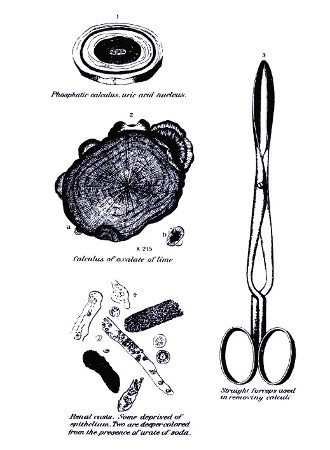
PLATE XI. CALCULI AND INSTRUMENT FOR REMOVAL.
INFLAMMATION OF THE URETHRA (URETHRITIS, OR GLEET).
This affection belongs quite as much to the generative organs, yet it can not be entirely overlooked in a treatise on urinary disorders. It may be induced by the same causes as cystitis (which see); by the passage and temporary arrest of small stones, or gravel; by the irritation caused by foreign bodies introduced from without; by blows on the penis by sticks, stones, or by the feet of a mare that kicks while being served; by an infecting inflammation contracted from a mare served in the first few days after parturition or one suffering from leucorrhea; by infecting matter introduced on a dirty catheter, or by the extension of inflammation from an irritated, bilocular cavity filled with hardened sebaceous matter, or from an uncleansed sheath.
Symptoms.—The symptoms are swelling, heat, and tenderness of the sheath and penis; difficulty, pain, and groaning in passing urine, which is liable to sudden temporary arrests in the course of micturition, and later a whitish, mucopurulent oozing from the papilla on the end of the penis. There is a tendency to erection of the penis, and in cases contracted from a mare the outer surface of that organ will show more or less extensive sores and ulcers. Stallions suffering in this way will refuse to mount or, having mounted, will fail to complete the act of coition. If an entrance is effected, infection of the mare is liable to follow.
Treatment in the early stages consists in a dose of physic (aloes 6 drams) and fomentations of warm water to the sheath and penis. If there is reason to suspect the presence of infection, inject the urethra twice daily with borax 1 dram, tepid water 1 quart. When the mucopurulent discharge indicates the supervention of the second stage a more astringent injection may be used (nitrate of silver 20 grains, water 1 quart), and the same may be applied to the surface of the penis and inside the sheath. Balsam of copaiba (1 dram daily) may also be given with advantage after the purulent discharge has appeared.
Every stallion suffering from urethritis should be withheld from service, as should mares with leucorrhea.
STRICTURE OF THE URETHRA.
This is a permanent narrowing of the urethra at a given point, the result of previous inflammation, caused by the passage or arrest of a stone, or gravel, by strong astringent injections in the early nonsecreting stage of urethritis, or by contraction of the lining membrane occurring during the healing of ulcers in neglected inflammations of that canal. The trouble is shown by the passage of urine in a fine stream, with straining, pain, and groaning, and by frequent painful erections. It must be remedied by mechanical dilatation, with catheters just large enough to pass with gentle force, to be inserted once a day, and to be used of larger size as the passage will admit them. The catheter should be kept perfectly clean and washed in a borax solution and well oiled before it is introduced.
URINARY CALCULI (STONE, OR GRAVEL).
These consist in some of the solids of the urine that have been precipitated from the urine in the form of crystals, which remain apart as a fine, powdery mass, or magma, or aggregate into calculi, or stones, of varying size. (See Pl. XI.) Their composition is therefore determined in different animals by the salts or other constituents found dissolved in the healthy urine, and by the additional constituents which may be thrown off in solution in the urine in disease. In this connection it is important to observe the following analysis of the horse's urine in health:
Water918.5
Urea13.4
Uric acid and urates.1
Hippuric acid26.4
Lactic acid and lactates1.2
Mucus and organic matter22.0
Sulphates (alkaline)1.2
Phosphates (lime and soda).2
Chlorids (sodium)1.0
Carbonates (potash, magnesia, lime)16.0
———
1000.0
The carbonate of lime, which is present in large quantity in the urine of horses fed on green fodder, is practically insoluble, and therefore forms in the passages after secretion, and its microscopic rounded crystals give the urine of such horses a milky whiteness. It is this material which constitutes the soft, white, pultaceous mass that sometimes fills the bladder to repletion and requires to be washed out. In hay-fed horses carbonates are still abundant, while in those mainly grain-fed they are replaced by hippurates and phosphates—the products of the wear of tissues—the carbonates being the result of oxidation of the vegetable acids in the feed. Carbonate of lime, therefore, is a very common constituent of urinary calculi in herbivora, and in many cases is the most abundant constituent.
Oxalate of lime, like carbonate of lime, is derived from the burning up of the carbonaceous matter of the feed in the system, one important factor being the less perfect oxidation of the carbon. Indeed, Füstenberg and Schmidt have demonstrated on man, horse, ox, and rabbit that under the full play of the breathing (oxidizing) forces oxalic acid, like other organic acids, is resolved into carbonic acid. In keeping with this is the observation of Lehmann, that in all cases in which man suffered from interference with the breathing oxalate of lime appeared in the urine. An excess of oxalate of lime in the urine may, however, claim a different origin. Uric and hippuric acids are found in the urine of carnivora and herbivora, respectively, as the result of the healthy wear (disassimilation) of nitrogenous tissues. If these products are fully oxidized, however, they are thrown out in the form of the more soluble urea rather than as these acids. When uric acid out of the body is treated with peroxid of lead it is resolved into urea, allantoin, and oxalic acid, and Wœhler and Frerrichs found that the administration of uric acid not only increased the excretion of urea but also of oxalic acid. It may therefore be inferred that oxalic acid is not produced from the carbonaceous feed alone but also from the disintegration of the nitrogenous tissues of the body. An important element of its production is, however, the imperfect performance of the breathing functions, and hence it is liable to result from diseases of the chest (heaves, chronic bronchitis, etc.). This is, above all, liable to prove the case if the subject is fed to excess on highly carbonaceous feeds (grass and green feed generally, potatoes, etc.).
Carbonate of magnesia, another almost constant ingredient of the urinary calculi of the horse, is formed the same way as the carbonate of lime—from the excess of carbonaceous feed (organic acids) becoming oxidized into carbon dioxid, which unites with the magnesia derived from the feed.
The phosphates of lime and magnesia are not abundant in urinary calculi of the horse, the phosphates being present to excess in the urine in only two conditions—(a) when the ration is excessive and especially rich in phosphorus (wheat, bran, beans, peas, vetches, rape cake, oil cake, cottonseed cake); and (b) when, through the morbid, destructive changes in the living tissues, and especially of the bones, a great quantity of phosphorus is given off as a waste product. Under these conditions, however, the phosphates may contribute to the formation of calculi, and this, above all, is liable if the urine is retained in the bladder until it has undergone decomposition and given off ammonia. The ammonia at once unites with the phosphate of magnesia to form a double salt—phosphate of ammonia and magnesia—which, being insoluble, is at once precipitated. The precipitation of this salt is, however, rare in the urine of the horse, though much more frequent in that of man and sheep.
These are the chief mineral constituents of the urine which form ingredients in the horse's calculi, for though iron and manganese are usually present it is only in minute quantities.
The excess of mineral matter in a specimen of urine unquestionably contributes to the formation of calculi, just as a solution of such matters out of the body is increasingly disposed to throw them down in the form of crystals as it becomes more concentrated and approaches nearer to the condition of saturation. Hence, in considering the causes of calculi we can not ignore the factor of an excessive ration, rich in mineral matters and in carbonaceous matters (the source of carbonates and much of the oxalates), nor can we overlook the concentration of the urine that comes from dry feed and privation of water, or from the existence of fever which causes suspension of the secretion of water. In these cases, at least the usual quantity of solids is thrown off by the kidneys, and as the water is diminished there is danger of its approaching the point of supersaturation, when the dissolved solids must necessarily be thrown down. Hence, calculi are more common in stable horses fed on dry grain and hay, in those denied a sufficiency of water or that have water supplied irregularly, in those subjected to profuse perspiration (as in summer), and in those suffering from a watery diarrhea. On the whole, calculi are most commonly found in winter, because the horses are then on dry feeding, but such dry feeding is even more conducive to them in summer when the condition is aggravated by the abundant loss of water by the skin.
In the same way the extreme hardness of the water in certain districts must be looked upon as contributing to the concentration of the urine and correspondingly to the production of stone. The carbonates, sulphates, etc., of lime and magnesia taken in the water must be again thrown out, and just in proportion as these add to the solids of the urine they dispose it to precipitate its least soluble constituents. Thus the horse is very subject to calculi on certain limestone soils, as over the calcareous formations of central and western New York, Pennsylvania, and Ohio, in America; of Norfolk, Suffolk, Derbyshire, Shropshire, and Gloucestershire, in England; of Poitou and Landes, in France; and Munich, in Bavaria.
The saturation of the urine from any or all of these conditions can only be looked on as an auxiliary cause, however, and not as in itself an efficient one, except on the rarest occasions. For a more direct and immediate cause we must look to the organic matter which forms a large proportion of all urinary calculi. This consists of mucus, albumen, pus, hyaline casts of the uriniferous tubes, epithelial cells, blood, etc., mainly agents that belong to the class of colloid or noncrystalline bodies. A horse may live for months and years with the urine habitually of a high density and having the mineral constituents in excess without the formation of stone or gravel; again, one with dilute urine of low specific gravity will have a calculus.
Rainey, Ord, and others furnish the explanation. They not only show that a colloid body, like mucus, albumen, pus, or blood, determined the precipitation or the crystalline salts in the solution, but they determined the precipitation in the form of globules, or spheres, capable of developing by further deposits into calculi. Heat intensifies this action of the colloids, and a colloid in a state of decomposition is specially active. The presence, therefore, of developing fungi and bacteria must be looked upon as active factors in causing calculi.
In looking, therefore, for the immediate causes of calculi we must consider especially all those conditions which determine the presence of albumen, blood, and excess of mucus, pus, etc., in the urine. Thus diseases of distant organs leading to albuminuria, diseases of the kidneys and urinary passages causing the escape of blood or the formation of mucus or pus, become direct causes of calculi. Foreign bodies of all kinds in the bladder or kidney have long been known as determining causes of calculi and as forming the central nucleus. This is now explained by the fact that these bodies are liable to carry bacteria into the passages and thus determine decomposition, and they are further liable to irritate the mucous membrane and become enveloped in a coating of mucus, pus, and perhaps blood.
The fact that horses, especially on the magnesian limestones, the same districts in which they suffer from goiter, appear to suffer from calculi may be similarly explained. The unknown poison which produces goiter presumably leads to such changes in the blood and urine as will furnish the colloid necessary for precipitation of the urinary salts in the form of calculi.
CLASSIFICATION OF URINARY CALCULI.
These have been named according to the place where they are found, renal (kidney), ureteric (ureter), vesical (bladder), urethral (urethra), and preputial (sheath, or prepuce). They have been otherwise named according to their most abundant chemical constituent, carbonate of lime, oxalate of lime, and phosphate of lime calculi. The stones formed of carbonates or phosphates are usually smooth on the surface, though they may be molded into the shape of the cavity in which they have been formed; thus those in the pelvis of the kidney may have two or three short branchlike prolongations, while those in the bladder are round, oval, or slightly flattened upon each other. Calculi containing oxalate of lime, on the other hand, have a rough, open, crystalline surface, which has gained for them the name of mulberry calculi, from a supposed resemblance to that fruit. These are usually covered with more or less mucus or blood, produced by the irritation of the mucous membrane by their rough surfaces. The color of calculi varies from white to yellow and deep brown, the shades depending mainly on the amount of the coloring matter of blood, bile, or urine which they may contain.
Renal calculi.—These may consist of minute, almost microscopic, deposits in the uriniferous tubes in the substance of the kidney, but more commonly they are large masses and lodged in the pelvis. The larger calculi, sometimes weighing 12 to 24 ounces, are molded in the pelvis of the kidney into a cylindroid mass, with irregular rounded swellings at intervals. Some have a deep brown, rough, crystalline surface of oxalate of lime, while others have a smooth, pearly white aspect from carbonate of lime. A smaller calculus, which has been called coralline, is also cylindroid, with a number of brown, rough, crystalline oxalate of lime branches and whitish depressions of carbonate. These vary in size from 15 grains to nearly 2 ounces. Less frequently are found masses of very hard, brownish white, rounded, pealike calculi. These are smoother, but on the surface crystals of oxalate of lime may be detected with a lens. Some renal calculi are formed of more distinct layers, more loosely adherent to one another, and contain an excess of mucus, but no oxalate of lime. Finally, a loose aggregation of small masses, forming a very friable calculus, is found of all sizes within the limits of the pelvis of the kidney. These, too, are in the main carbonate of lime (84 to 88 per cent) and without oxalate.
Symptoms of renal calculi are violent, colicky, pains, appearing suddenly, very often in connection with exhausting work or the drawing of specially heavy loads, and in certain cases disappearing with equal suddenness. The nature of the colic becomes more manifest if it is associated with stiffness of the back and hind limbs, frequent passage of urine, and, above all, the passage of gravel with the urine, especially at the time of the access of relief. The passage of blood and pus in the urine is equally significant. If the irritation of the kidney goes on to active inflammation, then the symptoms of nephritis are added.
Ureteric calculi.—These are so called because they are found in the passage leading from the kidney to the bladder. They are simply small, renal calculi which have escaped from the pelvis of the kidney and have become arrested in the ureter. They give rise to symptoms almost identical with those of renal calculi, with this difference, that the colicky pains, caused by the obstruction of the ureter by the impacted calculus, are more violent, and if the calculus passes on into the bladder the relief is instantaneous and complete. If the ureter is completely blocked for a length of time, the retained urine may give rise to destructive inflammation in the kidney, which may end in the entire absorption of that organ, leaving only a fibrous capsule containing an urinous fluid. If both the ureters are similarly blocked, the animal will die of uremic poisoning.
Treatment of renal and ureteric calculi.—Treatment is unsatisfactory, as it is only the small calculi that can pass through the ureters and escape into the bladder. This may be favored by agents which will relax the walls of the ureters by counteracting their spasm and even lessening their tone, and by a liberal use of water and watery fluids to increase the urine and the pressure upon the calculus from behind. One or two ounces of laudanum, or 2 drams of extract of belladonna, may be given and repeated as it may be necessary, the relief of the pain being a fair criterion of the abating of the spasm. To the same end use warm fomentations across the loins, and these should be kept up persistently until relief is obtained. These act not only by soothing and relieving the spasm and inflammation, but they also favor the freer secretion of a more watery urine, and thus tend to carry off the smaller calculi. To accomplish this object further give cool water freely, and let the feed be only such as contains a large proportion of liquid, gruels, mashes, turnips, beets, apples, pumpkins, ensilage, succulent grasses, etc. If the acute stage has passed and the presence of the calculus is manifested only by the frequent passage of urine with gritty particles, by stiffness of the loins and hind limbs, and by tenderness to pressure, the most promising resort is a long run at pasture where the grasses are fresh and succulent. The long-continued secretion of a watery urine will sometimes cause the breaking down of a calculus, as the imbibition of the less dense fluid by the organic, spongelike framework of the calculus causes it to swell and thus lessens its cohesion. The same end is sought by the long-continued use of alkalies (carbonate of potassium), and of acids (muriatic), each acting in a different way to alter the density and cohesion of the stone. It is only exceptionally, however, that any one of these methods is entirely satisfactory. If inflammation of the kidneys develops, treat as advised under that head.
Stone in the bladder (vesical calculus, or cystic calculus).—These may be of any size up to over a pound in weight. One variety is rough and crystalline and has a yellowish-white or deep-brown color. These contain about 87 per cent carbonate of lime, the remainder being carbonate of magnesia, oxalate of lime, and organic matter. The phosphatic calculi are smooth, white and formed of thin, concentric layers of great hardness extending from the nucleus outward. Besides the phosphate of lime they contain the carbonates of lime and magnesia and organic matter. In some cases the bladder contains and may be even distended by a soft, pultaceous mass made up of minute, round granules of carbonates of lime and magnesia. This, when removed and dried, makes a firm, white, and stony mass. Sometimes this magma is condensed into a solid mass in the bladder by reason of the binding action of the mucus and other organic matter, and then forms a conglomerate stone of nearly uniform consistency and without stratification.
Symptoms of stone in the bladder.—The symptoms of stone in the bladder are more obvious than those of renal calculus. The rough, mulberry calculi especially lead to irritation of the mucous membrane and frequent passing of urine in small quantities and often mingled with mucus or blood or containing minute, gritty particles. At times the flow is suddenly arrested, though the animal continues to strain and the bladder is not quite emptied. In the smooth, phosphatic variety the irritation is much less marked and may even be altogether absent. With the pultaceous deposit in the bladder there is incontinence of urine, which dribbles away continually and keeps the hair on the inner side of the thighs matted with soft magma. In all cases alike the calculus may be felt by the examination of the bladder with the oiled hand in the rectum. The pear-shaped outline of the bladder can be felt beneath, and within it the solid, oval body. It is most easily recognized if the organ is half full of liquid, as then it is not grasped by the contracting walls of the bladder, but may be made to move from place to place in the liquid. If a pultaceous mass is present it has a soft, doughy feeling, and when pressed an indentation is left.
In the mare the hard stone may be touched by the finger introduced through the short urethra.
Treatment of stone in the bladder.—The treatment of stone in the bladder consists in the removal of the offending body; in the mare this is easily effected with the lithotomy forceps. These are slightly warmed and oiled, and carried forward along the floor of the passage of the vulva for 4 inches, when the orifice of the urethra will be felt exactly in the median line. Through this the forceps are gradually pushed with gentle, oscillating movement until they enter the bladder and strike against the hard surface of the stone. The stone is now grasped between the blades, care being taken to include no loose fold of the mucous membrane, and it is gradually withdrawn with the same careful, oscillating motions as before. Facility and safety in seizing the stone will be greatly favored by having the bladder half full of liquid, and if necessary one oiled hand may be introduced into the rectum or vagina to assist. The resulting irritation may be treated by an injection of laudanum, 1 ounce in a pint of tepid water.
The removal of the stone in the horse is a much more difficult proceeding. It consists in cutting into the urethra just beneath the anus and introducing the lithotomy forceps from this forward into the bladder, as in the mare. It is needful to distend the urethra with tepid water or to insert a sound or catheter to furnish a guide upon which the incision may be made, and in case of a large stone it may be needful to enlarge the passage by cutting in a direction upward and outward with a probe-pointed knife, the back of which is slid along in the groove of a director until it enters the bladder.
The horse may be operated upon in the standing position, being simply pressed against the wall by a pole passed from before backward along the other side of the body. The tepid water is injected into the end of the penis until it is felt to fluctuate under the pressure of the finger, in the median line over the bone just beneath the anus. The incision is then made into the center of the fluctuating canal, and from above downward. When a sound or catheter is used as a guide it is inserted through the penis until it can be felt through the skin at the point where the incision is to be made beneath the anus. The skin is then rendered tense by the thumb and fingers of the left hand pressing on the two sides of the sound, while the right hand, armed with a scalpel, cuts downward onto the catheter. This vertical incision into the canal should escape wounding any important blood vessel. It is in making the obliquely lateral incision in the subsequent dilatation of the urethra and neck of the bladder that such danger is to be apprehended.
If the stone is too large to be extracted through the urethra, it may be broken down with the lithotrite and extracted piecemeal with the forceps. The lithotrite is an instrument composed of a straight stem bent for an inch or more to one side at its free end so as to form an obtuse angle, and having on the same side a sliding bar moving in a groove in the stem and operated by a screw so that the stone may be seized between the two blades at its free extremity and crushed again and again into pieces small enough to extract. Extra care is required to avoid injury to the urethra in the extraction of the angular fragments, and the gravel or powder that can not be removed in this way must be washed out, as advised below.
When a pultaceous magma of carbonate of lime accumulates in the bladder it must be washed out by injecting water through a catheter by means of a force pump or a funnel, shaking it up with the hand introduced through the rectum and allowing the muddy liquid to flow out through the tube. This is to be repeated until the bladder is empty and the water come away, clear. A catheter with a double tube is sometimes used, the injection passing in through the one tube and escaping through the other. The advantage is more apparent than real, however, as the retention of the water until the magma has been shaken up and mixed with it hastens greatly its complete evacuation.
To prevent the formation of a new deposit any fault in feeding (dry grain and hay with privation of water, excess of beans, peas, wheat bran, etc.) and disorders of stomach, liver, and lungs must be corrected. Give abundance of soft drinking water, encouraging the animal to drink by a handful of salt daily. Let the feed be laxative, consisting largely of roots, apples, pumpkins, ensilage, and give daily in the drinking water a dram of either carbonate of potash or soda. Powdered gentian root (3 drams daily) will also serve to restore the tone of the stomach and system at large.
Urethral calculus (stone in the urethra).—This is less frequent in horses than in cattle and sheep, owing to the larger size of the urethra in the horse and the absence of the S-shaped curve and vermiform appendix. The calculi arrested in the urethra are never formed there, but consist of cystic calculi which have been small enough to pass through the neck of the bladder, but are too large to pass through the whole length of the urethra and escape. Such calculi therefore are primarily formed either in the bladder or kidney, and have the chemical composition of the other calculi found in those organs. They may be arrested at any point of the urethra, from the neck of the bladder back to the bend of the tube beneath the anus, and from that point down to the extremity of the penis. I have found them most frequently in the papilla on the extreme end of the penis, and immediately behind this.
Symptoms of urethral calculus.—The symptoms are violent straining to urinate, but without any discharge, or with the escape of water in drops only. Examination of the end of the penis will detect the swelling of the papilla or the urethra behind it, and the presence of a hard mass in the center. A probe inserted into the urethra will strike against the gritty calculus. If the stone has been arrested higher up, its position may be detected as a small, hard, sensitive knot on the line of the urethra, in the median line of the lower surface of the penis, or on the floor of pelvis in the median line from the neck of the bladder back to the bend of the urethra beneath the anus. In any case the urethra between the neck of the bladder and the point of obstruction is liable to be filled with fluid, and to feel like a distended tube, fluctuating on pressure.
Treatment of urethral calculus may be begun by an attempt to extract the calculi by manipulation of the papilla on the end of the penis. This failing, the calculus may be seized with a pair of fine-pointed forceps and withdrawn from the urethra; or, if necessary, a probe-pointed knife may be inserted and the urethra slightly dilated, or even laid open, and the stone removed. If the stone has been arrested higher up it must be extracted by a direct incision through the walls of the urethra and down upon the nodule. If in the free (protractile) portion of the penis, that organ is to be withdrawn from its sheath until the nodule is exposed and can be incised. If behind the scrotum, the incision must be made in the median line between the thighs and directly over the nodule, the skin having been rendered tense by the fingers and thumb of the left hand. If the stone has been arrested in the intrapelvic portion of the urethra, the incision must be made beneath the anus and the calculus extracted with forceps, as in stone in the bladder. The wound in the urethra may be stitched up, and usually heals slowly but satisfactorily. Healing will be favored by washing two or three times daily with a solution of a teaspoonful of carbolic acid in a pint of water.
Preputial calculus (calculus in the sheath, or bilocular cavity).—These are concretions in the sheath, though the term has been also applied to the nodule of sebaceous matter which accumulates in the blind pouches (bilocular cavity) by the sides of the papilla on the end of the penis. Within the sheath the concretion may be a soft, cheesy-like sebaceous matter, or a genuine calculus of carbonate, oxalate, phosphate and sulphate of lime, carbonate of magnesia, and organic matter. These are easily removed with the fingers, after which the sheath should be washed out with castile soap and warm water and smeared with sweet oil.