DISEASES OF THE DIGESTIVE ORGANS.
Reading edition
By Ch. B. Michener, V. S.
[Revised by John R. Mohler, V. M. D.]
It is not an easy task to write "a plain account of the common diseases, with directions for preventive measures, hygienic care, and the simpler forms of medical treatment," of the digestive organs of the horse. Being limited as to space, the endeavor has been made to give simply an outline—to state the most important facts—leaving many gaps, and continually checking the disposition to write anything like a full description as to cause, prevention, and modes of treatment of diseases.
WATER.
It is generally held, at least in practice, that any water that stock can be induced to drink is sufficiently pure for their use. This practice occasions losses that would startle us if statistics were at hand. Water that is impure from the presence of decomposing organic matter, such as is found in wells and ponds in close proximity to manure heaps and cesspools, is frequently the cause of diarrhea, dysentery, and many other diseases of stock, while water that is impregnated with different poisons and contaminated in very many instances with specific media of contagion produces death.
Considering first the quantity of water required by the horse, it may be stated that when our animals have access to water continually they never drink to excess. Were the horse subjected to ship voyages or any other circumstances where he must depend upon his attendant for the supply of water, it may be roughly stated that he requires a daily average of about 8 gallons of water. This varies somewhat upon the character of his feed; if upon green feed, less water will be needed than when fed upon dry hay and grain.
The time of giving water should be carefully studied. At rest, the horse should receive it at least three times a day; when at work, more frequently. The rule should be to give it in small quantities and often. There is a popular fallacy that if a horse is warm he should not be allowed to drink, many asserting that the first swallow of water "founders" the animal or produces colic. This is erroneous. No matter how warm a horse may be, it is always entirely safe to allow him from six to ten swallows of water. If this is given on going into the stable, he should have at once a pound or two of hay and allowed to rest about an hour before feeding. If water is now offered him it will in many cases be refused, or at least he will drink but sparingly. The danger, then, is not in the "first swallow" of water, but is due to the excessive quantity that the animal will take when warm if he is not restrained.
Ice-cold water should never be given to horses. It may not be necessary to add hot water, but we should be careful in placing water troughs about our barns to have them in such position that the sun may shine upon the water during the winter mornings. Water, even though it is thus cold, seldom produces serious trouble if the horse has not been deprived for a too great length of time.
In reference to the purity of water, Smith, in his "Veterinary Hygiene," classes spring water, deep-well water, and upland surface water as wholesome; stored rain water and surface water from cultivated land as suspicious; river water to which sewage gains access and shallow-well water as dangerous. The water that is used so largely for drinking purposes for stock throughout some States can not but be impure. I refer to those sections where there is an impervious clay subsoil. It is the custom to scoop, or hollow out, a large basin in the pastures. During rains these basins become filled with water. The clay subsoil, being almost impervious, acts as a jug, and there is no escape for the water except by evaporation. Such water is stagnant, but would be kept comparatively fresh by subsequent rains were it not for the fact that much organic matter is carried into it by surface drainage during each succeeding storm. This organic matter soon undergoes decomposition, and, as the result, we find diseases of different kinds much more prevalent where this water is drunk than where the water supply is wholesome. Again, it must not be lost sight of that stagnant surface water is much more certainly contaminated than is running water by one diseased animal of the herd, thus endangering the remainder.
The chief impurities of water may be classified as organic and inorganic. The organic impurities are either animal or vegetable substances. The salts of the metals are the inorganic impurities. Lime causes hardness of water, and occasion will be taken to speak of this when describing intestinal concretions. Salts of lead, iron, and copper are also frequently found in water; they also will be referred to.
About the only examination of water that can be made by the average stock raiser is to observe its taste, color, smell, and clearness. Pure water is clear and is without taste or smell.
Chemical and microscopic examination will frequently be necessary in order to detect the presence of certain poisons, bacteria, etc., and can, of course, be conducted by experts only.
FEEDS AND FEEDING.
In this place one can not attempt anything like a comprehensive discussion of the subject of feeds and feeding, and I must content myself with merely giving a few facts as to the different kinds of feed, preparation, digestibility, proper time of feeding, quality, and quantity. Improper feeding and watering will doubtless account for more than one-half the digestive disorders met with in the horse, and hence the reader can not fail to see how very important it is to have some proper ideas concerning these subjects.
KINDS OF FEED.
In this country horses are fed chiefly upon hay, grass, corn fodder, roots, oats, corn, wheat, and rye. Many think that they could be fed on nothing else. Stewart, in "The Stable Book," gives the following extract from Loudon's Encyclopedia of Agriculture, which is of interest at this point:
In some sterile countries they [horses] are forced to subsist on dried fish, and even on vegetable mold; in Arabia, on milk, flesh balls, eggs, broth. In India horses are variously fed. The native grasses are judged very nutritious. Few, perhaps no, oats are grown; barley is rare, and not commonly given to horses. In Bengal a vetch, something like the tare, is used. On the western side of India a sort of pigeon pea, called gram (Cicer arietinum), forms the ordinary food, with grass while in season, and hay all the year round. Indian corn or rice is seldom given. In the West Indies maize, guinea corn, sugar-corn tops, and sometimes molasses are given. In the Mahratta country salt, pepper, and other spices are made into balls, with flour and butter, and these are supposed to produce animation and to fine the coat. Broth made from sheep's head is sometimes given. In France, Spain, and Italy, besides the grasses, the leaves of limes, vines, the tops of acacia, and the seeds of the carob tree are given to horses.
We can not, however, leave aside entirely here a consideration of the digestibility of feeds; and by this we mean the readiness with which they undergo those changes in the digestive canal that fit them for absorption and deposition as integral parts of the animal economy.
The age and health of the animal will, of course, modify the digestibility of feeds, as will also the manner and time of harvesting, preserving, and preparing.
In the horse digestion takes place principally in the intestines, and here, as in all other animals and with all feeds, it is found that a certain part only of the provender is digested; another portion is undigested. This proportion of digested and undigested feed must claim passing notice at least, for if the horse receives too much feed, or bulky feed containing much indigestible waste, a large portion of it must pass out unused, entailing not only the loss of this unused feed, but also calling for an unnecessary expenditure of vital force on the part of the digestive organs of the horse. It is thus that, in fact, too much feed may make an animal poor.
In selecting feed for the horse we should remember the anatomical arrangement of the digestive organs, as well as the physiological functions performed by each one of them. Feeds must be wholesome, clean, and sweet, the hours of feeding regular, the mode of preparation found by practical experience to be the best must be adhered to, and cleanliness in preparation and administration must be observed.
The length of time occupied by stomach digestion in the horse varies with the different feeds. Hay and straw pass out of the stomach more rapidly than oats. It would seem to follow, then, that oats should be given after hay, for if reversed the hay would cause the oats to be sent onward into the intestines before being fully acted upon by the stomach, and as a result produce indigestion. Experience confirms this. There is another good reason why hay should be given first, particularly if the horse is very hungry or if exhausted from overwork, namely, it requires more time in mastication (insuring proper admixture of saliva) and can not be bolted, as are the grains. In either instance water must not be given soon after feeding, as it washes or sluices the feed from the stomach before it is fitted for intestinal digestion.
The stomach begins to empty itself very soon after the commencement of feeding, and continues rapidly while eating. Afterwards the passage is slower, and several hours are required before the stomach is entirely empty. The nature of the work required of the horse must guide us in the selection of his feed. Rapid or severe labor can not be performed on a full stomach. For such labor feed must be given in small quantity and about two hours before going to work. Even horses intended for slow work must never be engorged with bulky, innutritious feed immediately before going to labor. The small stomach of the horse would seem to lead us to the conclusion that he should be fed in small quantities and often, which, in reality, should be done. The disproportion between the size of the stomach and the quantity of water drunk tells us plainly that the horse should always be watered before feeding. One of the common errors of feeding, and the one that produces more digestive disorders than any other, is to feed too soon after a hard day's work. This must never be done. If a horse is completely jaded, it will be found beneficial to give him an alcoholic stimulant on going into the stable. A small quantity of hay may then be given, but his grain should be withheld for one or two hours. These same remarks will apply with equal force to the horse that for any reason has been fasting for a long time. After a fast, feed less than the horse would eat, for if allowed too much the stomach becomes engorged, its walls paralyzed, and "colic" is almost sure to follow. The horse should be fed three or four times a day. It will not do to feed him entirely upon concentrated feed. Bulky feed must be given to detain the grains in their passage through the intestinal tract; bulk also favors distention, and thus mechanically aids absorption. For horses that do slow work the greater part of the time, chopped or cut hay fed with crushed oats, ground corn, etc., is the best manner of feeding, as it gives the required bulk, saves time, and half the labor of feeding.
Sudden changes of diet are always dangerous. When desirous of changing, do so very gradually. If a horse is accustomed to oats, a sudden change to a full meal of corn will almost always sicken him. If we merely intend to increase the quantity of the usual feed, this also must be done gradually. The quantity of feed given must always be in proportion to the amount of labor to be performed. If a horse is to do a small amount of work, or rest entirely from work for a few days, he should receive a proportionate quantity of feed. If this should be observed even on Saturday night and Sunday, there would be fewer cases of "Monday morning sickness," such as colics and lymphangitis.
Feeds should also be of a more laxative nature when the horse is to stand for several days.
Musty or moldy feeds.—Above all things, avoid feeding musty or moldy feeds. They are very frequent causes of disease of different kinds. Lung trouble, such as bronchitis and "heaves," often follows their use. The digestive organs always suffer from moldy or musty feeds. Musty hay is generally considered to produce disorder of the kidneys, and all know of the danger from feeding pregnant animals upon ergotized grasses or grains. It has often been said to produce that peculiar disease known variously as cerebrospinal meningitis, putrid sore throat, or choking distemper.
Hay.—The best hay for horses is timothy. It should be about one year old, of a greenish color, crisp, clean, fresh, and possessing a sweet, pleasant aroma. Even this good hay, if kept too long, loses part of its nourishment, and, while it may not be positively injurious, it is hard, dry, and indigestible. New hay is difficult to digest, produces much salivation (slobbering), and occasional purging and irritation of the skin. If fed at all it should be mixed with old hay.
Second crop, or aftermath.—This is not considered good hay for horses, but it is prized by some farmers as good for milch cows, the claim being made that it increases the flow of milk. The value of hay depends upon the time of cutting, as well as care in the curing. Hay should be cut when in full flower, but before the seeds fall; if left longer it becomes dry, woody, and lacks in nutrition. An essential point in making hay is that when the crop is cut it should remain in the field as short a time as possible. If left too long in the sun it loses color, flavor, and dries or wastes. Smith asserts that one hour more than is necessary in the sun causes a loss of 15 to 20 per cent in the feeding value of hay. It is impossible to state any fixed time that hay must have to cure, this depending, of course, upon the weather, thickness of the crop, and many other circumstances; but it is well known that in order to preserve the color and aroma of hay it should be turned or tedded frequently and cured as quickly as possible. On the other hand, hay spoils in the mow if harvested too green or when not sufficiently dried. Mow-burnt hay produces disorder of the kidneys and bowels and causes the horse to fall off in condition.
The average horse on grain should be allowed from 10 to 12 pounds of good hay a day. It is a mistake of many to think that horses at light work can be kept entirely on hay. Such horses soon become potbellied, fall off in flesh, and do not thrive. The same is true of colts; unless the latter are fed with some grain they grow up to be long, lean, gawky creatures, and never make so good horses as those accustomed to grain with, or in addition to, their hay.
Straw.—The straws are not extensively fed in this country, and when used at all they should be cut and mixed with hay and ground or crushed grain. Wheat, rye, and oat straw are the ones most used; of these, oat straw is most easily digested and contains the most nourishment. Pea and bean straw are occasionally fed to horses, the pea being preferable, according to most writers.
Chaff.—Wheat and rye chaff should never be used as a feed for horses. The beards frequently become lodged in the mouth or throat and are productive of more or less serious trouble. In the stomach and intestines they often serve as the nucleus of the "soft concretions," which are to be described when treating of obstructions of the digestive tract.
Oat chaff, if fed in small quantities and mixed with cut hay or corn fodder, is very much relished by horses. It is not to be given in large quantities, as I have repeatedly witnessed a troublesome and sometimes fatal diarrhea following the practice of allowing horses or cattle free access to a pile of oat chaff.
Grains.—Oats take precedence of all grains as a feed for horses, as the ingredients necessary for the complete nutrition of the body exist in them in the best proportions. Oats are, besides, more easily digested and a larger proportion absorbed and converted into the various tissues of the body. Care must be taken in selecting oats. According to Stewart, the best oats are one year old, plump, short, hard, clean, bright, and sweet. New oats are indigestible. Kiln-dried oats are to be refused, as a rule, for even though originally good this drying process injures them. Oats that have sprouted or fermented are injurious and should never be fed. Oats are to be given either whole or crushed—whole in the majority of instances; crushed to old horses and those having defective teeth. Horses that bolt their feed are also best fed upon crushed oats and out of a manger large enough to permit of spreading the grain in a thin layer.
In addition to the allowance of hay above mentioned, the average horse requires about 12 quarts of good oats daily. The best oats are those cut about one week before they are fully ripe. Not only is the grain richer in nutritive materials at this time, but there is also less waste from "scattering" than if left to become dead ripe. Moldy oats, like hay and straw, not only produce serious digestive disorders but have been the undoubted cause of outbreaks of that dread disease in horses, already referred to, characterized by inability to eat or drink, sudden paralysis, and death.
Wheat and rye.—These grains are not to be used for horses except in small quantities, bruised or crushed, and fed mixed with other grains or hay. If fed alone, in any considerable quantities, they are almost certain to produce digestive disorders, laminitis (founder), and similar troubles. They should never constitute more than one-fourth the grain allowance, and should always be ground or crushed.
Bran.—The bran of wheat is the one most used, and its value as a feeding stuff is variously estimated. It is not to be depended upon if given alone, but may be fed with other grains. It serves to keep the bowels open. Sour bran is not to be given, for it disorders the stomach and intestines and may even produce serious results.
Maize (corn).—This grain is not suitable as an exclusive feed for young horses, as it is deficient in salts. It is fed whole or ground. Corn on the cob is commonly used for horses affected with "lampas." If the corn is old and is to be fed in this manner it should be soaked in pure, clean water for 10 or 12 hours. Corn is better given ground, and fed in quantities of from 1 to 2 quarts at a meal, mixed with crushed oats or wheat bran. Great care should be taken in giving corn to a horse that is not accustomed to its use. It must be commenced in small quantities and very gradually increased. I know of no grain more liable to produce what is called acute indigestion than corn if these directions are not observed.
Linseed.—Ground linseed is occasionally fed with other feeds to keep the bowels open and to improve the condition of the skin. It is of particular service during convalescence, when the bowels are sluggish in their action. Linseed tea is very often given in irritable or inflamed conditions of the digestive organs.
Potatoes.—These are used as an article of feed for the horse in many sections. If fed raw and in large quantities they often produce indigestion. Their digestibility is increased by steaming or boiling. They possess, in common with other roots, slight laxative properties.
Beets.—These are not much used as feed for horses.
Carrots.—These make a most excellent feed, particularly during sickness. They improve the appetite and slightly increase the action of the bowels and kidneys. They possess also certain alterative properties, making the coat smooth and glossy. Some veterinary writers assert that chronic cough is cured by giving carrots for some time. The roots may be considered, then, as an adjunct to the regular regimen, and if fed in small quantities are highly beneficial.
Grasses.—Grass is the natural food of horses. It is composed of a great variety of plants, differing widely as to the amount of nourishment contained, some being almost entirely without value and only eaten when nothing else is obtainable, while others are positively injurious, or even poisonous. None of the grasses are sufficient to keep the horse in condition for work. Horses thus fed are "soft," sweat easily, purge, and soon tire on the road or when at hard work. Grass is indispensable to growing stock, and there is little or no doubt that it acts as an alterative when given to horses accustomed to grain and hay. It must be given to such horses in small quantities at first. The stomach and intestines undergo rest, and recuperate if the horse is turned to grass for a time each year. It is also certain that during febrile diseases grass acts almost as a medicine, lessening the fever and favoring recovery. Wounds heal more rapidly than when the horse is on grain, and some chronic disorders (chronic cough, for instance) disappear entirely when at grass. In my experience, grass does more good when the horse crops it himself. This may be due to the sense of freedom he enjoys at pasture, to the rest to his feet and limbs, and for many other similar reasons. When cut for him it should be fed fresh or when but slightly wilted.
Silage.—Regarding silage as a feed for horses, Rommel in Farmers' Bulletin 578 writes as follows:
Silage has not been generally fed to horses, partly on account of a certain amount of danger which attends its use for this purpose, but still more, perhaps, on account of prejudice. In many cases horses have been killed by eating moldy silage, and the careless person who fed it at once blamed the silage itself, rather than his own carelessness and the mold which really was the cause of the trouble. Horses are peculiarly susceptible to the effects of molds, and under certain conditions certain molds grow on silage which are deadly poisons to both horses and mules. Molds must have air to grow, and therefore silage which is packed air-tight and fed out rapidly will not become moldy. If the feeder watches the silage carefully as the weather warms up he can soon detect the presence of mold. When mold appears, feeding to horses or mules should stop immediately.
It is also unsafe to feed horses frozen silage on account of the danger of colic. * * *
To summarize, silage is safe to feed to horses and mules only when it is made from fairly mature corn, properly stored in the silo. When it is properly stored and is not allowed to mold, no feed exceeds it as a cheap winter ration. It is most valuable for horses and mules which are not at heavy work, such as brood mares and work horses during the slack season. With plenty of grain on the cornstalks, horses will keep in good condition on a ration of 20 pounds of silage and 10 pounds of hay for each 1,000 pounds of live weight.
PREPARATION OF FEEDS.
Feed is prepared for any of the following reasons: To render it more easily eaten; to make it more digestible; to economize in amount; to give it some new property; and to preserve it. We have already spoken of the preparation of drying, and need not revert to this again, as it only serves to preserve the different feeds. Drying does, however, change some of the properties of feed, i. e., removes the laxative tendency of most of them.
The different grains are more easily eaten when ground, crushed, or even boiled. Rye or wheat should never be given whole, and even of corn it is found that there is less waste when ground, and, in common with all other grains, it is more easily digested than when fed whole.
Hay and fodder are economized when cut in short pieces. Not only will the horse eat the necessary quantity in a shorter time, but it will be found that there is less waste, and the mastication of the grains (whole or crushed) fed with them is insured.
Reference has already been made to those horses that bolt their feed, and we need only remark here that the consequences of such ravenous eating may be prevented if the grains are fed with cut hay, straw, or fodder. Long or uncut hay should also be fed, even though a certain quantity of hay or straw is cut and fed mixed with grain.
One objection to feeding cut hay mixed with ground or crushed grains, and wetted, must not be overlooked during the hot months. Such feed is liable to undergo fermentation if not fed directly after it is mixed; even the mixing trough, unless frequently scalded and cleaned, becomes sour and enough of its scrapings are given with the feed to produce flatulent (wind) colic. A small quantity of salt should always be mixed with such feed. Bad hay should never be cut simply because it insures a greater consumption of it; bad feeds are dear at any price, and should never be fed.
The advantage of boiling roots has been mentioned. Not only does this render them less liable to produce digestive disorders, but it also makes them clean. Boiling or steaming grains is to be recommended when the teeth are poor, or when the digestive organs are weak.
DISEASES OF THE TEETH.
Dentition.—This covers the period during which the young horse is cutting his teeth—from birth to the age of 5 years. With the horse more difficulty is experienced in cutting the second or permanent teeth than with the first or milk teeth. There is a tendency among farmers and many veterinarians to pay too little attention to the teeth of young horses. Percivall relates an instance illustrative of this that is best told in his own words:
I was requested to give my opinion concerning a horse, then in his fifth year, who had fed so sparingly for the last fortnight, and so rapidly declined in condition in consequence, that his owner, a veterinary surgeon, was under no light apprehensions about his life. He had himself examined his mouth without having discovered any defect or disease, though another veterinary surgeon was of opinion that the difficulty or inability manifested in mastication, and the consequent cudding, arose from preternatural bluntness of the surfaces of the molar teeth, which were, in consequence, filed, but without beneficial result. It was after this that I saw the horse, and I confess I was, at my first examination, quite as much at a loss to offer any satisfactory interpretation as others had been. While meditating, however, after my inspection, on the apparently extraordinary nature of the case, it struck me that I had not seen the tusks. I went back into the stable and discovered two little tumors, red and hard, in the situation of the inferior tusks, which, when pressed, gave the animal insufferable pain. I instantly took out my pocketknife and made crucial incisions through them both, down to the coming teeth, from which moment the horse recovered his appetite and, by degrees, his wonted condition.
The mouths of young horses should be examined from time to time to see whether one or more of the milk teeth are not remaining too long, causing the second teeth to grow in crooked, in which case the first teeth should be removed with the forceps.
Irregularities of teeth.—There is a fashion of late years, especially in large cities, to have horses' teeth regularly "floated," or "rasped," by "veterinary dentists." In some instances this is very beneficial, while in most cases it is entirely unnecessary. From the character of the feed, the rubbing, or grinding, surface of the horse's teeth should be rough. Still, we must remember that the upper jaw is somewhat wider than the lower, and that, from the fact of the teeth not being perfectly apposed, a sharp ridge is left unworn on the inside of the lower molars and on the outside of the upper, which may excoriate the tongue or cheeks to a considerable extent. This condition may readily be felt by the hand, and these sharp ridges when found should be rasped down by a guarded rasp. In some instances the first or last molar tooth is unnaturally long, owing to the fact that its fellow in the opposite jaw has been lost or does not close perfectly against it. Should it be the last molar that is thus elongated, it will require the aid of the veterinary surgeon, who has the necessary forceps or chisel for cutting it. The front molar may be rasped down, if much patience is taken. In decay of the teeth it is quite common to find the tooth corresponding to the decayed one on the opposite jaw very much elongated, sometimes to such an extent that the mouth can not be perfectly closed. Such teeth must also be shortened by the tooth forceps, chisel, tooth saw, or rasp. In all instances in which horses "quid" their feed, if they are slobbering, or evince pain in mastication, shown by holding the head to one side while chewing, the teeth should be carefully examined. Horses whose teeth have unduly sharp edges are liable to drive badly; they pull to one side, do not bear on the bit, or bear on too hard and "big," toss the head, and start suddenly when a tender spot is touched. If, as is mostly the case, all the symptoms are referable to sharp corners or projections, these must be removed by the rasp. If decayed teeth ere found, or other serious difficulty detected, or if the cause of the annoying symptoms is not discovered, an expert should be called.
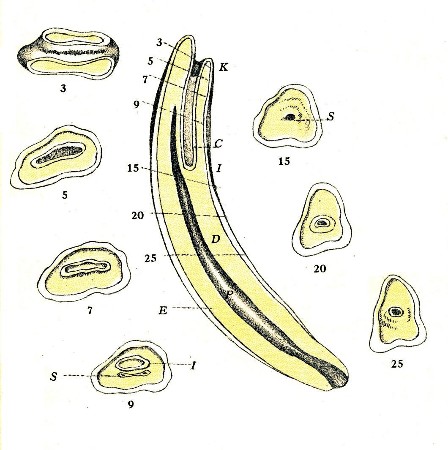
PLATE IV. Age of Horses as Indicated by Teeth. Longitudinal section of left central lower incisor and cross sections of same tooth showing table surfaces as they appear at the ages of 3, 5, 7, 9, 15, 20 and 25 years. C, Cement; D, Dentine; E, Enamel; I, Infundibulum; K, Cup; P, Pulp Cavity; S, Star.
Toothache.—This is rare in the horse and is mostly witnessed when there is decay of a tooth or inflammation about its root. Toothache is to be discovered in the horse by the pain expressed by him while feeding or drinking cold water. I have seen horses, affected with toothache, that would suddenly stop chewing, throw the head to one side, and slightly open the mouth. They behave as though some sharp body had punctured the mouth. If upon examination, no foreign body is found, we must then carefully examine each tooth. If this can not be done with the hand in the mouth, we can, in most instances, discover the aching tooth by pressing each tooth from without. By tapping the teeth in succession with a hard object, such as a small hammer, the one that is tender may be identified. The horse will flinch when the sore tooth is pressed or tapped upon. In most cases there is nothing to be done but extract the decayed tooth, and this, of course, is to be attempted by the veterinarian only.
Deformity.—There is a deformity, known as parrot-mouth, that interferes with prehension, mastication, and, indirectly, with digestion. The upper incisors project in front of and beyond the lower ones. The teeth of both jaws become unusually long, as they are not worn down by friction. Such horses experience much difficulty in grazing. Little can be done except to examine the teeth occasionally, and if those of the lower jaw become so long that they bruise the "bars" of the upper jaw, they must be shortened by the rasp or saw. Horses with this deformity should never be left entirely at pasture.
The method of determining the age of a horse by the teeth is illustrated in Plate IV.
DISEASES OF THE MOUTH.
LAMPAS.
Lampas is the name given to a swelling of the mucous membrane covering the hard palate and projecting in a more or less prominent ridge immediately behind the upper incisors. The hard palate is composed of spongy tissue that fills with blood when the horse is feeding, which causes the ridges to become prominent, and they then help to keep feed from dropping from the mouth. This swelling is entirely natural and occurs in every healthy horse. Where there is some irritation in the mouth, as in stomatitis or during teething, the prominence of the hard palate may persist, owing to the increased blood supply. In such cases the cause of the irritation should be nought for and removed. By way of direct treatment, slight scarification is the most that will be required. Burning the lampas is barbarous and injurious, and it should never be tolerated.
It is a quite common opinion among owners of horses and stablemen that lampas is a disease that very frequently exists. In fact whenever a horse fails to eat, and if he does not exhibit very marked symptoms of a severe illness, they say at once "he has the lampas." It is almost impossible to convince them to the contrary; yet it is not the case. It may be put down, then, as an affliction of the stable-man's imagination rather than of the horse's mouth.
STOMATITIS.
Stomatitis is an inflammation of the mucous membrane lining the mouth and is produced by irritating medicines, feeds, or other substances. The symptoms are swelling of the mouth, which is also hot and painful to the touch; there is a copious discharge of saliva; the mucous membrane is reddened, and in some cases vesicles or ulcers in the mouth are observed. The treatment is simple, soft feed alone often being all that is necessary. A bucket of fresh, cold water should be kept constantly in the manger so that the horse may drink or rinse his mouth at will. In some instances, it may be advisable to use a wash of chlorate of potash, borax, or alum, about one-half ounce to a pint of water. Hay, straw, or oats should not be fed unless steamed or boiled. A form of contagious stomatitis, characterized by the formation within the mouth of small vesicles, or blisters, sometimes occurs. In this disease the horse should be isolated from other horses, and his stall, especially the feed box, and his bit should be disinfected.
GLOSSITIS (INFLAMMATION OF THE TONGUE).
Glossitis, or inflammation of the tongue, is very similar to stomatitis, and mostly exists with it and is due to the same causes. Injuries to the tongue may produce this simple inflammation of its covering membrane, or, if severe, may produce lesions much more extensive, such as lacerations, abscesses, etc. These latter would require surgical treatment, but for the simpler forms of inflammation of the tongue the treatment recommended for stomatitis should be followed.
SALIVATION (PTYALISM).
Ptyalism, or salivation, consists in an abnormal and excessive secretion of saliva. This is often seen as a symptom of irregular teeth; inflammation of the mouth or tongue, or of the use of such medicines as lobelia, mercury, and many others. Some feeds, such as clover, and particularly second crop, produce it; foreign bodies, such as nails, wheat chaff, and corncobs becoming lodged in the mouth, also are causes. If the cause is removed no further attention is necessary, as a rule. Astringent washes may be applied to the mouth as a gargle or by means of a sponge.
PHARYNGITIS.
Pharyngitis is an inflammation of the mucous membrane lining of the pharynx or throat. It rarely exists unless accompanied with stomatitis or laryngitis, especially the latter. In those rare instances in which the inflammation is mostly confined to the pharynx are noticed febrile symptoms—difficulty of swallowing either liquids or solids; there is but little cough except when trying to swallow; there is no soreness on pressure over larynx (head of the windpipe). Increased flow of saliva, difficulty of swallowing liquids in particular, and cough only when attempting to swallow, are the symptoms best marked in pharyngitis. In some cases the throat becomes gangrenous and the disease ends in death. For treatment a wet sheet should be wrapped around the throat and covered with rubber sheeting and a warm blanket. This should be changed three times daily; or the region of the throat may be rubbed with mercurial ointment twice daily until the skin becomes irritated, but no longer; chlorate of potash may be given in 2-dram doses four times daily, mixed with flaxseed meal or licorice-root powder and honey, as an electuary. Soft feeds should be given, and fresh water should be constantly before the horse.
PARALYSIS OF THE PHARYNX.
Paralysis of the pharynx, or, as it is commonly called, "paralysis of the throat," is a rare but very serious disease. The symptoms are as follows: The horse will constantly try to eat or drink, but will be unable to do so; if water is offered him from a pail he will apparently drink with avidity, but the quantity of water in the pail will remain about the same; he will continue by the hour to try to drink; if he can get any fluid into the back part of the mouth it will come out at once through the nose. Feeds also return through the nose, or are dropped from the mouth, quidded. An examination of the mouth by inserting the hand fails to find any obstruction or any abnormal condition. These cases go on from bad to worse; the horse constantly and rapidly loses in condition, becomes very much emaciated, the eyes are hollow and lusterless, and death occurs from inanition.
Treatment is very unsatisfactory. A severe blister should be applied behind and under the jaw; the mouth is to be frequently swabbed out with alum or chlorate of potash, 1 ounce to a pint of water, by means of a sponge fastened to the end of a stick. Strychnia may be given in 1-grain doses two or three times a day.
This disease may be mistaken at times for foreign bodies in the mouth or for the so-called cerebrospinal meningitis. It is to be distinguished from the former, upon a careful examination of the mouth, by the absence of any offending body and by the flabby feel of the mouth, and from the latter by the animal appearing in perfect health in every particular except this inability to eat or drink.
ABSCESSES.
Abscesses sometimes form back of the pharynx and give rise to symptoms resembling those of laryngitis or distemper. Interference with breathing that is of recent origin and progression, without any observable swelling or soreness about the throat, will make one suspect the formation of an abscess in this location. But little can be done in the way of treatment, save to hurry the ripening of the abscess and its discharge by steaming with hops, hay, or similar substances and by poulticing the throat. The operation for opening an abscess in this region necessitates an intimate knowledge of the complex anatomy of the throat region.
DISEASES OF THE ESOPHAGUS OR GULLET.
It is rare to find diseases of this organ, except as a result of the introduction of foreign bodies too large to pass or to the administering of irritating medicines. In the administration of irritant or caustic medicines great care should be taken that they be thoroughly diluted. If this is not done, erosions and ulcerations of the throat ensue, and this again is prone to be followed by constriction (narrowing) of the gullet.
CHOKING.
The mechanical trouble of choking is quite common. It may occur when the animal is suddenly startled while eating apples or roots, and we should be careful never to approach suddenly or put a dog after horses or cows that are feeding upon such substances. If left alone these animals very rarely attempt to swallow the object until it is sufficiently masticated.
Choking also arises from feeding oats in a deep, narrow manger to such horses as eat very greedily or bolt their feed. Wheat chaff is also a frequent cause of choke. This accident may result from the attempts to force eggs down without breaking or from giving balls that are too large or not of the proper shape.
Whatever object causes the choking, it may lodge in the upper part of the esophagus, at its middle portion, or close to the stomach, giving rise to the designations of pharyngeal, cervical, and thoracic choke. In some cases where the original obstruction is low we find all that part of the gullet above it to be distended with feed.
Symptoms.—The symptoms vary somewhat according to the position of the body causing choke. In pharyngeal choke the object is lodged in the upper portion of the esophagus. The horse will present symptoms of great distress, hurried breathing, frequent cough, excessive flow of saliva, sweating, trembling, or stamping with the fore feet. The abdomen rapidly distends with gas. The diagnosis is completed by manipulating the upper part of the throat from without and by the introduction of the hand into the back part of the mouth, finding the body lodged here. In cervical choke (where the obstruction is situated at any point between the throatlatch and the shoulder) the protrusion caused by the object can be seen and the object can be felt. The symptoms here are not so severe; the horse will be seen occasionally to draw himself up, arch his neck, and make retching movements as though he wished to vomit. The abdomen may be tympanitic. Should there be any question as to the trouble, a conclusion may be reached by pouring water into the throat from a bottle. If the obstruction is complete, by standing on the left side of the horse and watching the course of the esophagus, you can see the gullet, just above the windpipe, become distended with each bottle of water. This is not always a sure test, as the obstruction may be an angular body, in which case liquids would pass it. Solids taken would show in these cases; solids should not, however, be given, as they serve to increase the trouble by rendering the removal of the body more difficult.
In thoracic choke the symptoms are less severe. Feed or water may be ejected through the nose or mouth after the animal has taken a few swallows. There will be some symptoms of distress, fullness of the abdomen, cough, and occasionally retching movements. Sometimes a choking horse is heard to emit groans. The facial expression always denotes great anxiety and the eyes are bloodshot. The diagnosis is complete if, upon passing the probang (a flexible tube made for this purpose), an obstruction is encountered.
Treatment.—If the choke is at the beginning of the gullet (pharyngeal) an effort must be made to remove the obstacle through the mouth. A mouthgag, or speculum, is to be introduced into the mouth to protect the hand and arm of the operator. Then, while an assistant, with his hands grasped tightly behind the object, presses it upward and forward with all his force, the operator must pass his hand into the mouth until he can seize the obstruction and draw it outward. This mode of procedure must not be abandoned with the first failure, as by continued efforts we may get the obstacle farther toward the mouth. If we fail with the hand, forceps may be introduced through the mouth and the object seized when it is just beyond the reach of the fingers. Should our efforts entirely fail, we must then endeavor to force the obstruction downward by means of the probang. This instrument, which is of such signal service in removing choke in cattle, is decidedly more dangerous to use for the horse, and I can not pass this point without a word of caution to those who have been known to introduce into the horse's throat such objects as whipstalks, shovel handles, etc. These are always dangerous, and more than one horse has been killed by such barbarous treatment.
In cervical as well as in thoracic choke we must first of all endeavor to soften or lubricate the obstruction by pouring oil or mucilaginous drinks down the gullet. After this has been done endeavor to move the object by gentle manipulations with the hands. If choked with oats or chaff (and these are the objects that most frequently produce choke in the horse), begin by gently squeezing the lower portion of the impacted mass and endeavor to work it loose a little at a time. This is greatly favored at times if we apply hot fomentations immediately about the obstruction. Persist in these efforts for at least an hour before deciding to resort to other and more dangerous modes of treatment. If unsuccessful, however, the probang may be used. In the absence of the regular instrument, a piece of inch hose 6 feet long or a piece of new three-quarter-inch manila rope well wrapped at the end with cotton twine and thoroughly greased with tallow should be used. The mouth is to be kept open by a gag of wood or iron and the head slightly raised and extended. The probang is then to be carefully guided by the hand into the upper part of the gullet and gently forced downward until the obstruction is reached. Pressure must then be gradual and firm. At first too much force should not be used, or the esophagus will be ruptured. Firm, gentle pressure should be kept up until the object is felt to move, after which it should be followed rapidly to the stomach. If this mode of treatment is unsuccessful, a veterinarian or a physician should be called, who can remove the object by cutting down upon it. This should scarcely be attempted by a novice, as a knowledge of the anatomy of the parts is essential to avoid cutting the large artery, vein, and nerve that are closely related to the esophagus in its cervical portion.
Thoracic choke can be treated only by means of the introduction of oils and mucilaginous drinks and the careful use of the probang.
STRICTURE OF THE ESOPHAGUS.
This is due to corrosive medicines, previous choking (accompanied with lacerations, which, in healing, narrow the passage), or pressure on the gullet by tumors. In the majority of cases of stricture, dilatation of the gullet in front of the constricted portion soon occurs. This dilatation is the result of the frequent accumulation of solid feed above the constriction. Little can be done in either of these instances except to give sloppy or liquid feed.
SACULAR DILATATION OF THE ESOPHAGUS.
This follows choking, and is due to stretching or rupture of the muscular coat of the gullet, allowing the internal, or mucous, coat to protrude through the lacerated muscular walls. Such a dilatation, or pouch, may gradually enlarge from the frequent imprisonment of feed. When liquids are taken, the solid materials are partially washed out of the pouch.
The symptoms are as follows: The horse is able to swallow a few mouthfuls without apparent difficulty; then he will stop feeding, paw, contract the muscles of his neck, and eject a portion of the feed through his nose or mouth, or it will gradually work down to the stomach. As the dilatation thus empties itself the symptoms gradually subside, only to reappear when he has again taken solid feed. Liquids pass without any, or but little, inconvenience. Should this dilatation exist in the cervical region, surgical interference may sometimes prove effectual; if in the thoracic portion, nothing can be done, and the patient rapidly passes from hand to hand by "swapping," until, at no distant date, the contents of the sac become too firm to be dislodged as heretofore, and the animal succumbs.
DISEASES OF THE STOMACH AND INTESTINES.
As a rule it is most difficult to distinguish between diseases of the stomach and of the intestines of the horse. The reason for this is that the stomach is relatively small. It lies away from the abdominal wall, and so pressure from without can not be brought to bear upon it to reveal sensitiveness or pain. Nor does enlargement, or distention, of the stomach produce visible alteration in the form of the abdomen of the horse. Moreover, it is a rule to which there are few exceptions, that an irritant or cause of disease of the stomach acts likewise upon the intestines, so that it is customary to find them similarly deranged. For these reasons it is logical to discuss together the diseases of the stomach and intestines and to point out such localizations in one organ or another as are of importance in recognizing and treating the diseases of the digestive organs of the horse.
It should be understood that gastritis signifies an inflammation of the stomach and enteritis an inflammation of the intestines. The two terms may be used together to signify a disease of the stomach and intestines, as gastro-enteritis.
COLIC.
The disease of the horse that is most frequently met with is what is termed "colic," and many are the remedies that are reputed to be "sure cures" for this disease. Let us discover, then, what the word "colic" means. This term is applied loosely to almost all diseases of the organs of the abdomen that are accompanied with pain. If the horse evinces abdominal pain, he probably will be considered as suffering with colic, no matter whether the difficulty is a cramp of the bowel, an internal hernia, overloading of the stomach, or a painful disease of the bladder or liver. Since these conditions differ so much in their causation and their nature, it is manifestly absurd to treat them alike and to expect the same drugs or procedures to relieve them all. Therefore, it is important that, so far as possible, the various diseased states that are so roughly classed together as colic shall be separated and individualized in order that appropriate treatments may be prescribed. With this object in view, colics will be considered under the following headings: (1) Engorgement colic, (2) obstruction colic, (3) flatulent or tympanitic colic, (4) spasmodic colic. Worm colic is discussed under the heading "Gastrointestinal parasites," page 90.
The general symptoms of abdominal pain, and therefore of colic, are restlessness, cessation of whatever the horse is about, lying down, looking around toward the flank, kicking with the hind feet upward and forward toward the belly, jerky switching of the tail, stretching as though to urinate, frequent change of position, and groaning. In the more intense forms the horse plunges about, throws himself, rolls, assumes unnatural positions, as sitting on the haunches, and grunts loudly. Usually the pain is not constant, and during the intermissions the horse may eat and appear normal. During the period of pain sweat is poured out freely. Sometimes the horse moves constantly in a circle. The respirations are accelerated, and usually there is no fever.
Engorgement colic.—This form of colic consists in an overloading of the stomach with feed. The horse may have been overfed or the feed may have collected in the stomach through failure of this organ to digest it and pass it backward into the intestines. Even a normal quantity of feed that the horse is unaccustomed to may cause disease. Hence a sudden change of feed may produce engorgement colic. Continued full rations while the horse is resting for a day or two or working too soon after feeding may serve as a cause. New oats, corn, or hay, damaged feed, or that which is difficult of digestion, such as barley or beans, may incite engorgement colic. This disease may result from having fed the horse twice by error or from its having escaped and taken an unrestricted meal from the grain bin. Ground feeds that pack together, making a sort of dough, may cause engorgement colic if they are not mixed with cut hay. Greedy eaters are predisposed to this disease.
Symptoms.—The horse shows the general signs of abdominal pain, which may be long continued or of short duration. Retching or vomiting movements are made; these are shown by labored breathing, upturned upper lip, contraction of the flank, active motion at the throat, and drawing in of the nose toward the breast, causing high arching of the neck. The horse may assume a sitting position like a dog. At times the pain is very great and the horse makes the most violent movements, as though mad. At other times there is profound mental depression, the horse standing in a sleepy, or dazed, way, with the head down, the eyes closed, and leaning his head against the manger or wall. There is, during the struggles, profuse perspiration. Following retching, gas may escape from the mouth, and this may be followed by a sour froth and some stomach contents. The horse can not vomit except when the stomach is violently stretched, and, if the accumulation of feed or gas is great enough to stretch the stomach so that vomiting is possible, it may be great enough to rupture that organ. So it happens not infrequently that a horse dies from ruptured stomach after vomiting. After the stomach ruptures, however, vomiting is impossible. The death rate in this form of colic is high.
Treatment.—The bowels should be stimulated to contraction by the use of clysters of large quantities of water and of glycerin. Veterinarians use hypodermic injections of eserin or arecolin or intravenous injections of barium chlorid, but they must be employed with great caution. It is not profitable to give remedies by the stomach, for they can not be absorbed. But small doses of morphin (5 grains) or of the fluid extract of Indian hemp (2 drams) may be placed in the mouth and are absorbed in part, at least, without passing to the stomach. These drugs lessen pain and thus help to overcome the violent movements that are dangerous, because they may be the means of causing rupture of the diaphragm or stomach. If facilities are available, relief may be afforded by passing an esophageal tube through which some of the gaseous and liquid contents of the stomach may escape.
Rupture of the stomach.—This mostly occurs as a result of engorged or tympanitic stomach (engorgement colic) and from the horse violently throwing himself when so affected. It may result from disease of the coats of the stomach, gastritis, stones (calculi), tumors, or anything that closes the opening of the stomach into the intestines, and very violent pulling or jumping immediately after the animal has eaten heartily of bulky feed. These or similar causes may lead this accident.
The symptoms of rupture of the stomach are not constant or always reliable. Always make inquiry as to what and how much the horse has been fed at the last meal. Vomiting may precede rupture of this organ, as stated above. This accident appears to be most liable to occur in heavy draft horses. A prominent symptom observed (though it may also occur in diaphragmatic hernia) is when the horse, if possible, gets the front feet on higher ground than the hind ones or sits on his haunches, like a dog. This position affords relief to some extent, and it will be maintained for several minutes; it is also quickly regained when the horse has changed it for some other. Colicky symptoms, of course, are present, which vary much and present no diagnostic value. As the case progresses the horse will often stretch forward the fore legs, lean backward and downward until the belly nearly touches the ground, and then rise up again with a groan, after which the fluid from his nostrils is issued in increased quantity. The pulse is fast and weak, breathing hurried, body bathed in a clammy sweat, limbs tremble violently, the horse reels or staggers from side to side, and death quickly ends the scene.
In the absence of any pathognomonic symptom we must consider the history of the case; the symptoms of colic that cease suddenly and are succeeded by cold sweats and tremors; the pulse quick and small and thready, growing weak and more frequent, and at length running down and becoming altogether imperceptible; looking back at the flank and groaning; sometimes crouching with the hind quarters; with or without eructation and vomiting.
There is no treatment that can be of any use whatever. Could we be sure of our diagnosis it would be better to destroy the animal at once. Since, however, there is always the possibility of a mistake in diagnosis, we may give powdered opium in 1-dram doses every two or three hours, with the object of keeping the stomach as quiet as possible.
Obstruction colic.—The stomach or bowels may be obstructed by accumulations of partly digested feed (fecal matter), by foreign bodies, by displacements, by paralysis, or by abnormal growths.
Impaction of the large intestines.—This is a very common bowel trouble and one which, if not promptly recognized and properly treated, results in death. It is caused by overfeeding, especially of bulky feed containing an excess of indigestible residue; old, dry, hard hay, or stalks when largely fed; deficiency of secretions of the intestinal tracts; lack of water; want of exercise, medicines, etc.
Impaction of the large bowels is to be diagnosed by a slight abdominal pain, which may disappear for a day or two to reappear with more violence. The feces are passed somewhat more frequently, but in smaller quantities and drier; the abdomen is full, but not distended with gas; the horse at first is noticed to paw and soon begins to look back at his sides. Probably one of the most characteristic symptoms is the position assumed when down. He lies flat on his side, head and legs extended, occasionally raising his head to look toward his flank; he remains on his side for from five to fifteen minutes at a time. Evidently this position is the one giving the most freedom from pain. He rises at times, walks about the stall, paws, looks at his sides, backs up against the stall, which he presses with his tail, and soon lies down again, assuming his favored position. The intestinal sounds, as heard by applying the ear to the flank, are diminished, or there is no sound, indicating absence of motion of the bowels. The bowels may cease entirely to move. The pressure of the distended intestine upon the bladder may cause the horse to make frequent attempts to urinate. The pulse is but little changed at first, being full and sluggish; later, if this condition is not overcome, it becomes rapid and feeble. Horses may suffer from impaction of the bowels for a week, yet eventually recover, and cases extending two or even three weeks have ended favorably. As a rule, however, they seldom last more than four or five days, many, in fact, dying sooner than this.
The treatment consists of efforts to produce movement of the bowels and to prevent inflammation of the same from arising. A large cathartic is to be given as early as possible. Either of the following is recommended: Powdered Barbados aloes 1 ounce, calomel 2 drams, and powdered nux vomica 1 dram; or linseed oil 1 pint and croton oil 15 drops; or from 1 pint to 1 quart of castor oil may be given. Some favor the administration of Epsom or Glauber's salt, 1 pound, with one-quarter pound of common salt, claiming that this causes the horse to drink largely of water, thus mechanically softening the impacted mass and favoring its expulsion. Whichever physic is selected, it is essential that a full dose be given. This is much better than small and repeated doses. It must be borne in mind that horses require about twenty-four hours in which to respond to a physic, and under no circumstances is it to be repeated sooner. If aloes has been given and has failed to operate at the proper time, oil or some different cathartic should then be administered. Allow the horse all the water he will drink. Calomel may be administered in half-dram doses, the powder being placed on the tongue, one dose every two hours until four doses are given.
Enemas of glycerin, 2 to 4 ounces, are often beneficial. Rubbing or kneading of the abdominal walls and the application of stimulating liniments or strong mustard water also, at times, favor the expulsion of this mass. Walking exercise must occasionally be given. If this treatment is faithfully carried out from the start the majority of cases will terminate favorably. When relief is not obtained inflammation of the bowels may ensue and cause death.
Constipation, or costiveness.—This is often witnessed in the horse, and particularly in the foal. Many colts die every year from failure on the part of the attendant to note the condition of the bowels soon after birth. Whenever the foal fails to pass any feces, and in particular if it presents any signs of colicky pains—straining, etc.—immediate attention must be given it. As a rule, it will be necessary only to give a few injections of soapy water in the rectum and to introduce the finger through the anus to break down any hardened mass of dung found there. If this is not effective a purgative must be given. Oils are the best for these young animals, and preferably castor oil, giving from 2 to 4 ounces. The foal should always get the first of the mother's milk, which, for a few days, possesses decidedly laxative properties. If a mare, while suckling, is taking laudanum, morphin, atropia, or similar medicines, the foal during this time should be fed by hand and the mare milked upon the ground. Constipation in adult horses is often the result of long feeding on dry, innutritious feed, deficiency of intestinal secretions, scanty water supply, or lack of exercise. If the case is not complicated with colicky symptoms a change to light, sloppy diet, linseed gruel or tea, with plenty of exercise, is all that is required. If colic exists a cathartic is needed. In very many instances the constipated condition of the bowels is due to lack of intestinal secretions, and when so caused may be treated by giving fluid extract of belladonna in 2-dram doses three times a day and handful doses of Epsom salt daily in the feed. It is always best, when possible, to overcome this trouble by a change of diet rather than by the use of medicines. For the relief of constipation such succulent feeds as roots, grass, or green forage are recommended. Silage, however, should be fed sparingly, and not at all unless it is in the very best condition. Moldy silage may cause fatal disease.
Foreign bodies (calculi, stones) in the stomach.—There are probably but few symptoms exhibited by the horse that will lead one to suspect the presence of gastric calculi, and possibly none by which we can unmistakably assert their presence. They have been found most frequently in millers' horses fed sweepings from the mills. A depraved and capricious appetite is common in horses that have a stone forming in the stomachs. There is a disposition to eat the woodwork of the stable, earth, and, in fact, almost any substance within their reach. This symptom must not, however, be considered as pathognomonic, since it is observed when calculi are not present. Occasional colics may result from these "stomach stones," and when the latter lodge at the outlet of the stomach they may give rise to symptoms of engorged stomach, already described. There is, of course, no treatment that will prove effective. Remedies to move the bowels, to relieve pain, and to combat inflammation should be given.
Intestinal concretions (calculi or stones in the intestines).—These concretions are usually found in the large bowels, though they are occasionally seen in the small intestines. They are of various sizes, weighing from 1 ounce to 25 pounds; they may be single or multiple, and differ in composition and appearance, some being soft (composed mostly of animal or vegetable matter), while others are porous, or honeycombed (consisting of animal and mineral matter), and others are entirely hard and stonelike. The hair balls, so common to the stomach and intestines of cattle, are very rare in horses. Intestinal calculi form around some foreign body, as a rule—a nail or piece of wood—whose shape they may assume to a certain extent. Layers are arranged concentrically around such nucleus until the sizes above spoken of are attained. These stones are also often found in millers' horses, as well also as in horses in limestone districts, where the water is hard. When the calculi attain a sufficient size and become lodged or blocked in some part of the intestines, they cause obstruction, inflammation of the bowels, colicky symptoms, and death. There are no certain signs or symptoms that reveal them. Recurring colics of the type of impaction colic, but more severe, may lead one to suspect the existence of this condition. Examination through the rectum may reveal the calculus.
The symptoms will be those of obstruction of the bowels. Upon post-mortem examinations these stones will be discovered mostly in the large bowels; the intestines will be inflamed or gangrenous about the point of obstruction. Sometimes calculi have been expelled by the action of a physic, or they may be removed by the hand when found to occupy the rectum.
As in concretions of the stomach, but little can be done in the way of treatment more than to overcome spasm (if any exists), and to give physics with the hope of dislodging the stone or stones and carrying them on and outward.
Intussusception, or invagination.—This is the slipping of a portion of the intestine into another portion immediately adjoining, like a partially turned glove finger. This may occur at any part of the bowels, but is most frequent in the small guts. The invaginated portion may be slight—2 or 3 inches only—or extensive, measuring as many feet. In intussusception, the inturned bowel is in the direction of the anus. There are adhesions of the intestines at this point, congestion, inflammation, or even gangrene. This accident is most liable to occur in horses that are suffering from spasm of the bowel, or in those in which a small portion of the gut is paralyzed. The natural wormlike or ringlike contraction of the gut favors the passage of the contracted or paralyzed portion into that immediately behind it. It may occur during the existence of almost any abdominal trouble, as diarrhea, inflammation of the bowels, or from injuries, exposure to cold, etc. A fall or leaping may give the initial maldirection. Foals are most likely to be thus afflicted.
Unless the invaginated portion of the gut becomes strangulated, probably no symptoms except constipation will be appreciable. Strangulation of the bowel may take place suddenly, and the horse die within 24 hours, or it may occur after several days—a week even—and death then follow. There are no symptoms positively diagnostic. Colicky pains, more or less severe and continuous, are observed, and at first there may be diarrhea, followed by constipation. Severe straining occurs in some instances of intussusception, and when this occurs it should receive due credit. As death approaches, the horse sweats profusely, sighs, presents an anxious countenance, the legs and ears become cold, and there is often freedom from pain immediately before death. In some rare instances he recovers, even though the invaginated portion of the gut has become strangulated. In this case the imprisoned portion sloughs away so gradually that a union has taken place between the intestines at the point where one portion has slipped into that behind it. The piece sloughing off is found passed with the manure. Such cases are exceedingly rare. Nonirritating laxatives, such as castor oil, sweet oil, or calomel in small doses, should be given. Soft feed and mucilaginous and nourishing drinks should be given during these attacks. E. Mayhew Michener has operated successfully on a foal with intussusception by opening the abdomen and releasing the imprisoned gut.
Volvulus, gut tie, or twisting of the bowels.—These are the terms applied to the bowels when twisted or knotted. This accident is rather a common one, and frequently results from the violent manner in which a horse throws himself about when attacked by spasmodic colic. The symptoms are the same as those of intussusception and obstructions of the bowels; the same directions as to treatment are therefore to be observed.
Paralysis of the intestine.—This occurs in old, debilitated animals that have been fed on coarse, innutritious fodder. This produces a condition of dilatation so pronounced as to make it impossible for the intestine to advance its contents, and so obstruction results. The symptoms are as in other forms of obstruction colic. The history of the case is of much service in diagnosing the trouble. The treatment consists in the administration of laxatives. One may give 1 quart of raw linseed oil and follow it the next day with 1 pound of Glauber's salt dissolved in a quart of warm water. Strychnia may be given in doses of 1 grain two or three times daily. If the stagnant mass of feces is in the rectum, it must be removed with the hand.
Abnormal growths, such as tumors or fibrous tissue, producing contraction or stricture, may be causes of obstruction. The colic caused by these conditions is chronic. The attacks occur at gradually shortening intervals and become progressively more severe. Relief is afforded by the use of purgatives that render the feces soft and thin and thus enable them to pass the obstruction, but in time the contracted place is liable to close so far that passage is impossible and the horse will die.
Flatulent colic (tympanitic colic, wind colic, or bloat).—Among the most frequent causes of this form of colic are to be mentioned sudden changes of feed, too long fasting and feed then given while the animal is exhausted, new hay or grain, large quantities of feed that is green or that has lain in the manger for some time and become sour, indigestible feed, irregular teeth, crib biting, and, in fact, anything that produces indigestion may produce flatulent colic.
Symptoms.—The symptoms of wind colic are not so suddenly developed nor so severe as those of cramp colic. At first the horse is noticed to be dull, paws slightly, and may or may not lie down. The pains from the start are continuous. The belly enlarges, and by striking it in front of the haunches a drumlike sound results. If not soon relieved the above symptoms are aggravated, and in addition difficult breathing, bloodshot eyes, and red mucous membranes, loud tumultuous heart beat, profuse perspiration, trembling of front legs, sighing respiration, staggering from side to side are noticed, and, finally, plunging forward dead. The diagnostic symptom of flatulent colic is the distention of the bowels with gas, detected by the bloated appearance and resonance on percussion.
Treatment.—The treatment for wind colic differs very greatly from that of cramp colic. Absorbents are of some service, and charcoal may be given in any quantity. Relaxants and antispasmodics are also beneficial in this form of colic. Chloral hydrate not only possesses these qualities, but it also is an antiferment and a pain reliever. It is, then, particularly well adapted to the treatment of wind colic, and should be given in the same-sized doses and in the manner directed for spasmodic colic. Diluted alcohol or whisky may be given, or aromatic spirits of ammonia in 1-ounce doses at short intervals.
A physic should always be given as early as possible in flatulent colic, the best being Barbados aloes in the dose already mentioned. Injections, per rectum, of turpentine 1 to 2 ounces, linseed oil 8 ounces, may be given frequently to stimulate the peristaltic motion of the bowels and to favor the escape of wind. Blankets wrung out of hot water do much to afford relief; they should be renewed every 5 or 10 minutes and covered with a dry woolen blanket. This form of colic is much more fatal than cramp colic, and requires prompt and persistent treatment. It is entirely unsafe to predict the result, some apparently mild attacks going on to speedy death, while others that at the onset appear to be very severe yielding rapidly to treatment. No efforts should be spared until the animal is known to be dead. In these severe cases puncturing of the bowels in the most prominent (distended) part by means of a small trocar and cannula or with a needle of a hypodermic syringe, thus allowing the escape of gas, has often saved life, and such punctures, if made with a clean, sharp instrument that is not allowed to remain in the horse too long, are accompanied with little danger and do more to relieve the patient quickly than any other treatment.
Spasmodic or cramp colic.—This is the name given to that form of colic produced by contraction, or spasm, of a portion of the small intestines. It is produced by indigestible feed; large drinks of cold water when the animal is warm; driving a heated horse through deep streams; cold rains; drafts of cold air, etc. Unequal distribution of or interference with the nervous supply here produces cramp of the bowels, the same as external cramps are produced. Spasmodic colic is much more frequently met with in high-bred, nervous horses than in coarse, lymphatic ones.
Symptoms.—These should be carefully studied in order to diagnose this from other forms of colic requiring quite different treatment. Spasmodic colic always begins suddenly. If feeding, the horse is seen to stop abruptly, stamp impatiently, and probably look back. He soon evinces more acute pain, shown by pawing, suddenly lying down, rolling, and getting up. During the period of pain the intestinal sounds, as heard by applying the ear over the flank, are louder than in health. There is then an interval of ease; he will resume feeding and appear to be entirely well. In a little while, however, the pains return and are increased in severity, only to pass off again for a time. As the attack progresses these intervals of ease become shorter and shorter, and pain may be continuous, though even then there are exacerbations of pain. Animals suffering from this form of colic evince the most intense pain; they throw themselves, roll over and over, jump up, whirl about, drop down again, paw, or strike rather, with the front feet, steam and sweat, and make frequent attempts to pass their urine. Only a small quantity of water is passed at a time; this is due to the bladder being so frequently emptied. These attempts to urinate are often regarded by horsemen as symptoms of trouble of the kidneys or bladder. In reality they are only one of the many ways in which the horse expresses the presence of pain. As a matter of fact, diseases of the bladder or kidneys of the horse are exceedingly rare.
To recapitulate the symptoms of spasmodic colic: The history of the case, the type of horse, the suddenness of the attack, the increased intestinal sounds, the intervals of ease (which become of shorter duration as the case progresses), the violent pain, the normal temperature and pulse during the intervals of ease, the frequent attempts to urinate, etc., should be kept in mind, and there is then but little danger of confounding this with other forms of colic.
Treatment.—Since the pain is due to spasm or cramp of the bowels, medicines that overcome spasms—antispasmodics—are the ones indicated. Chloral hydrate may be used. This is to be given in a dose of 1 ounce in a pint of water as a drench. As this drug is irritant to the throat and stomach, it has to be well diluted. A common and good remedy is sulphuric ether and laudanum, of each 2 ounces, in a half pint of linseed oil. Another drench may be composed of 2 ounces each of sulphuric ether and alcohol in 8 ounces of water. If nothing else is at hand give whisky, one-half pint in hot water. Jamaica ginger is useful. If relief is not obtained in one hour from any of the above doses, they may then be repeated. The body should be warmly clothed and perspiration induced. Blankets dipped in very hot water to which a small quantity of turpentine has been added should be placed around the belly and covered with dry blankets or the abdomen may be rubbed with stimulating liniments or mustard water. The difficulty, however, of applying hot blankets and keeping them in place forces us in most instances to dispense with them. If the cramp is due to irritants in the bowels, a cure is not complete until a cathartic of 1 ounce of aloes or 1 pint of linseed oil is given. Injections of warm, soapy water or salt and water into the rectum aid the cure.
Rectal injections, clysters, or enemas as a rule should be lukewarm, and from 3 to 6 quarts are to be given at a time. They may be repeated every half hour if necessary. Great care is to be taken not to injure the rectum in giving such injections. A large syringe or a piece of rubber hose 4 or 5 feet long, with a funnel attached at one end, affords the best means by which to give them. The pipe of the syringe or the hose introduced into the rectum must be blunt, rounded, and smooth; it is to be thoroughly oiled and then carefully pushed through the anus in a slightly upward direction. Much force must be avoided, for the rectum may be lacerated and serious complications or even death result. Exercise will aid the action of the bowels in this and similar colicky troubles, but severe galloping or trotting is to be avoided. If the horse can have a loose box or paddock, it is the best, as he will then take what exercise he wants. If the patient is extremely violent, it is often wise to restrain him by leading him with a halter, since rupture of the stomach or displacement of the bowels may result and complicate the trouble.
INDIGESTION OR GASTROINTESTINAL CATARRH.
From the facts that they merge insensibly into each other and usually occur simultaneously, there is ample reason for considering these conditions together. This condition may be acute—that is, of sudden onset—or it may be chronic. The changes of structure produced by this disease occur in the mucous membrane lining of the stomach and intestines. This membrane becomes red from increased blood supply or from hemorrhage into it, is swollen, and is covered by a coating of slimy mucus. In some especially severe cases the membrane is destroyed in spots, causing the appearance of ulcers or of erosions.
The causes of indigestion are numerous, but nearly all are the result of errors in feeding.
Some horses are naturally endowed with weak digestive organs, and such are predisposed to this condition. Anything that irritates the stomach or intestines may cause this disease. Feeds that the animal is unaccustomed to, sudden changes of diet, imperfectly cured, unripe, or damaged feeds are all fruitful causes, and so are worms. In suckling foals this condition may come from some disease of the dam that renders her milk indigestible, or from overexertion or overheating of the mare. Another prolific cause is bad teeth, making mastication imperfect, and thus causing the horse to swallow his feed in a condition unfit for the action of the digestive juices. Working a horse too soon or too hard after feeding may cause either colic or indigestion. Any condition that reduces the vitality, such as disease, overwork, poor feed, or lack of care, may directly bring on indigestion by weakening the digestive organs.
Symptoms.—Indigestion is characterized by irregular appetite; refusing all feed at times, and at others eating ravenously; the appetite is not only irregular, but is often depraved; there is a disposition on the part of the horse to eat unusual substances, such as wood, soiled bedding, or even his own feces; the bowels are irregular to-day, loose and bad smelling, to-morrow bound; whole grain is often passed in the feces, and the hay passed in balls or impacted masses, undergoing but little change; the horse frequently passes considerable quantities of sour-smelling wind. The animal loses flesh, the skin presents a hard, dry appearance and seems very tight (hidebound). If the stomach is very seriously involved, the horse may yawn by stretching the head forward and upward and by turning the upper lip outward. There may be more or less colicky pain. In the chronic cases there is mental depression; the horse is sluggish and dull. The abdomen gradually becomes small, giving a "tucked up" appearance, or, on the other hand, it becomes flaccid and pendulous.
Treatment.—One should commence with the feed—its quality, quantity, and time of feeding; examine the water supply, and see, besides, that it is given before feeding; then carefully observe the condition of the mouth and teeth; and, continuing the observations as best we may, endeavor to find the seat of the trouble. If the teeth are sharp or irregular they must be rasped down; if any are decayed they must be extracted; if indigestion is due to ravenous eating or bolting, the feed must then be given from a large manger where the grain can be spread and the horse thus compelled to eat slowly.
Any irritation, such as worms, undigested feed, etc., that is operating as a cause is to be removed by appropriate treatment, as advised elsewhere. If there is a tendency to distention of the stomach and bowels, with gas, during indigestion, the following may be used: Baking soda, powdered ginger, and powdered gentian, equal parts. These are to be thoroughly mixed and given in heaping tablespoonful doses, twice a day, before feeding. This powder is best given by dissolving the above-named quantity in a half pint of water and given as a drench.
As a digestive tonic the following is good: Glauber's salt, 2 pounds; common salt, 1 pound; baking soda, one-half pound. Of this a heaping tablespoonful may be given in each feed. If diarrhea exists, the treatment advised below may be used.
DIARRHEA.
Diarrhea is due to indigestion or intestinal catarrh or to irritation of the bowels from eating moldy or musty feed, drinking stagnant water, diseased condition of the teeth, eating irritating substances, to being kept on low, marshy pastures, and to exposure during cold nights, or in low, damp stables. Some horses are predisposed to scour and are called "washy" by horsemen; they are those with long bodies, long legs, and narrow, flat sides. Horses of this build are almost sure to scour if fed or watered immediately before being put to work. Fast or road work, of course, aggravates this trouble. Diarrhea may exist as a complication of other diseases, as pneumonia and influenza, for instance, and again during the diseases of the liver.
The symptoms are the frequent evacuations of liquid stools, with or without pronounced abdominal pain, loss of appetite, emaciation, etc.
Treatment is at times very simple, but requires the utmost care and judgment. If due to faulty feed or water it is sufficient to change these. If it results from some irritant in the intestines this is best gotten rid of by the administration of an oleaginous purge, for which nothing is better than castor oil, although raw linseed oil may be used if the case is not severe. The diarrhea often disappears with the cessation of the operation of the medicine. If, however, purging continues it may be checked by giving wheat flour in water, starch water, white-oak bark tea, chalk, opium, or half-dram doses of sulphuric acid in one-half pint of water twice or thrice daily. Good results follow the use of powdered opium 2 drams and subnitrate of bismuth 1 ounce, repeated three times a day. In all cases it should be remembered to look to the water and feed the horse is receiving. If either of these is at fault it is at once to be discontinued. We should feed sparingly of good, easily digested feeds. With that peculiar build of nervous horses that scour on the road but little can be done as a rule. They should be watered and fed as long as possible before going on a drive. If there is much flatulency accompanying diarrhea baking soda or other alkaline medicines may effect a cure, while if the discharges have a very disagreeable odor it may be corrected by 1 ounce of sulphite of soda or dram doses of creolin in water, repeated twice a day. Be slow to resort to either the vegetable or mineral astringents, since the majority of cases will yield to change of feed and water or the administration of oils. Afterwards feed upon wheat-flour gruel or other light feeds. The body should be warmly clothed.
Superpurgation.—This is the designation of that diarrhea, or flux from the bowels, that, at times, is induced by and follows the action of a physic. It is accompanied with much irritation or even inflammation of the bowels and is always of a serious character. Although in rare instances it follows from a usual dose of physic and where every precaution has been taken, it is most likely to result under the following circumstances: Too large a dose of physic; giving physics to horses suffering from pneumonia, influenza, or other debilitating diseases; riding or driving a horse when purging; exposure or drafts of cold air; or giving large quantities of cold water while the physic is operating. There is always danger of superpurgation if a physic is given to a horse suffering from diseases of the respiratory organs. Small and often-repeated physics are also to be avoided, as they produce debility and great depression of the system and predispose to this disorder. When a physic is to be given one should rest the horse and give him sloppy feed until the medicine begins to operate; clothe the body with a warm blanket; keep out of drafts; give only warm water in small quantities. After a horse has purged from twelve to twenty-four hours it can mostly be stopped, or "set," as horsemen say, by feeding on dry oats and hay. Should the purging continue, however, it is best treated by giving demulcent drinks—linseed tea and oatmeal or wheat-flour gruel. After this the astringents spoken of for diarrhea may be given. Besides this the horse is to receive brandy in doses of from 2 to 4 ounces, with milk and eggs, four or five times a day.
Laminitis ("founder") is a frequent sequel of superpurgation and is to be guarded against by removing the shoes and standing the horse on moist sawdust or some similar bedding.
DYSENTERY.
This disease, sometimes called "bloody flux," is an intestinal disease attended with fever, occasional abdominal pains, and fluid discharges mingled with blood. Discharges in dysentery are coffee colored or bloody, liquid, and very offensive in odor, and passed with much straining. It is rare in the horse, but is sometimes quite prevalent among foals.
Causes.—Probably the most common cause is keeping young horses in particular for a long time on low, wet, marshy pastures, without other feed (a diarrhea of long standing sometimes terminates in dysentery); exposure during cold, wet weather; decomposed feeds; stagnant water that contains large quantities of decomposing vegetable matter; low, damp, and dark stables, particularly if crowded; the existence of some disease, as tuberculosis of the abdominal form. In suckling foals it may come from feeding the dam on irritant feeds or from disease of the udder. In other foals it may be produced by exposure to cold and damp, to irritant feed, or to worms.
Symptoms.—The initial symptom is a chill, which probably escapes notice in the majority of instances. The discharges are offensive and for the most part liquid, although it is common to find lumps of solid fecal matter floating in this liquid portion; shreds of mucous membrane and blood may be passed or the evacuations may be mucopurulent; there is much straining, and, rarely, symptoms of abdominal pain; the subject lies down a great deal; the pulse is quickened and the temperature elevated. Thirst is a prominent symptom. In the adult, death rarely follows under two to three weeks, but in foals the disease may end in death after a few days.
Treatment.—This is most unsatisfactory, and I am inclined to place more dependence upon the care and feed than any medication that may be adopted. First of all the horse must be placed in a dry, warm, yet well-ventilated stable; the skin is to receive attention by frequent rubbings of the surface of the body, with blankets, and bandages to the legs. The water must be pure and given in small quantities; the feed, that which is light and easily digested. Medicinally, give at first a light dose of castor oil, about one-half pint, to which has been added 2 ounces of laudanum. The vegetable or mineral astringents are also to be given. Starch injections containing laudanum often afford great relief. The strength must be kept up by milk punches, eggs, beef tea, oatmeal gruel, etc. In spite of the best care and treatment, however, dysentery is likely to prove fatal. In the case of nurslings, the dam should be placed in a healthy condition or, failing in this, milk should be had from another mare or from a cow.
GASTROENTERITIS.
This condition consists in an inflammation of the stomach and intestines. Instead of being confined to the mucous, or lining, membrane, as in gastrointestinal catarrh, the inflammatory process extends deeper and may even involve the entire thickness of the wall of the organ.
This disease may be caused by irritant feed, hot drinks, sudden chilling, moldy or decayed feeds, foul water, parasites, or by chemical poisons. It may also complicate some general diseases, especially infectious diseases, as anthrax, influenza, rabies, or petechial fever. Long-continued obstruction of the bowels or displacement resulting in death are preceded by enteritis.
Symptoms.—The symptoms differ somewhat with the cause and depend also, to some extent, upon the chief location of the inflammation. In general the animal stops eating or eats but little; it shows colicky pain; fever develops; the pulse and respiration become rapid; the mucous membrane becomes red; the mouth is hot and dry. Pressure upon the abdomen may cause pain. Intestinal sounds can not be heard at the flank. There is constipation in the earlier stages that is, followed later by diarrhea. The extremities become cold. Sometimes the feces are coated with or contain shreds of fibrin, looking like scraps of dead membrane, and they have an evil, putrid odor. If the disease is caused by moldy or damaged feed there may be great muscular weakness, with partial paralysis of the throat, as shown by inability to swallow. If chemical poisons are the cause, this fact may be shown by the sudden onset of the disease, the history of the administration of a poison or the entire absence of known cause, the rapid development of threatening symptoms, the involvement of a series of animals in the absence of a contagious disease, and the special symptoms and alterations known to be produced by certain poisons. To make this chain of evidence complete, the poison may be discovered in the organs of the horse by chemical analysis. In nearly all cases of gastro-enteritis there is nervous depression.
The poisons that are most irritant to the digestive tract are arsenic, corrosive sublimate, sugar of lead, sulphate of copper, sulphate or chlorid of zinc, lye, or other strong alkalies, mineral acids, and, among the vegetable poisons, tobacco, lobelia, and water hemlock.
Treatment.—The treatment will depend upon the cause, but if this can not be detected, certain general indications may be observed. In all cases feed should be given in small amounts and should be of the most soothing description, as oatmeal gruel, flaxseed tea, hay tea, fresh grass, or rice water. The skin should be well rubbed with alcohol and wisps of straw, to equalize the distribution of the blood; the legs, after being rubbed until warm, should be bandaged in raw cotton or with woolen bandages. The horse should be warmly blanketed. It is well to apply to the abdomen blankets wrung out of hot water and frequently changed; or mustard paste may be rubbed on the skin of the belly. Internally, opium is of service to allay pain, check secretion, and soothe the inflamed membrane. The dose is from 1 to 2 drams, given every three of four hours. If there is constipation, the opium should be mixed with 30 grains of calomel. Subnitrate of bismuth may be given with the opium or separately in 2-dram doses. Stimulants, such as alcohol, aromatic spirits of ammonia, or camphor may be given in 2-ounce doses, mixed with warm water to make a drench.
If putrid feed has been consumed, creolin may be administered in doses of 2 drams, mixed with 1 pint of warm water or milk. If there is obstinate constipation and if a laxative must be employed, it should be sweet or castor oil, from 1 pint to 1 quart.
Antidotes for poisons.—For the various poisons the remedies are as follows:
Arsenic: Oxyhydrate of iron solution, 1 pint to 1 quart; or calcined magnesia, one-half ounce in 1 pint of water.
Corrosive sublimate (bichlorid of mercury): The whites of a dozen eggs, or 2 ounces of flowers of sulphur.
Sugar of lead: Glauber's salt, 1 pound in 1 quart of warm water; to be followed with iodid of potash, 3 drams at a dose, in water, three times daily for five days.
Sulphate of copper: Milk, the whites of eggs, or reduced iron.
Sulphate or chlorid of zinc: Milk, the whites of eggs, or calcined magnesia.
Lye or alkalies, as caustic potash or soda: Vinegar, dilute sulphuric acid, and linseed tea, with opium, 3 drams.
Mineral acids: Chalk, or calcined magnesia, or baking soda; later give linseed tea and opium.
HEMORRHOIDS, OR PILES.
These are rare, comparatively, in horses. They are diagnosed by the appearance of bright-red irregular tumors after defecation, which may remain visible at all times or be seen only when the horse is down or after passing his manure. They are mostly due to constipation, irritation, or injuries, or follow from the severe straining during dysentery. I have observed them to follow from severe labor pains in the mare.
Treatment.—Attention must be paid to the condition of the bowels; they should be soft, but purging is to be avoided. The tumors should be washed in warm water and thoroughly cleansed, after which scarify them and gently but firmly squeeze out the liquid that will be seen to follow the shallow incisions. After thus squeezing these tumors and before replacing through the anus, bathe the parts with some anodyn wash. For this purpose the glycerite of tannin and laudanum in equal parts is good. Mucilaginous injections into the rectum may be of service for a few days.