Notes.
Reading edition
In default of a Gloss to this hymn, the indispensable Sahagun again comes to our aid. He informs us in the Appendix to the second book of his Historia that “When the Indians celebrated the festival called atamalqualiztli, which took place every eight years, certain natives called Mazateca swallowed living serpents and frogs, and received garments as a recompense for their daring.” We are not informed as to the purpose of the festival, and its name, which signifies “eating bread made with water,” is merely that of one of the regular systems of fasting in vogue in ancient Mexico. (See Sahagun, Lib. III., cap. 8.) The song before us appears to be a recitation calling on a number of the Nahua divinities.
1. “The flower in my heart” is a metaphorical expression for song.
2. Tonan, “Our Mother”; Tlazolteotl, the goddess of lascivious love, Venus impudica. The verb yecoa appears to have its early signification, expressing carnal connection.
3. Centeotl, god of maize and fertility.
8. The flowers referred to are the youths and maidens who die young.
9. The house of the ball player is the tomb.
11. This verse is very obscure and is obviously corrupt. It contains the only Spanish word in the text of these hymns—obispo—a word including two letters, b and s, not in the Nahuatl alphabet.
12. The woman referred to is Xochiquetzal. See Hymn IX.
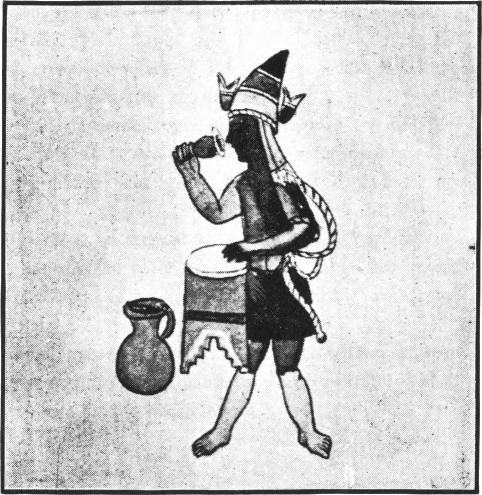
Priest of Xippe Totec, Drinking and Playing on a Drum. Hymn XV.