Chapter VII · HINTS ON RIDING
Reading edition
If you have occasion to ride for any considerable distance, and particularly if the weather is hot, bear in mind that the weight of the rider and saddle on his back for a long period of time tires the horse quite as much as forcing him beyond his gait. It is better, therefore, to keep a horse at a sharp walk or, if you are trotting, at a sharp trot, so as to cover the ground and then to rest him at intervals for ten or fifteen minutes, than it is to keep going for the whole time at a slow walk or trot. When you rest your horse be sure to loosen the girths, and, if you have far to go, it is better to take the saddle off entirely and let the horse roll if he wants to, as few things refresh him as much.
It is equally important not to force a horse under saddle beyond his gait; find out his natural fast gait and keep him at it and neither force him beyond it nor let him lag.
If you have a nervous or high-spirited horse who wants to go, it is far better to let him go in moderation than to be constantly holding him back, as that
In riding, even for a short distance, it is most advisable to start and finish your ride at a walk, following the old maxim, “Walk the first mile out and the last mile in.” At the beginning of a ride a horse needs to get going a bit in order to be limbered up and catch his wind. So, if you start off, as many do, at a fast trot or a canter, the horse will soon be winded and the rest of your ride will be spoiled. If you start him slowly, he will warm up to his work and you will have the best part of the ride where it should be—toward the end and not at the beginning. When you bring your horse home he should be well cooled off before he arrives, that he may not take a chill. By bringing your horse home in this condition, you save your groom a vast amount of work, and work which only the most conscientious grooms can be depended upon to do; that is, to cool the horse off properly before he is stabled or fed.
With regard to the gait at which you should ride,
In riding at night, when it is too dark for you to see the road, let your horse pick his own way, as a horse sees very much better in the dark than a person.
If you are riding through a strange country and lose your way, give him his head and he will find the way home. Horses have an exceptionally well developed sense of locality and can nearly always be trusted to find their way home by instinct.
In these days of automobiles, it is important to follow the rule of the road and always keep to the right.
If you have occasion to dismount and lead your horse, by far the best way to hold him is, standing on the near side, to take the two curb reins in the right hand, separated by the forefinger and passing through the body of the hand where they are firmly held, keeping the hand about two or three inches from the bit. In this position you have the horse under perfect control, and, when you are leading him with your hand in this position, do not look at him or pay any attention to him and you will find that he will follow. Whereas, if, as many do, you take only one rein in hand along the horse’s neck and then speak to him, he will either pull back or he may get away from you and you cannot stop him. Approach your horse’s head from the side and not the front, and be sure not to raise your hand or whip or do anything which might frighten him or give him the idea that you were about to hit him on the head. Horses, especially Western-bred horses, are very sensitive about their heads and, if an attempt is made to grab the reins suddenly or violently, they are almost sure to back away and very apt to rear.
If your horse limps and you are alone, or the person whom you are with does not know what to do, you should immediately dismount and look at the foot on which he is limping, to see if he has picked
In regard to park hacks and long-tailed saddle horses, the only way to solve the problem in this country of the two types, in horse shows, is to divide the classes having long tails and short tails. At present in horse shows in the saddle classes long-tailed and docked horses are frequently entered in the same class, which makes it doubly difficult for the judge,
Every horsewoman should have at least a general knowledge of when and with what to feed her horse. In general a horse should be fed three times a day, and the allowance for the average horse is four quarts of oats, at six in the morning, and as much hay as he will eat about an hour later. At noon two quarts of oats and hay about an hour later, and at night a bran mash composed of about two quarts of oats and an equal mash of bran, well salted. A horse should never be watered after eating. He should be watered about twenty minutes before his first morning meal and may be watered about twenty minutes before each of his other meals. There is no objection to watering him at other times, not after feeding, and in hot weather it is advisable to water him frequently. When watering a horse in the stable, he should be allowed to have as much as he wants to drink, but the water should never be very cold. In winter the
The above hours for feeding, except the hour for his breakfast, must, however, be modified by the time when he comes in from work, as a horse should always have a good rest and be thoroughly cooled off before he is fed oats. He can eat hay when he is hot but never oats.
Many horses will require more than the above allowance and many others less, and some horses require as much humoring about their food as a nervous child.
If a horse is very thin and not working hard, one of the best ways to fatten him is to give him light, steady work and mix molasses with his feed. If, however, a horse is becoming poor in spite of taking all his food, it is probably because his teeth are too long and need filing down, as a horse with long teeth will never masticate or digest his food properly.
With most horses, any food remaining in the manger after a meal should be taken out and thrown away, as the sight of it is apt to disgust them and put them off their feed.
A sweating horse should not be watered unless while on the road, in which case it does him no harm to give him, from time to time, a drink of not too cold water, but after each drink he should be walked
While on the road it is much safer not to let your horse eat any grass, and if he does eat any, be sure not to trot him until he has had ample time to digest it. On the other hand, when a horse is brought home and is being cooled off by the groom, it refreshes him very much to be allowed to nibble the grass.
It is very advisable, if you have land enough, to have a portion fenced off as a paddock, even if you keep only one or two horses. When a horse comes in tired, after a hard day, nothing refreshes him so much as to be turned out without even a bridle, and allowed to roll as much as he wants; and if horses are not being used it is better for them to be turned out for a few hours in the paddock rather than to remain all day in the stall. If you have a paddock, however, be sure that the fence is high enough to prevent your horses jumping it, and be particularly careful that the inside of the fence is smooth and that there are no nails or barbed wire or anything that might injure the horse. There are portable paddock fences to be had, which are easily put up and moved, and they are very useful when you move your stable about from place to place.
If you are fortunate enough to buy a thoroughly trained horse, the difficult thing is to keep him so
Much can be done by caresses and the use of the voice. But in the caressing be sure that the horse does not think that you are slapping him. Most horses resent being slapped on the back quite as much as most of your friends. In fact, all horses worth riding dislike anything that will startle them, or any sudden shock.
It is easy to establish a sort of a private signal code with your horse, which he will always understand. It is only necessary always to do the same thing to bring about the same result. If you wish your horse to move the part of the body in front of the saddle, the signal should be by stroking him on the neck or shoulders, and if he is to move any part of his body behind the saddle, he should be stroked or touched on the quarters. If he obeys, continue stroking, but if he disobeys or misunderstands, cease the caress. In time he will come to regard the caress as a signal. For example, if you wish your horse to back, do not stroke him on the
When riding in company remember there is a “riding courtesy.” You have your comrade and your comrade’s horse to consider as well as yourself and your own horse. The two horses should be kept going together, and on the same gait as much as possible, so if your horse begins to urge ahead, keep him back a trifle. There is nothing more annoying than the “galloping friend” who will not take the trouble to control her mount, and so makes the other horse nervous and unmanageable.
Never “cluck” to your horse, even when you are riding alone. It is a very bad habit to acquire, and, when you are riding in company, the other horse or horses are sure to hear you and to increase their gait quite as much as you want your horse to increase his. You are supposed to ride a trained horse, who will obey the signals from the reins, heel, or whip, and if your horse does not know these signals he must be taught them before you ride in company. Do not, however, under any circumstances, flourish your whip or use it with such force that another horse can hear it, for the effect will be quite as bad as clucking.
If your horse lays his ears back and bites at the other horse, do not pull his head away, especially if you are up with the other horse, for that will put him in a position where he can kick to great advantage.
If you have occasion to raise your right hand to adjust your hat or hair, be sure first to place the whip in the left hand, as otherwise your horse or your comrade’s horse is very apt to be frightened by seeing the whip flourished in the air.
A most important point to be remembered is that your horse should be girthed before you mount him, and never after mounting—first, because it is very dangerous to mount with the girths loose, for if the horse should break away from the groom, or whoever is holding him, or even swerve or buck suddenly, the saddle is almost sure to twist and there may be a very bad accident; and, secondly, because girthing a horse after the rider is mounted generally results in the girths being drawn too tight, and too tight girths not only cause the horse great pain but make him apt to stumble or lag in his gait and become unduly exhausted. Tight girthing has very much the same effect on the horse as tight lacing has on the rider.
If you have occasion to look to the rear, always turn your body toward the right; not only is it much easier to look around in this way, but you cannot turn to the left without raising your right knee more or less, and you are apt to raise it so high that if the
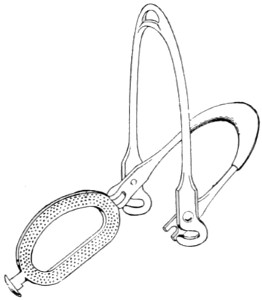
Safety Stirrup, Open
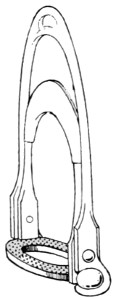
Safety Stirrup, Closed
With the side-saddle, safety skirts and stirrups should always be used, as with them a fall is very unlikely to injure the rider. With the plain skirt a bad accident may be caused through the skirt catching on the pommels, and with a plain stirrup there is great danger of being dragged by the foot.
If the horse shies to the right, always remember to throw the weight to the left; this keeps the legs tight in position which enables the rider to maintain her balance; whereas, if you throw your weight to the right, you lose the grip from the right knee and have no means of recovering your balance, so that a fall
When you feel yourself being thrown, especially if you have on a plain skirt or have a plain stirrup, or both, be sure not to let go of the reins, for in case you do not fall clear of the saddle, your one chance for self-preservation is that in some measure you still have control of the horse. If you keep hold of the reins you have a good chance of being able to pull him in and keep him from running away, and you will save yourself from being dragged and probably escape a very serious accident.
If a horse in the act of shying or balking succeeds in turning half-way round with you, do not try to turn him back against the direction in which he has shied, but, instead, pull him quickly and completely around in the direction which he has taken. He will not attempt to resist you and you will at
If your horse rears, give him his head immediately and throw your weight as far forward as possible. This will usually bring him down. If, however, you feel that he is going over, remember that a horse when he rears always falls to one side or the other. Therefore, as soon as you find that he is bound to fall, pull his head with all your strength to the right so as to make him lose his balance and fall on that side. The chances are that you will not be hurt, whereas, if he falls to the left, you are almost sure to have your legs caught beneath him and so be seriously injured.
If your horse backs, give him his head and particularly be sure not to have any pressure on the curb, as that keeps his head in. Sit close and urge him forward with the left leg and touch him on his off quarter with your whip. If you are wearing a spur, touch him lightly at first and then as hard as may be necessary.
If your horse kicks or bucks, keep his head up by loosening the curb and using the snaffle only. Sit close and put him in motion, but be careful not to let the left leg go back, as this is apt to terrify him and make him kick or buck all the harder. Very few horses will either kick or buck when they are in
If your horse balks, by far the best thing to do is to distract his attention or else let him stand quietly without offering him any resistance. A horse has only one idea in his mind at a time, but that idea is very fixed, so that if you strike a balking horse or resist him, you will simply arouse all his obstinacy and he will balk all the worse. The best way to distract his attention is to pet him and speak to him. In the course of a short time he will tire of the balking and attempt to start forward. If at this moment you keep him standing a bit longer he will become possessed of the idea that he wants to go, and you will have no more difficulty with him for the time being. Indeed, I have found that this is by far the best way to break a horse of the habit of balking.
When you are riding in company, an important thing for both your companion and yourself to remember is that if your companion, whether man or woman, is mounted on a slower horse than yours, and your horse starts to run, the very worst thing that he can do is to try to catch you. The noise and excitement which his horse produces will make your horse run all the faster; his horse being slower, he