Chapter II · HANDS
Reading edition
The hands should be held on a level about six inches in front of the waist; the forearms horizontal, the upper arms hanging naturally from the shoulders, so as to keep the elbows level, and in a vertical plane with the shoulders. Bowing the elbows out, or, on the other hand, clapping them too close to the sides, are common faults, and are equally bad not only for the sake of appearances, but because, in either of these positions, the strength of the arms is lessened. Similarly, the elbows should not be carried back when the hands are in position, for, if they are, you cannot pull the horse up should he stumble, or, on occasion, stop him suddenly; nor should they be carried forward over the knee, for that position is stiff and tiring and gives the body a tendency to bend forward.
In jumping a horse trained to jump in the American fashion, when approaching the jump, the hands are carried well forward and, at the same time, the body is also carried forward. The reason for this is partly to help the horse over the jump, and partly
Both hands should be kept in position, and neither arm should ever be allowed to hang at the side in military fashion. Nothing looks worse in park riding for either a woman or a man. In riding a horse that is bridlewise and perfectly broken so that he will obey the slightest movement of the reins and can make all the changes of action and of gait by a mere suggestion from one hand, the other hand should still be kept in almost the same position as if it held the reins, and remember that if it is necessary to rearrange the hair or the hat, or if you wish to make any gesture with the right hand, to be sure to transfer the whip to the left hand. By neglecting this precaution and carrying the whip in the right hand, when it is moved about, your horse, or your companion’s, may see the whip and think he is about to be struck, and a serious accident may result.
The left hand is the bridle-hand and the one in which the reins should habitually be carried. After mounting, and in first taking up the reins, remember that the snaffle rein is a trifle longer and wider than the curb rein and that the ends of the snaffle reins
There are different ways of first taking up the reins. One of the best is to grasp them together in the right hand, the curb reins in the middle and the snaffle reins on the outside, drawing them sufficiently tight to feel the horse’s mouth very lightly, with the ends passing through the hand and out under the little finger; then, holding them all horizontal, to pass the left hand down on them vertically, the near snaffle rein outside the little finger, the near curb between the little finger and the third finger, the off curb between the second and third fingers, and the off snaffle between the first and second fingers. Then let go with the right hand and turn the left hand into its position with the ends of the reins coming out between the thumb and forefinger.
Another way is first to take up the snaffle reins with the right hand, the off rein outside the little finger, the near between the first and second fingers, feel the horse’s mouth lightly, and then pass them into their correct position in the left hand, the near snaffle outside the little finger, the off snaffle between the first and second fingers; then pick up the curb reins with the right hand and pass them to the left hand separated by the third finger.
A third way is first to pick them up in the right
The reins should be adjusted to their proper length with the right hand so as to feel the horse’s mouth lightly before the fingers of the left hand are closed on them. With regard to the ends of the reins, it is equally correct to have all four reins one upon the other, and then put the thumb on top of them all, or to put the thumb on top of the snaffle reins and have the curb reins pass to the right of the thumb, if one is riding on the snaffle; or, if one is riding on the curb, to have the thumb resting on the curb reins and the snaffle reins passing to the right of the thumb.
The reins should be properly arranged in the left hand, as I have described, at the start, when the body and the elbow are in their correct positions, and they should be held at this same length at all times and not allowed to slip through the fingers. They should be held by pressing the edges of the reins, with the fingers, against the cushion of the hand, and not by squeezing the flat surfaces of the reins between the fingers. The principal reason why beginners let the reins slip through their fingers is that they do not hold the reins by the edges.
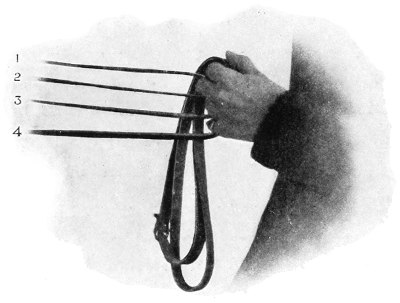
Correct Position of Reins 1—Off snaffle rein. 2—Off curb rein. 3—Near curb rein. 4—Near snaffle rein. View larger image.
The whip, crop, or stick, whichever may be carried, belongs in the right hand, but the whip and
I have already described the position of the reins in the left hand. The next thing to be considered is the position of the left hand itself when holding the reins.
As I have said, the forearm must be horizontal. The hand must be held with the knuckles nearly vertical, and not horizontal, as many hold it. The hand must be bent in toward the body at the wrist, and the wrist must be flexible so as to give slightly with the movement of the horse’s head. Nearly all beginners have great difficulty in remembering to keep the wrist bent, as they are apt to straighten it out so as to give a direct tug on the horse’s mouth with
The right hand should be held symmetrically with the left, bent in at the wrist in the same way, and with the knuckles at about the same angle. For beginners, it is better, until they have acquired fairly good “hands,” to hold the bight of all four reins in the right hand between the thumb and forefinger, about an inch from the left hand and just below the whip, the bight of all four reins passing through the right hand and out under the little finger. This keeps the right hand in position ready for an emergency, but it does not allow it to interfere with the even pressure and “feel” which the left hand has on the horse’s mouth, with both the near and off reins. Remember that, under normal circumstances, all four reins must be held firmly in the left hand, and that there must be an exactly even pressure on the horse’s mouth on both sides, and that, in order to keep the reins so and prevent them from slipping, they must be held by the edges between the second joints of the fingers and the cushion of the hand, and must also be firmly pressed down between the thumb and forefinger.
The right hand should, as it were, be kept in reserve and used as circumstances may require. For instance, if the horse is thoroughly bridlewise, he will
Now, with a horse which has an exceptionally sensitive mouth, and a rider with exceptionally good hands, this can be done by a mere turn of the left wrist; but if the horse has not a sensitive mouth, or the rider has not very good hands, the right hand must be called into assistance. In such a case turning the horse to the right is very simply accomplished by taking the off reins in the right hand a few inches in front of the left (which, however, must retain its grasp of all the reins without shifting), separated by the little finger, the two reins passing out between the thumb and forefinger. Then, by a slight pressure of the right hand, bring the horse’s head around to the right.
Turning to the left, however, is not done by taking
Another purpose for which the right hand must be always available is for shortening the reins. This should be done by grasping the bight or ends of all four reins together in the right hand, behind the left, between the thumb and forefinger, passing through the hand and out by the little finger, and slipping the left hand up on the reins as much as may be needed.
If, however, more strength is required than can be had from the left arm only, the right hand should be placed on all four reins in front of the left hand, which, of course, will have to be turned so as to bring the knuckles horizontal, the reins occupying the same position in the right hand as in the left, only reversed; that is, the off snaffle coming outside the little finger, and the near snaffle between the first and second fingers, etc. The fingers of the right hand are then closed upon the reins and the horse pulled in with all the strength of both arms.
I do not mean to imply for a moment that any horse can be pulled up or stopped by a steady pull on the reins, for no woman is strong enough to stop a horse who is determined to run, by pitting her strength against his. There must be a “give and take,” and even in stopping a runaway, alternately giving him his head and then pulling him in, is far more effective than a steady pull; nor should a horse ever be stopped or pulled up with a jerk unless to avoid running over a child or in some other emergency. To stop a horse or make him slow down, he should first be given his head slightly by carrying the hand forward, and then pulled up gradually. If you start to pull a horse with a violent jerk you will immediately excite his resentment and make him pull against you with all his strength, and you will end in giving him a hard mouth and developing a “puller.”
Another purpose for which the right hand should be in readiness is to tighten the curb reins. If the horse is being ridden, as he usually will be, either with the pressure on all four reins about even or with the curb reins somewhat looser than the snaffle, and he starts to pull, or there is some other occasion for using the curb, the right hand may be brought over in front of the left and the curb reins taken in the right from two to six inches in front of the left hand, separated by the third finger, passing out between the thumb
Some riders with very light hands, when riding very powerful horses with rather hard mouths, may find it desirable to ride on the curb instead of on the snaffle. In such case there are two positions which may be taken. One is to put the curb reins in the position of the snaffle reins and vice versa, and then leave the snaffle reins somewhat looser than the curb. This is a method much used with the Kentucky type of saddle-horse and with horses which have been broken to the use of the curb only, as are nearly all army horses.
Another way of holding the reins when riding on the curb is to separate the two curb reins with the little finger of the left hand and the two snaffle reins with the middle finger. The reins are then held in the army fashion. Some horses have been broken to
Neither of these last two ways of holding the reins of which I have spoken should be attempted by beginners as they will only confuse them.
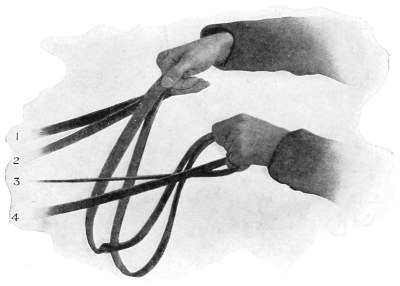
Reversing Position of Curb and Snaffle Reins 1—Off curb rein. 2—Off snaffle rein. 3—Near curb rein. 4—Near snaffle rein. View larger image.
Another point which is very often neglected is that the reins must not be twisted between the bridle and their ends. Be sure that they are kept straight at all times, as it looks very badly to see them twisted either on the neck or in the bight of the reins, and if the bight is twisted, one is very apt to mix the reins when changing them.
With regard to holding the reins in both hands, this should only be done by beginners, and in the hunting field, and with absolutely green horses who have to have their heads pulled around in order to turn them.
I shall discuss the position of the hands in the hunting field in the chapter on hunting, and what I have said about turning horses who are not bridlewise covers all that needs to be said about green horses.
Beginners should not use the curb reins at all, and should hold one snaffle rein in each hand, the snaffle reins being held in the position of the near snaffle rein in the left hand, and the off snaffle rein in the right hand; that is, passing outside of the little finger up through the hand and held between the thumb and forefinger. A beginner, particularly if she has ever driven, will naturally start to take a rein in each hand in the driving position, that is, separated by the thumb and forefinger and coming out under the little finger. This position is never taken in riding. The object of taking a rein in each hand is to accustom the fingers to the reins, and the rider to holding the right hand parallel with the left. Keeping the right hand in a corresponding position to that of the left not only looks smart and neat, but it helps to keep the right shoulder in place. Of course,
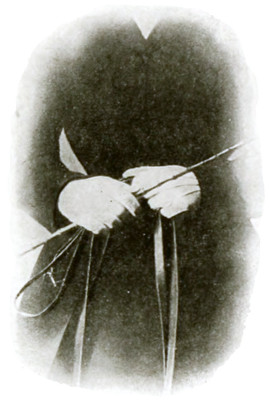
Correct Position for Park Riding Right hand holding reins lightly and riding stick
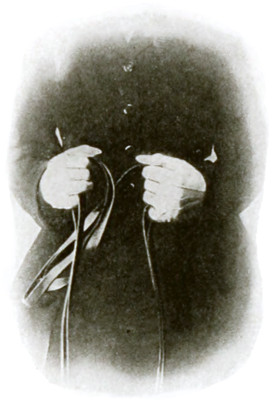
Reins in Both Hands Position for beginner Reins in same position in each hand
In riding astride beginners should also hold a rein in each hand, as holding the reins in the left hand only tends to pull the left shoulder forward and out of place. So when riding astride, the symmetrical position of the right hand and arm with the left brings the right shoulder forward and keeps the shoulders square.
I have mentioned above the reasons for sometimes reversing the positions of the curb and snaffle. Another case where this may properly be done is where a running martingale is used.
Next to balance, light hands are the most important attribute of a good rider. They really are a gift, like an ear for music, or a delicate sense of touch, or acute vision, and go with a certain nervous and sensitive temperament. Some riders have naturally light hands and scarcely need any instruction with regard to them. With them the feeling of the horse’s mouth is instinctive. Light hands, however, can, to a great extent, be cultivated, and there is no excuse for any experienced rider having heavy hands. Women are more apt to have light hands than men, and while men may rely on strength to control a horse, and can control many horses by sheer brute force, women very seldom have sufficient physical strength to do this. Women should seek “the strength of effect and not the effect of strength.”
It is hard to define the term “light hands.” If I might attempt a definition, I would say that the hands serve as a means of communication between the horse’s and the rider’s mind, so that the rider, through the touch of the horse’s mouth, communicated through the reins and hands, knows what is in the horse’s mind and so can make the horse’s mind
Lightness does not in any way denote weakness, for, behind the light touch, there must always be firmness, decision, and strength. Nor does lightness mean a touch so vague that it produces upon the horse’s mind an impression of vacillation. In riding it is most important for the rider, once she has made up her mind what to make the horse do, to make the horse do that thing and not allow him to do anything else. One might, indeed, say that lightness of hands is very closely akin to tact and that it is a means of inducing a horse to adopt as his own the will of his rider.
I spoke a moment ago of strength. By this I mean firmness and not brute force. If a rider is fortunate enough to be gifted with lightness, she will be able to control her horse by a spirit of love instead of adopting the brutal method of controlling him by fear and having him prepared at every moment to obtain his revenge upon his rider, as a horse that has been treated brutally is almost certain to do when he has the opportunity.
Coupled with the lightness of hands should be fearlessness in the mind of the rider, and the horse