Chapter XVII · BITS AND BEARING REINS
Reading edition
In the illustration on the opposite page are shown the various types of driving bits, and I shall not attempt to describe them in detail any more than I did with respect to the riding bits. They are fully treated in many of the standard works on the subject and a detailed description of them would not belong in this book.
For single horse driving either the Liverpool or Ashleigh is correct for all occasions, except for the show ring and park driving with ladies’ traps, such as the George IV or Peters’ phaeton, where the Buxton is the correct bit for single horses as well as pairs, and except also for gigs where a gig bit is correct. Gig bits, however, should not be used with other traps than gigs. For pair horse driving the Buxton is correct for the show ring and park driving and may be used for informal occasions, though personally I think it rather poor form for country driving with any kind of trap. The Buxton, however, not having a hole to correspond with the “half cheek” of the Liverpool or Ashleigh, is, unless you use the “full cheek,” rather a severe bit for any but a skilled
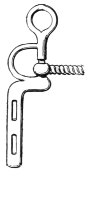
1. Coaching
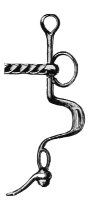
2. Buxton
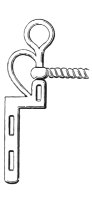
3. Ashleigh
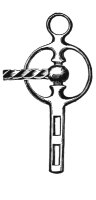
4. Liverpool
Bits
If your horse has a very light mouth, and you have not acquired very light hands, it may be better to drive with the reins in the full cheek. If, however, you have acquired light hands, the reins had better be in the half cheek of the Liverpool or Ashleigh, or in the middle bar of the Buxton, as this gives much more control and “feel” of the horse’s
In pair driving the bitting is most important. It is the rarest thing in the world to find two horses who are not only well matched in appearance but have the same dispositions and require the same bitting. In fact, there is an old saying, “There is always one to a pair.” By correct bitting and a proper adjustment of the coupling reins the differences in the dispositions of the two horses can be equalized, and they can be made to go well together. This is a point which is very frequently neglected by inexperienced
The general principle, of course, is that the slow horse of the pair should have the reins in the cheek or half cheek, while the fast horse should have them in the half cheek, or the first, or even the second, hole in the bar, and it may be found necessary to put a severe bit on the fast horse and a plain bit on the slow one. Similarly, if one horse has a light mouth and the other a hard one, the bits and the coupling reins must be regulated and the curb chains adjusted accordingly. It is impossible to lay down any fixed rules to follow. It is all a matter of experiment with the particular pair of horses that you are driving.
Of equal importance with the proper adjustment of the bits and of the reins in the cheek or bar is the adjustment of the coupling reins. These are the two shorter inside reins by which the near horse is coupled with the off rein and the off horse with the near rein. The coupling reins should be so adjusted that the pressure on the reins of each horse will be the same; that is, the off horse should have the same pressure from the off rein as he has from the near coupling rein, and the near horse should have the
If it happens that the two horses go absolutely together and have the same mouths and the same dispositions, which, as I have said, is almost never the case, then the coupling reins will be buckled in the same hole on each rein. If the two horses have different mouths or different dispositions, the buckles will have to be shifted accordingly. That is, for instance, if the near horse has more life or a harder mouth, the off coupling rein must be taken up so that there will be more pressure on him than on the off horse. The coupling reins are also adjusted for the purpose of bringing the two horses nearer together, and for keeping their heads together or apart as may be necessary.
The two horses of a pair should have their bodies and heads straight and parallel to the pole, but it will be found that some horses are inclined to carry their heads to one side or the other, and the coupling reins should be taken up or loosened accordingly. For example, if the near horse carries his head to the near side, the off coupling rein must be taken up, which compels him to straighten his head.
If you have two horses that seem to be perfectly matched, but the off horse carries his head a little out to the front and has a light mouth, and the near
A common fault of coachmen and grooms lies in buckling both coupling reins too tightly, which makes the horses carry their heads in toward the pole instead of going away straight. This looks very badly, makes the horses’ mouths hard, and either keeps the horses going diagonally or causes them to carry their heads crooked.
If horses have acquired, through wrong coupling, the habit of turning their heads in toward the pole, or their quarters out from it, it is sometimes a good plan to change their positions instead of always driving them on the same side. Then, on the other hand, horses sometimes get into the habit of leaning in against the pole. This is a difficult habit to break, but by changing their positions or by adjusting the bits and the coupling reins, and steady and careful driving, this habit can be broken.
Bearing reins are required in the appointments
Proper Adjustment of Bearing Reins
Bearing reins should be just tight enough to keep the horse’s head up in its natural position. When so adjusted they prevent a horse from putting his
Bearing reins are particularly necessary in pair driving, for however well matched two horses may be in general appearance, they seldom carry their heads naturally at just the same height. In that case the horse who naturally carries his head high should have his bearing rein quite loose and the other quite tight, so that their heads may be at the same height. Nothing looks worse than to see two horses in a pair carrying their heads one low and one high. Most of the best authorities on driving also say, and I have no doubt that it is true, that bearing reins keep a tired horse up and make his going easy; they also keep him from nodding.
Of course, many thoughtless grooms draw the bearing reins altogether too tight, so as to force the horse’s head up and make him almost ewe-necked. This naturally frets a horse, especially when he is standing still. The bearing reins should be fastened to a bridoon and not to the bit, as, if fastened to the bit, they raise it too high and are apt to spoil the “feel” of the horse’s mouth.
For runabouts, at all times, bearing reins should be dispensed with, and they may be dispensed with
The overhead check-rein should never be used, except with roadsters or trotting horses.