Chapter IV · RIDING ASTRIDE
Reading edition
In these days of “advanced” ideas the advisability of women aping men in yet another way, by riding astride, is the subject of general discussion. Many “authorities” upon riding—“mere men,” it is needless to say—speak with enthusiasm of the day when all women will ride in this, for most of them, ungainly and unbecoming fashion. Personally, I deplore this tendency and believe that it is a mere passing fad and that, except under peculiar conditions which I shall mention, most women ride best and look best in the side-saddle.
The average woman is not built for cross-saddle riding; her legs from the knee up are too short; her thighs too thick; her hips too big, and she is cushioned too high to enable her to keep close down with the required firmness on the saddle. The side-saddle certainly insures a stronger seat, especially in all cases of pitching forward, as, for instance, with a stumbling horse or a kicking one, or on landing after a jump. With safety skirts and safety stirrups the danger from dragging is obviated and this, the only serious danger in the use of the side-saddle, is more
Up to the age of eleven or twelve it is a good plan for a young girl to learn to ride astride and so acquire balance and confidence, but if she is to use the side-saddle eventually she should certainly begin to use it at the age of twelve, and I would advise beginning as early as eleven. If she begins on the cross-saddle and acquires the knack at this early age, it will be easier for her to take it up again on occasion later in life, and, of course, the advantages which come from
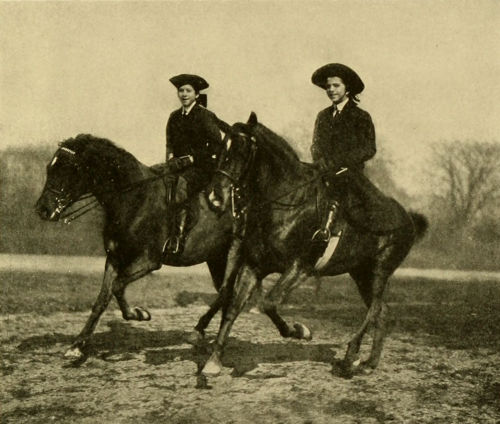
Correct Costume for Young Girls Riding Astride
In riding, women are very generally accompanied by men, and there are few occasions when a woman has it in her power to look better—or worse—than when in the saddle. It is only those women who are built like men and very young girls who look at all well astride. A woman with merely a normally developed figure looks both ridiculous and immodest in
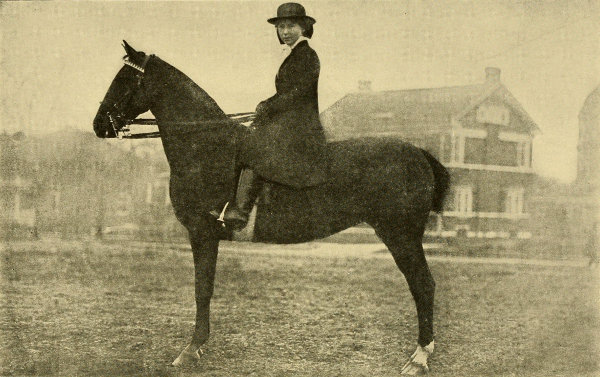
Correct Position for Riding Astride
Much as I disapprove of most women using the cross-saddle, yet, as this book is intended to be a somewhat complete treatise on riding for women, and as many women insist on using the cross-saddle, and as in some parts of the West, and in roughing it, riding must be astride if at all, I shall make a few suggestions about the way in which a woman can best attempt to do this, though it is something in which she can rarely, if ever, attain perfection.
The saddle for cross riding generally used by women in the East is the same as a man’s, although some makers are offering a cross-saddle especially adapted for women (see illustration, page 155). These saddles are built more on the lines of an army saddle, having more dip and a straighter flap than those for men.
Many men, and nearly all hunting men and polo players, use plain flap saddles; that is, without rolls and cut well forward so as to give plenty of room for the knees (see illustration, page 155). This type of saddle enables the rider to have his knees well up and forward and gives him a very firm seat for jumping. Few women, however, are long enough in the legs from the knee up to take this seat, so most women will find a roll flap saddle more comfortable.
In the West the Mexican type of saddle is generally used. This saddle has a high pommel, or even a high horn in front and a very high cantle serving as a back rest, making what is practically a “dished out” seat, far better suited to a woman’s conformation than the English saddle. The Mexican type of saddle, however, is not adapted to a horse with a square trot, but only to the loping or fox trotting horses of the West. The reason for this is that in posting or rising to the trot, the knees should be quite well up and forward, and the Mexican saddle is so built that in it one cannot take this position.
There are two distinct types of seats recognized in this country which may be called, for distinction, the military and park seats; the former is the correct seat for the saddle of the Mexican type. In this seat the rider sits upright with the legs almost straight, the knees scarcely bent, and the ball of the foot resting on the iron, with the leather very long. In fact, many military riders have their legs perfectly straight and their toes down. This seat is comfortable only on the “five-gaited” horses; that is, horses whose gaits are the single foot, the lope, the canter, the pace, but whose trot, instead of being the smart square trot of the Eastern park hack, is more of a running walk and is known as the “fox trot.” With a horse that has a true, square trot, it will be found, as I have
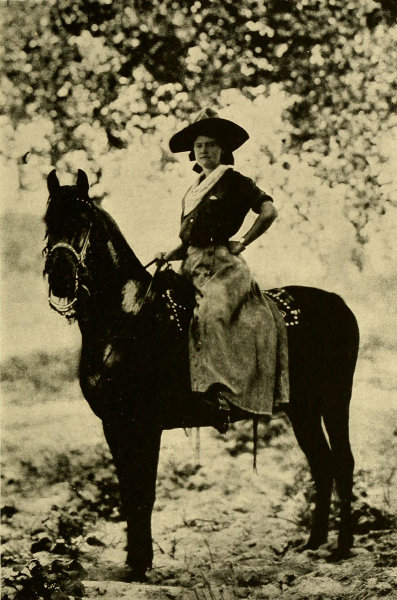
The “Cowboy” Western Costume and Saddle
The park seat looks much smarter than the other, and suits the gaits of the types of horses used in the East far better and is the proper seat for the English or hunting saddle. In this seat the stirrups are considerably shorter and the knees are well bent and carried in front of the leathers. The feet may be carried “home” in the irons or resting on the ball of the foot, as preferred. For hunting, the former is the position used by almost all men and equally advisable for women. Many of the best riders ride with their feet “home” at all times because, with most saddles, particularly if the rider has long legs, with the feet “home” the lower leg is advanced about six inches and, as it should be, carried vertically. This brings the knee well in front of the leathers. This position gives the correct hunting seat and that seat is entirely correct for park riding. Personally, I prefer riding with the feet “home” at all times.
To acquire a firm and balanced seat in riding
While women cannot be expected to go through this preliminary course without saddle or stirrups, it is unquestionably the best way to teach boys, and I see no reason why girls should not go through it as well. The great advantage of beginning without stirrups is that it teaches a close seat at the start. Many riders who have not learned by riding at first without saddle and stirrups acquire the habit of relying altogether too much on the stirrups to keep their seats. In doing this their muscles are kept rigid, they become stiff and awkward, and they rely upon grip and strength, when they should rely on ease and balance. This fault is especially common with women, probably because they have been used to the support of the pommel and leaping horn of the side-saddle.
In riding bareback, or on a blanket, the rider, if she is to retain her seat at all, must do so by acquiring
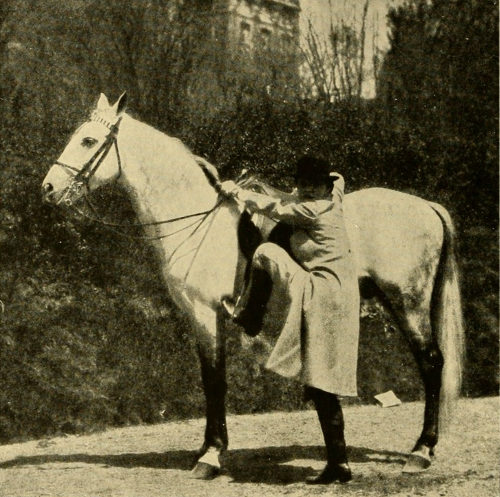
Mounting English Fashion First position, right hand on cantle. Note that the left hand is grasping the mane instead of the pommel
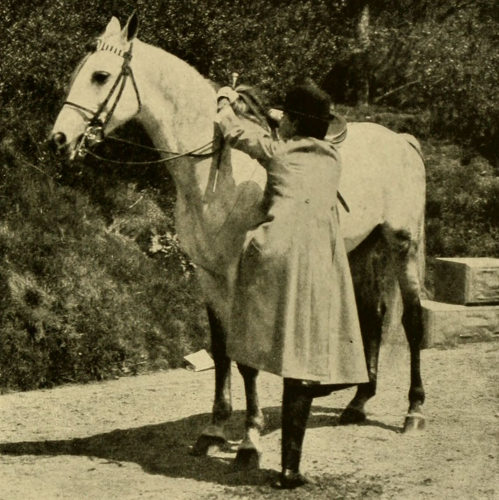
Mounting English Fashion (Another Way) First position, left hand grasps mane instead of resting on pommel, and right hand on pommel instead of cantle. This position is good with a restive horse
There are two recognized methods of mounting—the “army” and the “English.” The latter is generally adopted in the East, but there is much to be said in favor of the former, even with the English saddle, while it is far the better method with the
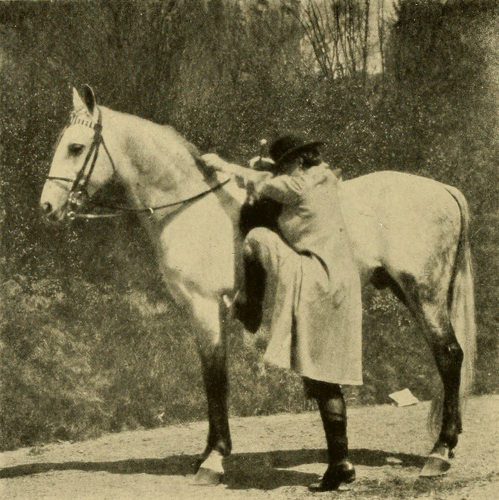
Mounting Military Fashion First position, right hand on pommel, left hand grasping mane. This is practically the same as shown on page 47
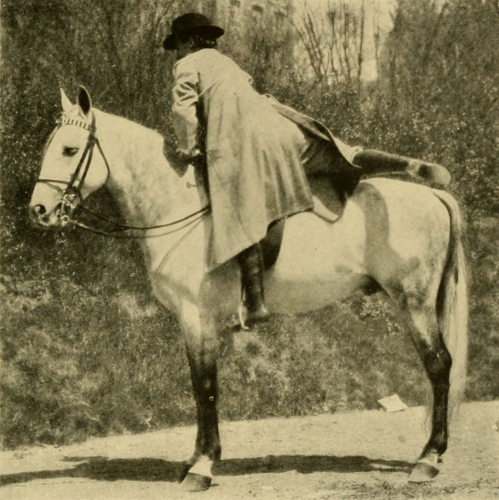
Mounting Either Fashion Second position, body balanced by throwing weight on both arms
The army method is this: The rider stands at the horse’s near shoulder, facing toward the pommel. The snaffle reins only are gathered in the right hand so as to feel the horse’s mouth lightly. The off rein outside the little finger, the near rein between the first and the second fingers, and the bight of the reins passing between the thumb and the forefinger and
This army method of mounting is claimed to be, and I am inclined to think it is, safer than the other, especially with a restive or kicking horse. It appears to give the rider a firmer hold while in the act of mounting. The rider’s weight is so far forward that it is very difficult for the horse to rear, and the rider, before placing his foot in the stirrup, stands so far to the front that he is out of the reach of the horse’s kick. When mounting in the English fashion, if the horse rears before the rider has swung his leg over, there is quite serious danger of an accident, and a minor point is that, unless the saddle is tightly girthed, it is very much less liable to slip when mounting in the army fashion, as a large part of the
This army method of mounting is in general use in the West, and of course in the American army, and many men with army training habitually use it with the English saddle.
In order to adjust the leathers to the proper length before mounting, most women will find, as most men do, that the stirrup from the tread of the iron to the extremity of the leather should be the length of the whole arm extended, and this may readily be measured by placing the tips of the fingers on the stirrup bar, so that the base of the iron rests against the armpit.
After mounting, to adjust the length of the stirrups, clear the feet from the irons and straighten the legs so that they fall naturally. The tread of the iron should then be made to come just at the ankle joint, and the stirrups will then be the right length when the feet are carried “home.”
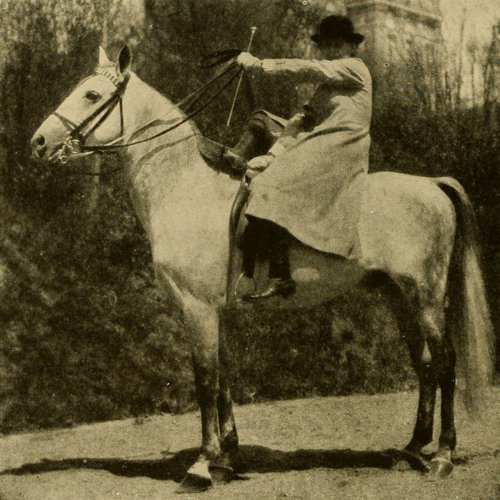
Dismounting Right leg over pommel, left foot clear Few, however, can dismount in this fashion without shifting the reins
In dismounting, whichever method you adopt, be sure to clear the left foot from the stirrup as well as the right foot before you start. There are two methods in vogue: the first is to clear both feet from the stirrups and then throw the right leg over the horse’s head, turning the body on the saddle to the left and dropping the reins for a moment as the right
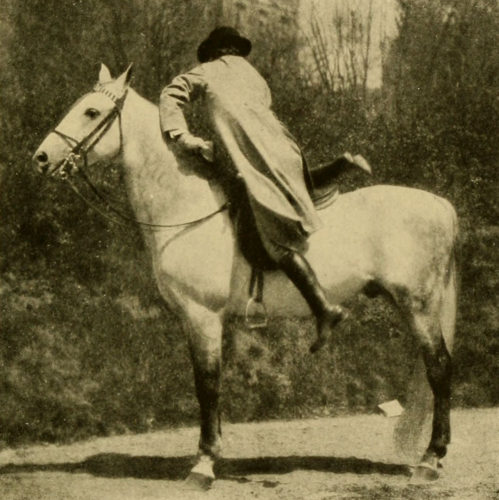
Dismounting Right leg over cantle, left foot clear This method is safer than the last
Many riders step off the horse; that is, they keep the left foot in the stirrup, disengage the right foot,
It goes without saying that no reliance whatever must be placed on the reins for keeping the seat. Many beginners, and even some experienced riders who should know better, whenever they feel themselves losing their balance, hang on by their reins. This invariably results in giving the horse a hard mouth, and is very dangerous with a spirited horse or one whose mouth has not been spoiled by this practice, as it is almost sure to make him rear, which causes the inexperienced rider to lose her seat completely. It is the principal cause of the hard mouth of the typical “riding-school horse.” No rider with good hands will ever hang on by the reins, and in nearly every case in my experience it has been the pulling rider and not the pulling horse.
The secret of the close seat in the position astride is to turn the legs inward from the thigh joints so as to open the legs to their utmost capacity. This brings the rider’s body in the closest possible contact with
I cannot say too often that the seat must be acquired by balance and all the muscles of the legs and of the body and arms must be relaxed. If the leg muscles are rigid and the legs are not turned inward from the thigh joints, the rider will be lifted off the saddle by the contraction of the muscles of the thigh and will not be in balance. Dependence will then be placed on gripping, and this gripping will be done with the calves instead of the knees. A sure indication that the legs are thus held is when the feet are turned outward, for they cannot be unless the whole leg from the thigh joints is so turned.
The legs should be kept well forward, with the knees in front of the leathers, and the legs from the knees down vertical and hanging naturally. At the canter the legs from the knees down should be carried forward rather than back. The body should be well back in the saddle about two inches in front of the cantle and resting comfortably.
Most beginners, although they may take this seat while the horse is standing or at a walk, lose it the moment he takes up a trot. They then begin to lose their seats by leaning too far forward, contracting
With regard to playing polo, many women have the idea that they can only play polo in a man’s saddle. My opinion, based on my own experience and the experience of many of my friends, is directly to the contrary. Many women play polo, and play it very well, in a side-saddle, and I do not know any reason why a woman cannot play at least as well riding in a side-saddle as riding astride. She certainly has a more secure seat in the side-saddle, and the first awkwardness of the back-hand stroke in this position being overcome, all the other strokes are quite as easy, and it is so much easier to ride another player off when one is in the side-saddle that all the women on both teams should ride either in the side-saddle or in the man’s saddle in order to make the game fair.