Chapter I · FORM IN RIDING
Reading edition
With all the changes in fashion and fads, riding still holds its own, and the field which it occupies can never be invaded. For women, quite as much as and even more than for men, it is of all exercises the one best adapted to keep them in condition, to restore the glow of health, and to key up the whole system to respond to all the delights of life. No less for a woman than for a man is the old saying true, “There is something about the outside of a horse that is good for the inside of a man.”
Self-made riders are apt to scoff at what is termed “form,” but “form” is neither fad nor fashion. It is that way of doing any particular thing that is recognized as the best. This is why a self-taught person is at a disadvantage. She may, possibly from her experience, have worked out the correct theory of riding, but she has not had the advantage
Riding should, I think, be as much a part of a child’s education as any of the subjects taught at school; in fact, I would paraphrase and say that “Reading, Riding, and ’Rithmetic” were the essential elements of every child’s education. All children find in it the keenest pleasure, and to the delicate child it offers salvation. Once the first difficulties are overcome, the benefits are soon realized. Benefits not only to the general health, with restored circulation and appetite, but to the character which acquires patience and self-control—qualities quite as essential as the proper use of hands and legs for the making of a horsewoman.
I do not, however, approve of very young children taking riding lessons. The age of seven is quite young enough, for when younger than that a child’s legs are so short that it is difficult for her to keep her balance at any gait faster than a walk. But I do approve of very young children becoming accustomed to the motion and acquiring balance by being held on the back of a very quiet pony, which, of course, should not go beyond a walk. The great danger in beginning too young is that the child may have a fall, and, if she does, may receive a shock to her
I like to have a child come to me for her lesson without fear, not timid from any past experience, yet enough awed at assuming control of so big an object as a pony to have respect for, and be dependent on, her teacher. Later on, confidence will come with increasing knowledge, and so her education as a horsewoman will be properly begun.
Although learning to ride in childhood is certainly an advantage, yet age is not necessarily an impediment to a woman’s learning the art. I have known many women who have never been on a horse’s back until they were forty years of age, or even older, who, after a few courses of lessons, have derived much pleasure from their riding, and, with application, have even become proficient. However, the best riders, like the best singers or pianists, are born, not made, and there is a grace about the natural rider that cannot be attained even by the most thorough training.
Form in riding depends chiefly upon a correct seat, and that in turn depends upon balance and correct position. Balance can only be attained by keeping the muscles relaxed and being ready to respond at any moment to every movement of the horse. It is impossible to acquire balance if all the muscles
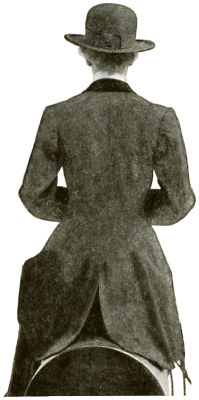
Correct Position of Body in Side-Saddle
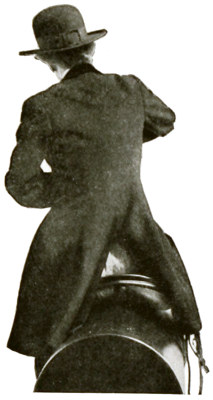
Incorrect Position of Body Right shoulder too high and too far forward, caused by wrong position of right knee
Quite as important as balance is the proper position in the saddle. The first point, remember, is that the body must be squarely in the saddle, neither to the right nor to the left, and the right rigid, against the saddle-flap and should be nearly vertical, neither and the right leg should not touch the left leg. If the right leg is kept in proper place, the right shoulder—the bane of so many women riders—will be neither forward nor down, but squarely in line.
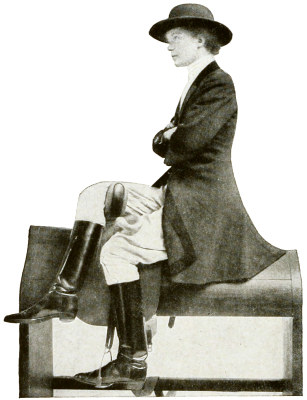
Correct Position of Legs Right leg vertical, left leg bent at knee and hanging naturally
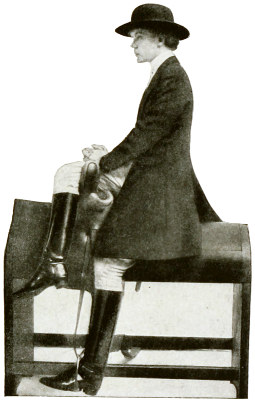
Another Position of Legs Some women hold their legs in this position, but I do not approve of it
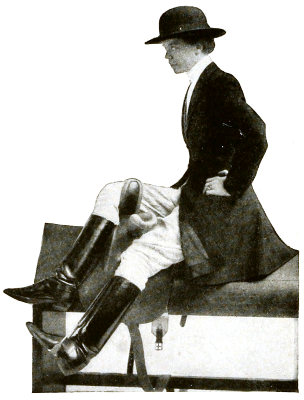
Incorrect Position of Legs Both legs too far forward
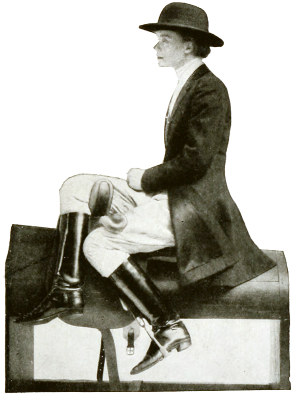
Incorrect Position of Legs Left leg too far back
The left leg should be kept in the same position as a man’s leg, that is, held in firmly against the
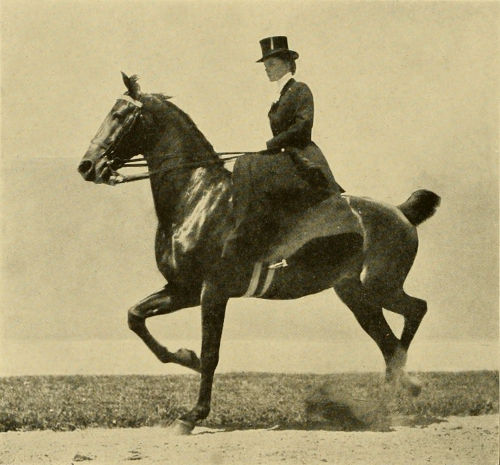
Correct Position with Horse in Action
On this correct position of the left leg depends the evenness of the hips, and on the correct position of both legs depend the level of the shoulders, the level of the hips, the squareness and firmness of the seat, and the proper control of balance.
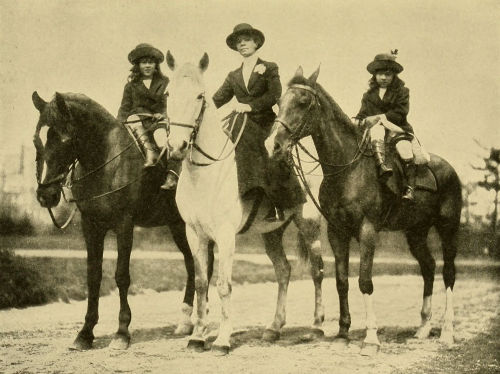
The Position of the Child on the Left of the Picture is Correct and that of the Child on the Right is Incorrect