Chapter X · THE SADDLE HORSE
Reading edition
In writing my description of the lady’s saddle horse I find that, of all the horses I have ever seen, I have not yet found one that eclipses, or even equals, “Lady Bonnie.” I have described her before, and all the change that is needed is in the tense, which, alas! must now be in the past. When asked for a perfect type of lady’s saddle horse, I close my eyes and think of her. She may have had her faults, but who has not? To my mind she came as near perfection as any horse in the world. Her beautiful walk, perfectly balanced trot, and straight and delightful canter, made her a joy to ride. Her well-crested, lengthy neck, giving room for plenty of rein; her sloping shoulders and beautifully defined withers meant for keeping the saddle in place; her back of just the right length to make the saddle look in proportion; her smoothly turned quarters, with tail set high, carrying out the perfection of her top line; her small head, wide between the eyes; her tiny well-set and well-carried ears, combined with the fineness and beauty of her coat, like black
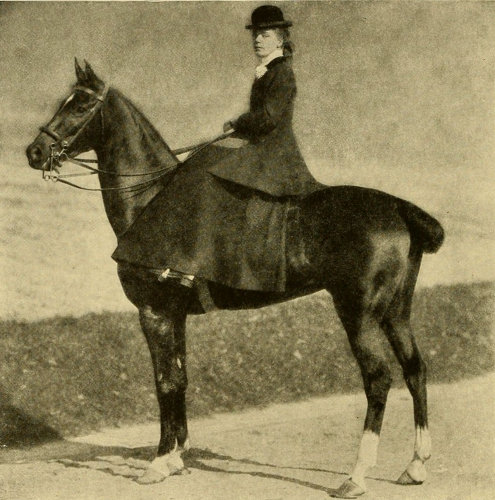
Champion Saddle Mare (Lady Bonnie)
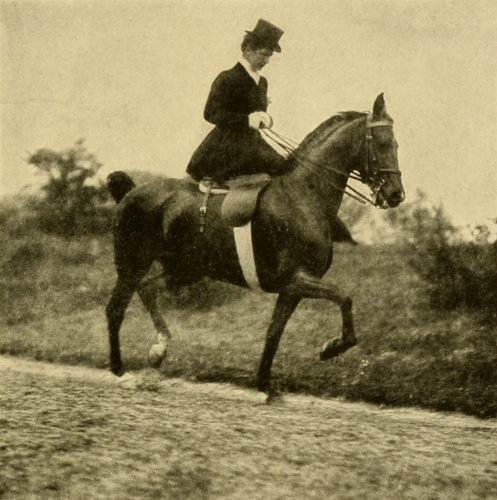
Combination Type (Lady Macdonald)
A lady’s saddle horse should be of solid color, black, chestnut, bay, or brown. White pasterns,
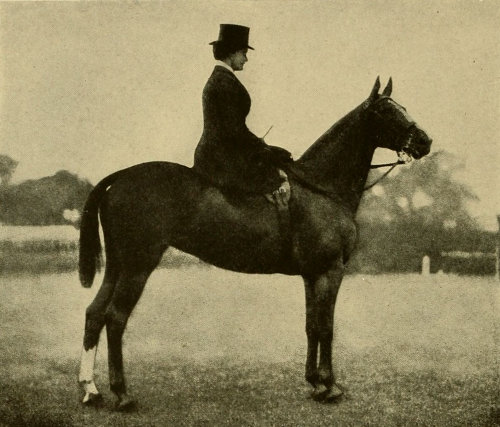
English Type of Lady’s Park Hack
The only gaits used in the show ring, and generally for park riding in the East, are the walk, trot, and canter. The walk should be quick, yet without tendency to jigjog; the trot square, well balanced, and with no hint of mixed gaits. There should be plenty of “all-round action,” of the hocks quite as
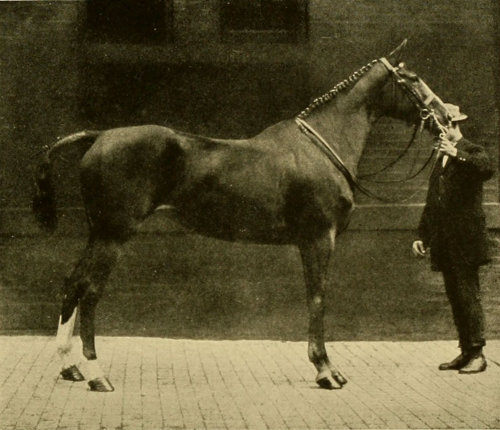
Light-weight Thoroughbred Lady’s Riding Horse (Indian Flower)
The thoroughbred should be the ideal saddle horse, as he is fashioned by nature for that purpose alone. In England this is the type of “riding horse” most in vogue, and in this country he may, in a few
A very strong strain of thoroughbred blood is needed to produce the best type of saddle horse and,
Riding a thoroughbred is altogether different from riding any other kind of a horse. It is then that all the niceties of the art of riding are called into play, not so much as regards the seat, for his gaits are easy, but the hands must be more than usually light, more than usually firm, and more than usually quick in their communication between the mind of the rider and the mouth of the horse. In fact, I am going to say the mind of the horse too, for of good gray matter the thoroughbred possesses an ample share. Thoroughbreds are so excitable and so hot-blooded that only experienced riders with good hands can manage them, and they are very unsafe for those who have not mastered the art. They are hard to manage when ridden in company with other horses, and they are so fussy and unreliable that they afford but little pleasure except to an accomplished horsewoman.
Next in order to the thoroughbred comes the hunter. Were I limited to one horse I would, of all others, select the hunter because of his general all-round usefulness. He is thoroughly suitable for park riding, he can be driven, he can be hacked, and his jumping qualities put him in a class by himself.
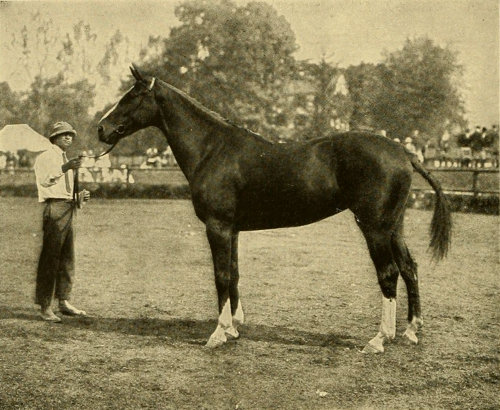
Thoroughbred Hunter (Sunday Morning)
Probably the best hunters are the Irish. They are up to more weight, they have more substance, greater endurance, and, for their own country, are the safest jumpers in the world. These Irish hunters
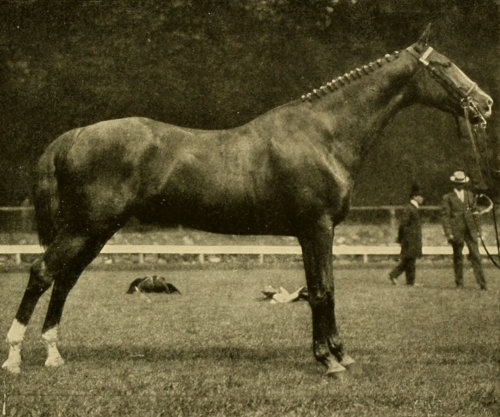
Perfect Type of Heavy-weight Thoroughbred Riding Horse (Heartspring)
Hunting in the vicinity of the great cities of the East has changed entirely in this country in the last fifteen years, and the types of horses that were suited to former conditions are not fast enough and do not jump high enough for the pace we have now. The present tendency in the East, since there are no longer wild foxes to be hunted, is to turn hunting into steeple-chasing, and the only horses that will carry their riders fast enough and safely over the courses as they are laid out are thoroughbreds or three-quarter breds.
In other parts of the country, of course, the country is not so stiff and the thoroughbred type is not essential.
In the South, particularly in Virginia, the best traditions of the hunting field have been upheld since the earliest times, and there is the home of the best hunting to be had in this country. There has been as yet no invasion by barbed wire. The country has not been exploited or commercialized, and the farmers are of an entirely different class from those to be found in the neighborhood of the great cities or in the North. As a general rule they are heartily in sympathy with hunting; many of them follow the hounds and breed hunters, and even use them on their farms. In fact, the hunter is the general type of horse to be found throughout that section of the country.
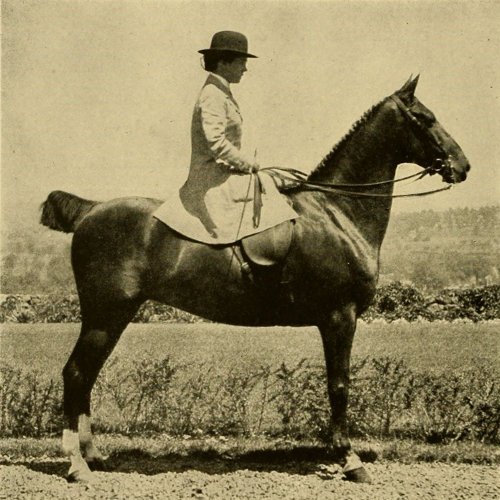
Show Winner in Park Hack Classes (Sonia)
The hunter is the one kind of mount for a woman in which beauty, though desirable, is not a requisite. Rather does one seek in hunters breeding, courage, and intelligence, and the greatest of these is intelligence. The good hunter will show a long neck, withers standing well back, and forelegs well forward of the girth. He should have sloping shoulders and great depth of chest. In fact, his chest should be so deep that when you look at him his legs should not appear as long as they are. He should have strong quarters, and there is no valid objection to their being “ragged,” for he needs great power in his quarters to carry him over the jumps. Of course, one may recall many instances of light-weight thoroughbreds of beautiful conformation who are admirable hunters, but they cannot be hunted every day over a heavy country. That a hunter is to be ridden by a woman, is no reason why his appearance should be ladylike. The extra weight of a side-saddle and the unevenness of the distribution of the rider’s weight on his back, make it necessary that a woman’s hunter should be quite as large and powerful as a man’s. The recognized type of hunter is close to the thoroughbred and quite distinct from the harness horse. Without exception, all hunters have more or less thoroughbred blood, though sometimes we have to go unexpectedly far
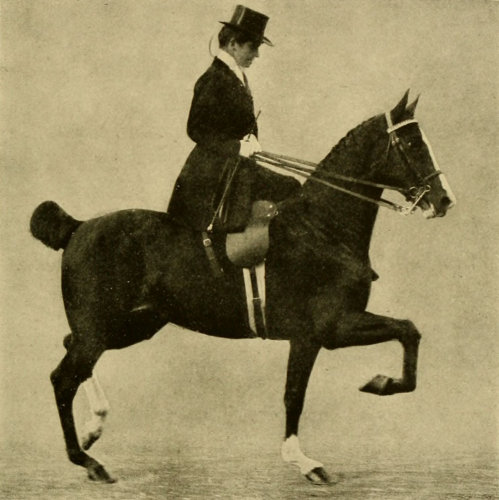
High-stepping Park Hack (Roslyn)
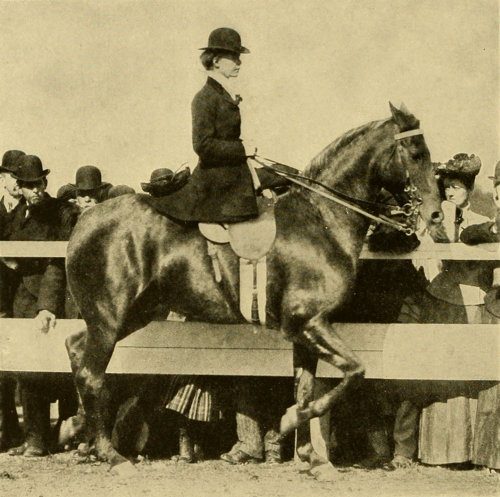
An Old-fashioned Combination Type (Warwick)
The correct type for a park hack is the subject of much diversity of opinion in the show ring as well as in park riding. Some judges favor the thoroughbred type, while some go to the other extreme and favor the harness type. My choice for a park hack is a sort of a “betwixt-and-between”; a riding horse “smarter” and more “peacocky” than either the
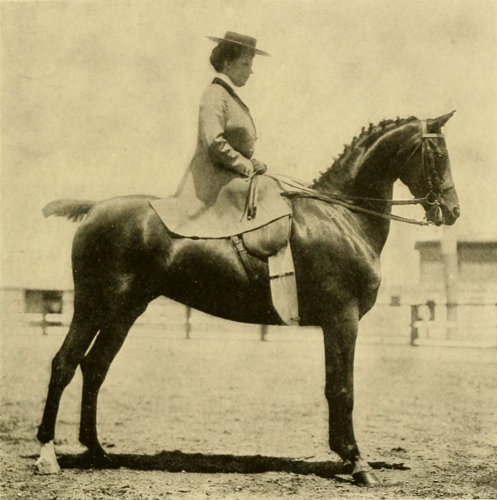
Combination Type (Mayo)
Of late the term “road hack” has come into use. This title does not yet denote a definite type. If I were attempting to define it I should say a horse more like the English cob, low in stature, not over 15.1, but great in substance, and with beauty somewhat sacrificed to utility. He must be well mannered, be as willing to stand as he is willing to go, and should have a fast, well-balanced trot, as the hardness of the roads often makes cantering impossible on the highway. He should resemble the park hack, but should be of a more useful and heavier type, and if he can jump a bit, so much the better.
In all horse shows there is now a class for what is called the “combination horse,” a type, as I have heard some people say, that cannot exist without detriment to either the riding or driving qualities of the animal. With this I personally do not agree. I think all saddle horses should be broken to drive, for there are many occasions when they will be more useful to their owners in harness than under saddle, and it is far better when one cannot ride to exercise one’s saddle horse by driving it to a light trap than to have it ridden by a groom or a stranger. In this country it is almost impossible to find a groom with “hands,” and one’s own saddle horse should be kept
So we find that the combination horse ought to be rather a saddle horse that can be driven than a harness horse that can be ridden, and, for the show ring, the ideal combination horse is really a park hack well broken to harness.
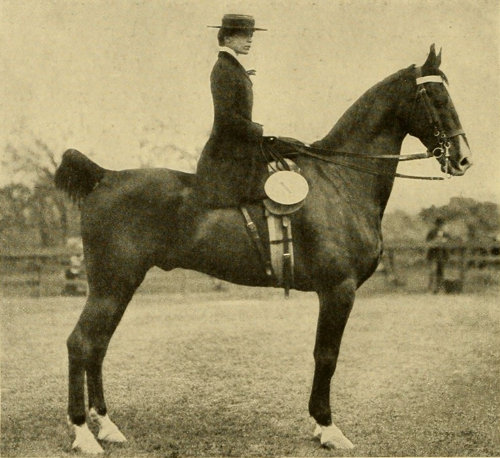
Lightfoot, Winner of Ladies’ Saddle Class at Age of Twenty-three
A good polo pony is a treasure in any stable. For a country hack he is excellent, giving a good ride, never tiring you, and never being tired himself. His early training makes him unusually quick to
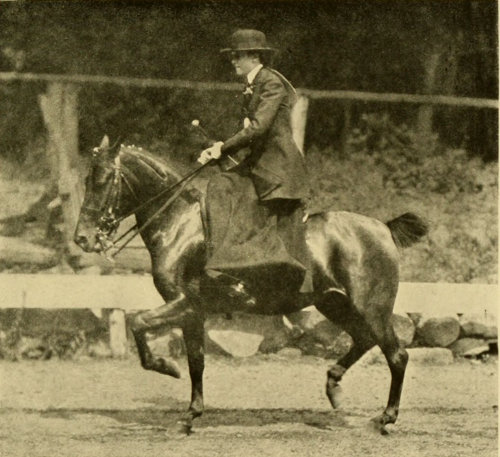
Show Pony
The type of polo pony has changed in the last ten years, as the game is so much faster than it was. Formerly the limit of height was fourteen hands. Now it is 14.3. The type used to be a stocky, rather heavily built pony, more of the type of an English cob with a docked tail, such as we see in the
There is an exceptionally good type of pony which has not appeared to any extent in this country, commonly known as the Irish pony. This is a cross between a thoroughbred and a half-bred hackney, the small size being gained, of course, through the hackney cross with the pony. They have much of the fineness of the thoroughbred and a great deal of the substance of the hackney. They have tremendous endurance, are remarkably good combination horses, can often jump a bit, and can be ridden and driven all day long by any lady, and very often are so gentle that a child can ride them. As a combination pony they cannot be excelled, and they are particularly useful to help out in a small stable, as they can be used for station work and for taking the children to the beach, and all that sort of thing. They are, however, very high-priced and hard to pick up at a bargain.
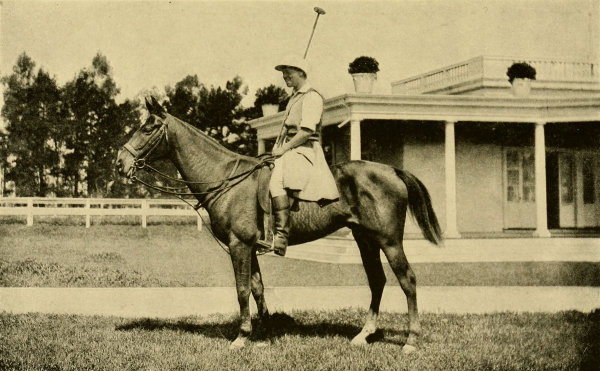
Polo Pony Note the polo costume
The safest and most reliable pony, from my experience, for a child to begin on is an old polo pony which has been ridden for some time by a woman and has not had the excitement of the polo field for many a year. If one wants, however, a smaller pony
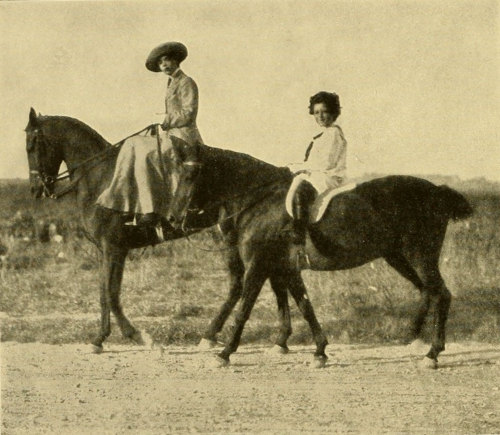
Welsh Pony. The Best Type for Children