Chapter XII · FORM
Reading edition
Before stepping into the trap, the horsewoman should make it a habit to inspect the horse, harness, and trap, and see that everything is as it should be: that the horse is properly put to, that the bit is right, that the girths are neither too tight nor too loose, that the traces are neither too long nor too short, and if there is a stop on the shaft that it is just back of the tug. Be sure also that the trap is properly turned out, that the rubbers are in, that there is no accumulation of dust, that the nuts on the wheels are tight, and that every detail has been properly attended to. Not only is this a wise precaution to use with hired traps, but it shows your own coachman that you know what you are about, and it keeps him up to his work. Having made this inspection, which ought really to be done at a glance,—except that a careful examination should always be made of the horse’s head to be sure that the curb chain is neither too loose nor too tight, the bit not too far up nor too far down, and the mouthpiece the width of the horse’s mouth—neither too wide nor too narrow—and that the check or bearing
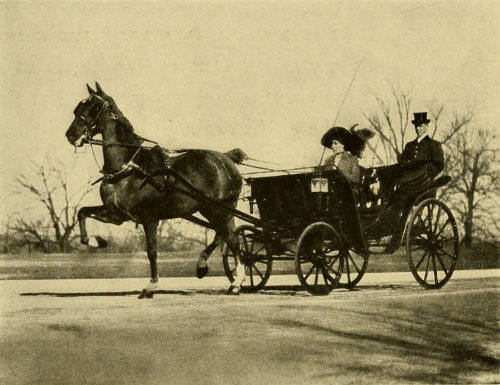
George IV Phaeton Note that the horse is too large for the trap
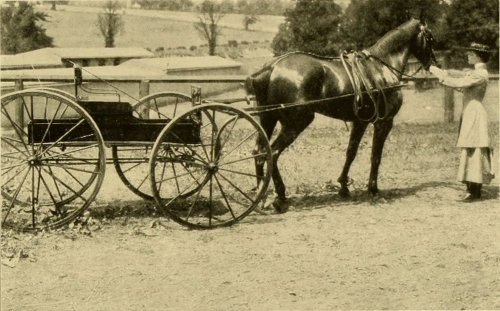
Inspection of the Harness
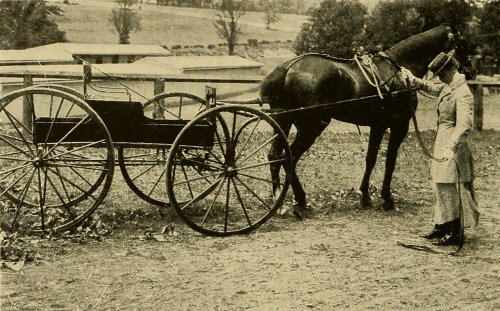
Getting Length of the Reins
If you are driving a runabout or a cart, or any other than a distinctly lady’s trap, the groom should leave the whip in the socket and should pass the reins doubled through the off terret of the pad from rear to front in such a way that the buckle end of the reins will hang even with the loop. You should go to the off-side of the horse and draw the reins through the terret with the left hand; then take the reins in the right hand, the near rein
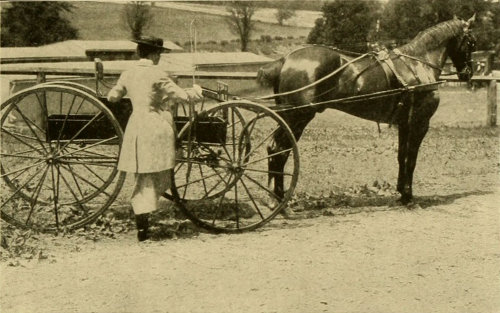
Stepping into the Trap
For ladies’ traps I prefer the square, almost level driving cushion to the slanting one, as it is more comfortable and gives a woman a more distinctive appearance. For country traps, and particularly for high carts, a slanting cushion may be more suitable.
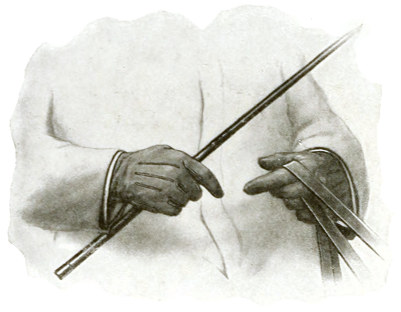
“Orthodox” Position of Reins and Whip
When driving, it is most important that a woman should sit correctly. She should hold herself erect, without stiffness; her feet should be together and her knees slightly bent. She should neither sit with her knees straight nor, what is worse, be perched on
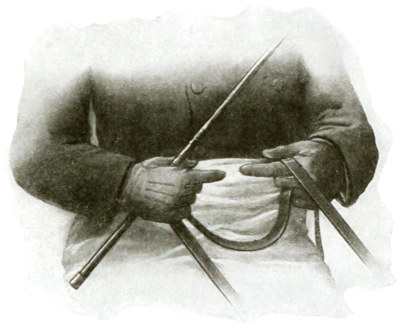
“Modern” Position of Reins with Loop
There are only two correct ways to hold the reins when driving, and so many people hold them incorrectly that I will describe them in detail. The two reins should always be held in the left hand, the near rein between the thumb and forefinger, the off rein between the second and third fingers, and the ends passing down and out by the little finger. The reins should be gripped by the fingers holding the edges of the reins against the cushion of the hand,
The whip should be balanced in the palm of the right hand, passing between the thumb and forefinger so as to leave all the fingers free to grasp the reins if need be. It should be carried at an angle of forty-five degrees, and point toward the left and front. The lash of the whip, for single and pair horse driving, should always be free.
The theory of correct driving is that the left hand is to hold the reins, the right hand to hold the whip and to assist the left hand in shortening the reins and in turning and stopping. The method of holding the reins in the left hand, and keeping the right hand only to assist the left, as I have described, [1] and for convenience I will call it the orthodox method.
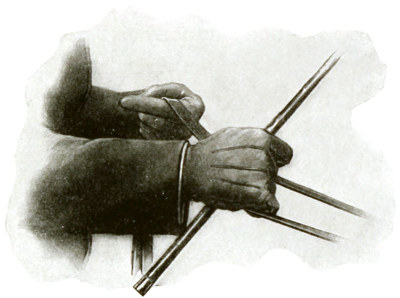
Correct Position for Shortening Reins
A variation on this method has, however, been introduced recently, and is now generally adopted by many of the best whips, both in England and this country, and is almost universally used in the show ring, where it is considered the correct form. For convenience I shall refer to this as the modern method. In this method, while the reins are held in the left hand as I have described, the off rein is
The whip must always be held in the right hand; the horse must never be touched with the whip while the right hand is on the reins. The whip should be used sparingly, and it is much more likely to be too much used than too little. It is used more in driving a pair than in driving a single horse, as one horse often lags behind the other and it may be necessary to use it on him to keep him up, though this should be done rather by proper bitting than by the use of the whip. Before using a whip, however, for punishment, be sure you hold the reins firmly in the left hand and that the horse is well gathered, otherwise he will start forward when you
I cannot insist too strongly on the necessity of having both reins securely held in the left hand and the horse well gathered before using the whip, for if you touch the horse with the whip with the off rein in the right hand, you are sure to slacken that rein and thus cause the horse to turn to the left. Moreover, if the horse starts, you are not in a position to control him.
To pull horses up and to stop them, you must first see that the reins are held evenly in the left hand; then place the right hand as far in front of the left as may be necessary. If you know that the horse has a hard mouth and does not stop readily, the right hand must be a foot or even more in front of the left, while with a horse that is light mouthed and stops quickly it should be only a few inches. The right hand is placed over both reins—some separate the reins by the third and little fingers, others put the little finger on top of both reins—and the left hand is raised and carried forward, at the same time the right hand is brought back so as to bring the
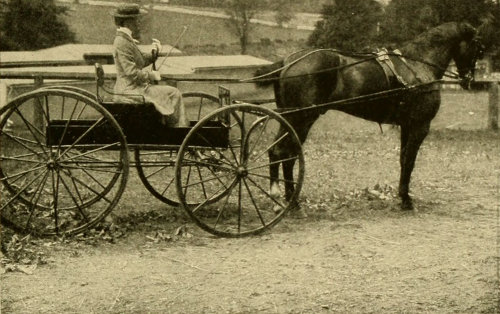
Pulling Up
Nothing looks worse or is such bad form, in stopping horses, as to pull the reins in toward the body, as is so often done by those who do not understand driving. Not only does this look badly, but it is dangerous, for it leaves the driver with no control
If you wish to turn to the left, when driving with what I have called the orthodox method, you should take the near rein in the right hand between the second and third fingers a few inches in front of the left hand and pull gently with the right hand, keeping the left hand as it was or advancing
In turning to the right the off rein should be gathered in the right hand under the little finger, a few inches in front of the left, and the horse pulled to the right by the right hand similarly to the way I have described for turning to the left.
In both the “orthodox” and “modern” methods, to shorten the reins in order to keep horses under better control or to slow them down, the reins must first be evenly held in the left hand; then the right hand is placed in front of the left, the off rein under the little finger, the near rein between the first and second fingers, and the reins are then grasped firmly in the right hand and drawn back and pushed through the left hand. It is bad form, in shortening the reins, to take the reins behind the left hand and pull them through with the right, though through carelessness many do it. If there is occasion to shorten the reins more than a few inches, instead of pushing through, let go with the left hand and again grasp the reins with the left hand in front of the right, and then, if necessary, continue to pull in hand over hand.
If in the act of turning a corner, or making any
Styles of Ladies’ Traps, Country and Town
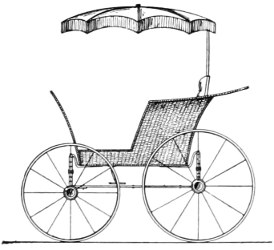
Basket Phaeton
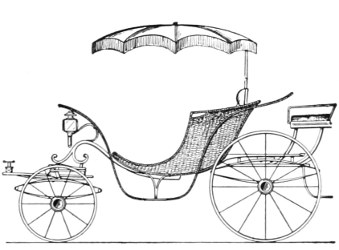
George IV Basket Phaeton
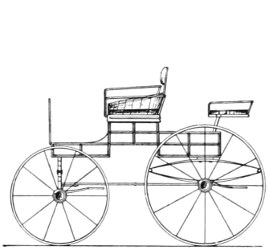
Cut-under Lady’s Trap
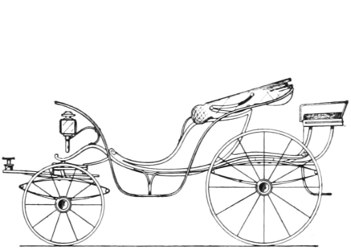
George IV Phaeton
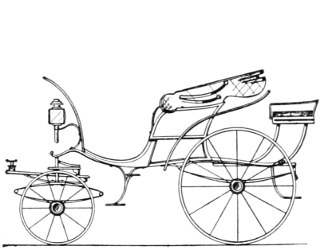
Peters’ Phaeton
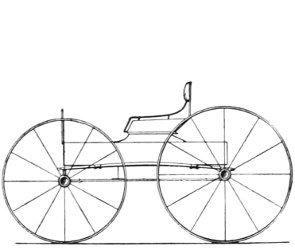
Runabout
To lengthen the reins, do not let them slip through
All that I have said above with regard to the management of the reins, applies equally to the driving of a pair or of a single horse. It does not apply to the driving of roadsters or trotting horses, as they are differently trained and driven in an entirely different method.
In learning to drive, unless one is being taught by a professional or other experienced whip, I would rather advise beginning with the “orthodox” method, page 199, the beginner may fall into the very incorrect, though common, method of holding a rein in each hand, and so not have the right hand constantly in readiness to assist the left in shortening the reins, in pulling up, in turning, and in the use of the whip.
The reins should never under any circumstances be held separately, one in each hand, for, obviously, if they are, the right hand cannot assist the left, the whip cannot be used, the horses can only be pulled up to the extent of the distance of the two hands in front of the body, and it is impossible to keep an even pressure on both reins; one hand will always pull more than the other. Holding a rein in each hand violates the first and fundamental principle of correct driving—that the two reins must at all times be held firmly in the left hand.
It is needless to add that the horse must never, under any circumstances, be struck with the reins.
When starting, the horses should first be gathered well in hand, and then, at the moment of starting,
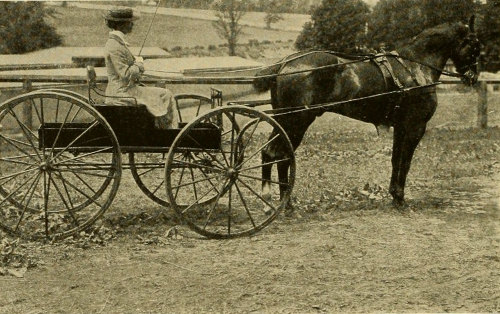
Starting
If you are driving in the afternoon, and there is any chance of your being out after dark, you should always be sure that the lamps are on the trap and that they have new candles; also, in country driving, be sure at all times that there are tools under the seat, including a wrench, a hoof pick, and matches.
In using the whip never strike a horse in front of the pad, or on his belly or legs, but always
In driving, if your horse shies, you should never whip him; you must keep control of him by a firm hold of the reins, and if possible drive him quietly up to the object that he is afraid of and make him pass it, and if practicable make him pass it two or three times until he has forgotten his fear. You must have the right hand in readiness to pull hard on the rein opposite to the side toward which he is shying, so as to avoid his overturning the trap, which, incidentally, is another demonstration of the importance of using the correct method.
If your horse rears, give him his head immediately by loosening the reins, and urge him forward with voice or whip, or both if necessary. If he
In driving, particularly with a single horse, the greatest danger is from kicking, for once your horse begins to kick you are in great danger in any kind of a trap, except a breaking cart, where the distance between the driver and the horse is so great that he can kick freely without touching the body of the cart. Of course no woman should knowingly drive a kicking horse, and if there is any question about it she should always take the precaution to use a kicking strap. A kicking strap cannot, however, be used in the show ring, but generally its use on other occasions is advisable. A kicking strap, fitting tightly when the horse is standing, of course effectually prevents a horse from kicking, as he cannot kick without first raising his quarters. The kicking strap, to be of real service, must be very strong. Bad accidents have happened through the kicking strap breaking, and a horse in the act of raising his quarters to kick has great power.
In driving green horses single, it is much safer to use a high cart than any kind of a four-wheel
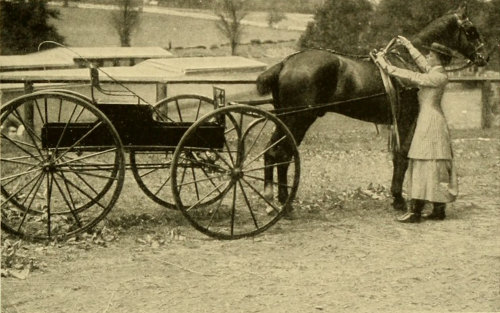
Pulling Reins Through Terret after Pulling Up
To get out of a trap when you have no groom, first lay the whip on the seat pointing toward the back of the trap, then place the reins in the right hand, taking them up enough to feel the horse’s mouth. Grasp the dash with the right hand and step out of the trap backward, with the right foot on the step, the left foot coming first to the ground; then step forward until opposite the pad and put the reins through the off terret in the position described on page 197.
When, however, a servant is in attendance, he should, as soon as you pull up, stand at the horse’s head; you then simply drop the reins with the left hand so that they lie over the dash; either lay the whip, as above described, to the left of the reins pointing to the rear, or else place it in the socket; then step out of the trap, facing forward, the left foot on the step. The servant then steps into the trap on the same side on which you have stepped out.
If the horse will not stand, it is quite correct to step out forward, keeping the reins in the left hand, and then to hand them to the servant when you have reached the ground, having first laid the whip on the seat pointing to the rear.
If you are driving a phaeton with a servant on the rumble, he should jump out as you begin to pull up and run to the horse’s head. If, however, your horse is very nervous and will not stand, it is quite correct to have the servant stay on the rumble, and then, after you have pulled up, to pass the reins back to him on your left side. Then place the whip in the socket and step out, facing forward.