Chapter XIII · FOUR-IN-HAND AND TANDEM DRIVING
Reading edition
As this book is limited in its scope to riding and driving for women, I shall not attempt to discuss four-in-hand and tandem driving in detail, and for a very exhaustive work on four-in-hand driving, would refer the reader to “A Manual of Coaching,” by Fairman Rogers (Philadelphia, J. B. Lippincott Co., 1900), and to “Driving for Pleasure,” by Frank Underhill (D. Appleton, 1897).
One of the best short books on the technique of driving is “Hints on Driving,” by Captain C. Morley-Knight, R.A. (George Bell & Sons, London, 1895). Chapter VI of that book describes in detail the method of holding and shortening the reins in four-in-hand driving, and chapter X the same problem in tandem driving. Like other English authorities, he, however, gives quite a different position for the right hand in tandem driving from that in four-in-hand driving, while the chief American writers, and nearly all the best whips of my acquaintance, advocate and use substantially the same position of the right hand in both.
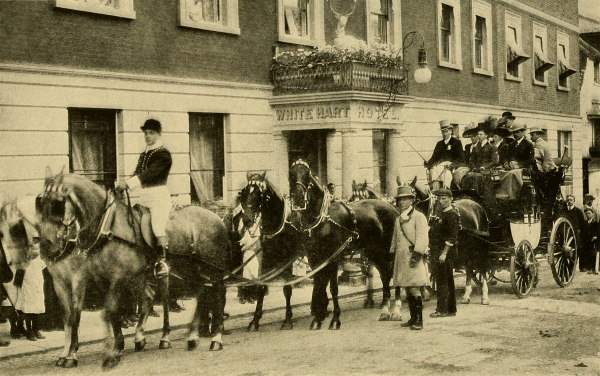
A Perfectly Appointed Road Coach with Postilion (London-Brighton, 1907)
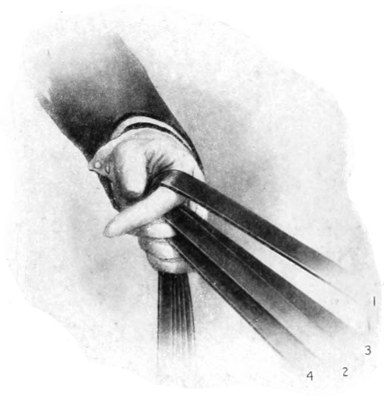
Position of Four-in-Hand and Tandem Reins in Left Hand
1. Near lead rein
2. Off lead rein
3. Near wheel rein
4. Off wheel rein
View larger image.
Before beginning to drive either tandem or four-in-hand, it is absolutely essential that you become proficient in handling the whip, and I would strongly advise learning to “catch a thong,” by daily practice, either outside on the ground, or, better still, on the box of the coach or driving seat of the cart, of course without the horses. By so doing one can concentrate one’s mind upon the thong without being distracted with the management of the reins and the movement of the horses. The best and
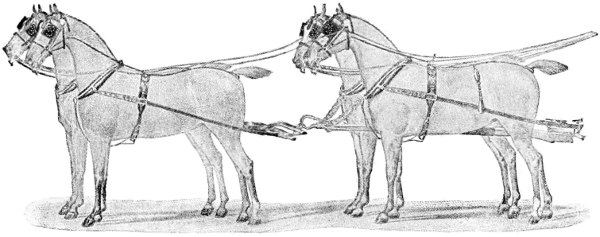
Four-in-Hand Harness
“Hold the whip horizontally in front of you with the end of the thong held between the handle of the whip and your fingers. Face a wall or the side of a building and with the quill end of the whip describe a letter “S” backward. Begin with the lower tail of the letter, following its form to the upper end. Don’t move the arm, keep the elbow easily by the side, and direct the movement of the whip by turning the wrist. Continue to increase the speed until the thong falls in place. At first a short downward movement at the end will facilitate the accomplishment of this somewhat difficult feat.
“Still another method involves a new movement. Hold the whip with the right hand against the waist and the quill end well around to the left and on a line with the top of the head. Carry the stick at this angle around to the right until in a line with the right shoulder. In so doing raise the right hand gradually. Now drop the quill end of the whip until it is on a line with the handle. This last movement should be executed quickly so that the end of the stick strikes the thong on the right-hand side of the stick.
“When the thong is caught, it is wound around the stick in opposite directions. The lower end should be unwound with the right hand, the whip being held between the thumb and forefinger of the left hand. The end of the thong should be rewound in the same direction as the upper part and held in place by the right hand. The loop should be about two feet and a half long and caught on the quill part of the stick.”
Not until you are proficient enough to catch the thong with certainty should you attempt to drive either four-in-hand or tandem, and you will find, the moment that you take the reins in your hands and start to drive, that it will be far more difficult to catch the thong than when you could
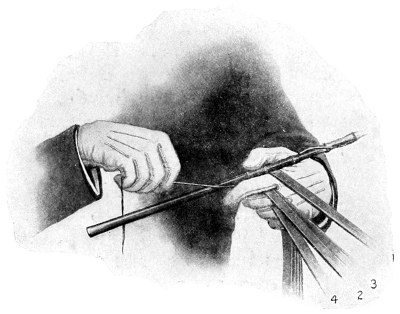
Winding Lash After Catching Thong
1. Near lead rein
2. Off lead rein
3. Near wheel rein
4. Off wheel rein
View larger image.
I shall not attempt to describe how the horses should be put to a coach or a tandem, for to do so would be to go far beyond the scope of this book, so I shall assume that the coach or cart, as the case may be, is correctly appointed and the horses properly put to.
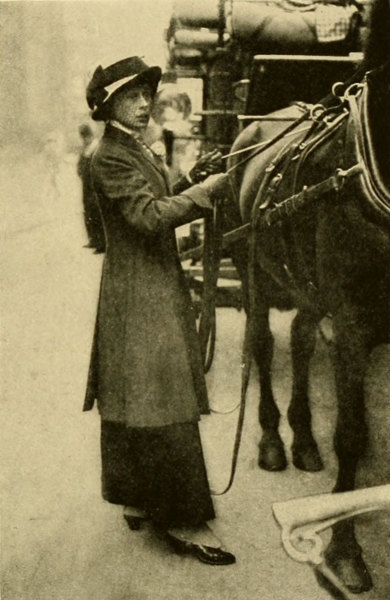
Photograph by the National News Association
Measuring the Reins Note correct tailor costume
To quote further from Mr. Garland’s work:
“In taking up the reins stand about two feet from the pad of the off wheeler. Remove the reins from the pad terret or trace tug and allow them to fall to the ground.
“First take up the near lead rein with the left hand, placing the little, second, and middle fingers
“Take up the wheel reins in the left hand, separating them with the middle finger, the near wheel rein on top. Drop the left hand to the side as described in the preceding paragraph. Now raise the hand and adjust the reins, with the thumb and forefinger of the right hand, so that the buckles on the wheel reins hang evenly.
“Pass the lead reins into the left hand, the near rein over the index finger and the off lead rein under the index finger and on top of the near wheel rein.
“When taking up the reins, draw each in turn gently through the terrets, tight enough merely to ‘feel’ the bit without causing the horse to flex his neck or make any backward movement.
“Step back to the wheelers’ hocks, and, keeping the left hand against the body, take the reins with the right hand in the same order as they are in the left hand. With the right hand close in front of the left one, draw the reins through the fingers of the left hand as far as the right arm can be extended, and then remove the right hand.
“As soon as this is done, take the whip in the right hand from the foot-board (if a tandem), or from
“Place your left foot on the hub, your right on the roller-bolt, then the left foot on the body step, and the right one on the foot-board. Take your seat as soon as possible and transfer the reins back into the left hand in the original order.”
A reference to the accompanying sketches on pages 219 and 222 will show the positions of the hands and reins quite clearly.
The correct position of the feet, legs, body, arms, and hands are the same as already described on page 198 in the notes on driving a single horse or a pair.
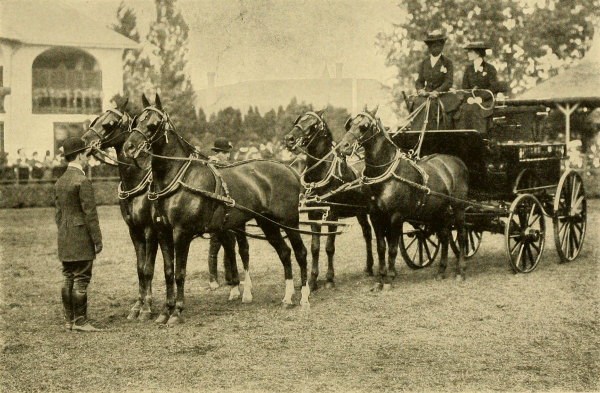
Lady’s Four-in-Hand Note correct position of reins and hands
To start a four-in-hand, the horses should, before starting, be well up in their collars, so that the traces are taut. The leaders’ reins should be shortened by grasping them in the right hand, separated by the middle finger, about a foot in front of the left hand and replacing them in the left by carrying the right hand behind the left. Take off the brake as quietly as possible, then advance the right hand, put the little and second fingers over the two off reins with the middle and index fingers so placed over the two near reins that the latter may be grasped. When you are sure that the four horses
“To shorten or lengthen the lead reins, place the middle finger of the right hand between the lead reins directly or at some little distance in front of the left hand, depending upon how much the lead reins are to be taken up or lengthened. If you wish to lengthen them, tighten the fingers of the right hand and draw the reins out to the desired distance. Should you wish to shorten the lead reins, take them out of the left hand, and in putting them back bring the left hand behind the right one. Do not advance the left hand.
“To lengthen or shorten the wheel reins, place the right hand under the lead reins and grasp the wheel reins in the same manner as described for taking up the lead reins. The wheel reins can now be either pushed back or drawn through the fingers of the left hand.
“TO STRAIGHTEN THE TEAM
“Should the leaders work over to the right of the wheelers, grasp the two reins, which are between the second and middle fingers of the left hand, between
“STOPPING
“When it is desired to stop the team, raise the left hand, and, placing the right hand over the reins, twelve inches in front of the left hand, as described in a preceding paragraph, press the reins in toward the body with the right hand.
“TURNING
“To turn to the right, shorten the leaders’ reins so that the lead bars hang slack, and place the little, second, and middle fingers over the off lead rein about five inches in front of the left hand (depending upon how sharp a turn you desire to make). Draw the off lead rein back over the forefinger of the left hand, first raising the left thumb. Whenever you think you have shortened the rein sufficiently, drop the thumb on the loop thus made.
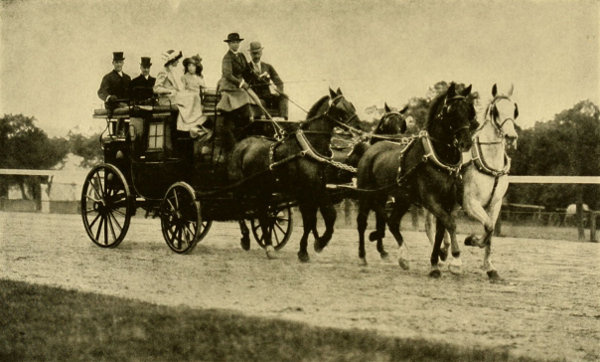
Lady’s Four-in-Hand Turning to the Right Note position of hands
“Place the right hand over the off reins and be ready to grasp the off wheel rein from the inside with the little and second fingers, should the off wheeler fail to follow the off leader in making the turn. At the same time place the middle finger of the right hand between the near wheel and the near lead rein with the forefinger over the latter, and
“It will be seen that the wheelers may be drawn back together at any time in making the turn. As soon as the turn has been completed, lift the left thumb and let out the loop of the off lead rein; then, after giving the leaders more rein, let the hands resume the position shown on page 238.
“To turn to the left, shorten the leaders’ rein so that the lead bars hang slack, and place the little, second, and middle fingers over the near lead rein about five inches in front of the left hand (depending upon how sharp a turn you wish to make). Draw the near lead rein back over the forefinger of the left hand, first raising the thumb. Whenever you think you have shortened the rein sufficiently, drop the thumb on the loop thus made. Grasp the off lead rein with the little and second fingers of the right hand and insert the middle finger between the off and near wheel reins. The near wheeler may be made to follow the near leader by tightening the near wheel rein with the middle and forefingers. Opposition may be exerted on each or both off reins, or the wheelers may be drawn back together. When the turn has been made, drop the loop and, after giving the leaders more rein, allow the hands to resume the position shown on page 238.
“TURNING ACUTE ANGLES
“In turning an acute angle to the right, take up the leaders as has been previously described. Then with the right hand reach over the lead reins, and,
“In turning an acute angle to the left, first take up the leaders, then place the right hand under the off lead rein, and push back toward the body the off wheel rein through the fingers of the left hand, and make the two points with the near lead and wheel reins. After the turn has been made, draw out the off wheel rein with the right hand until the buckles on the hand pieces are even. Then let out the off wheel rein and the two points as described in preceding paragraph.
“In turning a right angle, as from an avenue into a street, make the point, i.e., loop, over the forefinger when the leaders’ forefeet have reached the corner.
“In going downhill, take up your leaders so that the lead bars hang slack, and then shorten all four reins.
“If your reins become misplaced, keep your team going, unless approaching or on a sharp decline. Under the latter conditions, have the servants run to the horses’ heads and bring them to a stop as quickly as possible. It is much easier to readjust
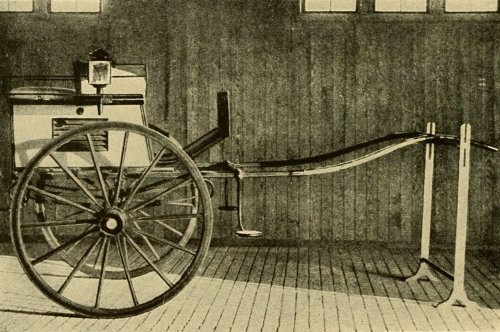
High Tandem Cart
What has been said and quoted above relates more particularly to four-in-hand driving, but the principles of tandem driving are the same, except that it must be borne in mind that to drive tandem requires far lighter hands and more quickness and skill on the part of the driver than it does to drive a four. There
As most of the current works on four-in-hand and tandem driving were written before the days of automobiles, added caution is now needed, particularly with respect to the tandem. No woman should, under any circumstances, attempt to drive horses tandem unless they are thoroughly accustomed to automobiles, and it is necessary nowadays to be very much more on the alert than it was before the evil days of gasolene.
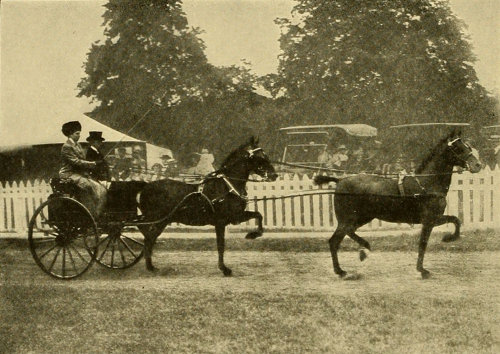
Tandem from Bay Shore, Long Island, Show, 1911
While with a well-trained tandem there will seldom be occasion for much whip work, at the same time, even with the best-trained horses, there will be occasions when the leader can only be controlled by the prompt and skilful use of the whip. With green horses it is quite impossible to control the leader without being prepared to use the whip at any moment. The ability to catch the thong comes into play far more frequently with a tandem than with a four-in-hand, and it is even more essential with a tandem, for the thong is more easily caught
With regard to the kind of cart to which the tandem should be driven, it is to be noted that, for several years past in the show ring, tandems have been generally shown to gigs, and very few tandems have been shown to carts even in country shows. This may result in giving the general impression that the gig is the correct vehicle to which to drive a tandem, which is far from being the case. No recognized authority holds that it is the correct vehicle, and, for road driving, a gig is thoroughly unsuited to a tandem. While a gig is more comfortable and balances better than a wrongly adjusted tandem cart, yet a gig is much too low for the driver either to have proper control of his leader or to be able to see obstacles in front of the leader. Moreover, a gig, having a much smaller body than a tandem cart and also short shafts, gives an appearance of wrong proportion to the tandem, and, especially from a distance, an effect of something lacking. This is particularly the case with horses over fifteen hands two. If a gig is used, it is important that the lead traces should be as short as possible, so as to make the whole appearance more compact.
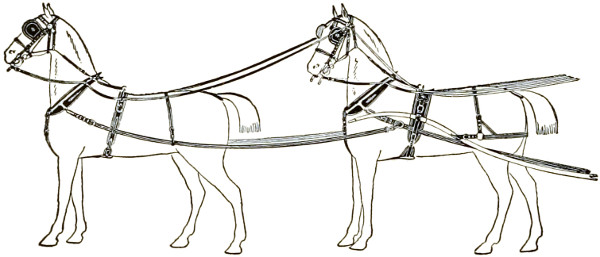
Correct Tandem Harness for Show Ring
For road work, and particularly for country driving, a tandem cart is not only correct, but is a more
With regard to balance, the body of a tandem cart is made to slide on runners, and the position of the body is regulated by a screw with a handle which comes up under the driving cushion. This handle may be turned so as to throw the body backward or forward, according to the number of persons who are to sit in the cart; thus, if a groom is to sit on the back seat, the body of the cart should naturally be much farther forward than if the back seat were empty, and, for the same reason, if there is the additional weight in front of another person besides the driver, the body of the cart should be moved farther back than if the driver were alone. The proper position of the body of the cart—so that it will be in balance—can only be learned by experiment, for it varies, of course, with the angle of the shafts and the weight of the load to be carried.
While the tandem cart is correct for tandem driving under all circumstances, for country use
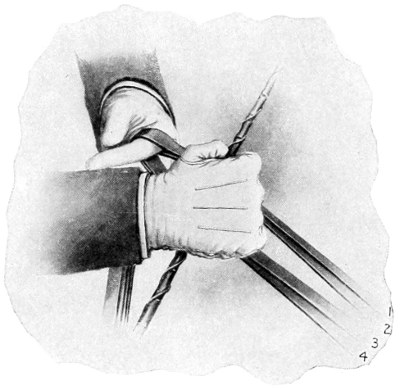
Correct Position of Hands Driving Four-in-Hand or Tandem Right hand ready to assist left View larger image.
In tandem driving, when going downhill, the leader’s reins should be shortened; if the hill is long, they should be grasped in the right hand a few inches in front of the left, separated by the middle finger, released from the left hand for a moment, then carried back with the right hand behind the left and grasped again in the left, and held there until the bottom of the hill is reached. If, however, the hill is only a short one, they may be simply taken up in the right hand and held there for a moment. The leader should, of course, not be pulling at all when going downhill; on the other hand, his traces should not be so loose as to give him any chance of getting his feet over. In travelling on the level, the leader’s traces should be only moderately taut. The tendency with beginners is to let the leader do too much work; this not only tires the leader, but it gets the wheeler in the bad habit of letting the leader pull not only the cart but the wheeler as well, and, in general, the leader should rather be reserved for uphill work. On the level most of the work, and downhill all of it, should be done by the wheeler.
While tandem driving originated in driving one’s hunter in the lead to the meet so that there was no attempt at having the horses match, nowadays matched pairs are commonly shown in the ring
Those who are in favor of putting a harness on their hunter will find that one of the best ways of exercising a hunter is by driving him in the lead of a tandem, as there he may be given much less pulling than if he is driven single. If you have a long-tailed hunter, do not, however, drive him in the lead. No long-tailed horse should ever be driven in the lead of a tandem, save in the exceptional case of showing a sporting tandem in the ring. The sporting tandem, as shown in the ring, is made up of any kind of a wheeler and the hunter in the lead
Of late years there has been a great outcry against the practice of docking which, in my opinion, has arisen through ignorance and prejudice, and has been raised by people who do not at all realize the dangers of driving long-tailed horses, especially in a four or tandem.
The arguments used against docking are first that it is cruel and second that it prevents a horse from brushing off the flies. Neither of these objections is well founded. The operation, when properly done by a competent man, causes almost no pain to the horse, is done very quickly, and has no after ill effects. With regard to brushing off flies, this argument would be quite good if horses were left out in the fields without anything on them, but to use it with regard to the driving horses of persons of means is perfectly ridiculous. When a horse is harnessed he cannot possibly use his tail to brush off the flies. When he is standing in a properly appointed stable, he is always covered in summer with a sheet and in winter with a blanket, and there are no flies in winter. When he is turned out in summer he is always covered with a sheet.
Docking is not, as its opponents assert, a senseless fashion, but is founded on reason. A long-tailed
Of course roadsters or trotting horses never should have their tails docked, nor should thoroughbreds or polo ponies, and many hunters do not. But when a woman drives any of these long-tailed horses, she is taking risks which she had better avoid.
With regard to the looks of a horse, to my mind no driving horse with any kind of a formal trap looks smart with a long tail any more than he does with a long mane, or forelock, or with the hair about his fetlocks untrimmed. I am not talking about a horse in the state of nature, but of a horse harnessed to a properly appointed trap.
With regard to saddle horses, I think also that a horse of the park, hack, or combination type looks far better with his tail docked.
It might be said that a trotting horse is quite as apt to get his tail over the rein as any other driving horse, but this assertion loses sight of the very different way in which a trotting horse is driven, and of the fact that in a trotting wagon the driver sits so near that he can reach down and lift the horse’s tail
Trotting horses are in a class by themselves, and it is more reasonable to say that the tails of trotting horses should be docked than that the tails of other driving horses should be long.
With regard to the mane, every driving horse should have his mane thinned out by pulling, so that it may not look shaggy. Most ponies look best with their manes closely hogged. If this gives a ewe-necked effect the mane may be cut in a curve, short at the head and withers and longer in the middle. The forelock on all driving horses should be cut entirely away.