Chapter XV · HINTS ON DRIVING
Reading edition
Regulate the pace by the distance that you have to go, and, whatever the distance, keep going at a steady pace—from seven to nine miles an hour is a good average—and it is a great mistake in long driving to go sometimes very fast and then try to balance it by going very slowly. In the old coaching days, when long distances were covered and the horses had to be kept in good condition, the general principle was to keep the horses going at about the same gait uphill and down, and this applies quite as much with a pair or a single horse. It is easier for a horse, and tires him less, to keep a steady gait than to walk up and down hill and then go very fast on the flat.
The most important thing about driving horses, especially for distance driving, is to find by experience their natural fast gait and then to keep them to it, and never to urge your horses beyond their natural gait, as nothing tires them so quickly. On the other hand, it tires a high-spirited horse almost as much to keep holding him back from his natural gait. Horses, after they have been driven a bit,
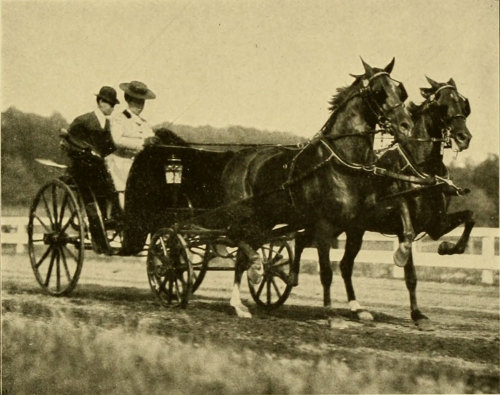
Driving a Pair to a George IV Phaeton
It is also a great mistake, which many drivers make, to walk horses down every hill they come to.
Start your horses slowly and let them gradually warm up to the work before them, and drive them slowly, or even walk them, for the last mile or two, so as to cool them before they go to the stable. As in riding, follow the old adage, “Walk the first mile out and the last mile in.”
When you are bringing your trap up to the house or to the curb, so as to get out yourself, or to let some one else out, you should rein in your horses gradually; keep them going at a gradually diminishing trot, until just before you are at the point at which you are to stop, and then stop them quietly but firmly. Do not attempt to dash up to the stopping place and then throw the horses back on their haunches, but do not bring your horses down to a walk twenty feet sooner than you need to and then creep up to the stopping place. Follow the same general principle when you are coming to a corner or entering a gate. That is, keep your horses well in hand and
In going up driveways, as in approaching a country house, be sure to keep your trap in the middle of the road, and to keep your horses up to their gait, always with your horses well in hand. Needless to say, it looks very badly to cut in on the grass on either side or to look as if you were cutting W’s.
It must be borne in mind when you are driving into a country place, that many of them have their drives so arranged that there is a turn to the stable near the entrance gate. Be sure that your horses are well in hand, and that you are prepared to turn them to the other side, as they are sure to see the stable turn and very apt to try to take it.
When you come to a hill, remember that your horses in going up need to stretch their heads out in order to exert their full strength. You should, therefore, give them their heads as much as they want, provided always that you keep them in hand. In going downhill, on the other hand, the horses
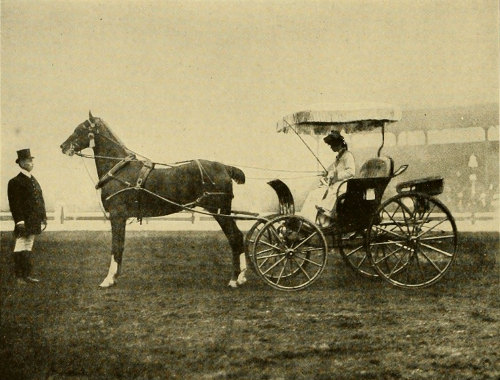
Basket Phaeton Note position of groom and livery
If you are driving a trap with a brake, with which some basket phaetons are equipped, as are all traps for use in hilly countries except runabouts, do not use the brake too freely. It is much better for the horses to accustom themselves to hold the trap back
The rule of the road in this country is “keep to the right,” but why this rule has ever been adopted, instead of the English rule of keeping to the left, I have never heard explained. A little reflection will show one that the English rule of keeping to the left is the naturally correct and sensible rule, and that the whole theory of correct driving is based upon it. Thus, the driver sits on the right side of the trap in order to be able to avoid hitting a trap passing in the opposite direction, as he is on the side where he can best watch his own trap and the trap that might strike him. So the whip is held in the right hand, pointing toward the left in order not to engage with the whip of a passing vehicle, and the reins are held in the left hand that the whip may be held in the right.
Similarly, I may add, in riding, a man rides on
For driving in the show ring, the park, or any crowded thoroughfare, the whip should be used to indicate to those behind you what you are going to
For all formal occasions, when you are driving any kind of a phaeton with a rumble, you should always have a servant on the rumble. For any formal occasion, where it is correct to drive a trap with a rumble, it is incorrect not to have the servant. It is better form, even for country driving, if you take a servant, to have him on the rumble, where he should always be if there is a rumble. It is not correct, where you have a rumble, to have the servant at your side. If the horses are pulling too hard, it is quite permissible to pass the reins back to the servant, or he may even drive them from the rumble,
For this reason the reins are made longer for a woman than for a man.