The West Union Baptist Church Ruth McBride Powers
Reading edition
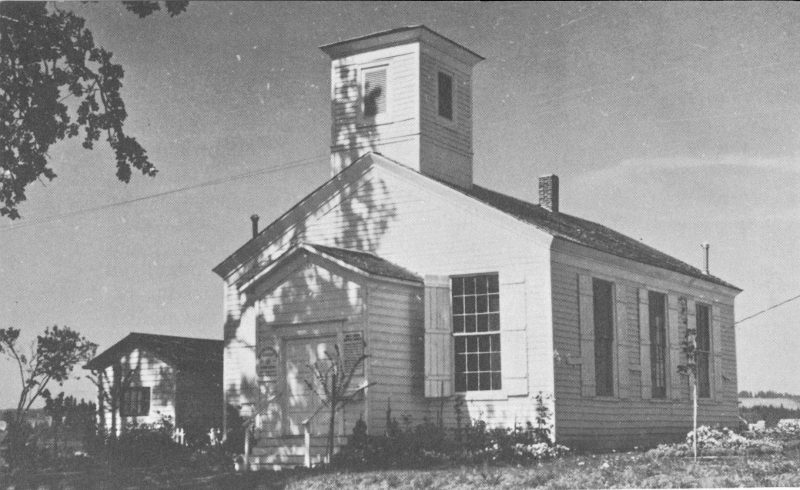
Oregon Historical Society
“We the undersigned agree to pay the sum annexed to our names severally for the purpose of Erecting a house of worship; to be the property of the West Union Baptist Church of Jesus Christ our Lord and Saviour; said house to be built in Washington County O. T., upon a lot of land furnished by David T. Lenox which the said Lenox and wife secures to the church by lease as long as they shall use it for a house of Worship, together with a burying ground, the lot of land is on the east side of the Lenox land claim at a point of timber adjoining the prairie, the house to be of good style frame 30 foot by 40 foot Square finished in good Style, the payments to be made to the trustees, David T. Lenox, Henry Sewell and Reubin W. Ford.”
* * * * * * * *
Thus reads a subscription paper dated April 20, 1853, which records pledges of $749.70 toward the total cost of $1,512.43 of the West Union Baptist Church. The average gift was $5.00 but David T. Lenox heads the list with $200.00, his son, Edward, $60.00. Generous pioneers of other faiths made contributions, including Dr. John McLoughlin, D. H. Lounsdale, and James Failing.
On May 25, 1844, five Baptists met in the log house of David Lenox on Tualatin Plains, about eight miles northwest of Hillsboro, and constituted the first church of the Baptist denomination in Oregon. 7 Their Minute Book shows that they named their church the West Union Baptist Church, decided to meet once each month at the homes of members, and elected David T. Lenox temporary Moderator. Subsequent entries clearly show that Lenox was the leading member of this pioneer church.
He was born in New York State in 1801, lived in Illinois and Missouri before leading a company of the 1843 wagon train to Oregon. Lenox sent out the call in 1848 that resulted in the formation of the Willamette Baptist Association. Although he was elected Moderator and Deacon, Lenox was voted out of his church in November, 1862, but was reunited with it before his death in 1872. His grave may be seen in the burying ground adjoining the white, turreted church situated on his Donation Land Claim. The West Union Baptist Church is the oldest Baptist Church west of the Rocky Mountains and one of the oldest Protestant buildings still standing in Oregon.
The Minute Book records the appointment of three committees to locate a site for a Meeting House, but it was not until David Lenox offered a portion of his land on April 9, 1855, that any progress was made toward the erection of the church. The Reverend Ezra Fisher, who was sent to Oregon by the American Baptist Home Mission Board in 1845, delivered the sermon of dedication on Christmas Day, 1853.
The West Union Baptist Church is the only pioneer church in Oregon, measured, blueprinted, and photographed in the Historic American Buildings survey in 1934. This project was carried out by the Civil Works Administration in cooperation with the National Parks Service of Plans and Designs within the Department of the Interior throughout the United States. It was a depression measure that offered employment to architects and secured records of great value pertinent to early American architecture.
Thirty-nine districts for research were designated. Oregon and Washington were “District 39.” The Oregon members of this district committee were Walter Church, architect, Portland; Nellie B. Pipes, librarian of the Oregon Historical Society, and W. R. B. Wilcox, Dean of the Department of Architecture of the University of Oregon. They employed twenty architects and two photographers. On the closing date of the project, April 28, 1934, forty-seven structures in Oregon and seven in Washington had been studied, delineated and photographed.
A list of these buildings may be found in the Oregon Historical Quarterly for June, 1934. Photographs and facsimiles of the blueprints may be inspected at the Oregon Historical Society Library in Portland or purchased through the National Archives in Washington, D. C.
8