George Fox College Mercedes J. Paul
Reading edition
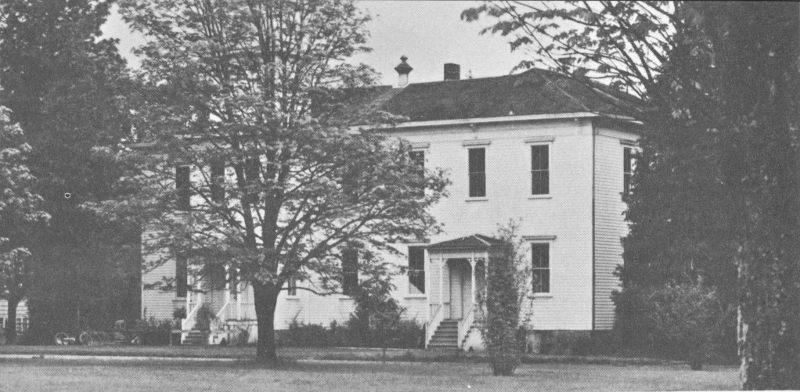
Ten years after William Hobson settled near the site of Newberg in 1875, the Friends had opened an academy for their children, the first Quaker school in Oregon and the forerunner of Pacific College, now George Fox.
In 1883 the pioneer Quaker parents, feeling the need of education for their children beyond that offered in the Oregon public schools, brought the subject of building an academy before the Monthly Meeting. Mary Edwards, Dr. Elias Jessup, David Wood, and Ezra Woodward were appointed to investigate.
By September, 1883, the committee reported $1,865 secured in good notes and that the subscribers had met and decided to call the school, Friends Pacific Academy.
C. J. Edwards recalled the establishment of the academy vividly. “One evening in the spring of 1884, as I was returning from school, I noticed that someone had cut a wide swath of wheat down along the west side of our garden and that several loads of lumber had been hauled to the place where the Friends Church now stands.... My father said he was very much dissatisfied with having to sell some of the land in the center of his farm for an academy building but that he was so anxious to have the privileges of the school for his family that he had consented to its erection near the center of the 80-acre field on the spot where the Friends Church now stands.”
On September 28, 1885, Friends Pacific Academy, a school of high school rank, opened its doors. Dr. Jessup had hauled the first 13 load of lumber with a mule team for the building, and Noah Heater and Charles Vaughn had contracted for the carpenter work.
The first academy building was moved in 1892 to the present campus where it became known as Hoover Hall in 1932 and was used as a men’s dormitory for twenty years. The architects declared it was suffering from “extreme fatigue,” and it was torn down in 1954, destroying a wall on which tradition says Herbert Hoover signed his name “Bertie.” The senior rose garden marks the site of the historic academy building.
Among the first to enroll on opening day was Bert Hoover, later thirty-first president of the United States. Then eleven years old, he was living with his uncle, Dr. Henry Minthorn, Pacific’s principal. On the college’s fiftieth anniversary Mr. Hoover was granted Pacific’s first honorary degree and his fiftieth.
When the academy opened, there were two of senior rank, eleven in the first year, twelve in the second, and thirty-four in the first year of the grammar department. There were two teachers besides Dr. Minthorn.
Six years later there were 125 students attending classes, and one had graduated. The Quakers were now confronted with the problem of providing further education for their children, and, since the nearest Quaker college was in Iowa, they decided to start their own.
Pacific College opened its doors on September 9, 1891, with Dr. Thomas Newlin as president. There were six other instructors. The college’s aim was that of “offering to young men and women the benefits of a liberal Christian education.” Two juniors, four sophomores, and seven deficient in preparatory work were enrolled in the college; and 136, in the academy.
Pacific’s first graduates were Clarence J. Edwards, son of Jessee Edwards, in whose wheatfield the academy had been built; and Amon C. Stanbrough, an early superintendent of Newberg schools.
In 1949-50, final action was taken to change the name of Pacific College to George Fox. It was felt that the increasing confusion of Pacific College with Pacific University at Forest Grove and the use of Pacific in the names of other schools on the Pacific coast made such a change imperative.
There are few colleges that send a larger proportion of their graduates into the so-called sacrificial fields, as teachers, preachers, or missionaries. George Fox, the fifth oldest Quaker college in the United States, emphasizes constantly the ideal of service rather than selfishness, and of character as well as scholarship.
14