Linn County Courthouse Florette Nutting and Helen J. Horton
Reading edition
Linn County, Oregon, is a mountain and river-valley region, extending from east to west from the summit of the Cascade Mountains to the Willamette River. The Santiam River and the Calapooya River, tributaries of the Willamette River, which have their sources in the Cascades, traverse the valley at approximately the county’s northern and southern boundaries.
In mounds south of Albany have been found human skeletons, and utensils and weapons of possibly Indian manufacture, pointing to the custom of burying with the dead, the weapons and implements used in life. This indicates that Linn County was a happy hunting ground for a large tribe of Indians known as the Calapooya tribe, which gave this name to the river flowing into the Willamette River at Albany.
Earliest settlements were made in Linn County at Albany, Brownsville, and Lebanon, in the Spring of 1846, by pioneers who had crossed the plains the year before and had wintered near Oregon City. The first cabin was erected in 1845 by William Packwood, where the old Indian trail, between Scio and Lebanon, crossed Crabtree Creek. It was sold to John Crabtree in the Summer of 1846. The Earl family were the first permanent settlers. They built a cabin about two miles east of Knox Butte in the Spring of 1846, and in the same year settlers located at Brownsville and Lebanon.
Brownsville was the county seat then. The schoolhouse on the Spalding donation land claim in South Brownsville was the first 63 courthouse. Organization of county government occurred December 11, 1849. Albany was designated as the county seat of Linn County by legislature in January, 1851; and, in 1852, a courthouse was erected.
Linn county’s second courthouse, erected in 1852, was identical in plan with the famed Octagon House. The Octagon courthouse cost nearly $5,000. This wood-frame building, located on West Fourth Avenue, Albany, burned to the ground September 1, 1861. The fire did not destroy the county records in use at the time, as they were protected by a fireproof vault. However, many records and historical documents from the early days of Albany and Linn County were completely destroyed.
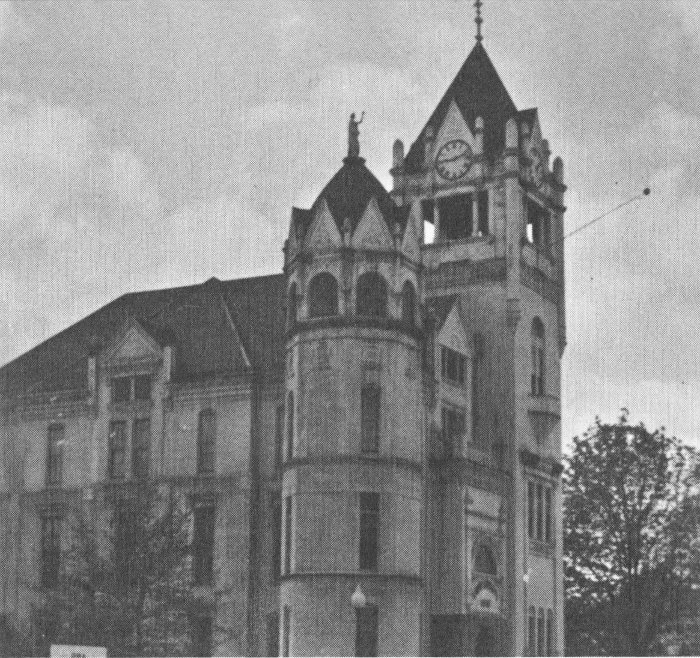
The Courthouse, pictured here, was completed between 1862 and 1865, at a cost of $35,000. The architecture was similar to Southern Colonial. It had a brick portico and four large Corinthian columns, two stories high. In 1899, the third story and the clock tower were added to the original building.
At the turn of the century, the town that didn’t possess a large town clock, with chimes, was not a town worthy of mention. Accordingly, the courthouse addition was designed around the clock tower. The clock itself had four ten-foot faces and was kept in motion by 1,000-pound weights. The bells, which rang Albany people to work in the morning and sounded curfew at night, could be heard in Sodaville when the wind was right. The clock was made by the Seth Thomas Company and kept nearly perfect time throughout its lifetime.
Not only was this courthouse interesting from a material standpoint but also for its outstanding usefulness to the whole community. In addition to housing the courtroom and county offices, it often served as a town hall, meetings of various kinds being held in the courtroom or in the attic above the second floor. In these same rooms, many eminent lecturers, evangelists, and other visiting speakers drew appreciative audiences of town and country folks. Some of the county’s able lawyers made their first speeches there. Directly to the north of the courthouse lay a vacant block which, in those early days, was called the “Courthouse Square.” Also, closely associated with the courthouse was the square, two-storied brick jail which stood on the southeast corner of the block. It was erected in 1871 at a cost of $9,550. When the second courthouse was enlarged and remodeled, the addition of a third story, two towers, a town clock, a statue of justice, and other adornments changed the style and appearance of the building completely, and the old courthouse became only a memory to those who had loved it.
64
STATE of OREGON
Portland
West Union Baptist Church
Joe Meek Donation Land Claim
Old College Hall, Pacific University
George Gay House
George Fox College
Belleque House
Champoeg Farmland
Amity Church of Christ
Wheatland Ferry
Salem
Monmouth Normal School
Stump House
Fort Hoskins
Bishop Simpson Chapel
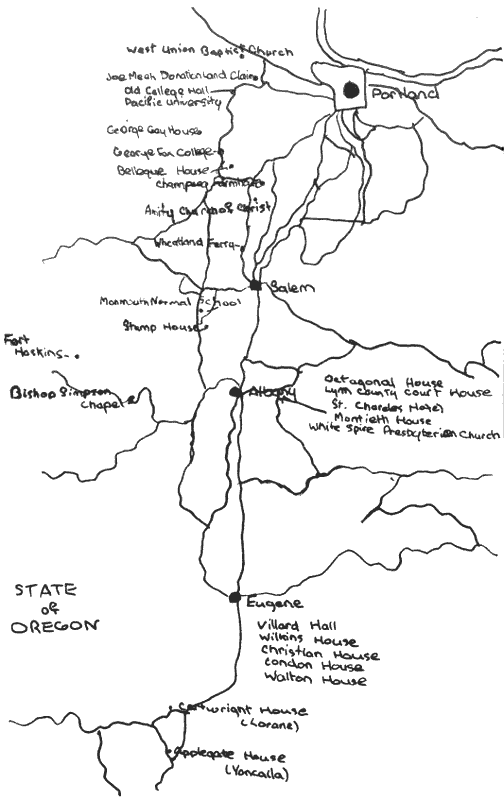
Albany
Octagonal House
Lynn County Court House
St. Charles Hotel
Montieth House
White Spire Presbyterian Church
Eugene
Villard Hall
Wilkins House
Christian House
Condon House
Walton House
Cartwright House (Lorane)
Applegate House (Yoncalla)