Old College Hall Irene S. Story
Reading edition
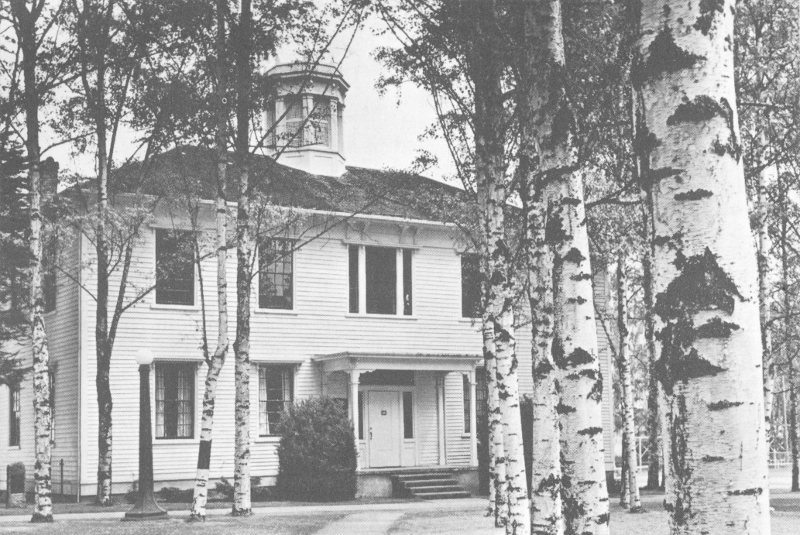
According to the caption on the bronze marker placed by the Multnomah Chapter of the Daughters of the American Revolution on May 12, 1939, “College Hall (is) the oldest building in continuous use for Educational purposes west of the Rocky Mountains. Here were educated men and women who have won recognition throughout the world in all the learned profession.”
In this building Tualatin Academy developed into what is now Pacific University. When the Academy was chartered in 1849, the classes met in the log cabin erected for the Congregational Church in West Tualatin Plains, now Forest Grove. But in 1850 the board of trustees authorized the erection of a two-story frame building. Here are the words of one of the students, Marcus W. Walker, concerning the “raising”:
“It was in 1850 but in the early summer and never did a brighter sun shine through, a bluer sky or more brilliant green bedeck forest and grove and plain than did those in which boys reveled during those days in which the frame of the old Academy building was placed in position.
9
“All spring, men and teams had been hewing out and hauling timbers while other men under the oversight of ‘Squire Tuttle,’ as he was familiarly called, had been framing them and now they were ready to be put together. It was yet in the days of log houses and ‘bee-raisings’ and notices and invitations had been sent out naming the day when everything would be ready. Men with families came from other neighborhoods in white-covered ox wagons, camping out for the time, and the affair greatly resembled the old-fashioned camp meeting. Tables were set in the old log building, partly school house, partly church, which has passed into history as the birthplace of Tualatin Academy and Pacific University, where bountiful dinners were provided by the women for the men at work. This department being under the energetic oversight of ‘Grandma Brown’ with her somewhat stern face and dignified bearing, but we knew that behind them lay the kindest heart that ever befriended a homeless orphan whose name is, if possible, more intimately associated with the history of this institution than that of Rev. Harvey Clark, its founder and patron.
“Squire Tuttle gave the signal, ‘He-oh-heave’ and up it went and settled into place. Money was scarce in those days and houses were built in a hurry so a winter and a summer passed away before even one room was ready. It was a frosty morning in October 1851 when 25 or 30 of us gathered in the lower north room and school began with J. M. Keeler on the platform. The fresh ceiling on the walls and overhead, the large new blackboard, the new double desks, homemade as they were, all combined to make it a veritable palace, used as we were to the rough log walls of the old building with its rough benches and long shelf running around the sides for desks.”
The building cost about $7,000 and the trustees were $2,000 in debt. The Rev. Harvey Clark gave 200 acres of land at first; this plot of ground was divided into lots and many of them were sold to help pay for the building. Later he gave more land for the same purpose. Tabitha Brown mentions in a letter that she gave $100, a big sum in those days, especially for a woman of 69 or 70 years of age earning her own money. Mrs. Mary Walker, wife of Rev. Elkanah Walker, gave her watch which was sold and the sale price added. Others gave generously also and the Society for the Promotion of College and Theological Education in the East contributed to the upkeep of the Academy.
In 1854, the Territorial Legislature granted a new charter with full collegiate privileges to “Tualatin Academy and Pacific University.”
10