The David Stump House in Monmouth David Campbell
Reading edition
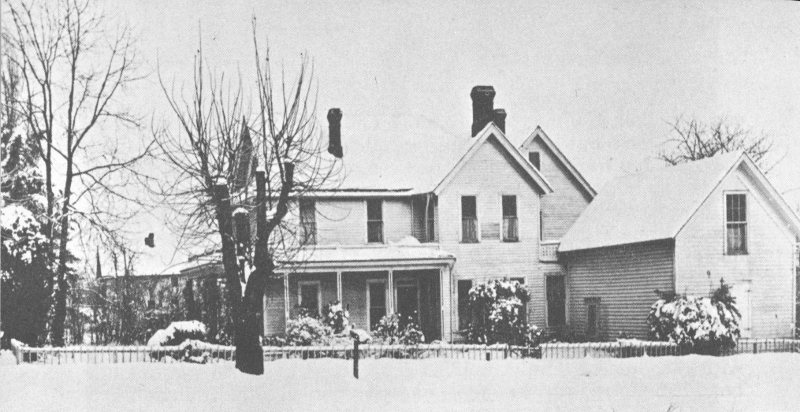
David Stump, of Pennsylvania Dutch stock, was born in Ohio on October 20 (or 29) 1819. As guard, outriding scout and hunter, he came to Oregon with the immigrant train of 1845. An experienced surveyor, his services were in demand for surveying the virgin territory of what is now Benton, Polk, and Yamhill counties. In 1851, he was married to Catherine Elizabeth Chamberlin, who had come, a child of nine, with her family in the wagon train of 1844.
David and Catherine Stump took up a donation claim on the Luckiamute River, six miles south of what later became the village of Monmouth, being among the very first settlers in that part of the Willamette valley. Here they prospered. They became devoted and loyal members of the Christian Church, which soon established a church-supported college in Monmouth. There were two sons and two daughters. When these were ready for higher education, David Stump acquired from the Lindsay family a home in Monmouth adjacent to the college. It stood at the intersection of Jackson and Monmouth streets on the southwest corner of a half-acre tract of land, facing to the west the Victorian Wolverton place, with the Orville Butler home to the north. This became—and continued for many years as—the Stump family home. Here, after a long illness, David Stump died on February 21, 1886.
In the mid-nineties the house was completely renovated and, to a great extent, rebuilt. The roof was raised to give space for a large 31 attic. Rooms and porches were added. The position of the entrances and chimneys was altered. In all, there were now seventeen rooms. Miss Ellen Chamberlain, Mrs. Alice Applegate Peil, Miss Antoinette Bruce, Miss Rose Bassett, Miss Lane, and other members of the Normal faculty lived there around the turn of the century. It became quite a center of college activities. Miss Cassie B. Stump had inherited the property from her father.
There was a good-sized barn at the east end, occupied by a Jersey cow and chickens and ornamented in Autumn with the glowing red of Virginia Creeper. There were a berry patch, a large vegetable garden with morning glories twining the corn stalks, and a row of huge sunflowers. Mrs. Stump and her daughter were great lovers of flowers. They had a small greenhouse for chrysanthemums, smilax, cacti, and various exotic plants. A gnarled Gravenstein produced great, juicy apples. There was a big white fig tree, which froze to the ground periodically, but somehow managed to survive. Directly behind the house stood two exceptionally tall Black Republican cherry trees, a rare sight when in bloom and by July covering the ground inches deep with an over-abundance of ripe fruit. There were madonna lilies, amaryllis, the spike of a yucca, and roses in profusion. A sweet Mission rose, brought to the farm from California, then transplanted to town, was by the front door. Inspired by a visit to the poet, Longfellow, during her student days at Wellesley college, Miss Stump had planted a hedge of lilacs modeled after his in Cambridge.
Not long after Miss Cassie Stump’s death in 1941, the property was acquired by the Oregon College of Education. The old house, by now in a state of disrepair, and the once lovely garden, neglected and overgrown, were removed to make way for the handsome, modernistic library building and the appropriate landscaping with which it is surrounded. A Jack pine and the great maples across the front are about the sole reminders of the former occupancy of the land.
A collection of pictures, records, and mementos of early days at the college is housed in the library. It seems eminently suitable that this particular site should become a permanent part of the campus of the school, in the founding and support of which the Stump family had had such a large share and in which the members had maintained a vital interest over so many years.
32