Christian College—Oregon Normal School—Oregon College of Education David Campbell
Reading edition
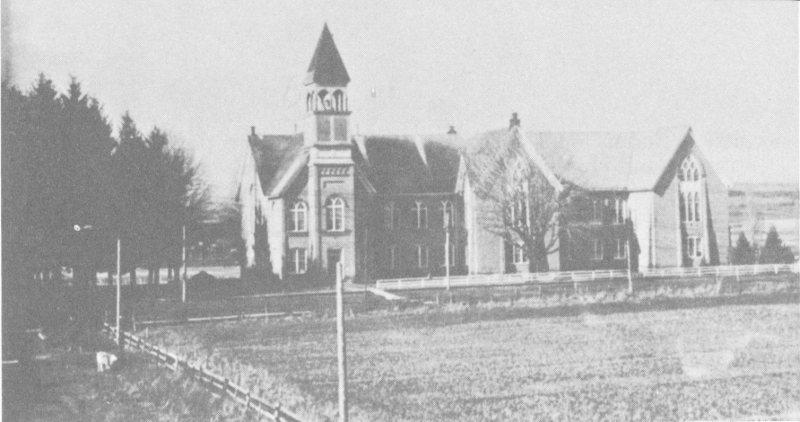
The early settlers in the Willamette Valley were not only provident and God-fearing, they were also deeply concerned with higher education for their young people. Academies and colleges sprang up in many of the valley communities. A group of prosperous farmers in Polk County, consecrated members of the Christian Church, gave land and financial support to found a church-affiliated school at Monmouth, to become known as Christian College.
In 1869, Thomas Franklin Campbell was engaged to head this institution. Originally from the deep South, he had come some years previously to Helena, Montana, where he conducted a school for boys and served as circuit judge. He was a man of wide interests and abilities, having served in the Mexican war, and been active as lawyer, minister, and promoter of various public projects. But he was before all else an educator. As a student at Bethany College in Virginia he had lived in the home of Alexander Campbell, founder of the Christian Church. There he had acquired an excellent classical education, had been ordained to the ministry, and had married a cousin of Alexander Campbell, only recently arrived from Ireland.
Responding to the call from Monmouth, with his wife, Jane Eliza and their three sons, he made the long, arduous trip from Helena to Oregon in a stagecoach. The challenging task for the 33 new administrator was to raise funds for a suitable, permanent structure. He solicited earnestly over the state and very soon a brick building, modelled as to general type after the Gothic-inspired architecture of Bethany College, was constructed. It was here that distinguished jurists and others prominent in Oregon life received a thorough grounding in the classics. The curriculum was mostly concerned with Greek, Latin, mathematics, logic, and philosophy. Science was not at that time, as it is with us, a prime consideration. The first graduating class was that of 1871.
By 1892, Christian College had been converted into a State Normal School. There was imperative need in the state to train teachers to meet the growing demands for their services. Prince Lucian Campbell, son of Thomas Franklin Campbell, was now the president. A new wing on the south was added to the original building. This included a science laboratory, several large classrooms, and an assembly hall known as “the Chapel.” The latter has undergone some changes and is at present called “Campbell Hall,” where hang the portraits of the two early presidents.
This new wing was surmounted by a bell tower from which the strong-toned bell peremptorily summoned students to their morning classes. Eventually the enlarged building was balanced with another wing added on the north to house a training school. The whole structure forms truly an historic Oregon Landmark, which is held in fond affection by the many who have studied there.
A sad mutilation occurred in the great wind of Columbus Day 1962. The familiar belfry was toppled to hang precariously. The forlorn picture was featured in newspapers and national magazines as evidence of the violence and destructive power of the unprecedented storm. Many great trees of the ancient fir grove and others on the campus were badly damaged. Much is irreparable, but effort is being made to replace the bell tower and to restore all possible.
The Oregon College of Education, with the other institutions in the State System of Higher Education, is experiencing a record enrollment. There are new and modern buildings to meet increasing demands. To foster tradition and the realization of past accomplishment, and to stress the foundation on which present achievement is based, the preservation and history of this original building at the Oregon College of Education is of signal importance.
34