La Creole Academy at Dallas Joseph D. Lee
Reading edition
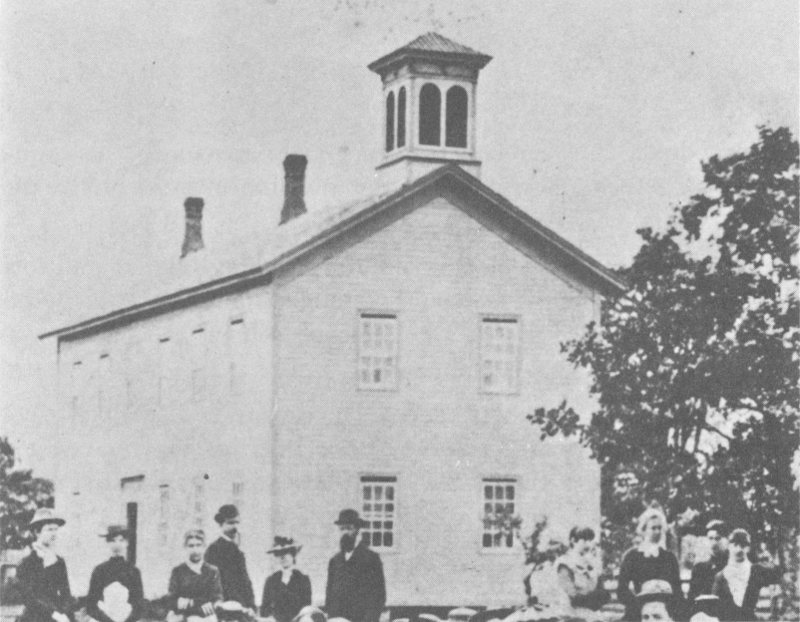
In Waverly, Ohio, Nicholas Lee and Sarah Hopper were married August 4, 1840. That same year they moved from Ohio to Iowa, while Iowa was still a territory. In the spring of 1847, they left for Oregon, fully equipped with a good team of oxen, two cows (Rose and Lilly) and necessary household goods. Raids by Indians upon the cattle of the train and losses by stampedes left them practically without a team. They threw away much of the household goods and fortunately purchased a yoke of oxen (Dave and George) from another train, enabling them to complete the journey.
The Lees and quite a number of others took the Southern route via Klamath Lake and Cow Creek Canyon. Of the train coming down the Columbia, several stopped at Dr. Marcus Whitman’s station and were ruthlessly murdered or captured in the Indian massacre of November 29 and 30, 1847.
It was late in the fall when the Lees reached the head of the Willamette Valley, for the trip was a hard one, especially Cow Creek Canyon. The cattle were weak and jaded. Elias Briggs, who had safely brought a hive of bees that far, lost them when his wagon was overturned in the water.
The Lees and James Fredericks selected claims and built cabins not far from Eugene Skinner’s, after whom the city of Eugene was named. In the spring of 1848, Frederick and Lee with their families 29 came to Polk County, seeking work and supplies. Their intention was to return, but hearing that the Indians had burned their cabins they decided to remain. They had the use of a two-room cabin for a time.
The winter of 1848 and 1849 was spent by the Lees in Salem. The California gold rush was on, and Mr. Lee, a cooper by trade, made pack saddles that winter and sold them to men leaving for the mines.
In the summer of 1849, they returned to Polk County and bought a claim two and one-half miles south of Dallas. The transition from the cabin to the “new house” was an important event with the pioneer family in 1852. The house is still in use but has been remodeled. Mr. Lee took an active part in establishing church and schools in Dallas and its area. In 1854, he was licensed as a preacher of the Methodist Episcopal Church, and is credited with organizing the original Methodist Society.
In 1855, Mr. Lee took the lead in building a log school house on the John Nicholas place. His two older children attended. Soon afterwards a move started for an independent academy in Dallas. Lee was one of the members of the first board of trustees, and served as treasurer. Land and money were donated, and the town site was moved from the north side of La Creole Creek to the south side.
In 1856-57 were built the new courthouse and jail. The La Creole Academic Institute had two rooms ready for school opening, February 15, 1857. Professor Horace Lyman and Miss Lizzie Boise were the teachers. The Lee children, as they grew large enough, walked three miles to school. To give the children advantage of winter school, Mr. Lee built a house in Dallas, which they occupied at times until the fall of 1862, when Mr. Lee started a small store in Dallas and they moved to town.
The Academy served as a school for all age groups until the 1880’s. The first public grade school building was erected about 1882.
In 1900, La Fayette Seminary, organized by a board of trustees of the Educational Association of the Evangelical church, was incorporated with La Creole Academic Institute in Dallas. It was known as Dallas College and La Creole Academy. The combined schools were endowed by the church. A dormitory was erected in 1900, costing $3000. The Woolen Mill property was purchased for $1,500, and—for the expenditure of about $1,000 in repairs and remodeling—the second floor was converted into a good gymnasium.
The schools closed in 1914 for lack of funds to meet the requirements of Oregon standardization laws.
30