General Joel Palmer Home Carl H. Francis
Reading edition
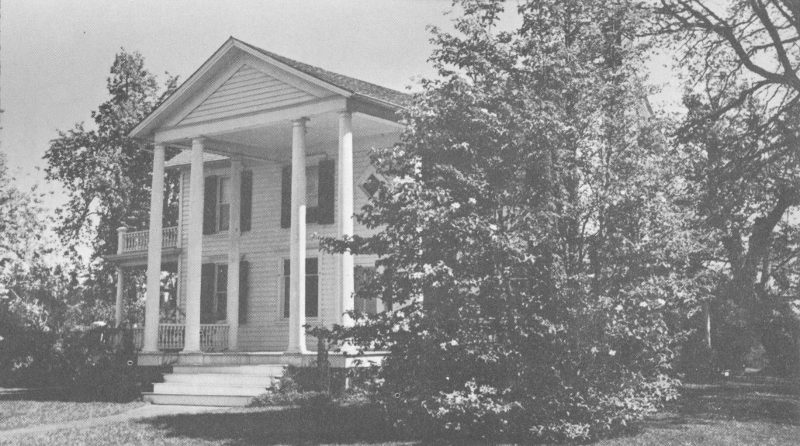
The impressive home of General Joel Palmer, with its stately columns, catches the eye and excites the curiosity. In Dayton’s City Park one of the few authentic blockhouses remaining, compels attention, and each year thousands of tourists read that it stands as a memorial to General Palmer; out of the dusty past ride the well-known figures of Sheridan, Grant, Russell (who died at the Battle of Winchester), Wheeler, (both of the Confederacy in the War between the States and of the Union in the Spanish-American War), all identified with the historic blockhouse. But no note is made of the regal structure which views the passing parade from its vantage point of the State Highway which traverses the small town; and history has itself passed by one of the most colorful persons who helped hammer out the destiny of Oregon.
Let us look first for a moment to this man—a man who shaped the future, first of the Indians who occupied the land, and then of his fellow countrymen. As Superintendent of Indian Affairs, he negotiated the treaties whereby the red man ceded title to the Oregon Country; these were ratified by the United States Senate and became the law of the land. Because of his humanitarian attitude toward the Indians, Palmer was the victim of unfair criticism. But when the Whitman massacre resulted in the Cayuse Indian War, Palmer readily took the field against the errant, and it was in this War that his title of “General” was obtained. Yet all the while, he served his fellow countrymen in numerous ways. In Indiana he had 11 been a member of the legislature before his first trip to Oregon in 1845.
As Faith Holdredge Watts says, he was then “on a journey of exploration, to test the feasibility of taking his family out later and establishing a permanent home there.” He was immediately elected captain of one company and in the fall of that year with Sam Barlow established what is now known as the “Barlow Trail”—a portent perhaps of how perverse history would refuse to recognize this leader, and give its laurels to another. Palmer then platted the Town of Dayton in 1850, setting aside the City Park as a “Court House Square” and the Brookside Cemetery in which he was later buried. His picture, in the Oregon State Capitol, looks down upon each Speaker of the Oregon Legislature, for he was the second Speaker of the Assembly—but again, perverse history dismisses him with a reference to a “Joe” Palmer; he was a State Senator, refused to run as a candidate for the United States Senate while in government employment, but in 1870, was the candidate of the burgeoning Republican Party for Governor, being defeated by less than 700 votes. He was characterized as a “man of honesty and integrity.” This was the man who built the house.
The house itself has been rebuilt, added to, and a part destroyed. Gertrude Palmer, granddaughter of the General, lives today in Lafayette, Oregon, and her mind leaps quickly back to the olden days; she recalls as a small child holding her grandmother’s hand while the original structure (one story and attic, with a double fireplace) was demolished. In the 1860’s, Palmer built an additional part which was remodeled in 1911, giving the present structure a “southern plantation” look. Palmer’s original Dayton home was Dutch Colonial. He was a “bound boy” in his youth; with no formal education, he struggled to achieve the recognition he received. The house would reflect his personality.
To this home, says his granddaughter, came orphans—and one sees here his hope that they be spared the rigors of his own youth. One of these, Christopher Taylor, drove the wagon train that brought Palmer’s wife to Oregon. Christopher Taylor was from Dayton, Ohio; and so the Oregon counterpart came to be named.
Palmer, although a distinguished leader in the pioneer community of Oregon, was apparently not fully aware of Oregon’s rainfall when he built his home. To the Civil-war period portion of his house (and incidentally, as a Republican leader he was strongly pro-Union), he dug a deep-bricked cellar, which filled with water during the winter months. Gertrude Palmer reminisces that when it so filled, “We used to get our shingle boats and play in the cellar.” This pastime became denied to juveniles with the 1911 remodelling.
12