The Condon House Josephine Evans Harpham
Reading edition
Boychuk Studio
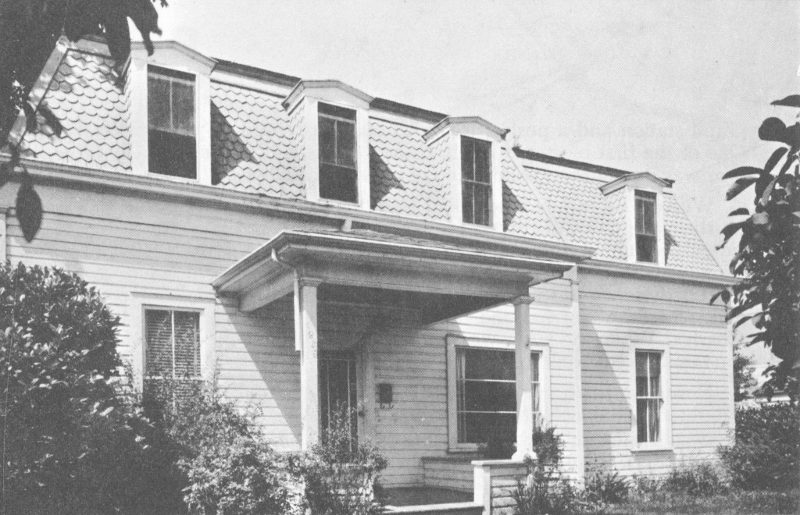
The early-day house of Dr. and Mrs. Thomas Condon stands at 1268 Jackson Street near 13th Avenue West. The home, built in the late seventies, originally stood at the Southwest corner of 11th and High Streets and was purchased by the Condons in 1882. It is a two-story house of wood construction with approximately ten rooms, which include a parlor and a charming living room with an old brick fireplace and plank walls, 2×10 and 2×12, set vertically. In earlier days a low white railing gracefully decorated the top of the house, which had a mansard roof, the latter also having been used in early University of Oregon buildings.
On its original site, the house stood on one half of what is now a city block and was not surrounded by any other buildings. The Condons planted many fine shrubs and trees, some of which are still standing at this home’s former location. In 1907, Dr. Condon passed away, and after a time the home was moved to its present location by Elwin McCornack of Eugene, a grandson.
Thomas Condon, pioneer Geologist of Oregon, was born in Southern Ireland in 1822 of Norman Irish stock, and the name is prominent in Ireland’s history, especially from the eleventh through the seventeenth centuries. When young Thomas was eleven years 47 old, his family moved to America, and their first home was in the wilderness which is now Central Park, near the site of the American Museum of Natural History in New York City. Here as a boy he began the study of nature and the flora and fauna of that region. After completing his education, he spent several years in teaching and later completed a course in Auburn Theological Seminary in 1852. A few months later, he married Miss Cornelia Holt, a young teacher of New England ancestry, whose home was near Buffalo, New York. The young couple decided to go to the Oregon Country as missionaries, the Home Missionary Board of the Congregational Church having accepted them for this important endeavor.
After a long voyage around Cape Horn and up the West Coast, they arrived in Portland, Oregon, and from there went to St. Helens and later to Albany. After a time the Condons decided to move to The Dalles. Here they established a church which was open to any denomination and to all kinds of people in all walks of life. Many of the latter, inspired by Dr. Condon’s avid interest in science, assisted him in collecting geological data and specimens. Too, at times he accompanied the U. S. Cavalry of old Fort Dalles, on field expeditions into the John Day region. Here he collected “fossil” material and other data of the utmost importance in the field of geology and palaeontology, and in turn exchanged this valuable information with the Smithsonian Institute.
After about ten years, the Condons left The Dalles, going to Forest Grove, where Dr. Condon taught at the college awhile. In 1876, he was asked to become a member of the first faculty of the University of Oregon and became head of the Natural Science Department, later the Department of Geology. In the latter capacity, he opened up the John Day “fossil beds” and adjacent regions to scientists from all over the world; he also contributed much to the literature in his field, one of his best-known works being his book, “Two Islands.” Condon Hall and Condon Museum of Geology on the University of Oregon campus bear his name, as does also the chapel in the First Congregational Church of Eugene.
Dr. Condon, a scholarly man and a very fine teacher, possessed also a fine sense of humor. In addition, he manifested a warm interest in, and a kind of sympathetic understanding of, the people with whom he came in contact. The Condons opened their home to faculty, students, world-famous scientists, ministers, neighbors, and friends, with true hospitality. Mrs. Condon always shared her husband’s activities.
48