Mr. Perris's Description of the French Counterblow
Reading edition
The French counterblow described above by Mr. Duranty was of great importance in changing the entire aspect of affairs for the Allies. Mr. Perris, in a dispatch dated June 12, gave these further particulars:
Faces that wore a serious expression yesterday morning are decidedly cheerful today. The battle has, in fact, taken a better turn. It is a very dreadful struggle; no Frenchman can forget that fact, and in the fever of weighing and measuring results more distant observers should not for a moment overlook what they mean in flesh and blood. That being said, we may join in the satisfaction of our allies that on its third day the German onset has suffered a distinct check.
Following the front from west to east, the first thing to note is the series of French counterattacks on the left, carried to a considerable measure of success by skill in the direction and high spirit and fortitude in the ranks.
At 11 A. M. yesterday a movement began from a little east of the railway line between Domfront and Wacquemoulin. The infantry were supported by tanks, and along the whole line the Germans were swept back. A French contingent actually reached points which were within the German front. The French advance went well beyond Rubescourt and Le Fretoy, half way between Courcelles and Mortemer, and between Mery and Couvilly, beyond Belloy, and to the border of St. Maur.
Meanwhile the enemy had delivered a very powerful blow at the French centre and had driven a way, despite vigorous opposition, as far as the village of Antheuil, two miles south of the Matz. At 4 P. M. a further counterattack was therefore made from the French left centre, and the enemy advance was completely arrested. In these combats a certain amount of confusion was apparent in the German ranks, and the fact that 1,000 prisoners and some cannon were taken speaks eloquently. This was not the heaviest punishment. Eyewitnesses say that German corpses strew the battlefield in piles.
Three critical days of the offensive have then given the enemy at the cost of enormous losses a not very magnificent result. We now know that the program was to reach Compiègne on the second day. General von Hutier must be greatly disappointed.
The attack was begun with fourteen divisions, at full strength, in the line. They included at the centre divisions of the Prussian Guard and four other crack divisions. About twice as many divisions have now been thrown into this battle, ten already holding the sector and the rest being fresh reserves.
These figures may be measured by the fact that the total German forces in the west amount to 207 divisions, and that of these before the offensive only sixty-two were in the general reserve, the rest being engaged on the front. The more we consider in the light of material considerations like these what the German command essayed and what it has accomplished the more we shall appreciate the valor of the French armies and the qualities of their chiefs; and it is impossible to do justice to either without such reflection.
FRENCH HOLD GAINS
On June 12 Mr. Perris reported that the French were holding their gains and gave these further details of the counterattack the day before:
The French lines hold all the way round from the important position of Mery Plateau by the hamlets of St. Maur and Antheuil to Marest and Chevincourt. Time after time, last night and this morning, the gray-coated masses of General von Hutier came on, only to be mowed down by waves of fire from the 75s and machine guns, and their remnants dispersed with bayonet and grenade.
Yesterday's French counterattacks met great bodies of the enemy prepared to force another advance. Four divisions were found to be ranged in a space of two miles. Hence the frightful intensity of the combat and the abnormal slaughter.
The French tanks did very good service, and fleets of airplanes, British as well as French, swept down upon the battlefield before and behind our infantry, dropping bombs and raining down volleys of bullets wherever a group of enemy soldiers was seen. The numerical inferiority of the French was thus made good.
The block of wooded hills was very difficult to defend, even if the enemy had got no further than Mareuil. The woods prevented long views and open fields of fire; the deep ravines invited infiltrations; the Oise Valley at the back left supply and relief columns open to the German guns, and the Matz Valley, on the west, was the plain path of envelopment. These are the reasons why this corner was not held longer.
Among the wheat and beet fields of the gently rolling plateau further west, on the other hand, the defense had more advantage. There are folds of ground enough to hide its batteries and reserves, but in every direction there are open lines of fire, room for manoeuvre and nume rous railroads. Striking northeast from the Estrées Railway, the French threaten the German centre.
To continue the southward march, even if it were possible, before this pressure on the west had been disposed of would be reckless. Hutier has met his match.
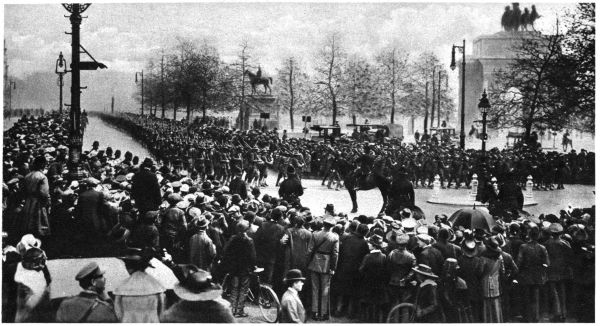
First parade of United States National Army men in London. The photograph shows them rounding the corner at Hyde Park (© Central News Photo Service)
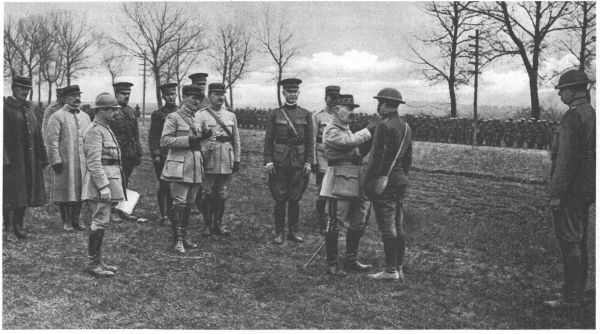
General Philipot of the French Army decorating American officers who distinguished themselves in opposing the German advance in Picardy (French Pictorial Service)
THE COMPIEGNE THRUST
On June 13 General von Hutier made a threatening thrust toward Compiègne, which was parried by the French and was practically the termination of further serious efforts in this phase by the Germans. Mr. Perris tells the story of it as follows:
South of the Aisne the high, bare farmlands extending from Soissons to the borders of the forest of Compiègne are cut by a valley running up from the other great forest of Villers-Cotterets to the river at Ambleny. This valley, with the villages of Laversine, Coeuvre, Cutry, Dommiers, and St. Pierre-Aigle, has constituted the front for the last fortnight, with French outposts on the east side, but the real line of resistance on the west.
Von Hutier having met with trouble beyond his expectations on the west of the Oise, his colleague, von Boehm, was sent yesterday morning to create a diversion on this flank of the battlefield. Five divisions, two of them fresh ones, were thrown forward on both sides of Laversine, a front of four miles.
Though outnumbered, the French have given a fine account of themselves, breaking repeated assaults of the enemy, who is reported to have got into the villages of Coeuvre and St. Pierre, a feat more than counterbalanced by the French advance at Damard, further south on the border of Villers-Cotterets Forest, and the admirable action of the Americans on the ground recently taken by them in Clignon Valley.
This, however, is not the best sign for the fifth day of the offensive. Von Hutier's thrust from the north toward Compiègne was by far the most threatening of the numerous lines of attack the German command has now opened. It has been brought to a stop by reactions of the French left and centre, and was this morning contained, as we may hope definitely, from the Mery Plateau and along the course of the Matz.
ENEMY'S FEVERISH HASTE
The feverish haste with which the enemy's attacks are multiplied as the field of the offensive is enlarged, speaks eloquently of the conscious need to bring the grand adventure to a speedy climax. But this haste involves heavy moral as well as numerical usury. Instead of a full normal period for refilling and new equipment, including rest at the rear, or in a quiet sector, and a course of fresh training being given to a division withdrawn from the line owing to its losses, it is hurriedly reconstituted and pushed back into the battlefront after as few days as possible.
Up to now the German armies have been sustained, not only by reinforcements from Russia, but by the long rest of the Winter months; otherwise they could not have accomplished what they have done. These sources of strength are being rapidly exhausted. The human material—cannon food—is failing in quality. The field depots have been emptied of recruits. Men from the depots in Germany are rushed to the front. Cavalry officers are dismounted to fill gaps in the infantry. Men detached for special work are called back to their units, and still the war god is unsatisfied.
Incorporation of the 1920 class began in April and May. Miners and mechanics are again turned into the fighting ranks, ill as they can be spared from industry. It is probable that not a division has been left in the east that would be fit for the western front. Wounded men and invalids imperfectly cured are pressed back into service. And behind the armies thus replenished there is the nation, hungry, enfeebled, terrorized, uttering words of despair even in its letters to the front. Ludendorff may well hurry!
DEFENSE OF COURCELLES
A very brief diary of the battle at a single point will give an idea of its bitter violence. The small village of Courcelles lies across the chief road of the western wing of the offensive, only about two miles from its starting point with the Montdidier-Estrées railway, and the same distance behind it. For these reasons, and because it stands on a spur of the Mery Plateau, it was certain to be a hardly contested position.
On Sunday morning, June 9, taking advantage of the cover afforded by broad fields of well-grown wheat, the Germans came up the slope from Rollot and rushed the village. At 9:40 the French re-formed and retook it, capturing 200 men and four officers. Forty minutes later a new wave was brought up from the north, but was thrown back. Some storm troops, however, got around by the rear. These were in turn repulsed.
Several hours passed in which the three streets of broken houses were put in order for a siege. At 3 P. M. a fresh attack was repulsed. Later in the afternoon the German success at Mery and Belloy resulted in Courcelles being beset on three sides, only a narrow alley of communication to the west remaining open.
The defenders now had their blood up. The reserves would soon arrive. This western flank of the battle was of the utmost importance. It had become a point of honor that the village should not be lost.
At 4:40 A. M. on Monday, after a preparatory bombardment, the next blow fell. In ten minutes its failure was evident, though the fighting about the barbed wire continued for an hour. Three more assaults followed in the afternoon and evening. In the last of these some Germans got into the village, but they were at last driven out. On Tuesday the heroes of this splendid defense reaped the only reward they desired. The great French counterattack definitely freed their little fortress.
TABLES TURNED
This time it was the turn of the French to win the benefits of initiative and surprise. Only a quarter of an hour was given to the French artillery for its preparation work. Tanks and infantry then went forward in alternate lines. An officer describes the advance of the tanks rolling over the green wheatfields, while shells burst around them, as having the appearance of a battle at sea.
The allied airmen, swooping above the moving line, not only sowed death in the enemy's ranks with their machine guns, but also raced forward and dropped bombs with effect on heavy batteries in the rear, killing their crews and putting the guns out of action.
In some enemy units during this battle the men fought well. In others there have been unmistakable signs of demoralization. Such inequalities are not surprising in this crisis. The total superiority of force which a few months ago was enough to have terrified us, and which is still sufficiently serious to require every effort that can be put forth, is ebbing away.