First American Offensive a Success
Reading edition
Capture of Cantigny by General Pershing's Troops Described in Vivid Detail
By THOMAS M. JOHNSON
Correspondent with the American Army
This stirring narrative of the first attack and capture of enemy territory by the American forces in France was written by a staff correspondent of The New York Evening Sun. It constitutes a memorable chapter in our military history, not because of the size of the town captured, but because the event marks the beginning of offensive operations in Europe by the United States Army. The brave men who took Cantigny—at the apex of the German salient aimed at Amiens—continued to hold it against all counterattacks through the succeeding weeks. Under date of May 29, 1918, Mr. Johnson cabled from the front:
The Americans have made their first real attack of the war, and it is a complete success. Advancing up a wooded slope behind French tanks and protected by a perfect and annihilating barrage from French and American guns, our infantry at 7 o'clock Tuesday morning, May 28, stormed and captured the village of Cantigny, northwest of Montdidier, and the German defenses to the north and south, making an advance of a mile on a two-mile front.
The Americans went over in open formation at 6:45 o'clock, advancing at an easy walk and maintaining intervals as if on parade. The sun had just risen, and through streaky clouds all about tongues of red flame were darting from the muzzles of hundreds of massed guns, big and small, while the air itself quivered with the shock of explosions, mingled with the deafening yet purring roar that is called drum fire.
Cantigny itself was turned into a veritable hell, a pillar of fire and smoke, and into it went the crawling, sinister tanks followed by the American infantry in thin lines or little groups. For a while they were swallowed up in the great white and brown and black cloud that enveloped the village, then back to the American line came the first message: "We're here! Everything O. K.!"
Thus these troops of the New World made their first real entry into the war. Thus they did what they could to help in offsetting the new German effort. Compared with the giant struggle going on elsewhere it was just a little outburst, but we did our best with it and have succeeded.
AN UNFORGETTABLE SCENE
No one who had the privilege to be on the scene at the time of this first American attack will ever forget the sight. It was unforgettable. The whole thing is uneffaceable from the time in the pregnant darkness when the troops that had been chosen for this most honorable of tasks went quietly along the shell-pitted roads to the jumping-off place; from the time the grotesque monsters called tanks rumbled up the same roads to hide until dawn in lairs behind the front line, while other monsters with long snouts crouched upon their heavy carriages like coiled serpents and were given their last drop of oil and their last daub of grease to make sure that their devastating charges would fall true upon their mark; from the time the men were given their last orders and their last "good luck" and went off, they knew not to what, in the first early streak of rosy dawn when the cannonade began and the first airplanes whirred overhead toward the doomed village.
From then until that last throbbing hour when the tempest of shellfire drowned out everything, yes, up to that tense minute at 6:45 o'clock when we turned to one another and in an awestruck whisper said, "They're over," it is all unforgettable. One lives such moments but once.
This operation had been planned for weeks down to the minutest detail under the direction of the Superior French Command, and in the closest co-operation with the French, to whom must go a liberal measure of the credit for its success.
So far as its objects may be disclosed, they were the following: To reduce the enemy salient and capture its strong point and observation post. Cantigny was all those things. Jutting out from the German front, it gave the enemy an advantage in the field of fire, while, because of its strong cellars, which were linked up with an especially long tunnel under the château in the southern part of the village, which might be likened to its citadel, it was decidedly a strong post.
Perhaps most important of all, it gave the boche a local advantage comparable to that of a man looking down a well. It commanded a sort of valley running back into our lines and permitted the enemy observers to see many things that went on there and so direct his artillery fire upon our back areas. For all of those reasons Cantigny was a prize of value out of all proportion to its size.
ATTACK CAREFULLY REHEARSED
The attack was carefully planned and was rehearsed by our infantry with tanks. They had the further advantage of valuable data gained by our patrols in frequent night explorations of the village, whence the boche seems to have withdrawn his infantry during darkness.
To two American soldiers goes the credit for the fine and loyal thing they did which immeasurably contributed to the success of their comrades. These two soldiers were captured early yesterday morning in a trench raid, and last night the question on every one's mind was, "did they tell?" They knew what was coming and had rehearsed it. Subjected to Prussian grilling, would they tell? The answer came this morning. The Germans were caught completely by surprise just as they made relief. The prisoners taken by us included some incoming and some outgoing troops. They hadn't the slightest idea the attack was coming. They didn't tell, those boys of ours. All the more honor to them for it!
PLAN OF THE ATTACK
This is how the attack was executed: The troops selected to make it entered the trenches in two shifts, the first on Sunday night and the second on Monday night, May 27. Special trenches had been constructed to accommodate a larger number of men than usual. Two hours before zero—that is to say, at 4:45 o'clock this morning—the men withdrew to supporting trenches, whence they went to the front line at zero, or 6:45.
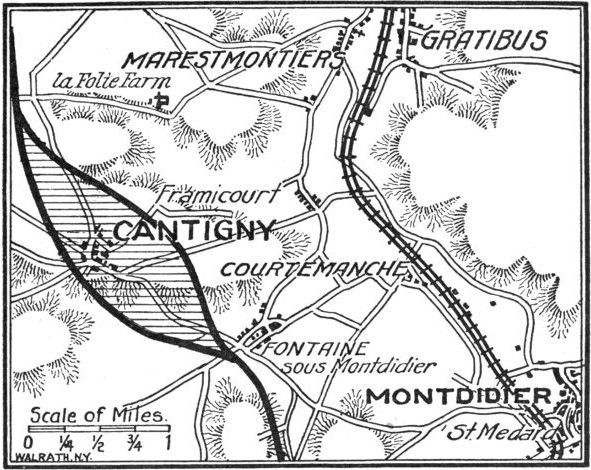
CANTIGNY, THE FIRST TOWN CAPTURED IN FRANCE BY AMERICAN TROOP
They were divided into three waves for the main attack, with separate detachments to whom had been allotted the task of mopping up the Cantigny cellars. On the right and centre the advance was made to the furthest objectives, while on the left, according to the plan, after mopping up the German trenches, our troops withdrew slightly to a better position, connecting with our old front line.
The troops went forward in extended order, preceded by the powerful tanks, all of which entered Cantigny and went some distance beyond. With the infantry went a detachment of flame throwers who were used against the cellars when the boche refused to come out when ordered to do so. They were also accompanied by a strong detachment of engineers, signal corps men, and carrier pigeons, but the wires have remained intact.
The artillery fire was tremendous. The German batteries at the rear were also drenched by gas. A rolling barrage behind which the infantry advanced was laid by the field guns. The infantry went forward first at the rate of fifty yards per minute and then at twenty-five yards per minute. The moving barrage of fire stalked ahead of our men into Cantigny, keeping the boche down until the infantry was upon him.
The timetable was adhered to perfectly. At 4:45 o'clock the artillery began a heavy concentrated fire, swelling to a drum fire at 6:45, "zero," continuing thence onward to 7:20, when the infantry reached their final objectives. At 7:30 the infantry outlined their position with flares so as to enable the airplanes to signal back. Thus it will be seen that Cantigny was taken in less than thirty-five minutes, for the final objectives were beyond the village.
ALL MODERN WEAPONS USED
There were some tough nuts to crack besides Cantigny itself, such as the trench system protecting it on the south, also part of the Fontaine Wood, and some separate houses at the crossroads at the southeastern outskirts of the town, but all were reduced with bombs, bayonets, or rifles, while the machine guns which went along with the infantry also aided.
Besides all this, a heavy smoke barrage was used, not only to screen our infantry from boche observers, but to blind the boche gunners. The tremendous effectiveness of the whole thing was shown by the fact that for nearly a half hour after the infantry went over the top, the German artillery was practically silenced. This was due especially to the accurate counterbattery work of the French heavies.
So the Americans in their first attack had the aid of every engine of modern warfare—tanks, gas, flame throwers, smoke barrage, numbers of airplanes, machine guns and automatic rifles, while some especially heavy trench mortars also were concentrated and hurled great bombs into the German trenches from close range. Reports all agree that the German defenses were completely leveled, and the smashed up trenches look like a field plowed by a giant harrow. Our men walked into the trenches through great gaps torn in the barbed wire, but in many places there was no wire at all for great stretches. So much for the main outlines of the attack.
WATCHING THE BEGINNINGS
Waking up early in the morning on the blanket bed on the floor of the dugout and taking a first peek through the sandbagged entrance, it was plain that our best hopes were going to be realized and that it would be a clear day with good visibility. The sun had not yet appeared, but the clouds were few and the early light showed every feature of the country. Here and there were dark dots denoting the waiting batteries, while sausage balloons were already swinging overhead.
In the messroom the commanding General sat at breakfast, cleanly shaven and unworried, although he had been on the front line most of the night. This General, who was in immediate command, talked not about the attack, but about the censorship, tactfully choosing the favorite subject of every correspondent.
By this time the artillery had started, so we went out along the road toward the front, passing a line of ambulances parked under the trees. The further we went along the road the more frequent became the flashes of the explosions on either side, but thus far not a single boche shell had come in and the sounds overhead were all caused by the familiar rushing of our shells and none by the whistle of the boche shells.
Some distance up the road was a vantage spot whence we got a clear view of Cantigny, or the spot where it had been. It was a picture terrible in its grandeur. Cantigny might have been a volcano in eruption shooting up clouds that were first white, then brown, then black, while above the air was filled with spiral shaped black clouds of exploding shrapnel.
GUNNERS BEAT THEIR RECORD
That great smoke cloud was eternally writhing and twisting and taking on new forms as if anguished Cantigny were trying to escape its fate, but every instant more guns flashed. Beside the observation post the cloud grew larger. Finally the smoke streamed off to the right. Near by the American gunners were working, stripped to their undershirts, dripping with perspiration. We walked over there.
"This is the fastest firing we've ever done," said one breathless officer.
Further to the right was the house where the correspondent spent several days and nights a month ago. It is ruined now, but batteries are still there, and they, too, were spouting fire and smoke.
To the left new batteries had opened and the din was terrific. It was hard to resist the impulse to put one's fingers in one's ears. A glance at the watch showed that it lacked barely five minutes of the "zero" hour. Those five minutes passed more rapidly, and yet more slowly, than any I had ever experienced.
Ahead was a green slope dotted with trees, up which our infantry was to advance. It was bare and empty. It seemed incredible that in a few minutes our men would be there. The second hand crawled, yet raced, around the dial. It rested on the figure 10 and we looked at one another. "They're over," we whispered.
We looked up from our watches to find that the smoke clouds had drifted down the slope until the whole country for miles about Cantigny was obscured by shifting, changing vapor from the great caldron toward which our unseen men were plunging. We almost groaned our disappointment, for in a moment there came a little rift in the smoke, revealing something moving on the ground.
Imagine looking at the teeth of a black comb through a wire screen and having some one pass the comb slowly before your eyes. That was what it looked like—those black teeth, our men, were screened by the shifting smoke. It was only the tiniest glimpse. Then the smoke drifted over and rose again, but we had seen them going forward and upward to Cantigny. After a time the smoke spread still further. Nothing remained to be seen.
ALL WENT AS REHEARSED
Walking back along the road, where now there were a few belated boche shells coming, the heavy artillery officer said: "From my observation post we could see them for a couple of minutes. They went just the way they rehearsed, just walked along slowly, keeping in fine alignment. We could see two of the three waves and not a single man out of place, following the barrage like veterans. We could even see an individual man sometimes."
Beside the road ambulances were waiting. From overhead an observer came sweeping down to drop a message near a white marker on the ground. He leaned out of his seat and waved his hand; then the machine soared up again. Evidently all was going well. Other planes were hovering over Cantigny.
As we entered headquarters all about the guns were crashing and flashing. Headquarters was an underground hive swarming with activity. Officers were hugging telephones or were bent over maps under electric lights. Some were in khaki and some were in light blue. The first of these latter was Lieut. Col. de Chambrun, a descendant of Lafayette. "It goes well," he said, and a moment later an American officer called from a telephone: "They can see the boche throwing down his arms in Cantigny." After that the messages came thick and fast:
"The first boche shell hit our front line at 7:06—the Colonel has twenty prisoners—the right flank is sending back about a hundred—balloon reports grenade fighting west of Cantigny where our men are mopping up the trenches—two of our stretcher bearers are returning with an empty stretcher—one tank returning from Cantigny—our men are seen walking around the street of Cantigny—flame throwers can be seen through the smoke clearing out the dug-outs—enemy fire beginning on Cantigny Wood at 7:30, three-quarters of an hour after zero."
After that come other reports of German batteries at last able to operate, though haltingly. Shortly afterward the officer reported, laconically, "There goes my observation post. Steve's gone to capture Cantigny single-handed. Couldn't keep him there."
The French and Americans were jubilant. There were mutual handshakings, then silence, and in came a grimy, sweaty, but happy soldier, the first of the men who'd been over the top into Cantigny. He saluted punctiliously: "Sir, I have brought back twenty prisoners."
PEN READY FOR PRISONERS
Sure enough, there they were outside, about to be herded into a detention pen that was already prepared for them. They were dull-looking men, still half stunned, in dirt-gray uniforms, looking like slugs or earthworms, sullen and angry at being captured by Americans. The officer said 120 had been counted up above already, and added: "Hope we get enough to even up for Seicheprey."
The soldier was triumphant. "I went with the first wave," he said. "We got to a sort of trench, and all of a sudden the boches jumped right up in front of us and started to throw grenades. We went at 'em with grenades, bayonets, rifles, pistols, whatever came handy. I spitted one big fellow on my bayonet, but the bayonet stuck. So I pulled out my trench knife and went for another, but he yelled 'Kamerad!' so I grabbed his gun and hit a third over the head with it. There were grenades busting all around, but I could hear our fellows shouting 'Go to it, Yanks!' the same as they did all the way over No Man's Land.
"Pretty quick all the boches were yelling 'Kamerad!' and putting up their hands. The Captain told me to herd these together and get them down quick so they could be questioned. There's about a hundred more up in the woods cut off by the barrage."
A little later the wounded began coming back to the dressing stations which had been specially prepared. The wounded were all cheerful, saying, "We went right through 'em—nothing to it—go back and do it again tomorrow." Every man asked only two things: "How many boches did we get?" and "Have you got a cigarette?"
These are the real victors of Cantigny. When all's said and done, the staff may plan, guns may fire, tanks may crawl, but the common infantry soldier is the real hero of all.