Capture of Belleau Wood
Reading edition
Brilliant Exploit of American Troops Northwest of Château-Thierry
The American troops achieved their most important exploit on June 6, 7, and 8 in the region northwest of Château-Thierry. Here they drove back the Germans for nearly two miles along a front of several miles, took from them the important Belleau Wood, captured over 1,000 prisoners, successfully resisted and seriously demoralized two crack divisions of Prussians which had been picked especially to punish them, and effectively blocked a desperate attempt of the Germans to break through the line, an attempt which, if successful, would have given them an open road toward Paris and created a situation of extreme peril to the Allies. Edwin L. James, a correspondent of The New York Times, described this achievement as follows:
[Copyrighted]
There was considerable wonderment among French and American officers last week when it was discovered that the crack 5th Guard and 28th German Divisions were in front of us. It was generally believed then that the Germans planned no immediate attempt to advance northwest of Château-Thierry, and there was much speculation as to why Hindenburg had sent these troops there. This is now explained by a captured German officer's statement, and is substantiated by documents found on him. He said these two divisions already were on their way to the rear for a four weeks' rest, to take part in another offensive, when suddenly they were ordered to go at once to the front northwest of Château-Thierry, "in order to prevent at all costs the Americans being able to achieve success."
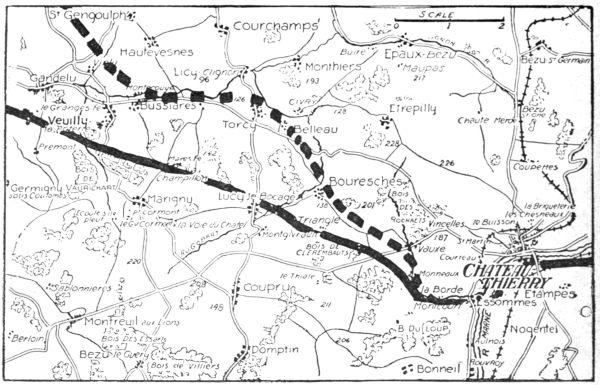
TERRITORY BETWEEN THE TWO DARK LINES WAS WON BACK IN HEAVY FIGHTING BY AMERICAN SOLDIERS AND MARINES
This showed the anxiety of the German High Command regarding the effect that an American success would have on the German Army and the populace, and of the great desirability of preventing such a happening.
UNDERESTIMATED OUR EFFORT
When I visited the headquarters of this French army today [June 14] a sheet of paper was handed to me on which was written a report of information gained from the examination of a large number of prisoners from the 28th German Division. The report said:
American assistance, which was underestimated in Germany because they doubted its value and its opportunity worries the German High Command more than it will admit. The officers themselves recognize that, among other causes, it is the principal reason for which Germany hastens to try to end the war and impose peace. They believe that if we succeed in holding on for the rest of this year the German cause will be lost. But they say that until the end of the year they will allow us no respite in their effort to break our morale and our will to conquer. They hope that fear of devastations and the terror caused in Paris, as well as continuing attacks of the German Army, determined to end the war, will get the best of our resistance before American aid will become truly effective.
All agree that the war is reaching the supreme crisis at this moment. They all declare that the offensives will be renewed and prolonged in view of this decision until the German forces are exhausted.
In addition, the prisoners did not conceal their great surprise at the training and quickness that the Americans have shown against them, nor at the good work accomplished by the artillery, which for three days engaged them, cutting off all food supplies and all reinforcements and causing them very heavy losses—practically all of the officers and twenty-five of the men were killed or wounded in a single infantry company and twelve in a machine-gun section, of which the full quota was seventeen men.
Especially important is this report coming from the French Army, not because the Americans would emphasize such statements by prisoners, but because of the probability that the Germans might be rather praiseworthy of Americans when questioned by our officers with a view to getting better treatment as prisoners of war. There is no question that this document speaks the truth.
A letter written by a German officer and found on his body said:
"The Americans are so courageous that they do not allow themselves to be made prisoners." Another letter written by a German private called the Americans "devilhounds."
GERMANY FEARS AMERICA
Germany fears America, and that fear is growing. At first the High Command told their officers and the officers told the soldiers that the Americans could not get to France because the U-boats would stop them. Then the German fighters began to find Americans appearing against them here and there, and finally at many points. Then the officers told the German soldiers the Americans would not fight. Now the German soldiers know the Americans can and will fight; and more and more of them are learning it every day. There is no lack of evidence that the German populace fears America's power in the war, and no question that the German High Command is seriously perturbed at the results when the real news of the Americans' fighting gets back to the people.
In no spirit of boastfulness it may be said that American fighters, with a proper amount of training, are the best fighters in France today. The soldiers of other armies of necessity are tired after nearly four years of fighting, but the Americans are fresh, fresh in spirit and physique. Other soldiers hope that Germany will be beaten; the American soldiers know that Germany will be beaten. And Germany knows that Germany will be beaten unless she wins in the next four months. That is her only chance, and she will play it for what it is worth. Everything is to be thrown into that effort. There will be ruthlessness, there will be frightfulness.
The four days' victorious fight for possession of the important Bois de Belleau, northwest of Château-Thierry, resulted in the capture, besides the prisoners mentioned, of two German field guns, 77s, and thirty machine guns, besides some small mortars. This was the first capture of German artillery by Americans. I believe that when the history of the war is written the Americans' capture of the Bois de Belleau will be ranked among the neatest pieces of military work of the conflict.
Five days ago, [June 9,] after the capture of the town of Bouresches, the Americans started the task of taking away the Bois de Belleau from the Germans. In the rush at Bouresches they had been unable to secure the rocky strongholds in the woods, and passed on, leaving many nests of machine guns there, which afterward kept up a harassing fire. The Americans several times made big raids into the woods, clearing out part of the Germans, but the next day the Germans would reappear with a harassing fire. Despite strong artillery work, the Germans seemed able to stay there.
On Sunday, the 9th, a rain of extra heavy artillery fire began on the woods. This kept up all Sunday night and Monday. On Monday night the fire was redoubled and the woods literally raked with lines of shellfire.
At about 3 o'clock Monday morning the marines started, as soon as the artillery fire was stopped, to go through those woods. At the nearer edge of the woods, devastated by our shellfire, they encountered little opposition. A little further on the Germans made a small stand, but were completely routed; that is, those who were not killed. By this time the marines were fairly started on their way. They swept forward, clearing out machine gun nests with rifle fire, bayonets, and hand grenades.
WORK OF MARINES
The Germans started in headlong flight when the Americans seized two machine guns and turned them on the Germans with terrific effect. The Germans soon tired of this, and those nearest the Americans began surrendering. In the meantime the marines kept up the chase.
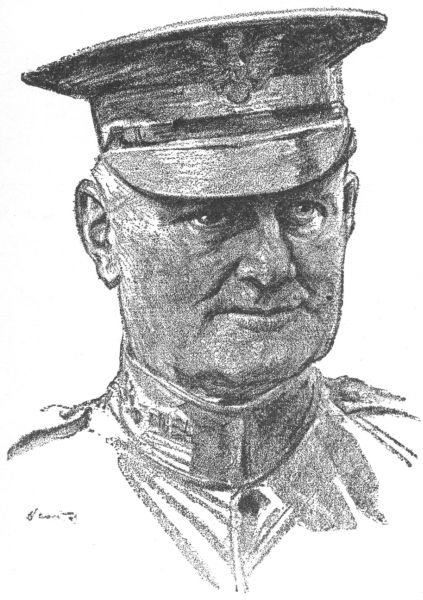
MAJOR GENERAL HARBORD, IN COMMAND OF AMERICAN MARINES
While this was going on the Americans almost surrounded the woods, and the Germans, fleeing from some of the Americans, ran into the machine gun and rifle fire of the others. Then those left rushed headlong the other way to surrender. In a short time the gallant marines had got to the other side of the woods, and immediately, with the aid of the engineers, started the construction of a strong position.
Prisoners counted that day numbered more than 300. It was found that they belonged to the crack 5th German Guard Division, which includes the Queen Elizabeth Regiment. There had been 1,200 Germans in the woods. With the exception of the prisoners nearly all the rest were slain.
The prisoners said they were glad of the chance to surrender and get out of the woods, because the American artillery fire for three days had cut off their food and other supplies and they had lived in a hell on earth. The Germans seemed deeply impressed by the fury of the American attack. One of the captured officers, when asked what he thought of the Americans as fighters, answered that the artillery was crazy and the infantry drunk. A little German private, taking up his master's thought, pointed to three tousled but smiling marines, and said: "Vin rouge, vin blanc, beaucoup vin." He meant he thought the Americans must be intoxicated, to fight as they did for that wood.
Our boys took especial delight in corralling the machine guns. These guns had been very well placed behind trees and in rocky caves and well supplied with ammunition. The Americans had practiced on a German machine gun previously captured, and knew just how to use them against the "Heinies." The captured guns were cleverly camouflaged and were almost overlooked by the Americans. The mortars had been used to throw gas shells from the heights into the woods upon the Americans.
GERMAN MORALE LOW
There was the greatest surprise among American officers at the evident low morale among members of the 5th Guard Division, thought to be one of the Kaiser's very best.
The Germans had tried their best to get the Americans out of the wood and to hold the valuable position. They had sent attack after attack there, always failing to gain complete free possession, but making things very unpleasant for our men. It was after four days of this that the marines got on their hind legs and went after the Germans.
An American General tonight characterized the capture of Belleau Wood as the most important thing the Americans at the front had yet accomplished. Its possession straightens our line, taking away from the German his protected wedge into our positions, and gives an excellent starting point for further operations.
Two hours after the Americans started through the wood the Germans launched their heavy attack to regain Bouresches. A dark and cloudy night had aided their preparations for the rush, but the Americans, expecting something of the sort, had the northern side of the town lined with machine guns, and had artillery all trained on the railroad embankment over which the Germans had to come. The Americans seem to have excellent tab on the German movements, and when, at 5 o'clock, the Germans came over, they met a terrific machine gun fire, while a heavy barrage which was put right behind the attacking party and gradually lowered on it not only cut off reinforcement for it but killed many in it. The slaughter of Germans in this attack was the heaviest the Americans have yet been able to inflict. Our men, in excellent positions at the edge of the town, suffered almost no losses. In this operation we took fifty prisoners, including one officer.