Growth of the Jugoslav Movement
Reading edition
Project for a South Slavic State, Aided by the Czechs, Threatens to Disrupt Austria-Hungary
Of the many internal troubles tending toward the disintegration of the Austro-Hungarian Empire the one that has grown most rapidly in the last year is the Jugoslav movement—the movement for an independent State to be known as Jugoslavia, and to include all the Southern Slavic provinces of Austria-Hungary, as well as Serbia and Montenegro in the Balkans. This project assumed a new phase in May, 1918, when it received the active support of the millions of Czechs in Bohemia, Austria's northwest border province. The Czech demand for a free Bohemia and Jugoslavia helped to precipitate a political crisis at Vienna, which Emperor Charles met by summarily suppressing Parliament. All indications pointed to the existence of a united effort of the Slavs, Czechs, Slovaks, Poles, Ukrainians, Croatians, and Italians to throw off the Teutonic yoke, completely dismembering the Austro-Hungarian Empire.
The only session of the Reichsrat that has been held in Austria-Hungary since the war began was opened on May 31, 1917, and closed abruptly by imperial order on May 4, 1918. Throughout that period the Slavic Deputies in the lower house showed increasing hostility to the war methods and plans of the Teutonic minority which rules the empire. The house consisted of 516 members, of whom only 233 were Germans. The dominant nationality has for years managed to keep its control of the Reichsrat through alliance with the Poles, who hold 80 or 90 seats, but in the Spring of 1918 the Poles broke away from the Germans, and suddenly the Government discovered that it was in a minority and that its war budgets were in serious danger of being defeated. Then it resorted to the drastic measure of adjourning Parliament under threat of force.
Already the Czechs, Slovaks, and Jugoslavs been working together in Parliament, generally getting the support of the Ruthenians (Ukrainians) and the Italians. In the closing months of 1917 this tendency was accentuated, when the Polish leaders came into closer alliance with the Czecho-Slovaks and Jugoslavs. This was cemented by a congress of Czech Deputies, held in Prague on Jan. 6, 1918, which adopted unanimously the declaration given below. The document was at first suppressed by the Austro-Hungarian censor, and the few publications that got hold of it were not allowed to leave the country.
THE CZECH DECLARATION
Despite this attempt at suppression the text of the document reached the outside world through the Czecho-Slovak National Council. It is as follows:
In the fourth year of this terrible war, which has already cost the nations numberless sacrifices in blood and treasure, the first peace efforts have been inaugurated. We, the Czech members of the Austrian Reichsrat, which, through the verdicts of incompetent military tribunals, has been deprived of a number of its Slav Deputies and Czech Deputies to the dissolved and as yet unsummoned Diet of the Kingdom of Bohemia, and to the equally unsummoned Diets of Moravia and Silesia, recognize the declarations of the Czech Deputies in the Reichsrat, and deem it our duty emphatically to declare, in the name of the Czech Nation and of its oppressed and forcibly silenced Slovak branch of Hungary, our attitude toward the reconstruction of international relations.
When the Czech Deputies of our regenerated nation expressed themselves during the Franco-Prussian war on the international European problems they solemnly declared in their memorandum of Dec. 8, 1870, that "all nations, great or small, have an equal right to self-determination, and their complete equality should always be respected. Only from the recognition of the equality of all nations and from mutual respect of the right of self-determination can come true equality and fraternity, a general peace and true humanity."
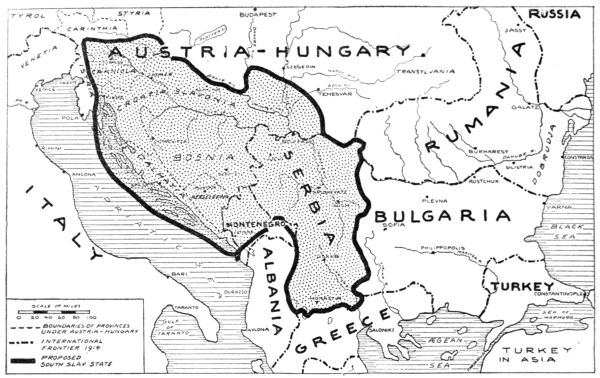
SHADED AREA SHOWS THE PROJECTED STATE OF JUGOSLAVIA, INCLUDING SERBIA, MONTENEGRO, AND SLAVIC PORTIONS OF AUSTRIA-HUNGARY
We, the Deputies of the Czech Nation, true even today to these principles of our ancestors, have, therefore, greeted with joy the fact that all States based upon democratic principles, whether they are belligerent or neutral, now accept with us the right of nations to free self-determination as a guarantee of a general and lasting peace.
Also the new Russia accepted the principle of self-determination of nations during its attempts for a general peace as a fundamental condition of peace. The nations were freely to determine their fate and decide whether they want to live in an independent State of their own or whether they choose to form one State in common with other nations.
DEMANDS INDEPENDENCE
On the other hand, the Austro-Hungarian delegate declared, in the name of the Quadruple Alliance, that the question of the self-determination of those nations which have not hitherto enjoyed political independence should be solved in a constitutional manner within the existing State. In view of this declaration we deem it our duty to declare, in the name of the Czecho-Slovak Nation, that this point of view of the Austro-Hungarian representative is not our point of view. On the contrary, we have in all our declarations and proposals opposed this solution, because we know, from our own numberless bitter experiences, that it means nothing but the negation of the principle of self-determination. We indignantly express our regret that our nation was deprived of its political independence and of the right of self-determination, and that by means of artificial electoral statutes we were left to the mercy of the German minority and of the Government of the centralized German bureaucracy.
Our brother Slovaks became the victims of Magyar brutality and of unspeakable violence in a State which, notwithstanding all its apparent constitutional liberties, remains the darkest corner of Europe, and in which the non-Magyars, who form the majority of the population, are ruthlessly oppressed by the ruling minority, extirpated, denationalized from childhood, unrepresented in Parliament and civil service, deprived of public schools, as well as of all private educational institutions.
The Constitution, to which the Austro-Hungarian representative refers, falsified even the justice of the general suffrage by an artificial creation of an over-representation of the German minority in the Reichsrat, and its utter uselessness for the liberty of nations was clearly demonstrated during the three years of unscrupulous military absolutism during this war. Every reference to this Constitution, therefore, means, in reality, only a repudiation of the right of self-determination for the non-German nations of Austria who are at the mercy of the Germans; and it means an especially cruel insult and injury to the non-Magyar nations in Hungary, where the Constitution is nothing but a means of shameful domination by the oligarchy of a few Magyar aristocratic families, as was again proved by the recent electoral reform proposal.
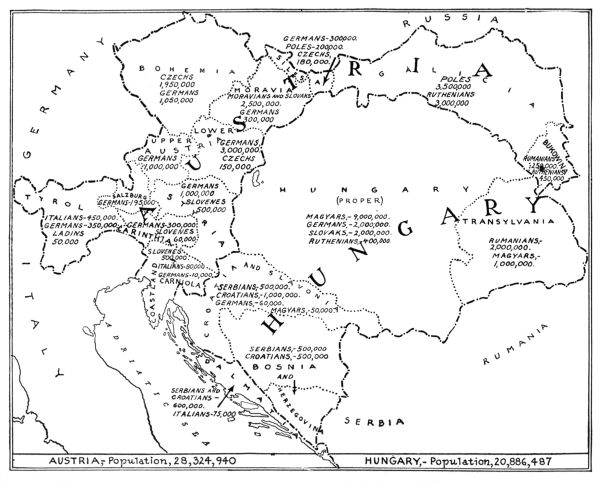
Austria-Hungary Sketch Map Showing Slavic Populations in Threatened Revolt
THE SLAVS IN ALL PARTS OF AUSTRIA-HUNGARY, SINCE THE SIGNING OF THE BREST-LITOVSK TREATY, HAVE DEVELOPED AN ORGANIZED OPPOSITION TO THE RULE OF THE GERMAN MINORITY AT VIENNA. IN THE NORTHWEST THE CZECHS OF BOHEMIA AND THE SLOVAKS OF MORAVIA, CONSTITUTING THE CZECHOSLOVAK MOVEMENT, HAVE TAKEN PART IN SERIOUS RIOTS AT PRAGUE AND ELSEWHERE ON BEHALF OF INDEPENDENCE. THE POLES AND RUTHENIANS OF GALICIA AND BUKOWINA ARE SUPPORTING THEM POLITICALLY. IN THE SOUTHWEST THE SLOVENES, CROATS, AND SERBIANS HAVE DEVELOPED A STRONG JUGOSLAV MOVEMENT, DEMANDING THE CREATION OF A NEW STATE HEADED BY THE KING OF SERBIA. THIS MOVEMENT RECENTLY GAINED THE SUPPORT OF THE ITALIANS BOTH IN AUSTRIA-HUNGARY AND IN ITALY.
SELF-DETERMINATION
Our nation longs with all the democracies of the world for a general and lasting peace. But our nation is fully aware that no peace can be permanent except a peace which will abolish old injustice, brutal force, and the predominance of arms, as well as the predominance of States and nations over other nations, and which will assure a free development to all nations, great or small, and which will liberate especially those nations which still are suffering under foreign domination. That is why it is necessary that this right of free national development and to self-determination of nations, great or small, to whatever State they may belong, should become the foundation of future international right, a guarantee of peace, and of a friendly co-operation of nations, as well as a great ideal which will liberate humanity from the terrible horrors of a world war.
We, deputies of the Czech nation, declare that a peace which would not bring our nation full liberty could not be and would not mean a peace to us, but only a beginning of a new, desperate, and continuous struggle for our political independence, in which our nation would strain to the utmost its material and moral forces. And in that uncompromising struggle it would never relax until its aim had been achieved. Our nation asks for independence on the ground of its historic rights, and is imbued with the fervent desire to contribute toward the new development of humanity on the basis of liberty and fraternity in a free competition with other free nations which our nation hopes to accomplish in a sovereign, equal, democratic, and socially just State of its own, built upon the equality of all its citizens within the historic boundaries of the Bohemian lands and of Slovakia, guaranteeing full and equal national rights to all minorities.
Guided by these principles, we solemnly protest against the rejection of the right of self-determination at the peace negotiations, and demand that, in the sense of this right, all nations, including, therefore, also the Czecho-Slovaks, be guaranteed participation and full freedom of defending their rights at the Peace Conference.
WAGRAM GATHERING
On March 2 a gathering of Jugoslavs met at Zagrub (Wagram) which included the Jugoslav Deputies of the Reichsrat, practically the entire membership of the Croatian Sabor, (the Legislature which exercises a limited amount of local autonomy,) and other representatives of the nation. According to the Hrvatska Drzhava, extracts from whose accounts have been translated by the Serbian Press Bureau in Geneva, they contained the following statement:
After having discussed the general political and national situation the assembly has agreed on the necessity of a concentration of all parties and groups which, from the point of view of national self-government, demand the creation of a national and independent States of Slovenes, Croats, and Serbs founded on the principle of democracy.
The language of this passage parallels the Declaration of Corfu, by which exiled leaders of the Jugoslav movement demanded the union of the Jugoslav territories in Austria-Hungary with Serbia and Montenegro into one kingdom under the Karageorgevitch dynasty. Austrian papers at once became agitated because there was no reference to the carrying out of this aim within the framework of the Hapsburg Empire. The fact that many, if not most, of those present were known to be in accord with the Declaration of Corfu, and the suspicion that practically all of them favored it at heart, caused many protests against the "introduction of the policy of Belgrade" in the Viennese press.
The matter was further complicated by the activity of the police in the affair, they having broken up the first session of the assembly and posted a guard around the hall. Demonstrations of the students against this, which seem to have gone no further than parading up and down the streets singing Slavic national songs, were broken up by the police with the utmost violence, and many were arrested.
This did not prevent a large gathering, principally of students, at the station the next day to bid farewell to Dr. Koroshetz, leader of the Jugoslav Club in the Reichsrat. Dr. Koroshetz is taking the lead in the organization of a Jugoslav National Council of some twenty-four members, whose aims are euphemistically described for the present as "to arrange the tactics of the general Jugoslav policy."
The economic conditions which contribute to the revolutionary ferment in the Jugoslav countries were set forth in a speech in the Reichsrat in the course of a budget discussion just before this assembly by Dr. Matko Leginja, Deputy from Istria and Vice Chairman of the Jugoslav Club. He quoted the appeal from an Istrian commune which ended:
We beg, ask, and demand bread, peace, and the return of our brethren, fathers, and sons to console us, to see that our fields are worked properly, and that there should be some one with us to close the eyes of the dying parents.
Of many instances of starvation which he gave was one of a parish in which in 1912 there were 67 births and 23 deaths. In 1917 there were 23 births and 68 deaths, without counting those who died in military service.
CONFERENCE AT ROME
The significance of the whole movement was deepened by the Conference of Oppressed Austrian Nationalities held at Rome on April 10, when a full understanding with Italy was reached. The territorial and other questions at issue between the Italians and Jugoslavs were settled, and the Poles joined the other delegates in the demand for a complete overthrow of the present Austrian Empire, declaring that the future of Poland lay in a firm alliance with the reconstituted nations of the Czecho-Slovaks, the Jugoslavs, and the Rumanians. The text of the formal declaration then adopted, is as follows:
1. Every people proclaims it to be its right to determine its own nationality and national unity and complete independence.
2. Every people knows that the Austro-Hungarian Monarchy is an instrument of German domination, and a fundamental obstacle to the realization of its rights to free development and self-government.
3. The Congress recognizes the necessity of fighting against the common oppressors.
The representatives of the Jugoslavs agree:
That the unity and independence of the Jugoslav Nation is considered of vital importance by Italy.
That the deliverance of the Adriatic Sea and its defense from any enemy is of capital interest to the two peoples.
That territorial controversies will be amicably settled on the principle of nationality, and in such a manner as not to injure the vital interests of the two nations; interests which will be taken into account at the peace conferences.
The Polish delegates added their declaration that they considered Germany to be Poland's chief enemy, and that they believed the disintegration of the Austro-Hungarian Empire to be indispensable for the obtaining of their independence from Germany.
ITALY'S ACTIVE HELP
As a result of this important conference, a separate section was established by the Italian Ministry of Foreign Affairs to look after the propaganda in favor of the Allies in the Austro-Hungarian countries and in their armies. The Austrian Premier, Dr. von Seidler, stated in his last speech before the adjourning of the Reichsrat that the Austro-Hungarian Government was fully aware of this propaganda and had taken measures to combat it. A Slovene paper, the Slovenic, commented as follows:
The German newspapers have begun at the same time to call the attention of the Jugoslavs to Italian imperialistic aims and to show all at once great devotion to our country, which, they say, is menaced by the Italian peril. With a special affection for our people, an affection never known before, they urge us to beware of our Italian neighbors, enumerating all the points of the London understanding with regard to our territory.
In publishing this agreement the Grazer Tagblatt, that ultra national German organ, wished to give us a political lesson of which they might have saved themselves the trouble. It was superfluous, if for no other reason, because it came from German nationalists, whose counsels we can never follow.
The Austrian Government and the German newspapers are troubling themselves in vain as to how to circumvent the Italian propaganda. It would be of more importance if they would take care to improve their system of government, the oppression and injustice of which only help the work of the propaganda. (Further thirty lines censored.)
PROTEST IN REICHSRAT
The Czecho-Slovak Deputies in the Reichsrat introduced a motion on April which was suppressed by the Vienna censorship. In the name of the Slovak Parliamentary Union, the motion, introduced by Deputy Kalinov, demanded that the Reichsrat refuse to sanction the imperial ordinance of May 1, 1915, which extended the age of service in the Landsturm from 43 to 50 years. The arguments presented in support of this demand, as summarized by a Berne correspondent of the Paris Temps, constitute a protest of all the Czecho-Slovak nations:
1. Against the war.
2. Against the militarism which, directed by the absolute will of the monarch, has enchained the free will of nations.
3. Against the military tyranny that has installed itself in Bohemia, and which is militarizing every stratum of society.
4. Against the spirit and tendencies of the army leaders, who have made of the army an instrument of Germanization and Magyarization.
5. Against absolutism, because the law has been interpreted in an unconstitutional manner, without the consent of the Reichsrat.
6. Against the dual system and the will for annexation, against peace based on violence, and, still more emphatically, against the shameful exploitation of Czecho-Slovak territory through requisitions and incessant contributions.
The Czecho-Slovak Deputies added:
An attempt is being made to starve our country, which was the granary of the whole Hapsburg Monarchy, and whose population, alike in villages and cities, is now suffering atrociously from famine and misery.
Our declaration is, above all, a unanimous manifestation of the collective will of the nation. It proves:
That the Czecho-Slovak Nation is firmly resolved to dispose henceforth of its own life and goods and children by the sole agency of its freely elected representatives.
That our nation and, first and foremost, our women demand a general and just peace, which alone can bring liberty and independence to the nation, and which alone can cause justice to reign in the whole world.
That we wish henceforth to live our own life in a State of our own, as a member of a society of free nations, a society that will solve without violence the questions that arise between peoples, depending upon a friendly understanding, and thus bringing happiness to liberated humanity.
When the Austro-Hungarian Government under Premier von Seidler found itself confronted by a hostile Slavic majority in the Reichsrat, threatening the defeat of its war budgets, Emperor Charles empowered the Premier to "adjourn Parliament forthwith and inaugurate measures to render impossible the resumption of its activities." This was done on May 4. The Parliament had been composed of 233 Germans, 108 Czechs, 92 Poles, 33 Ruthenians, 42 Jugoslavs, and 19 Italians. The Germans had considerably less than a majority.
In another respect the suppression of Parliament was viewed as a concession to the Magyars. Those holding reign in Hungary since 1867 had been resentful at the claims of the Czechs and the Jugoslavs, fearing that the Government would be forced to make some concessions to them. If the project of unity were realized Hungary would be reduced to about half of its present size. On several occasions the Magyars had called on the Government at Vienna to suppress the Parliamentary agitation, threatening to form a separate Hungarian army and impose restrictions on the exportation of foodstuffs.
The Government, in a public statement, ascribed its action to the food crisis, which was very acute, adding: "The Government will devote its entire strength to the economic problem and will try to create conditions required to enable the population to hold out."
THE PREMIER'S ADMISSION
A Vienna dispatch stated that the Premier, addressing a conference of party leaders, had demanded that the Parliamentary sittings be postponed, and added that, unless they took this step, the Government would prevent the sessions by force. In the debate that followed he had admitted the existence of many problems which must receive consideration, especially that of the agitation for a South Slavic State, but had added:
Discussion of this problem, however, is impossible at present, because it concerns not only Austria but also Hungary and Bosnia. But one thing is certain—if such a State were created it could be only under the sceptre of his Majesty, as a component part of the monarchy. It could not include those parts of Austrian territory which border on the Adriatic and are closely connected with districts where the German language is spoken. But national aspirations exist also in these districts, and it is only natural that the national wishes of the Southern Slavs be duly considered.
In the course of discussion of the question of revising the Constitution on the basis of national autonomy, Premier von Seidler announced that in Bohemia the Government would speedily issue regulations providing for the appointment of administrators for districts inhabited by distinct nationalities. After sounding a warning against inciting nationalities against one another, he said:
Our entire military and political situation has reached a climax. The next few months will bring a big decision. I am firmly convinced the decision on the battlefield will be in favor of Austria and her allies. Our economic, especially our food, conditions are very serious, but they are not at all desperate. To hold on now to a final happy decision is the vital question for the State. It therefore is necessary that, unhampered by Parliamentary confusion, the Government be left in a position to devote all its strength to these tasks.
FOOD SHORTAGE
The Austro-Hungarian Empire was at that time facing a dozen different crises, all aggravated by the problem of food. Even the racial animosities, always threatening to overturn the unstable rule of the German and Magyar minority over the Slavic majority, was inflamed into bitterness by sectional jealousies over food distribution. These crises reached a culmination in the decision of the Government to prorogue Parliament.
What straits the empire had reached were partially revealed by the Premier's speech to the party leaders, and also by the German official statement that all food supplies from the Ukraine during the month of May would be given to Austria-Hungary, on account of its greater need. Still more significant was Dr. von Seidler's admission, made public on May 4, that Austria was unable to feed the populations of North Tyrol and Northern Bohemia, and that he had, therefore, consented that the former be attached for provisioning purposes to Bavaria, and the latter to Saxony. This concession, the dispatch added, had been wrung from him by leaders of the German parties after a conference lasting six hours. It meant that for food supply purposes these portions of Austria were being annexed to Germany. The Austrian Government yielded with the greatest reluctance, realizing that the political consequences might be far-reaching. It was pointed out that this would accentuate the feud between the German and non-German races in Austria-Hungary, since the provinces affected are German-speaking, and would strengthen the agitation for the incorporation of Austria into a German federation.
The meeting of the German and Austrian Emperors at the German Great Headquarters on May 12 did not tend to allay fears of this nature. Though the results of the meeting remained secret, the belief was expressed in many quarters that it had constituted a formal acknowledgment of the subservient relations of Austria-Hungary toward the German Empire.
MARTIAL LAW IN PRAGUE
Shortly after the beginning of the war the Hungarian authorities suppressed the Slovak press almost in its entirety. Thus the Slovaks came to depend upon the Czech newspapers of Bohemia for their political and other information. On May 5 the Hungarian Government issued an order forbidding Czech newspapers from Bohemia and Moravia to circulate in Slovakia.
The whole Czech and Slovak population, indeed, was seething with hostility to the Imperial Government and its war policies. Prague, the capital of Bohemia, had become a centre for leaders of the Czecho-Slovaks, Jugoslavs, and Poles in their agitation for independence. Demonstrations of an anti-German character became frequent, and Czechs and Jugoslavs paraded the streets shouting "Long live Wilson, Clemenceau, and Lloyd George!" The manifestations against the Austrian State began afresh on the evening of May 17, when the police made arrests, and culminated on May 20, when the Government declared Prague under martial law. All political meetings were prohibited, and the police issued a proclamation announcing that any further disorders would be met with violent measures.
One of the events that had aroused popular hostility was the suppression of the Czech newspaper Narodni Listi. The last copy of this paper contained the text of the oath taken at Prague by the Czecho-Slovak, Jugoslav, and Polish journalists, as follows:
Gathered at Prague while the world war has made necessary a new reorganization of the world on the basis of a higher authority given to the people, we proclaim that we shall remain in the front line of battle for the freedom of peoples, that we shall fight together in favor of each other's interests, that we shall repulse together any despotic measure, and that we shall denounce together the oppression of the Austrian State.
We want to promote together the confidence of our people in the achievement of their aspirations, to encourage them to express their will more positively.
We raise our right hand and solemnly swear that we shall give all that we own, all our strength, all our possessions, for the liberation of our people and for the achievement of the political unity of the Czecho-Slovak people, the political unity of the Jugoslavs, and the political unity of the Polish people.
RIOTS IN WENSEL SQUARE
The disorders leading to the declaring of martial law were described by the Berliner Lokal-Anzeiger a few days later in these terms:
The chief demonstration in the new outbreak occurred in Wensel Square in Prague on May 20. The demonstration was a big one and reached such pitch that in the evening the police had to interfere. The Czechs sang their patriotic hymn with its additional anti-German verses and raised cheers for President Wilson and Professor Masaryk, the Bohemian delegate now in the United States. Although Wensel Square was thereafter barred to the demonstrators by the police, the demonstrations were repeated at 10 o'clock at night, and not until midnight did the mounted and foot police succeed in restoring order.
Another account gave other details:
At the celebration of the fiftieth anniversary of the Czech National Theatre speeches violently attacking Germany were delivered, and the renewal of the alliance between Germany and Austria-Hungary was denounced. Several deputies addressed the crowd, urging resistance to the end and the sacrifice of wealth and blood for Bohemia. The theatre was then closed and rioting occurred in the streets outside. The Jugoslavs who had participated in the Bohemian festivities were ordered to leave the city. Crowds singing patriotic songs accompanied them to the railway station.
In the next week about 800 Czechs were arrested at Prague and other Bohemian cities on a charge of seditious conspiracy.
REVOLT IN AUSTRIAN ARMY
Riots and disorders in Bohemia continued to increase during the following weeks. Crowds at Chozen, exasperated by police brutality, set fire to barracks and to the City Hall, where the mounted police were lodged. Eight of the officers were burned to death. At Kolin the people pulled down the Austrian and raised the Bohemian flag. Public buildings were burned at Tabor and in other Bohemian towns, also at Olmutz, Moravia. At Prague the offices of two German newspapers were sacked. The Neue Freie Presse of Vienna declared: "Only the tenacity and union of those who desire the preservation of the State can make the monarchy survive this great crisis."
Mutinies among the Slavic troops in the Austrian Army also assumed serious proportions. A Vienna dispatch to the Berliner Tageblatt on May 3 gave the following details:
The troubles began in the Slovene Battalion of the 9th Infantry Regiment at Judenbourg. The German officers were killed, after which the troops gave themselves up to acts of anarchy. In time they were driven into the mountains, where they finally were disarmed after a combat.
The Czechs of Pilsen, stationed at Fumberg, also revolted. The rising was put down by the sword. Part of the rebels, having succeeded in passing the frontier, took refuge in the mountains of Saxony, where they were made prisoner by the Germans.
A third case of serious revolt took place at Funkirchen, where a Serbian regiment from Austria revolted and massacred the officers. The exact details of these revolts are difficult to obtain. It appears, however, the instigators were Austrian soldiers returned from the prisoners' camps in Russia.
GERRYMANDERING BOHEMIA
On May 22 the Austro-Hungarian Government issued a decree dividing Bohemia into twelve districts, under a system giving new administrative and electoral advantages to the Germanic population. The German minority in the Imperial Parliament had been about to be completely isolated by a union of the Czechs, Slovaks, Jugoslavs, Ruthenians, and Poles. The electoral redistribution sought to avoid this by reducing the Czech strength in the Reichsrat at Vienna as well as in the Bohemian Diet. An official French bulletin dated May 22 said:
The law bulletin of the Austrian Empire publishes a decree according to which the district Governments which were so long demanded by the Germans are established in Bohemia. The twelve district Captains who are nominated will represent the Statthalter of Prague in each district and will have the same powers.
The boundaries of the districts are fixed, so far as possible, according to the national grouping. In the words of the decree, "the aim is to take the first steps toward the re-establishment of order in Bohemia." This decree foreruns undoubtedly a policy of repression, the first act of which tends to dismember Bohemia by granting to the German elements the guarantees or, better, the privileges which they demand.
Up to the present, Bohemia comprised thirteen districts, only two of which had a majority of German population, according to statistics from Vienna. In four of the districts there are hardly any Germans. The new plan aims at creating in each of the twelve new districts a German minority and to grant to this minority, however small it may be, considerable advantages in the administrative and electoral domains.
This method is meant to bring about as a first result a considerable increase in the number of German deputies in the Diet to the prejudice of the Czechs, who until now have held the majority of the seats. It is clear that this device of the Pan Germans is bound to arouse the most violent opposition on the part of the Czechs.
A dispatch printed in all the Wagram papers calls attention to the fact that martial law has been proclaimed in several districts of Bohemia because in certain regions serious riots have occurred. More than 150 persons have been put in prison. The estate of Prince Furstenberg was ransacked. Riots occurred at Marsch, Ostrau, Pilsen, and Nachod. The Czech press expresses itself very violently. The Vetcher writes:
"The Government is trying in vain to present its reform under bright colors, but it is evident at first sight, in fact, that nothing but the dismembering of Bohemia is under way. The Ministerial decree is preparing the parceling out of our fatherland and the foundation of a German province made of our own flesh."
The Narodni Listi, which was suppressed by the censorship as guilty of "criminal dealings," has written:
"It is in vain that threats are hurled at us to divert us from the line of conduct which we have decided to follow according to our proclamation. It is in vain that the sessions of Parliament are adjourned. Our indignation will not be less in June (the Austrian Chamber is to resume its sittings on June 19) and our opponents will have the opportunity of realizing it. The chart which, according to von Seidler, is to be granted to us will not change our resolution: 'We shall fight on without any consideration, with compromise, for the defense of the Czech State.'
"This evidently shows the attitude of all the nationalities crushed by the Germans and the Magyars in the Dual Monarchy. The movement was not entirely unexpected, but it is possible that the fact of threatening them with a pitiless repression has advanced it and made it more formidable.
"Emperor Charles is away from Vienna, and on his return he will find political conditions which the food situation will make even more distressing. Once more the frightfulness of German methods, so dear to the Germans, will bear its fruit by arousing rebellion of the people oppressed."
AUSTRIAN OFFICIAL VIEW
An official Austrian note, referring to the decree, said:
Certain events, which were a danger to the safety of the State and presented even a character of high treason, took place during the first days of the fiftieth anniversary celebration of the founding of the National Bohemian Theatre, and led the authorities to take repressive measures.
Swiss commentators explain that this alludes to a note from the police posted in Prague, which declared that mob gatherings and processions would be dispersed by force if necessary. Jugoslav guests, who had come to Prague to participate in the celebration, were obliged leave the city, and the newspaper Narodni Listi was suspended because the Austrian authorities declared: "The manner in which this paper is worded tends to arouse sympathy in favor of the Entente States."
Accounts of the great gathering at Prague, which caused the Austrian Government to declare martial law, stated that the city was adorned with the Czech colors and the Slav tricolor flag. The Czech press expressed regret at the absence of Russians and great satisfaction at the presence of Poles. It was reported that the Ruthenians of Eastern Galicia were prevented by the authorities from attending.
The festival was organized by the recently formed Independence Party of Dr. Kramarcz, and the ceremonies consisted generally of a glorification of the union of the Slavic peoples.
WEAKENING NATIONALISM
It is stated by American sympathizers of the Czechs that the new decree is intended also to weaken the Bohemian national movement by decentralizing the forces of the nation and partly to prepare for the possible establishment of a province of "German Bohemia," such as has been talked of in case the national movement is so strong as to force the Austrian Government to try to compromise on some sort of federalization.
The Czecho-Slovak Nation, which has declared its demands for unity and complete independence, includes the Slovaks in the northern part of the Kingdom of Hungary and the Czechs, now divided among Bohemia, Moravia, and Silesia, three of the seventeen crown lands of Austria.
There has been much reference in German-Austrian papers recently to the possible establishment of a German Bohemia, to include the districts with the largest German population. Any rearrangement on this basis would be beset with obstacles, for the Czecho-Slovaks refuse to consent to any partition and the Germans demand not only the border districts for their German Bohemia, but the City of Prague itself.
It was recently reported that in April the Pope, acting through the Papal Nuncio at the request of the Vienna Government, had caused the arrest of Dr. Yeglitch, Prince Archbishop of Laibach, on account of his activities in behalf of the Jugoslav movement. Dr. Yeglitch was the head of the Slovene Catholic party in Parliament, and his arrest produced an outburst of indignation in Croatia and Slovenia. A Vatican dispatch later declared the report of the Pope's connection with the matter to be entirely without foundation.
BOHEMIANS IN ITALY'S ARMY
Troops from Bohemia began joining the Italian Army in April to fight against Austria. The first detachments of this Czecho-Slovak army, which is being formed in many centres out of the one-time subjects of Emperor Karl, have taken up their positions in various parts of the Italian line. They wear the Italian uniform, with certain distinctive signs. The effect upon their fellow-Slavs who are still fighting under the Austrian colors is a subject of considerable interest on both sides. The new position of affairs is being assiduously explained to them by airplane propaganda, and committees of their own race are accredited to and working with the Italian high command. G. Ward Price, a British correspondent, telegraphed from Italian headquarters on May 1:
One night recently some of the Czechs fighting with the Italians were in the front line at a place where the Austrian battalion holding the trenches opposite consisted largely of their fellow-countrymen. After some preliminary conversation by megaphone one of the allied Czechs crawled out to the other lines and urged his compatriots to come over to our side, where they would be treated not as prisoners or deserters but as friends. The Austrian Czechs replied that they would willingly do so, but that the line behind their own was held by Hungarians, who would almost certainly see them moving out of the trench and open fire on them with machine guns.
The allied Czech brought this message in to his friends, whereupon the Italian guns were asked to put down a barrage between the Austrian front trenches and their support line, driving the Hungarians to cover and isolating them from the Czechs, of whom some were thus able to cross over in safety to our side.
RACIAL DIVISIONS IN HUNGARY
Hungary in no less degree than Bohemia presents a problem of racial antipathies which has been a cause of serious unrest for centuries; aggravated by the present worldwide aspiration for independent nationalism it has thrown the country into turmoil and given a strong impetus to a revolutionary movement by the non-Magyar inhabitants. In a recent issue of The New Europe, D. Draghicescu, in discussing the situation in Hungary, gives the following facts regarding its racial divisions:
Hungary is a country of 22,000,000 souls, of whom approximately 9,000,000 are Magyars and 13,000,000 non-Magyars, belonging to four or five different races. The Magyars have always insisted upon the fact that in Hungary they form by themselves a block of 9,000,000, while the other nationalities, taken altogether, are but 13,000,000, and that each of these, taken separately, constitute beside the Magyars a negligible minority. Naturally, if the 9,000,000 Magyars lived dispersed in all the provinces of Hungary, mingled with other nationalities in the proportion of 9 to 13, or 41 per cent., or if in each or in the majority of these provinces they formed a majority over the non-Magyars, or even an overwhelming majority over the most important of these nationalities, nothing could be done; the racial question in Hungary should not and would not arise. In that case, no doubt, the Hungarian State would properly bear the impress of the most numerous race, and would be, in fact, a national Magyar State, and the minority races would necessarily be sacrificed, even although their blood-brothers across the frontier might form powerful and prosperous States, (Rumania, Serbia, &c.) However objectionable might be the measures taken by the Magyars against these nationalities, they would, in such conditions, be up to a certain point excusable. It is impossible to create a strong and workable State and to insure peace and prosperity in a country so heterogeneous and containing an imbroglio of peoples each facing in its own direction and gravitating toward other neighboring States.
EACH RACE ISOLATED
He states that the Magyars, however, have never allowed it to be understood how the various races have been distributed in the kingdom, and he elucidates this as follows:
Hungary consists of several provinces, each of which is inhabited by a separate nationality, homogeneous and compact. Of these provinces one of the most important beyond question is the Hungarian Pousta, situated on the banks of the Theiss and the middle Danube, and inhabited by 7,000,000 to 8,000,000 Magyars. The remaining 1,000,000 to 2,000,000 Magyars are scattered over the other provinces, forming the ruling caste and providing officials, magistrates, and police. Their business is to dominate the nationalities of these provinces and bend them under the yoke of the Magyars.
In these other provinces each race is at home, and is as compact and homogeneous as the Magyars in the Pousta. Transylvania, for example, with the neighboring plains of the Banat, of Chrishana and Mamaramuresh is peopled by 4,000,000 or 5,000,000 Rumanians, among whom there are to be found here and there small bodies of Magyars. The Southern Slavs in their turn dwell in compact masses of between 5,000,000 and 6,000,000 in the southern part of Hungary; and there are at least 2,000,000 Slovaks in the north, who also form a compact group. The Magyars are determined that the 7,000,000 to 8,000,000 of the Hungarian Pousta shall rule the 13,000,000 of non-Magyars in Transylvania, Jugoslavia, and Slovakia, and that these nationalities shall disappear, losing their language and individuality and adopting those of the Magyar people. It is nothing less than national suicide which the Magyars demand from these races, and, since this is refused, the jingoes of Budapest, enjoying carte blanche from the Emperor and the European powers, have for sixty years been carrying out a veritable campaign of murder against the non-Magyar races of Hungary.
TRANSYLVANIA'S CASE
The problem is intensified by the fact that the Serbs and Rumanians of Hungary see 5,000,000 of their brother Serbs and 7,500,000 of their brother Rumanians across their frontiers in Serbia and in Rumania under separate sovereignties of their own people. Mr. Draghicescu continues as follows:
Doubtless, if Transylvania and Jugoslavia were merely isolated provinces without affinity or resemblance to neighboring States, as is, for example, the case of Ireland in the United Kingdom, we should admit that, however great might be the majority of these races over the Magyars, the racial question would not and could not arise. It would in that case be merely a question of domestic politics and administration without international interest. But this is far from being the case in Transylvania, for instance, where the Rumanian population touches upon three sides the Rumanians of the kingdom, and where it has no contact with the Magyars, except on one-third of its racial frontier. Moreover, assuming the Magyars to have a certain superficial claim to ascendency in Hungary, where they are 41 per cent. of the whole population, this claim cannot be admitted in Transylvania, where they are but 15 per cent. to 18 per cent. In Jugoslavia the proportion of Magyars is even smaller. Now, if we imagine the reunion of Transylvania to Rumania to be an accomplished fact, the proportion of races in Greater Rumania would be 92 per cent. Rumanians to 8 per cent. Magyars; for if to the 7,500,000 Rumanians of the kingdom there are added 4,500,000 Rumanians of Hungary among whom there live scattered bodies of Magyars to the number approximately of 1,000,000, we shall have 12,000,000 Rumanians to 1,000,000 Magyars.
In this case, in place of the crying injustice of a 15 per cent. Magyar population seeking to dominate and exterminate a Rumanian population of 60 per cent., we should have a liberal State in which the Rumanians would constitute 93 per cent. and the Magyars between 6 and 7 per cent. In Jugoslavia the same process would give similar results. It is impossible for Serbs and Rumanians to be indifferent to the fate of their kinsmen threatened with Magyarization. If they desire to save their captive brethren, if they desire to liberate them and unite with them, it is not because they are themselves impelled by a spirit of conquest and inspired by a reprehensible imperialism. In them such aims would be absurd. They are roused against the Magyars by legitimate fears for their own fate and liberty in the future. If the Rumanians and Serbs of Hungary were finally Magyarized it would be a proof that the Serb and Rumanian Nations were ephemeral and might easily disappear without harm to any one. Once the resistance of the Serbs and Rumanians of Hungary was broken, the fate of the Serbian and Rumanian Kingdoms would be sealed. The Magyars, with the help of their German allies and masters, would soon overcome the Serbs and Rumanians in the free kingdoms, exposed as these would be to the treacherous onslaughts of Bulgaria.
Therefore, the true terms and proportions of this question may be stated as follows: It is a war of life or death between 9,000,000 Magyars and some 25,000,000 Slavs and Latins. The former are vigorously upheld by the Germans and the Bulgars. And the others? Surely they should have for allies all who desire that Germany and her vassals should not destroy the liberties of the world.