Battle of Skagerrak as Germany Sees It
Reading edition
By CAPTAIN VON KUEHLWETTER
of the German Imperial Navy
[This article on the battle of Jutland was written during the week following the day on which it was fought, May 31, 1916]
Although Trafalgar, Tsushima, and Skagerrak will be treated and discussed together in future naval histories, it is not yet possible to draw the full historical consequences from the two last-named naval battles. We can estimate the effects of Trafalgar on the history of the world, for we know that it laid the foundations of British naval supremacy. With the exception of the immediate military advantage gained, the full results of the battle of Tsushima have not yet been developed. Still less can the battle of Skagerrak have left its impress upon world history.
For us Skagerrak [Jutland] has been a great, decisive victory, which our whole High Sea Fleet gained after a long, bitterly contested battle on the open sea, far from the home coast and its points of support, against the superior British Grand Fleet. Our naval forces inflicted upon the British fleet losses which, in terms of tons, even according to the British Admiralty, were double ours. But the tonnage does not fully represent the seriousness of the losses, since the British lost three dreadnoughts, as against one of ours, and three armored cruisers, as against one of our old armored cruisers.
If we add to this what our own observations, supported by statements of British prisoners, show, the enemy's losses were three and a half times ours; that is, in terms of fighting units, six dreadnoughts, including two older types, as against one dreadnought and one pre-dreadnought, and four armored cruisers and one small cruiser, as against four small cruisers.
The purpose of a battle is destruction, the victor being the side which goes further in this direction. The figures just quoted can leave no doubt on this point.
The German fleet remained on the battle area. After the repeatedly successful attacks of our torpedo boat flotillas the British fleet was forced to sheer off, and we never saw it again. Although the British ships were superior in speed and were reinforced by the arrival of twelve additional battleships, they made no attempt to recover contact with us and continue the battle. Our numerous torpedo boats searched for the British fleet all night without finding it, and instead utilized the opportunity to rescue a large number of British sailors.
This justifies us in calling the battle an absolute victory for us. It has demonstrated that the German fleet had within it the power to beat the more numerous and more up-to-date British fleet, and it opens up great possibilities for the future.
The battle of Skagerrak did not decide the war. Neither did Trafalgar nor Tsushima, nor did Tannenburg or the battle of the Masurian Lakes. A single battle between great powers will never be ultimately decisive. How much it contributes to the final outcome of a war cannot be estimated. The greatest result so far is not in the fact that Great Britain lost ships, but in the victory.
TRAFALGAR AND JUTLAND
Trafalgar and the name of Nelson stand high in naval history. Let us draw a military comparison between Trafalgar and the battle of Skagerrak. At Trafalgar there were on the British side 27 ships of the line, (of which 8 had 80 guns, 16 had 74 guns, and 3 had 64 guns,) four frigates, and two smaller vessels. On the side of the allied French and Spanish fleet there were 33 ships of the line, (of which 10 had from 80 to 110 guns, 22 had 74 guns, and one had 64 guns,) three frigates, and two smaller vessels. The French and Spanish fleet was not only numerically stronger, but its ships were better built and better armed.
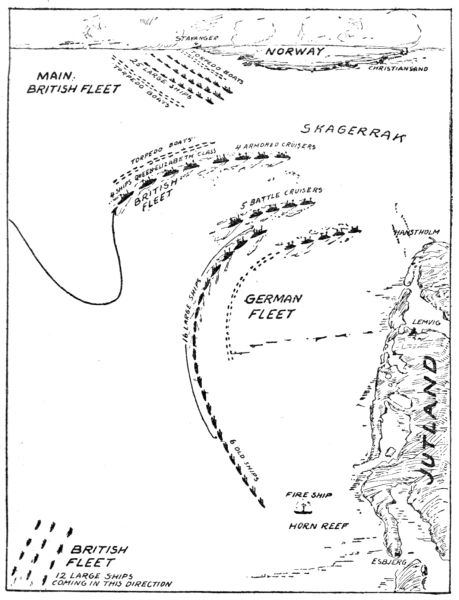
A GERMAN DIAGRAM OF THE BATTLE OF THE SKAGERRAK (JUTLAND)
In the battle of Skagerrak we had opposing each other: On the British side, thirty-one dreadnoughts, inclusive of six battle cruisers, and four armored cruisers; on the German side, twenty-one dreadnoughts, inclusive of five battle cruisers, and six older cruisers. Roughly speaking, we had twenty-seven big ships against thirty-live. Here also the better quality, judged by size, up-to-dateness, and armament, was on the side of the larger fleet. Apart from these big ships, there were on each side about fifty smaller vessels.
The total tonnage of the British fleet at Trafalgar was equal to about two modern dreadnoughts, as one of the ships of the line in Nelson's time was of about 2,000 tons. In numbers of guns and of crew there were more at Trafalgar, as at that time the ships were sailing vessels.
The British had between 17,000 and 20,000 men engaged, against 21,000 to 24,000. At Skagerrak we had from 35,000 to 40,000, as against 45,000 to 50,000 men. In this way we can compare the battle in its general aspect with Trafalgar. But if we look into the matter more closely, the French and Spanish fleet had within it an element of weakness arising from the fact that it consisted of two allied forces, between which there is never complete co-ordination. The French were further weakened by effects of the Revolution and exhaustion from previous battles. The French Admiral himself said: "Never before was the French fleet at such a low standard. We had bad masts, bad sails, bad rigging, bad officers, and bad seamen." Of the Spanish, Nelson said: "They have neither seamen nor officers." At the head of the allied forces was a French Admiral who had no confidence in the fleet and who was acting under instructions issued by Napoleon, which he felt incapable of carrying out. Opposed to him was the seasoned and well-schooled fleet of Nelson, so that it was not a battle of equal opponents and the result was annihilation. None of the French or Spanish ships was again seen at sea; nineteen were captured or destroyed, ten were driven into harbor and blockaded; four escaped, only to fall into the hands of the victors a few days later.
COMPARED WITH TSUSHIMA
And now Tsushima, another parallel. A Russian fleet, made up of any old vessels the Russians could get together, and of what ships still remained in the East—supported by Port Arthur—made one last bid against the sea power of the enemy. Without training, without points of support, honeycombed with revolutionary ideas, the Russian fleet started on its trip to the Far East, where it arrived on May 27, after suffering terrible hardships and being more than six months on the way to meet the enemy. Meanwhile, Port Arthur, with its fleet, had fallen. The Russian Admiral knew that he had absolutely no chance, but he did not have enough courage to retreat. Blindly and without confidence he started the battle against an opponent who was superior in numbers, equipment, and training. Of the 38 Russian ships which arrived on the morning of May 27, 1905, in the Strait of Korea, 19 were sunk and 7 captured, including 2 hospital ships. The Russian Admiral, 273 officers, and 5,833 petty officers and men were taken prisoner; 201 officers and 4,344 men were killed. Against this the Japanese lost only three torpedo boats and about 700 men.
Trafalgar was not a battle between equal forces, and still less so was Tsushima; hence, as regards their military value, they cannot be compared with Skagerrak. In this battle for the first time there were two sides equally well trained, equally imbued with the same spirit, equally determined. Here also the smaller force won. The superior force had to quit the battle area, and only the power it retained within itself saved it from annihilation. This battle gave us, in the military sense, a victory such as naval history has never yet recorded. Its moral effect upon our fleet, especially after the long harassing wait, cannot be expressed in words. It did not end the war, but it gave us more confidence and startled England, who always thought she had an invincible fleet.
On the victory of Trafalgar England founded her colonial world power, because she thereby obtained the mastery of the seas, which remained unchallenged. Tsushima gave Japan the sea power in the East which she needed to carry out her military plans on land. It no more ended the Japanese-Russian war than Trafalgar had ended the struggle of that day, but it gave Japan a military success which was of great value to her in peace negotiations. We hope that Skagerrak is a blow against the victory of Trafalgar and the first step toward the smashing of British sea power, and that other mighty hammer blows will fall against the barriers which shut off other peoples from the freedom of the seas.