Mexico and the United States
Reading edition
The President's Pledge
President Wilson delivered the following important speech to a delegation of Mexican editors at the White House June 7, 1918:
I have never received a group of men who were more welcome than you are because it has been one of my distresses during the period of my Presidency that the Mexican people did not more thoroughly understand the attitude of the United States toward Mexico. I think I can assure you, and I hope you have had every evidence of the truth of my assurance, that that attitude is one of sincere friendship—not merely the sort of friendship which prompts one not to do his neighbor any harm, but the sort of friendship which earnestly desires to do his neighbor service.
My own policy and the policy of my own Administration toward Mexico was at every point based upon this principle; that the internal settlement of the affairs of Mexico was none of our business; that we had no right to interfere with or dictate to Mexico in any particular with regard to her own affairs.
Take one aspect of our relations which at one time may have been difficult for you to understand. When we sent our troops into Mexico our sincere desire was nothing else than to assist you to get rid of the man who was making the settlement of your affairs for the time being impossible. We had no desire to use our troops for any other purpose, and I was in hopes that by assisting in that way and thereupon immediately withdrawing the troops I might give you substantial proof of the truth of the assurances that I had given your Government through President Carranza.
GERMAN INTRIGUES
And at the present time it distresses me to learn that certain influences, which I assume to be German in their origin, are trying not only to make a wrong impression, but to give an absolutely untrue account of the things that happen.
You know distressing things have been happening just off our coast; you know of vessels that have been sunk. I yesterday received a quotation from a paper in Guadalajara which stated that thirteen of our battleships had been sunk off the Capes of Chesapeake.
You see how dreadful it is to have the people so radically misinformed. It was added that our Navy Department was withholding the facts with regard to these sinkings. I have no doubt that the publisher of the paper printed this in perfect innocence and without intending to convey a wrong impression, but it is evident that allegations of that sort proceed from those who wish to make trouble between Mexico and the United States.
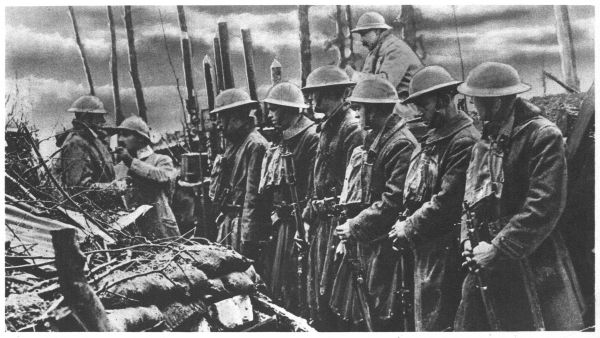
An American patrol under a French officer in the trenches in France. Some of the rifles are equipped for firing grenades (© Committee on Public Information, from international Film Service)
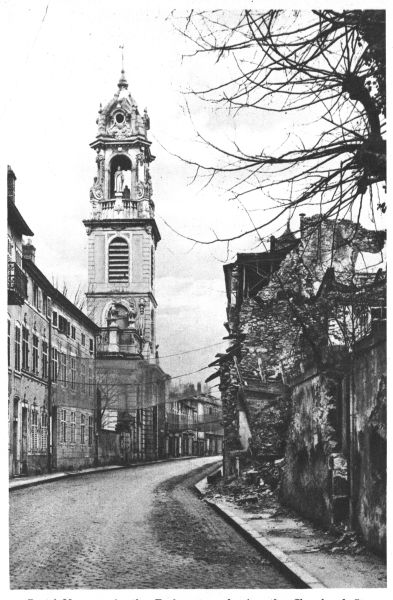
Pont-à-Mousson, in the Toul sector, showing the Church of St. Laurent. The transparent fabric hung across the street is for the purpose of misleading enemy aerial observers (French Pictorial Service)
Now, gentlemen, for the time being at any rate, and I hope that it will not be a short time, the influence of the United States is somewhat pervasive in the affairs of the world, and I believe it is pervasive because those nations of the world which are less powerful than some of the greatest nations are coming to believe that our sincere desire is to do disinterested service.
We are the champions of those nations which have not had the military standing which would enable them to compete with the strongest nations in the world, and I look forward with pride to the time which I hope will come when we can give substantial evidence not only that we do not want anything out of this war, but that we would not accept anything out of this war; that it is absolutely a case of disinterested action.
And if you will watch the attitude of our people you will see that nothing stirs them so deeply as the assurances that this war, so far as we are concerned, is for idealistic objects. One of the difficulties that I experienced during the first three years of the war, the years when the United States was not in the war, was in getting the Foreign Offices of the European nations to believe that the United States was seeking nothing for herself, that her neutrality was not selfish, and that if she came in she would not come in to get anything substantial out of the war—any material object, any territory or trade or anything else of that sort.
In some Foreign Offices there were men who personally know me and they believed, I hope, that I was sincere in assuring them that our purposes were disinterested; but they thought that these assurances came from the academic gentleman removed from the ordinary sources of information and speaking the idealistic purposes of a cloister. They did not believe I was speaking the real heart of the American people, and I knew all along that I was. Now I believe every one who comes in contact with American people knows that I am speaking their purposes.
READY TO HELP RUSSIA
The other night in New York at the opening of the campaign for funds for our Red Cross I made an address. I had not intended to refer to Russia, but was speaking without notes, and in the course of what I said my own thought was led to Russia, and I said that we meant to stand by Russia just as firmly as we would stand by France or England or any other of our allies.
The audience to which I was speaking was not an audience from which I would have expected an enthusiastic response to that. It was rather too well dressed. It was an audience, in other words, made up of a class of people who would not have the most intimate feeling for the sufferings of the ordinary man in Russia; but that audience jumped to its feet in enthusiasm. Nothing else that I said on that occasion aroused anything like the enthusiasm that single sentence aroused.
Now that is a sample, gentlemen. We cannot make anything out of Russia. We cannot make anything out of our standing by Russia at this time—the remotest of European nations so far as we are concerned, the one with which we have had the least connections in trade and advantage—and yet the people of the United States rose to that suggestion as to no other that I made in that address.
That is part of America as we are ready to show it by any act of friendship toward Mexico. Some of us, if I may speak so privately, look back with regret upon some of the more ancient relations that we have had with Mexico long before our generation; and America, if I may now so accept it, would now feel ashamed to take advantage of her neighbor.
NO SELFISH AGGRESSION
So I hope you can carry back to your homes something better than assurances and words. You have had contact with our people. You know of your own personal reception. You know how gladly we have opened to you the doors of every establishment that you wanted to see and have shown you just what we are doing, and I hope you have gained the right impression as to why we are doing it. We are doing it, gentlemen, so that the world may never hereafter have to fear the only thing that any nation has to dread—the unjust and selfish aggression of another nation.
Some time ago, as you probably all know, I proposed a sort of Pan-American agreement. I had perceived that one difficulty in our past relations with Latin America was this: The famous Monroe Doctrine was adopted without your consent and without the consent of any Central American or South American States. If I may adopt a term that we so often use in this country, we said: "We are going to be your big brother whether you want us to be or not."
We did not ask whether it was agreeable to you that we should be your big brother. We said we are going to be. Now, that was all very well as far as protecting you from aggression from the other side of the water, but there was nothing in it that protected you from aggression from us, and I have repeatedly seen an uneasy feeling on the part of representatives of States of Central and South America that our self-appointed protection might be for our own benefit and our own interest and not for the interest of our neighbors. So I have said:
"Very well, let us make an arrangement by which we will give bonds. Let us have a common guarantee that all of us will sign a declaration of political independence and territorial integrity. Let us agree that if any one of us, the United States included, violates the political independence or territorial integrity of any of the others, all others will jump on her."
I pointed out to some gentlemen who were less inclined to enter into this arrangement than others that that was, in effect, giving bonds on the part of the United States that we would enter into an arrangement by which you would be protected from us.
PEACE BY MUTUAL TRUST
Now, that is the kind of agreement that will have to be the foundation of the future life of the nations of the world, gentlemen. The whole family of nations will have to guarantee to each nation that no nation shall violate its political independence or its territorial integrity. That is the basis—the only conceivable basis—for the future peace of the world, and I must admit that I was anxious to have the States of the two Continents of America show the way to the rest of the world as to how to make a basis of peace.
Peace can only come by trust. If you can once get a situation of trust then you have got a situation of permanent peace. Therefore, every one of us, it seems to me, owes it as a patriotic duty to his own country to plant the seeds of trust and confidence instead of seeds of suspicion.
That is the reason I began by saying to you that I had not had the pleasure of meeting a group of men who are more welcome than you are, because you are our near neighbors. Suspicion on your part, or misunderstanding on your part, distresses us more than we would be distressed by similar feelings on the part of those less near to us.
It is you who can see how Mexico's future must depend upon peace and honor, so that nobody shall exploit her. It must depend upon every nation that has any relation with her and the citizens of any nation that has any relations with her keeping within the bounds of honor and fair dealing and justice, because so soon as you can admit your own capital and the capital of the world to the free use of the resources of Mexico it will be one of the most wonderfully rich and prosperous countries in the world.
And when you have foundations of established order and the world has come to its senses again we shall, I hope, continue in connections that will assure us all permanent cordiality and friendship.
In Flanders Fields By Lieut. Col. JOHN D. McCRAE [Written during the second battle of Ypres, April, 1915. The author,Dr. John McCrae of Montreal, Canada, was killed on duty in Flanders, Jan. 28, 1918.] In Flanders fields the poppies blow Between the crosses, row on row, That mark our place; and in the sky The larks, still bravely singing, fly, Scarce heard amidst the guns below. We are the dead. Short days ago We lived, felt dawn, saw sunset glow. Loved and were loved, and now we lie In Flanders fields. Take up our quarrel with the foe! To you from falling hands, we throw The torch. Be yours to hold it high! If ye break faith with us who die We shall not sleep, though poppies grow In Flanders fields.
America's Answer By R. W. LILLARD [Written after the death of Lieut. Col. McCrae, author of "In Flanders Fields," and printed in The New York Evening Post.] Rest ye in peace, ye Flanders dead. The fight that ye so bravely led We've taken up. And we will keep True faith with you who lie asleep With each a cross to mark his bed, And poppies blowing overhead, Where once his own life blood ran red. So let your rest be sweet and deep In Flanders fields. Fear not that ye have died for naught. The torch ye threw to us we caught. Ten million hands will hold it high, And Freedom's light shall never die! We've learned the lesson that ye taught In Flanders fields.