American Exports Versus the U-Boats
Reading edition
By CHARLES FREDERICK CARTER
Notwithstanding a net loss of the world's shipping, due to the usual perils of the sea as well as to enemy mines and submarines, of 2,632,279 tons from the beginning of the war to April 1, 1918, the vital trade route across the Atlantic has shown a steady increase in efficiency. Even more gratifying is the fact that in recent weeks the gain in efficiency has been accelerated.
All the essential requirements of our allies as well as of our own expeditionary forces abroad appear to be met, according to these official statistics from the Department of Commerce. For instance, exports of nitric, picric, sulphuric, and other acids, so essential in the manufacture of munitions, are going to Europe in a steadily increasing volume. Exportsof acids increased from a total value of $10,003,647 in the calendar year 1915 to $52,695,640 in 1917. Exports of copper, no less necessary for cartridges and other uses, to France, Italy, and Great Britain increased from 229,129,587 pounds in 1915 to 890,819,053 pounds in 1917.
The same three allies, which needed only 499,719 tons of steel billets, blooms, and ingots in the calendar year 1915, took 1,395,019 tons in 1916 and 1,847,201 tons in 1917. Exports of steel plates to the same three allies for ships, tanks, and other military uses increased similarly from 63,584,467 pounds in 1915 to 72,242,656 pounds in 1916 and 165,630,514 pounds in 1917. All Europe took but a negligible tonnage of steel rails in 1913, the last full year before the war. France alone took 5,362 tons in 1915 and 122,858 tons in 1917. Exports of locomotives to France kept pace with the rails, increasing from 38 in 1915 to 570 in 1917, and 129 in the month of January, 1918. Exports of metal-working machinery to these three allies increased from a total value of $29,229,683 in 1915 to $47,666,606 in 1916 and $54,906,405 in 1917.
Statistics on the exports of barbed wire epitomize the history of defensive works by our allies. Italy, for example, took only 2,000 pounds of that commodity in 1915. Next year her requirements jumped to 58,367,004 pounds, while last year the necessity of constructing an entirely new system of defenses in haste called for 204,972,438 pounds of American barbed wire. On the other hand, France, which needed 264,310,493 pounds of barbed wire in 1916, called for only 29,952,532 pounds in 1917.
EXPORTS OF LEAD
France, Italy, and England laid in a stock of lead from which to make bullets in 1915, the former country taking 21,234,108 pounds, Italy 5,176,794 pounds, and Great Britain 81,483,866 pounds. Next year total shipments to all three countries fell off to 23,015,071 pounds, but rose again to 59,470,181 pounds in 1917, "unrestricted" U-boat warfare to the contrary notwithstanding.
Not all exports of lead went to our allies. Although at peace, Denmark, Holland, and Sweden, each and severally, bought more American lead in 1916 than Italy needed in any one of three years of desperate fighting, total exports to these three neutrals in that year aggregating 18,113,859 pounds. Even last year, after the United States had declared war against Germany, 3,470,415 pounds of lead went to these three neutrals, all of which just happen to drive a thriving trade with Germany. The patriots who supplied this brisk neutral demand for material from which bullets are made probably would not care to trace the shipments to their ultimate effect in swelling American casualty list.
Exports of explosives, including shells and projectiles, increased from a total value of $188,969,893 in 1915 to $715,575,306 in 1916. In 1917, after England and France had attained such marvelous efficiency in the production of these essentials of war, exports declined, but still reached the enormous total of $633,734,405. Just to show that we are keeping our stride in supplying explosives to the firing line the fact may be mentioned that in spite of delays due to a lack of bunker coal in the unprecedentedly severe month of January, 1918, we shipped 2,606,297 pounds of dynamite during the month, as compared with 1,787,600 pounds in January, 1917, and 37,587,662 pounds of powder, against 36,767,984 pounds in the corresponding month of 1917.
Gasoline, the foundation on which present allied supremacy in the air is based, and which also plays so great a part in land transportation, is going to Great Britain, France, and Italy in swiftly increasing volume. Shipments to these three countries in 1915 totaled 36,936,303 gallons; in 1916, 98,178,139 gallons; in 1917, 141,327,159 gallons. As a basis of comparison it may be said that America's total exports of gasoline to all the world in 1913 amounted to only 117,728,286 gallons.
Gasoline engines are going abroad at a similar rate of increase, 50,317 being shipped in the seven months ended Jan. 31, 1918, as compared with 36,209 in the corresponding period of 1916-17.
So much has been said about submarine losses that the average man may be pardoned for accepting the German figures, which have been exaggerated from 46 to 113 per cent., and the German delusion that England is about to be "brought to her knees" by the modern form of piracy. To whatever extent this impression of Prussian frightfulness has been disseminated the submarine campaign has been a success; but right there success ends. In spite of the utmost the U-boats could do, munitions have flowed in steadily increasing volume from America to Europe, while the destructiveness of the undersea boats has as steadily declined. Furthermore, the fact must not be forgotten that not all ships sunk by submarines have been eastbound with cargoes of munitions for the Allies. Some have been lost on the westward voyage; others have been laden with grain for the starving Belgians, or for neutrals which have developed such an astonishing appetite for lard, lead, and other things of which Germany stands in need; still others have been hospital ships.
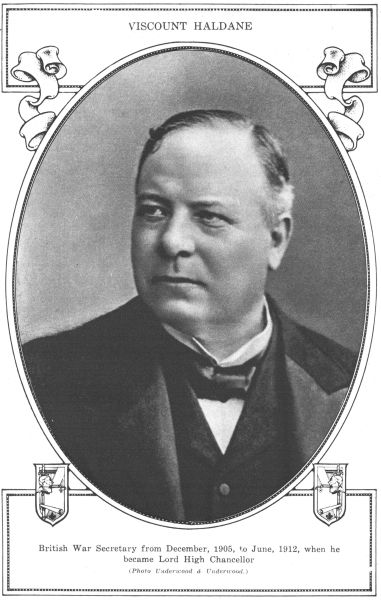
VISCOUNT HALDANE British War Secretary from December, 1905, to June, 1912, when he became Lord High Chancellor (Photo Underwood & Underwood.)
GERMAN COMMANDERS ON WEST FRONT

General von Hutier

General Sixt von Arnim

General von Boehn
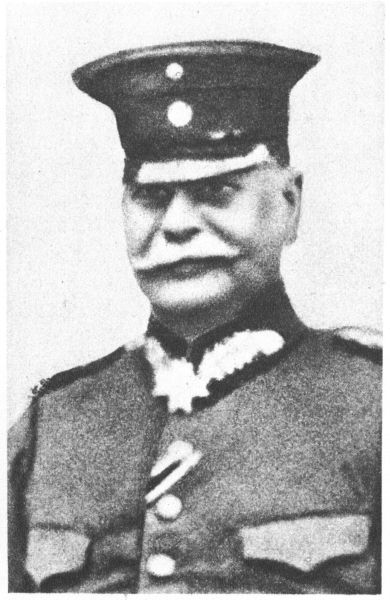
General von der Marwitz
If any further evidence of America's great part in the war, irrespective of participation by American troops in the fighting, is needed it can be found in statistics of exports of foodstuffs to the Allies, who have been obliged to depend more and more upon this country for the necessaries of life.
Exports of wheat flour to France in the calendar year 1915 were 2,392,952 barrels; in 1916, 2,263,990 barrels; in 1917, 2,659,328 barrels. Italy called for 148,999 barrels of American wheat flour in 1915 and 1,494,816 barrels in 1917, while Great Britain's requirements were 3,269,262 barrels in the former year and 4,808,141 barrels in the latter.
Our total exports of fresh beef to all the world in 1913 were only 6,580,123 pounds. In 1915 we sent Great Britain, France, and Italy 256,198,283 pounds. In 1916 exports to these three countries fell off to 160,879,642 pounds, but rose again to 172,940,833 pounds, in spite of von Tirpitz's unrestricted destructiveness.
In 1913 France took only 716,266 pounds of American bacon; but in 1915 the demand jumped to 52,044,475 pounds, increasing still further to 60,606,802 pounds in 1916 and to 73,195,974 pounds in 1917. Great Britain, which got along with 145,269,456 pounds of American bacon in 1913, needed 284,783,009 pounds in 1916 and 341,674,452 pounds in 1917. In the same period exports of hams and shoulders to France increased more than twelvefold and to Great Britain more than a third.
Exports of lard to France, Italy, and Great Britain increased from a total of 200,490,003 pounds in 1913 to 210,139,760 pounds in 1915 and 224,683,383 pounds in 1916. In 1917 exports to these three countries fell to 189,024,889 pounds. It is an interesting coincidence that Holland, whose appetite for American lard was fully satiated by 38,313,677 pounds in 1913, and which was able to skimp along with a trifle more than 20,000,000 pounds a year during the first two years of the world war, required 64,888,545 pounds in 1917, when Germany's need for fats grew desperate.
Exports of sugar have gone forward to the Allies on the same vast scale. In 1913 our entire export trade absorbed only 14,995,232 pounds of sugar. In 1915 we sent to Great Britain, France, and Italy alone 860,456,311 pounds; in 1916, 1,126,022,067 pounds; in 1917, 519,881,377 pounds. No wonder the sugar bowl disappeared from the American restaurant table last Fall and still remains in strict seclusion!
SOLDIERS AND CHEWING GUM
Not only have we been rendering the Allies a useful service by supplying so important a portion of their necessary food and munitions of war, but we have been for some months forwarding troops to the battleline. No figures are given out regarding movements of troops, but there is a significant bit of evidence in the monthly summaries of foreign commerce which proves that the number of American fighters abroad must be very large. As the Government has published this evidence, there can be no harm in referring to it here.
Gum is not chewed by Europeans, but seems to be regarded as a necessary of life in the United States, if the wagging jaws to be seen in street cars and other public places are any indication. Well, according to Government figures, no chewing gum whatever was exported in 1915; but in the calendar year 1917 the value of chewing gum exported was $1,403,888! The figures given, being at wholesale prices, represent upward of 176,000,000 cuds! Even on the most liberal allowance; so vast a quantity would supply a great many fighting men.
Viewed from another standpoint, these chewing-gum statistics are even more encouraging. If the shortage of cargo space to allied ports were as desperate as Germany's press agents would have us believe, it does not seem reasonable to suppose that any part of it would be frittered away on chewing gum in such formidable quantities. This conviction is strengthened by the discovery that exports of candy have increased one-third in the three calendar years of war, to a total of $2,108,081 in 1917.
Most gratifying of all is the fact that despite the utmost endeavors of the submarines, and notwithstanding upward of 3,000 strikes in American shipyards last year, the capacity and efficiency of transatlantic shipping increases from day to day not only positively but also negatively by the withdrawal of the heavy tonnage formerly serving enemy countries through contiguous neutral nations.
True, exports fell off somewhat for the eight months ended Feb. 28, 1918; but Europe received 63 per cent. of the total. Now when Europe is spoken of it means substantially England, France, and Italy. Russia obtained very little in those eight months, and Germany's neutral neighbors still less. The shrinkage in the volume of supplies to our fighting partners was not so much on account of anything the submarines could do as because of the temporary breakdown of our own system due to extraordinarily severe weather and to other causes.
Now the weather handicap has been lifted, our industrial machine has been geared up and more ships have been placed where they could render the most effective service. While in February, 1918, we could send our allies only 750,000 tons of food, which was 50,000 tons less than their minimum requirements, in the next month this was increased to 1,100,000 tons.
OUR NEW MERCHANT MARINE
After having the decadence of the American merchant marine dinned into our ears for decades, we may be pardoned for gloating over the way this same merchant marine has come back under the stress of war. Of total imports worth $1,778,596,695 in 1915, goods valued at $342,796,714 arrived in vessels flying the American flag. In 1917 the value of goods arriving in American vessels had increased to $732,814,858. The increase was the greatest shown by ships of any nation, and the total value was the highest for any, British ships ranking second with imports valued at $693,565,240. This was a decrease of only $7,000,000 from 1915, in spite of all the U-boats could do. French ships, fighting the same sneaking foe, were actually able to increase the value of goods delivered at American ports from $70,275,445 in 1915 to $102,346,317 in 1917, considerably more than making up for the decrease in imports arriving under British and Italian flags. In the seven months ended Jan. 31, 1918, nearly 29 per cent. of all imports arrived in ships flying the American flag.
And the efficiency curve is still climbing. Up to April 10 America, by restricting imports, withdrawing ships from less essential trade routes, and by obtaining neutral tonnage by agreement—in other words, by good management—had been able to place 2,762,605 tons of shipping in the transatlantic service to carry food, munitions, and men to France. Of this total, 2,365,344 tons were under American registry. By skillful handling in port at both ends of the route the efficiency of this tonnage had been increased 20 per cent., which was equivalent to adding more than 400,000 tons to the carrying capacity of the fleet as compared with normal times.
These figures include very little of the 500,000 tons of Dutch shipping requisitioned, and none at all of the 250,000 tons Japan has promised to contribute during the Summer. Neither do they include any of the tonnage of England and the other allies which the American Shipping Control Committee has the power to reroute, nor yet do they take into consideration any of the tonnage under way or to be built in American shipyards, nor the 200,000 tons Japan has agreed to build for us as soon as we can deliver the plates; for this article deals only with conditions as they now exist.
To sum up, the shipping situation, as disclosed by Government statistics, is far more satisfactory than current comment would lead one to believe. If it is not all we could wish, we have the satisfaction of knowing that Germany is much more dissatisfied with it than we are.