THE TERRIER (SCOTTISH).
Reading edition
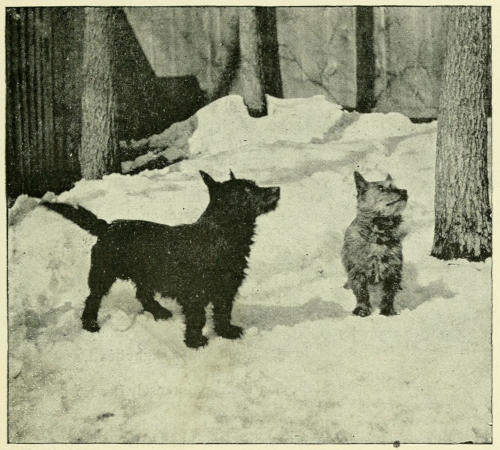
Newcastle Kennels, Brookline, Mass.
Bellingham Bailiff. Bonny C.
Origin.—Nothing definite of this breed can be traced, though it was for years known in Scotland as the Skye terrier.

Uses.—Unearthing vermin, badgers, foxes, etc.
* Scale of Points, Etc.
Value.
Skull 7½
Muzzle 7½
Eyes 5
Ears 5
Neck 5
Chest 5
Body 15
Legs and feet 10
Tail 2½
Coat 15
Size 10
Color 2½
General appearance 10
Total 100
General Appearance.—The face should bear a very sharp, bright, and active expression, and head carried up. The dog should look compact and be possessed of great muscle in his hind quarters. A Scottish terrier cannot be too powerfully put together.
Head.—Skull long, slightly domed, covered with short, hard hair about ¾ inch long or less; skull not quite flat. Muzzle very powerful, tapering toward nose, which should be black and of good size; jaws level; teeth square, though the nose projects somewhat over the mouth. Eyes wide apart, dark brown or hazel, small and piercing. Ears very small, prick or half prick, sharp-pointed, the hair not long, and free from any fringe on top.
Neck.—Short, thick, muscular; strongly set on sloping shoulders.
Chest.—Broad and proportionately deep.
Body.—Moderate length, rather flat-sided, well ribbed up, and exceedingly strong in hind quarters.
Legs and Feet.—Legs short, and very heavy in bone, the front ones being straight or slightly bent, and well set on under body; hocks bent; thighs very muscular; feet strong, small, and thickly covered with short hair.
Tail.—About 7 inches long, carried with a slight bend, and never cut.
Coat.—Rather short (about 2 inches), intensely hard, wiry, and very dense.
Size.—About 16 pounds for a dog; 14 pounds for a bitch.
Colors.—Steel or iron gray, brindle, black, red, wheaten, yellow, or mustard color. White markings are most objectionable.
Height.—Nine to twelve inches.
Faults.—Large or light eyes; silky or curly coat.