THE HOUND (BASSET).
Reading edition
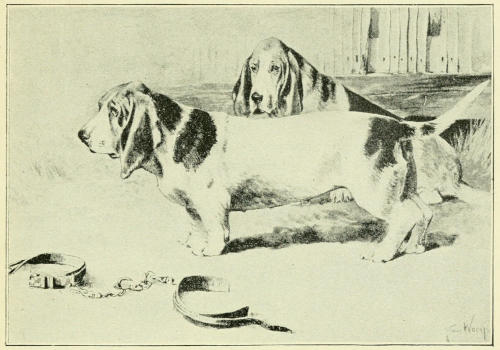
(From Modern Dogs.)
Origin.—Probably of French origin, yet closely allied to the dachshund, though larger and heavier in every particular.
Uses.—Having a very keen nose, is used for the general purposes of the smaller hounds, viz., for rabbits.
* Scale of Points, Etc.
Value.
Head, skull, eyes, muzzle, and flews 15
Ears 15
Neck, dewlap, chest, and shoulders 10
Fore legs and feet 15
Back, loins, and hind quarters 10
Stern 5
Coat and skin 10
Color and markings 15
Character and symmetry 5
Total 100
Head.—Closely resembling the bloodhound’s; long, narrow, heavy flews; occiput prominent; forehead wrinkled to the eyes, which should be kind and show the haw. Teeth small, and the protruding of the upper jaw is not a fault. Ears so long that in hunting the dog treads on them, set low, hang loose in folds, ends curl inward, thin and velvety.
Neck.—Powerful, with heavy dewlaps; elbows must not turn out; chest deep and full; body long and low.
Legs and Feet.—Fore legs short (about 4 inches), close-fitting to chest; massive paw, each toe standing out distinctly.
Stifles.—Well bent; quarters muscular, giving the dog a barrel-like shape and a peculiar waddling gait.
Stern.—Coarse underneath, and carried hound fashion, i.e., carried gaily.
Coat.—Short, smooth, fine, and glossy; skin loose and elastic.
Color.—Black, white and tan, with black patches on back; also sometimes hare-pied.
Weight.—Thirty to forty-five pounds.